Get in touch with Welong Company
Wellhead & Well Control: How the Equipment, Procedures, and Certification System Fit Together

Updated August 2026
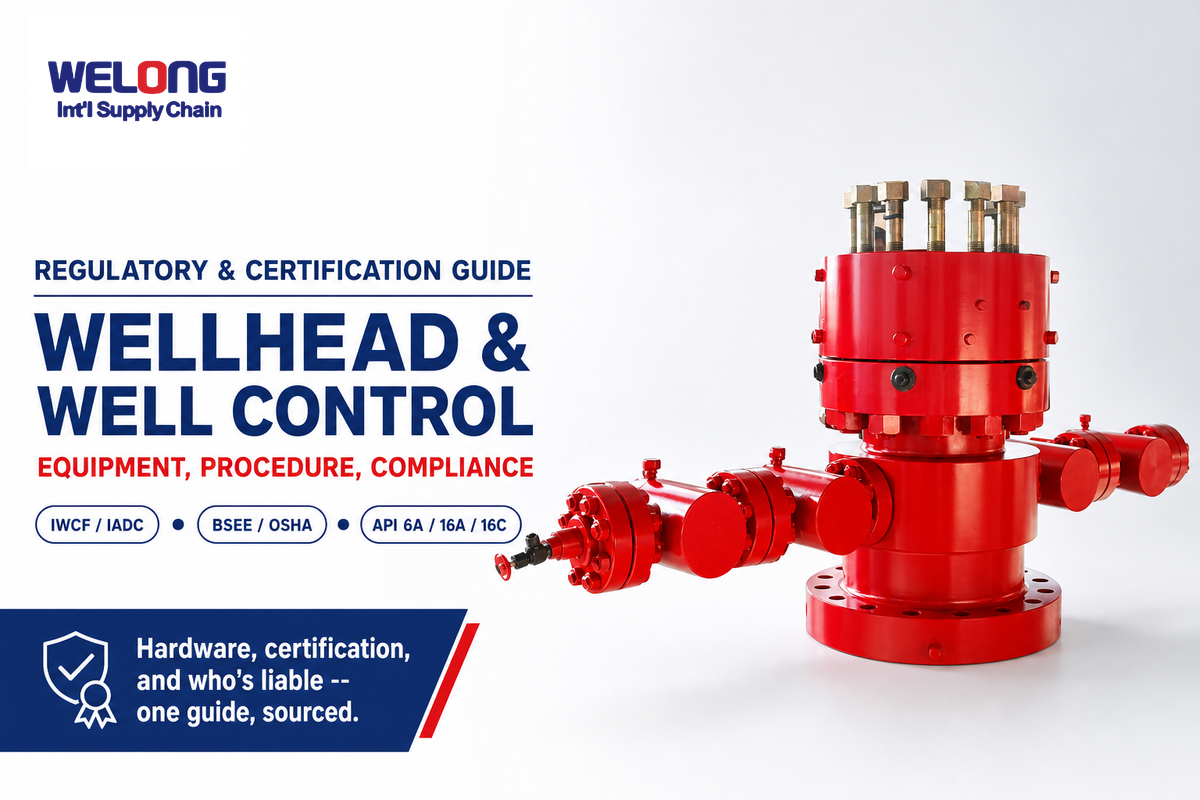
Wellhead & Well Control refers to two related but distinct things: the physical pressure-containing hardware stack at the top of a well, and the discipline that keeps that hardware from ever losing control of the well. A wellhead is the physical, pressure-containing hardware stack at the top of an oil well. Wellhead control — the umbrella term for the pressure-control equipment and the discipline that keeps it working — covers procedures, equipment redundancy, training, and regulation that keep that hardware from ever losing containment of a hydrocarbon influx of oil, gas, or water. Both terms get used almost interchangeably in casual conversation, but they answer different questions: an engineer sourcing wellhead systems and production equipment asks “what hardware is rated for this pressure?”; a well control specialist asks “what happens in the ninety seconds after a kick is detected?”, a discipline OSHA’s own drilling oil and gas eTool treats as a distinct safety topic from the wellhead hardware itself. This guide covers both, and — deliberately — goes further than a product catalog: it covers the well control training system crews actually need, who is legally and financially responsible when control fails, and what the historical record shows about how well control actually fails in practice across onshore and offshore well operations, from exploration through production. If you came here looking for a wellhead and well control PDF to save or print, everything below is organized the same way a good summary sheet would be — by hardware, certification, and compliance, so you can pull whichever section you need.
Quick Specs
| Wellhead pressure rating range | 2,000-15,000 psi across API material classes AA-FF |
| Governing hardware standards | API Spec 6A (wellhead/tree), API Spec 16A (BOP), API Spec 16C (choke & kill) |
| IWCF certification levels | Level 2 (well-site), Level 3 (Driller), Level 4 (Supervisor) |
| Control-of-Well insurance | $5,000-$11,000 minimum premium; often JOA-required |
What Wellhead and Well Control Actually Mean — and How They Differ
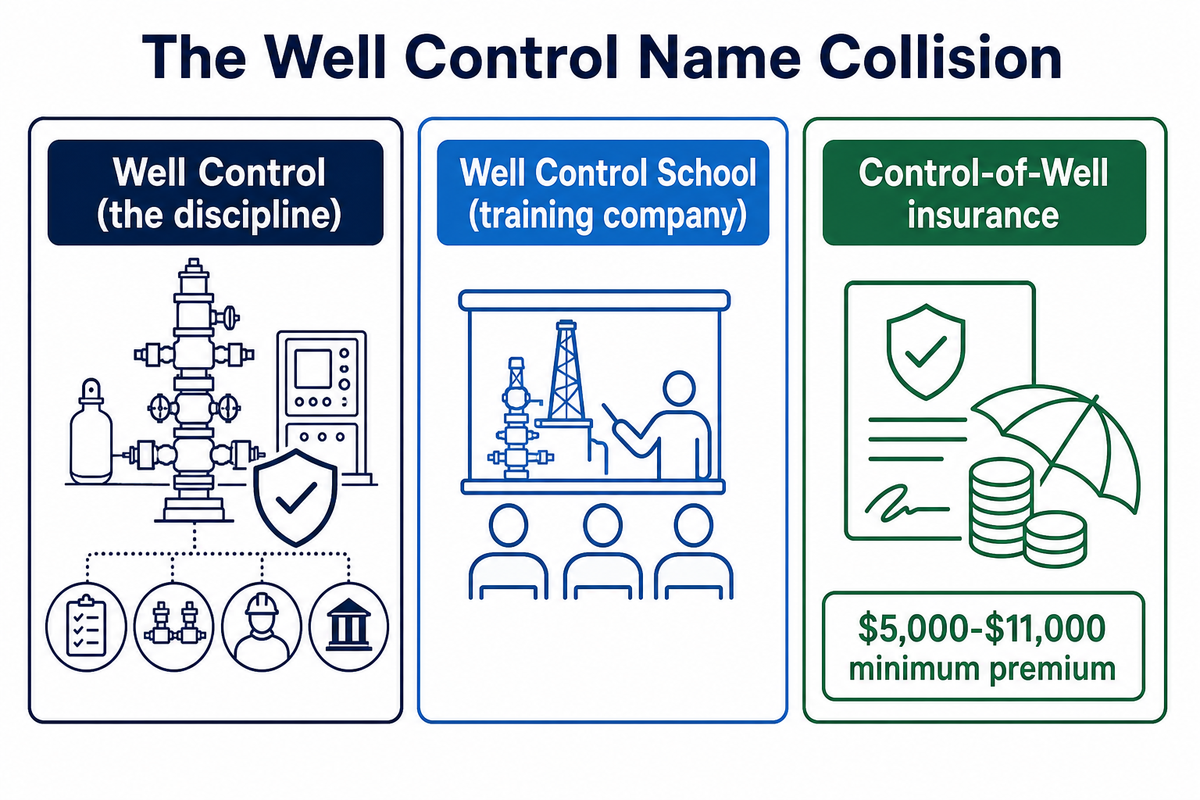
A wellhead is structural, pressure-containing equipment — the casing head, tubing head, and Christmas tree that physically seal and support a well. Well control is procedural and organizational: hydrostatic mud weight, mechanical barriers, trained personnel, and regulation that keep an unplanned influx from becoming an uncontrolled blowout — a distinct enough discipline that OSHA’s oil and gas drilling eTool treats it as its own safety topic, separate from wellhead hardware. You need both.
A wellhead unsupported by any well control discipline is just a pressure vessel with nobody watching the gauges; a well control program with no properly rated wellhead has nothing to actually seal against.
There’s a third, much less related meaning worth flagging early, since it causes true confusion in this space: “well control” is also the name of a specific for-profit training company (well control.com) and appears inside the name of “Control-of-Well insurance,” a financial product. None of the three are interchangeable, and confusing them leads buyers to search for the wrong thing. We call this the Well Control Name Collision, and it’s worth understanding before you go further, because it shows up again when crews are shopping for certification (H2-6) and when someone asks who’s financially on the hook if control fails (H2-7).
How Well Control Actually Works, Stage by Stage
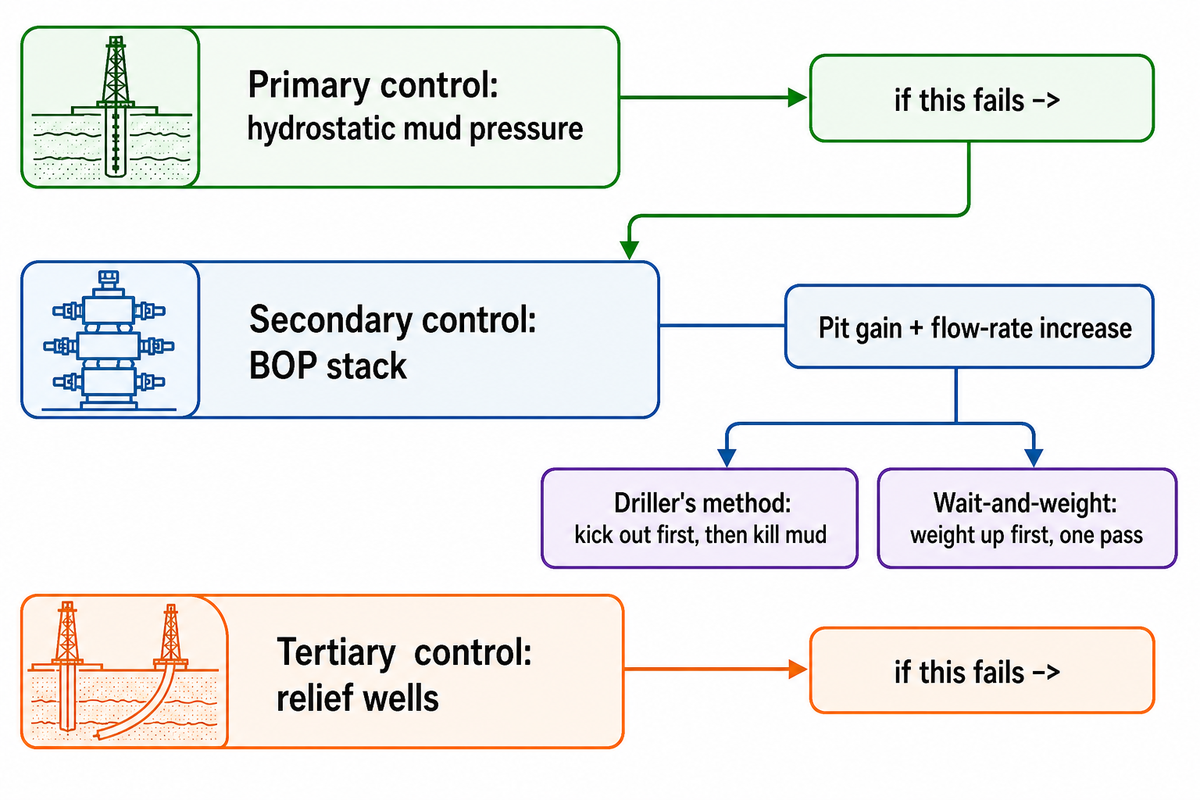
Well control is the umbrella that covers every operation of a well that extends from the first motion of the bit to the permanent plugging of the well; it is not a one-does-it-all type of mechanism, blow-out prevention on a drilling rig is a three layer structure, and it is the three layers working in conjunction that are the key, rather than any specific one. The industry frames it in three phases:
- Main-barrier-Hydrostatic control exerted by the density (or “weight”) of the drilling fluid (mud column) in wellbore above formation pressures, designed to control pressure throughout the wellbore and prevent formation influx. Main control is the inherent first barrier and the only barrier in effect during normal drilling, and all the surface control team does is pressure monitoring at surface — measuring annular pressure and pit volumes to verify adequate pressure integrity.
- Secondary control: It is also mechanical, not preventive in the literal sense — it is the blowout preventer (BOP) stack, part of the well control system engaged only when primary control has already failed and a kick has entered the wellbore, and the specific hardware federal regulation requires operators to pressure-test on a periodic basis. It is the response to a failure, not a substitute for good mud-weight management or a sound cement job at the casing shoe.
- Tertiary control – Relief wells dug by a secondary group of drilling rigs and the final, last resort attempts at control – not often actually implemented but it is the ‘dealbreaker’ situation everyone prays to avoid
They are eventually guarding the same thing, well integrity — verifying that the casing, cement and wellhead hardware collectively are still holding pressure as intended; a program can meet every certification in H2-6 below and still be at genuine risk without a separately ensured well integrity assurance.
Per OSHA’s oil and gas drilling eTool, initial detection of a kick is based on observing pit gain (the mud returned to the surface flows more quickly than it can be pumped in) and flow rate anomalies (the flow rate at surface jumps for no apparent reason) both indicators that formation fluid is flowing into the well bore quicker than the mud column can hold it back. After establishing a kick condition, the crew often selects one of two possible methods of circulation in order to neutralize the kick —driller’s method of circulating out the kick first then circulating in the heavier kill mud in a second pass versus wait-and-weight where the heavier mud is weighted up before circulating out the kick and the heavier mud all at once. The driller’s method is faster to start and easier to perform under duress but wait-and-weight usually applies less overall pressure to the wellbore and casing shoe over the entire circulating bottom kill operation which is more important on deep or marginal wells.
We will call one more limit to this three-tiered blowout prevention model: it is a response model, not a model describing how control degrades exactly. For Chemical Safety Board investigators in their Macondo investigation, in other words, they saw well control as a system of interdependent technical and organizational impediments — equipment, testing, crew choices, etc. — degrading in concert, not three separate, failing, tripwires (see H2-8 on the more complete model).
The Physical Hardware Stack — Casing Head, Tubing Head, and Christmas Tree
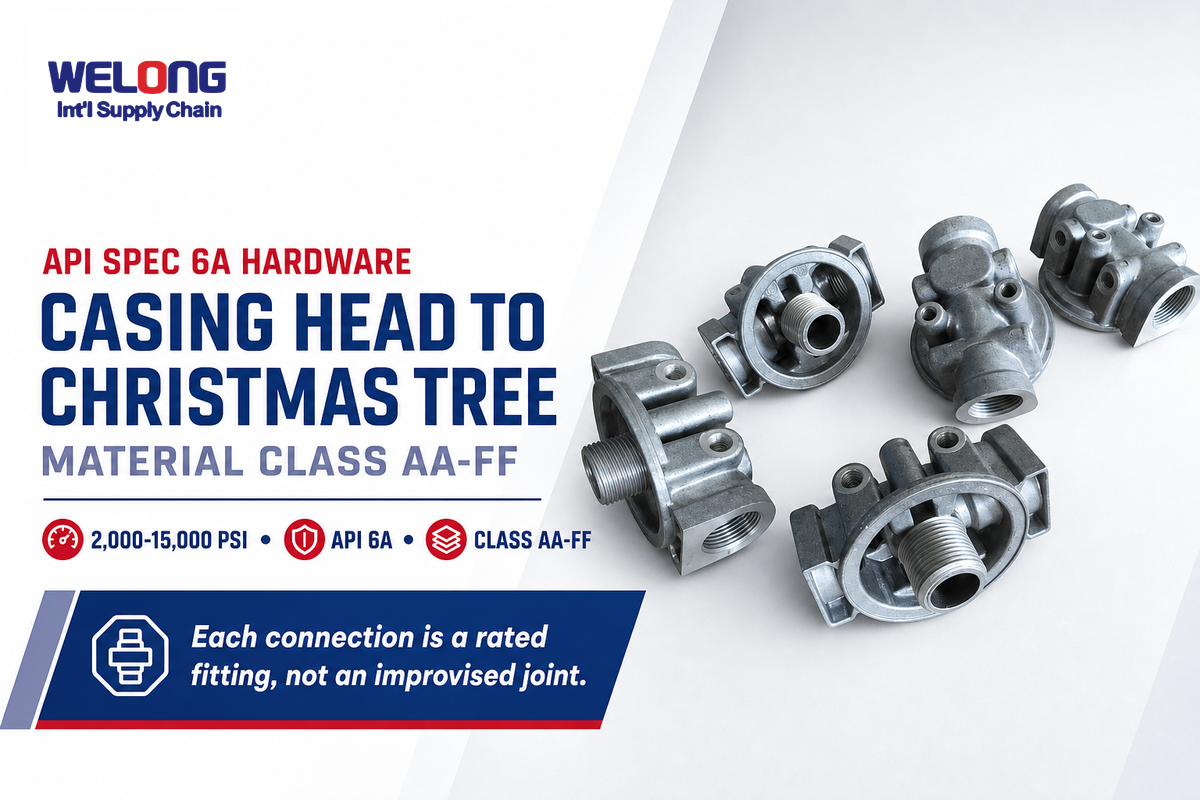
Wellhead hardware builds up in a set order, with each joint being a rated fitting, not an improvised one. At the bottom, the casing head sits and seals the outermost surface casing string and gives a base for the rest of the stack to bolt onto. Above it, the tubing head holds and seals the production tubing string, separating the annulus from the tubing bore.
The Christmas tree caps the well — it is the visible assembly of valves and surface safety valves at a surface wellhead: the master valve is at the bottom of the stack, just above the tubing head, and acts as the main shut-off. Wing valves branch out partway up the tree to control flow to the production flowline. The swab valve sits at the top and allows access for wireline work. Many trees also include a surface-controlled safety valve below the tree for emergency shutdown.
As completion operations move the well from the casing and tubing head to the production tree, each family of drilling and production equipment ships to a set of rules called API 6A, which is part of federal offshore rules. In most cases, wellhead parts are rated from 2,000 to 15,000 psi across API material classes AA to FF — a working range, not the full envelope the specification itself permits (API 6A’s own scope extends further, including higher classes). The class is chosen based on the temperature and whether the well has H2S gas, not just pressure. For the full spec-stack tables behind those numbers, see the casing and tubing head specifications and Christmas tree specifications pages.
For a wellhead offshore, the same rules about casing-head, tubing-head, and tree apply below a riser and BOP stack as they do at a surface well. The types of parts and the main standards do not change. But getting to the parts for tests and repairs is different, which is why offshore well control plans need more regular checks than those on land. Knowing the different types of wellhead setups — surface, subsea, and platform-mounted — is more about planning how to reach and test the parts than about how they handle pressure. The pressure part is still guided by the same API 6A rules no matter where the stack sits.
In section H-2 to find reference table and chart with equipment such as casing head, tubing heads, the tree, the BOP and kill/choke hardware listed by their related governing API specifications side-by-side to assist further with understanding to your and your own BSEE specified requirements.
Annular vs Ram BOP — What Each Actually Does
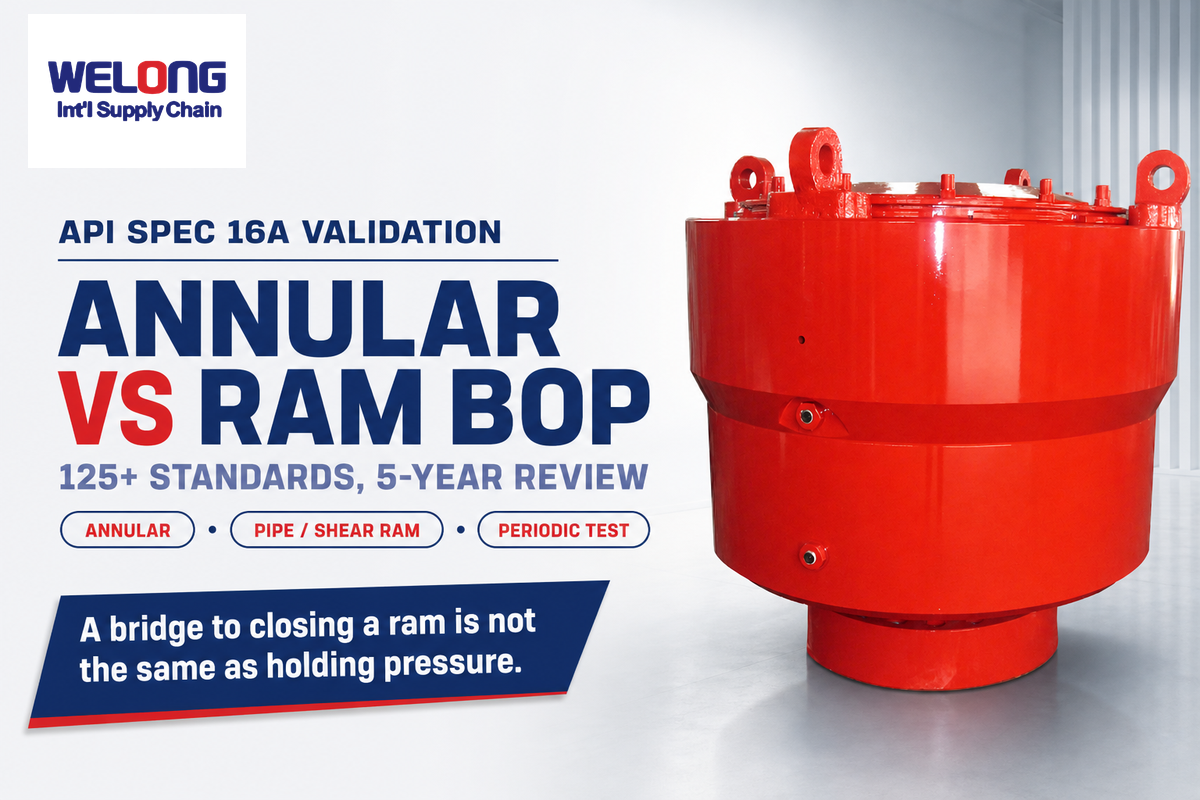
A blowout preventer stack is not just one device — it is usually a set of devices, because each type does a different job and none of them alone can handle every scenario. API Spec 16A — the standard for drill-through equipment — covers the main well-control BOP validation testing, distinct from the wellhead and tree equipment covered by API 6A, per BSEE’s own Standards Development Section. BSEE includes over 125 industry standards by reference into its rules this way, reviewing each roughly every five years. Equipment validation is not the same layer as field performance, though: BSEE separately incorporates API Standard 53, which sets the installation, testing, and maintenance requirements for a BOP system and its choke-manifold components once the equipment is actually on the rig — the standard that governs the periodic pressure-testing schedule described below, not API 16A itself. Like the wellhead it sits above, a BOP stack’s own working-pressure rating falls within that same 2,000-15,000 psi API class range, since the two must match for the assembly to hold pressure as a unit.
Annular BOP
- Seals around any shape or size of pipe using a rubber packing element
- Usually the first device closed on a kick — fastest to actuate, tolerant of tool joints passing through
- Not designed to hold full rated pressure indefinitely — a bridge to getting a ram closed
- Single unit typically sits at the top of the stack
Ram BOPs (pipe / shear / variable)
- Steel rams close around a specific pipe size (pipe ram) or cut through pipe entirely (shear ram)
- Rated to hold full working pressure for extended periods once closed
- Variable-bore rams close on a range of pipe diameters, trading some sealing margin for flexibility
- Multiple rams stack below the annular, each with a distinct job
Testing of the BOP is where theory and daily work meet: BSEE’s rules for offshore wells require pressure testing of BOP parts to be done regularly while drilling, not just when the BOP is first put in. This testing rule exists because a BOP that passed tests months ago is not the same as one that works today — a point made unavoidably clear during the Macondo spill investigation. See the full blowout preventer specifications page for rated pressures and configuration options across this product family.
What the Choke & Kill Manifold Does During a Well Control Event
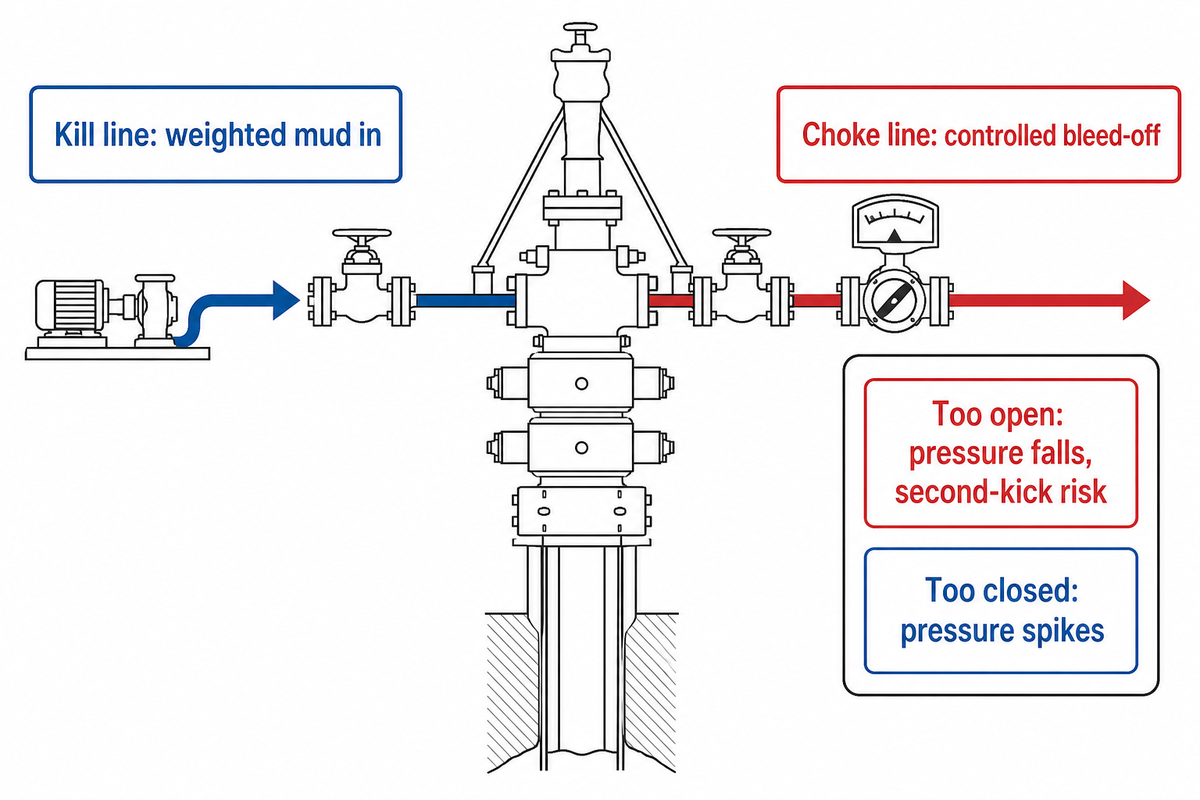
Per OSHA’s oil and gas drilling eTool, after the BOPs have closed in around an oil well, this choke manifold–along with the kill line as a choke and kill manifold–is used by personnel to bring the situation back under control rather than just passively shut in; a drill string within the shut-in system would receive pressurized, weighted mud through its kill line and then return fluid would circulate through the choke line where controlled bleed-off of back-pressure was introduced.
Mistiming the choke opening – too open causes a pressure bleed-off and a potential second kick, while too closed can result in spikes downhole and on the surface – is the primary reason that using the choke valve is a procedural task that must be learned, not just a procedure to manually adjust a valve. Because the BOP’s own rams are actuated by hydraulic fluid under pressure, there is a functional hydraulic power unit in support of the entire well-close-and-circulation sequence, operating behind both the choke and kill manifold and their lines, too. Coiled tubing workovers and servicing jobs on individual wells use their own less extensive pressure control equipment system.
API Spec 16C – Specification for Choke and Kill Systems is for surface and subsurface equipment in use on a choke-and-kill setup alone, separate from either the bop (API 16A) or the wellhead/tree assembly (API 6A). It is a separate family of equipment with its own specs in addition to the others, not a derivative class of the BOP, nor merely the label used for a different definition of “the pressure control stuff” — and like the BOP and wellhead it connects to, its own hardware is rated within that same 2,000-15,000 psi API pressure-class band, not a separate scale. MPD is, in effect, the equivalent of that same kind of choke management on more sophisticated levels-closed system of returning the returns, etc.-to maintain the bottomhole pressure, at any rate at a tighter window or envelope than is permissible with a standard choke – and is usually encountered only with narrow margins or with depleted reservoir conditions when a standard approach would have little to no margin for error at all.
Well Control Certification — IWCF/IADC WellSharp Levels 2-4 (Sourced Table) vs What BSEE Actually Requires
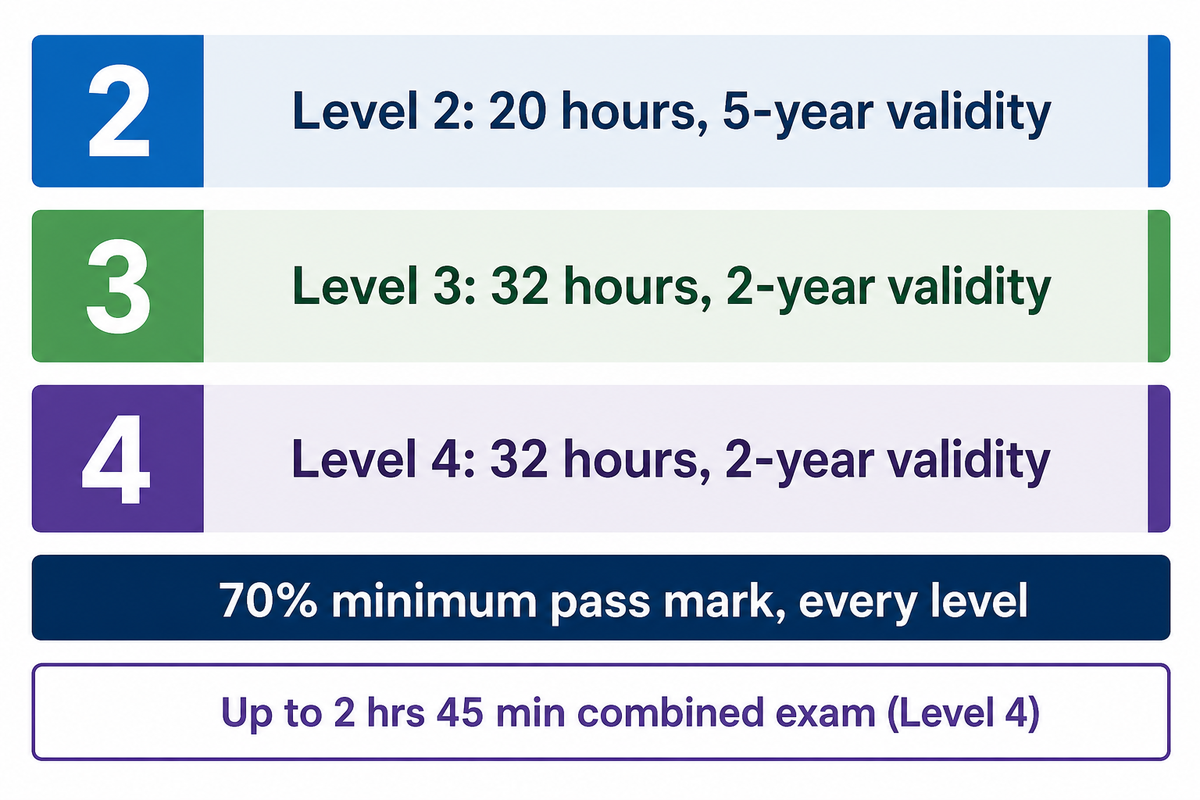
Of the certification providers that you’ll hear referred to in this space, the IWCF is likely the most mentioned, and their own programme page lays out a true level-by-level system rather than one generalized piece of paper. The IADC WellSharp programme would generally run on much the same scale of time, somewhere in the vicinity of 24 hours of classroom time plus a separate 3 hour examination period. IWCF’s combined drilling(surface)-and subsea(water)-based examinations will take up somewhat even more of your time as well – more in the order of 2 hours 45 minutes on their Level 4 supervision.
| Level | Recommended for | Minimum duration | Assessment | Certificate validity |
|---|---|---|---|---|
| Level 2 | Well-site positions whose action/inaction directly influences well control assurance | 20 hours | Two theory assessments, 70% minimum pass mark each | 5 years |
| Level 3 | Equipment operators who perform actions to prevent or respond to well control incidents (assessed as Driller) | 32 hours | Two theory assessments + one practical simulator assessment, 70% minimum pass mark | 2 years |
| Level 4 | Supervisors who oversee that correct actions are carried out (assessed as Supervisor) | 32 hours | Two theory assessments + one practical simulator assessment, 70% minimum pass mark | 2 years |
What’s it that’s easy to assume — and false — is that a particular certification like IWCF or IADC WellSharp is precisely what 30 CFR 250.1505 spells out as what’s required under federal regulation: it isn’t. It’s just that 30 CFR 250.1505, the set of rules for US operators working offshore, says what’s required in a deliberately vague way: You can train yourself or send your guys anywhere that meets the rules of your training plan. IWCF/IADC WellSharp have just emerged as what you as a company can reasonably say will meet the standard in practice. This is an important distinction: certification and compliance are two different questions, and assuming they’re one and the same is a common (and expensive) trap for a company creating a training program. All of the IWCF levels share a 70% pass minimum, so the real variable in your planning is how long each course is and what role they prepare for, not how hard the assessment is.
Who Is Responsible for Well Control — Four Non-Overlapping Regimes: BSEE, OSHA’s Limited Role, JOA Insurance, and Voluntary Certification
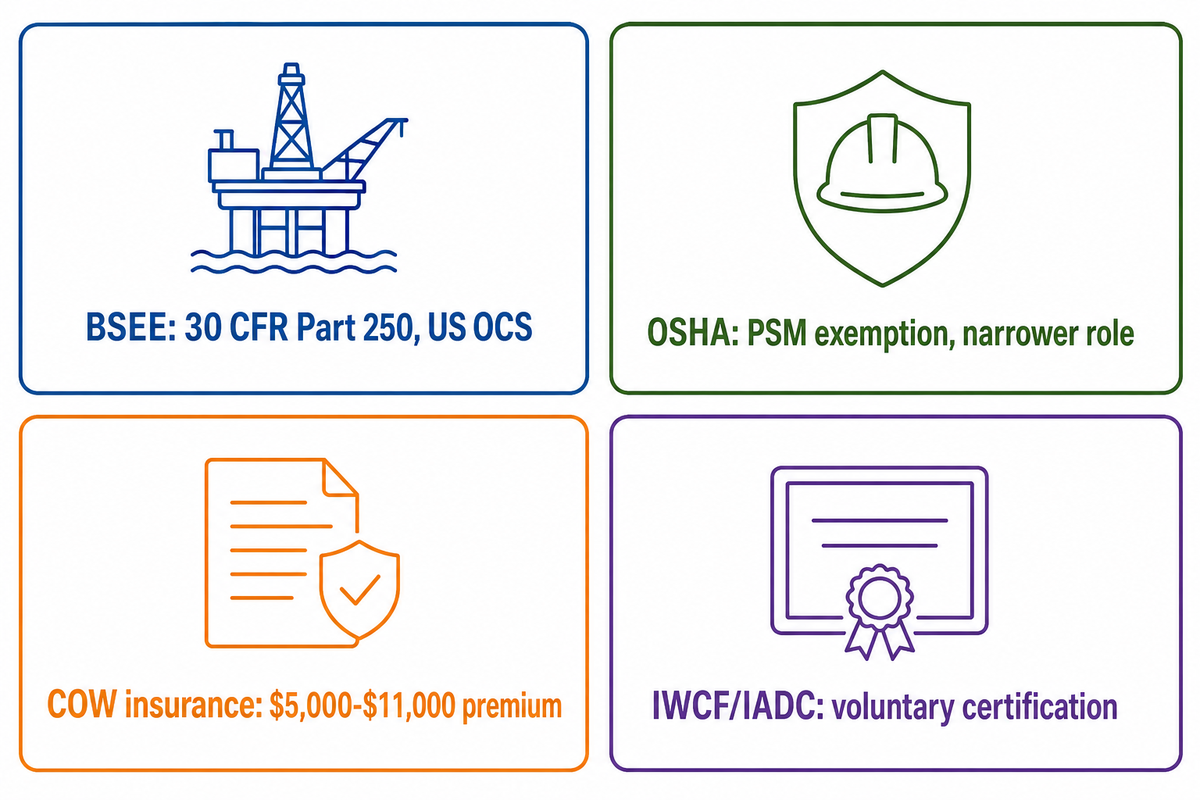
Responsibility for well control is actually four entirely different sets of rules and organizations — federal BSEE regulation, OSHA’s much narrower role, privately insured joint operating agreements, and voluntary certification — which do not coalesce into a single well-control law. This fourway division is what is happening in practice as the Well Control Name Collision: try searching “who is responsible for well control” expecting there to be one answer, and you will find four.
All four are ultimately aimed at protecting the safety of personnel and operational safety and efficiency, but each enforces compliance with industry standards through very different regulations:
- BSEE (federal offshore regulation) — the Bureau of Safety and Environmental Enforcement regulates well control on the US Outer Continental Shelf under 30 CFR Part 250, including the BOP testing schedule (H2-4) and training-plan requirements (H2-6). Federal jurisdiction only for offshore-drilling activities. Two adjacent jurisdictions are easy to assume away: onshore and Indian-lease wells fall under a separate Bureau of Land Management well-control regime (43 CFR 3172.6) with its own BOP-class and choke/kill-line equipment tables, not BSEE’s Title 30 rules; and for coastal spill response, BSEE and the U.S. Coast Guard operate under a standing memorandum of agreement, with BSEE leading source control and the USCG leading discharge removal and shoreline response.
- OSHA — a genuinely narrower scope of regulation than many realize — is two things: a major set of workplace rules and a federal regulator, and a narrower set of rules for the oilfield industry. OSHA’s flagship Process Safety Management (29 CFR 1910.119) explicitly recognizes that oil and gas well drilling and well-servicing operations on a gas well or oil well are not covered in scope; OSHA’s own enforcement directive (which is nonetheless the current official interpretation of the rule unchanged on osha.gov) notes that “is intended to cover all drilling operations and any well servicing operation including acidizing”. That means that for drill and workover scope, OSHA is not a parallel set of rules with BSEE; instead OSHA is quite a bit narrower in scope, limited instead to the General Duty Clause, most of the general industry rules, and not much more.
- Control of Well insurance — not a government-regulated product but a private contract — a much more concrete version of the third definition of “well control” (H2-1). It is real insurance coverage, which you can purchase; minimum premiums tend to be in the range of $5,000-$11,000 with deductibles in the range of $25,000-$150,000, and policy limits are available in a range from the low millions to hundreds of millions depending on the deal rather than fixed at a set industry-standard number. Statutorily no one is required to carry it (though many companies voluntarily do so), but working-interest partners will often include it as a requirement for drilling with other partners (doing the job of a law).
- IWCF/IADC WellSharp – an optional international industry certification, not government-required law (H2-6) – is often what is most frequently used by the industry, or suggested by insurers or by operators’ own planned training programs.
Do
- Treat BSEE’s training-plan requirement and IWCF/IADC certification as related but separate compliance questions
- Confirm whether your JOA contractually requires Control-of-Well insurance before assuming it is optional
- Ask which specific regime (BSEE, insurer, or a named certification) a claim about “well control requirements” is actually describing
- Check API material class (AA-FF) against your actual service conditions, not just working pressure
Do not
- Assume OSHA runs a full parallel well-control code alongside BSEE for drilling and servicing operations — it is exempted by name
- Assume an API material class like “AA” or “FF” alone tells you whether equipment resists a specific corrosive environment — the class governs material/mechanical properties, not a blanket corrosion guarantee
- Treat “Control-of-Well insurance,” “well control equipment,” and “Well Control School” (a specific training company brand) as the same thing when researching this topic
- Assume a named certification is what the regulation itself legally requires — check the training-plan language directly
When Well Control Fails — Macondo’s Technical AND Organizational Lessons
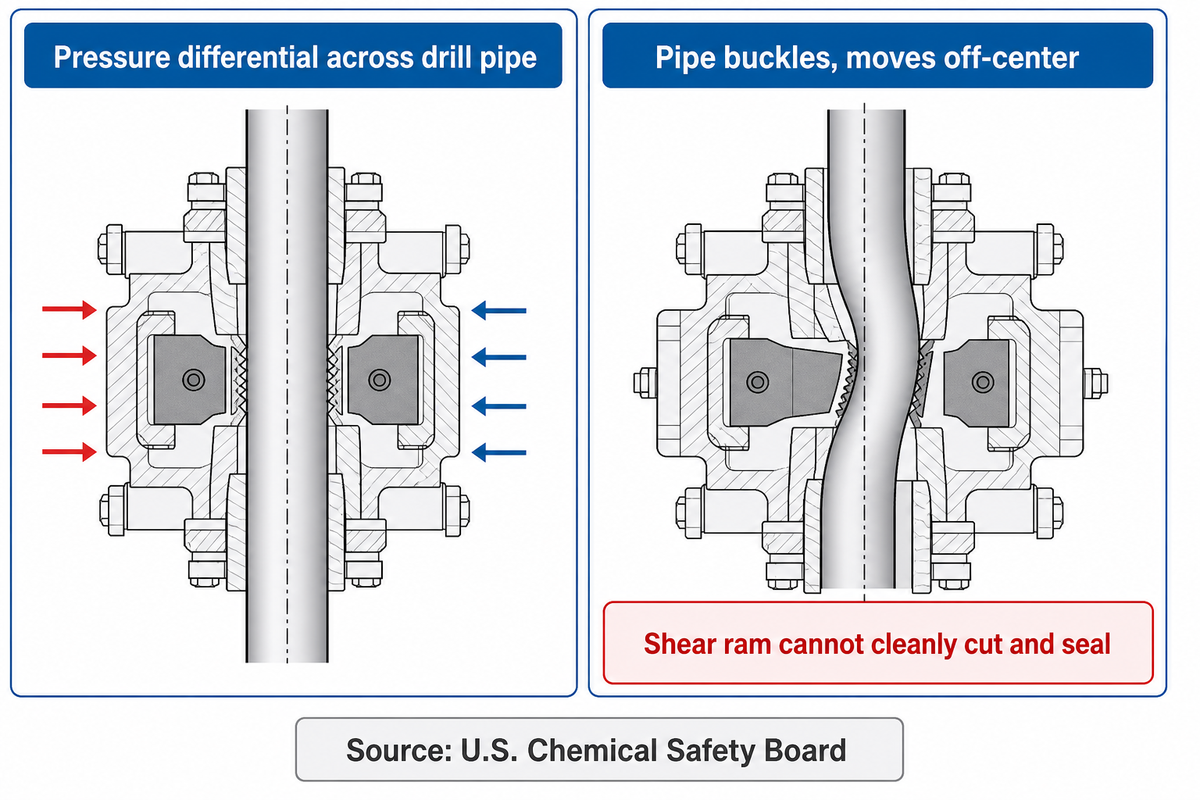
The most detailed, publicly documented investigation into a well-control failure is the U.S. Chemical Safety Board’s independent investigation of the April 20, 2010 blowout of the Deepwater Horizon well at Macondo, whose blowout-preventer failure mechanism was later defined as “effective compression.”
Drilled at nearly 5,000 feet of water approximately 50 miles off the coast of Louisiana, the blowout killed 11 personnel on board, injured another 17, took out the offshore platform 2 days later, and continued its uncontrolled release of fluid and natural gas for 87 days, until well intervention finally brought it under control .
A sharp pressure differential between the inside and outside of the drill pipe within the BOP resulted in compression and off-centering, hindering the blind shear ram’s ability to form an adequate seal during the incident. In addition, the report highlighted instances in which miswiring of the BOP’s redundant hydraulic control system “blue pod” or “yellow pod” each were combined with a simultaneous battery failure. Investigators also concluded that the BOP lacked sufficient capacity to shear and seal the 6-5/8 inch drill string for much of the operations conducted at Macondo.
But equipment failure comprises just one of the two aspects that the CSB highlighted, and it is generally the half that gains much of the repeated attention. However, the organizational dimension of equipment failure could perhaps be of far greater importance to any who operate a well-control program. The CSB found that although equipment that was in regular use and inspection on the rig, such as daily tests of BOP seals and wear on rubberizers and BOP rams, was in working condition, neither Transocean nor BP ever conducted formal or scheduled periodic testing of the BOP emergency functions in response to or even outside potential scenarios where they might be called upon. Simply put, the primary means of emergency shutdown had never been tested to know whether or not it would indeed function when the emergency was most desperately needed.
“The two-volume report we are releasing today makes clear why the current offshore safety framework needs to be further strengthened.” — Dr. Rafael Moure-Eraso, Chairperson, U.S. Chemical Safety Board
Perhaps most pertinently, the recommendations provided to the American Petroleum Institute, which were announced alongside the report’s preliminary findings on June 5, 2014, address these two aspects by asking API to add more thorough testing requirements of BOP emergency systems as an update to API Standard 53 (an “organizational and testing regime” fix, rather than one based entirely on equipment redesign).
So if your goal is to maintain a functioning well-control program, the lesson to be derived is not to “buy a heavier-duty piece of equipment.” Instead, realize and adhere to the idea that there exist both independent equipment reliability and independent inspection discipline, and a system that attends to one while neglecting and not rigorously checking and validating the other will always be inherently higher risk than it appears based on its equipment specifications alone.
The Well Control Readiness Checklist
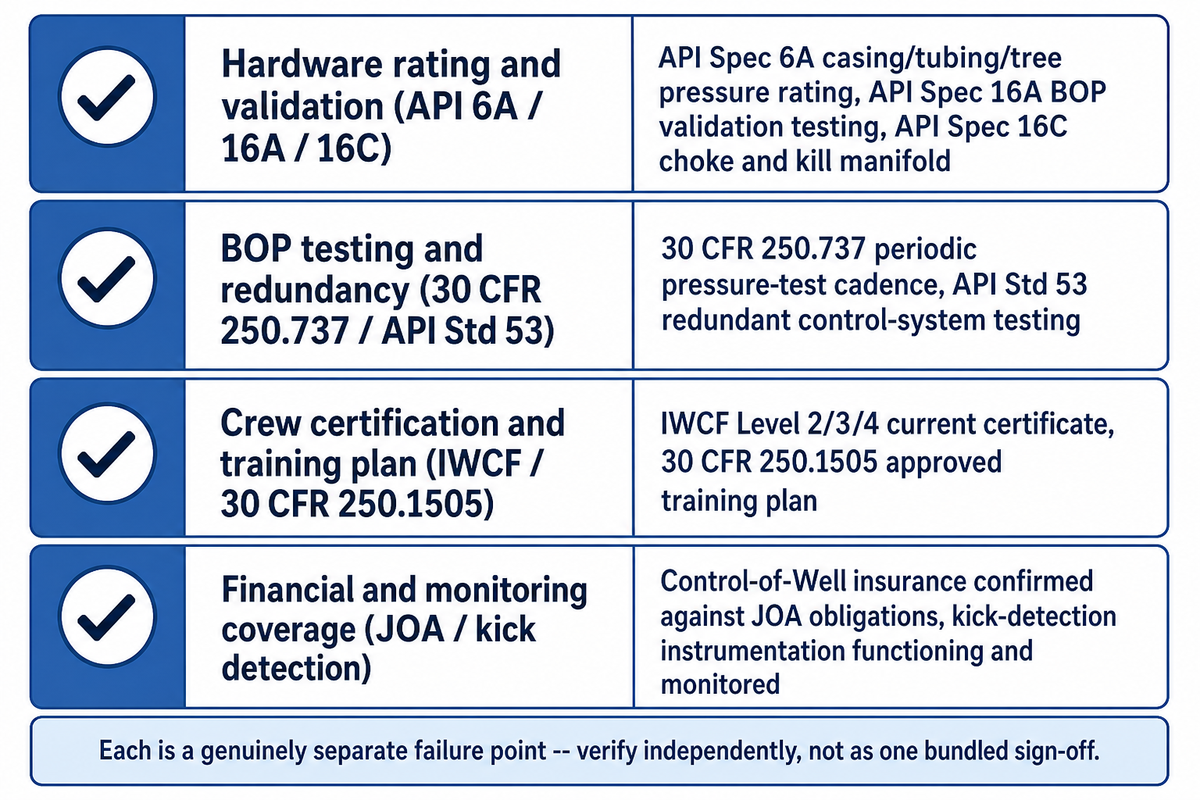
By pulling the hardware (H2-3/4/5), certification (H2-6), and compliance (H2-7) sections together, here is what *really* gets onto a defensible pre-op review-the Well Control Readiness Checklist we would use before signing off on a job that the well control is truly ready, not just theoretically present. None of these checks are set-and-forget: certificates lapse after 2-5 years and BOP testing runs on its own periodic clock, so a crew that was ready at spud is not automatically ready months later.
Key takeaway
A well control setup is not “ready” because the equipment is rated correctly — it is ready when hardware certification, BOP testing cadence, crew IWCF/IADC level, and Control-of-Well insurance status have all been verified independently, because each is a genuinely separate failure point.
| # | Item to verify | Governing reference | How to verify |
|---|---|---|---|
| 1 | Casing head / tubing head / tree pressure rating vs actual service conditions | API Spec 6A | Manufacturer’s test certificate + material class (AA-FF) |
| 2 | BOP validation testing current | API Spec 16A | Third-party validation test record, not just acceptance test |
| 3 | BOP pressure test cadence during drilling met, not just initial install | 30 CFR 250.737 | Periodic test log reviewed against the required interval |
| 4 | Redundant BOP control systems (blue pod / yellow pod equivalents) independently tested | API Std 53 | Documented latent-failure test, not day-to-day operational test alone |
| 5 | Choke and kill manifold rated and function-tested | API Spec 16C | Function test record on the specific manifold in service |
| 6 | Crew IWCF/IADC WellSharp level matches assigned role (Driller vs Supervisor) | IWCF Level 2/3/4 | Current certificate, not expired (5-year for Level 2, 2-year for Level 3/4) |
| 7 | Training plan satisfies BSEE’s approval requirement, independent of which certifier issued it | 30 CFR 250.1505 | Written training plan reviewed against operator’s approved scope |
| 8 | Control-of-Well insurance status confirmed against JOA obligations | JOA contract terms | Certificate of insurance cross-checked against JOA-required limit |
| 9 | Kick-detection monitoring (pit gain / flow rate) instrumentation functioning and monitored | Rig operating procedure | Instrument calibration log + crew shift-handover confirmation |
Now for the hardware families underlying it all and the standards that apply-useful if you are auditing items 1 through 5 above against a spec sheet, and also if you want to check item 3’s periodic BOP testing against your company’s log — it is the same equipment, organized by governing standard.
| Equipment | Family | Governing standard |
|---|---|---|
| Casing head | Wellhead / tree | API Spec 6A |
| Tubing head | Wellhead / tree | API Spec 6A |
| Master valve | Wellhead / tree | API Spec 6A |
| Wing valve | Wellhead / tree | API Spec 6A |
| Annular BOP | Drill-through / BOP | API Spec 16A |
| Ram BOP (pipe / shear / variable) | Drill-through / BOP | API Spec 16A |
| BOP control pods / redundant systems | BOP control | API Spec 16D |
| BOP field performance / periodic testing | BOP field performance | API Std 53 |
| Choke & kill manifold | Choke & kill | API Spec 16C |
Ready to see what this translates into a real hardware stack?
Head over to our wellhead and well control equipment page, which covers the full product family, spec stack, and procurement info this guide is explicitly designed to avoid duplicating. Save or bookmark this page and leave the discipline reference (certification, regulations, insurance) out of your spec sheet shopping process.
FAQ
Q: What is the difference between a wellhead and a well?
A wellhead is the pressure-containing equipment stack at surface; a well is the entire drilled bore, from surface all the way down to the producing reservoir, that the wellhead sits on top of and seals.
A well is the physical borehole and its downhole components – the casings, the completion equipment from surface to the producing interval. The wellhead is the set of surface equipment – casing head, tubing head, and Christmas tree – at its top, providing a pressure-rated access port. Though we talk of “the well” as an entire asset, “the wellhead” always describes that visible surface package.
Q: What does well control do?
Well control prevents and manages uncontrolled formation influxes, using layered barriers: hydrostatic mud weight first, mechanical BOP equipment second, and trained crew procedures and regulation running underneath both, throughout every stage of the well’s life.
That’s the coordinated system of initial fluid-control strategy (hydrostatic mud pressure), its primary physical safety net (the BOP stack), and only-used-as-a-last-resort strategy (relief wells), supported by the kick-recognition and -response procedures and regulated, certified workforce to properly execute it under extreme pressure. See H2-2 for stage-by-stage; a bit further down you can contrast driller’s method with wait-and-weight.
Q: How much does a wellhead cost?
Wellhead cost depends heavily on pressure rating, material class, and configuration, so there’s no single industry-wide figure worth quoting without knowing your specific service conditions first.
Since pressures range from 2,000 psi to 15,000 psi, and materials get more complex and expensive (from Class 1 up to class 6 or FF to handle H2S and higher temperatures) based on service requirements, it makes more sense to request quotes based on your *exact* well conditions than on a generic average pressure and material combination.
Q: What is IADC?
IADC is the International Association of Drilling Contractors, which administers its own WellSharp well control certification programme as one of the two main industry pathways alongside the separately-run IWCF system.
IADC WellSharp is our main training partner alongside IWCF (see H2-6). IADC covers industry roles from driller up through supervising drilling technician, IWCF from operator through supervisor – the distinction boils down to operator or contractor practice rather than formal job responsibilities.
Q: Why is well control important?
Because the alternative — an uncontrolled blowout — is one of the few oilfield failure modes that can cause mass-casualty and environmental-disaster outcomes in minutes.
The Macondo case study (H2-8) is the clearest documented example: a single BOP failure mode, compounded by an inspection gap, led to 11 deaths and the largest oil spill in offshore history. Well control discipline exists specifically to keep a routine kick from ever reaching that scale.
Q: What is the difference between a wellhead and a Christmas tree?
The Christmas tree is one component of the wellhead stack, not a separate system — it’s specifically the valve assembly at the top, above the casing head and tubing head.
“Wellhead” is the umbrella term for the full stack — casing head, tubing head, and tree together. The Christmas tree specifically is the valve assembly at the top that controls flow once the well is completed. See H2-3 for the full component walkthrough.
Q: Do I need well control certification to work on a rig?
Federal regulation requires an approved training plan, not a specific named certification — but in practice, most operators and contractors require IWCF or IADC WellSharp.
30 CFR 250.1505 requires only that training come from a source meeting your operator’s approved training plan (H2-6) — it doesn’t name IWCF or IADC by name. In practice, though, those certifications have become the de facto industry standard that most operators and contracting companies specify as a hiring requirement, independent of what the letter of the federal regulation says. Items 6 and 7 of the Well Control Readiness Checklist above cover both sides of this distinction.
Q: What is Control-of-Well insurance, and is it different from well control equipment?
Yes — Control-of-Well insurance is a financial product covering blowout-related costs, completely separate from the physical BOP and wellhead equipment this guide otherwise describes throughout every other section.
Control-of-Well insurance is underwritten coverage — commonly $5,000-$11,000 minimum premium with $25,000-$150,000 deductibles — that pays out for costs like relief-well drilling, pollution cleanup, and redrill expenses if a well control event occurs. It has nothing to do with the physical equipment covered elsewhere in this guide; it’s a risk-transfer contract, often required by a Joint Operating Agreement rather than by any government regulation. This is the clearest everyday example of the Well Control Name Collision: same three words, three unrelated things (see H2-7 for the full four-regime breakdown).
Why We Write This
China Welong has supplied wellhead, BOP-adjacent, and downhole tooling into the oil and gas industry since 2001, and sees the same buyer confusion repeatedly: procurement teams researching “well control” — and sometimes wellhead control panels specifically — often can’t tell whether they need equipment, training, or insurance — the Well Control Name Collision this guide names directly. We separate those three questions using regulatory text and certification-body data, not secondhand summaries. Reviewed by the China Welong technical team.
References & Sources
- Drilling Well Control Programme — International Well Control Forum (IWCF)
- 30 CFR 250.1505 — Where may I get training for my employees? — Bureau of Safety and Environmental Enforcement, eCFR
- The Standards Development Section (SDS) — Bureau of Safety and Environmental Enforcement
- 30 CFR 250.737 — BOP testing requirements — U.S. Government Publishing Office (govinfo.gov)
- CPL 02-02-045 — Process Safety Management Compliance Guidelines — Occupational Safety and Health Administration
- CSB Final Report — Deepwater Horizon Blowout Preventer Failure — U.S. Chemical Safety Board
- Control-of-Well Insurance: What It Is and Why It Matters — Kinsale Insurance
- WellSharp Accreditation — International Association of Drilling Contractors (IADC)
The BOPE, Christmas tree, and Casing and Tubing Head specifications addressed above concern the hardware purchasing aspects described earlier. As for choke and kill hardware, refer to choke and kill manifold specifications, and, coincidentally, to the choke and kill hoses product line.
Why Buyers Work With Welong
About Welong Engineering Support
China Welong supports oilfield buyers with engineered supply-chain service for drilling tools, well-control equipment, rig-floor tools, casting parts, and industrial forged components.
Project Review Before RFQ
We help buyers compare tool family, material route, API or ISO requirements, inspection records, supplier capability, delivery risk, and documentation needs before a purchase decision is finalized.
Request An Oilfield QuoteCompany Profile // Data Sheet
CompanyChina Welong International Supply Chain
BrandWelong
CountryChina
Business TypeOilfield tools and industrial supply-chain partner
Main ProductsDownhole drilling tools, fishing and milling tools, wellhead and well-control equipment, oilfield hoses, rig-floor handling tools, mill rolls, and forgings
Engineering CapabilityTool-family selection, specification envelope review, API / ISO reference support, material traceability, inspection coordination, and supplier-route comparison
RFQ Data NeededTool type, size, connection, rating, grade, standard, quantity, drawings, and delivery target
Websitewelongoiltools.com
![Casing, Tubing & Drill Pipe Elevators [Field Guide]](https://welongoiltools.com/wp-content/uploads/2026/09/casing-tubing-drill-pipe-elevators-guide-featured-768x512.png)
![Choke & Kill Hose: [Field Guide]](https://welongoiltools.com/wp-content/uploads/2026/07/choke-kill-hose-guide-featured-1-150x150.png)