Get in touch with Welong Company
API-5DP SPEC
Product Documentation
Drill Pipe
Drill Pipe | API 5DP Supply, Welong
API SPEC 5DP drill pipe is available in grades E75 to S135 and sizes 2 3/8 in to 6 5/8 in; confirm the selected grade and connection.
Oilfield manufacturing
Order-specific
Third-party inspection
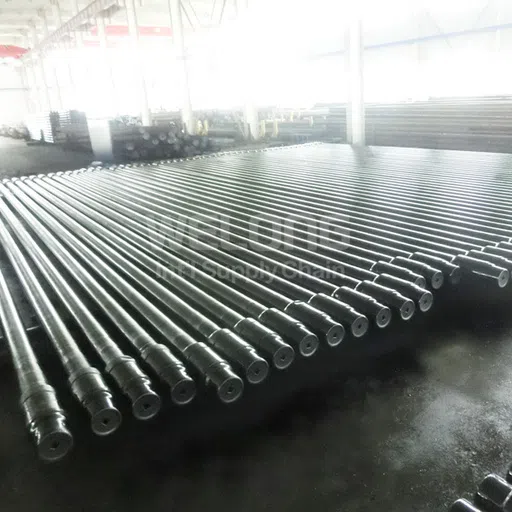
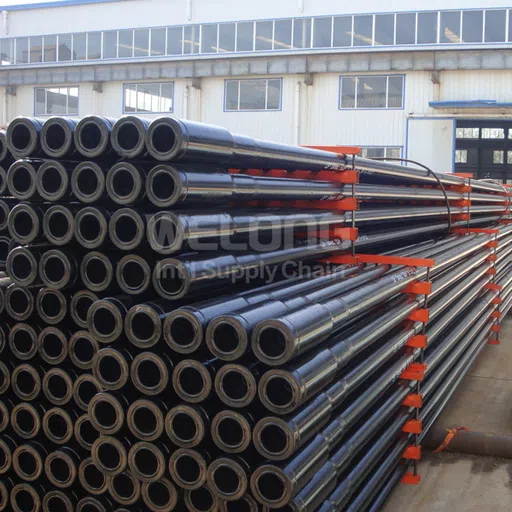
⇄ Click to Swap
2 3/8″–6 5/8″
OD Size Range
E75–S135
Grade Range
31.5 ft
Standard Joint Length
NC26–6 5/8FH
Connection Types
When Off-Spec Drill Pipe Costs You Downtime
MOD // 01
Drill pipe is a heavy-duty steel tube that transmits torque and pumps drilling fluid from the surface to the bit, and its connection area is where drilling programs most often lose time. Published fatigue-failure case studies of drill pipe in deep-well operations point to the thread and connection area as a recurring point of failure.[1][2] A single connection failure downhole doesn’t just cost the pipe; it costs hours to days of rig downtime to fish or sidetrack, the day-rate while the string is out of the hole, and, in the worst cases, the well itself, a risk gap that generic drill pipe specifications on a data sheet don’t reveal on their own.
MOD // 02
Most of that risk traces back to three manufacturing variables: inconsistent wall thickness across a joint, alloy chemistry and heat treatment that drifts outside the target window, and connections cut to a tolerance that won’t hold torque after repeated make-up and break-out cycles. The reason these gaps are hard to catch is structural, none of them show up on a spec sheet until the pipe is already downhole in the wellbore, mid-drilling operation. For the selected order, the quotation confirms the responsible manufacturer, wall-thickness tolerance, tool-joint process and full-length inspection scope before shipment, so connection reliability and joint longevity are engineered in rather than left to chance in the field.
Why Connection Integrity Drives the Spec
Rotary drill pipe transmits torque, tension, and internal pressure simultaneously. SPE-published dynamic measurement studies have shown that periods of excessive surface torque correlate with sustained lateral vibration in the drill pipe.[3] That’s why wall-thickness consistency and tool-joint heat treatment, not just headline yield strength, determine real service life.
Welong Drill Pipe Grades, Sizes & Connections
Welong supplies API SPEC 5DP drill pipe and manages production across the full range drilling contractors specify for onshore and offshore programs, four grades, seven OD sizes, and the matching API connection for each. The risk with sourcing from multiple catalogs is a mismatch that only surfaces at the rig: a connection gauged to a slightly different tolerance, or a wall thickness a supplier substituted without flagging it. The table below is the complete size-to-connection matrix for the drill pipe range Welong supplies: nominal weight, wall thickness, grade, and standard 31.5 ft joint length for every combination, so an engineer can specify a full string from one source instead of cross-referencing multiple supplier catalogs and hoping the tolerances line up.
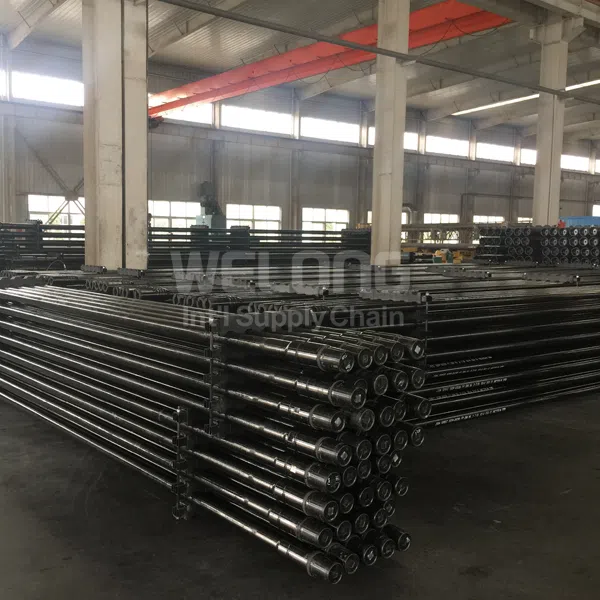
| OD | Nominal Weight | Wall Thickness | Grade | Standard Connection | Length |
|---|---|---|---|---|---|
| 2 3/8″ | 6.65 lb/ft | 0.280 in | G/E/X | API NC26 | 31.5 Ft |
| 2 3/8″ | 6.65 lb/ft | 0.280 in | S | API NC26 | 31.5 Ft |
| 2 7/8″ | 10.40 lb/ft | 0.362 in | G/E/X | API NC31 | 31.5 Ft |
| 2 7/8″ | 10.40 lb/ft | 0.362 in | S | API NC31 | 31.5 Ft |
| 3 1/2″ | 13.30 lb/ft | 0.366 in | G/E/X | API NC38 | 31.5 Ft |
| 3 1/2″ | 13.30 lb/ft | 0.366 in | S | API NC38 | 31.5 Ft |
| 3 1/2″ | 15.50 lb/ft | 0.449 in | G/E/X | API NC38 | 31.5 Ft |
| 3 1/2″ | 15.50 lb/ft | 0.449 in | G/E/X | API NC38 | 31.5 Ft |
| 4″ | 14.00 lb/ft | 0.330 in | G/E/X | API NC40 | 31.5 Ft |
| 4″ | 14.00 lb/ft | 0.330 in | S | API NC40 | 31.5 Ft |
| 4″ | 15.70 lb/ft | 0.380 in | G/E/X | API NC40 | 31.5 Ft |
| 4″ | 15.70 lb/ft | 0.380 in | S | API NC40 | 31.5 Ft |
| OD | Nominal Weight | Wall Thickness | Grade | Standard Connection | Length |
|---|---|---|---|---|---|
| 4 1/2″ | 16.60 lb/ft | 0.337 in | G/E/X | API NC46 | 31.5 Ft |
| 4 1/2″ | 16.60 lb/ft | 0.337 in | S | API NC46 | 31.5 Ft |
| 4 1/2″ | 20.00 lb/ft | 0.430 in | G/E/X | API NC46 | 31.5 Ft |
| 4 1/2″ | 20.00 lb/ft | 0.430 in | S | API NC46 | 31.5 Ft |
| 5″ | 19.50 lb/ft | 0.362 in | G/E/X | API NC50 | 31.5 Ft |
| 5″ | 19.50 lb/ft | 0.362 in | S | API NC50 | 31.5 Ft |
| 5″ | 25.60 lb/ft | 0.500 in | G/E/X | API NC50 | 31.5 Ft |
| 5″ | 25.60 lb/ft | 0.500 in | S | API NC50 | 31.5 Ft |
| 5 1/2″ | 21.90 lb/ft | 0.361 in | G/E/X | API 5 1/2FH | 31.5 Ft |
| 5 1/2″ | 21.90 lb/ft | 0.361 in | S | API 5 1/2FH | 31.5 Ft |
| 5 1/2″ | 24.70 lb/ft | 0.415 in | G/E/X | API 5 1/2FH | 31.5 Ft |
| 5 1/2″ | 24.70 lb/ft | 0.415 in | S | API 5 1/2FH | 31.5 Ft |
| 5 7/8″ | 23.40 lb/ft | 0.361 in | G/E/X | API JSHET57 | 31.5 Ft |
| 5 7/8″ | 23.40 lb/ft | 0.361 in | S | API JSHET57 | 31.5 Ft |
| 5 7/8″ | 24.20 lb/ft | 0.415 in | G/E/X | API JSHET57 | 31.5 Ft |
| 5 7/8″ | 24.20 lb/ft | 0.415 in | S | API JSHET57 | 31.5 Ft |
| 6 5/8″ | 27.70 lb/ft | 0.362 in | G/E/X | API 6 5/8FH | 31.5 Ft |
| 6 5/8″ | 27.70 lb/ft | 0.362 in | S | API 6 5/8FH | 31.5 Ft |
| Grade | Min Yield Strength | Reference Application | Best Fit When |
|---|---|---|---|
| E75 | 75,000 psi (517 MPa) | Conventional onshore, moderate-depth wells | String weight and torsion stay within standard-duty margins |
| X95 | 95,000 psi (655 MPa) | Intermediate-depth, higher torsional demand | Extended reach adds pipe weight beyond E75’s safe working load |
| G105 | 105,000 psi (724 MPa) | Deep wells, directional/horizontal sections | Program requires extra tensile reserve without upsizing OD |
| S135 | 135,000 psi (931 MPa) | Ultra-deep, high-torque, extended-reach drilling | Maximum grade needed to keep string weight and torsion within safety margin at depth |
Wall-thickness options within a given OD (for example, the two 4 1/2″ rows at 0.337 in and 0.430 in) let engineers dial in torsional and tensile reserve without moving to a heavier OD, useful when casing clearance is fixed but the drilling program needs a stronger string in the lower interval. Note that not every drill pipe joint uses an upset end at every size and depth combination; drill pipe isn’t always upset, especially for shallower drilling depths where the added manufacturing step isn’t cost-justified, so confirm upset type against your BHA and depth requirements rather than assuming a single default.
Grade Selection by Well Depth & Load
Cross-checked mechanical data: Welong’s grade specifications (also written E-75, X-95, G-105, S-135 in some industry references) align with the API SPEC 5DP mechanical properties published in the IADC Drilling Manual’s drill string reference table[4]: minimum yield strength of 75,000 psi for E-75, 95,000 psi for X-95, 105,000 psi for G-105, and 135,000 psi for S-135, with minimum tensile strength of 100,000 / 105,000 / 115,000 / 145,000 psi respectively, so buyers cross-referencing our spec sheet against published industry data see the same numbers, not supplier-specific outliers. High strength grades (G105 and S135) are the ones deepwater and extended-reach drilling operations most often specify, where every added foot of true vertical depth adds tension load to the string.
Related Drill String Components & Terminology
Drill pipe makes up the majority of the drill string, but it isn’t the whole assembly. Drill collars, thicker-walled steel pipe placed near the bit to add weight-on-bit without relying on drill pipe tension, sit between the drill pipe and the bottom-hole assembly; confirm drill collar sourcing separately if your BHA design calls for it. Heavy weight drill pipe (also written heavyweight drill pipe, or HWDP), a transition component with the same OD as standard drill pipe but a thicker wall, is also part of Welong’s drill string range, see our dedicated HWDP grade and connection guide for full dimensional specifications.
On terminology buyers frequently ask about: OCTG (Oil Country Tubular Goods) is the umbrella category covering drill pipe, casing pipe, and tubing as a group of API-governed steel pipe products; drill pipe is the OCTG sub-category built for rotation and torque, not static well-bore support like casing. IEU (Integral External Upset, alongside external upset and internal upset variants) describes how the pipe-body wall thickens toward the tool-joint end to reinforce the threaded connection; threaded connections and thread types are specified by API connection code (NC26 through 6 5/8FH in Welong’s range) together with outer diameter and pin/box gauge.
API SPEC 5DP Order Basis & Production Review
The selected drill pipe is specified against the applicable API SPEC 5DP requirements, which governs dimensions, materials, and testing for rotary drill pipe. Confirm the documentation required for the selected pipe.
Quality Control Through the Production Cycle
The inspection scope and records are confirmed for the selected drill-pipe order. Third-party inspection by SGS, DNV, or another qualified provider can be arranged when requested, with its timing and deliverables stated in the quotation.
“A tool joint that make-up torques correctly on the test bench and a tool joint that holds up after two hundred connection cycles in the field are not the same thing. That gap is exactly what full-length inspection before shipment is meant to close, we would rather catch a marginal joint on our own floor than have a customer catch it downhole.”
Coating & Hardbanding Options
Internal coating is available in TK34 and TK34P for corrosion and erosion resistance in the pipe bore, an application-specific choice for corrosive or H2S-bearing formations rather than a default on every order. External hardbanding options include Arnco 100XT and 300XT for tool-joint wear resistance in abrasive formations. Skipping the coating/hardbanding review at RFQ stage is a common mistake, it’s cheaper to specify the right combination against your drilling fluid chemistry up front than to discover a wear-rate problem mid-program. Request our detailed coating and hardbanding specification sheet for your exact grade and connection before finalizing an RFQ.
New API 5DP Drill Pipe vs. Reclaimed Pipe, Traceability & Fatigue-Life
A search for “drill pipe” today turns up two very different products under the same name: new, API-manufactured drill pipe built for active drilling programs, and decommissioned oilfield pipe resold outside the oil and gas industry, most often into ranch fencing and structural fabrication, where wall thickness and steel grade matter but drilling-grade fatigue history doesn’t. It’s worth being direct about the difference, because the two aren’t interchangeable for a drilling program, even though search results often blend them.
| Factor | New Drill Pipe Supplied by Welong | Pipe Resold Outside the Oilfield Industry (e.g. fencing surplus) |
|---|---|---|
| Mill Test Report | Issued per heat/lot, traceable to raw material source | Not issued to structural resale buyers |
| Fatigue/service history | Zero prior drilling cycles | Unknown number of prior drilling cycles and connection make-ups |
| Inspection basis | In-process + final inspection to API SPEC 5DP; optional SGS/DNV third-party | Condition-graded for structural use, not re-classified against API drill-stem inspection criteria |
| Reference buyer | Drilling contractors, operators sourcing for active well programs | Agricultural/structural buyers (fencing, corrals, gate posts) |
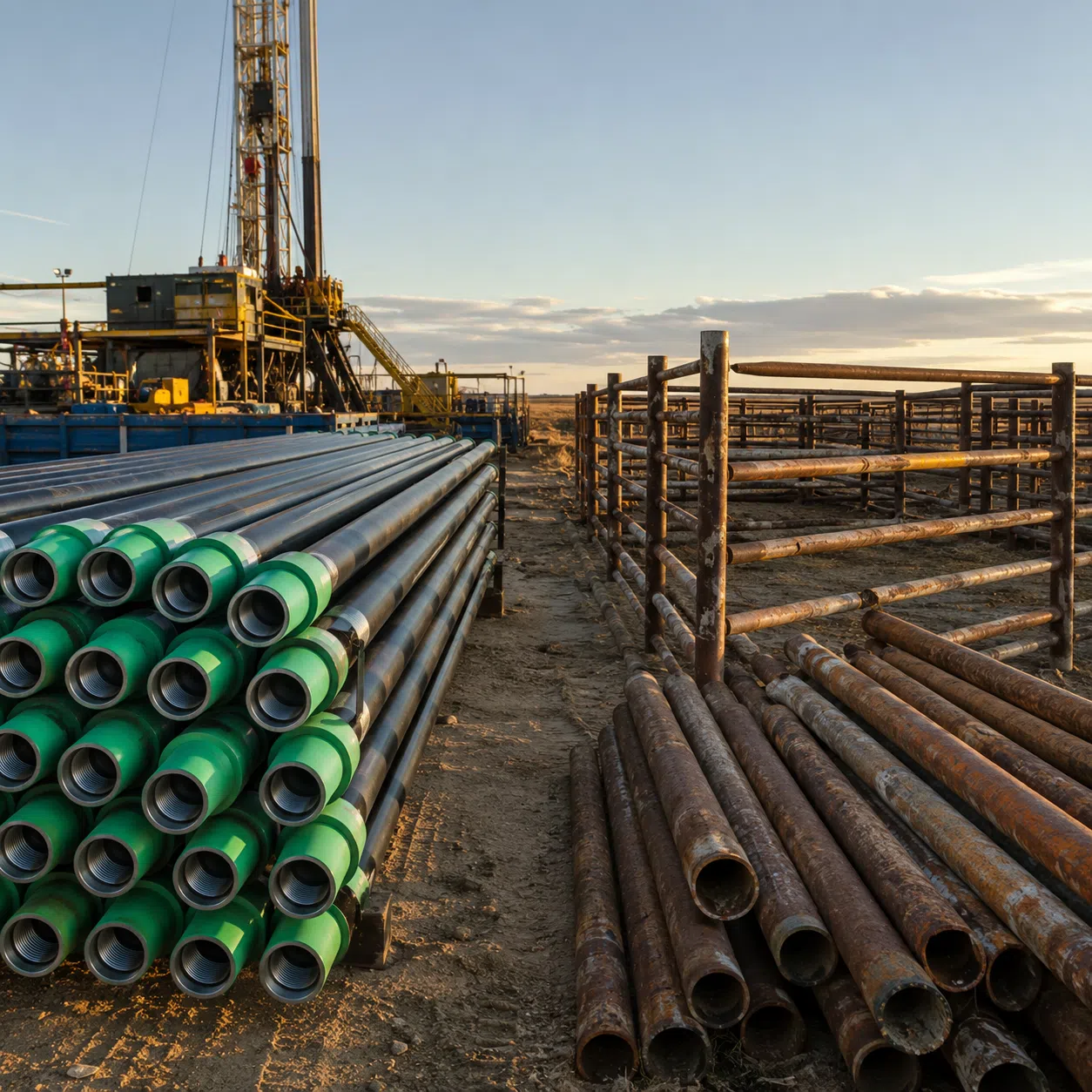
The honest version of this comparison requires being precise about two data points, because overstating either would be as misleading as ignoring them. TENORM contamination levels in equipment varied widely among types of equipment and geographic region, per the U.S. EPA.[6] It’s a real, documented risk category for produced-water-contact equipment, not a certainty on every piece of decommissioned pipe, and we won’t claim that every piece of reclaimed pipe carries that risk, since equipment can legitimately be cleaned and returned to service once radiation levels are reduced.[6] Second, on inspection: API does maintain a formal recommended practice for inspecting and classifying used drill-stem elements within the industry, so “used equals undocumented” isn’t industry truth across the board, remanufacturing programs that follow that practice are a different category from pipe that exits the industry entirely for structural resale.[7] The distinction that matters for a drilling program isn’t new-versus-used in the abstract; it’s whether the pipe you’re buying carries a Mill Test Report and a documented inspection history tied to drill-string service, or whether it doesn’t.
A 2010-2011 U.S. International Trade Commission hearing on drill pipe imports captured this distinction directly from industry testimony: “On used, it’s a bit like buying a used car… I have an extensive experience in drill pipe, both new and used, to the inspection history.”[8] That’s the practical trade-off a buyer is really weighing when comparing sources, not just price per foot, but whether the inspection history is documented or has to be taken on faith.
Welong supplies drill pipe and downhole tooling for onshore and offshore drilling applications. Confirm the required specification, grade, connection, and documentation for the selected order.
It’s worth noting the broader market context here rather than only our own claims, because the trade-off buyers actually weigh is rarely quality-versus-risk in the abstract: Chinese-manufactured drill pipe isn’t a fringe sourcing choice. Precision Drilling, Canada’s largest drilling rig contractor, publicly confirmed a “strategic purchase” of drill pipe from China in October 2024, ahead of Canada’s 25% surtax on Chinese steel and aluminum imports taking effect that same month — a surtax that names drill pipe under its own dedicated tariff classification (HS 7304.22/7304.23) — increasing its capital budget specifically to secure extra drill pipe for the following year.[9] A drilling contractor of that scale doesn’t make a bulk purchase decision like that on quality it doesn’t trust; timing around a tariff deadline, not a quality concern, was the deciding factor. Where we differentiate isn’t in being “a Chinese supplier” but in the specific inspection and traceability process described in the previous sections, that’s the structural reason a buyer should look at process, not country of origin, when comparing drill pipe manufacturers.
On logistics, we support multiple transport options, sea, air, and rail, and can structure orders under FOB, CIF, DDP, or DDU terms depending on which party you want managing customs clearance and inland freight for offshore or remote-site drilling programs. You compare the landed-cost structure and choose the terms that fit your import process, rather than being locked into one shipping arrangement.
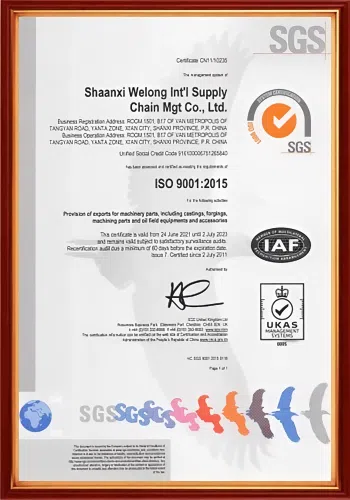
DOCUMENTATION // QUALITY RECORDS
Certifications & Quality Assurance
For supplier qualification, confirm the applicable manufacturing documentation and product-specific testing records for the selected drill pipe.
For the selected drill-pipe order, the quotation states the in-process and final inspection scope. If independent verification is required, third-party inspection by SGS, DNV, or another qualified provider can be arranged, with timing and records confirmed before production.
STATUS: ORDER REVIEW
×
![Enlarged Certification]()
Welong Drill Pipe Specification & Supplier Evaluation Tools
Drill Pipe Grade & Connection Selector
Filter Welong’s full API SPEC 5DP size/grade/connection matrix to find the joint you need.
New vs. Reclaimed Drill Pipe: Traceability Checklist
Check off what your current or prospective supplier can actually provide. This isn’t about new vs. used in the abstract — it’s about whether the inspection history is documented.
Incoterms Comparison: Who Handles What
FOB, CIF, DDP, and DDU shift customs clearance and duty responsibility differently. Click a term to see what Welong handles vs. what stays with you.
Drill Pipe Supplier Evaluation Scorecard
Score any drill pipe manufacturer or supplier you’re evaluating — including Welong — on the criteria that actually predict reliable delivery.
FAQ
Frequently Asked Questions
Drill pipe is a hollow steel tube used on drilling rigs to transmit rotational torque to the drill bit and circulate drilling fluid down to the bottom of the well and back up the annulus. Individual joints, often around 31.5 ft in a standard Range 2 length, are connected end-to-end by threaded tool joints to build the drill string. Drill pipe sizes often run 2 3/8″ to 6 5/8″ OD, and API 5DP drill pipe dimensions for a given size can vary by wall thickness and grade, which is why a drill pipe specifications chart, not a single number, is the right reference for selection. Most industrial drill pipe manufacturers publish a similar chart; the difference is whether the grades and connections listed on it are actually in current production.
For a drill-pipe order, confirm the required manufacturing documentation, third-party inspection scope, and mill test record by heat or lot.
A manufacturer controls pipe-body production and tool-joint attachment in-house and may trace a joint to its raw-material heat number. A distributor sources finished pipe from one or more mills and resells it; inspection and traceability records depend on the upstream mill and can vary by supplier. Ask which role a supplier performs before assuming manufacturer-level traceability.
Yes, Mill Test Reports are issued per heat/lot as part of our standard documentation package. Request a sample report format at RFQ stage if you want to confirm it matches your quality system’s intake requirements before ordering.
Sour-service suitability (NACE MR0175 / ISO 15156) depends on the specific H2S environment and material grade selected, it is not a blanket property of API SPEC 5DP grades. Contact our engineering team to confirm the sour-service classification your application requires before specifying.
API SPEC 5DP is the American Petroleum Institute specification covering dimensional, material, and testing requirements for drill pipe used in oil and gas drilling, the pipe body, tool joints, and their assembly. It defines the grades (E75, X95, G105, S135), size ranges, and connection standards drill pipe manufacturers and drill pipe suppliers worldwide reference when specifying drill pipe, including manufacturers based outside the USA.
Lead time depends on grade, size, order volume, and whether third-party inspection is requested. Confirm a delivery window against your specific specification and shipping method (sea/air/rail) at RFQ stage rather than assuming a standard timeline, large or non-standard orders take longer than in-stock combinations.
Procurement & Capability
Drill Pipe Capability Review
China Welong reviews the buyer drawing, product specification and inspection scope before quotation.
This review is scoped to the Drill Pipe configurations set out in the specification table on this page — 12 documented rows covering OD, Nominal Weight, Wall Thickness and Grade.
24 hEngineer-reviewed quotation on business days
2001Founded in 2001
30+30+ engineers on staff
5 yrStamped serial traceability
Quotation Scope and Commercial Terms
Pricing is prepared against the selected product configuration, material route, inspection scope and shipment terms.
- Quotes are returned within 24 hours on business days, reviewed by an engineer.
- T/T or L/C by wire transfer.
- We ship EXW, FOB, CFR or CIF; other Incoterms on request.
- We work from 2D drawings and 3D CAD models (AutoCAD, Pro/ENGINEER, SolidWorks; .dwg and .igs).
Production Planning
Production timing is confirmed with the quotation after quantity, process route and finishing scope are reviewed.
- We hold agreed items in stock and ship against your release to shorten delivery. Feasibility is confirmed at drawing review.
- Manufacturing at Xi'an, Shaanxi and at Jiyuan, Henan.
- 0.01 mm machining precision.
- Material standards to ISO, BS, ASTM, ASME, DIN, JIS and GB.
- Orders ship in standard export wooden cases, or the packing you specify.
Order Review and Responsibility
The responsible manufacturer, inspection scope and document package are identified for the selected item.
- Every quotation states whether the item is made in our own works or by an approved supplier we developed and supervise.
- We develop, audit and supervise the mills and workshops that make your parts: material mills are re-audited every two years and approved by Welong before they run your order.
- Forgings from 0.2 to 50 tons.
Specification and Inspection Evidence
The specification table on this page is the technical basis for this review: its numeric rows define what we quote, manufacture and inspect against.
- Each piece carries a stamped serial number and stays traceable for five years to its chemical composition, mechanical properties and measurement report, with the test coupon retained.
- An EN 10204-3.1B material certificate with chemical composition and mechanical properties, a dimensional measurement report, and UT and MT reports ships with your order.
- Inspection is by coordinate measuring machine, ultrasonic, magnetic particle and X-ray.
Request a Product Review
Send the drawing, product specification and inspection requirements for a quotation review.
![Choke & Kill Hose: [Field Guide]](https://welongoiltools.com/wp-content/uploads/2026/07/choke-kill-hose-guide-featured-1-150x150.png)