Get in touch with Welong Company
Wellhead & Well Control
Wellhead & Well Control Equipment Built to API 6A / 16A / 16C Standards
China Welong coordinates blowout preventers, Christmas trees, casing and tubing heads, and choke and kill manifolds against buyer well data and stated specifications. The quotation identifies the responsible manufacturer, proposed route and inspection scope; the 2,000–15,000 psi range and NACE MR0175 / ISO 15156 material options are confirmed for the order.
4 Product Families
BOP · Christmas Tree · Casing/Tubing Head · Choke & Kill2,000–15,000 psi
Working pressure envelopeAPI/NACE basis mapped by product
Conformity + NACE MR0175Custom · Lead time · Incoterms
FOB / CIF / DDP quoted per order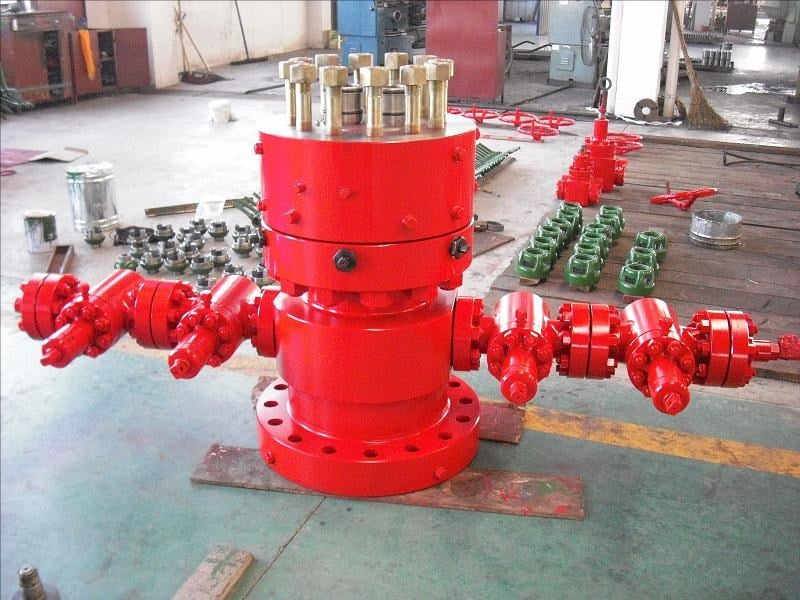
Built to API 6A · 16A · 16C
Designed in conformity with the applicable specifications
NACE MR0175 / ISO 15156
Sour (H2S) service material options
Founded
Supply coordination and quality-control support since 2001
Third-Party Inspection
SGS / DNV witnessing available per order
Well Control Starts at the Wellhead — What This Equipment Does
Every barrel produced from an oil or gas well passes through a stack of pressure-containing hardware, and the wellhead is the structural, pressure-containing datum the whole surface system latches onto. When a well kicks — an unplanned influx of formation fluid — the well control equipment on and above that wellhead is what keeps a manageable event on the oil well from becoming a blowout.
Risk runs highest in high-pressure and sour (H2S-bearing) wells, where the wrong material class or an under-rated component can fail by sulfide stress cracking rather than slow corrosion. That failure mode is fast, and it is exactly what the API 6A / 16A / 16C specifications and NACE MR0175 are written to prevent.
A well that gets away is not just a safety event; it is a financial one. Offshore, rig spread can exceed USD 250,000 a day, so every hour the well is not under control is measured in six figures — and a single failed pressure barrier can cost far more than the equipment that should have held it.
That economic reality is why buyers treat well control equipment as risk mitigation first and a purchase second, and why conformance, pressure-testing records and inspection outrank the quote on this class of hardware.
A complete well control system is not a single machine. It is a chain of drilling and production equipment that works together to detect, contain and circulate out an influx while the driller rebuilds mud density and regains control of the flow of fluids downhole.
What is well control equipment?
Well control equipment is the set of surface pressure control equipment that detects and contains an unplanned influx of oil or gas during drilling and production. It comprises the mud system, the blowout preventer (BOP) stack, the choke & kill manifold, and monitoring or mud-gas separation (MGS) systems. Together these components let an operator shut in the well, circulate out the kick under controlled back-pressure, and safely restore normal drilling operations.
Well control, stage by stage
Mud system — primary control:
the drilling fluid column holds back formation pressure during normal drilling operations.Kick detection and monitoring —
pit-volume and flow sensors flag an influx of oil or gas early, before it climbs the well.BOP stack — secondary control:
annular and ram preventers shut the well in when the mud column is no longer enough.Choke and kill manifold —
circulates the influx out under controlled back-pressure while mud weight is rebuilt.Mud-gas separator —
strips gas from the returns so the influx is handled safely at surface.Each stage is a fallback for the one before it, which is why the physical hardware — the BOP stack and the choke & kill manifold — has to be engineered to one consistent standard.
Because that chain has to hold as one system, coordinating the selected equipment families against confirmed interface requirements reduces the mismatch risk that appears when a BOP from one maker meets a wellhead from another.
Info gain: “sour-rated” does not mean corrosion-proof
It’s a common mistake to believe that if a component has a NACE MR0175 sour-service rating, the component is impervious to corrosion, but that isn’t true. NACE MR0175 / ISO 15156 only addresses one type of failure mode; that of sulfide stress cracking (SSC) which is a mechanism completely separate from other general forms of weight-loss corrosion. When sourcing a sour-rated BOP or tree it’s still necessary to select the appropriate corrosion resistant alloy (CRA) class depending upon CO2 and chloride exposure, so it’s carefully chosen based upon that and the operating environment, rather than assumed to be based solely on the pressure rating.
Four Product Families, One Quoted Source
China Welong coordinates the selected equipment families of wellhead and tree products as one set of spec-matched equipment, which is presented below by family. Each has a simplified micro-spec listed; use the child links at the bottom to access tables, drawings and ordering keys of each product with the detailed engineering specs to aid specification of a precise model from each family.
Each family is surface equipment for oil and gas exploration, drilling and production, coordinated by China Welong against the selected configuration, responsible manufacturer and inspection scope. For the selected configuration, the material class, flange size and pressure rating are coordinated at every level, from casing head up to the tree.
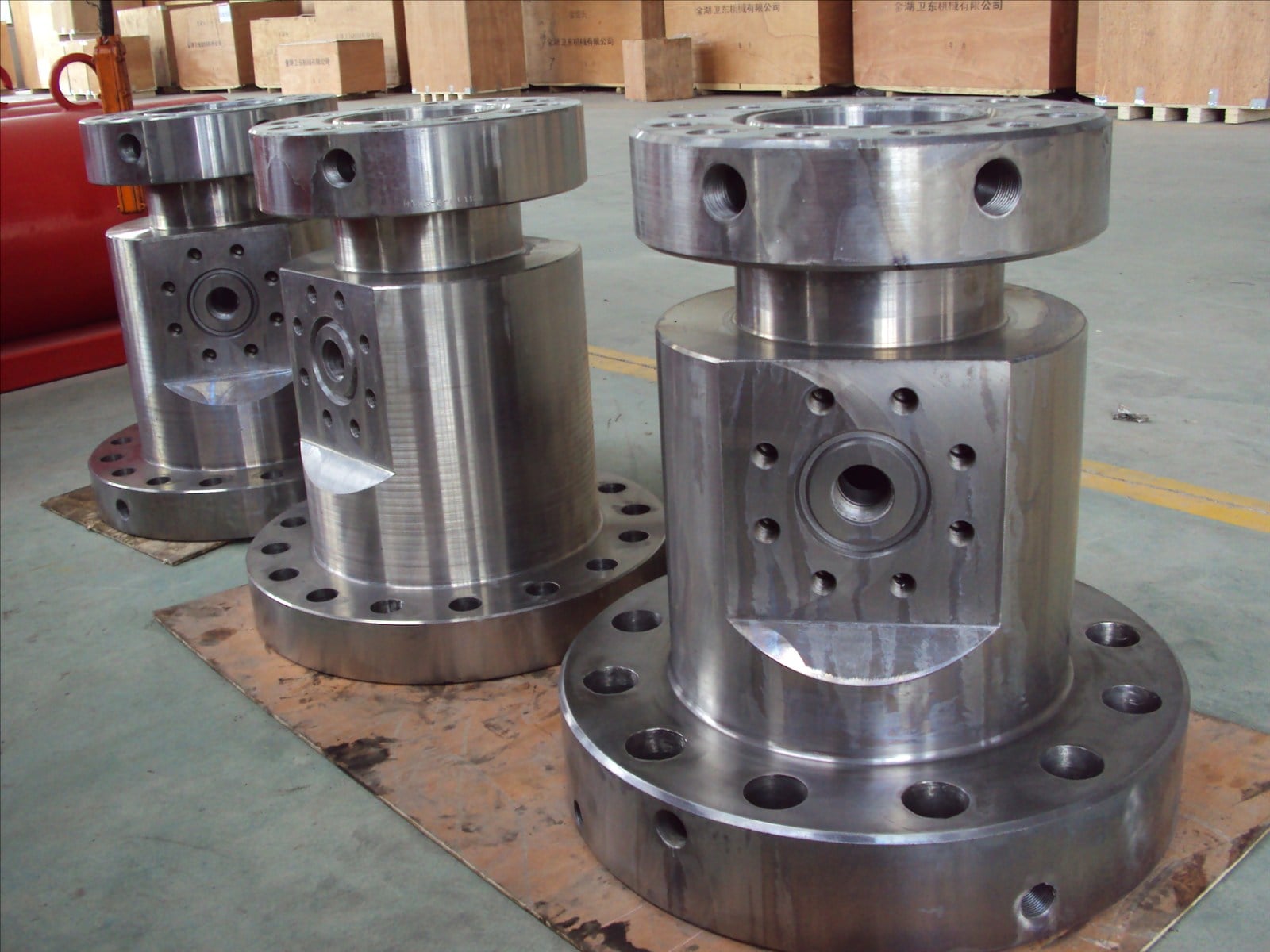
Design-conformant to API 6A
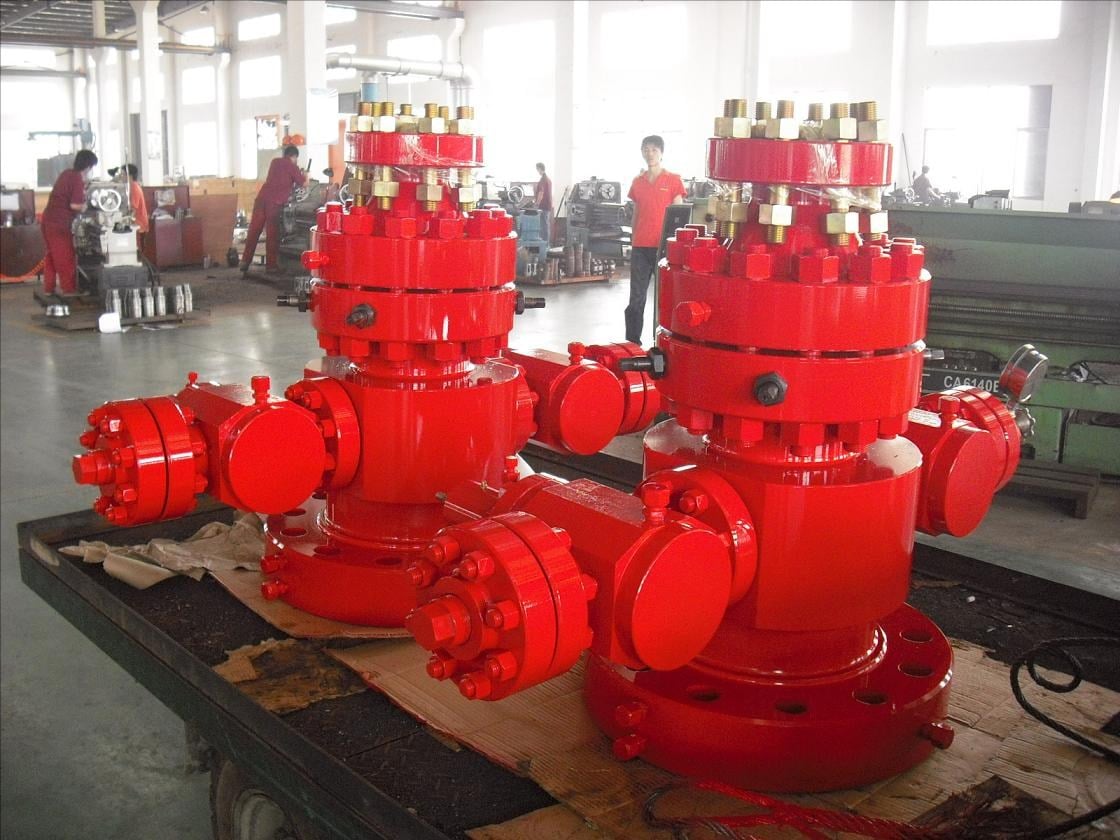
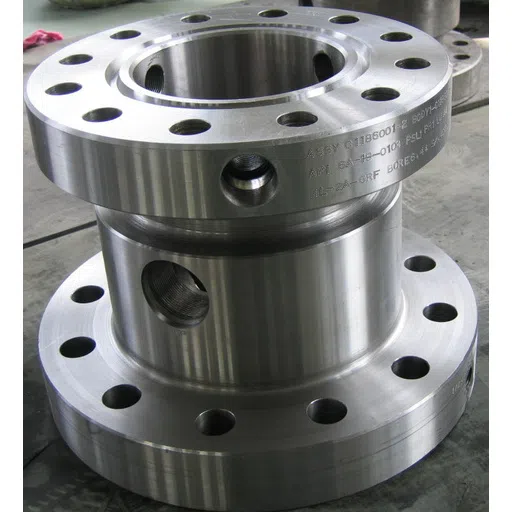
Casing Head & Tubing Head
- Casing Head flange 11″–21¼”
- Tubing Head flange 7-1/16″–13-5/8″
- Material AA–FF; PSL1–3G; PR1
- Anchors the casing string cemented in place; carries the tubing head spool
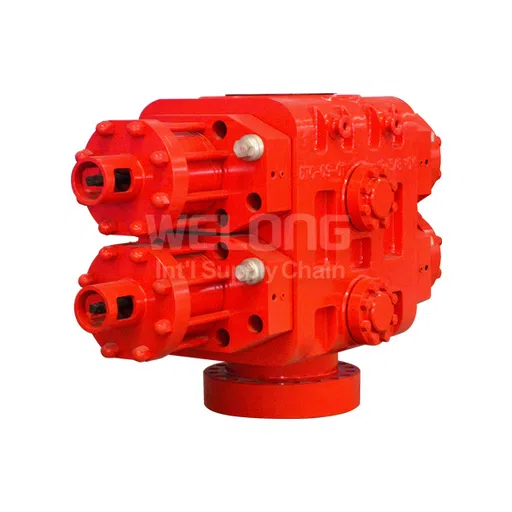
Built to API 16A + NACE MR0175
Blowout Preventer (BOP)
- Annular BOP: bore 9″–21¼”, 2,000–15,000 psi
- Ram BOP: double / single / shear / variable rams
- Material class AA–FF; sour classes per NACE
- Body, header, packing element and piston, tested per API 53 practice
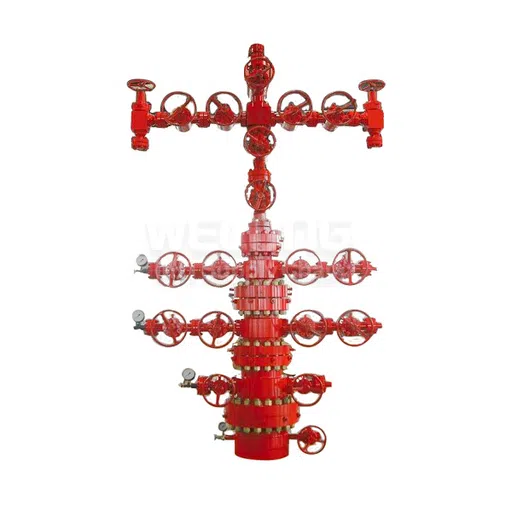
Design-conformant to API 6A
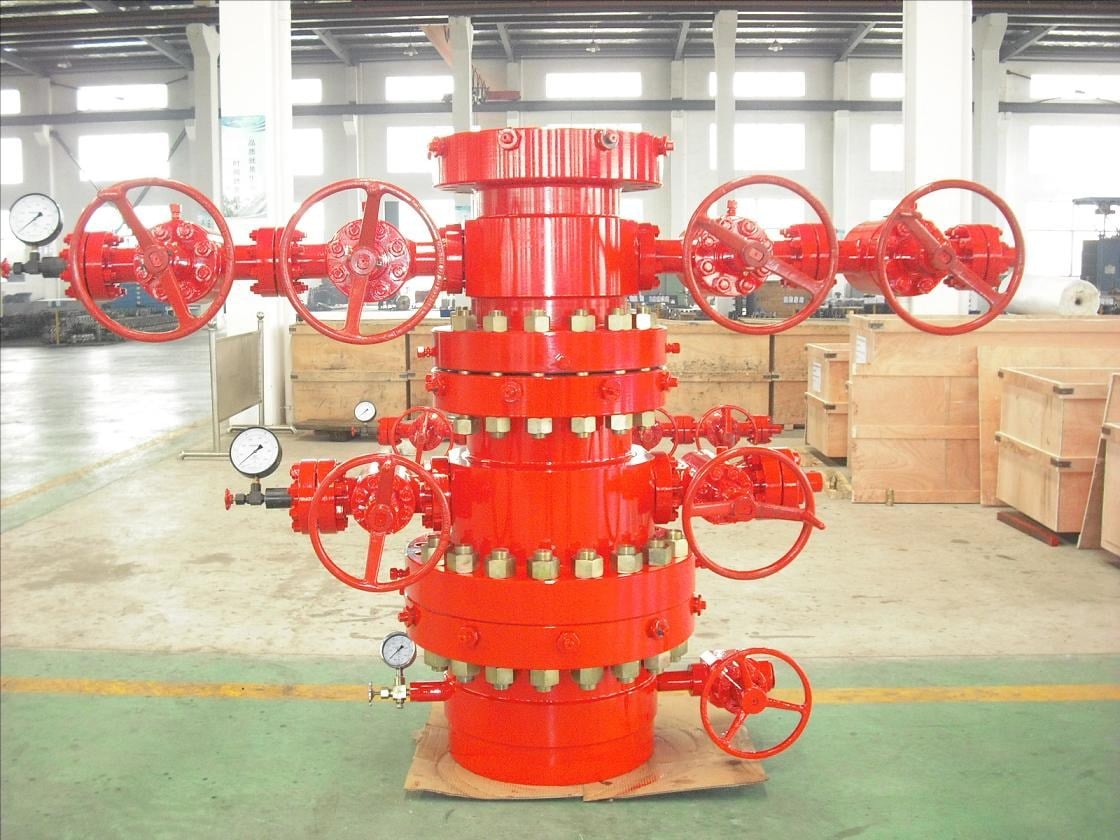
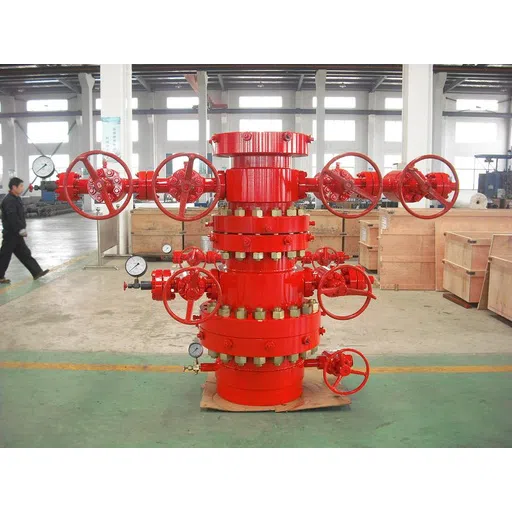
Wellhead Christmas Tree
- Bore 2-1/16″–4-1/16″; PSL1–3G (table-verified)
- 2,000–15,000 psi working pressure
- Connects casing, suspends tubing, controls and regulates flow of oil
- Upper / lower master valve, swab valve, kill wing valve, tubing hanger
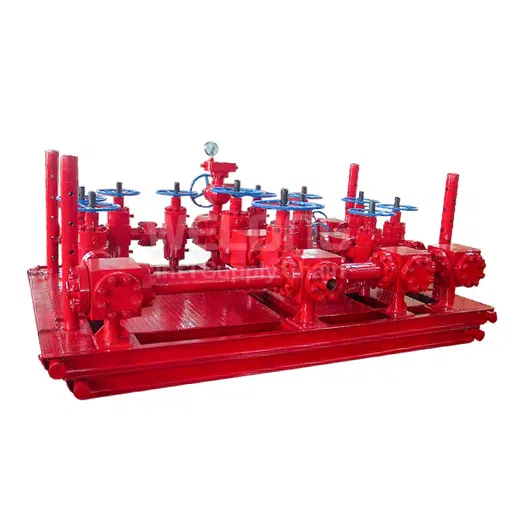
Built to API 6A + API 16C + NACE
Choke & Kill Manifold
- Choke JG-35/70/105 · Kill YG-35/70/105
- 2,000–15,000 psi; manual or hydraulic
- Material class DD–FF (sour service)
- Choke bleeds back-pressure; kill line injects kill fluid (check-valve, inject-only)
Wellhead Versus Christmas Tree
The wellhead refers to the equipment set assembled at surface including the casing head and tubing head, that anchors and seals each of the casing strings and supports the suspended tubing, and that acts as a structural base for the pressure containment on the surface of the earth. The Christmas tree is assembled on top of the wellhead after well completion to control the flow of fluids during production. Simply put, the wellhead builds the well, and the tree makes the well flow.
The four families fit together on one well
Casing head and tubing head systems make up the surface wellhead: they anchor the casing strings cemented in the ground and suspend the tubing on tubing hangers (coiled tubing hangers may be used for intervention work). Mounted on top of the head, the Christmas tree and its valves and fittings work together with the wellhead sub-assemblies for fluid management at surface, while the BOP stack and choke & kill manifold provide the well-control functions for operations such as drilling and workover.
For the selected configuration, the quotation identifies the responsible manufacturer, pressure rating, material class, inspection scope and interface requirements.
This same product line also covers wellhead-and-frac and frac stack products for stimulation work, and both surface and subsea wellhead configurations, so tubing and casing programs across drilling, completion and workover draw on one spec discipline rather than a patchwork of suppliers. That configuration-specific coordination extends downhole too: China Welong also manufactures the related tubular items that run below these surface systems, so a drilling program can be specified against one quality system from the wellhead to the bit.
The Well Control Spec Stack — API Standard × Pressure Envelope by Family
Buyers comparing surface pressure control equipment usually have to piece the specifications together across separate datasheets, so the Well Control Spec Stack below aligns the selected equipment families against one set of columns – API standard, pressure envelope, bore, material class, PSL/PR and sour-service handling. One engineer can then read the whole surface system at a glance.
Click to Swap
| Product Family | API Standard (Conformity) | Working Pressure | Bore / Flange | Material Class | PSL / PR | Well Stage | Sour (H2S) |
|---|---|---|---|---|---|---|---|
| Annular BOP | API 16A | 2,000–15,000 psi | 9″–21¼” | AA–FF | — | Drilling | NACE MR0175 |
| Ram BOP (double/single/shear/variable) | API 16A | 2,000–15,000 psi | 7-1/16″–21¼” | AA–FF | — | Drilling | NACE MR0175 |
| Wellhead Christmas Tree | API 6A | 2,000–15,000 psi | 2-1/16″–4-1/16″ | AA–FF | PSL1–3G | Production | NACE (DD–FF) |
| Christmas Tree safety valves | API 6A | 2,000–15,000 psi | 2-1/16″–4-1/16″ | AA–FF | PSL1–3G / PR2 | Production | NACE MR0175 |
| Casing Head | API 6A | 2,000–15,000 psi | flange 11″–21¼” | AA–FF | PSL1–3G / PR1 | Wellhead | NACE MR0175 |
| Tubing Head | API 6A | 2,000–15,000 psi | flange 7-1/16″–13-5/8″ | AA–FF | PSL1–3G / PR1 | Completion | NACE MR0175 |
| Choke Manifold (JG-35/70/105) | API 6A + API 16C | 2,000–15,000 psi | 2-1/16″–4-1/16″ | DD–FF | — | Well control | NACE MR0175 |
| Kill Manifold (YG-35/70/105) | API 6A + API 16C | 2,000–15,000 psi | 2-1/16″–4-1/16″ | DD–FF | — | Well control | NACE MR0175 |
Ordering Key (API 6A)
A complete API 6A order specifies: equipment type + working pressure rating + temperature class (K–V, −60 °C to 121 °C) + material class + PSL.
API 6A vs 16A vs 16C — What Does Each Cover?
API Spec 6A (21st Edition, 2021), the Specification for Wellhead and Christmas Tree Equipment, governs the static pressure-containing hardware that stays on the well for its producing life – wellheads, casing and tubing heads, and Christmas trees. API 16A covers drill-through equipment, meaning the annular and ram blowout preventers that are run only while the well is being drilled. API 16C covers choke & kill equipment – the manifolds, valves and lines that route, throttle and circulate flow during a live well-control event – so together the three specifications span the full surface stack from the wellhead up through the BOP and back down the choke and kill lines.
Reading The Stack: Five Specs Define Every Order
An API 6A order is complete only when five specs are fixed together: equipment type, working pressure, temperature class, material class and PSL. Miss one and the equipment can read as “API” yet be wrong for the well.
Temperature class (K through V, roughly −60 °C to 121 °C) is the spec most often left off a request, yet it sets the low-temperature toughness of the steel – which is why Charpy V-notch impact data belongs in the material record for the colder classes. Pressure ratings and material class are then chosen on their own axes, as the well demands.
Wellhead systems themselves come in single-bowl, multi-bowl and internal latch wellhead system designs, and the right choice depends on the casing program and how many strings the well runs. China Welong specifies all of these to API Spec 6A so the whole surface stack shares one standard.
Info Gain: Pressure Rating And Material Class Are Independent Axes
Higher pressure requiring higher-grade metallurgy sounds logical, yet within API 6A the two criteria are specified independently: pressure rating follows the well’s requirements, not the quality of the metal, while material class follows whether the fluid needs corrosion resistance. A 2,000 psi sour well can demand the more expensive DD alloy-steel class, while a 15,000 psi sweet well may need only AA carbon steel. So the real task is to match pressure rating to pressure and material class to fluid compatibility — two independent parameters, not a single grade.
Info Gain: Not Every Component Carries The Full Stack Rating
An additional nuance learned in the field: only equipment from and including the choke valve back to the wellhead is required to meet the full rated working pressure of the BOP stack. Downstream, beyond the choke — the deliberate pressure-drop element — standard practice allows a step down: a one-class reduction (for example 10,000 psi down to 5,000 psi) is permitted for the valves and associated buffer tank, because the choking operation has already served its function. This is considered a sound cost-reducing engineering compromise that doesn’t impact safety on the outlet side.
Standards Compliance, QC & Why Operators Source From China Welong
100% QC Verified
The primary filter when purchasing critical well control equipment is standards conformity, long before pricing becomes a significant factor. The quotation maps each selected line to the applicable specification and responsible manufacturer; BOPs to API 16A, wellheads / casing & tubing heads / Christmas trees to API 6A, choke & kill manifolds to API 6A in combination with API 16C, and, when required for sour service, NACE MR0175 materials can be specified for all lines.
When we say conformity, honesty should prevail: a product conforms to a specification if it meets all its requirements. Where a purchaser requires proof of conformance beyond the specification and the documentation package, independent third-party inspection is written into the quoted scope and carried out before shipment.
Inspection scope and available documentation, including material and pressure-test records where agreed, are identified for the selected configuration and quoted manufacturer.
In-process QC
Dimensional and material checks during machining and assembly, with traceability back to the heat and the casting.
Final QC
Hydrostatic and gas pressure testing to the rated working pressure, with Charpy V-notch data where the material class requires it.
Optional third-party
SGS, DNV or Bureau Veritas witnessing and pre-shipment inspection at order-specific packaged, arranged per order.
What operators actually rank first — and it is not price
So what order do buyers actually use when selecting critical well control gear? While price is ever-present, it is rarely at the head of the pack for high-criticality items; the ranking that decides most awards is:
- Standards Conformity – API 6A/16A/16C, NACE MR0175.
- Third-party inspection — SGS, DNV or Bureau Veritas reports.
- Company Track Record – years in operation, projects supplied.
- Delivery reliability — realistic lead time and on-time performance.
Price is important, but it usually ranks 4th or 5th out of 5.
This is why this page emphasizes standards conformity and the mechanisms for their verification, rather than shouting the lowest number – getting the wrong or late equipment costs far more than the difference between the 4th and 5th (or even 1st and 2nd) numbers in a price comparison.
Conformity you can verify, stated the way it is
Licence status is confirmed for the responsible manufacturer at quotation.
Conformity is granted per product scope, so every family on your quotation names the specification it is built to and the inspection that verifies it.
Here, each family is thus stated to be built to specification and with the back of third-party inspection, not dressed up as a certification China Welong doesn’t yet possess. That’s a claim that an operator can verify against the industry standard specifications themselves.
Why trust an overseas manufacturer you have not bought from before?
Operators fear the unit delivered to the rig will differ from the qualified sample, therefore an unknown overseas manufacturer needs to gain trust via evidence rather than by reputation – a true factory audit, third-party evidence, full material traceability and a during-production/pre-shipment review against that approved sample.
The real distrust of an unknown overseas supplier is proof of capability — a genuine factory, genuine technical knowledge, and shipped units that match the qualified sample — not a lower price.
The quotation identifies the responsible manufacturer, applicable specifications, inspection scope and any agreed third-party witness points. Factory-audit or delivery-inspection terms are included only when agreed for the selected order.
Advanced Wellhead & Well Control Solutions
Wellhead & Well Control Engineering Tools
API 6A / NACE MR0175 Material Class Selector
Match your well fluid to the correct API 6A material class before you request a wellhead, Christmas tree, or casing/tubing head quote. Sour (H2S) service and corrosion-resistant wetted parts drive the class — and the price.
API 6A Working Pressure & PSL Envelope Checker
Confirm the required working pressure, material class, product specification level and inspection scope in the RFQ; the selected configuration is confirmed in the quotation.
Well Control Downtime Cost Calculator
Put a number on the reason wellhead and well-control equipment gets specified on certification and delivery, not price. Estimate the cost of a well that is not under control — rig spread plus deferred production — for the hours it takes to recover.
FAQ — Wellhead & Well Control Equipment
What is the difference between an annular BOP and a ram BOP?
An annular BOP features a universal rubber packing element capable of sealing around almost any bore configuration (drill pipe, tubing, open hole), and the stack’s flexible first line. An individual ram BOP uses one or two steel rams designed for a particular function: pipe rams seal around a set size of pipe; shear rams can cut the pipe and then seal; or variable rams can adjust around a range of sizes. Nearly every well-control stack includes an annular preventer as the uppermost component, over one or more ram preventers.
How do I choose material class for sour (H2S) service?
When selecting sour-service material, we look at the well fluid, not the pressure: under NACE MR0175 / ISO 15156, it is your operating envelope — H2S partial pressure, temperature, chlorides and pH — that determines your API 6A class, from sweet service AA/BB/CC to sour service DD/EE/FF/HH. These fluid and temperature ranges select the material group, with carbon and low-alloy steels constrained to 22 HRC maximum to combat sulfide stress cracking. Once that fluid data is available, China Welong determines the proper group; if it is not, it is our engineers’ first question — because assuming the class is the fast track to the wrong equipment.
What is the practical difference between API 6A PR1 and PR2?
PR1 and PR2 are levels of performance and requirements in API 6A that indicate the intensity of validation of a component. PR2 includes the cyclic and endurance tests of the requirements PR1 and safety valves are usually specified PR2. Casing and tubing heads are usually specified PR1.
What are the main components of a wellhead?
A wellhead is built mainly from two pressure-containing bodies plus their accessories: the casing head mounts the surface casing string and seals it at ground level. The tubing head sits just above the casing head, supports the production tubing string on tubing hangers, and provides the top connection for the Christmas tree. Hangers, spools and seals are the essential equipment and accessories that go with them, and together the casing head and tubing head form the well’s surface foundation.
Do I have to buy the whole stack from the quoted manufacturer?
You don’t have to, but there’s a real advantage: when BOPs, casing and tubing heads, wellhead, Christmas tree and choke & kill manifold are coordinated against the selected configuration and interface requirements, the seals, material grades and pressure ratings at the interfaces are confirmed for the selected interface. That removes the integrity risk of adapting components from different makers and cuts the documentation, traceability and spare-parts burden to a single point of contact — which is exactly why China Welong offers the selected equipment families in the selected configuration. China Welong confirms replacement-part compatibility for the selected configuration in the quotation.
Can you supply equipment for offshore and subsea wells?
Yes – the four families are sized for surface wellhead applications on both onshore and offshore drilling & production, and the subsea wellhead configurations can be quoted from the well data. Offshore work makes the evidence for specifications and inspection more critical, because rigs are (relatively) expensive, and once equipment is on the seabed there is little opportunity for access, so third-party inspection and complete traceability is the norm rather than the exception. As the oil and gas industry explores deeper waters and higher pressures, matching the correct pressure rating and material class to the specific well is what keeps the drilling & production equipment reliable over their service life.
What are the minimum order quantity and lead time?
There is no fixed umbrella minimum – orders are quoted by configuration, and single critical assemblies are normal. Delivery lead time is driven by whether the item is a stock item or requires custom manufacture, and a realistic committed date is quoted at time of quotation rather than upon receipt of order.
Order support and documentation
Any warranty, replacement part, response or compatibility term is stated by the quoted manufacturer and confirmed for the selected configuration in the supply contract.
Working with China Welong
Order Terms, Evidence and Next Steps
The commercial terms below apply to every oilfield tools order we quote. They are the same terms our quotation repeats back to you, so nothing on this page has to be re-negotiated once a drawing is on the table.
What we make, and from what
We work from 2D drawings and 3D CAD models (AutoCAD, Pro/ENGINEER and SolidWorks; .dwg and .igs).
Founded in 2001. Manufacturing at Xi’an, Shaanxi and at Jiyuan, Henan, with 30+ engineers on staff.
Forgings from 0.2 to 50 tons, finished to 0.01 mm machining precision. Material standards to ISO, BS, ASTM, ASME, DIN, JIS and GB.
How the price is set
Send a drawing and we reply within 24 hours; a drawing-based quotation follows in 1–3 working days.
Payment is T/T or L/C. We ship EXW, FOB, CFR or CIF; other Incoterms on request.
Orders ship in standard export wooden cases, or the packing you specify.
When it ships
Production lead times are confirmed with your quotation, based on quantity, process route and finishing scope.
We hold agreed items in stock and ship against your release to shorten delivery.
Who makes it, and who answers for it
Every quotation states whether the item is made in our own works or by an approved supplier we developed and supervise.
Material mills are re-audited every two years and approved by Welong before they run your order.
The evidence that travels with the order
An EN 10204-3.1B material certificate with chemical composition and mechanical properties, a dimensional measurement report, and UT and MT reports ship with your order.
Inspection is by coordinate measuring machine, ultrasonic, magnetic particle and X-ray.
Each piece carries a stamped serial number and stays traceable for five years to its chemical composition, mechanical properties and measurement report.
What to send to start
Send the drawing or a photograph of the part, the dimensions, the material requirement and the quantity to oiltools@welongpost.com, call +86 029 88331331 or message WhatsApp +86 135 7217 2362, or use the enquiry form on our contact page.
An engineer reviews it and comes back within 24 hours.
| Term | What we commit to |
|---|---|
| Quotation turnaround | Reply within 24 hours; drawing-based quotation in 1–3 working days |
| Production schedule | Confirmed with your quotation, by quantity, process route and finishing scope |
| Drawing formats | 2D drawings and 3D CAD models (.dwg, .igs) |
| Company | Founded in 2001 |
| Machining precision | 0.01 mm |
| Forging envelope | 0.2 to 50 tons |
| Serial traceability | 5 years, with the test coupon retained |
| Documents with shipment | EN 10204-3.1B certificate, measurement report, UT and MT reports |