Get in touch with Welong Company
Specifications / Process / Resources
Mill Rolls, Cast, Forged, HSS & Carbide Rolling Mill Rolls
China Welong coordinates mill-roll supply against your drawing, roll position, grade, hardness and inspection requirements. The quotation identifies the responsible manufacturer, proposed route and inspection scope for cast iron, cast steel, forged alloy steel, HSS or carbide rolls.
Roll Failure, Long Lead Times & Opaque Sourcing, How China Welong Solves It
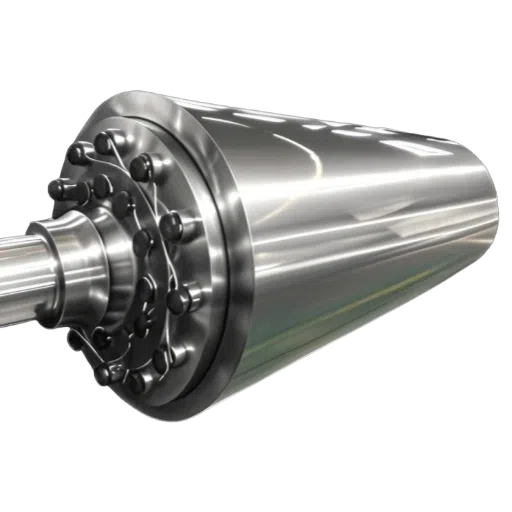
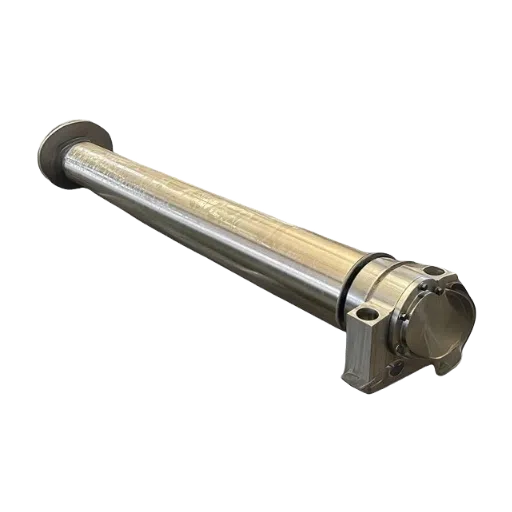
A mill roll is a consumable precision part; it carries thousands of tons of rolling load, wears a little on every pass, and eventually must be reground or replaced. Choose the wrong material family or hardness for the stand, and the roll heat-checks, spalls, or loses profile early.
38%
A common assumption is that a Chinese-made roll must trade quality for price. Buyer data pushes back: in supplier surveys, about 38% of new buyers name product-quality defects as their biggest difficulty with new Chinese suppliers, and that fear is a documentation-and-QC problem rather than an inevitability.
Three failure modes drive most of the pain buyers bring to us:
- Premature roll failure: a grade or hardness mismatched to the roll position, so campaigns run short and roll changes multiply.
- Unpredictable and long delivery times: steel mills can’t operate with an undefined delivery lead time for a rolled part that’s made to a specific print.
- Poor sourcing practices: low roll price, no material certifications, no NDT (ultrasonic inspection) on new rolls and an inability to hold suppliers accountable for roll failures.
How Welong answers each failure mode
- Right-grade selection: the Selection Matrix below matches material and hardness to your stand, so the roll is specified, not guessed.
- Documented quality: chemical composition, dimensional, dynamic-balance, ultrasonic and visual checks, with mill test certificates and agreed order documentation.
- Accountable sourcing: custom-to-drawing manufacture, defined trade terms, and a free re-make if a quality issue traces to us.
So the question this page answers isn’t cast-versus-forged in the abstract. It’s which combination of roll grade, hardness, and position correctly fits your mill, your product, and your operating conditions. Everything below shows you how to specify it.
The Mill Roll Selection Matrix, Material × Roll Position × Hardness × Application
Most roll suppliers scatter grades across separate pages and leave the buyer to reverse-engineer the match. We put the decision on one screen, because roll selection is a two-axis problem: the stand position sets what the roll must survive, and the material family sets what it can survive. Read a row across and you’ve a defensible starting specification for an RFQ, not a guess, and not a blanket claim that forged always beats cast.
| Material family | Usual roll position | Hardness (as sourced) | Strength / limit | Best-fit application |
|---|---|---|---|---|
| Low-alloy cast steel (60CrNiMo) | Early roughing (R1) | HS 40–55 (≈320–420 HB) | Toughness, shock resistance / limited wear | Roughing stands, heavy bite |
| Semi-steel | Late roughing / early finishing | HS 50–65 (≈380–500 HB) | Toughness + wear balance / heat-checks hot | Transition stands |
| High-Cr cast iron / composite | Finishing F1–F5 | HS 60–75 (≈450–580 HB) | Wear + heat-check resistance, economical / lower toughness | Hot strip finishing |
| Infinite chilled cast iron (ICDP) | Late finishing F5–F7 | 75–80 HSD | Very good wear + surface finish / lower fracture toughness | Hot strip late stands |
| High-speed steel (HSS) | High-speed finishing | 60–66 HRC surface | Outstanding wear + thermal fatigue, long campaigns / higher cost | High-throughput finishing |
| Forged alloy steel | Cold strip / temper / reversing | 58–66 HRC (80–95 HSD) | High contact-fatigue resistance, toughness / needs clean steel | Cold rolling work rolls |
Hardness is quoted in the scale each source uses, Shore/HS, HSD, HRC and HB are different scales and aren’t directly interconvertible. Contact stress runs roughly >800–1200 MPa on hot strip and >1500–2500 MPa on cold strip, which is why cold-mill rolls skew to forged steel. Bands cover the range for each grade family, not fixed limits, confirm the exact grade and hardness against your stand schedule.
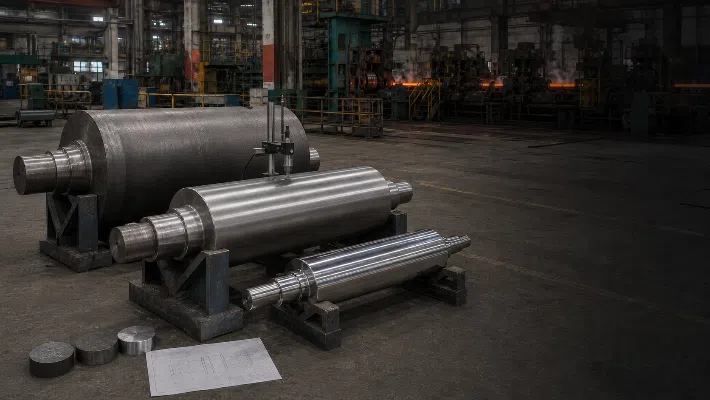
The rule the matrix encodes
Roughing prioritizes toughness first; finishing prioritizes hardness and wear resistance first. A roll that’s perfect at F6 can spall at R1, so roll position, not headline hardness, leads the choice.
Want this matrix applied to your stand schedule?
Ask for a stand-by-stand roll recommendation →China Welong Mill Roll Range, Cast Iron, Cast Steel, Forged & Carbide
Forged work rolls are manufactured in-house. Centrifugal casting is used for sink rolls, stabilizer rolls and radiant tubes; high-Cr, HSS and ICDP rolls are sourced and supervised against the buyer drawing, grade, inspection scope and quoted manufacturer.
| Specification | Range / basis |
|---|---|
| Roll body outer diameter | Φ40 – Φ1600 mm |
| Roll length | ≤ 10,000 mm |
| Roll weight | 100 – 7,000 kg |
| Dimensioning | To customer drawing (custom OEM) |
| Material designation | ASTM / DIN / AISI / ANSI / ASME / GB grades |
| Core components | Roll body + bearing seat + bearing |
| Order evidence | agreed order documentation; mill test certificate per roll |
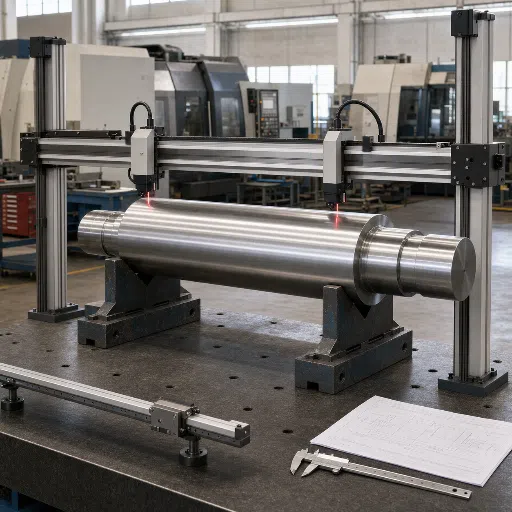
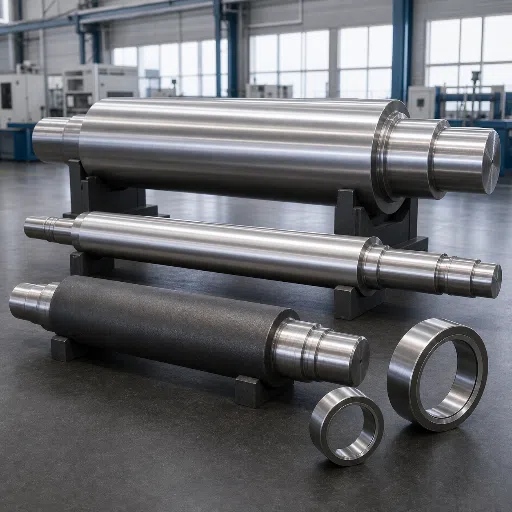
Low-alloy cast steel · semi-steel · high-Cr / ICDP
Cast Iron & Cast Steel Rolls
Toughness-first roughing rolls and wear-resistant finishing rolls for hot strip, section and plate mills, cast to the grade your stand needs.
58–66 HRC surface · ESR/VAR-clean steel
Forged Alloy-Steel Rolls
Cold-rolling work rolls and backup rolls forged, machined and heat-treated for high contact-fatigue resistance and tight surface finish.
By roll position · strip / tandem / temper
Work Rolls & Backup Rolls
Work rolls carry the reduction; backup rolls (3–5% Cr, shell/core design) support them. We supply both, matched as a set.
Welong work rolls for strip & tandem mills →
Supplied to specification
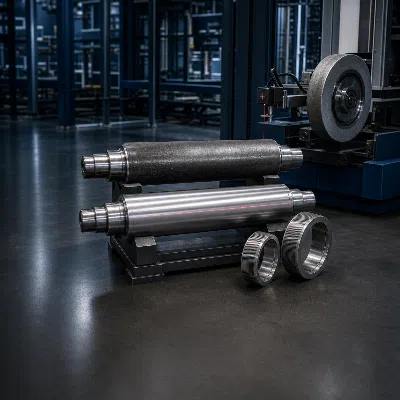
HSS & Carbide Grades
High-speed-steel and tungsten-carbide rolls and rings are sourced and QC-inspected to your drawing where a campaign demands them, supplied, not overclaimed.
Two honest boundaries keep this list defensible. The quotation identifies the machining and inspection route, including dimensional, balancing and ultrasonic checks where agreed, and we frame the widest grades, HSS, high-chrome, carbide, as supply-chain-sourced and QC-controlled with each responsible production route identified in the quotation. For roll-position detail on strip and tandem mills, see the dedicated Welong work-roll page.
Cast vs Forged vs Carbide Rolls, Performance & Total-Cost Comparison
On a purchase order, the cheapest roll is rarely the cheapest roll per ton rolled. Value comes down to total cost of ownership: roll price plus grinding, handling and the residual value of a failed roll, divided by the tons it rolled. Ranges below depend on stand position and operating conditions, so treat them as direction rather than a guarantee for your mill.
| Roll type | Hardness band | Wear / heat-check | Campaign between regrinds (range) | Cost-per-ton driver | Best-fit |
|---|---|---|---|---|---|
| Cast (high-Cr / ICDP) | 450–650 HB / 75–80 HSD | High wear + heat-check resistance | Roughing 20,000–60,000 t | Lower roll price; more changes on high-throughput lines | Hot strip roughing & finishing |
| HSS (high-speed steel) | 60–66 HRC | Outstanding wear + thermal fatigue | Finishing 60,000–120,000 t | Higher roll price; fewest changes, highest availability | High-volume finishing |
| Forged alloy steel | 58–66 HRC (80–95 HSD) | Very high contact-fatigue resistance | Cold-mill regrind cycles (surface-finish driven) | Higher price; long life, tight tolerance | Cold rolling & backup rolls |
| Carbide (WC rings) | Highest (WC-Co) | Extreme wear resistance / brittle | Longest wear life in-groove | Highest price; specialist wire-rod / finishing blocks | Wire-rod finishing blocks |
60k–120k t
Tons rolled between regrinds for high-speed-steel finishing rolls, against roughly 20,000–60,000 t for roughing grades — longer campaigns mean fewer roll changes and lower cost per ton rolled. Wear runs 0.01–0.03 mm per 1,000 t for HSS versus 0.02–0.06 mm for roughing grades.
Source: campaign and wear ranges consistent with published rolling-mill references (Roberts; Schröder) and the AIST total-cost-of-ownership methodology. Figures depend on stand position and operating conditions; the values for your mill are confirmed on the quotation.
One finding cuts against the easy story. Published metallurgy data shows the ratio of roll cost to tons rolled has been decreasing as roll performance improves, so cheap-roll-equals-high-total-cost isn’t automatic. Matching campaign length to your throughput is the real lever, and that’s a selection decision rather than a price decision.
Comparing roll grades on total cost, not unit price?
Request a cost-per-ton sizing discussion →Mill Rolls by Mill Type, Hot Strip, Cold Rolling, Section, Wire Rod & Plate
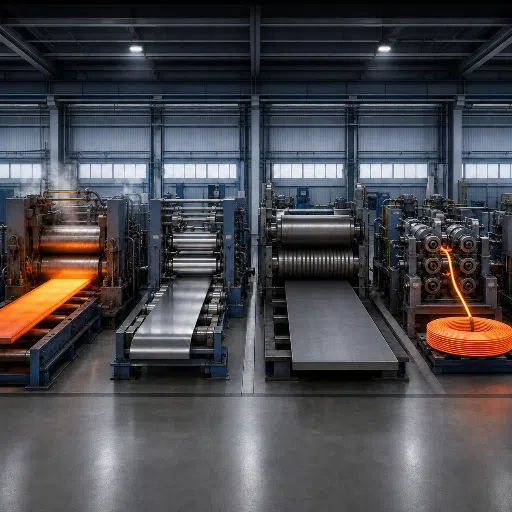
Mill type sets the environment the roll lives in, so the same work roll means a different grade in hot and cold rolling: a hot strip mill versus a cold tandem line. Get that match wrong and the roll heat-checks, cracks or wears out of profile early, and the line loses a stand to an unplanned roll change. Each type of rolling puts its own demand on the roll, because temperature drives the dominant failure mode: hot rolling mills fight heat and thermal fatigue, cold mills fight contact stress.
01 / Hot Strip Mills
Hot strip mills roll above recrystallization (roughly >900 °C), which demands thermal-fatigue and heat-check resistance: ICDP and high-Cr cast iron on finishing stands, HSS where throughput is highest, tough cast steel on roughing.
02 / Cold Rolling Mills
Cold rolling mills work near ambient temperature at far higher contact stress with tight surface-finish targets, so they favor forged alloy-steel work rolls at 58–66 HRC, sometimes textured or plated.
03 / Section & Plate Mills
Section and plate mills use grooved and flat rolls in tough cast steel or high-Cr, chosen for bite and profile retention.
04 / Wire Rod Mills
Wire rod mills run carbide rings in finishing blocks for increased wear life, and cast or forged rolls take billet down into and through the intermediate stands.
Cold rolling has a deep engineering literature of its own: roll-surface texturing, chatter and flatness control; we keep it brief here on purpose, because the full stand-by-stand treatment belongs in a dedicated technical guide rather than a category page. This section stays a selection map for mill operators and routes the depth to that guide. Send us your mill type and pass schedule, and we return the matched grade per stand for your production line.
A costly mill-type mistake buyers make
A common error is ordering one hardness for the whole mill; unlike a single-grade order, a stand-matched set follows the trade-off between toughness and wear down the line. China Welong identifies the responsible manufacturing route and agreed inspection scope for each selected roll, and we will not claim a single grade that is right at every stand. The honest version is that roll position, not a headline number, leads the specification.
Not sure which grade each stand on your mill type needs?
Get a stand-by-stand spec recommendation →How We Control Roll Quality, UT, Spectrometry, Third-Party Inspection & Mill Test Certificates
For the selected roll, the quotation identifies the manufacturing route, responsible manufacturer and agreed inspection documents from chemistry through release.
5-Stage QC Protocol
- Chemical composition, spectrometric verification of the specified grade.
- Dimensional check against your drawing, body diameter, length and neck dimensions.
- Dynamic balance on a balancing machine, so the roll runs true at speed.
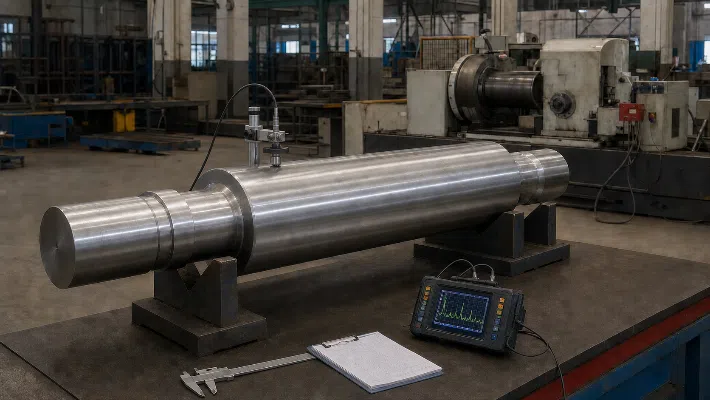
- Ultrasonic testing (UT) for sub-surface soundness of body and necks.
- Visual and surface inspection, finish and roughness against tolerance.
Those checks run on a real, named QC lab: tensile testing machine, metallographic microscope, impact tester, roughness meter and balancing machine, with the dimensional check held against your drawing to against the drawing-defined body-diameter tolerance. For forged rolls and shafts, ultrasonic acceptance references EN 10228-3 for ferritic and martensitic steel forgings, with ASTM A388/A388M as the equivalent current ultrasonic-examination practice in the ASTM system.
On standards, the honest answer
We cite only standards that are current and that we actually work to: agreed order documentation for the selected order, EN 10228-3 (or the equivalent ASTM A388/A388M practice) for forged-roll ultrasonic testing, and the ASTM/DIN/AISI/GB grade you specify on the drawing. We supply material and heat-treatment records, and we can add independent third-party (SGS/DNV) inspection to the order when your specification calls for it.
agreed order documentation
Documentation scope confirmed by quotation
EN 10228-3
Forged-roll UT (current)
Mill test cert
Per roll, on shipment
SGS / DNV
Third-party on request
×
![Enlarged product and inspection image]()
Engineering Calculation & Decision Tools for Mill Roll Specification
Explore our specialized online technical tools designed for roll shop engineers and procurement managers to calculate optimal material grades, evaluate total cost of ownership (TCO) per ton rolled, and compare performance specs across roll families.
TOOL 01 // STAND PARAMETER MATCHING
Grade Selection Calculator
Match material family, hardness, and roll position directly against your stand schedule and operating conditions for a defensible RFQ specification.
Launch Grade Selection Calculator
→
TOOL 02 // TOTAL COST OF OWNERSHIP
Cost-Per-Ton (TCO) Calculator
Calculate true rolling cost per ton considering unit roll price, campaign tonnage between regrinds, grinding cycles, and downtime impact.
Launch Cost-Per-Ton Calculator
→
TOOL 03 // METALLURGICAL BENCHMARKING
Cast vs Forged vs Carbide Roll Comparison
Evaluate metallurgical properties, thermal fatigue resistance, contact stress limits, and wear performance across primary mill roll families.
Explore Metallurgical Comparison
→
Mill Rolls FAQ
Send your roll drawing, body diameter, length, neck and bearing-seat detail, together with the specified material grade and the mill type and stand it runs on. The quoted manufacturer confirms the route against the drawing across Φ40–1600 mm and up to 10,000 mm long, at 100–7,000 kg, then return a written specification and an inspection plan before any metal is cut, so you approve the build rather than discover it on delivery.
Roll position leads the choice: tough cast steel for roughing, high-Cr or ICDP cast iron for hot-strip finishing, forged alloy steel for cold rolling, HSS for high-throughput finishing, and carbide rings for wire-rod finishing blocks. The Selection Matrix above maps material to roll position and application.
Work rolls make the desired reduction at the surface of the strip, while backup rolls (usually larger, often 3 to 5% Cr) serve to support them at the surfaces and prevent their collapse. Backed-up work/backup roll assemblies are normally furnished as matched sets.
Work-roll hardness depends on grade and roll position: hot-strip cast grades run roughly HS 40–80 (about 320–650 HB), while HSS and forged cold-mill work rolls reach 58–66 HRC on the surface. Always specify the exact hardness scale on the drawing.
A roll matched to the stand runs a longer campaign between regrinds, on the order of 60,000–120,000 t for HSS finishing versus 20,000–60,000 t for roughing grades, which means fewer roll changes and higher mill availability. These ranges depend on your operating conditions.
Cold-mill work rolls are forged alloy steel at 58–66 HRC from ESR/VAR-clean steel; backup rolls use 3–5% Cr forged or composite steel. Final selection depends on stand position, strip grade, rolling load and required surface finish, so the drawing should state the hardness scale and depth. For high-finish cold strip, cleanliness, residual stress and case depth can matter as much as surface hardness because subsurface defects or an unstable profile shorten regrind life and may mark the strip.
Lead time is quoted against your grade, size and customization rather than a fixed catalog number, because a forged cold-mill roll and a cast roughing roll don't schedule alike. Shipments go FOB, CIF, DDP or DDU by sea or rail, packed in fumigation-free wooden boxes or on iron stands, with HS classification and importer-of-record documentation so your landed cost stays clean and predictable from quote to delivery.
Working with China Welong
Order Terms, Evidence and Next Steps
The commercial terms below apply to every rolls and forgings order we quote. They are the same terms our quotation repeats back to you, so nothing on this page has to be re-negotiated once a drawing is on the table.
What we make, and from what
We work from 2D drawings and 3D CAD models (AutoCAD, Pro/ENGINEER and SolidWorks; .dwg and .igs).
Founded in 2001. Manufacturing at Xi'an, Shaanxi and at Jiyuan, Henan, with 30+ engineers on staff.
Forgings from 0.2 to 50 tons, finished to 0.01 mm machining precision. Centrifugal castings to 3,000 kg, 4,000 mm long, 2,000 mm outside diameter, 8 mm minimum wall. Material standards to ISO, BS, ASTM, ASME, DIN, JIS and GB.
How the price is set
Send a drawing and we reply within 24 hours; a drawing-based quotation follows in 1–3 working days.
Payment is T/T or L/C. We ship EXW, FOB, CFR or CIF; other Incoterms on request.
Orders ship in standard export wooden cases, or the packing you specify.
When it ships
Production lead times are confirmed with your quotation, based on quantity, process route and finishing scope.
We hold agreed items in stock and ship against your release to shorten delivery.
Who makes it, and who answers for it
Every quotation states whether the item is made in our own works or by an approved supplier we developed and supervise.
Material mills are re-audited every two years and approved by Welong before they run your order.
Forged work rolls are made in our own works; centrifugal casting is used for sink rolls, stabilizer rolls and radiant tubes; high-chrome, HSS and ICDP rolls are sourced from approved mills under our supervision.
The evidence that travels with the order
An EN 10204-3.1B material certificate with chemical composition and mechanical properties, a dimensional measurement report, and UT and MT reports ship with your order.
Inspection is by coordinate measuring machine, ultrasonic, magnetic particle and X-ray.
Each piece carries a stamped serial number and stays traceable for five years to its chemical composition, mechanical properties and measurement report.
What to send to start
Send the drawing or a photograph of the part, the dimensions, the material requirement and the quantity to oiltools@welongpost.com, call +86 029 88331331 or message WhatsApp +86 135 7217 2362, or use the enquiry form on our contact page.
An engineer reviews it and comes back within 24 hours.
| Term | What we commit to |
|---|---|
| Quotation turnaround | Reply within 24 hours; drawing-based quotation in 1–3 working days |
| Production schedule | Confirmed with your quotation, by quantity, process route and finishing scope |
| Drawing formats | 2D drawings and 3D CAD models (.dwg, .igs) |
| Machining precision | 0.01 mm |
| Forging envelope | 0.2 to 50 tons |
| Centrifugal casting envelope | 3,000 kg, 4,000 mm long, 2,000 mm outside diameter, 8 mm wall |
| Serial traceability | 5 years, with the test coupon retained |
| Documents with shipment | EN 10204-3.1B certificate, measurement report, UT and MT reports |