Get in touch with Welong Company


API 16A Scope · Founded in 2001
Blowout Preventer (BOP)
API 16A Ram & Annular BOP Supply Review
Blowout preventer failures don’t stay at the wellhead — they halt the rig, trigger regulatory review, and put the crew at risk. The quotation identifies the responsible manufacturer, applicable API 16A requirements, pressure and bore scope, order tests, and the records supplied with the selected ram or annular BOP.
Technical Specifications
2,000–15,000 psi
Working Pressure9″–21-1/4″
Annular Bore7-1/16″–21-1/4″
Ram BoreNACE MR0175
Sour ServiceCast / Forged
Body ConstructionOn request
Third-Party Inspection
Well Control Risk and How Welong's BOP Systems Solve It
A well control doesn’t pick the most convenient time. uncontrolled reservoir pressure in the wellhead can go from a mild kick to a full blowout-and an oil spill-in minutes, and the bop stack between your drill string and that outcome is, at its core, a large valve, effective only if each component work exactly as intended on demand during live drilling operations.
Field reports indicate two consistent culprits: A BOP pressure-rated at a lower pressure class than required by the well program, and a sealing element that was never tested against sour service conditions at the factory. Both are often traceable back to an over-compressed specification stage in response to a delivery deadline.
API Spec 16A details drill-through equipment design, fabrication, and testing (BOP body, rams, bonnets, elastomer seals); API Standard 53 separately outlines operation, including field tests, frequency of testing, accumulator performance, controls and training. Owning a compliant BOP addresses the former; keeping one operating compliantly on the rig addresses the latter.
Welong supplies both ends of that stack: the annular bop uses a single elastomeric packing element to close over nearly any pipe or open hole shape, and the ram BOP uses opposite steel rams to seal a specific size of pipe or completely shut in a well with a shear ram.
- annular bop - a single-element elastomeric packing element closes on pipe sizes and open hole shapes of various diameters; usually located on top of the BOP stack
- Ram BOP - pairs of interchangeable steel ram blocks-pipe, blind, shear, and variable rams-usually below the annular; designed to shut in specific sizes of pipe or completely shut in a well with a shear ram
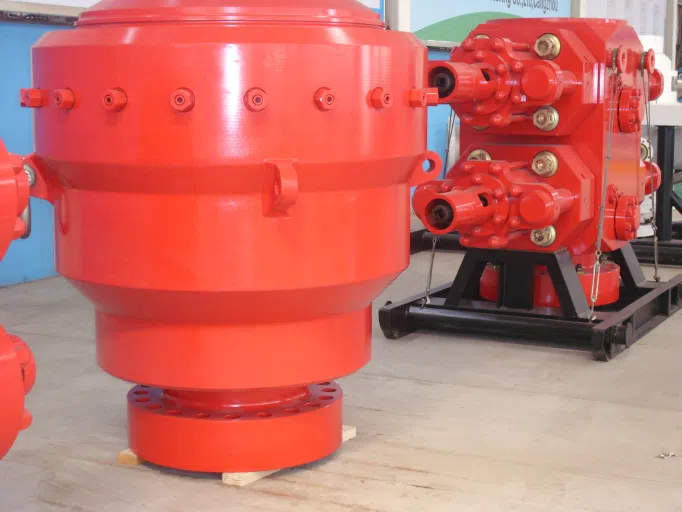
Engineering Note
For each quoted annular unit, confirm the closing-time requirement, bore, pressure class and hydraulic actuation basis against the responsible manufacturer's documents. If sour service is required, the quotation should identify the applicable NACE MR0175 (ISO 15156) material requirements and the supporting material records.
Generally, a stack include an annular preventer at the top and one or more ram preventers beneath it; size, pressure class and ram combination depends on the well program you're drilling.
Why Pressure Class Selection Is Not Optional
API Spec 16A has you covered from working pressures as low as 2,000 psi up to as high as 20,000 psi, and with material yield-strength classes from 36K to 75K. "API 16A certified," by itself, doesn't tell you whether a given unit is a fit for your well. matching the pressure class to your well program is the first line item on any legitimate RFQ, before connection type or ram configuration even enters the conversation.
- Under-specifying the pressure class is by far the single most common sizing mistake we see on incoming RFQs
- Over-specifying adds cost and lead-time without a corresponding safety benefit — it is a real trade-off, not free insurance, for a well program that will never see that pressure
- Temperature rating (ambient, and down to -75F for certain material classes) is as important as pressure class for cold climate or high-altitude applications
- this is exactly what the product line below matches to your well program - Welong specifies bore size, pressure class, and connection type at the RFQ stage rather than shipping out the default one-size-fits-all.
Welong BOP Product Line, Annular & Ram Models and Specifications
Welong supplies both BOP product families to API Spec 16A, available in cast or forged bodies, with the connection type and pressure class specified at the RFQ to match your wellhead bore size and well program pressure class. A complete stack will also require kill line and choke line outlets to circulate out an influx once the well is shut in - the two specification tables below address the preventer bodies themselves; any request for sour service material or custom connections will be confirmed upon request.
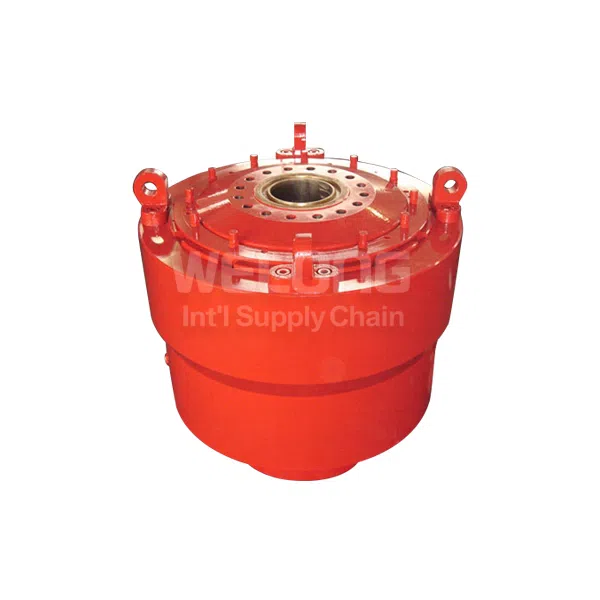
Annular Blowout Preventer
| Body | Cast, Forged |
| Bore Size | 9", 11", 13-5/8", 20-3/4", 21-1/4" |
| Working Pressure | 2,000 / 3,000 / 5,000 / 10,000 / 15,000 psi |
| Connection Type | Bolted or Flanged |
| Sealing Element Family | Hydril GK-type, Hydril GL-type, Shaffer Spherical-type |
| Anti-H2S Option | NACE MR0175 |
Names for sealing element families correlate to industry-standard type designations, cross-referenced to documented drilling manual references and published sealing-assembly engineering rather than the product list of any specific competitor.
Stripping Operations
The packing element closes inward to seal around the drill pipe against tool joint sizes from smallest to largest (as listed above), allowing an annular to be used to strip pipe (pull pipe through a closed BOP under pressure).
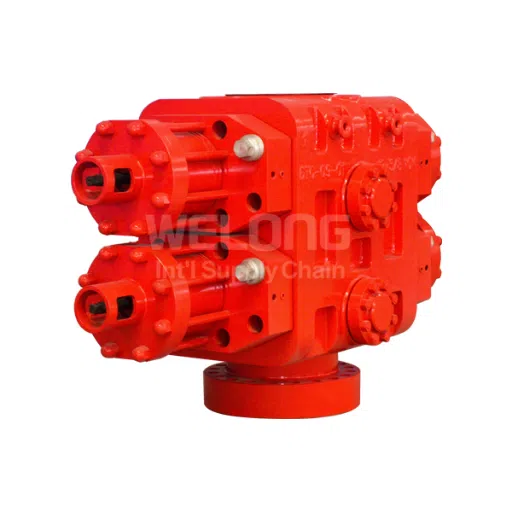
Ram Blowout Preventer
| Body | Cast, Forged |
| Bore Size | 7-1/16", 13-5/8", 20-3/4", 21-1/4" |
| Working Pressure | 2,000 / 5,000 / 10,000 / 15,000 psi |
| Connection Type | Studded or Flanged |
| Ram Types | Pipe ram, blind ram, shear ram, variable ram (double-faced interchangeable configurations available) |
| Pressure Ratings | Matched to well program at RFQ stage — see working pressure row above |
The ram type you select actually changes the function of the BOP under pressure. A pipe ram seals around a specific drill-pipe outside diameter (OD); double-faced pipe ram configurations handle most routine pipe sizes with only minor adjustment of the semi-ring seal element and ram briquetting to suit the drill string size, and single-faced ram configurations can't be reversed and must be oriented for pressure from a specific direction — closing the wrong-facing single ram will not regain pressure control on that pipe size.
- blind ram - seals the wellbore entirely with no pipe in the well
- shear ram - the emergency last-resort option that cuts the drill pipe to seal the well
- variable ram - seals a range of drill pipe and tubing sizes without a ram change
Before You Send an RFQ
Before you contact any supplier, have ready: your wellhead bore size, the expected working pressure of the well, and the desired connection type. Welong can quote both bolted/flanged annular units and studded/flanged ram units within the above ranges. (Specifying the wrong connection type is the single most common reason for a second round of RFQ discussion).
Annular vs Ram BOP, Decision Matrix
| Factor | Annular BOP | Ram BOP |
|---|---|---|
| Sealing Method | Single elastomer packing element, closes around variable OD | Opposing steel ram blocks, seals a specific OD or shears pipe |
| Welong Bore Range | 9"–21-1/4" | 7-1/16"–21-1/4" |
| Reference Stack Position | Top of stack | Below the annular, often 2+ units |
| Best-Fit Scenario | Stripping operations, variable tool-joint sizes, open hole | Full shut-in on a known pipe size, emergency shear |
| Welong Working Pressure | 2,000–15,000 psi | 2,000–15,000 psi |
Not sure which bore and pressure combination fits your well program?
BOP technical documents →
Cameron-Type, Hydril-Type & Shaffer-Type, Compatibility & Selection Guide
Most of rig crews don’t start at square zero; the choice of whether to get or lease what has to accommodate whichever BOP family the rig has, and the names which were adhered to by the rig sector; Cameron BOP, Hydril BOP, Shaffer BOP - were functional design families now not only the history of brands.
A Short History Behind the Type Names
Cameron introduced the first commercially viable ram-type BOP for offshore oil and gas drilling in the 1920s, then both Hydril and Shaffer each developed a unique geometry of the annular sealing element. These three names became the shorthand in the industry for what's happening in the sealing mechanism, over decades of experience in the field - and then deepwater remote control pods were placed on top of this core principle in subsea stacks - hence you still find RFQs for "Hydril-type" or "Shaffer-type" devices, from operators who never have owned equipment made by those specific, early manufacturers.
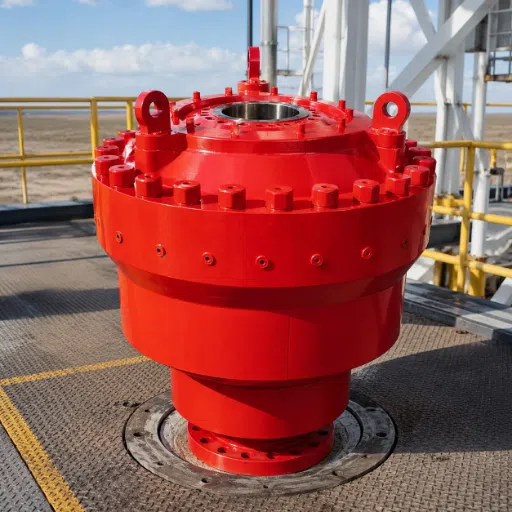
Sealing Principle
Conical rubber packing element compressed by a piston
Field NoteMost common surface annular configuration on land rigs
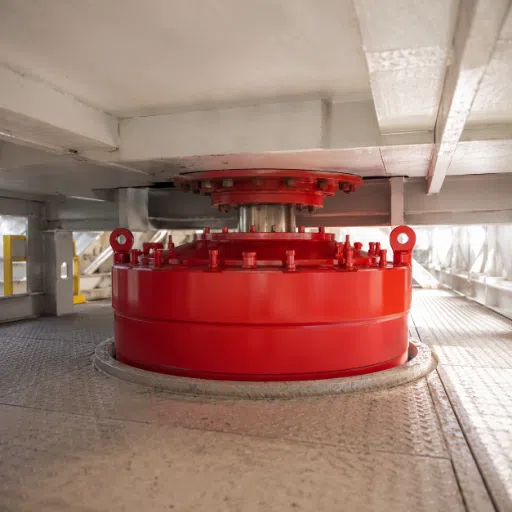
Sealing Principle
Low-profile variant of the GK sealing geometry
Field NoteSelected where vertical clearance under the rig floor is limited
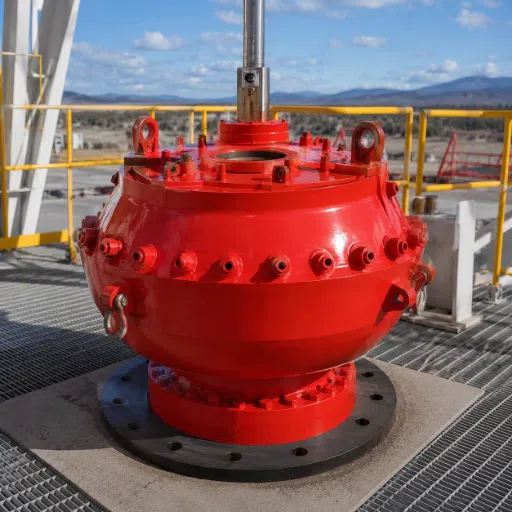
Sealing Principle
Spherical rubber element, quick-release top cover
Field NoteFaster packing-element changeout than a conventional bonnet design
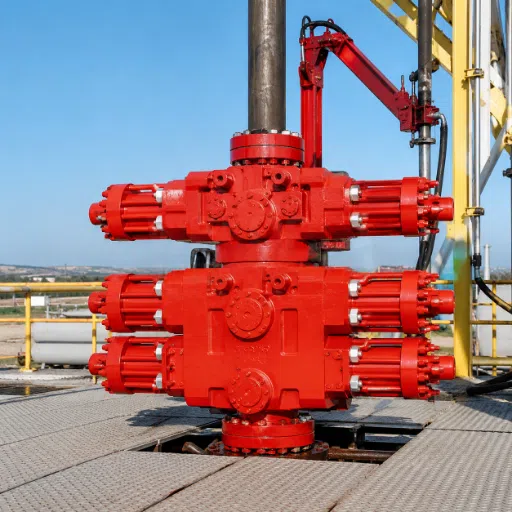
Sealing Principle
Opposing steel ram blocks, bolted bonnet doors
Field NoteWidest installed base globally — crews already trained on this family adapt fastest
Design Enhancements
Design is so much more than just one ring of rubber these days; the U.S. Patent No. 7,409,988 B2 outlines non-metal composite insert material for the sealing elements and U.S. Patent No. 5,064,164 A a metal-insert sealing assembly resistant to extrusion in high-fluid pressures-both are enhancements beyond current-style Hydril-and Shaffer-elements.
Boltless Bonnet Trend
They're also increasingly going toward boltless bonnet design. The boltless bonnet is capable of reducing ram changeover time from up to about 4 hours to under 40 minutes on new product lines, a trend Welong's engineers stay abreast of when consulting on the timing for a customer to upgrade rather than a complete system change.
Ready to match a replacement unit to your existing stack?
Request a Custom Comparison →BOP System Selection
Established in 2001, China Welong is a leading professional international integrated supply-chain service provider, BOP supply and production management sits within an oilfield tooling business that provides Supplier Development & Management, Purchasing Supervising and Quality Control service to international operators for more than twenty years, in a sector where OSHA-documented well-control equipment requirements leave little room for error.
What Happens Before Your BOP Ships
- Final machined to drawing dimensions In-process examination at casting or forging through final machining
- Final inspection against the order's certified drawing before shipment
- optional third party inspection, in coordination with SGS or DNV upon request
We ship to Europe, US, the Middle East, Russia and South America and can facilitate shipment by sea, air or train depending on the length of your order timeline. All trade terms are customized for each order (FOB, CIF, DDP or DDU) - this puts logistics risk squarely in your team's court, not some default contract.
From Specification to Delivery
- RFQ & Specification Check - Bore Size, Pressure Class, Connection Type & Sour service condition all confirmed prior to quote submission
- In-process inspection - casting, forging, machining, assembly
- Final inspection against your approved drawing - can include optional third-party SGS or DNV sign-off on request
- Full documentation package supplied with your shipment for import and customs clearance - including material test reports, inspection records and certification
- Shipping of goods to your location via sea, air or rail under your nominated Incoterm
Why This Matters for Your RFQ
A supplier that also keeps in-process inspection records, not just a final certificate provide something for your quality personnel to audit on your part prior to it ever shipping. For that matter, any BOP supplier should be providing you with a records of their inspection points as part of the bid proposal, not only the final test certificate.
Certifications & Standards Compliance, API 16A / NACE MR0175
A 16A licensing record on a data sheet is the entry requirement, not the finish line. Purchasers that accept a certificate number alone, and fail to review the actual test records, can be seriously burnt - in even relatively straightforward tender evaluations, partially completed or expired API Composite List entries are frequent enough to trigger disqualification, even when the underlying sealing-element engineering is sound.
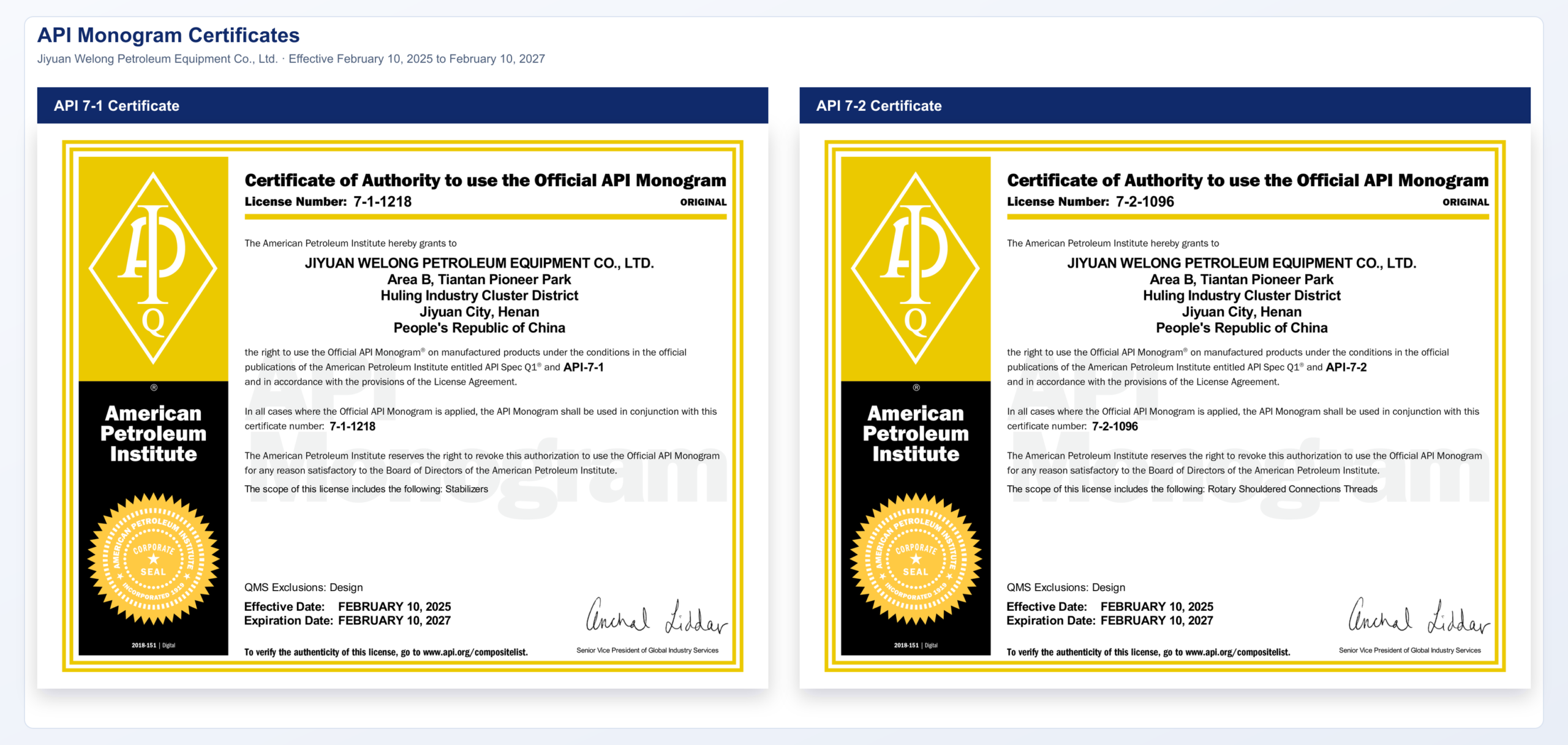
API 16A
Drill-through equipment design & manufacturing
NACE MR0175
ISO 15156 sour-service materials
SGS
Quotation-confirmed third-party inspection scope
DNV
Quotation-confirmed third-party inspection scope
Documents to Confirm for the Quoted Order
- The responsible manufacturer, applicable API 16A requirements, and the BOP body, bonnet and elastomer scope identified in the quotation
- NACE MR0175 / ISO 15156 material option, maintained at a maximum 22 HRC (250 HV10) hardness for base material, weld metal and heat-affected zones
- Material test reports and hardness inspection records identified for the quoted sour-service scope
Verifying a Supplier's Certification Before You Order
- Directly check the API Composite List for an active 16A licensing record license under the supplier’s legal entity - not an image scan of a certificate.
- Request specific material test and hardness inspection records for your sour-service order, rather than a generic compliance statement.
- Inquire if third-party inspection services (e.g., SGS, DNV) are offered as an optional add-on and their associated cost over the standard inspection package.
- Confirm that the certificate provided specifically applies to your requested pressure class and bore size, not just the product family in general.
A Certificate Is a Starting Point, Not a Safety Guarantee
A certification record does not replace order-specific review of testing, accumulator readiness and operating procedures. Confirm the responsible legal entity, licensing scope, order test records and delivered documents rather than relying on a certificate image alone.
Need the full documentation package for your tender?
Full supporting documentation →
Frequently Asked Questions
What does a blowout preventer do?
A blowout preventer can seal a wellbore upon demand, closing on the drill pipe, casing, or open hole and prevent formation fluids from entering the wellbore and reaching the surface uncontrolled.
What is the difference between annular and ram BOP?
An annular bop can use a single elastomer packing element to seal around almost any size pipe or open hole, providing a more flexible top-of-stack option. A ram BOP uses either paired steel blocks specific to the size of the pipe in the wellbore, or a shear ram capable of cutting the pipe entirely - our Decision Matrix (above) provides an honest, comparative overview of sealing types, bore ranges and application best fits, rather than a purely marketing overview.
How many types of BOP are there?
There are two basic families of BOP - annular and ram - with the ram family sub-dividing further into pipe, blind, shear and variable rams for various sealing applications. Most stacks combine an annular preventer with at least two ram preventers.
How much does a blowout preventer cost?
BOP price varies based on bore size, pressure rating, connection configuration, sour-service requirements, inspection level and any associated spare-parts packages - you can review our Procurement Guide (above) for a complete breakdown of pricing factors instead of a single number. Submit your specification to Welong for an immediate, personalized quote.
Which certifications should a BOP manufacturer have?
Valid API 16A licensing record license verified through the API Composite List (a certificate image itself is insufficient) For sour service BOPs, also require NACE MR0175 material test reports.
Can Welong be a single-source supplier for BOP and wellhead equipment?
Yes - Welong's range of wellhead and well-control products includes casing heads, blowout preventers, wellhead christmas trees and choke manifolds to API 6A/16A, so your RFQ for a BOP can extend to all equipment on either side. Refer to the Wellhead & well control product page for a full listing.
Why does testing cadence matter as much as certification?
If a BOP can't close on demand it can't perform its duty as a failsafe, which is the primary reason why maintenance testing intervals and the state of accumulator fluid readiness are more important than a shipping certificate - there's no paperwork that can compensate for a functional failure on the critical part of the chain. This is why Welong records its in-process inspection milestones in addition to final testing certifications (see Certifications & Standards Compliance, above).
Which ram types does Welong offer?
Pipe rams, blind rams, shear rams, and variable rams, both in single-faced or double-faced versions. Detailed information is included in the Ram blowout preventer Table above.
What are blind rams in a BOP?
A blind ram is a ram which completely closes the wellbore when there's no pipe in the hole (in contrast to a pipe ram which closes about a given size of drill-pipe, and a shear ram which closes on the pipe in extremis). All four types of rams are part of the Welong range of standard ram-type BOPs, see how they're incorporated into the same BOP above.
![Choke & Kill Hose: [Field Guide]](https://welongoiltools.com/wp-content/uploads/2026/07/choke-kill-hose-guide-featured-1-150x150.png)