Get in touch with Welong Company
How Should a Lifting Bail Be Managed Across Its Service Life?

Oilfield hoisting equipment guide · Updated October 2026
A lifting bail refers to the load-path link between the elevator and hoisting assembly; this guide follows its evidence and service decisions from receiving to retirement.
The short answerA lifting bail is an identified component in a larger hoisting system, not a loose piece of steel with a rating. Manage it by connecting the exact item to its approved application, current evidence and latest disposition before use. If any of those links is missing or a condition is uncertain, stop the task, tag the item and trace the governing decision.
In oilfield language, a lifting bail is commonly an elevator link or bail that connects the elevator to the hoisting arrangement. It carries load as part of a system to handle drill pipe, casing, and other tubulars. That simple description may be misleading, because the component can’t be managed safely by appearance, a certificate or a load marking alone.
This guide uses a lifecycle approach to explain what follows the bail after receiving, why a pre-use observation differs from a formal examination, when repair, requalification and retirement decisions arise, and how to document them. It doesn’t repeat product models, ratings, dimensions, prices or lead times because those commercial details belong in the separate solution-page context where buyers can evaluate the relevant configuration. Welong covers those selection and procurement details on its lifting bail solution page.
Safety boundary: this is an informational governance guide, not a rigging procedure, inspection instruction or pass/fail standard. The manufacturer, applicable current standards, competent or qualified personnel, site procedures and local law remain controlling. Suspended-load control, pinch points, hand placement, rig movement and stop-work rules must stay inside the site safe-work system.
If identity, evidence or disposition cannot be matched to the item, stop the handoff and restore the chain.
What Is a Lifting Bail, and What Is It Not?
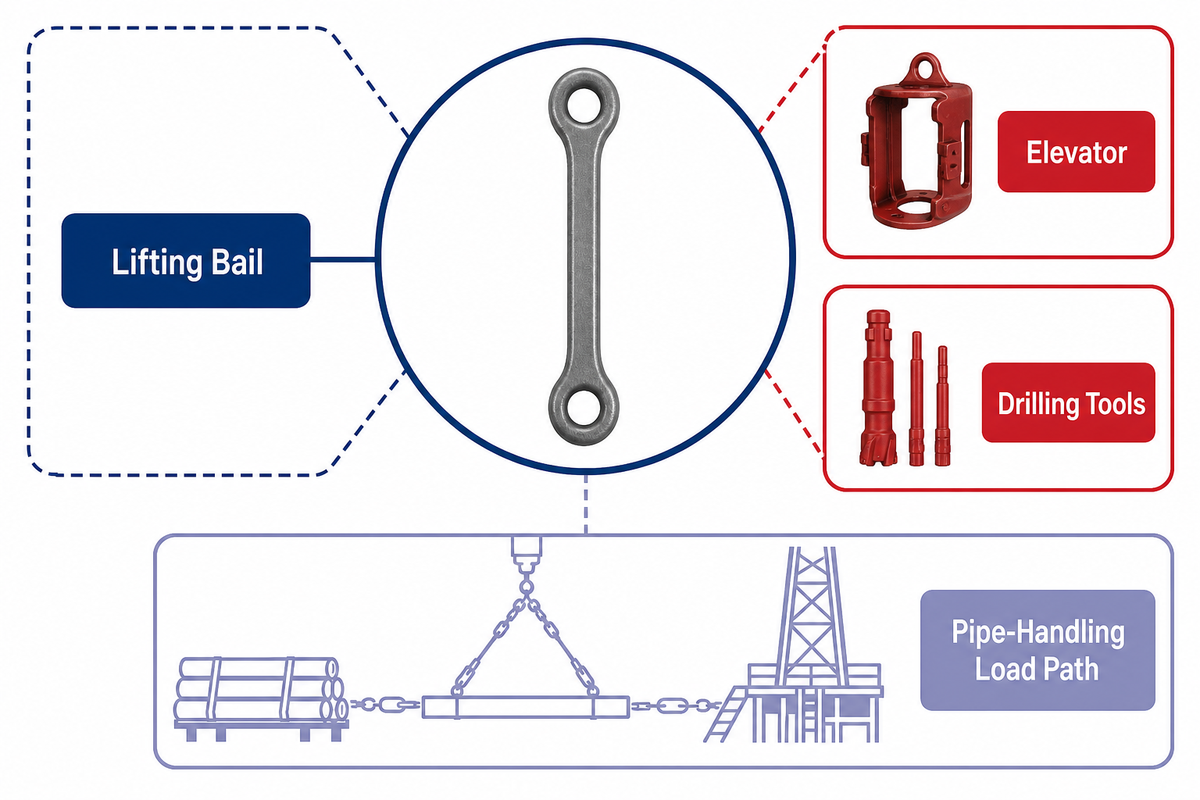
Direct answer: in the drilling context covered here, a lifting bail is a structural link between the elevator and the hoisting system. It is not the elevator itself, not a generic below-the-hook attachment, and not proof that a complete handling arrangement is suitable for a particular job.
In oil and gas drilling operations, “oil tools” covers many distinct products. Within that scope, a lifting bail is not a rotary sub, tool joint, one of the drill collars, one of the drill bits or another class of drilling tools. Those products have different functions, interfaces and controls. The bail instead belongs in the pipe-handling equipment load path.
For lifting operations, a general “standard lifting” label is not an acceptance basis. Descriptions such as durable, heavy-duty, high-strength or load-bearing, the choice of steel alloys, and broad claims of durability and reliability do not establish suitability for specific lifting tasks or lifting applications. Environmental conditions, including offshore drilling exposure, must be evaluated against the controlling design and evidence.
Safe and efficient lifting depends on a safe and controlled protocol, not a marketing adjective; precision in identity, approved interfaces, current industry standards and a documented decision path supports safe operation while reducing the risk of an incorrect handoff. The platform owner still defines the applicable controls. For broader system context, see Welong’s pipe-handling tools guide and its separate elevator selection page.
The official scope of ISO 13535 covers design, manufacture and testing of drilling and production hoisting equipment, including elevator links. The ISO catalogue identifies the 2000 first edition as current after confirmation in 2022. That tells us where this equipment family sits in the product-standard landscape. It does not turn the catalogue abstract into an in-service inspection schedule or a discard chart.
Terms can overlap. “Bail” is also found in concrete buckets, containers, jewelry and threaded handling accessories. Even in oilfield work, crews may say elevator bails, elevator links or links. Thus, identification requires more than a familiar name. The component type, the manufacturer or supplier, a unique identifier, applicable drawings or designations must also be recorded. The intended interface with the equipment must also be reported. An unmarked item can’t be relied upon. This also applies to bails of different geometry or duty.
Material descriptions such as alloy steel, forged construction or heat treatment are manufacturing attributes, not independent release decisions. Generic references to a thread, joint or connection are equally incomplete. The governing evidence must match the physical item and the configured elevator, hook or link adapter in which it will operate.
Key takeaway: look past the name to identify the exact object. Define it by unique identity, properties and interfaces rather than by its name, color or apparent size.
Where the Lifting Bail Sits in the Load Path
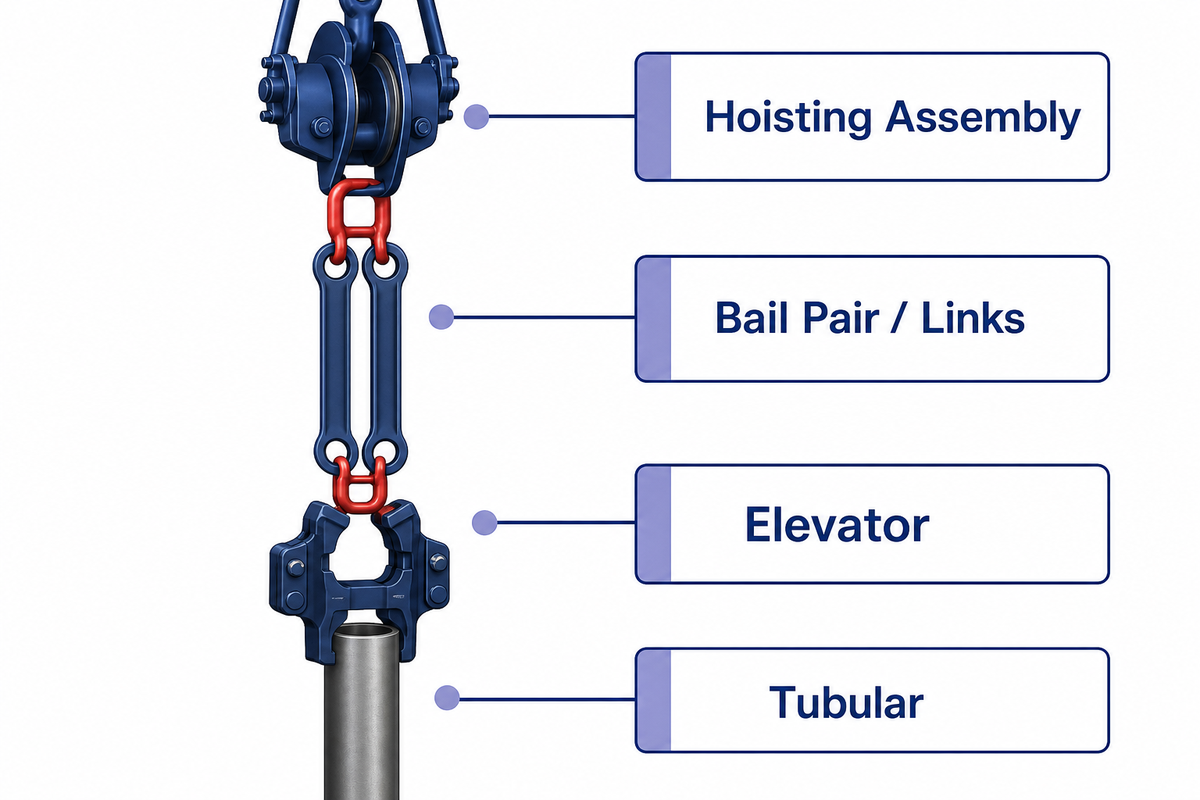
Direct answer: the bail transfers load between the elevator and the hoisting assembly. Its condition matters, but so do the interfaces above and below it, the paired link, the elevator, the tubular and the way the complete system is handled.
OSHA’s tripping eTool describes elevators gripping the pipe and being attached to elevator links during tripping operations. It also shows why the component shouldn’t be isolated from the task: workers face suspended equipment, caught-between hazards and moving tubulars while the hoisting and pipe-handling sequence changes around them. The eTool supplies process and hazard context; it doesn’t publish a bail-specific acceptance rule.
A useful load-path sketch
Hoisting assembly → bail pair or links → elevator → tubular. Add the actual pins, ears, eyes, adapters and restraints used at each interface. Then name which drawing, instruction or acceptance record controls each connection.
Named trade reporting from Drilling Contractor likewise treats the elevator as one component among pipe handlers, roughnecks and other drill-floor equipment. The relevance is not that automation changes a bail’s acceptance criteria. It is that modifying an interface, mode of operation or working sequence can change what needs to be validated by an operator prior to the next lift.
A load-path review should therefore ask four questions. Is the exact bail approved for the intended elevator and hoisting interface? Are mating surfaces, pins and retainers in the required configuration? Does the handling sequence introduce contact, side loading, binding or uncontrolled movement outside the approved arrangement? Can the item and its latest status still be identified after the shift or location changes?
Key takeaway: inspect the component, but decide within the configured system. A good-looking bail cannot verify a mismatched elevator, damaged interface or uncontrolled task.
The 3-Path Bail Assurance Model: Load, Proof and Record
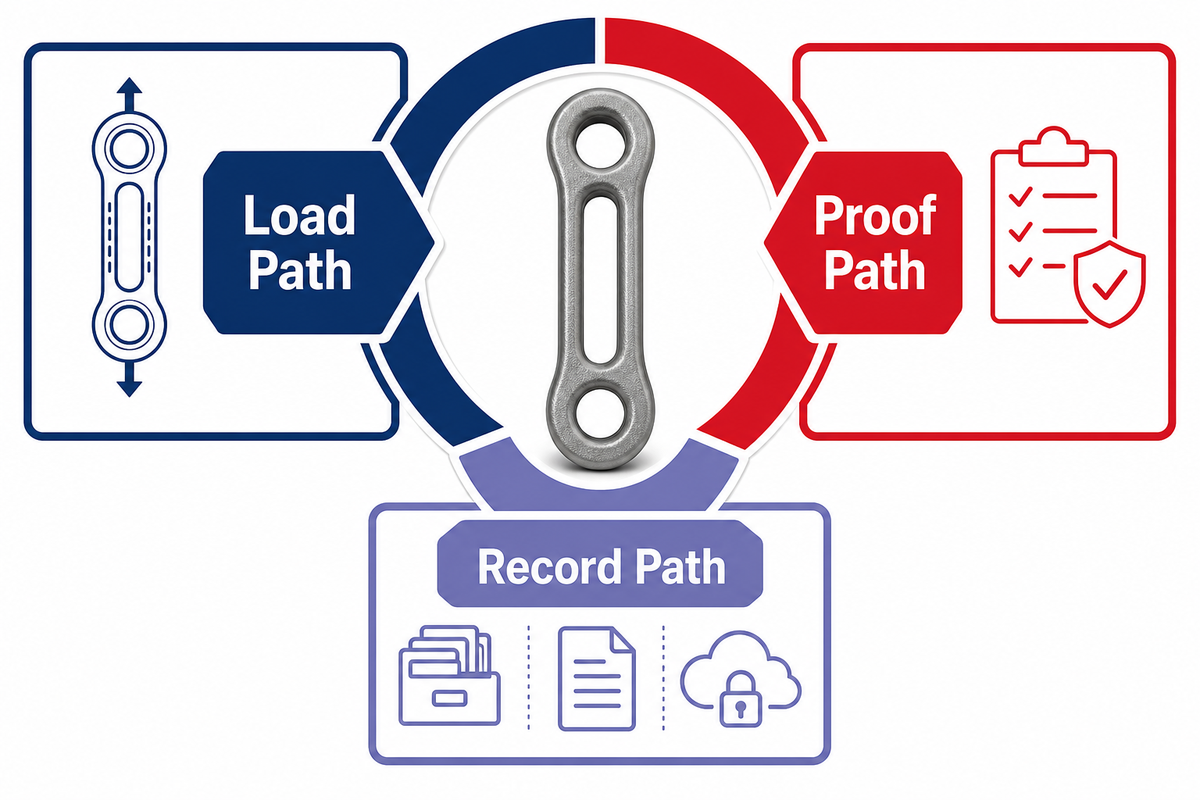
Direct answer: a defensible lifecycle decision requires three paths to agree. The load path describes how force moves through the hardware. The proof path identifies the standard and evidence that is used to arrive at a judgment on the item. The record path connects that evidence and disposition to the unique bail.
| Path | Question it answers | Common break |
|---|---|---|
| Load | How does force pass through the configured hoisting and pipe-handling system? | An approved item is placed in an unverified interface or altered operating sequence. |
| Proof | Which current requirement, method, result and authority support the decision? | A test name or certificate is present, but scope and acceptance basis are unclear. |
| Record | Can the evidence and latest disposition be tied to this physical item? | A document exists, but the identifier is missing, duplicated or unreadable. |
The record path is easy to undervalue. The Lifting Equipment Engineers Association explains that unique identification connects equipment with its usage, inspection and certification history. Its product-knowledge guidance also emphasizes unambiguous intended-use and performance documentation. Applied to a lifting bail, the practical point is simple: a certificate that cannot be matched to the component does not close the evidence loop.
The proof path also requires scope discipline. A manufacturing test, a pre-use check, an NDT examination and a return-to-service decision answer different questions. One may support another, but they aren’t interchangeable. The method offers evidence of a condition under a stated circumstance; acceptance is made by an authorized decision and the controlling criteria.
Key takeaway: an “OK” mark is weak evidence unless the load arrangement, decision basis and exact item can be reconstructed together.
Receiving and Identity Checks Before the Bail Enters Service
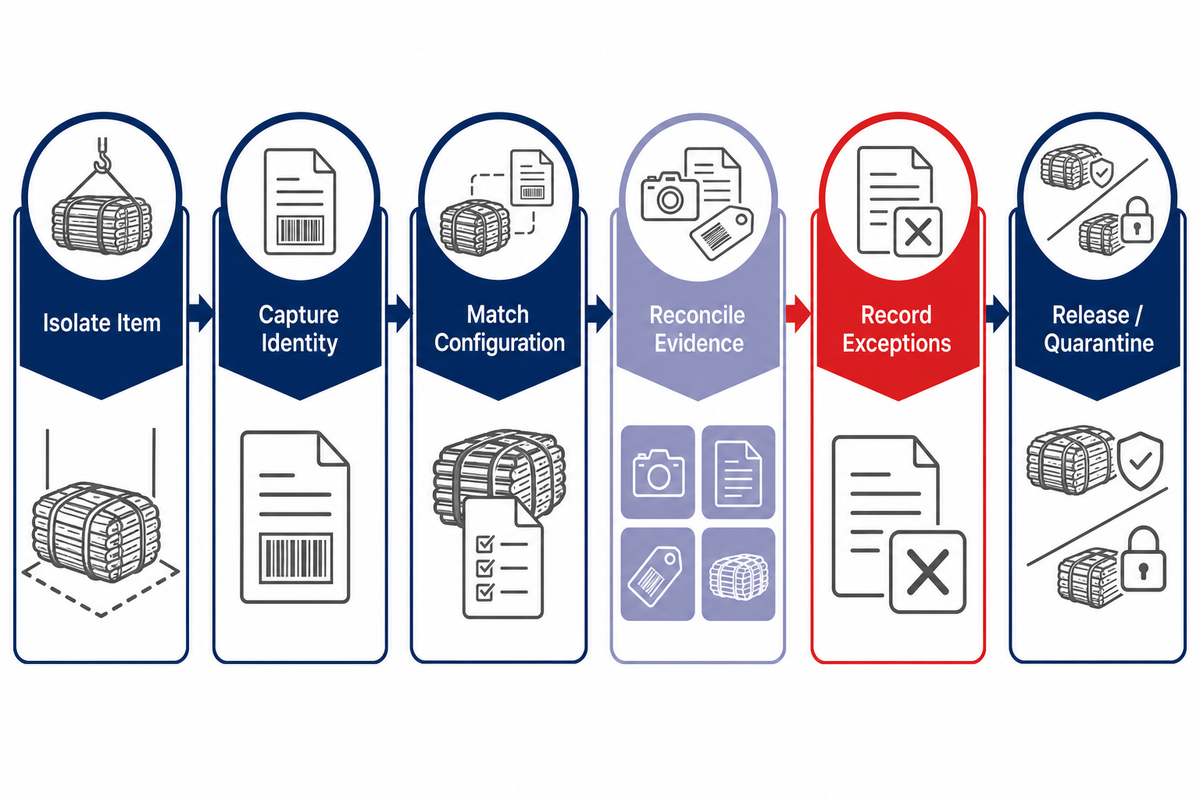
Direct answer: receiving should establish that the delivered item, ordered configuration and document set describe the same lifting bail before the equipment is released to operations.
- Isolate the delivered item — prevent an unverified bail from blending into serviceable stock.
- Capture physical identity — record the readable unique identifier, designation and relevant markings without guessing missing characters.
- Match the ordered configuration — compare the item with the approved purchase data, drawing and intended elevator or hoisting interface.
- Reconcile the evidence — connect certificates, inspection or test records and approved deviations to the same item identity.
- Record condition and exceptions — document transport damage, corrosion, thread damage where applicable, altered surfaces or missing evidence for disposition.
- Authorize release or quarantine — name the person or function permitted to accept the package for service.
Receiving shouldn’t be used as a substitute for engineering selection. If a component bears an “OK” mark but there is doubt about the decision basis, the mark should not be “fixed” or interpreted. If two links form a controlled pair, the identity and evidence should be preserved as required by the owner or manufacturer. If a certificate describes a family or batch rather than the individual component, the evidence should be recorded.
The receiving file should also note the revision or edition of the governing document used at that time. Standards and manufacturer instructions change. Keeping only the standard name makes reviewing the files difficult since the team cannot identify which criteria were applied. The same is true of an API, ISO, or site procedure reference without the applicable scope.
Welong describes supplier development, purchasing supervision and quality-control support on its About Us page. This first-party source information clarifies the company’s activities. It doesn’t mean the buyer has approved the service or released it.
Key takeaway: the fastest useful receiving question is not “does the certificate look complete?” It is “can the physical identifier and the controlled documents identify the same item and configuration?”
Pre-Use Decisions: Stop, Tag or Continue?
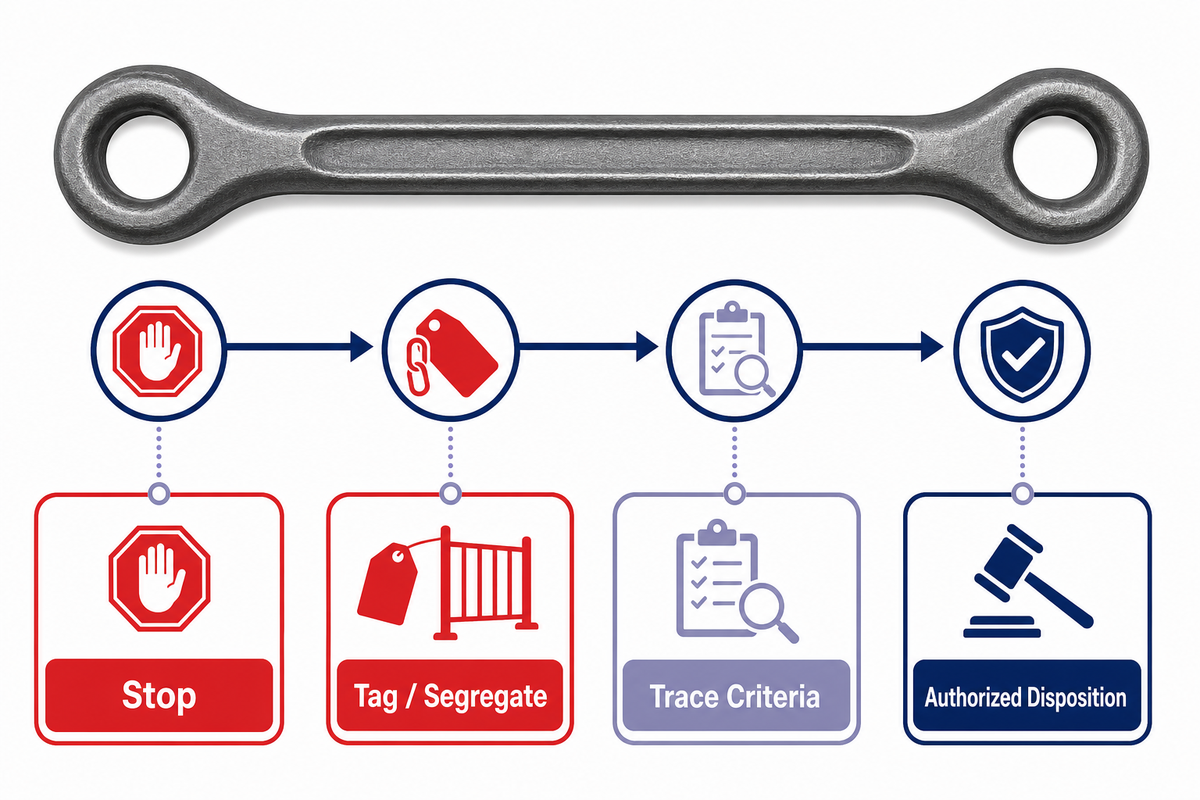
Direct answer: a pre-use check should confirm readiness for the next task. When a relevant condition, identity or evidence is uncertain, the safe administrative response is to stop the task, tag or segregate the item and trace the decision to the authorized criteria.
A visible anomaly raises “should work pause?” before it answers “is this item permanently rejectable?” The first error is to continue work because no discard dimension is printed nearby. The second error is to scrap a component because of a generalized symptom. Cracks, deformation, wear, corrosion, altered markings, heat evidence, missing retainers or an undocumented repair can all justify work interruption. Final disposition remains the responsibility of authorized personnel applying the governing procedure.
| Observed state | Immediate administrative response | What must be traced |
|---|---|---|
| Identity, status and configured use are clear; no reportable concern is found. | Continue only within the approved task and site controls. | Current record, next due event and responsible user. |
| Condition is questionable, evidence conflicts, or identity is incomplete. | Stop and tag or segregate the item. | Controlling criteria, competent review and disposition authority. |
| Damage, unauthorized alteration, expired status or rejection is confirmed. | Remove from service under the site process. | Quarantine, notification, repair or retirement route and final record. |
Do
- Pause on uncertain identity or disposition.
- Protect the tag from loss during segregation.
- Record the observation in neutral terms.
- Name who can make the next decision.
Do not
- Invent a discard limit from a web article.
- Erase or restamp identity without authority.
- Treat “looks fine” as traceability.
- Return an item to service on an oral handoff.
This grid does not account for dynamic hazards associated with suspended equipment. The site still needs controls for hand placement, fall zones, movement, energy isolation and communication. The grid only ensures that uncertainty about the bail itself is not passed silently to the next person.
Key takeaway: “stop” is a temporary control, not a final technical verdict. This temporary stop protects the task while the proof and record paths are restored; it is not a machine verdict.
Inspection Without Inventing Universal Discard Limits
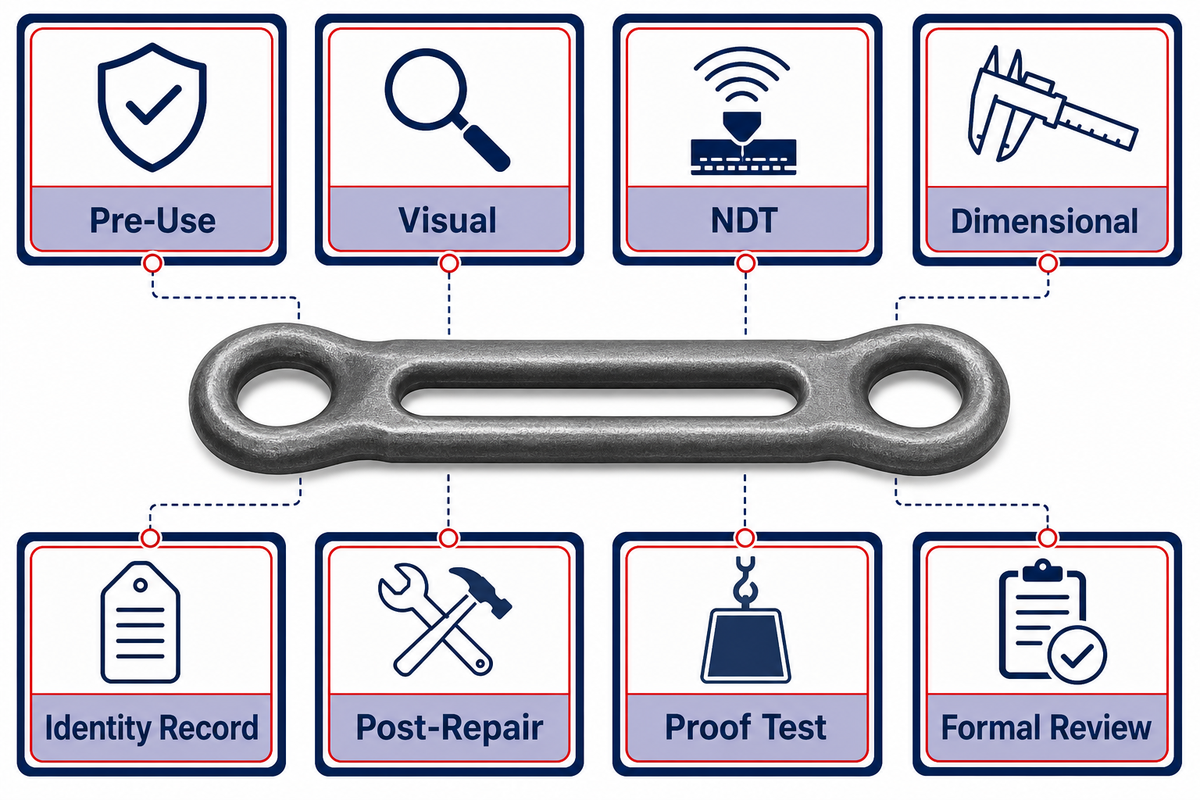
Direct answer: inspection needs a defined object, method, procedure, competence, acceptance basis and disposition authority. No single public frequency, NDT technique or discard dimension can be safely applied to every lifting bail and jurisdiction.
API’s official description of RP 8B covers inspection, maintenance, repair and remanufacture for hoisting equipment, including elevator links. This lifecycle scope is useful because it separates functions that are often lumped together as “inspect it.” This guide does not reproduce category details or intervals from an unparsed document. Teams should obtain the current applicable edition and use it together with the manufacturer, equipment owner and local requirements.
| Evidence category | Question | What it does not prove alone |
|---|---|---|
| Pre-use observation | Is the identified item apparently ready for this next task? | Hidden condition or formal continued-service acceptance. |
| Visual examination | Are relevant accessible surfaces, geometry and markings consistent with the procedure? | Conditions outside visual capability. |
| MT, PT, UT or another NDT method | What reportable indications can the approved method detect in the defined area? | Automatic acceptance, repair authorization or fitness for every application. |
| Dimensional check | How do measured features compare with the correct drawing or criteria? | Material condition or hidden discontinuities. |
| Identity and record review | Do the reports, markings and service history belong to this exact item? | The physical condition or suitability of the configured system. |
| Post-repair examination | Does the authorized examination address the approved repair scope? | Return-to-service authority or acceptability outside that scope. |
| Load or proof test when required | Was the specified test performed on the identified item under the approved procedure? | That routine testing is required at every examination or safe for every item. |
| Thorough examination or formal review | What does the applicable scheme and competent authority require for continued service? | Every task-specific pre-use control or operating hazard. |
Jurisdiction changes the answer. As one clearly bounded example, the UK Health and Safety Executive describes LOLER thorough-examination duties, including default 6- or 12-month intervals unless a written examination scheme applies, specified report particulars and notification of dangerous defects. Those are UK requirements, not a global schedule. They demonstrate why “there’s no universal interval” must never be misread as “no authoritative interval exists.”
The same HSE guidance distinguishes thorough examination from routine inspection and maintenance. It also states that, for most lifting equipment, thorough examination wouldn’t require routine overload testing. Further, some overload tests could potentially damage the equipment. Therefore, what testing, if any, is required and what form it takes is largely dependent on the equipment, its application, and the regulating authority.
Key takeaway: The inspection method describes how evidence is obtained. The governing criteria and authorized person determine what the evidence means.
Repair, Requalification and Retirement Boundaries
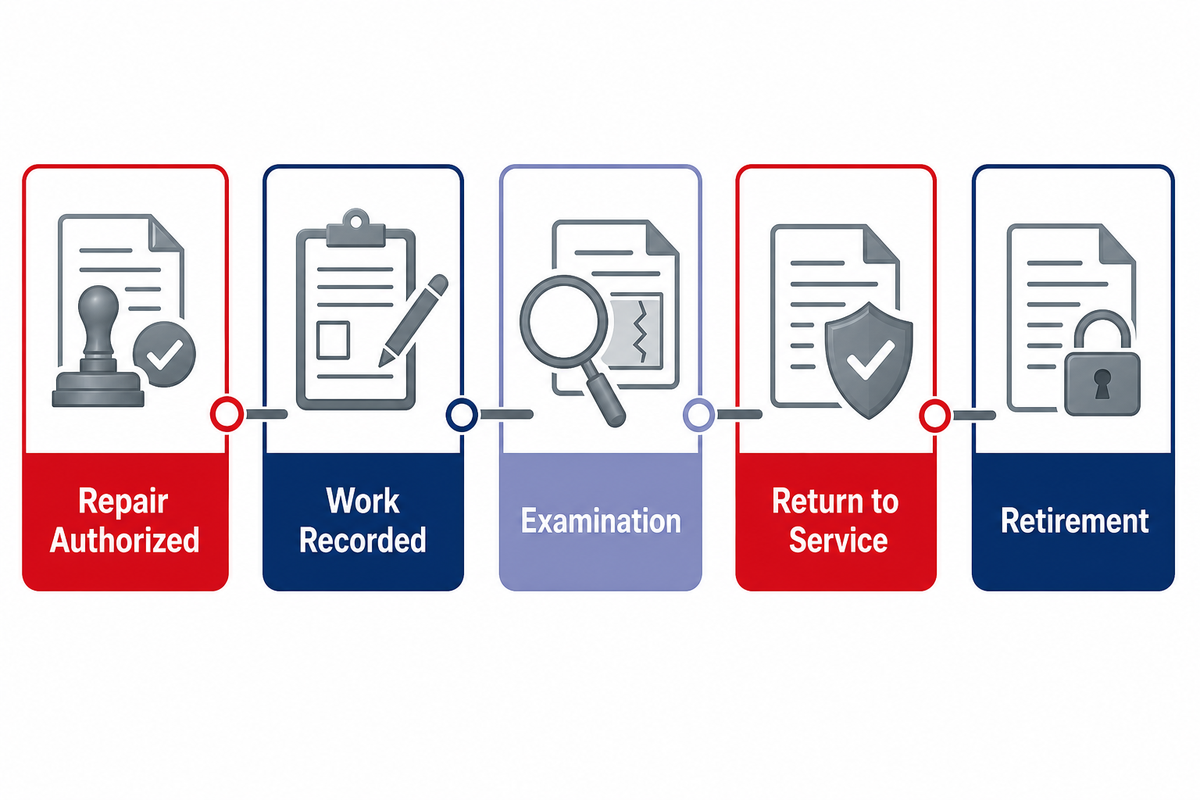
Direct answer: quarantine, repair authorization, examination or requalification, return-to-service acceptance and retirement are separate decisions. Combining them into one “repaired and OK” note creates a gap in both proof and traceability.
When a bail is held, first preserve its identity and the condition that triggered the hold. The next record should name the authority for repair, not the individual that will perform the repair. There are many ways to repair or restore a component. Examples include grinding, straightening, welding, heat treatment, thread restoration and marking changes. This article gives no repair instruction because the permitted process depends on the design, material, manufacturer, controlling standard and qualified procedure.
After authorized work, keep the repair record separate from the return-to-service decision. The file should show what was approved, what was done, who performed it, what examination or testing followed, which acceptance criteria applied and who released the item. An NDT report can be part of that package, but a report with “no relevant indications” does not, by itself, establish that geometry, material properties, configuration and application are acceptable.
Retirement is also controlled. A rejected bail should not be routed to spare stock or another unauthorized location. Controls that prevent unauthorized use should continue to apply after the bail is retired. If historical records are kept after destruction or disposal, they should be clearly identified.
Evidence boundary
Repair evidence explains the intervention. Requalification evidence explains the examination or test. A return-to-service disposition names the authority and decision. A retirement record prevents reuse. Each record has a different job.
Key takeaway: Do not mistake a repaired surface for an authorized return to service. Preserve the entire decision chain.
Shift Handoff and the 6-Field Bail Lifecycle Record
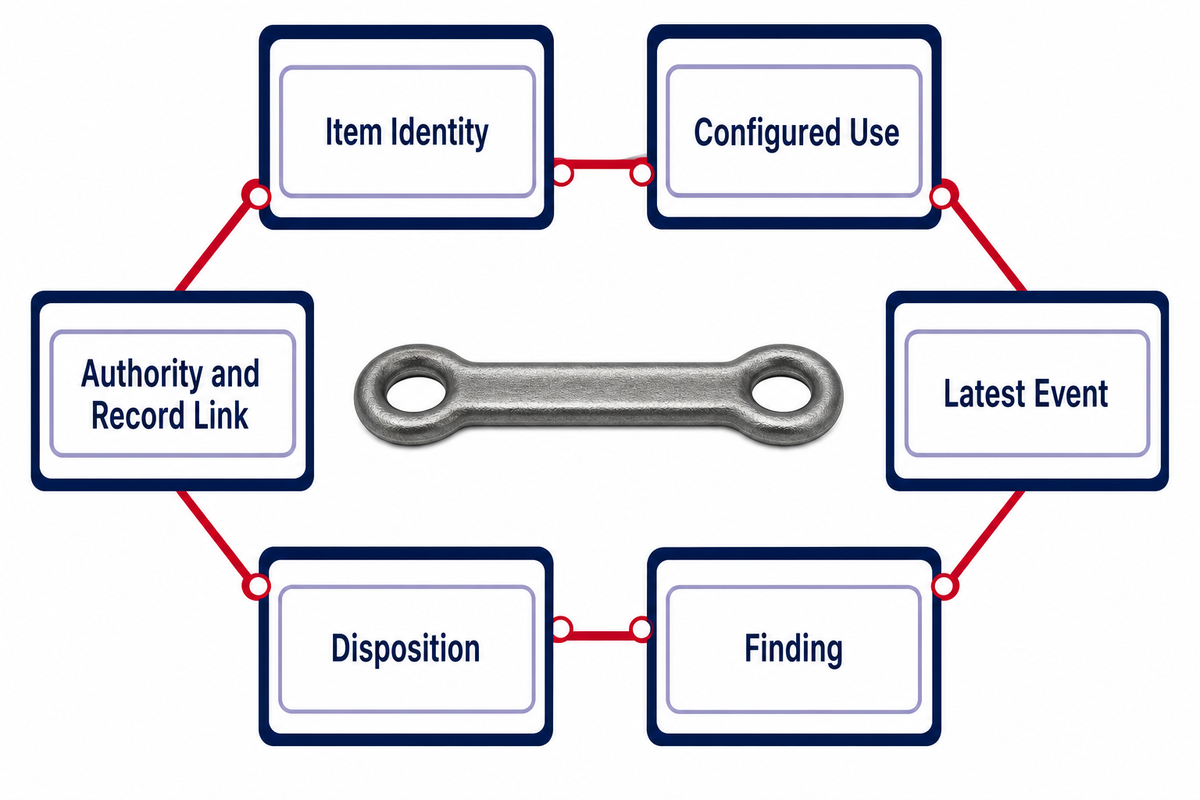
Direct answer: a shift handoff should carry enough information for the next person to find the exact lifting bail, understand its current state and trace the controlling evidence without reconstructing the story from memory.
| Field | Minimum handoff content |
|---|---|
| 1. Item identity | Unique identifier, component designation and paired or assembly relationship where controlled. |
| 2. Configured use | Approved elevator, hoisting interface, task boundary and relevant drawing or instruction. |
| 3. Latest event | Receiving, pre-use check, inspection, examination, repair, requalification or retirement event and date. |
| 4. Finding | Neutral description of the relevant condition or evidence gap, with report reference. |
| 5. Disposition | Released, restricted, stopped, quarantined, sent for repair or retired, including limits and next due event. |
| 6. Authority and record link | Named responsible role or person, governing criteria and location of the controlled evidence. |
This six-field set is intentionally small enough for a shift or location handoff. It supplements, and never replaces, a statutory thorough-examination report, inspection certificate, maintenance record, repair package or complete site safety system. In the UK example above, a formal LOLER report requires prescribed particulars beyond this compact record. Other jurisdictions and owners impose different obligations.
Vague handoffs such as “checked OK,” “NDT done,” or “good for next job” should be avoided. Stronger handoff entries record the identifier, purpose, event, finding, action, authority and link to the case record. If a paper tag is used as part of a process, the controlled electronic or register entry should still exist after the tag is turned over or removed.
Commercial handoffs should include enough information to identify the product, its interface, and the requirements for documentation, marking, and traceability. It should also include the applicable standard, owner specification and acceptance criteria. Ratings, dimensions, configuration, and pricing should be included on the commercial page where they belong.
Key takeaway: The handoff succeeds when the next person in charge can locate the item, evidence and decision authority without relying on oral history.
Frequently Asked Questions
What is a lifting bail?
A lifting bail in this oilfield guide means an elevator link or bail that connects an elevator to the hoisting arrangement used for handling drill pipe, casing or other tubulars. The term is also used for unrelated equipment, so the name alone is not enough for identification. Confirm the unique item, approved interfaces, markings and governing documents before applying any inspection or service decision.
Is it lifting bail or lifting bale?
“Bail” is the usual spelling for the rigid or link-like lifting component discussed here. “Bale” normally refers to a compressed bundle of material, such as hay or fiber. Search results and informal records sometimes mix the spellings. In controlled documents, use the manufacturer’s component designation and unique identifier rather than relying on spelling or a generic equipment nickname.
How often should a lifting bail be inspected?
There is no single worldwide interval that this article can assign. The answer depends on the equipment, service, manufacturer, current applicable standard, owner scheme and jurisdiction. A pre-use check, routine inspection and competent-person thorough examination are different layers. Some jurisdictions impose explicit intervals or allow a written examination scheme, so teams should document which rule controls rather than copying a generic schedule.
Does a certificate prove that the bail can stay in service?
Not by itself. The certificate must match the physical item and its scope must answer the decision being made. Continued-service acceptance may also require current condition evidence, applicable criteria and an authorized disposition.
Can visual inspection replace NDT?
No universal substitution rule is safe. Visual inspection and each non-destructive testing method have different capabilities and limitations. The controlling procedure should define the method, area, preparation, personnel, equipment controls, acceptance criteria and disposition authority.
What should happen after an undocumented repair is found?
Stop use under the site process, preserve the item’s identity and record the observed condition without inventing the repair history. The responsible authority should then determine the required examination, evidence, repair or retirement route before any return to service.
Need the commercial handoff?
Bring the intended interface, documentation and traceability requirements. Welong can then discuss product configuration while this guide remains focused on lifecycle control.
References & Sources
- International Organization for Standardization: ISO 13535 catalogue
- US Occupational Safety and Health Administration: Tripping Out and In
- Drilling Contractor: Mechanization and automation system context
- Lifting Equipment Engineers Association: Know Your Products
- American Petroleum Institute: API RP 8B scope notice
- UK Health and Safety Executive: Thorough examinations and inspections of lifting equipment
Technical note: There are changes in standards, legal duties and configuration of equipment. Verify the latest edition, the scope of application, the jurisdiction, manufacturer’s instructions and the site’s procedures. The final decisions for inspection, repair, requalification, return to service and retirement remain with the responsible authority and qualified personnel.
Why Buyers Work With Welong
About Welong Engineering Support
China Welong supports oilfield buyers with engineered supply-chain service for drilling tools, well-control equipment, rig-floor tools, casting parts, and industrial forged components.
Project Review Before RFQ
We help buyers compare tool family, material route, API or ISO requirements, inspection records, supplier capability, delivery risk, and documentation needs before a purchase decision is finalized.
Request An Oilfield QuoteCompany Profile // Data Sheet
CompanyChina Welong International Supply Chain
BrandWelong
CountryChina
Business TypeOilfield tools and industrial supply-chain partner
Main ProductsDownhole drilling tools, fishing and milling tools, wellhead and well-control equipment, oilfield hoses, rig-floor handling tools, mill rolls, and forgings
Engineering CapabilityTool-family selection, specification envelope review, API / ISO reference support, material traceability, inspection coordination, and supplier-route comparison
RFQ Data NeededTool type, size, connection, rating, grade, standard, quantity, drawings, and delivery target
Websitewelongoiltools.com
![Casing, Tubing & Drill Pipe Elevators [Field Guide]](https://welongoiltools.com/wp-content/uploads/2026/09/casing-tubing-drill-pipe-elevators-guide-featured-768x512.png)