Get in touch with Welong Company

Oil & Gas Well Drilling
Drill Bits (Tricone & PDC)
Oil Drill Bits for Oil & Gas Well Drilling
China Welong coordinates roller cone and fixed-cutter drill-bit supply against the formation profile, hole size and drill-string connection in your enquiry. The quotation identifies the responsible manufacturer, proposed route and inspection scope for the selected bit.
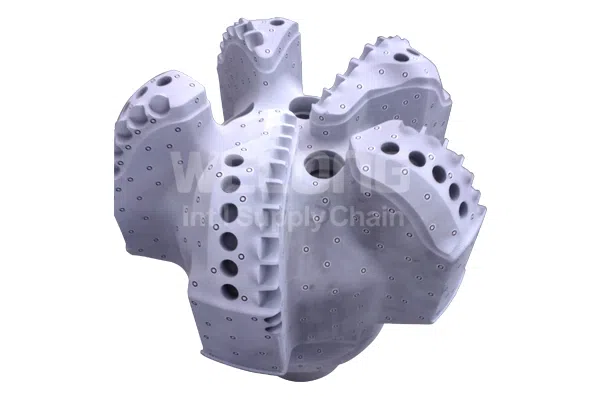
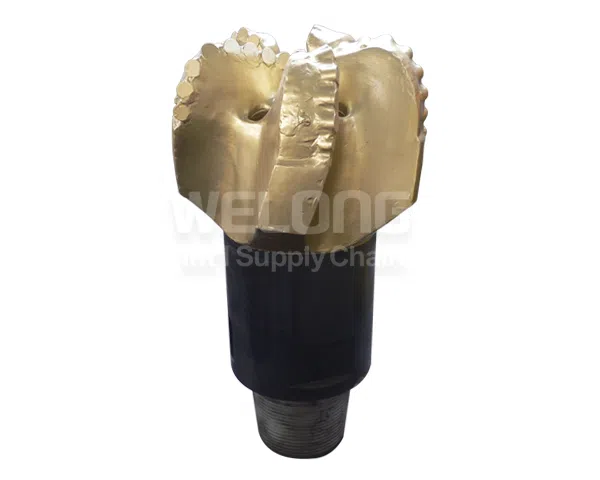
- Diameter confirmed against hole size and selected bit family Diameter range, built to order
- 2 families Roller cone and fixed cutter
- API Spec 7-2 Connection threading & gauging basis
- Inspection scope Confirmed for the selected order
- SGS / DNV Third-party inspection on request
- Founded in 2001 Supplier and inspection coordination
Picking the Wrong Oil Drill Bit Costs More Than the Bit Does
A bit that stops cutting at 8,000 ft doesn’t cost you the price of the bit. It costs you the hours it takes to trip out, the hours to trip back in, and whatever the hole does while it sits open. That’s why the purchase price is usually the least interesting number in a bit decision.
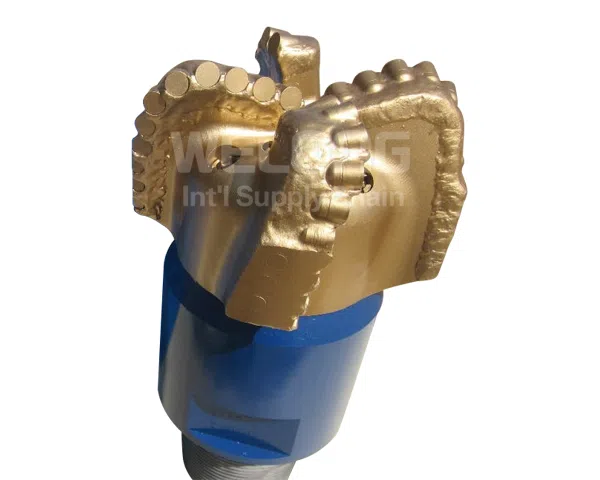
Same two bit families. Same programme. Opposite answers.
The key wasn’t the bit type; it was the rig capability.
Those figures come from a Sandia National Laboratories field study, worked in full in the cost section of this page.
How the two families break rock
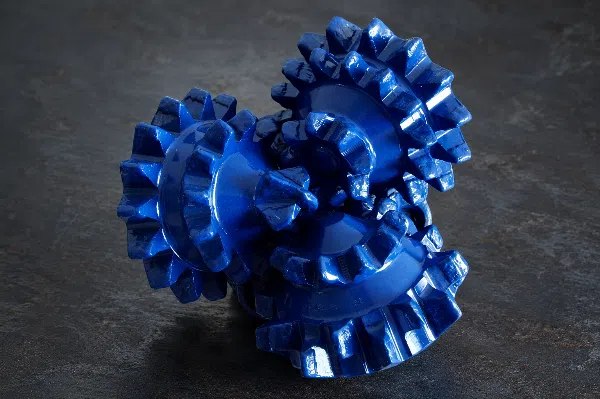
Roller cone bits break the rock by crushing and gouging it under three independently rotating cones. Fixed-cutter bits shave it off smoothly and continuously with synthetic diamond cutters and have no moving parts.
If you want proof that price is the wrong number to start with, look not to advertising, but to performance data. In one documented hard-rock program a fixed-cutter bit costing roughly 14 times as much as a refurbished roller cone still finished cheaper per foot — $45 against $72.40 — while a second bit in the same program lost badly when its rig’s torque could not support it.
Why the arithmetic runs that way
Allowing a 1,000 ft/hour average for round-trip travel (from the depth up, then back down) at 8,000 ft means a stopped bit represents roughly 16 hours of rig time before the replacement reaches bottom: you pay the rig rate for 8,000 ft out and again for 8,000 ft back in.
That trip-time penalty, paid repeatedly, is the costliest mistake we see, so we price on that arithmetic rather than the list price.
For that reason, our selection process starts with your formation and your rig, not a size list, and the selection logic below is public. Independent work on hard-rock bit performance published in the Stanford Geothermal Workshop proceedings reached similar conclusions about performance factors other than price.
Downhole Bit Mechanics, and Why the Bit Is Often Not the Problem
That sentence comes from the drilling contractors’ own association, not from a company that sells bits. It’s worth reading twice before ordering anything, because it reverses the common assumption behind most bit enquiries. Slow footage is more often a dysfunction problem than a hardness problem.
“When drilling data is examined closely it is clear that in much of the footage drilled the bit is not cutting efficiently and this, rather than rock hardness, is the primary cause of low rates of penetration.”
IADC Drilling Manual, 12th Edition, Drilling Practices chapter, 2014
Three numbers that reset the assumption
Observation
Rock strength rises 10%
What it overturns
“Hard formation means we need a harder bit”
Observation
+25 ft/hr per step until the bit founders between 15,000 and 20,000 lb; the next step buys only +10 ft/hr
What it overturns
“More weight on bit means faster drilling”
Observation
120 ft/hr → 500 ft/hr
What it overturns
“If we are drilling slowly, buy a better bit”
The Starting-Parameter Window, and why we will not hand you a determined table
| Parameter | Fixed cutter (PDC) | Roller cone | Basis |
|---|---|---|---|
| Weight on bit | 1,000–2,500 lb per inch of bit diameter | Higher per inch; ceiling set by bearing load | Published operating guidance |
| Rotary speed, rotary table | 85–140 rpm; most applications under 120 rpm | Roughly 40–120 rpm | Published operating guidance |
| Rotary speed, on a mud motor | Reported to 750 rpm at 1,000 lb/in | Limited by bearing and seal life | Published operating guidance |
| Bit hydraulics | 2.0–4.0 hydraulic horsepower per square inch | Set by cleaning requirement | Published operating guidance |
| Life-limiting subsystem | Cutter wear and thermal damage | Bearing and seal life, not tooth wear | Drilling engineering literature |
Inside the cutting structure
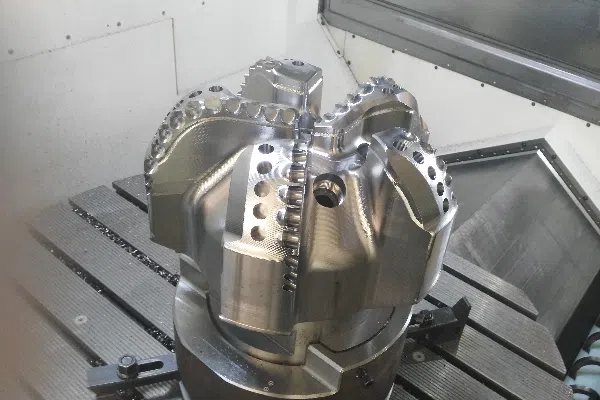
Roller cone teeth are either milled into the steel cone and hardfaced with tungsten carbide, or pressed in as separate tungsten carbide inserts. Fixed-cutter bits use a synthetic diamond layer bonded to a tungsten carbide substrate. Bonding metal is where the thermal limit lives.
~750 °C
the temperature above which a published review reports damage to cobalt-bonded polycrystalline diamond
~1200 °C
the limit the same review reports once the cobalt catalyst is leached out, producing thermally stable material
Both figures are reported thresholds from a review of the materials literature, not measurements we’ve made, and the primary literature doesn’t converge on a single number – treat them as the order of magnitude that separates the two material classes rather than as design limits
“We get asked for the parameter sheet before the formation data, and we push back every time. Nozzle selection can change hydraulic performance without changing the bit family, so we would rather look at your hydraulics first and sell you the right bit second.”
Two Drill Bit Families, One Well Plan: Where Tricone and PDC Bits Each Earn Their Place
Across the types of drilling bits for oil wells in commercial use, two families cover effectively all of it. Fixed-cutter bits are not always the faster choice, even though they now drill the large majority of world footage – a share that took twenty years to build, from under 2% in 1980 to 24% by 2000 and above 90% by 2015 as reported in the drilling contractors’ trade press.
Share statistics tell you what the industry drills on average. They don’t tell you which family suits your interval.
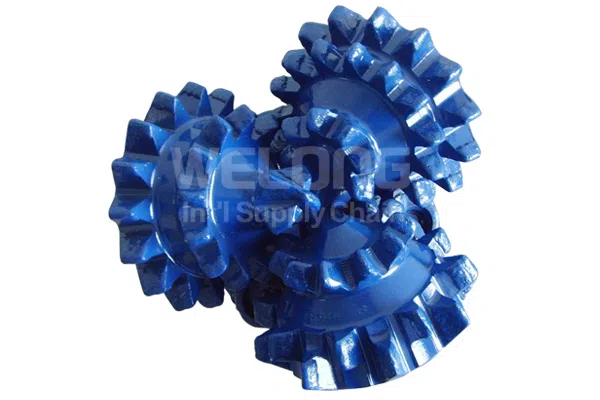
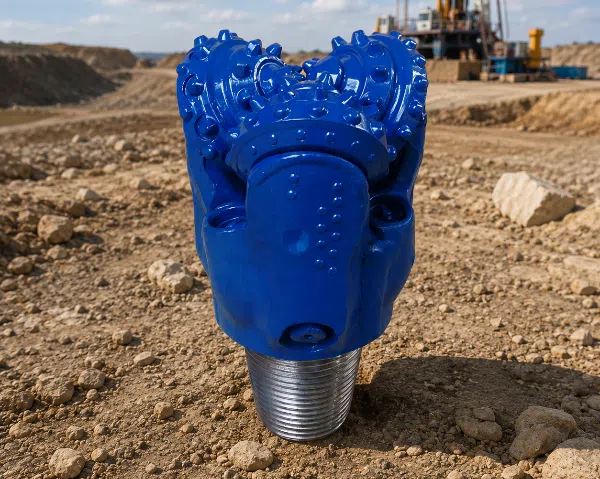
Tricone (Roller Cone) Bits
Three rotating cones, the geometry Hughes patented in 1909, with milled steel teeth or tungsten carbide inserts. Chosen when the interval is interbedded, when hard stringers would shock fixed cutters, or when rig torque won’t support a shearing bit.
Diameter
4¾″ – 36″
Cutting structure
Milled tooth or TCI
Bearings
Open, sealed roller, journal
Life limiter
Bearing and seal
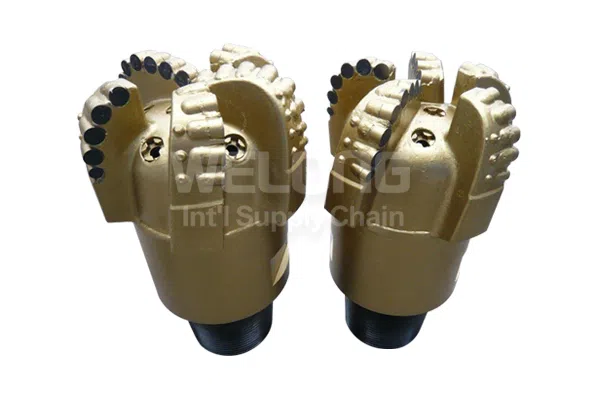
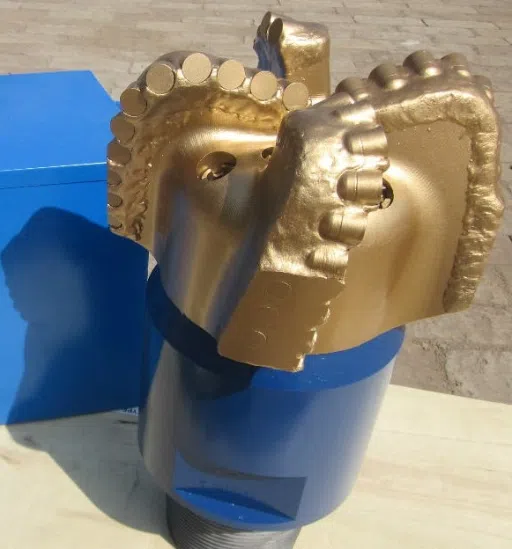
PDC (Fixed Cutter) Bits
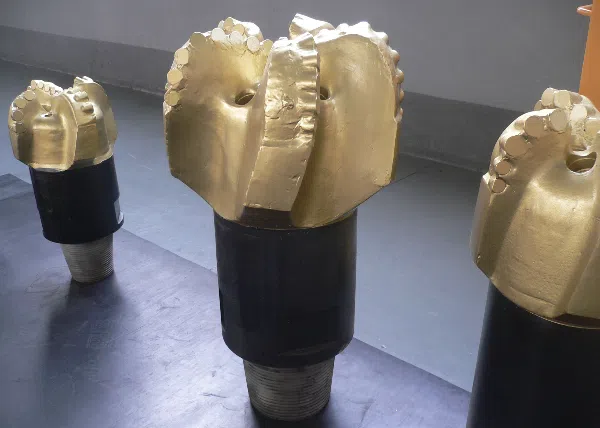
Synthetic diamond cutters, shearing in constant contact. No bearing to fail. The choice for soft to medium-hard, reasonably uniform sections where a long single run will out-perform a cheaper bit and an extra trip.
Diameter
3⅞″ – 26″
Body
Matrix or steel
Thermal ceiling
~750 °C reported
Life limiter
Cutter wear, thermal damage
Routing by what the interval does, not by which bit is newer
| Interval behaviour | Indicated family | Reason |
|---|---|---|
| Uniform soft to medium-hard section, long interval | Fixed cutter | Continuous shearing, one run instead of two, no bearing to fail |
| Interbedded with hard stringers | Roller cone or hybrid | Axial shock breaks cutters — IADC lists this as its own dysfunction class |
| Hard, abrasive rock at depth | Roller cone (TCI) | Fixed cutter has documented under-performance in hard-rock programmes |
| Rig torque or top-drive limited | Roller cone | Torque limits are what damaged the fixed-cutter bit in the Sandia programme |
| Large diameter surface hole | Roller cone | Torque becomes the limiting factor as diameter grows |
From Mud Log to Purchase Order: Selecting a Drill Bit by Rock Strength
The Mud-Log-to-PO Crosswalk below is where most supplier pages have their gap. They'll list bit types and they'll list sizes, but nothing connects the formation description in your mud log to the line you actually type on a purchase order.
Step 1: put a strength band on the lithology
Strength values for the rock types above are published in MPa by a university compilation at Penn State; the psi column is our conversion at 145.038 psi per MPa. Peer-reviewed compilations of the same property record wide scatter within every lithology, so use the bands as indicative, not definitive. We deliberately omitted anhydrite, chert, and unconsolidated sand, for which we hadn't sourced justifiable bands, and in particular chert, for which bitability is a significant issue.
Step 2: correct for the fact that the rock is not unconfined
Why the surface number understates the hole
The UCS is measured with no confining stress, the conditions under which the rock is weakest. The actual strength will be greater, to an extent depending on internal friction angle as well as confining pressure.
Petroleum rock mechanics uses the Mohr-Coulomb form σ1 = UCS + σ3 tan²(45° + Φ/2), where Φ is the internal friction angle. Work published in the Journal of Petroleum Science and Engineering and hosted at Stanford states that both parameters are needed to define rock strength at depth.
Measured internal friction angles for shales run 15° to 40°, so the confining term is rarely negligible even in softer rocks. Conventional fixed cutter bits work to roughly 45,000 psi of confined strength and high density bit designs with 8mm cutters reach drilled formation strengths up to 55,000 psi.
Step 3: the part nobody standardised
We are not going to pretend this link is a standard. IADC's roller cone system classifies formation hardness qualitatively — series 1–3 milled tooth, series 4–8 insert, rising with hardness and abrasiveness — and within each series type 1 is the softest and type 4 the hardest. What no published authority does is assign compressive-strength thresholds to those series numbers. Any chart that maps a psi band straight onto an IADC series is following vendor convention, not a standard, and you should read it that way — including when a supplier hands you one.
Step 4: the order line itself
- Begin with the hole diameter from the programme, not from stock.
- Then cutting structure family and construction (step 1 to 3), applying confined strength correction from the preceding paragraphs.
- Run length and the weight-on-bit ceiling determine bearing configuration and body style.
- Connection: threading and gauging of rotary shouldered connections is governed by API Spec 7-2 / ISO 10424-2, the basis NIST names for its calibration and certification service as custodian of the API Grand Master rotary thread gauges. Specify the connection on that basis and state your drill string connection so the pin is cut to match. If you are buying drill pipe in the same programme, quoting both together keeps the thread and gauge specification consistent end to end.
- Nozzle size and the resultant total flow area are set with your hydraulics, given what the founder point evidence above shows hydraulics can be worth.
Rock Bit Economics: Cost Per Foot, Not Per Bit
Ask three oil and gas drill bit manufacturers for an oil rig drill bit price and you get three prices built on three very different sets of assumptions. Drilling engineers therefore don't judge bits on purchase price at all.
Cost per foot puts bit cost alongside rig cost multiplied by the sum of drilling time and trip time, all divided by the interval drilled. Bit price is one factor of four, and it's generally the smallest one.
The cheapest bit on a quote is rarely the best bit on the invoice, since the two failure modes which cost serious money - an early trip, and a bit destroyed downhole - both scale with rig hours rather than bit price.
$45/ft vs $72.40/ft
Same 725 ft granite interval. A fixed-cutter bit at roughly fourteen times the unit price of a refurbished roller cone still finished at $45 per foot against $72.40 — a $19,000 saving on one interval, because the roller cone would have needed two bits and an extra trip.
Published third-party case study, not a Welong result: Sandia National Laboratories, SAND 2012-3652C, geothermal granite well, Chocolate Mountains, California, 2011–2012. The application and the date are stated because they matter — this is hard rock on a geothermal programme, not a shale lateral, and no published source converts it into an oil-and-gas benchmark. Read it as arithmetic that shows how the trade works, not as a figure to expect on your well.
That same report shows the case most vendor pages skip. A second fixed-cutter bit in that programme was ruined by repeated drill-offs on a rig with which it didn't agree, and finished at $115 per foot against an estimated $77 for a roller cone on the same interval.
| Case | Bit Result | Cost / FT | Interval Cost |
|---|---|---|---|
| A — actual Fixed cutter, run 1 |
725 ft in one run, 26.45 ft/hr avg | $45 | $33,000 |
| B — comparison Roller cone |
~10 ft/hr, ~400 ft life (2 bits) | $72.40 | $52,000 |
| C — actual Fixed cutter, run 2 |
Damaged, rig torque insufficient | $115 | $65,000 |
| E — comparison Roller cone |
Same interval at reference rates | $77 | $44,000 |
Read those four figures together and the lesson isn't "fixed cutter wins", but that one purchase decision produced a $19,000 saving in one interval and a $21,000 loss in another, with rig capability rather than bit type leading the decision. The report is filed with the US Department of Energy, and the selection process underlying it - considering cost per foot alongside specific energy - is indexed in the drilling engineering literature at OSTI.
What cost per foot cannot give you
Cost per foot is backwards-looking. It's only available after the interval is drilled, so it's too late to change anything. Mechanical specific energy - the work done per volume of rock cut, formalised by Teale in 1965 - is calculated in real time and used to identify dysfunction as it happens rather than in the post-run review.
The Crossover Footage
Crossover footage is the number of feet at which a more expensive bit is no longer more expensive: The difference in the price between two bits, divided by the difference in the cost-per-foot they provide, gives the number of feet beyond which the dearer bit is cheaper.
In the example above that point was well within a single 725 ft run, so the fixed-cutter bit was king. In the damaged-bit example it was never reached, since the run finished early.
The Crossover Footage, and what actually moves a Welong quotation
-
01
Family and cutting structure
Insert and diamond cutting structures cost more than milled steel teeth
-
02
Diameter
More material and more machining time as diameter rises
-
03
Bearing or body configuration
Sealed and journal bearings above open; matrix body above steel
-
04
Inspection level
Third-party inspection adds cost above standard in-process and final
-
05
Order quantity and mix
Per-unit cost improves with volume and with consolidating families into one order
-
06
Custom engineering
A bit designed to your formation profile carries engineering time a catalogue item does not
Two things a new supplier should admit
First off, refurbishment is a genuine consideration here - repair of a fixed-cutter can reach about 40% of the original price, changing the arithmetic on reruns.
Secondly, a cost per foot comparison is only relevant when the assumptions made are consistent on both sides. You can't be assured a price advantage by a supplier with zero run experience in your formation, and we won’t pretend. Provide us with your offset data and we’ll run the comparison on your assumptions instead of ours.
Sourcing a Mixed Drill Bit Package: Tricone and PDC Bits on One Order
Sourcing oilfield drill bits from an overseas supplier for the first time is a risk-management exercise, not a price exercise. Failure modes here are well documented by engineers who have lived through them.
What buyers say actually goes wrong
- Material or component substitution after the qualifying order is accepted, without notice.
- Inspection reports altered so out-of-tolerance features read as in-spec.
- Batch-to-batch property collapse - one reported case had castings testing at roughly a third of the required strength.
- Rejected lots scrapped rather than investigated, so the next lot repeats the defect.
View more details & insights
- Two quality tiers, one for the domestic market and one for export, with the applicable standard never pinned in the contract.
Those come from an engineers' professional forum rather than from a supplier's marketing. One contributor summarised the honest position better than any vendor could: any product can be made anywhere on the spectrum between top quality and junk, and China covers the entire range. A more useful question isn't which country made it - it's what you can independently verify.
What changed those buyers' minds
Control
What it is worth
Factory assessment before contract signature
One metallurgist reported auditing 11 factories to find 2 he would work with
Full oversight on the first shipments
Inspection frequency relaxed later, without telling the supplier
Third-party inspection with the inspector's data checked
One importer runs random inspection on the first completed container; competence and impartiality of inspection bodies is itself standardised under ISO/IEC 17020
Standard named in the contract
Prevents an equivalent-looking national standard being substituted
Root-cause response on any rejection
Distinguishes a supplier who fixes the process from one who re-sorts the box
How Welong is set up to be checked
Inspection scope
Inspection stages and any independent witness point are confirmed for the selected order
SGS / DNV
Third-party inspection arranged on request, in-process or pre-shipment
API Spec 7-2
Connection threading and gauging basis, stated as a design basis
Records on request
Inspection documentation released with the order, not summarised
How the standards claim stays checkable.
Each bit is quoted against the specification it is built to, and the quotation names the responsible manufacturer together with the inspection scope, so the claim can be verified independently. Where you appoint a third-party inspector, the competence and impartiality of inspection bodies is itself specified by ISO/IEC 17020, so you can hold the inspector to a standard as well as the goods. Naming a standard as a design basis and holding a licence under it are different statements, and the quotation keeps them separate.
Why a mixed package is a different purchase
Ordering roller cone bits, fixed-cutter bits and spares as one package changes three things at once. One inspection plan can cover the whole order rather than three separate exercises, one consolidated shipment carries a different per-unit freight cost than three, and the lead-time difference between families becomes something to sequence rather than something to discover.
Lead time and landed cost, what we will not put a number on
We aren't publishing a lead time in weeks, because it depends on family, diameter, bearing or body configuration, inspection level and the current order book. A figure printed on a web page would be a guess dressed as a commitment. [Request lead time estimate] with your specification and we'll give you a dated one.
On customs: rock-drilling and earth-boring tools sit under heading 8207, split by the material of the working part between subheading 8207.13 for tools with a working part of cermets and 8207.19 for others and parts. Which one your bits fall under is a working-part determination, so confirm the subheading with your broker or request a binding ruling - the current schedule is published by the United States International Trade Commission. Trade terms available are FOB, CIF, DAP and DDP under Incoterms 2020, with DDP subject to import clearance being legally performable by the seller in your destination country.
Drill Bits (Tricone & PDC) Tools
-
Trip Cost Estimator
Calculate the total operational cost per trip to optimize drilling efficiency and reduce rig downtime.
Access Tool -
Crossover Footage Calculator
Accurately estimate crossover footage requirements across varying formation layers to extend bit lifespan.
Access Tool -
Formation Strength Lookup
Access critical compressive strength data for various rock formations to guide precise Tricone and PDC bit selection.
Access Tool -
Mixed Package RFQ Builder
Configure and submit a customized request for quotation for integrated Tricone and PDC drill bit packages.
Access Tool
01
How much does an oil drill bit cost?
How much does an oil drill bit cost?
Prices span an order of magnitude, so a comparison beats a number. What decides the cheaper option is cost per foot, not sticker price — the economics section above works a published case in full. A quotation turns on the bit family and cutting structure, diameter, bearing or body configuration, inspection level and the mix of an order, so ask for one against your specification rather than a catalogue number.
02
What are oil drill bits made of?
What are oil drill bits made of?
Roller cone bits are steel, with milled teeth hardfaced in tungsten carbide or with pressed-in tungsten carbide inserts. Fixed-cutter bits carry a synthetic polycrystalline diamond layer bonded to a tungsten carbide substrate; the bonding method sets the thermal limit, reported at roughly 750 °C for cobalt-bonded material and around 1200 °C once the cobalt is leached out.
03
What do IADC codes on a drill bit mean?
What do IADC codes on a drill bit mean?
Roller cone bits use three digits plus an optional fourth character — series and type for formation hardness, then bearing and gauge. Fixed-cutter bits use a separate four-character code for body material, cutting structure, cutter density and profile. One caveat worth knowing before you read any vendor chart: these are qualitative hardness descriptions, not compressive-strength values, so a chart that maps a psi range straight to a series number is vendor convention rather than the standard. Our IADC code decoder breaks down each position.
04
Is the connection covered by API Spec 7-1 or 7-2?
Is the connection covered by API Spec 7-1 or 7-2?
API Spec 7-2, equivalent to ISO 10424-2. Spec 7-1 has been amended so its gauging sub-clauses now point to Spec 7-2, so state your drill string connection size on enquiry and we cut the pin to it.
05
Why is my rate of penetration low if I bought the right bit?
Why is my rate of penetration low if I bought the right bit?
Often because the bit isn't the bottleneck. The drilling contractors' association identifies inefficient cutting, rather than rock hardness, as the limiting factor across much of the footage drilled — in one reported case the achievable rate rose from 120 to 500 ft/hr on the same bit by altering hydraulics alone. Investigate hydraulics, weight-on-bit response and dysfunction signatures before changing bits; a step test on your own well costs a couple of hours rather than a trip.
06
What sizes can you supply, and do you sell used oilfield drill bits?
What sizes can you supply, and do you sell used oilfield drill bits?
Select the bit family, hole size, connection, formation data and inspection scope in the RFQ. Availability and the responsible manufacturer are confirmed in the quotation.
07
Can I get third-party inspection before shipment?
Can I get third-party inspection before shipment?
Yes. Inspection requirements and any third-party verification are confirmed for the selected order. Asking for inspection data is prudence, not a lack of confidence.
Working with China Welong
Order Terms, Evidence and Next Steps
The commercial terms below apply to every oilfield tools order we quote. They are the same terms our quotation repeats back to you, so nothing on this page has to be re-negotiated once a drawing is on the table.
What we make, and from what
We work from 2D drawings and 3D CAD models (AutoCAD, Pro/ENGINEER and SolidWorks; .dwg and .igs).
Founded in 2001. Manufacturing at Xi'an, Shaanxi and at Jiyuan, Henan, with 30+ engineers on staff.
Forgings from 0.2 to 50 tons, finished to 0.01 mm machining precision. Material standards to ISO, BS, ASTM, ASME, DIN, JIS and GB.
How the price is set
Send a drawing and we reply within 24 hours; a drawing-based quotation follows in 1–3 working days.
Payment is T/T or L/C. We ship EXW, FOB, CFR or CIF; other Incoterms on request.
Orders ship in standard export wooden cases, or the packing you specify.
When it ships
Production lead times are confirmed with your quotation, based on quantity, process route and finishing scope.
We hold agreed items in stock and ship against your release to shorten delivery.
Who makes it, and who answers for it
Every quotation states whether the item is made in our own works or by an approved supplier we developed and supervise.
Material mills are re-audited every two years and approved by Welong before they run your order.
The evidence that travels with the order
An EN 10204-3.1B material certificate with chemical composition and mechanical properties, a dimensional measurement report, and UT and MT reports ship with your order.
Inspection is by coordinate measuring machine, ultrasonic, magnetic particle and X-ray.
Each piece carries a stamped serial number and stays traceable for five years to its chemical composition, mechanical properties and measurement report.
What to send to start
Send the drawing or a photograph of the part, the dimensions, the material requirement and the quantity to oiltools@welongpost.com, call +86 029 88331331 or message WhatsApp +86 135 7217 2362, or use the enquiry form on our contact page.
An engineer reviews it and comes back within 24 hours.
| Term | What we commit to |
|---|---|
| Quotation turnaround | Reply within 24 hours; drawing-based quotation in 1–3 working days |
| Production schedule | Confirmed with your quotation, by quantity, process route and finishing scope |
| Drawing formats | 2D drawings and 3D CAD models (.dwg, .igs) |
| Company | Founded in 2001 |
| Machining precision | 0.01 mm |
| Forging envelope | 0.2 to 50 tons |
| Serial traceability | 5 years, with the test coupon retained |
| Documents with shipment | EN 10204-3.1B certificate, measurement report, UT and MT reports |