Get in touch with Welong Company

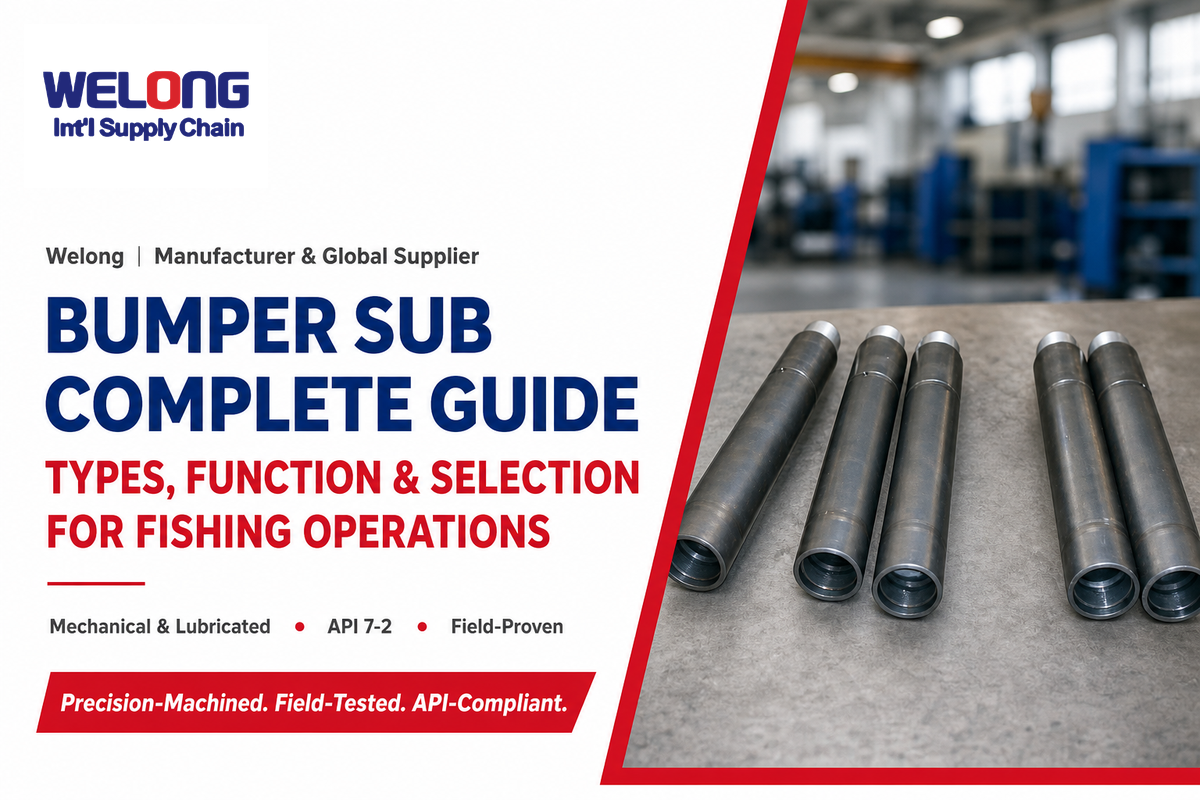
A bumper sub is a telescoping downhole tool run in a fishing string to deliver a controlled impact on a stuck fish while still transmitting full torque. The quick-reference specs below cover the working range across the market before the guide walks through mechanism, placement, selection, and field practice in detail.
Quick Specs
| Working stroke | 10-36 in, depending on model |
| OD range | 1-5/8 in (rod fishing) to 9 in (heavy work) |
| Pressure rating | up to 15,000 psi, model-dependent |
| Connection types | Regular, IF, FH, and other rotary-shouldered threads |
| Two configurations | Mechanical (slack-joint) and lubricated (hydraulic-oil-filled) |
A bumper sub is a telescoping, downhole tool that’s run in the fishing string and designed to impart an impact or “bump” up or down into a stuck fish without killing torque. Placed immediately above the fishing tool-which can be either a spear or an overshot-the tool enable an operator to put weight, jar, or release the catch without binding up the release features of the tool. The guide walks through how the tool functions, its placement in the fishing string, when to select between its two primary design, and common mistakes made by buyers and field crews.
A bumper sub is a telescopic sub that runs above a fishing tool within a drill or work string, transferring vertical string movement into an instantaneous upward or downward impact while internal splines keep transmitting torque. Working stroke commonly ranges 10-36 inches on most models, and the choice between lubricated and mechanical design depends on pump pressure and well temperature.
What Is a Bumper Sub?
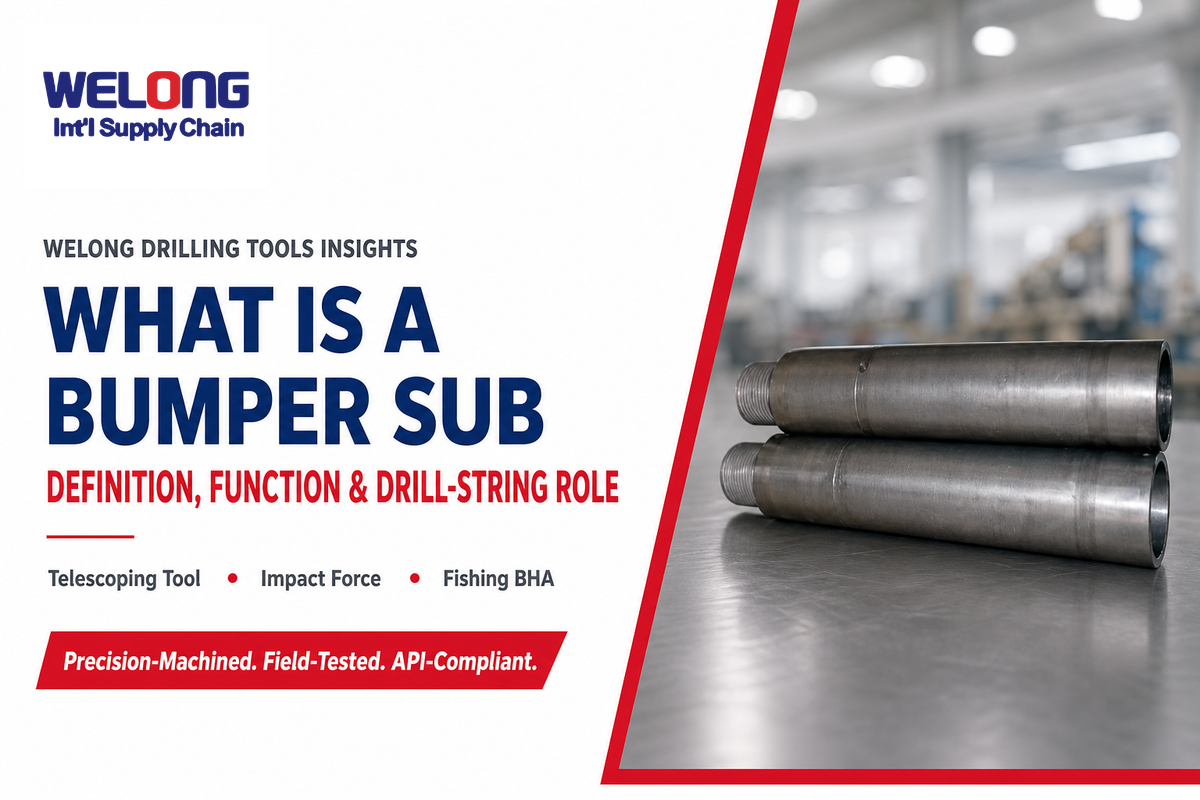
Peel back the marketing blurb and a bumper sub is, at its core, a mechanical solution to one specific problem: delivering an impact downhole without giving up the ability to spin the string. A solid drill collar or piece of pipe has no travel. That’s why a bumper sub uses a mandrel that slides into a housing over a set stroke, still transmitting torque through splines on the interior.
The U.S. Occupational Safety and Health Administration’s Oil and Gas Well Drilling and Servicing eTool classifies bumper subs along with spears, jars, and overshots in the general class of fishing tools installed on wireline or drill string and treats them for hazard analysis in the same manner as other jarring or hoisting equipment – a good reminder that these are field-safety tools, not inanimate spacer rings.
“Bumper sub-a percussion tool placed in a fishing string, used to jolt the stuck object in either upward or downward direction and knock the fish loose; has body that moves up and down on mandrel,” says one oilfield glossary. That’s the mechanical essence in a sentence. Also known as a bumper jar in some regions, this fishing bumper sub design is built for harsh downhole conditions and long-term durability. The rest of this guide covers the full range of bumper sub applications, from stuck-pipe recovery to controlled catch-tool release.
Skipping the diagnosis step is a costly and avoidable mistake in the field: running a full fishing BHA before confirming whether the pipe is genuinely stuck — not just differentially stuck against the wellbore wall — can waste 4-6 hours of rig time, because a bumper sub fishing tool’s moderate, repeatable impact is not built to overcome hard mechanical sticking the way a purpose-built jar is. In practice, crews confirm sticking type and try circulation and string work first, then reach for a bumper sub as part of a planned recovery, not as a first guess.
How a Bumper Sub Works
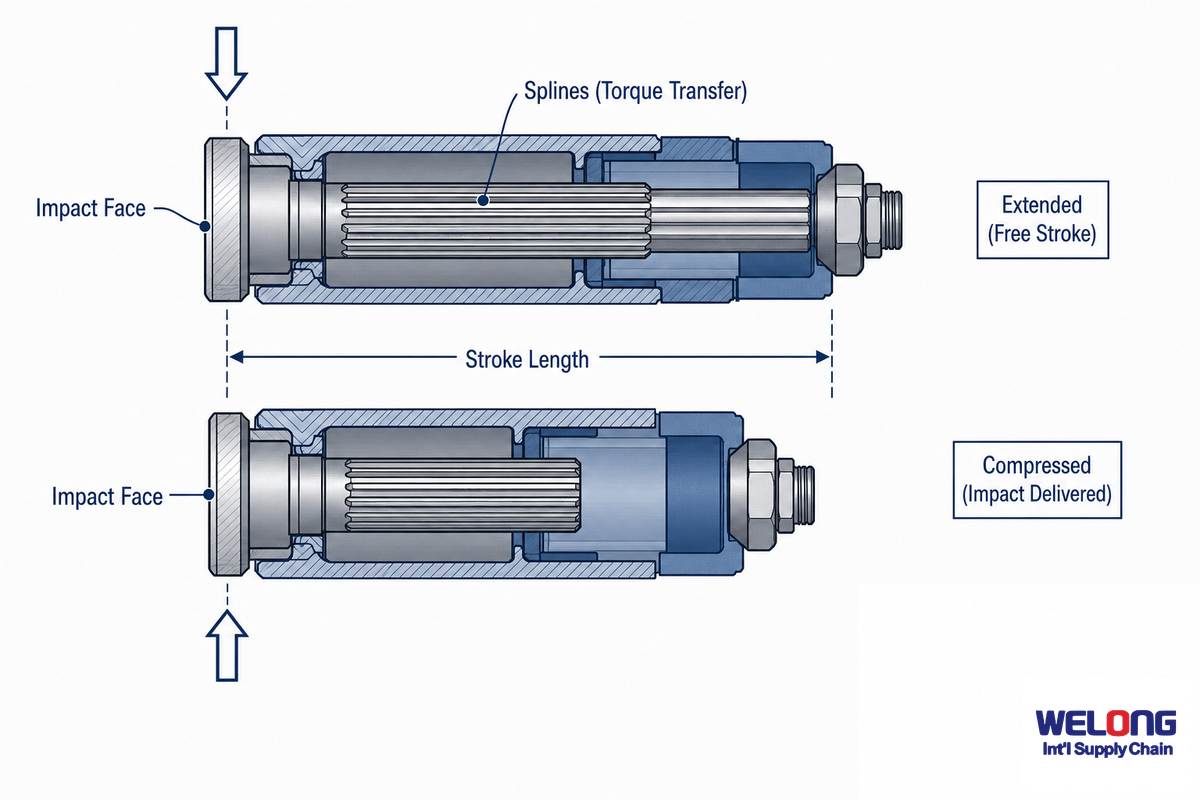
A bumper sub works through a splined mandrel that slides inside a matching splined housing over a fixed stroke length. The splines keep torque transmitting from top to bottom even while the mandrel travels, and when it reaches either end of its stroke it strikes an internal shoulder, delivering a controlled impact to whatever is connected below.
How Does a Bumper Sub Work?
Inside the tool, the mandrel slides over a housing in the tool string. Their splines lock them rotationally – so string still rotates and torque may still be applied to it – while they may slide along the length of the tool up to the tool’s designed stroke length. As the string is run in or pulled out, the mandrel slides its stroke and hits an internal shoulder at either extreme of travel imparting force on the work-string connection below.
The basic principle of this mechanism is well described by two U.S. patents from the 1970s and are the best available record of the basic concept today: US Patent 3,804,185, “Jarring and bumping tool for use in oilfield drilling strings”, and US Patent 3,329,221, “Pressure balanced bumper sub”, both rely on a splined mandrel-and-housing that translates longitudinal string movement to an impact load. Another patent, US 4,333,542, “Downhole fishing jar mechanism”, details a variation of the mandrel-and-spline concept used in a similar impact tool. Although the mechanism hasn’t changed at all in 50 years – it’s just the materials, seal design and manufacturing tolerances that have been improved.
“The mechanism itself is old and proven – what differentiates a reliable bumper sub from a problem one is almost always the connection tolerance and the seal quality, not the concept.”
Welong Technical Team
Because the splines are designed to transmit high torque throughout the entire stroke, a jarring action can be generated at any point in the stroke without the operator having to stop rotating the string to retrieve. That same stroke can deliver either a downward blow or, run in reverse, an upward force to dislodge debris or a light obstruction, while the downward force at the connection is what lets the crew release the fishing tool from the fish and release from the fish cleanly once the catch is no longer needed. This is a key advantage, particularly when working on directional and horizontal wells, where continuing to rotate reduces the likelihood of the fishing string getting stuck again.
Where a Bumper Sub Sits in the Drill String (BHA & Overshot Context)
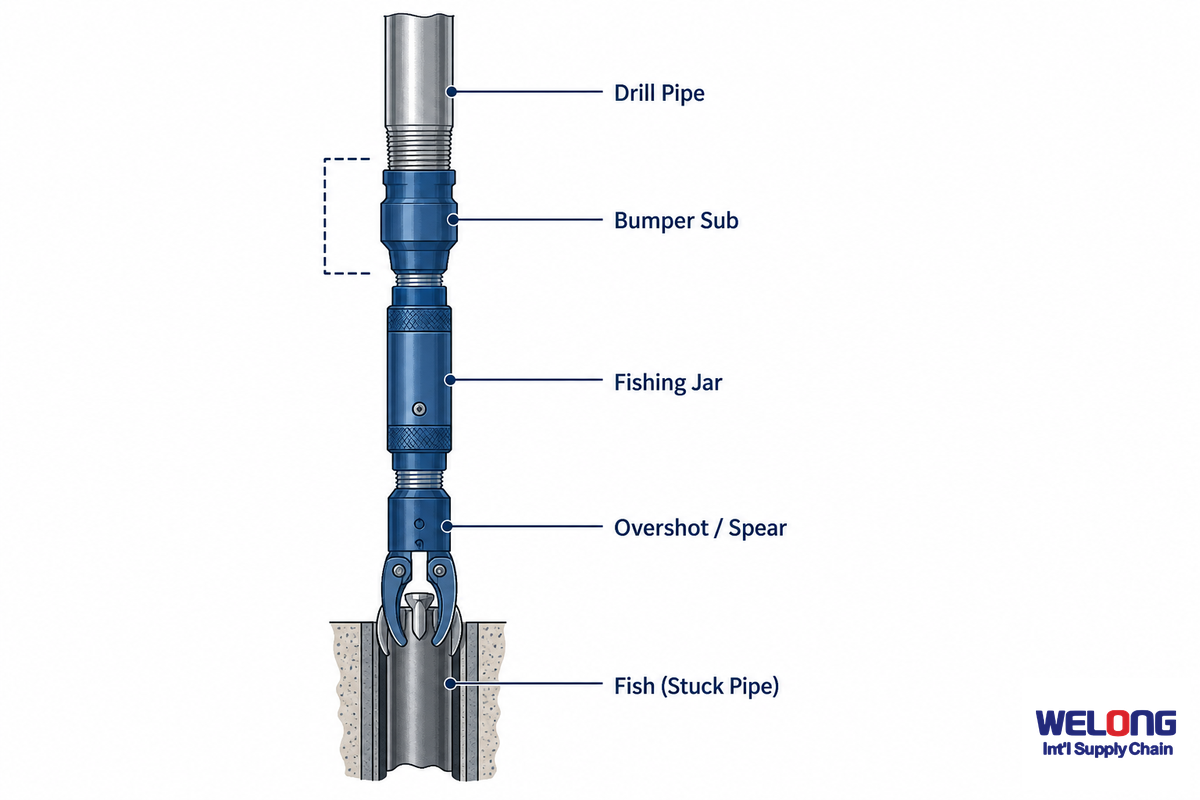
Bumper subs are rarely used in isolation. They’re always positioned directly above the retrieval tool – an overshot, a spear, or another of the grappling tools used to catch stuck equipment downhole – so the delivered shock load and impact force are directed at the fishing string’s connection with the fish.
Connection compatibility with the grappling tool below and the drill pipe or tubing above is what makes that impact force actually count for something. There’s significantly more search interest in the term “overshots” than in “bumper sub” – a reminder that, in practice, the bumper sub is rarely the star of the show, but is the device that enables the catch tool to release under pressure.
The placement of the bumper sub isn’t simply a matter of convenience; it’s a key consideration in a fishing assembly, which in effect is a substitute for a section of the bottom-hole assembly and will have to contend with the same challenges. If the bumper sub’s diameter and connection type don’t match the size and thread of the overshot positioned beneath it, for example, you risk creating a nasty interface issue that can transform an otherwise routine operation into another stuck-pipe incident.
📐 Engineering Note
When the bumper sub is used above an overshot, its stroke length must be compatible with the overshot’s retrieval mechanism travel. Inadequate clearance between the two could result in an overshot being damaged or breaking due to excess shock from a long stroke bumper sub. The stop feature built into the mandrel to limit its travel to the tool’s rated capacity is designed to prevent stroke overshoot that would destroy the carefully controlled impact. The bumper sub’s connection types both at the bottom and top ends should be consistent with the type of rotary-shouldered thread being used for the overshot and fishing string assembly-unless a crossover sub is deliberately included.
A short catch overshot, a basket grapple overshot, or a spear each have different internal clearances and grip strengths; just one more reason the bumper sub’s stroke and jarring force should be matched to the catch tool on the string, and not simply the outside diameter of the fish, as the mandrel-and-housing mechanism described in US Patent 3,804,185 makes clear when it lays out how the impact load transfers through the connection below the bumper sub. On strings in which a clean back-off point is also planned above the stuck interval, a safety joint may be run in the same interval as the bumper sub, providing the crew with a deliberate weak link above the fish to disconnect from, should the fishing run itself need to be abandoned.
Bumper Sub Types, Mechanical vs. Lubricated
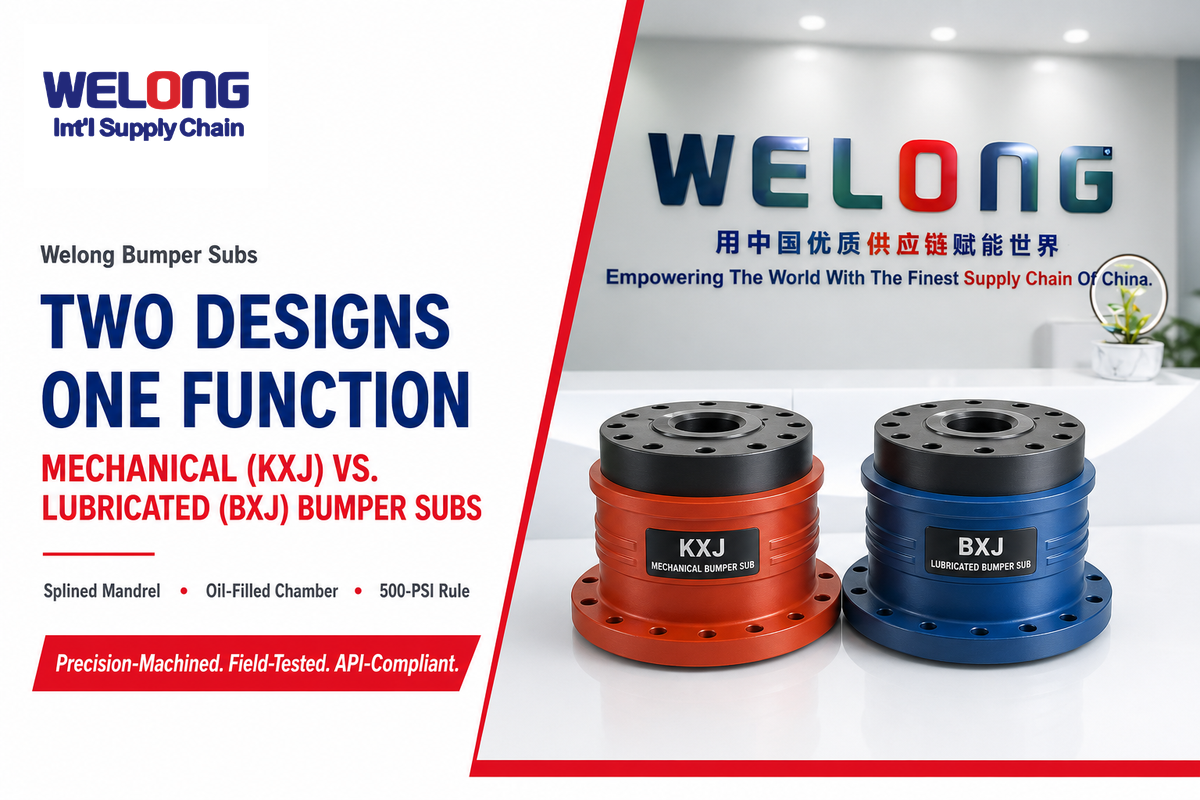
There are only two types of bumper subs manufactured in the market, and the difference between them has far-reaching implications for what mode of failure you’re actually trying to prevent.
Mechanical (slack-joint) type. Here, the mandrel rides either dry or with very little lubricant within the housing, sealed by wear rings, rather than a contained fluid chamber. Less material means less elastomer in the load path, so there’s less to fail at high temperature.
Lubricated type. These designs feature an interior, enclosed chamber that’s filled with hydraulic fluid, separated by seal rings and housing; it helps dampen the mechanical shock, prolongs splines, and delivers extended service life-provided the seals survive. This pressure-balanced housing concept is the same principle described in US Patent 3,329,221, “Pressure Balanced Bumper Sub”, one of the foundational patents behind the lubricated design.
| Condition | Choose | Why |
|---|---|---|
| High wellbore temperature expected | Mechanical | Sustained heat can destroy the seals in a lubricated bumper sub’s closed chamber |
| Pump pressure >500 psi expected | Lubricated | Its closed housing and seal rings protect the mechanism from pressure-driven wash-out that a mechanical joint cannot resist as well |
| Both conditions present (hot + high pressure) | Escalate to engineering review | The two rules point in opposite directions — do not default to one without checking actual bottomhole temperature and anticipated circulating pressure together |
The 500-psi/150F threshold-that’s about the only hard number that comes up consistently in field discussions on which bumper sub design to run-doesn’t trace to an API standard or peer-reviewed paper. It’s a well-understood rule of thumb based on industry practice and, when a well fall on the boundary between those thresholds, consult your specific tool manufacturer’s rating sheet before defaulting.
⚠️ Common Mistake
It’s a common mistake in the field to just go with the “lubricated” design because it reduces wear. But in hot conditions, the part that’s intended to lubricate your bumper sub can be precisely what causes it to fail; high temperature degrades the seal package that keeps the hydraulic fluid contained before it impacts anything else in the mechanism.
When You Need a Bumper Sub, Stuck-Pipe & Fishing Applications
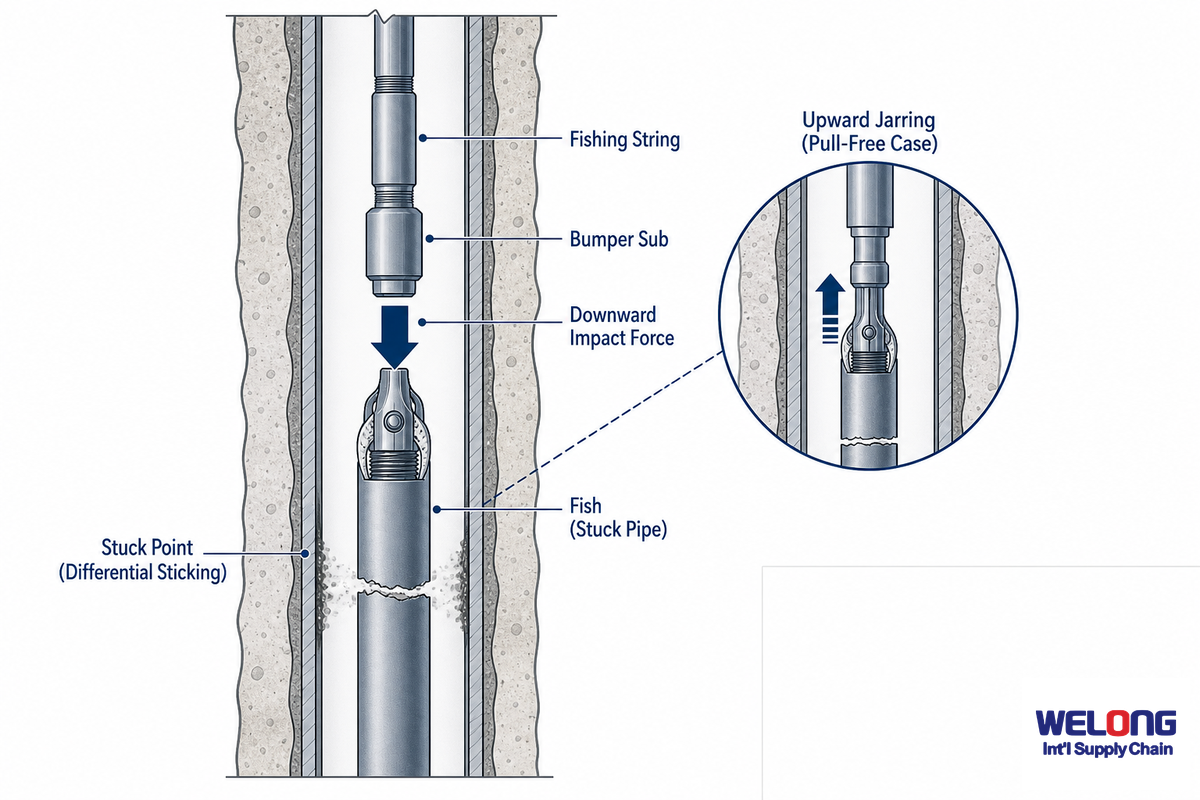
Stuck pipe is far from a fringe concern: a University of Baghdad engineering review of the pipe sticking mechanism places stuck-pipe events at more than 25 percent of all nonproductive time, with industry-wide costs above $250 million annually. The bumper sub turns that problem from a lengthy fishing operation into a controlled retrieval.
The same review cites BP’s own reported figure of stuck-pipe costs exceeding $30 million a year for that operator alone – a reminder that the economics here are not abstract.
💡 The 6-Application Bumper Sub Deployment Checklist
- Release differentially and mechanically stuck fish with a downward or upward jar action.
- Release overshot or spear from the fish after the catch is no longer necessary.
- Cleanout and milling work, absorbing shock while the bit or mill engages junk
- Moving a work string that’s attached to a stuck fish without over-torquing the connection
- Applying weight through internal mechanical cutters during a milling or cutting run
- Acting as a “feed-off” tool, lowering the string a set distance to disengage from a fish under controlled conditions
A field scenario illustrates why the sizing decision in the previous section isn’t academic. A workover crew fishing a parted sucker rod string in a moderately hot well selected a lubricated bumper sub on the assumption that it would extend service life across the job.
After roughly six hours of jarring at elevated bottomhole temperature, the seal package began to weep hydraulic oil, and the tool’s effective stroke shortened as the chamber lost fluid – a mechanical bumper sub, chosen up front against the known temperature profile, would have avoided that failure mode entirely, even at the cost of somewhat higher wear over the same run.
Bumper Sub vs. Drilling Jars & Other Fishing-String Tools
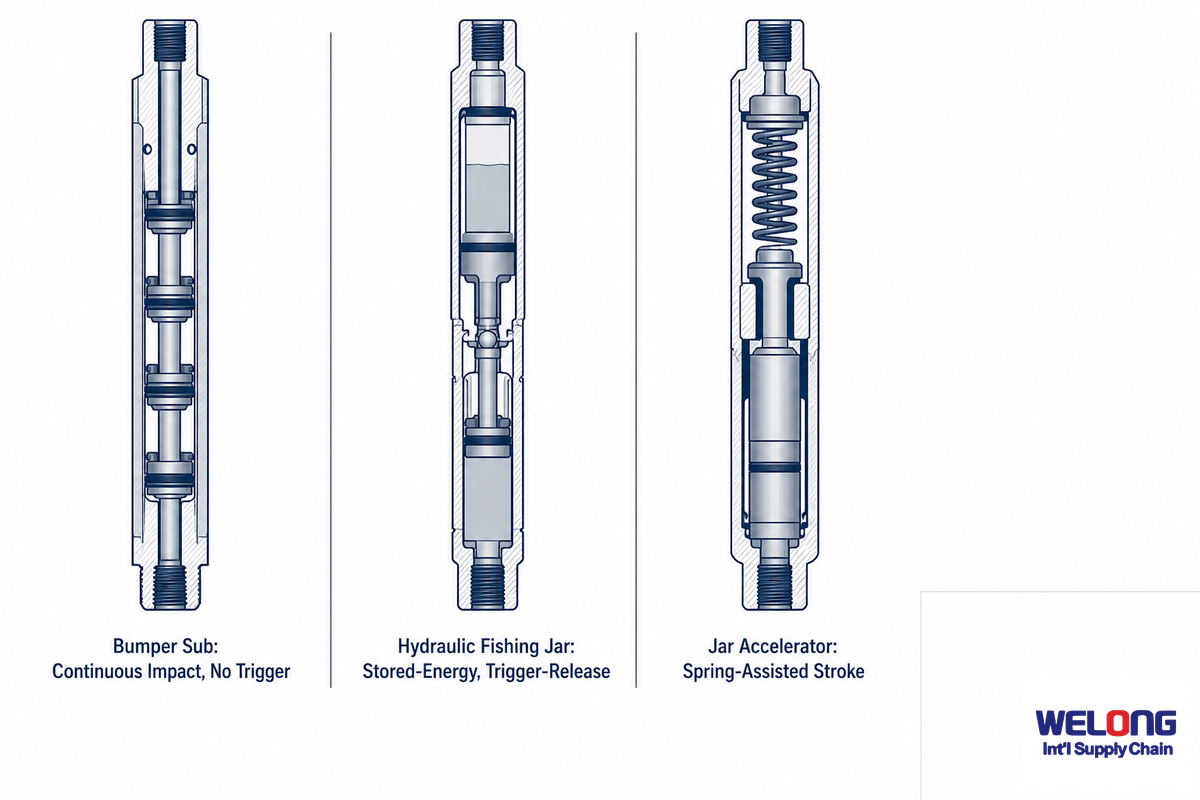
A bumper sub is frequently confused with a drilling or fishing jar – understandably, since both deliver impact loads inside a fishing or drill string, as US Patent 4,333,542, “Downhole Fishing Jar Mechanism” describes for the jar’s own mandrel-and-spline design.
They aren’t interchangeable, and the difference matter when you’re speccing a string, not just when you’re naming parts.
| Feature | Bumper Sub | Drilling / Fishing Jar |
|---|---|---|
| Impact mechanism | Telescoping mandrel strikes an internal shoulder at each end of a fixed stroke | Mechanical or hydraulic trigger releases stored tension/compression in a single sharp blow |
| Impact style | Repeatable, controlled, moderate-force cycles | Sudden, high-force single or repeated blows |
| Typical use | Feeling for the top of a fish, releasing catch tools, absorbing rig-heave motion | Freeing pipe that is stuck hard enough to resist a bumper sub’s moderate impact |
| Common pairing | Run above an overshot or spear | Often run together with a bumper sub and an intensifier jar in the same jarring assembly |
In practice, the two tools frequently work as a team rather than as alternatives: a jarring assembly commonly includes drill collars, a jar, an intensifier, and a bumper sub together, each doing a distinct mechanical job.
A bumper sub also pairs naturally with a hydraulic fishing jar in the same string when a fish resists the bumper sub’s moderate cycling force and a harder, stored-energy release is needed – the two tools are complementary, not competing choices for the same slot in the string. Industry reference material on fishing-string assemblies generally treats the direction of stroke as another distinguishing point worth checking against a supplier’s own documentation: a bumper sub’s controlled stroke is typically applied downward against the fish, while the companion oil jar in a jarring assembly is more commonly built to deliver an upward stroke, with an intensifier used to boost the jar’s force rather than substitute for either tool.
How to Select & Size a Bumper Sub
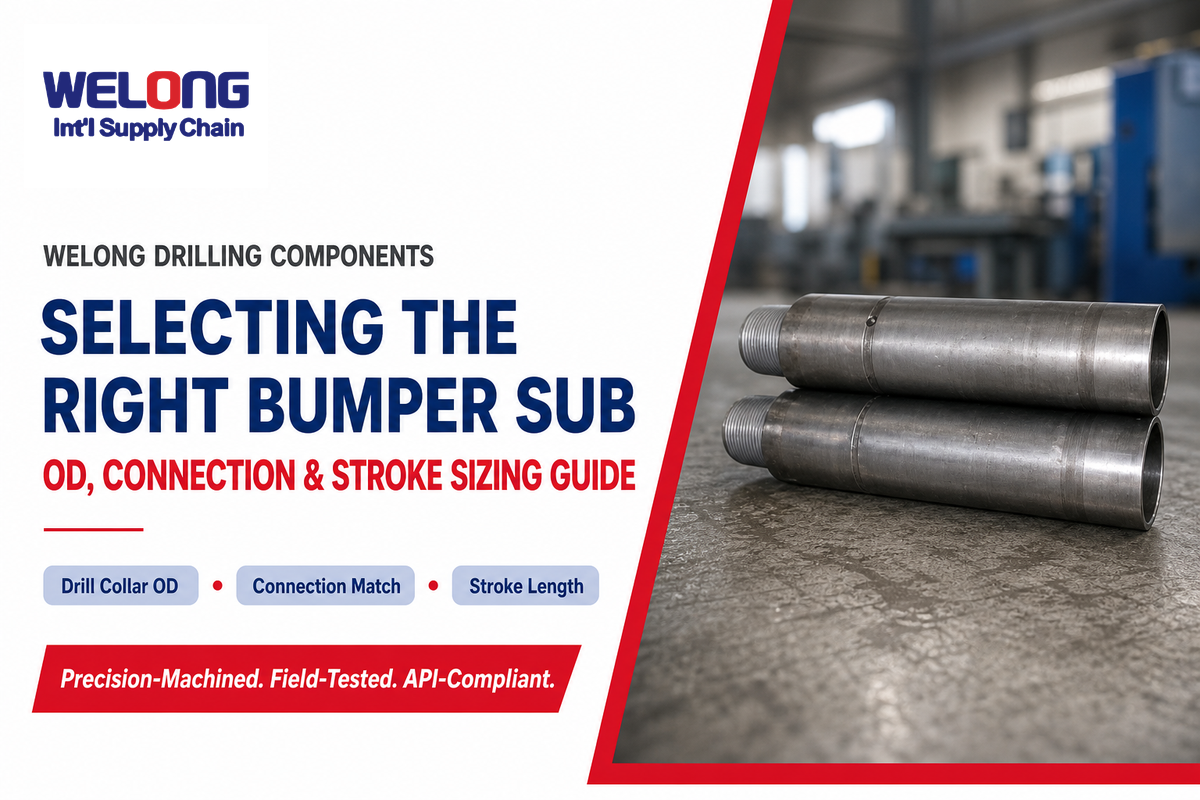
Beyond the mechanical-vs-lubricated decision covered above (see the pressure-balanced housing design in US Patent 3,329,221), four factors determine whether a bumper sub actually fits the job:
Selection Checklist
- Connection type – must match the rotary-shouldered thread family used on the string above and below it (Regular, IF, FH, and similar), not just the nominal size
- OD and ID – OD must clear the wellbore or casing restriction with margin; ID affects fluid circulation and wireline access if needed mid-fish
- Stroke length – longer stroke gives more feel and more feed-off travel, but adds overall string length and requires more rig-floor room to work the tool
- Tension and torque rating – must exceed the anticipated jarring load and the string’s running torque with margin, not just match it
Several manufacturers’ industry spec sheets list the operating bumper sub working tension rating as between 300,000 and more than 1,000,000 lb, and operating torque between 7,500 and more than 15,000 ft-lb-all rising with the outer diameter. This gives a rough industry benchmark against which to compare an actual quotation; though individual manufacturers use their own tested numbers instead of a single composite table. Welong’s KXJ mechanical and BXJ lubricated bumper sub series range between them across this entire scope, from NC23 up to 7-5/8 REG, which means the selection can be dictated by well-bore conditions rather than by whatever one size a vendor happens to have on hand.
A good approach to using the list: start with the connection family currently in the string (don’t work the other way around), check that the OD will pass through your minimum ID restrictions, and then pick stroke and tension for the specific fishing job – for instance, a short, high-tension stroke will feel for a fish in a tight bore, whereas a longer stroke is needed if feed-off and/or rig-heave compensation on a floating rig is paramount. In the field, undersizing the tension rating is a common and costly mistake: a bumper sub rated below the anticipated jarring load can fail mid-run, adding another 8-12 hours of remedial fishing just to recover the failed tool itself before the original job can continue.
The 12-Model Type-to-Connection Reference Matrix
To make the connection-first approach concrete, here is Welong’s full KXJ mechanical and BXJ lubricated model range, sorted by outer diameter. Cross-check your string’s connection and target OD against this table before requesting a quote:
| Model | Type | O.D. (mm) | I.D. (mm) | Sealing Pressure (MPa) | Work Stroke (mm) | Connection |
|---|---|---|---|---|---|---|
| KXJ31B | Mechanical | 79 | 25.4 | 20 | 508 | NC23 |
| BXJ31B | Lubricated | 80 | 25.4 | 30 | 394 | 2-3/8 REG |
| KXJ36B | Mechanical | 95 | 32 | 20 | 508 | NC26 |
| BXJ36B | Lubricated | 95 | 28 | 30 | 394 | NC26 |
| KXJ42B | Mechanical | 108 | 38 | 20 | 508 | NC31 |
| BXJ44B | Lubricated | 114 | 38 | 30 | 394 | NC31 |
| BXJ46B | Lubricated | 121 | 38 | 30 | 400 | NC38 |
| KXJ62B | Mechanical | 159 | 51 | 20 | 1400 | NC50 |
| BXJ64B | Lubricated | 165 | 57 | 30 | 460 | NC50 |
| KXJ76B | Mechanical | 197 | 70 | 20 | 1500 | 6-5/8 REG |
| BXJ80B | Lubricated | 203 | 76.2 | 30 | 465 | 6-5/8 REG |
| KXJ90B | Mechanical | 229 | 76 | 20 | 1500 | 7-5/8 REG |
On tensile rating, the mechanical KXJ line runs from 300 kN on the smallest NC23 model up to 2,200 kN on the largest 7-5/8 REG model, with work torque scaling from 3 kN·m to 25 kN·m across the same range — the full 12-model spec sheet with tensile and torque ratings by model is available on Welong’s bumper sub product page.
It’s worth being honest that this table is a starting filter, not the whole sizing decision. Fishing-planning references in the industry typically size a full assembly — bumper sub, jar, overshot, and accelerator together — against the fish itself: its outside diameter, whether the top profile is known, deviation and doglegs in the interval, and expected pressure and temperature, not the bumper sub in isolation. A bumper sub that matches the connection and tension table above but ignores the surrounding BHA design is still a mis-sized tool. For an ongoing inspection reference beyond the running checklist below, API also publishes RP 7G-2, covering inspection and classification of used drill stem elements, alongside Spec 7-1 itself.
Running, Inspection & Maintenance Best Practices
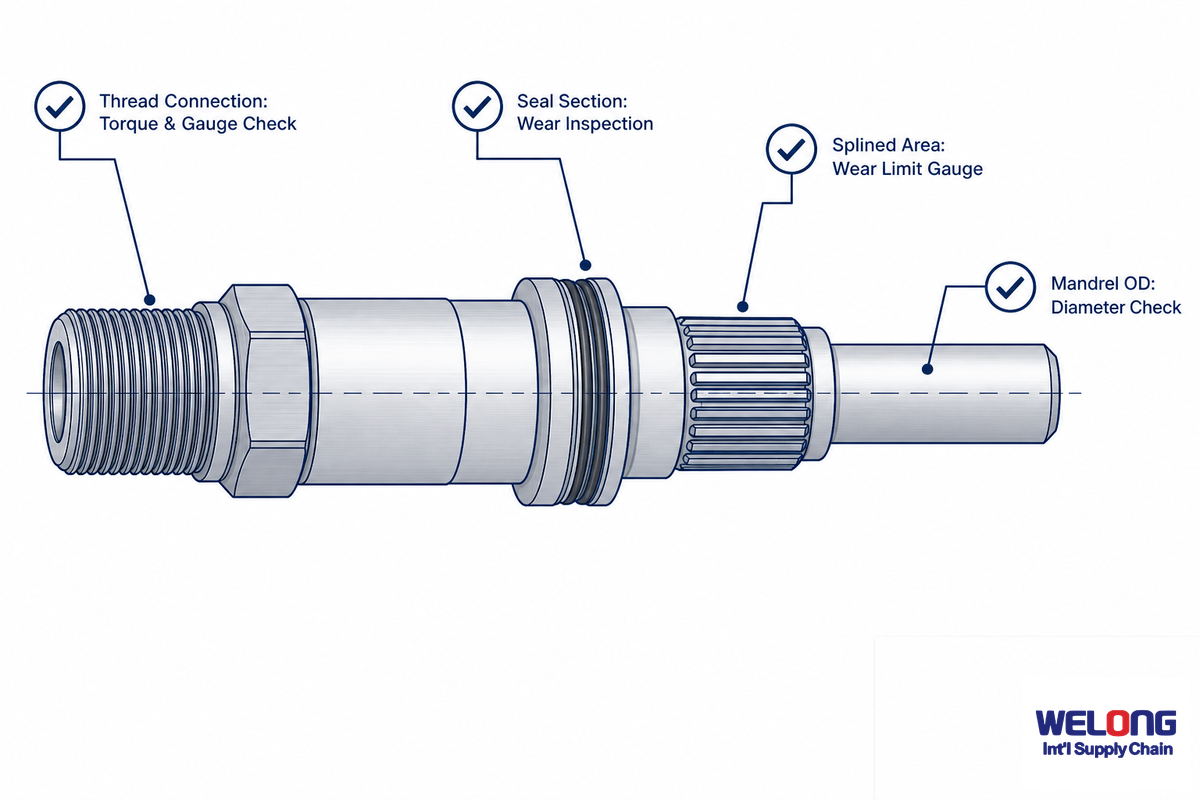
Most bumper sub product sheets claim, quite unequivocally, that the unit is built to “API Spec 7-1.” While true on one level, the statement deserves a bit of nuance. The API’s current product list distinguishes API Spec 7-1, Rotary Drill Stem Elements, from API Spec 7-2, Threading and Gauging of Rotary Shouldered Connections, and Spec 7-1 explicitly directs the design and gauging of the rotary shouldered connections to Spec 7-2. Only the threads, not the bumper sub body itself, actually require Spec 7-2 gauging and dimensional tolerances to ensure it connects properly to the other members of an API-compliant drill string.
Both specifications are current and under revision, API confirms that Spec 7-1, 2nd edition, has Errata 2 effective November 2025 and Spec 7-2, 2nd edition, has Addendum 3 effective September 2025-so a supplier’s compliance statement is only valid for the version it was certified against.
Whether a supplier’s design standard compliance and whether they follow a quality-management standard are entirely separate considerations and are worth verifying.
API-Q2 is the API quality-management standard for the oilfield equipment sector; ISO 9001:2015 is a general manufacturing quality standard. Welong has ISO 9001:2015 certification, and inspects its bumper subs with a third party (SGS/DNV), so it’s wise to request the quality certification and mill test certificates for the specific batch from any supplier.
📐 Engineering Note
Before going in hole, check the mandrel travels the full stroke length without binding, the condition of both threads compared to the appropriate API Spec 7-2 gauging tolerance, and the condition of the seals on lubricated models by looking for signs of oil weep from the housing interface. When the bumper sub come out of the hole, perform the same inspection and check again for stroke length versus original tool dimensions; any loss in lubricated stroke is a sign of seal failure rather than just wear and tear.
OSHA’s oil and gas well servicing guidelines categorize bumper subs along with other fishing tools within its special-services hazard classification, identifying the risk of a struck-by hazard during jarring, hoisting and rotation and recommending wireline and connection inspections prior to use as well as a documented job hazard analysis for fishing operations – a reminder that the inspection discipline mentioned above is a safety best practice, not merely one that’s beneficial for tool life. On offshore work, the Bureau of Safety and Environmental Enforcement’s regulatory programs, including its Well Control Rule, add a further layer of inspection and compliance expectations on top of the manufacturer’s own standards.
Industry Outlook, What’s Changing in Fishing Tool Design
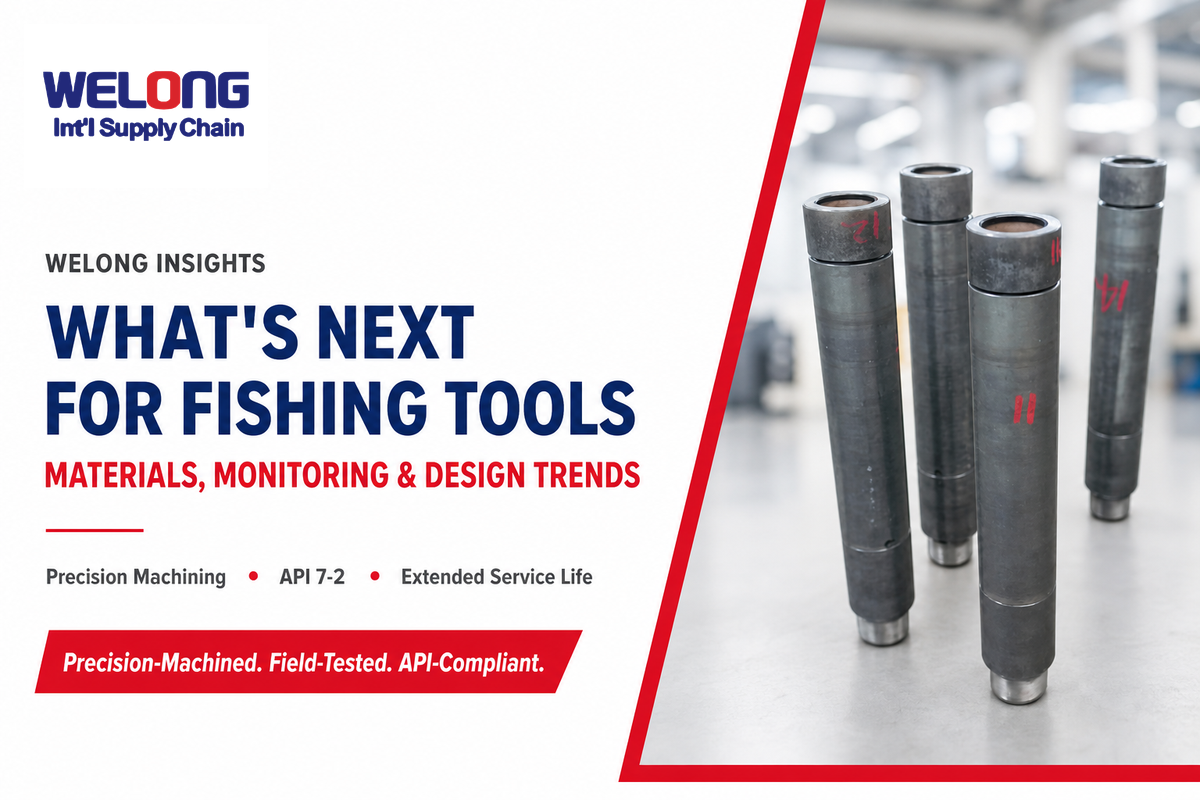
(Updated July 2026) The clearest immediate influence on fishing tool design isn’t new mechanics – the bumper sub’s core mandrel and spline concept hasn’t changed much in five decades – but the drive to outfit normally mechanical fishing tools with real-time downhole instrumentation. Customers increasingly prefer fishing strings that communicate pressure, temperature, and engagement status to surface as the tool is deployed instead of depending solely on surface weight readouts and feel to gauge success when fishing a tool or performing a jarring stroke. For an operator planning to procure fishing tools in 2026 or 2027, the practical move is to ask suppliers about sensorized versions of their bumper sub and compatible catch tools instead of assuming the mechanically-operated tools will be the only choice moving forward. Regulatory emphasis on real-time well-control monitoring, reflected in BSEE’s own Well Control Rule, is part of what is pushing operators toward instrumented fishing strings rather than purely mechanical ones.
A second, and far less sexy, driver is helping propel the first one: a large volume of today’s fishing jobs involve remediation work on mature fields with long well lives where lost time due to a failed fishing operation becomes less tolerable, and as a result, the market become more receptive to tools that minimize guesswork. While market-size figures for the oil-and-gas fishing tools market can vary widely, most sources predict mid- to high-single-digit CAGR growth for the market as a whole through the early 2030s, with mature-field maintenance being the underlying demand driver, not a resurgence in new well drilling – whether that means completing the original interval in the target formation or sidetracking around the fish entirely once recovery is judged uneconomical.
This shift creates a real capability gap and risk for buyers who wait too long to ask: fishing-tool suppliers that have not invested in sensor integration over the past 2-3 years are unlikely to catch up quickly, because retrofitting real-time telemetry requires redesigning the mandrel housing itself, not just bolting on a surface readout. In practice, suppliers that are already certified to ISO 9001:2015 and hold API-Q2 certification tend to have the manufacturing discipline to make that transition without sacrificing the mechanical reliability the tool depends on.
Frequently Asked Questions
Q: What is the difference between a bumper sub and a fishing jar?
View Answer
When operated, a bumper sub transmits a moderate, repeated impact to the drill string through a telescoping mandrel that continues to transmit torque throughout its entire stroke; its use typically involves feeling for a fish or releasing a catch tool. A fishing jar uses stored mechanical or hydraulic energy and delivers a single, instantaneous, high-force impact, applied when a fish is unresponsive to the gentler impact delivered by a bumper sub, which it would try to feel or coax free before attempting to retrieve. the two tools are most often run in combination in the same jarring assembly as they serve different purposes: A bumper sub can’t help a fish that’s seriously stuck, nor is a jar the ideal tool for the feeling/release applications it performs.
Q: Can a bumper sub be used as a jar?
View Answer
Not effectively in the case of severely stuck pipe. A bumper sub’s stroke provides a relatively mild, repeated impact, not a high-energy release of stored energy, so while it can facilitate release of a lightly stuck fish, it is not effective as a substitute for a purpose-designed fishing jar. Both the bumper sub and jar are commonly run in tandem on the same jarring string as complementary tools, rather than as alternative options.
Q: Why use a bumper sub instead of jarring directly with the drill string?
View Answer
Striking directly with a stiff string is like whacking an entire system, including the rig, without any travel control for damping the impact. A bumper sub, with its stroke, will take that impact and translate it into a precise and repeatable impact on the tool itself. This reduces the shock loading for the rest of the string, and allows the operator to “feel” the top of the fish by exerting some weight, not the entire string weight, in a single shot.
Q: How long is a typical bumper sub stroke length?
View Answer
Stroke lengths on the market generally run 10-20 inches for standard units, while some heavy-duty models have strokes as long as 36 inches, providing increased feed-off travel or rig-heave compensation.
Q: What certifications should a bumper sub manufacturer hold?
View Answer
It is useful to look for ISO 9001:2015 certification for general manufacturing quality, and API-Q2 for oilfield-equipment-quality. It’s also good to have a third-party inspection of the production lot, rather than simply a generic company claim (e.g., SGS, DNV).
Q: How often should a bumper sub be inspected or serviced?
View Answer
Pre-fishing trip checks: at a minimum: full stroke test, thread condition of both connections and, for lubricated units, seal condition. Post-fishing trip inspection: inspect these points again, and measure stroke against a previous measurement, logging it against a baseline – a shortening stroke on a lubricated unit is a signal of premature seal wear and indicates a need to take action before the next run.
Why We Write This
We published this guide because almost no information about bumper subs exists online beyond spec sheets and unattributed field rules. We fact-checked the selection criteria, mechanism, standards, and economics against government safety guidance, published research, and U.S. patents – and found that most “API Spec 7-1 compliant” claims from manufacturers actually point to the wrong specification for the connection itself. Reviewed by the China Welong technical team.
References & Sources
- Oil and Gas Well Drilling and Servicing eTool, Special ServicesU.S. Occupational Safety and Health Administration
- Offshore Regulatory Programs: Regulations & StandardsBureau of Safety and Environmental Enforcement
- API Monogram and APIQR Latest UpdatesAmerican Petroleum Institute
- API Spec 7-1, Rotary Drill Stem ElementsGlobalSpec Engineering Standards
- A Step Change in Fishing Efficiency: Recovering Stuck Pipe Using the Fishing Agitation ToolSociety of Petroleum Engineers, OnePetro
- Analysis of Stuck Pipe in Deviated BoreholesSociety of Petroleum Engineers, OnePetro
- Review of the Pipe Sticking Mechanism in Oil Well Drilling OperationsJournal of Engineering, University of Baghdad
- US Patent 3,804,185, Jarring and Bumping Tool for Use in Oilfield Drilling StringsUSPTO / Google Patents
- US Patent 3,329,221, Pressure Balanced Bumper SubUSPTO / Google Patents
- US Patent 4,333,542, Downhole Fishing Jar MechanismUSPTO / Google Patents
- How Does Fishing Work?Rigzone Training
![Choke & Kill Hose: [Field Guide]](https://welongoiltools.com/wp-content/uploads/2026/07/choke-kill-hose-guide-featured-1-150x150.png)