Get in touch with Welong Company


Updated July 2026
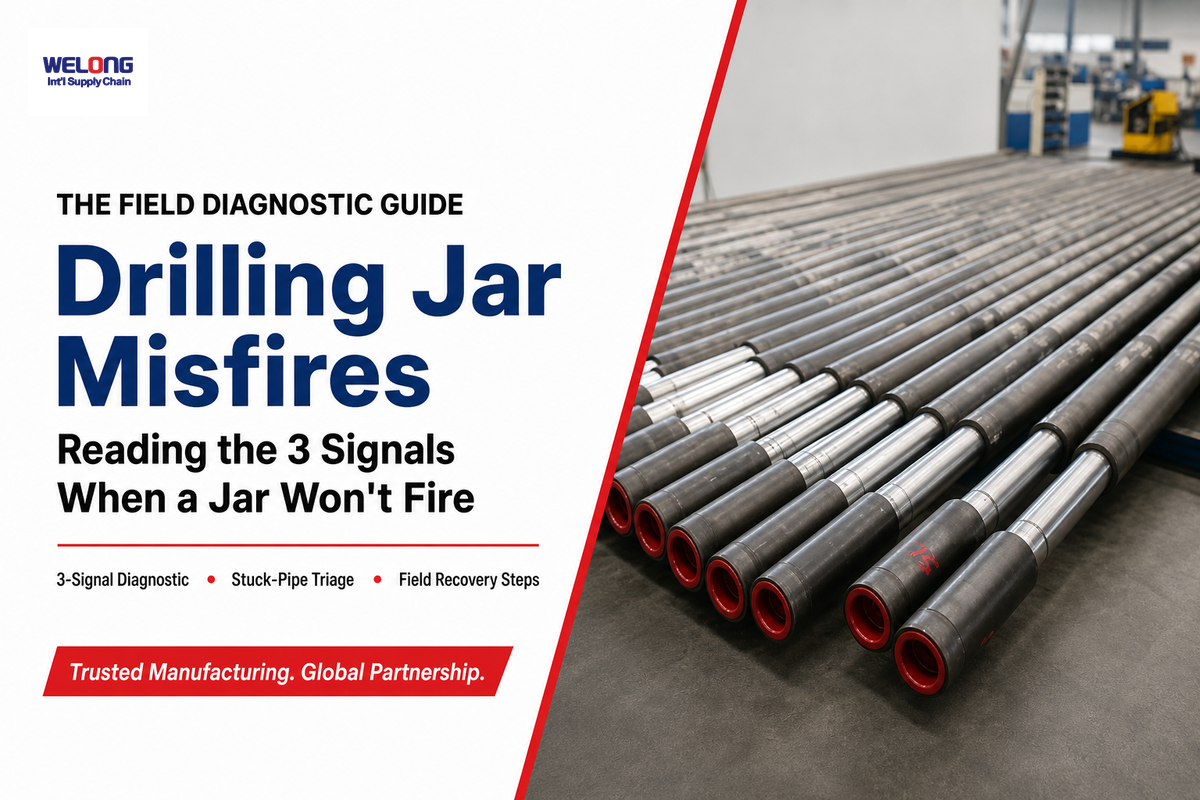
Drilling jars that won’t fire are a disquieting problem on a rig floor: the crew is already struggling with a stuck drillstring, and now the one tool built to fix it is refusing to work. Firing logic stays the same whether the jar is running in a drilling string or a fishing string. Most guides stop at describing what a drilling jar is supposed to do; this one covers what a misfire actually looks like, which of three specific signals it’s sending, and what each signal means for the next step.
Quick Reference: Misfire Signal → Likely Cause
| Tension climbs, no release | Delay-timing or seal issue |
| Releases, impact feels weak | Insufficient hammer mass or excess string friction |
| Partial or repeated releases | Mechanical latch wear or preset-tension drift |
Those three signals only matter once you know the jar is actually the right tool for the stuck string in front of you; a jar that never had a chance to work looks the same on surface gauges as a jar that’s genuinely misfiring, which is why triage comes before diagnosis.
Stuck Pipe Triage, Is This Actually a Jarring Problem?
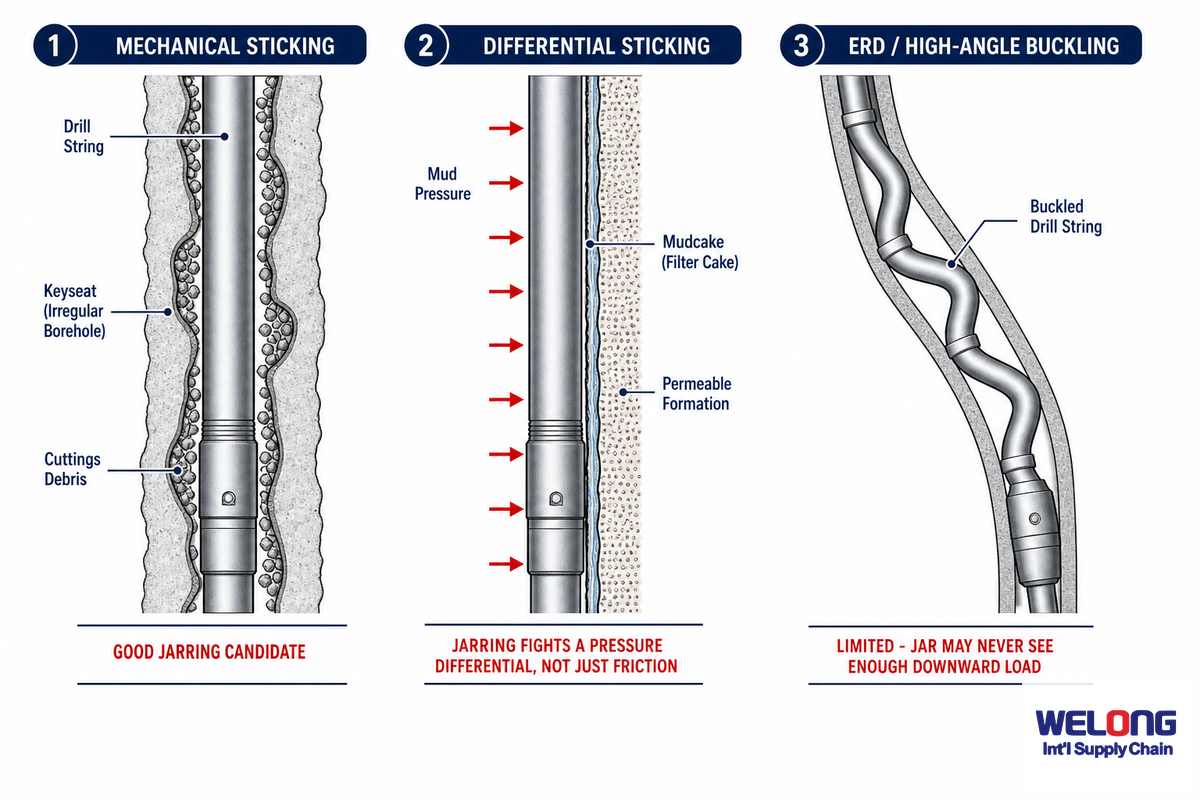
A rough estimate that often circulates in stuck-pipe research puts the toll at around one-third of total drilling time lost industry-wide, one of several such figures quoted in a Stanford University Energy Resources Engineering review of stuck-pipe prediction methods. Not every stuck string responds to a jar’s force the same way, and running a jar against the wrong cause wastes rig time without freeing anything.
| Sticking Type | What’s Happening | Jarring Response |
|---|---|---|
| Mechanical (keyseat, cuttings pack, wellbore geometry) | String physically obstructed by the hole itself | Good candidate, impulse needs to reach and overcome the obstruction |
| Differential sticking | Filter cake against a permeable formation under overbalanced mud pressure pins the string | Can work, but a jar fights a pressure differential, not just friction |
| ERD or high-angle buckling | Drill string buckles under compression before enough downweight reaches the jar | Limited, the jar may never see enough load to cock in the down direction |
The value of that third row far exceeds its perceived weight. On high-angle, extended-reach wells, downweight delivered to the jar may not be as great as it appears due to drill-string buckling – the tool can’t be cocked and fired downwards at all. Whatever a rig can overpull may be just as limiting on jarring upward as the downward force applied to hit hard. Assuming “jar it and see” without determining the condition (of these three possibilities) before trying to jar is equivalent to “fishing blind” and one of the common methods by which a crew gets “doubly stuck”: the string becomes stuck once on the original problem, then a jar attempt fail to nail the fix because the string was never going to free from that particular cause through impact load alone, and it stays stuck a second time over.
Reading a Misfire, The 3-Signal Diagnostic
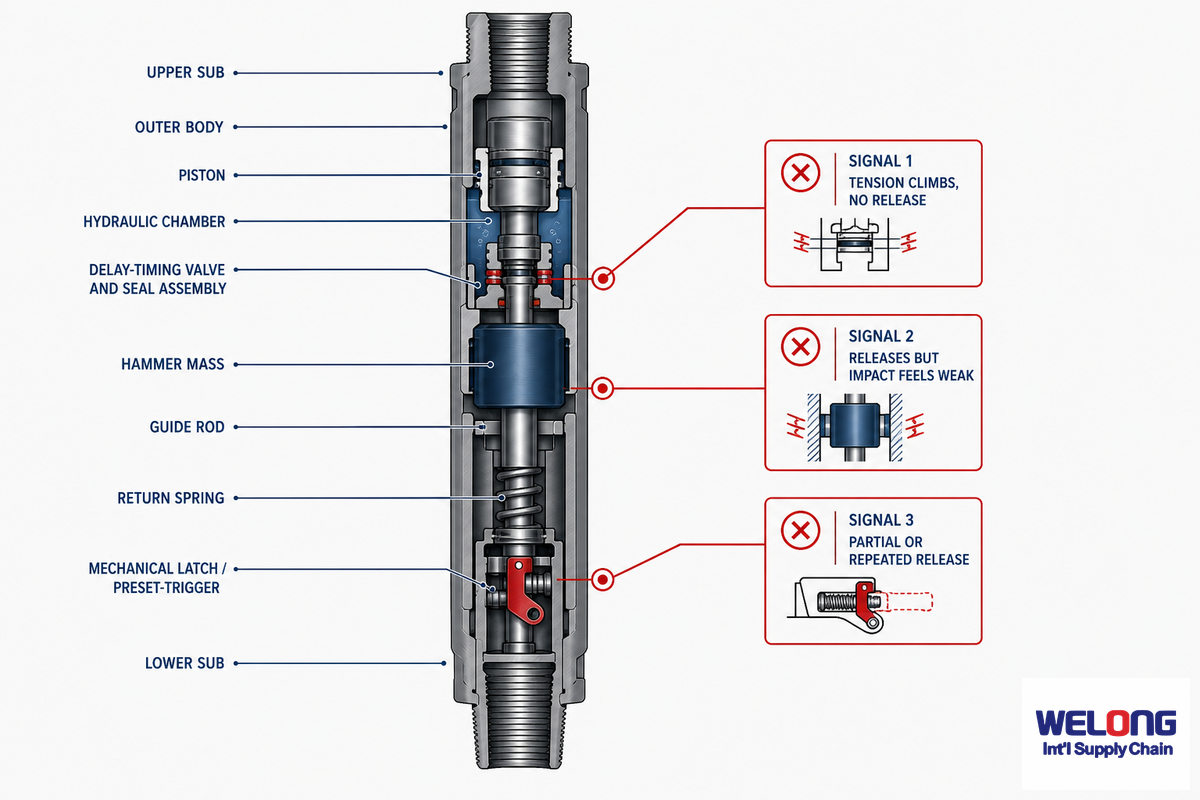
The drilling jar’s whole job is to amplify surface force into an impact force delivered as a violent downhole shot. The standard rig documentation about a jar focuses on this idealized action and doesn’t tell the rig hands what happens when it misfires – and the failure signature is your roadmap. The three signals listed below aren’t a list of manufacturer features; they’re organized around the measurements from the famous rig-floor test designed to figure out how jars work in the first place.
In one of the earliest and still most-cited jar bench-test programs, researchers used jars from more than twenty units, from 6.25 inches up to 8 inches in outside diameter, in a purpose-built horizontal jarring rig, measuring release force, friction force, stroke length, time delay, and axial and tensile loading for each unit under controlled conditions.
A. Kyllingstad & G.W. Halsey, Rogaland Research, “Performance Testing of Jars,” IADC/SPE Drilling Conference, 1990 (SPE 20001-MS)
These four measurements, the release force, friction force, the stroke and the delay time, are exactly the dimensions that a misfire interferes with. That’s the reason field symptoms are classified into three signals instead of a lengthy laundry list of potential failures and the reason why a driller watching surface gauges can usually tell which signal is active well before a calculation has been touched.
Signal 1, Tension Climbs and Nothing Releases
string tension builds as expected but never gets the kick-release it was anticipating. This condition indicates either a problem with the delay-timing mechanism itself, a hydraulic metering restriction that fails to clear in timely manner, or a failed seal allowing pressure to leak instead of building it. In the case of a mechanical jar, this symptom will typically lead to a drifting preset trigger setting.
Signal 2, It Releases, But the Impact Feels Weak
It fires, but the resultant shock doesn’t feel proportional to the amount of tension that was in the string. Usually the problem is that not enough hammer mass was set on top of the jar to adequately strike it, or the amount of friction within the string’s guide rod is so high that much of the released tension energy is dissipated before it reaches the jar. Both issues can be considered as much questions of placement and string design as they’re defects.
Signal 3, Partial or Repeated Releases
It fires but fires weakly and perhaps even repetitively or may fail to fully complete its stroke. This pattern most strongly signals mechanical latch wear or a drift in the preset trip-tension setting, common once a jar has fired and been run across multiple wells without a full functional recheck.
⚠️ Important, Two Failure Lanes, Not One
Misfire issues are fundamentally different than structural jar failure. A 2023 Journal of Petroleum Technology summary of an SPE study involving fatigue analysis concluded that because of their complex shapes and moving parts, which are prone to concentrating stress, especially in larger borehole sizes, the jar is one of the weakest points in the drill string. But the fact that a jar fires exactly per design does not mean that it cannot break off at a connection due to cyclical bending stresses. That’s placement and connection-design issue, not a misfire, and it is covered more in the placement section on our drilling jar solution page.
For the most part, causes of the three signals are straightforward. Improper tune-up and excessive operation cycles can prematurely weaken internal components of a jar, and while it’s a very common cause of premature jar failure, there won’t be a visible flaw when it first occurs well. Sometimes this problem stems from crews or vendors working the job changing out partway through, because each vendor’s tools require different calibration. Even a properly placed jar may have inadequate hammer mass, incorrect placement calculation or other string-balance and impulse math problems.
When Standard Jarring Doesn’t Work, Field Recovery Options
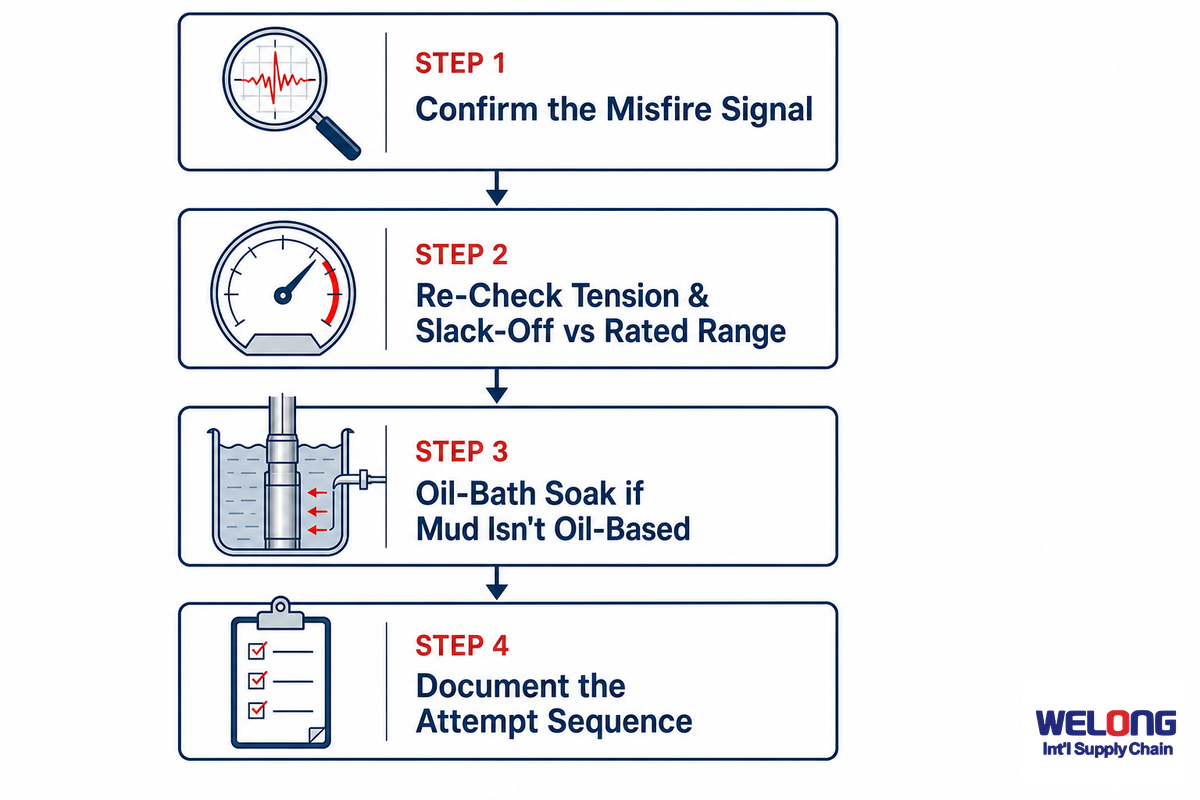
Diagnosing the signal is the first order of business. What the crew does next, when the initial jarring attempt doesn’t free the string, is more a matter of field experience than spec sheet: a long-running Eng-Tips engineering discussion puts the force needed at roughly 40-45 tons to activate a first mechanical stroke, and 60-80 tons for a second hydraulic stroke.
Those figures aren’t universal for every model and the discussion itself isn’t recent, but the underlying physics hasn’t changed, and they still set a realistic expectation for how much force a crew should plan to apply before assuming the tool itself has failed.
That same Eng-Tips discussion describes a field fix for when jarring is proving ineffective and the mud isn’t oil-based: pumped some oil down the annulus at the depth of interest, then hung the drill pipe at its own weight (undisturbed) for about 12 hours. After that, worked the string free again. Oil reduces friction and differential pressure in the stuck interval far more effectively than repeated jarring can when given time to work into the filter cake.
A Practical Escalation Order
- Confirm the misfire signal (1, 2, or 3 above) before changing anything else on surface
- Re-check tension and slack-off settings against the jar’s rated activation range before assuming a tool fault
- If jarring produces no effect and the mud isn’t oil-based, consider an oil-bath soak with hydraulic oil at the stuck interval before further mechanical attempts, a reset of the plan rather than a repeat of the same jarring action
- Document the attempt sequence and resume normal drilling operation only once the jar’s release has been confirmed, this is exactly the data a manufacturer need if a unit is returned for a functional recheck
downhole hydrostatic pressure and any deviation in the wellbore can alter the force that actually reach the jar, which means the field-tested force is a planning guide, not a constant; computerized placement modeling (SPE-14746-MS) accounts for these downhole variables more precisely than surface judgment alone. There’s also risk involved in handling drilling jars themselves; this and other surface equipment represent documented safety hazards on the rig floor, particularly when a mechanical locking device to prevent cocking isn’t in place. That needs careful thought prior to putting crews under the pressure to speed things up on a stuck string.
Mechanism, Placement & Sour Service, Quick Reference
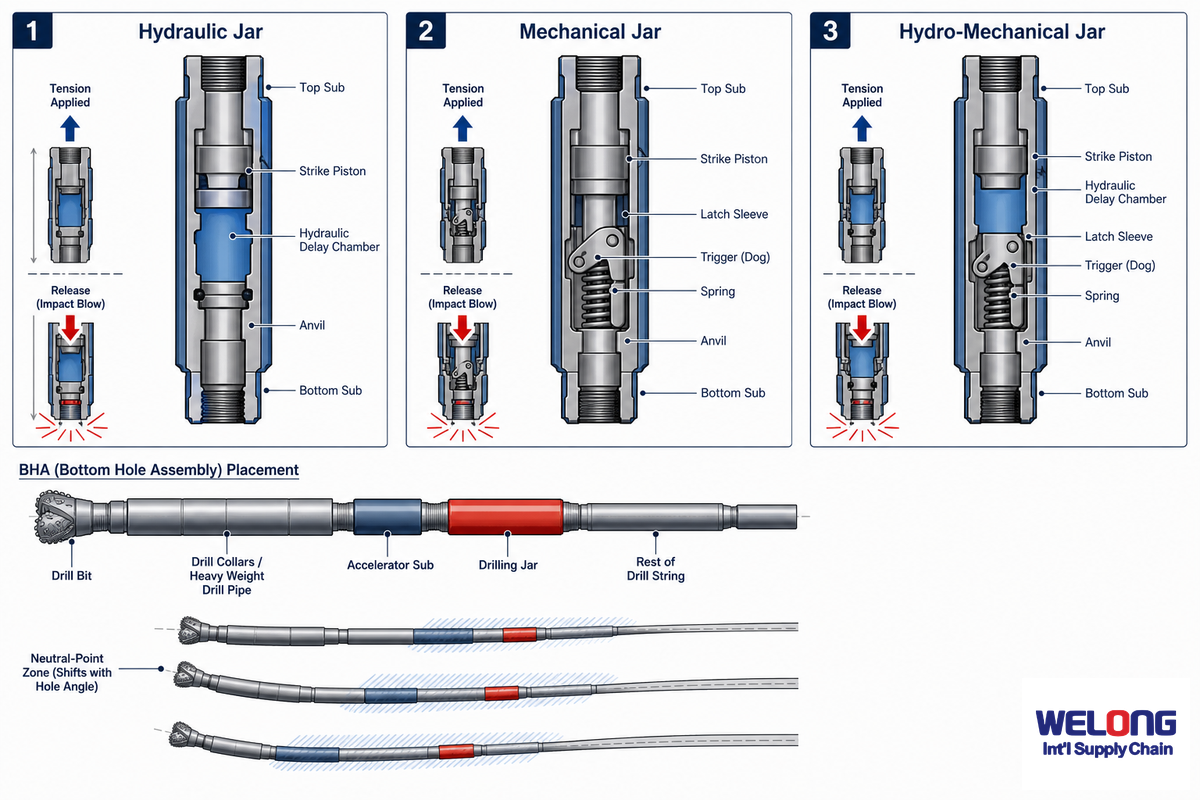
This diagnostic is based on a certain level of comfort with the operation of hydraulic and mechanical drilling jars, their position within the bottom hole assembly, and the effect of sour-service conditions on jar materials. Those topics get a full explanation elsewhere on this site. Here’s the quick summary, complete with links:
- Mechanism: a hydraulic drilling jar uses a metering delay before releasing stored tension as an upward or downward blow, with internal fluid pressures that can run into the thousands of psi on larger models, delivering its upward or downward impact loads once the delay clears; a mechanical jar uses a preset trigger rather than a double-acting hydraulic delay, and a hydro-mechanical design combines both jarring actions. Force applied at surface determines the magnitude of the impact delivered downhole, whether the string is running vertical or deviated. See the full double-acting jarring breakdown.
- Placement: jars sit in the upper part of the assembly, usually with the drill collars or heavy weight drill pipe, with enough hammer mass above them and, on many designs, an accelerator sub to help the string stretch and store energy before the jar suddenly releases it. Computerized placement modeling has shown that surface-reaction judgment alone can miss what downhole is really doing in tapered strings and directional wells, which runs against the common assumption that the neutral point sits at one fixed spot in the string. It doesn’t; the zone shifts with hole angle and weight-on-bit, so a flat buffer number isn’t always a safe placement rule on its own. Full placement guidance including how drilling conditions in ERD wells change the neutral-point assumption is on the solution page.
- Sour service: ANSI/NACE MR0175-2021/ISO 15156:2020 governs H2S-environment material selection, and industry explainers of the standard describe high-strength BHA tools, jars included, as often unable to withstand or meet its low-hardness limits, which is why sour-service risk on a jar job is usually managed through drilling-fluid chemistry and lubricant selection rather than a jar-specific certification. More detail is on our solution page’s sour-service section.
- Adjacent BHA components and use cases: a stabilizer or downhole motor immediately above or below the jar change the bending-stress picture at the connection, which is why sizing a jar in isolation from the rest of the tool string rarely works. This same double-acting mechanism used to free stuck drill pipe applies equally to running jars in workover and fishing operations, and to fishing jars used to retrieve lost tools rather than free stuck drill pipe. Some designs, such as National Oilwell Varco’s ShockForce line, add a mechanical lock so the jar can’t cock and fire while tripping in or out of the hole.
None of this replaces a proper calculation for a specific well, high-temperature bottom hole conditions and deep, deviated geometry both change the numbers, but it’s enough to get through the rest of the diagnostic without treating “the jar” as a black box.
Industry Outlook, Sensor-Assisted Firing Confirmation Is the Real Recent Innovation
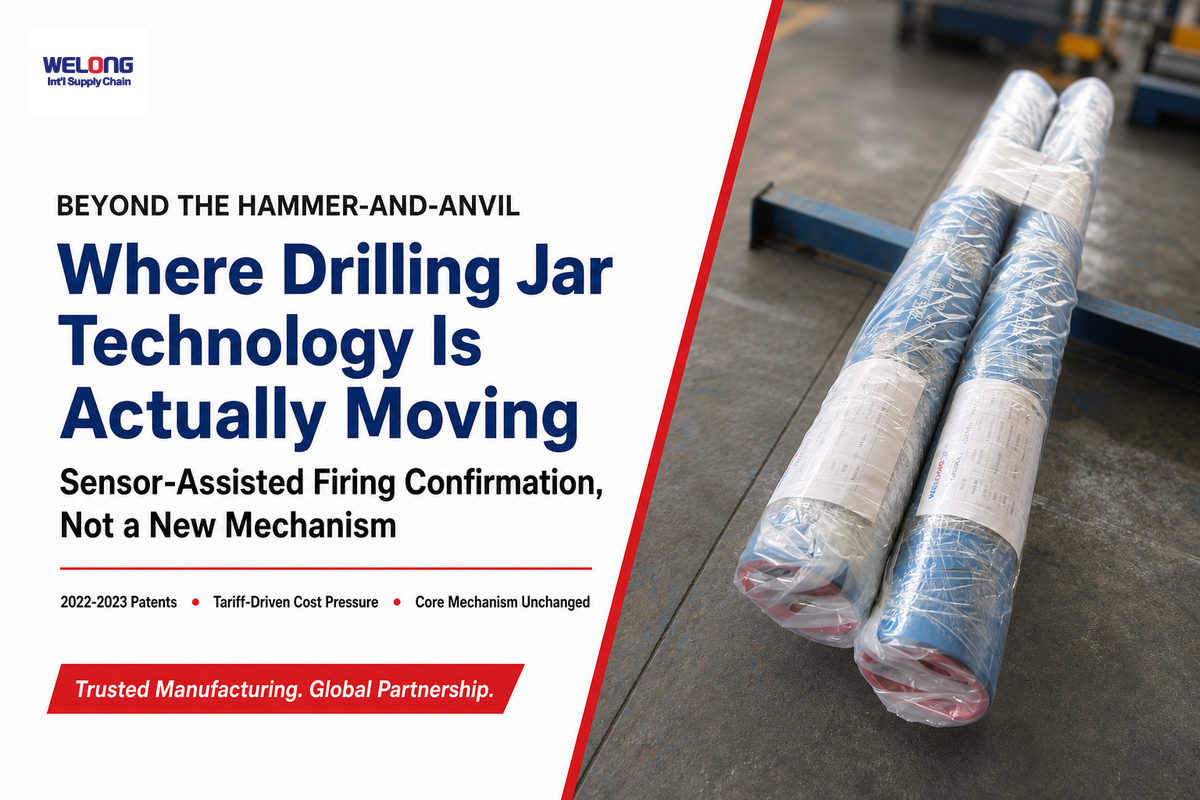
Saudi Aramco was awarded a patent (US11506011B2) in November 2022 for a ‘smart jarring device.’ Unlike previous efforts that focused on the physical mechanics of initiating and controlling a jarring action (using what’s known as the hydraulic and mechanical firing principle), the new design centers on adding instrumentation to ‘see’ the jarring action. It combines the use of laser transmitters and receivers with multiple sensors – to measure temperature, torque, tension and vibration – as a means to pinpoint when and how a jar fired. In an application filed a year later in 2023, Saudi Aramco proposed another system for jar firing; this time the objective wasn’t merely detection, but also anticipation of problems. The application outlined a ‘multi-directional jar apparatus with pre-emptive activation using an internal helical groove, proximity sensors and velocity sensors.’ This mechanism aimed to jar in advance to prevent a drill string from getting stuck, rather than waiting until after the fact. However, this particular design seem to have been abandoned, according to Google Patents’ records. Even so, the patenting activity is telling: The current cutting edge in drill string technology is moving away from mechanical ingenuity toward sensor-based confirmation and prediction of mechanical events, such as jarring events. That’s a somewhat counterintuitive picture for anyone expecting a new generation of hammer-and-anvil hardware; the core jarring mechanism itself has barely moved in decades, and the real innovation has shifted to reading it rather than reinventing it.
That move towards instrumentation, alongside the automated stuck-pipe-detection systems using deep-learning models mentioned earlier that could anticipate a full stick before it happens, extends naturally to the cost side. Both section 232 tariffs (on steel and aluminum) went from 25% to 50% beginning June 4, 2025, and for US operations specifically, oil country tubular goods costs rose by roughly 40% from year to year in Q4 2025, adding an estimated 4% to well total cost. While this may not translate to every jar supplier including bench-test values in a spec sheet for next quarter, the pressure is definitely on, because when the equipment prices go up the questions go up as to what’s truly behind that reliability claim in the first place as opposed to relying on the number on a brochure.
Frequently Asked Questions
Q: What does it mean when a drilling jar’s tension climbs but nothing releases?
View Answer
Here is signal 1 of misfire diagnostics: a timer or delay circuit on a hydraulic jar isn’t clearing at the proper time, or the seal integrity has been compromised. On a mechanical jar, it normally signals a preset trigger that has slipped from its original set-point and needs a functional recheck.
Q: How much force does it actually take to activate a stuck drilling jar?
See the Figures
Discussions between drilling engineers suggest a mechanical jar stroke needs roughly 40-45 tons to activate, with a second hydraulic stroke around 60-80 tons, though the real number varies by model and well. Treat this as a planning estimate, not a fixed spec, and check the jar’s own rated activation range.
Q: What’s a field workaround when jarring alone won’t free the string?
Read the Technique
When jarring alone has no effect and the mud isn’t oil-based, one field technique pumps oil into the annulus at the stuck interval, then leaves the string under its own weight for roughly twelve hours before trying mechanically again. The goal is letting the oil work into the filter cake at the stuck point, rather than relying on jarring alone.
Q: Is a weak jar impact always a sign the tool is defective?
Expand Answer
Usually not, and treating it that way is a common assumption worth dropping. Signal 2 (a weak misfire) tends to be related more to placement or a string-design flaw than the tool itself: insufficient hammer mass positioned above the jar, or friction in the string absorbing energy before the impact reaches the jar. Reviewing hammer mass and string friction, and confirming the tool is set up within its rated activation range, is more fruitful than concluding the tool itself has failed before pulling the string to inspect it.
Q: How does a drilling jar work, in short?
Show Answer
A hydraulic jar uses a time delay to build tension before releasing it as a sharp impact; a mechanical jar fires at a preset load instead of a timed delay. Full mechanism details, including double-acting jarring, are on our solution page.
References & Sources
- Stuck Pipe Prediction and Avoidance — Stanford University, Energy Resources Engineering
- Performance Testing of Jars (SPE 20001-MS) — Kyllingstad & Halsey, IADC/SPE Drilling Conference, 1990
- Computerized Drilling Jar Placement (SPE-14746-MS) — SPE/IADC Drilling Conference
- Improvement Plan Using Fatigue Analysis Minimizes Jar Twistoff — SPE Journal of Petroleum Technology
- ANSI/NACE MR0175-2021/ISO 15156:2020 — Materials for Use in H2S-Containing Environments in Oil and Gas Production
- US11506011B2, Method and Apparatus of Smart Jarring System — Saudi Arabian Oil Company, granted 2022
- Presidential Proclamation 10947 — Federal Register, Section 232 steel/aluminum tariff adjustment
- Stuck Drill String — Eng-Tips engineering forum discussion
About This Analysis
This piece grew out of a gap we kept noticing: most drilling jar content explains how the tool is supposed to work, but almost none of it addresses what a crew actually does when the jar doesn’t cooperate. China Welong has manufactured hydraulic and mechanical drilling jars since 2001, and our in-process and final inspection procedures, including third-party checks with SGS and DNV, exist precisely because a jar that passes a dimensional check on the bench can still misfire in the field for reasons that have nothing to do with the drawing. The diagnostic framework above draws on published bench-test research and field-engineer discussion rather than a single vendor’s field notes, because a misfire on a customer’s well isn’t the moment to test whose explanation is right.
Reviewed by the China Welong technical team.
Seeking the full catalog of hydraulic, mechanical, and hydro-mechanical drilling jars, complete with WLQY specification charts and API connection size information? Visit our drilling jar solution page, or find out more about China Welong.
Related Articles
- Drilling Jars, Hydraulic, Mechanical & Hydro-Mechanical Jar Manufacturer — full mechanism, placement, and selection matrix
![Casing, Tubing & Drill Pipe Elevators [Field Guide]](https://welongoiltools.com/wp-content/uploads/2026/09/casing-tubing-drill-pipe-elevators-guide-featured-768x512.png)
![Choke & Kill Hose: [Field Guide]](https://welongoiltools.com/wp-content/uploads/2026/07/choke-kill-hose-guide-featured-1-150x150.png)