Get in touch with Welong Company

Quick Specs
| OD Range | 3½” – 6⅝” |
| Position in Drill String | Between drill collars and standard drill pipe |
| Wall Thickness | Roughly 2–3× a standard drill pipe of the same OD |
| Typical Grades | 55,000 / 75,000 / 95,000 / 110,000 psi yield |
| Governing Standards | API Spec 7-1 (body) + API Spec 7-2 (connection thread/gauge) |
heavy weight drill pipe (HWDP, also written heavy-weight drill pipe or, informally, heavy wall drill pipe) is a thick-walled tubular placed between drill collars and standard drill pipe within a drill string that absorbs bending stress that would otherwise accumulate at that transition, preventing fracture of either component. HWDP isn’t just a lighter version of drill collars or a stiffer drill pipe; it’s a purpose-built engineered component with its own unique API specification, connection requirements, and failure modes. Its main function is to provide a gradual transition in stiffness between drill pipe and drill collars, not simply to add weight. Assuming it’s an interchangeable substitute for either neighbor is where design and selection errors arise.
HWDP is manufactured to API Spec 7-1 in outer diameters (OD) from 3½” to 6⅝”, carries a wall roughly two to three times thicker than same-size drill pipe, and is available in Standard, Spiral, Slick, and Non-Magnetic configurations rated at 55,000 to 110,000 psi yield strength depending on grade.
In This Guide
- What HWDP actually does in the drill string, and why “extra weight” is the wrong way to think about it
- HWDP’s functional role in a drill string and why “additional weight” is a mischaracterization
- Comparing the benefits and cost implications of the four available HWDP types
- Access to full dimensional specifications, cross-referenced with manufacturer production data
- Navigating grade, connection, and standard specifications to avoid confusing drill pipe and HWDP characteristics
What Heavy Weight Drill Pipe Does in the Drill String
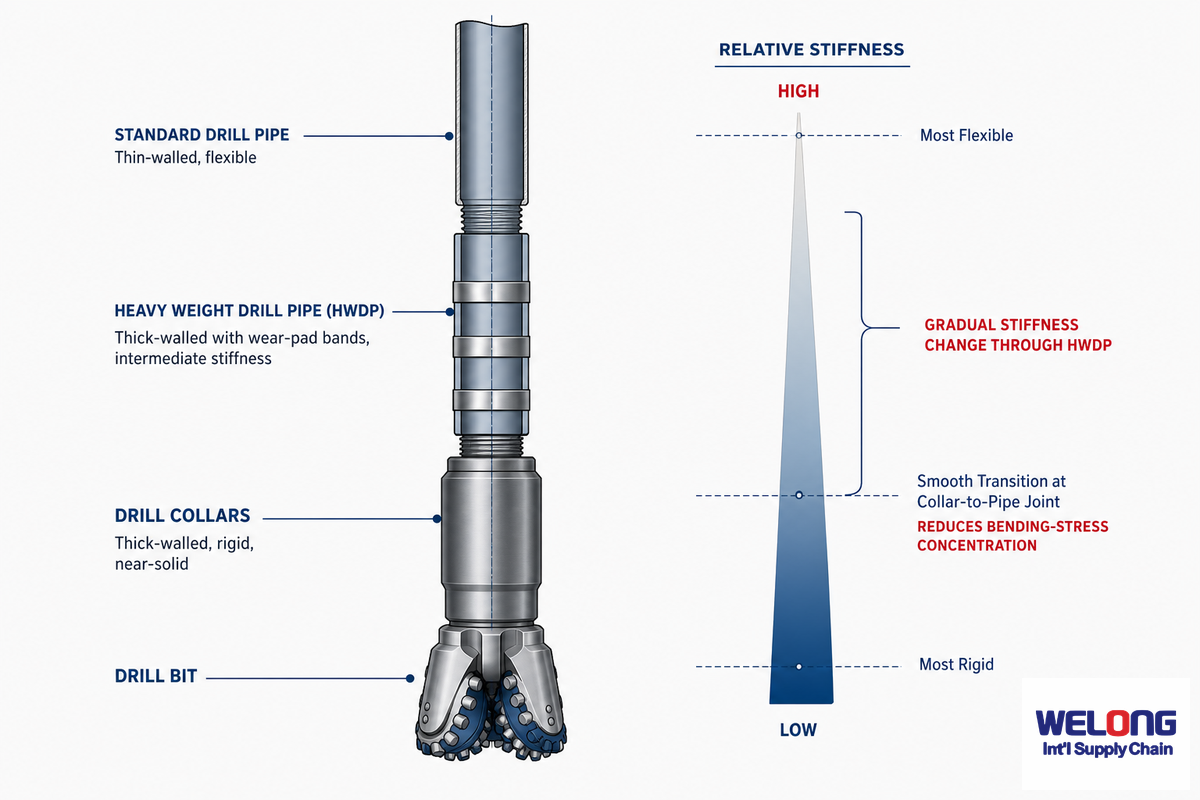
Every drill string experiences a stiffness mismatch at its two internal joints, where rigid drill collars meet flexible drill pipe, and at every build/curve/lateral transition in a directional well. A drill collar is a rigid, thick-walled tube; standard drill pipe is thin-walled and flexible. Connecting them directly concentrates cyclic bending stress at the joint, leading to drillstring fatigue fractures. HWDP exists specifically to manage that transition.
Left unmanaged, that transition-zone crack risk can cause a costly fishing job and 2 or more days of nonproductive rig time. China Welong engineers HWDP specifically because this is a structural problem, not an operator error, and it needs a dedicated component rather than a workaround. HWDP serves as a transitional component to alleviate this issue. Its thick wall lets it withstand buckling loads comparable to a collar, yet its overall stiffness fall between its neighbors, distributing bending loads over a greater length rather than focusing them on a single joint. In a directional or horizontal well, this stiffness characteristic also performs a secondary function as a weight-on-bit (WOB) delivery system. By positioning HWDP in the vertical or low-angle portion of the string, an operator can apply the necessary drilling weight without relying heavily on stiff, difficult-to-handle drill collars near the rig. Also, the increased flexibility of HWDP compared to a collar allows it to better tolerate the dogleg severity of curve sections. In practice, 20 or more joints of HWDP are frequently run between the drill collars and the drill pipe on a directional BHA. The precise quantity depend on the required WOB and the specific dogleg profile, rather than a standardized formula. Running fewer, well-placed HWDP joints instead of extra drill collars can also cut tripping time during long BHA make-up and break-out cycles, which matters on any HWDP drilling program with a tight rig schedule.
What Is Drill Pipe Used For?
Standard drill pipe is the hollow, thin-walled oilfield tubing that makes up most of the length of a drill string, the piece that transmits rotational torque and drilling fluid from the surface equipment down to the bottom hole assembly (BHA) and its drill bit. Its job is to convey rotary motion and fluid, adding very little weight to the string – the real drilling weight of a string comes from the BHA’s drill collars and HWDP, not the drill pipe.
Unlike generic steel pipe, this drilling process demands a purpose-engineered product: switching between grades of drill pipe isn’t a shortcut to correctly sized HWDP – drill pipe is a torque-and-fluid conduit, and a source of weight secondarily.
Types of Heavy Weight Drill Pipe
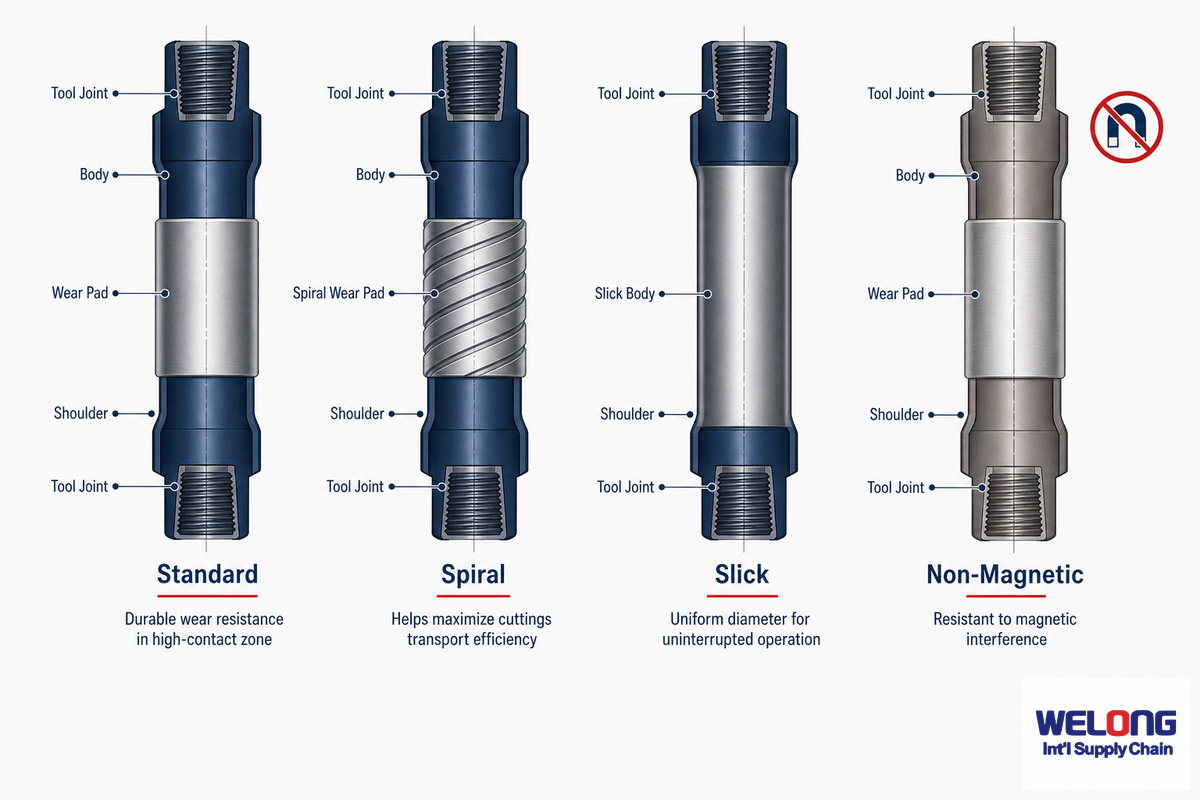
There are four common wear-pad setups used for most wells, the difference primarily related to how the tube interacts with the borehole wall, and only secondarily with the wall material.
Four HWDP Configurations
- Standard – full-length center wear pad. This is the default option for conventional vertical and low-angle wells.
- Spiral heavy weight drill pipe has a center section that’s helically machined to reduce the contact area of the tool with the wall and the chance of differential sticking. Can help with circulation of fluid in high-drag wells. Available as a full spiral or a three-spiral machine pattern.
- Slick – the center of the pipe is the same diameter as the ends, with no additional wear pad; used when it’s more important to keep the tool from rubbing the hole, for example, in certain fishing or casing-clearance situations.
- Non-Magnetic – Machined from non-magnetic materials (typically Monel), a design lineage documented in stress-corrosion-resistant HWDP patents, that won’t affect nearby survey or MWD tools. Required when drilling close to those instruments, optional in other cases.
Another classification that intersects the above, is the construction type. Options generally split between an integral (one-piece forged or friction-welded) tool joint and a welded tool construction. Most manufacturers can produce the Standard, Spiral, and Non-Magnetic versions of HWDP in either construction style. So a spec sheet for HWDP should confirm the wear pad style as well as the tool construction method. Hardbanding – a wear-resistant weld overlay on the tool joint OD – is sometimes specified as a separate service life measure, independent of which wear-pad style is chosen.
HWDP Specifications and Weight Chart
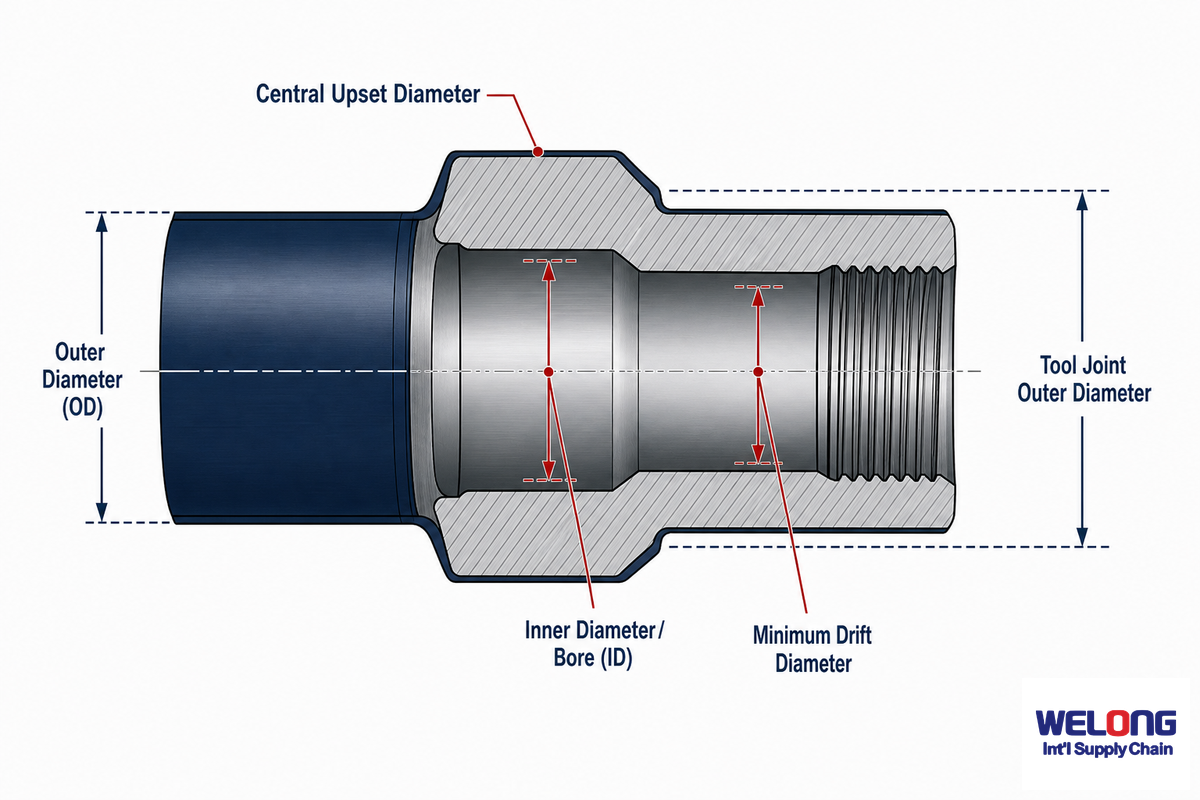
The following heavy weight drill pipe specifications and weight chart was created from a combination of Welong’s standard production spec sheet for their full line of HWDP with relevant requirements from the API Spec 7-1 publication, which governs the manufacturing process, connections, and dimensions.
| Size (OD, in.) | Conn. Type | Connection | I.D. (in.) | Tool Joint O.D. (in.) | Central Upset Dia. (in.) | Min. Drift Dia. (in.) |
|---|---|---|---|---|---|---|
| 3½ | Numbered (NC) | NC38 | 2¼ | 4¾ | 4 | 2 |
| 3½ | Numbered (NC) | NC38 | 2 1/16 | 4⅞ – 5 | 4 | 1 13/16 |
| 4 | Numbered (NC) | NC40 | 2½ | 5¼ | 4½ | 2¼ |
| 4 | Numbered (NC) | NC40 | 2 9/16 | 5¼ | 4½ | 2 5/16 |
| 4½ | Numbered (NC) | NC46 | 2 11/16 | 6¼ | 5 | 2 7/16 |
| 4½ | Numbered (NC) | NC46 | 2¾ | 6¼ | 5 | 2½ |
| 4½ | Numbered (NC) | NC46 | 2 13/16 | 6¼ | 5 | 2 9/16 |
| 5 | Numbered (NC) | NC50 | 3 | 6⅝ | 5½ | 2¾ |
| 5½ | Flush Hemispherical (FH) | 5½ FH | 3¼ | 7¼ – 7½ | 6 | 3 |
| 5½ | Flush Hemispherical (FH) | 5½ FH | 3⅜ | 7¼ – 7½ | 6 | 3⅛ |
| 5½ | Flush Hemispherical (FH) | 5½ FH | 3⅞ | 7¼ – 7½ | 6 | 3⅝ |
| 5½ | Flush Hemispherical (FH) | 5½ FH | 4 | 7¼ – 7½ | 6 | 3¾ |
| 6⅝ | Flush Hemispherical (FH) | 6⅝ FH | 4 | 8 – 8½ | 7⅛ | 3¾ |
| 6⅝ | Flush Hemispherical (FH) | 6⅝ FH | 4½ | 8 – 8½ | 7⅛ | 4¼ |
| 6⅝ | Flush Hemispherical (FH) | 6⅝ FH | 5 | 8 – 8½ | 7⅛ | 4¾ |
📐 Engineering Note
The central upset diameter – the actual size of the wear pad section – runs a consistent ½ inch over nominal OD across the production range (e.g., 4″ nominal → 4½” central upset; 5½” nominal → 6″ central upset), and this is the measurement that actually controls hole-wall contact and wear-pad life, not the nominal body OD. Confirm central upset diameter against your specific bit/casing clearance before ordering.
Steel Grades, Tensile and Torsional Ratings
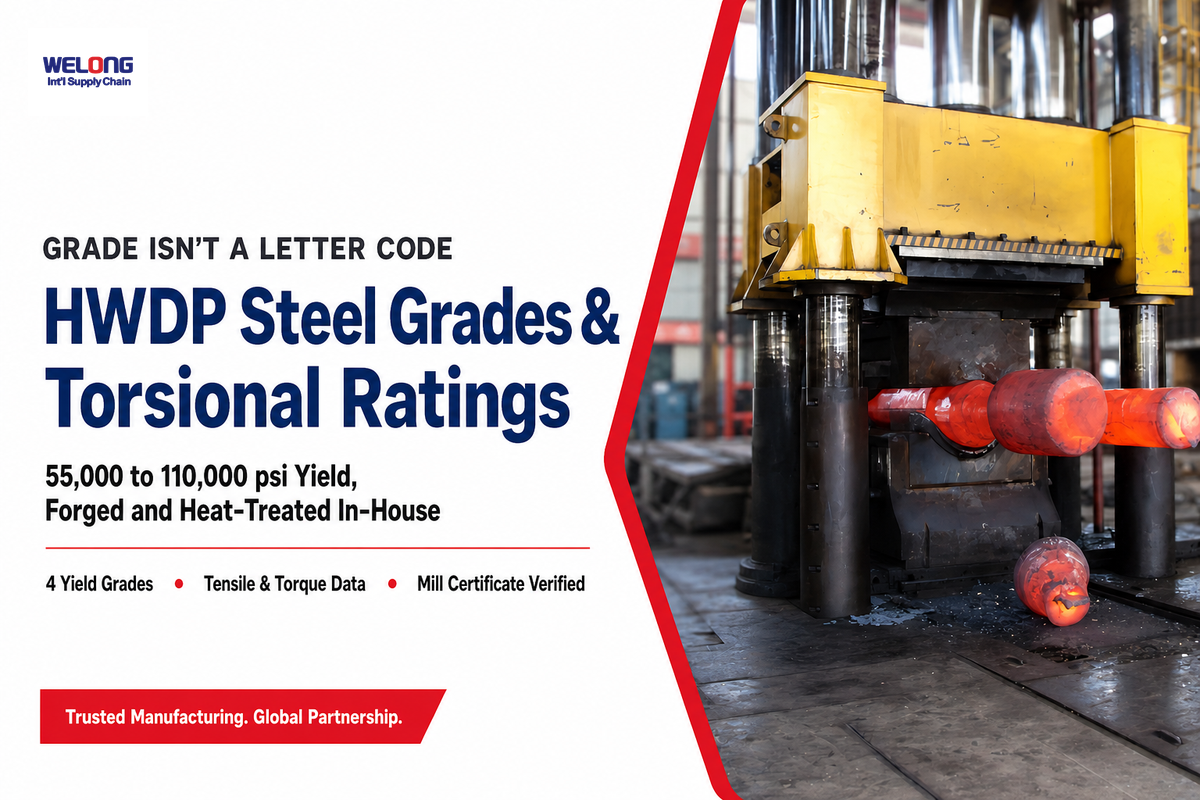
HWDP is specified by yield strength (conventional: 55,000, 75,000, 95,000 and 110,000 psi [typically integral], not the letter-grades from API Spec 5D/5DP for standard drill pipe, E-75, X-95, G-105, S-135) – a distinction documented in heat-treated HWDP grade research. Suppliers will list an HWDP grade as “75,000 psi” for example. If they refer to letter grades, ask them to confirm the actual yield strength.
To provide an example size, a 3.5″ OD HWDP joint would provide about 345,500 lbs tensile yield and 19,600 ft-lbs torsional yield; a 4″ OD joint goes up to about 407,600 lbs tensile yield and 27,600 ft-lbs torsional yield. Higher grade 5″ OD HWDP assemblies have shown yield torque between 52,000 and 105,300 ft-lbs, and tensile capacities of 691,200 to 1,382,300 lbs (depending on wall thickness and connection), with make-up torque in the 26,000 to 63,200 ft-lbs range for the same size. Again, these vary considerably by manufacturer and specific dimensional design – treat any number as a reference point, not a universal constant, and verify drilling torque and tensile ratings from the mill certificate of the actual joints you’ll run.
Choosing the wrong yield grade is a real risk, not just a paperwork problem: an undersized grade can crack or fail under torsional load in a high-torque well, and a single resulting stuck-pipe event can cost 2 to 5 days of rig time to fix. China Welong engineers each grade because field failures in the wrong application are far more expensive than the incremental cost of the correct one, with tolerance to published mechanical properties confirmed against Welong’s own 20+ years of production data.
Tool Joint and Connection Types (NC38–6⅝ FH)
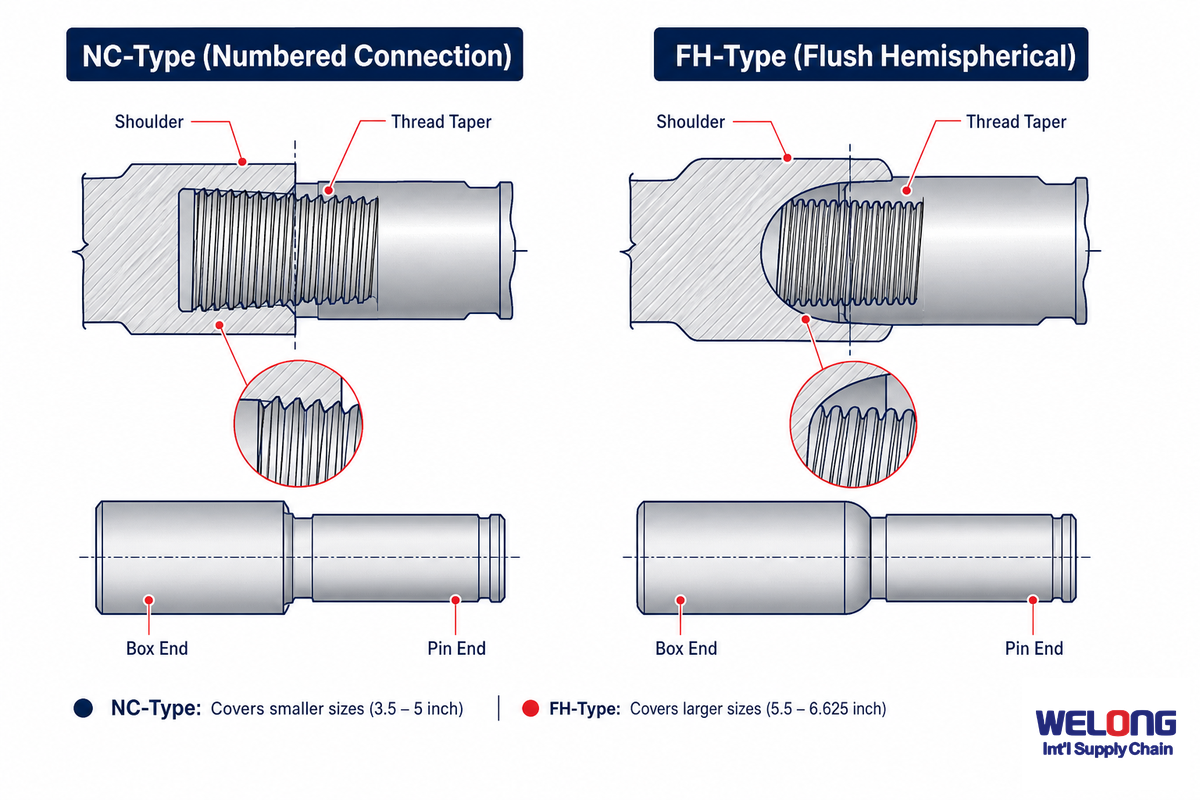
6 Size HWDP Connection Chart
HWDP connections span from NC38 on the smallest 3½” size all the way to 6⅝ FH on the largest 6⅝” size, and choosing the wrong one is one of the more expensive selection errors possible because the wrong connection leads to the wrong tool joint OD and drift diameter, not just threads that won’t make up. The full specification table above shows the corresponding connection for each production size, but the general trend to remember is that the smaller “NC” sized connections (NC38 through NC50) are for the smaller diameters, while flush-hemispherical “FH” connections dominate the 5½” and 6⅝” sizes to handle the larger tool joint OD through a wider shoulder.
💡 Pro Tip
While the body dimensions of HWDP tubes and their manufacturing are addressed by API Spec 7-1, the actual threading and gauging for those NC and FH connections is covered by a different standard, API Spec 7-2 (Threading and Gauging of Rotary Shouldered Connections). If a supplier simply tells you they are “API 7-1 compliant” when describing the connection quality, all that’s been communicated is that the pipe body itself meets specification; you must specifically ask if the thread form and gauging have been inspected to API Spec 7-2.
Overall performance specifications of the completed joint, which include torsional and tensile yields at the connection (not just the tube body), fall under yet a third standard, API RP 7G-1 (Drill Stem Design and Operating Limits), which includes a very important disclaimer that its provided performance data represents calculated values and must be considered as guidelines, not guarantees of performance in the field under specific well conditions.
Heavy Weight Drill Pipe vs Drill Collar: Key Differences
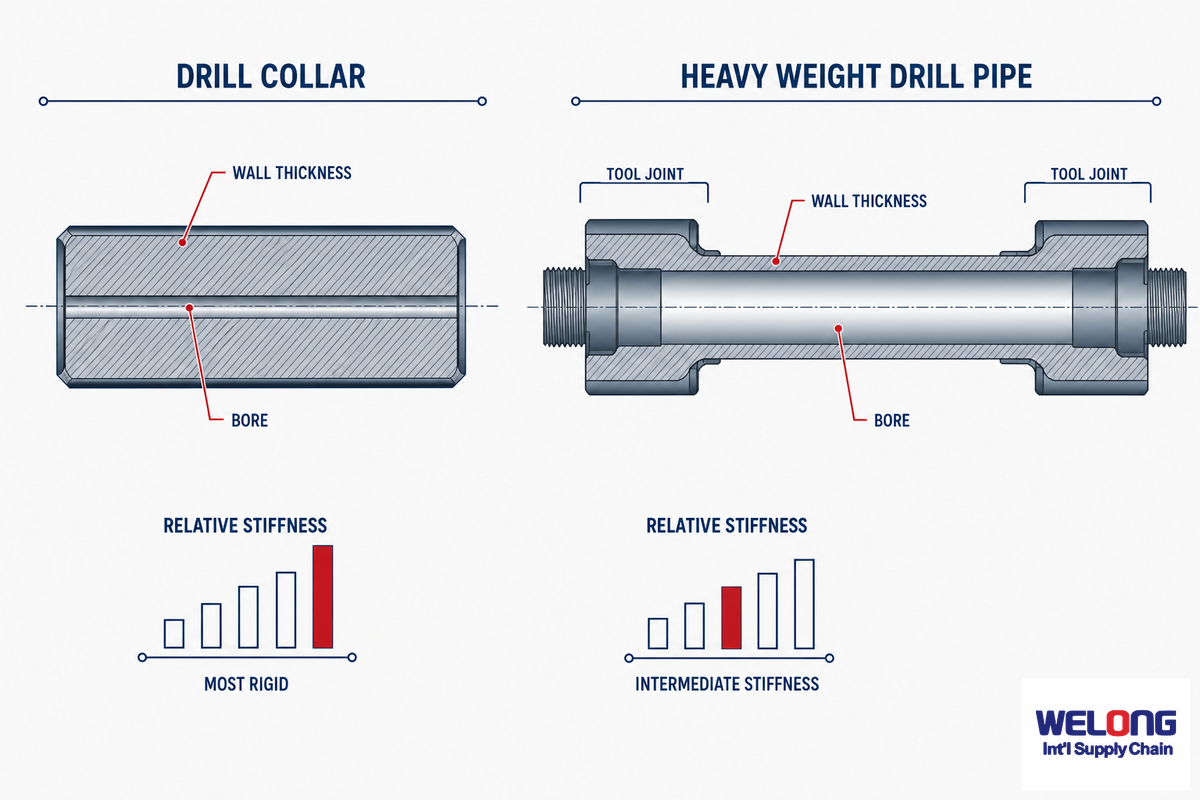
| Property | Heavy Weight Drill Pipe | Drill Collar |
|---|---|---|
| Relative stiffness | Intermediate — transition member | Highest — rigid, near-solid wall |
| Tool joint length | Up to 2× standard drill pipe joint length | N/A — collar itself is a single heavy section |
| Fatigue resistance in bending | Higher — designed for the transition-zone stress cycle | Lower at the collar-to-pipe connection if run directly against pipe |
| Directional/high-angle flexibility | Better — commonly the primary WOB source in directional BHAs | Limited — minimized in modern directional BHA designs |
| Differential-sticking exposure | Lower (smaller OD, less wall contact) | Higher (larger OD increases contact area) |
How to make practical selections: use drill collars when the absolutely highest non-negotiable rigidity is required – the most common use is for string directly above the bit in vertical and low-angle sections. Select HWDP when you need substantial weight in the BHA but need it to be able to flex and tolerate cyclic loading without fracturing, which explains the trend in modern directional BHA design to use fewer collars and rely on HWDP for the vast majority of weight-on-bit contribution. Getting this wrong is a genuine field risk: an all-collar string in a high-angle well can crack at the collar-to-pipe connection because the stiffness step is too abrupt, while an all-HWDP string in a straight vertical hole under-delivers weight on bit and slows penetration rate. China Welong resolves this trade-off with size-matched HWDP and drill collar lines built to the same API connection standards, so an operator isn’t mixing incompatible tool joints mid-string.
How to Select the Right HWDP for Your Well Program
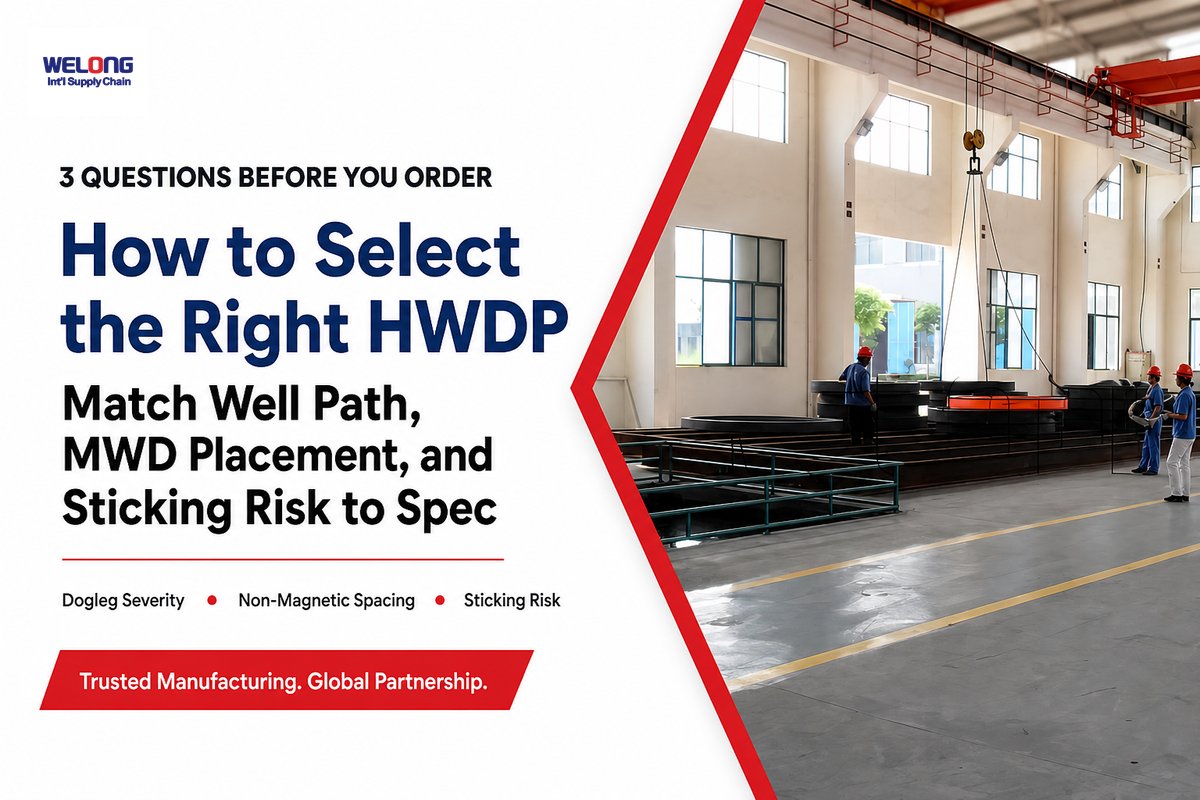
Selecting the right HWDP comes down to three questions about your well path, your MWD/survey placement, and your sticking risk – answer those first, then size the OD, connection, and type against the specification table above. The selector below turns that decision into a quick reference instead of a judgment call made under time pressure at the rig.
3 Question HWDP or Drill Collar Selector
| Question | If Yes → |
|---|---|
| Does the well path include a build/curve section with meaningful dogleg severity? | Favor HWDP for weight in and above the curve — its flexibility tolerates bending stress collars can’t. |
| Is the drilling assembly running near an MWD/survey tool? | Specify Non-Magnetic HWDP within the manufacturer’s stated non-magnetic spacing distance — standard HWDP will distort the survey. |
| Is the section prone to differential sticking (permeable, overbalanced, high-angle hold)? | Specify Spiral HWDP to cut wall contact area, or reduce compression running practice in that interval. |
While a common geometric guideline used for running HWDP in compression is 2x tool OD should be greater than OD openhole (2TJOD > OH), in actual practice many rigs are much more conservative and crews don’t run compression-mode HWDP in large diameter vertical wells where 2x tool OD would exceed OD openhole based solely on this geometry criterion. This 2TJOD>OH ratio should be treated as a preliminary screen only, and all well programs that are to involve running HWDP in compression must be checked against a buckling analysis conducted by a drilling engineer. Skipping this check is the mistake that causes real problems in the field: an operator who runs a generic joint count without matching it to the well’s dogleg severity risks a stuck-pipe delay costing 2 or more days of rig time. China Welong provides size-specific selection guidance because a one-size-fits-all HWDP count is a false economy once a fishing job or side-track is factored in.
Handling, Fatigue, and Common Failure Points
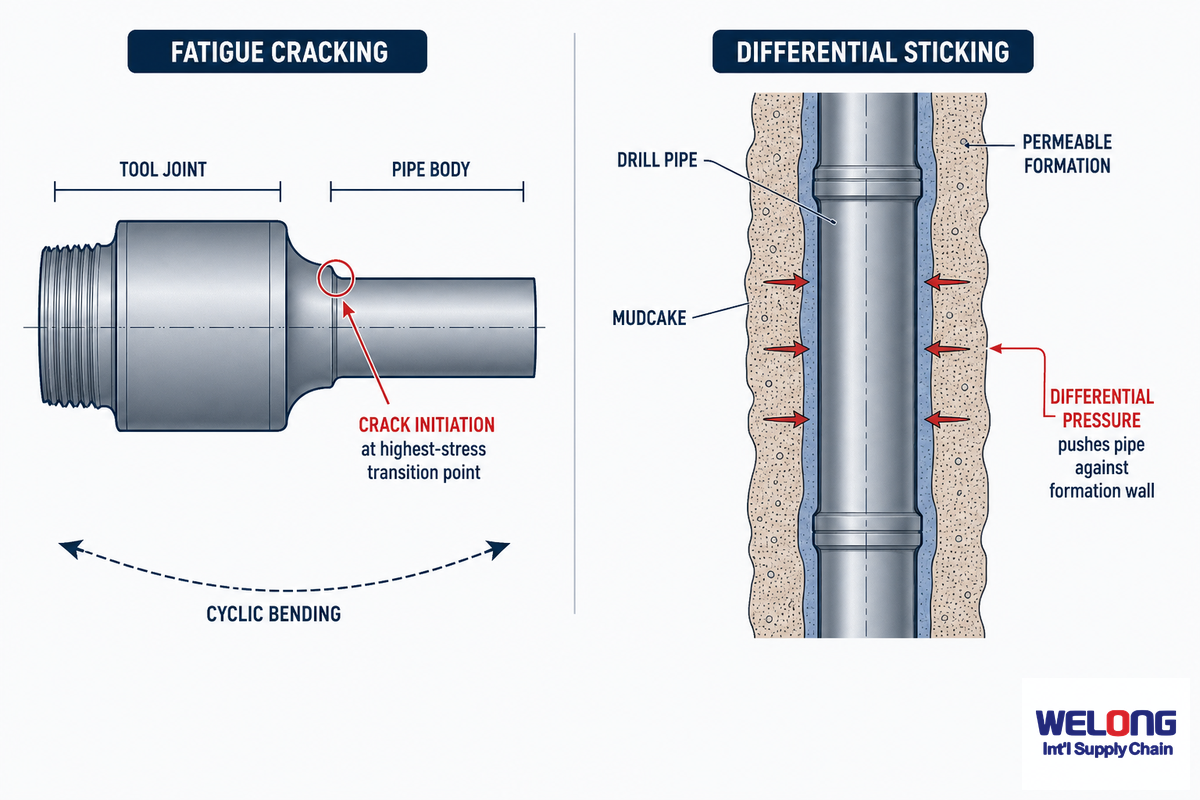
The primary failure modes discussed in the drillstring failure-analysis literature are fatigue cracking, washout and twist-off – fatigue cracking is the mode of greatest relevance to HWDP, as HWDP was conceived and is run specifically to control the stress cycle that causes this mode of buckling. Differential sticking is related but not similar to a failure mode: the pipe is pressed against a permeable, overbalanced formation wall by differential pressure, and while it occurs on HWDP it’s common to a greater extent on the larger diameter drill collar as the contact surface area varies with OD. In the field, this is the gap that catches crews off guard: differential sticking looks identical to mechanical sticking at the surface, but the fix is different, because it’s driven by differential pressure against a permeable zone, not a hole-cleaning or bit problem. China Welong flags this distinction in its technical support because misdiagnosing the sticking mechanism can add 4 to 8 hours or more to a stuck-pipe recovery on a directional or horizontal well.
“A center wear pad or spiral groove reduces sticking risk by cutting contact area, but it doesn’t eliminate the underlying mechanism, differential pressure against a permeable zone. Crews still need to manage circulation and avoid extended static periods in a known-sticky interval, regardless of which HWDP configuration is run.”
The other two failure contributors to these recurring field phenomena: (1) high build-rate sections (15° to 25° per 100 ft vs about 3° per 100 ft for a typical vertical well section) generate significantly more cyclic bending stresses on HWDP than were predicted by the transition zone, conventional application for which it was designed, which is one factor that explains why non-customized conventional HWDP often shows a poor record against fatigue failures in severe high-angle horizontal applications, and why crews planning that kind of drilling operation should ask suppliers about fatigue-rated alternatives up front; and (2) stress corrosion cracking (SCC) in sour-service wells (sour service is defined as any wellbore where there’s any H2S or CO2 in low-pH brine or polymer muds) has increased over the years, which is primarily a materials matter, not one of configuration – this need should be met with a sour-service qualified grade, not simply with heavier wall pipe.
Sourcing HWDP: Manufacturers and Standards Compliance
There are two more qualification items for HWDP suppliers that are far more important than cost: 1. Sour service material qualification: Not just any HWDP with a thicker wall is automatically OK for sour service – it has to be a HWDP grade with sour-service qualification, according to the ISO 15156 / NACE MR0175 material-selection principles applicable to H2S bearing environments, and the supplier needs to reference the qualification rather than the product line. (ISO 15156-1:2020 is in the revision process; verify which version is listed on a certification).
2. If it is not new HWDP that you are buying or renting, ensure any used or rental-fleet inspection and classification are according to API RP 7G-2:2020(R2025) which provides the proper inspection level, procedure and criteria, and that is specific to the inspection and Classification of Used drill Stem Elements including HWDP.
A ‘visually inspected’ Used joint is not the same as a certified Used joint with a specified API RP 7G-2 classification level.
About Welong’s HWDP Manufacturing
Welong has fabricated downhole drilling tools such as heavy weight drill pipe for over 20 years, with in-process and final inspection integrated into the fabrication process and optional third-party inspection available at request. This guide is based on Welong’s own fabrication spec range, because we’d rather a forward-looking reader cross-check our dimensional data against their well program before calling us, than rely on generic charts. Presented by China Welong technical team. (Updated to July 2026.)
If your well program falls in the 3½”–6⅝” range defined above, Welong’s heavy weight drill pipe product line has Standard, Spiral, and Non-Magnetic versions in all six connection sizes in this guide, fabricated to API Spec 7-1 with in-process and final inspection on every run.
See Full HWDP Specifications & Request a Quote →
Industry Outlook: What’s Changing in HWDP Demand
(Updated July 2026) – The structural driver behind growing HWDP demand isn’t a niche, but two simultaneous trends in actual wellbores being drilled. In the U.S., 81% of completions in 2021 were horizontal or directional (compared with 19% vertical), and average footage drilled per well almost doubled from 7,300 ft to 15,200 ft between 2010 and 2021 (U.S. Energy Information Administration figures) – and Permian alone accounted for 48% of the U.S. record 13.6 million b/d of crude oil production in 2025. Every one of those longer, more severely inclined wells needs more HWDP joints per BHA to provide weight-on-bit through the build and lateral portion than a comparable vertical well did a decade earlier. The same justification applies offshore in the deepwater and ERD well field: greater dogleg severity and fatigue-cycle counts push these demands even further, and the industry is gradually shifting from high-cap standard-grade HWDP towards higher-margin, fatigue-resistant premium alloys accordingly.
The practical import for a buyer deploying 2026-2027 procurement is to size HWDP ordering according to well-path characteristics, rather than a one-size-fits-all program assumption. A program moving from predominantly vertical to predominantly directional/horizontal wells should expect its HWDP joint count and grade requirements to shift upward, not stay flat. Due to variation among publisher estimates (single-digit-billion-dollar magnitude, mid-single-digit CAGR) the HWDP market size figure is only indicative rather than a basis for a procurement plan. The risk on the buyer side is under-ordering for the well types actually being drilled today: a program still budgeting HWDP counts against a 2010-era vertical-well mix risks a mid-campaign shortage once the longer, higher-angle wells reach the field.
FAQ
Q: What is the capacity of a heavy weight drill pipe?
View Answer
Size and grade determine capacity, not a single figure. Standard HWDP is rated for 55,000 psi yield, while premium grades can be supplied at 75,000 psi, 95,000 psi, or 110,000 psi for improved tensile and torsional capacity, generally in integral connection design, since capacity also varies by actual wall thickness and OD. Always check the mill certificate for exact figures on the specific joints you’re running.
Q: How much does heavy weight drill pipe weigh?
View Answer
Drill pipe weight and HWDP weight per foot both scale with OD, but HWDP always runs heavier: smaller 3½” HWDP sits at the lighter end of the line. A 5” OD joint runs around 22-30 lbs/ft and a 6⅝” OD joint runs around 30-50 lbs/ft, noticeably heavier than standard drill pipe of the same size due to thicker walls. Overall joint weight also varies with tool-joint length, which on HWDP can run twice a standard joint’s length.
Q: How strong is drill pipe?
View Answer
Standard drill pipe comes in strength grades E-75 (75,000 psi minimum yield) to S-135 (135,000 psi minimum yield) under the API drill pipe specification. Heavy weight drill pipe is a distinct product line with its own rating range (55,000-110,000 psi), not a direct equivalent of those standard letter grades when ordering.
Q: What is a Drill Collar?
View Answer
A thick-walled, almost solid tubular section run directly above the bit, adding concentrated weight and stiffness. Unlike drill pipe or HWDP, it has almost no bore, often weighing 4,000 lbs or more per joint versus HWDP’s much lighter per-foot weight.
Q: Can HWDP tool joints be re-cut or repaired?
View Answer
Yes, but only to a point. If the tool-joint on a HWDP is worn or damaged but the threads can be recut to the next standard gauge dimension, this process can be repeated a number of times before the joint no longer conforms to API Spec 7-2 gauging requirements and must be retired or rebuilt. A repaired or re-cut joint being returned to service must be classified per API RP 7G-2, not simply visually inspected.
Q: Is spiral or non-magnetic HWDP more expensive than standard?
View Answer
Both cost more than standard HWDP, but for different reasons. Spiral HWDP costs more due to the added machining time for the helical middle section. Non-magnetic HWDP costs more because Monel-family alloys run far higher per pound than standard drill-pipe steel.
Why We Write This
Welong wrote this guide by synthesizing more than 20 years of its own HWDP production experience, in addition to API standard documentation and third-party engineering resources, specifically to enable buyers to independently cross-check dimensional and grade data against our specs prior to placing an order. The cost and grade data cited in the sections above are from Welong’s own production specification sheets, supplemented by independent manufacturer tables where available. Technical Review: Welong China technical team.
References & Sources
- API Spec 7-1: Specification for Rotary Drill Stem Elements (2023, 2nd Ed. + 2025 Addendum 1) – American Petroleum Institute
- API Spec 7-2: Threading and Gauging of Rotary Shouldered Connections – American Petroleum Institute
- API RP 7G-1: Drill Stem Design and Operating Limits – American Petroleum Institute
- API RP 7G-2:2020(R2025): Inspection and Classification of Used Drill Stem Elements – American Petroleum Institute
- U.S. well completion trends, 2010–2021 – U.S. Energy Information Administration
- U.S. crude oil production record, 2025 – U.S. Energy Information Administration
- Differential Sticking, Engineering overview – ScienceDirect
- Drillstring failure analysis review – Engineering Failure Analysis, ScienceDirect
- EP1078190B1, Heavy Weight Drill Pipe (stress-corrosion/hydrogen-embrittlement resistant design) – Google Patents / European Patent Office
- US20160305194A1, Heat Treated Heavy Weight Drill Pipe – Google Patents / USPTO
- Drill String Components, Technical Note 31 – Texas A&M University, Ocean Drilling Program
- Lightweight, ultra-high-strength drill pipe may meet demands of ERD, critical deep drilling – Drilling Contractor (IADC)
- Defining drillstring specifications to maximize safety, performance in sour service environments – Drilling Contractor (IADC)
![Casing, Tubing & Drill Pipe Elevators [Field Guide]](https://welongoiltools.com/wp-content/uploads/2026/09/casing-tubing-drill-pipe-elevators-guide-featured-768x512.png)
![Choke & Kill Hose: [Field Guide]](https://welongoiltools.com/wp-content/uploads/2026/07/choke-kill-hose-guide-featured-1-150x150.png)