Get in touch with Welong Company

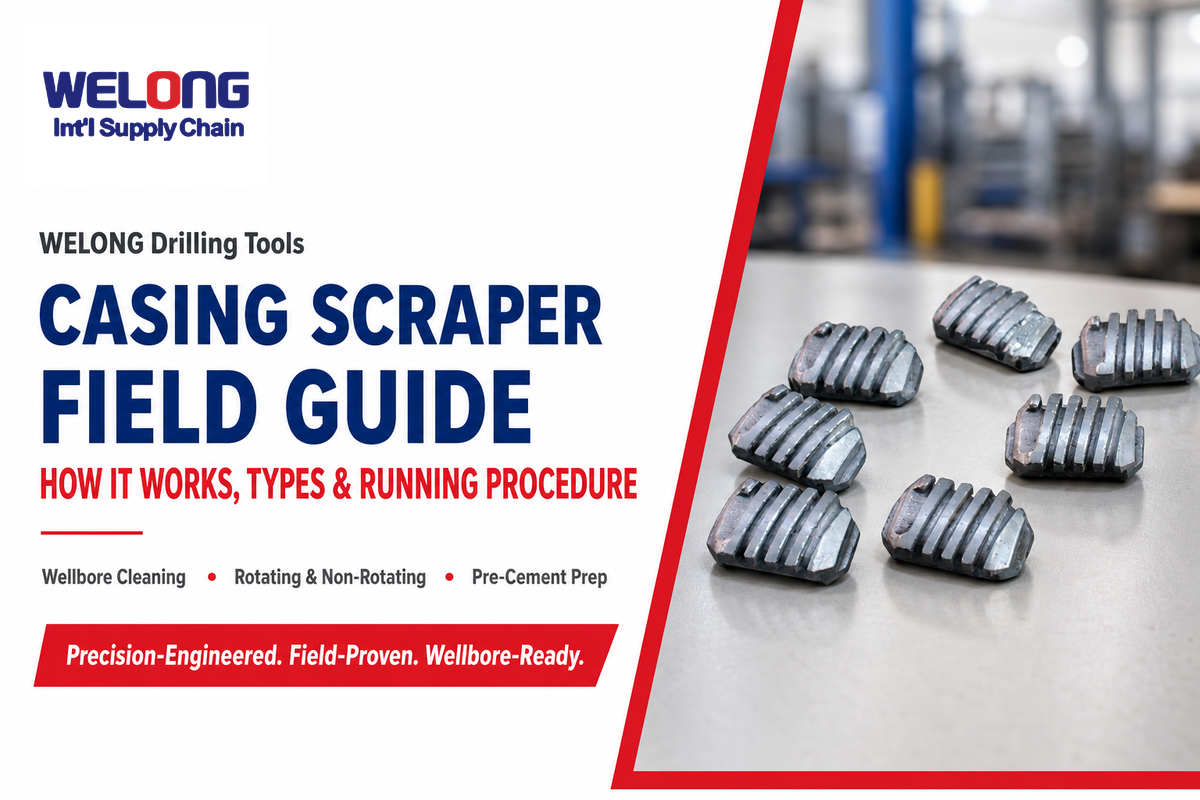
A casing scraper is a downhole tool run on drill pipe or tubing to clean scale, cement, rust, and debris from the inside of a casing string before critical well operations.
Quick Specs
| Blade hardness (typical) | 55–60 to 58–62 HRC depending on manufacturer, heat-treated / case-hardened alloy steel |
| Rotating cleaning speed | 40–120 RPM (aggressive mode) |
| Typical max trip speed | ~200 ft/min (OEM-rated example) |
| Minimum recommended passes | 3 full passes per interval, with circulation between passes |
| Run on | Drill pipe, tubing, or workstring |
A casing scraper is a downhole tool run on drill pipe or tubing to remove scale, mill scale, cement, rust, and debris from the internal wall of the casing before critical operations like cementing, packer setting, or completion — a routine step across the oil and gas industry. It looks like a simple piece of steel, but the choice of scraper – and how it’s run – directly affects whether the next trip into the well goes smoothly or turns into a fishing job.
A casing scraper removes scale, cement, rust, and mill debris from the casing ID using spring-loaded or fixed steel blades, run on drill pipe or tubing in either a low-aggression reciprocating pass or a more aggressive 40-120 RPM rotating pass.
It clears the path for packers, plugs, and completion tools to seat correctly.
Key Takeaways
- Rotating scrapers are not automatically the better choice – in deviated and horizontal wells, they carry a real risk of casing wear and stuck tools that non-rotating designs avoid.
- Blade hardness across major manufacturers converges tightly in the 55-62 HRC band, even though no single published metallurgical standard governs the spec.
- Cementing literature widely cites shear bond strength at the cement-formation interface falling by 83-99% once mud cake reaches roughly 5mm thick – a reminder that debris left inside the pipe matters even before the cement job starts.
- One of the strongest 2024-2025 innovations in this category isn’t a better blade – it’s tools that eliminate the separate cleanout trip entirely.
What Is a Casing Scraper?
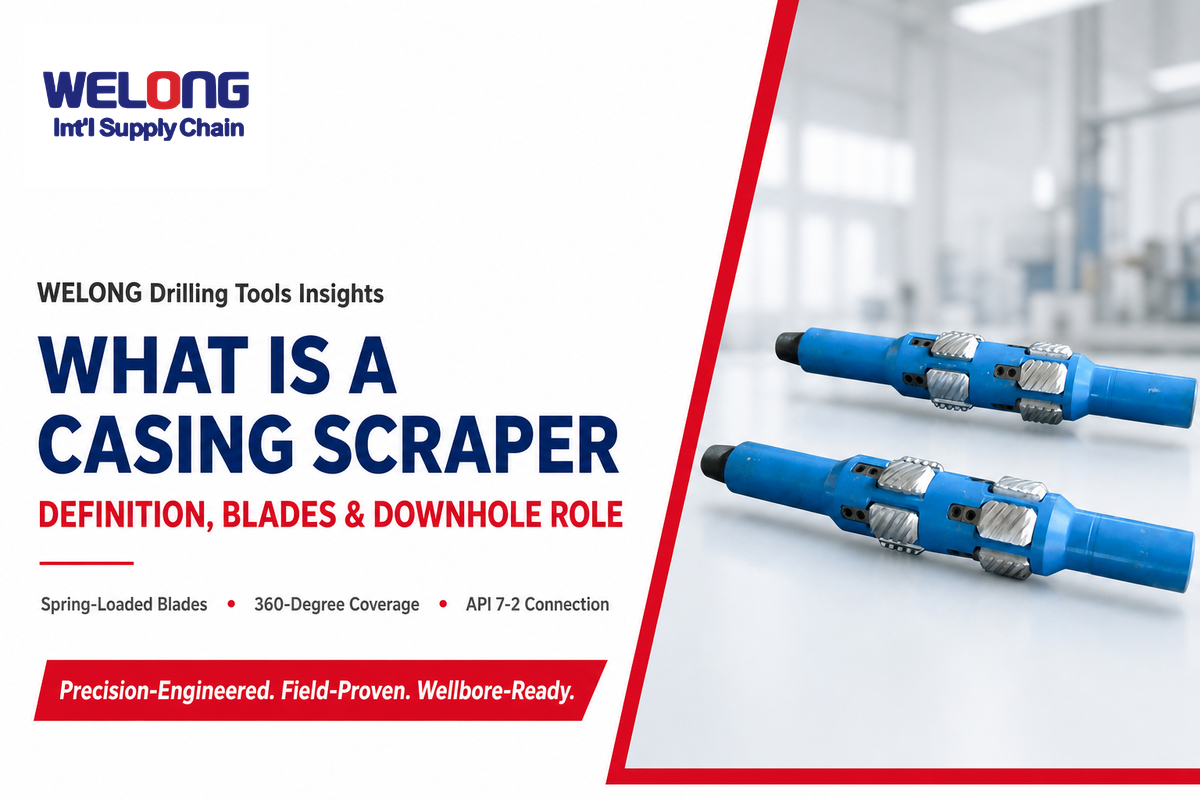
A casing scraper is a mechanical downhole tool built around a body carrying a set of hardened steel blades, run on drill pipe or tubing to clean scale, cement, rust, and debris from the inside of a casing string. It’s not to be confused with an architectural paint scraper or a “casing driller,” a completely different rotary drilling tool.
According to the SLB Energy Glossary, it’s defined as “a downhole tool incorporating a blade assembly that’s used to remove scale and debris from the internal surface of a casing string.” It’s generally run on tubing or drill pipe, deployed on the end of the string during workover or completion operations, run to depth, then worked across the target interval before reinstalling the completion string.
This tool is often confused with a casing scratcher, a related but mechanically different accessory clamped to the outside of the casing before it’s cemented in place, used to disturb mud cake on the borehole wall as the casing is reciprocated or rotated during the cement job, a mechanism OSHA’s own eTool on casing operations describes in its casing-operations reference (quoted in full below). By contrast, a casing scraper cleans the inside diameter (ID) of casing that’s already been run and cemented – typically before completion tools go in, or during a later workover.
Both get lumped together in casual industry conversation, but they solve different problems on different sides of the pipe.
How a Casing Scraper Works
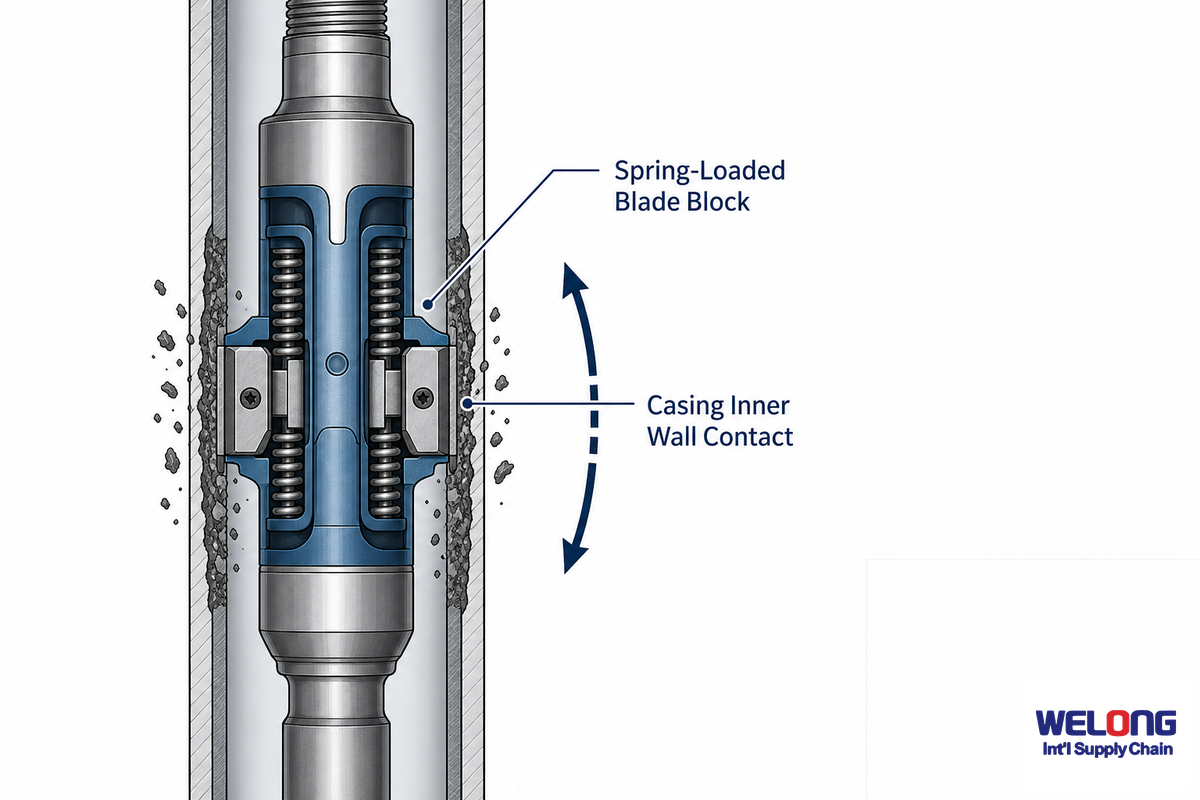
Mechanically, it works by using spring-biased steel blades that press outward against the casing ID, cutting or knocking loose scale, cement, and rust as the tool is reciprocated or rotated through the target interval. Blade design self-adjusts to minor variations in bore diameter as it travels.
According to USPTO Patent 7,311,141, the blades are spring-biased outward from the tool body and adjust to the inner diameter of the casing as the tool passes through slightly varying degrees of wear or tolerance. Critically, the patent states that the blade surfaces “will be hardened, for example by case-hardening, but won’t normally be hard faced, so as to reduce the chances of scoring or wearing the casing wall” – it’s engineered to clean hard but not harm the pipe it’s cleaning.
Casing crews can operate the scrapers in one of two modes: a non-rotating (reciprocating) pass, which involves simple back-and-forth movement of the tool through the zone for low-aggression routine cleanout. With the string attached to a tool, a rotating pass of the scraper at approximately 40 to 120 rpm is also implemented, causing the blades to dig harder for hardened scale and cement that the straight pass can’t remove. Hard numbers from a Halliburton Drill Tech data sheet reflect this: fixed and spring-loaded 25° blades are available with individual finger actuation, at maximum trip speeds up to around 200 ft/min, maximum rotating speeds to 120 rpm (while in tension; 90 rpm while in compression), and maximum compressive loads that vary by casing size: 50 KLBS for 11¾–13⅝-in casing, 35 KLBS for 7–8⅝-in casing, and 15 KLBS for 5–5½-in casing.
While blade materials themselves aren’t a focus of public specification sheets for any given manufacturer, there’s a strong consistency among manufacturers in their design: scraping blades are arranged around the tool body, machined from rugged heat-treated alloy steel bar stock and built to be durable enough for repeated field use, engineered for reliability across varied casing conditions. Bilco Tools says their blades are “precision cast and surface casehardened to 55-60 HRC,” and an unrelated manufacturer’s technical resource says that heat-treated alloy steel blades in modern designs generally fall within a range of 58-62 HRC. Older patents also confirm this approach: US4,558,738 and US4,572,291 show the use of high-alloy or cast steel, often with flame-hardening or other heat treatments, but without citing a specific material grade. No manufacturer provides an AISI/SAE designation for scraper blades, so assume any sources suggesting otherwise to be unconfirmed.
📑 Engineering Note
This 55-62 HRC range for the blade material is in the ballpark of a high-quality file or a hard-working machine tool; sufficiently hard to effectively shave scale and cement, yet below the point where it might easily scratch more-soft API casing steel. That’s why the original patent avoids suggesting hard-facing the blades: the harder the blade, the more it cleans but the greater the risk of scoring the pipe it’s designed to clean.
Engineering on the tool continues. In US Patent 12,188,332, granted January 7, 2025, Halliburton details a new scraper concept with up to three modes downhole – retracted (off), non-rotating (reciprocating), and rotating – activated via pump pressure with a lug-and-control-pattern mechanism that can change modes without pulling the string. It’s clear that OEMs still view the rotating vs. non-rotating choice as something they need to actively engineer, rather than accept as a settled issue.
Why Wellbore Cleaning Matters Before Cementing and Completion
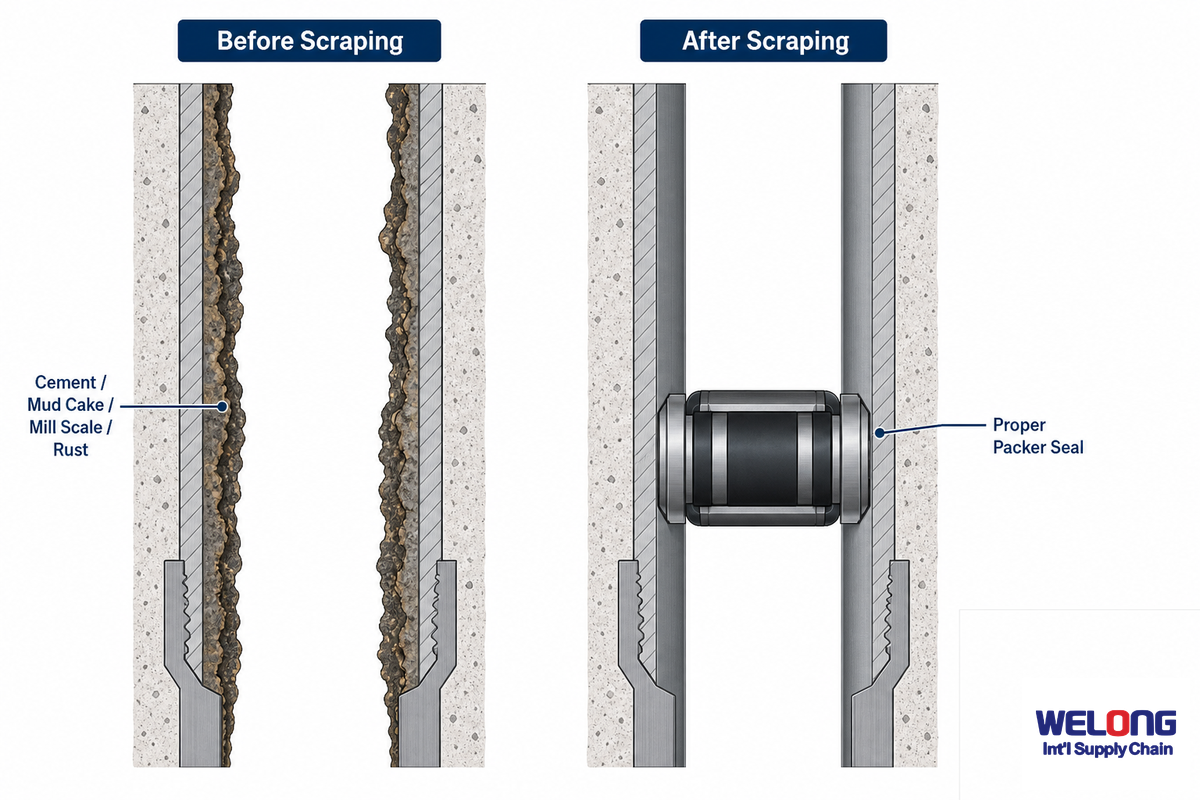
Wellbore cleaning matters because debris left on the casing ID can stop packers, plugs, and liners from seating properly, and can contaminate cement as it’s pumped down the casing during the job. Left unaddressed, a single dirty run can cascade into a stuck tool and a costly remedial trip.
The 4-Link Failure Chain: How a Dirty Casing ID Becomes a Stuck Tool. Debris on the casing ID isn’t just causing one problem. It’s a chain of events. Scale, cement fragments, or perforation burrs left behind in the casing create an obstacle that a packer, plug, or liner can’t seat past cleanly, and that obstacle becomes link one in the chain. Link two is what happens if the tool is shoved through regardless: the contact with the debris multiplies the probability that it hangs up, sticks, or has to be pulled and re-run. Link three is the remedial trip: it takes up valuable rig time trying to pull out a stuck or misrun tool that a simple scraper run would have avoided. Last in the chain is the cost that accumulates to the project from there: NPT, and in the worst case, a fishing job.
Halliburton’s own Drill Tech case data demonstrates the value of ending that chain early: in a data set of over 43 jobs in which a casing scraper was included in the running string ahead of permanent packer and plug, the company cites a 70% cost reduction, and trouble-free placement of cement above the packer or plug on the first attempt.
Going into detail on which cleaning concern the casing scraper actually addresses is worth effort. Published, peer-reviewed literature firmly establishes the detrimental effect that mud cake left on the outside of the pipe (in the annulus, against the formation) can have on cement bond quality. Shear bond strength at that cement-formation interface has been shown to decline 83.4% to 99.9% as the annular mud cake grows to around 5mm. That’s a real, widely-cited finding, however, these bond-strength figures speak specifically to the formation-facing side of the cement job, and don’t directly relate to the internal dirt and debris that a casing scraper confronts. OSHA’s own eTool on casing operations confirms this distinction: “…the casing is reciprocated or rotated so that scratchers remove excess wall cake for a better cement bond”
What a casing scraper really solves is a more mechanical problem than the CBL information allows for: if the debris can be liberated while still inside the casing ID, it can be flushed into the cement slurry as it’s pumped down through the casing on its way to the zone, contaminating the mixture before it even gets there. That’s the real, ID-specific importance of scheduling a scraper run – not as a remedy for dirt in the annulus, but to ensure nothing loose inside the pipe lands somewhere it shouldn’t, or ends up compromising the cement sheath once it sets.
Casing Scraper Types: Rotating vs. Non-Rotating
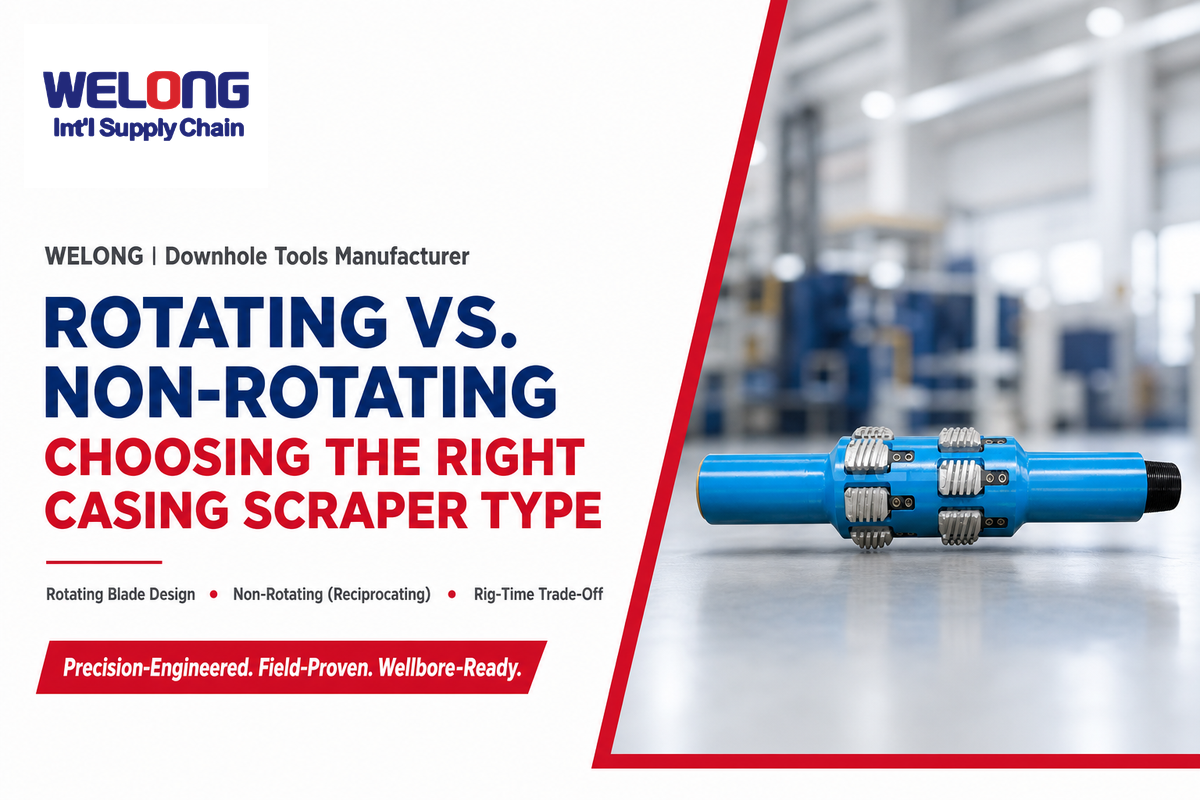
Industry marketing copy often presents rotating scrapers as the more aggressive, the more effective, the default “better” option for cleaning up downhole. Engineering literature, however, paints a different picture. One industry technical resource writes it outright: “Neither tool is universally superior.” Rotating scrapers do carry a documented downside of increased risk to casing integrity and a higher potential for getting stuck and/or experiencing torque issues, especially in deviated or horizontal wellbores. Non-rotating scrapers, in fact, are more suited for complex wellbore geometries, not as an inferior fallback when rotation isn’t available.
Separately, patent US20150027713A1 reinforces this from a design perspective, stating that a rotating scraper in a deep or near-horizontal wellbore could result in “unacceptable frictional drag and long-term casing wear or damage” – the very same real-world risk flagged in the field-level source above. That conclusion, reached through independent lines of engineering reasoning, was identical.
| Comparison Factor | Non-Rotating Type | Rotating Type |
|---|---|---|
| Cleaning action | Up-and-down pass, lower aggression | 40–120 RPM rotation while reciprocating, higher aggression |
| Best suited for | Deviated / horizontal wells, routine cleanout | Hardened scale or cement in mostly vertical wells |
| Main risk | May under-clean hardened deposits | Casing wear, drag, stuck-tool/torque risk in deviated wells |
| Typical operating speed | No rotation, reciprocating stroke only | 40–120 RPM (120 RPM max in tension, 90 RPM in compression) |
| Blade engagement pattern | Continuous, lighter contact along the pass | Higher-force intermittent contact as blades rotate through debris |
| Casing wear risk | Minimal under normal conditions | Elevated, especially in deviated/horizontal sections |
| Recommended well geometry | Deviated and horizontal wellbores | Mostly vertical wellbores |
| Blade material class | Same 55–62 HRC heat-treated alloy steel class as rotating designs | Same 55–62 HRC heat-treated alloy steel class as non-rotating designs |
| Evidence | Field/technical article + patent US20150027713A1 | USPTO US7,311,141 (40–120 RPM spec) |
Casing Scraper vs. Casing Brush vs. Junk Mill: Which Downhole Cleaning Tool Do You Need?
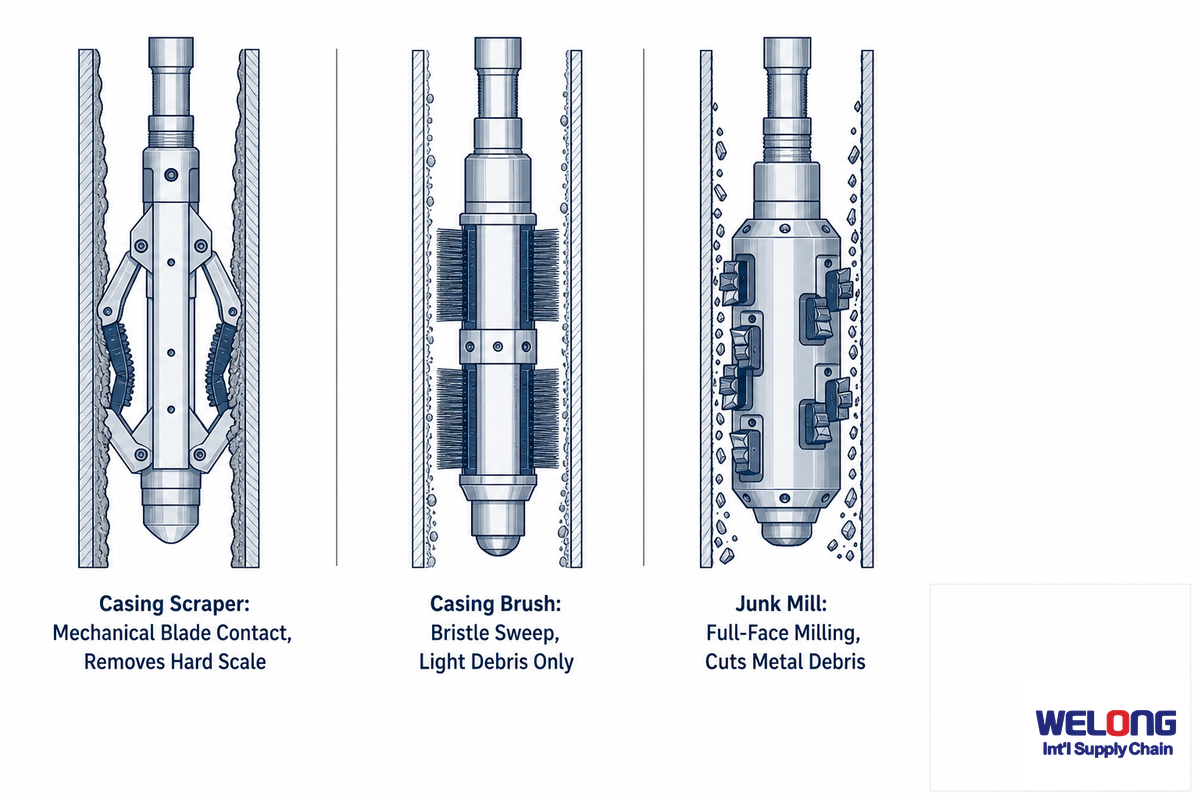
Three tools get lumped together as “wellbore cleanup” tools, but they target different debris at different severity levels: a casing scraper removes scale and hardened deposits with rigid blades, a casing brush uses bristles for lighter residue like paraffin, and a junk mill aggressively grinds down hard obstructions and metal debris.
According to one technical source about well perforation, a single or tandem casing scraper is generally used in the bottom section of casing to sweep down planned perforations and packer seating intervals while circulating, removing debris that could damage the packer. By contrast, a casing brush uses bristles rather than rigid edges and is best for cleaning lighter residue, such as paraffin, whereas a junk mill actively grinds down solid obstructions and metal debris that a scraper’s blades might simply skid across. That design boundary is deliberate: USPTO Patent 7,311,141 specifies the scraper’s blade surfaces as hardened but explicitly “not… hard faced” to avoid scoring the casing wall, the opposite design goal of a mill built to grind through metal.
For perspective on the scale of debris and work scope, consider a real-world example of a junk mill cleanout in 11.75-in. casing. A 5.75-in. mill was run at 2.5 bbl/min. circulation rate (roughly 78 ft/min. annular velocity) and brought back 16.8 lb/gal solids with debris up to 4 mm in diameter. That’s a qualitatively different operation than what a scraper would accomplish, in terms of both equipment and objectives.
Although often used in combination rather than one-or-the-other, adding tools together isn’t automatically a better strategy, and it carries a real risk of its own. In one case detailed in Oil & Gas Journal, a workover using well wash chemicals and brushes resulted in serious formation damage when displaced debris entered the reservoir, because the process cleaned the entire tubing and casing length rather than the specific interval that actually needed it. That operator eventually resorted to a limited, targeted approach used in the field on later jobs. In practice, for an OEM-rated tool selection, the takeaway isn’t to run more tools, but to select the correct tool and clean out only what you actually need to.
Please see the casing scraper product page for information on Welong’s casing scrapers for your specific size, connection type, and RFQ.
Running a Casing Scraper: Step-by-Step Field Procedure
“Casing Scraper, Small Tool, Big Role in Well Integrity: In drilling and workover operations, the casing scraper is one of those unsung heroes downhole. Though simple in design, it plays a critical role in ensuring the success of cementing, completion, and well intervention operations… Skipping it can mean compromised cement jobs, stuck tools, and costly interventions.”
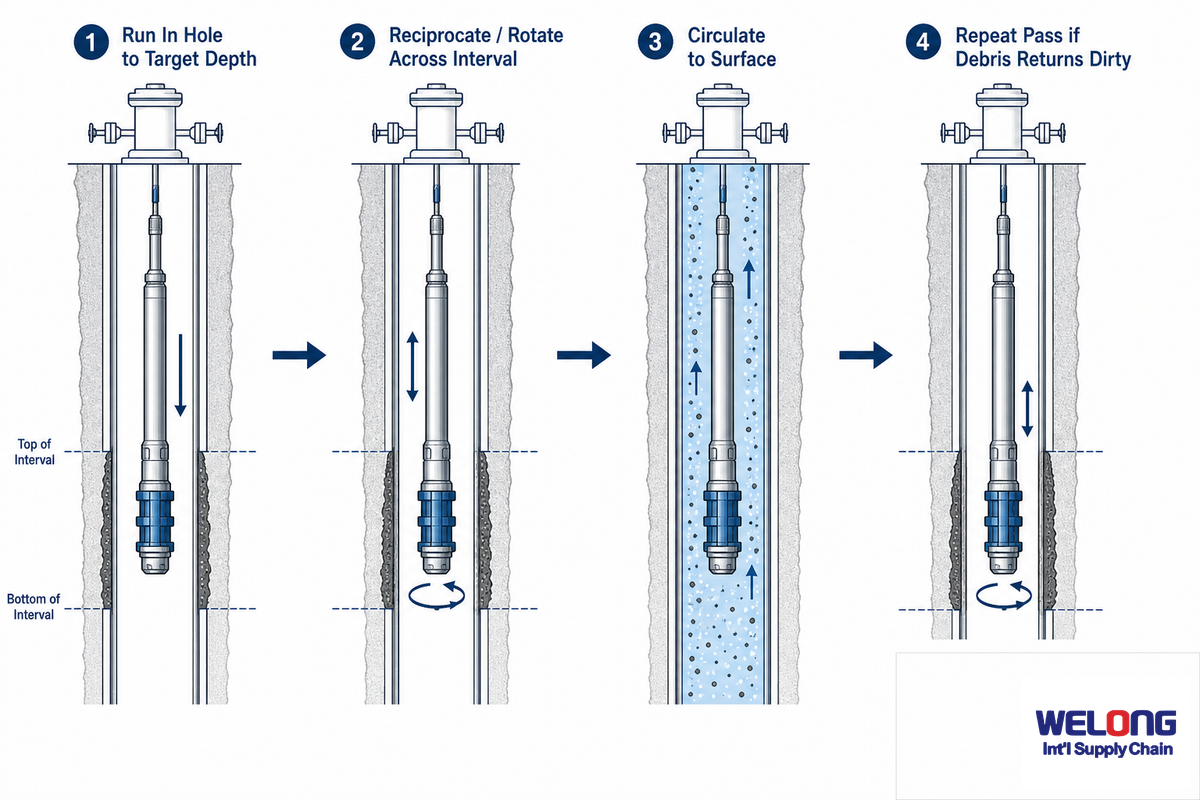
A casing scraper running procedure follows a consistent field sequence, built on running-string mechanics that are well documented but rarely spelled out step by step:
- Make up the string. Scraper make-up happens on drill pipe, tubing, or workstring – not on wireline alone, since the tool needs weight and rotation/reciprocation capability.
- Run in hole (RIH) to the target interval. Trip in at a controlled speed – roughly 200 ft/min on OEM-rated equipment – monitoring for drag that could indicate an obstruction above the target zone.
- Work the interval with circulation running. Circulation isn’t optional: running the tool at trip speed without circulating fluid just relocates debris inside the casing rather than removing it from the well. This same circulate-while-working approach is routinely used across most operators, since it’s suitable for any casing size the tool is rated for.
- Reciprocate or rotate, per the well’s risk profile. Straight vertical intervals with hardened scale can justify a rotating pass at the 40-120 RPM range set out in the governing blade-mechanism patent; deviated or horizontal sections favor a non-rotating pass to avoid the casing-wear risk covered above.
- Pull out of hole (POOH) and inspect returns. Checking what actually came back up – scale, cement chips, rust – confirms the pass did its job before the next tool goes in.
2-Cycle Pass Rule for Casing Scraper Runs
Field guidance from a trade blog sets a useful floor: a minimum of three full passes through each target interval, with circulation between passes – and heavier debris loads, particularly after milling operations, may require five or more. A practical way to apply that: treat the first pass as a baseline, and require at least two full clean-circulation cycles with visibly clearing returns before calling the interval done. One pass with dirty returns isn’t a completed job – it’s a diagnostic.
| Well Condition | Recommended Minimum Passes |
|---|---|
| Routine pre-completion cleanout, light debris | 3 passes, circulation between each |
| Heavy debris load, post-milling operations | 5 or more passes |
Q: When Should You Run a Casing Scraper?
View Answer
A scraper run is standard practice ahead of any operation that requires a clean, close-tolerance casing ID – running packers, setting plugs, landing a liner, or reinstalling a completion string during a workover. It’s also run after milling or perforating operations, where metal cuttings and burrs are a near-certainty inside the casing. Skipping the run doesn’t save time if the next tool hangs up on debris that a 20-30 minute scraper pass would have cleared – the remedial trip almost always costs more than the prevention would have.
Inspecting Blade Wear and Knowing When to Retire a Scraper
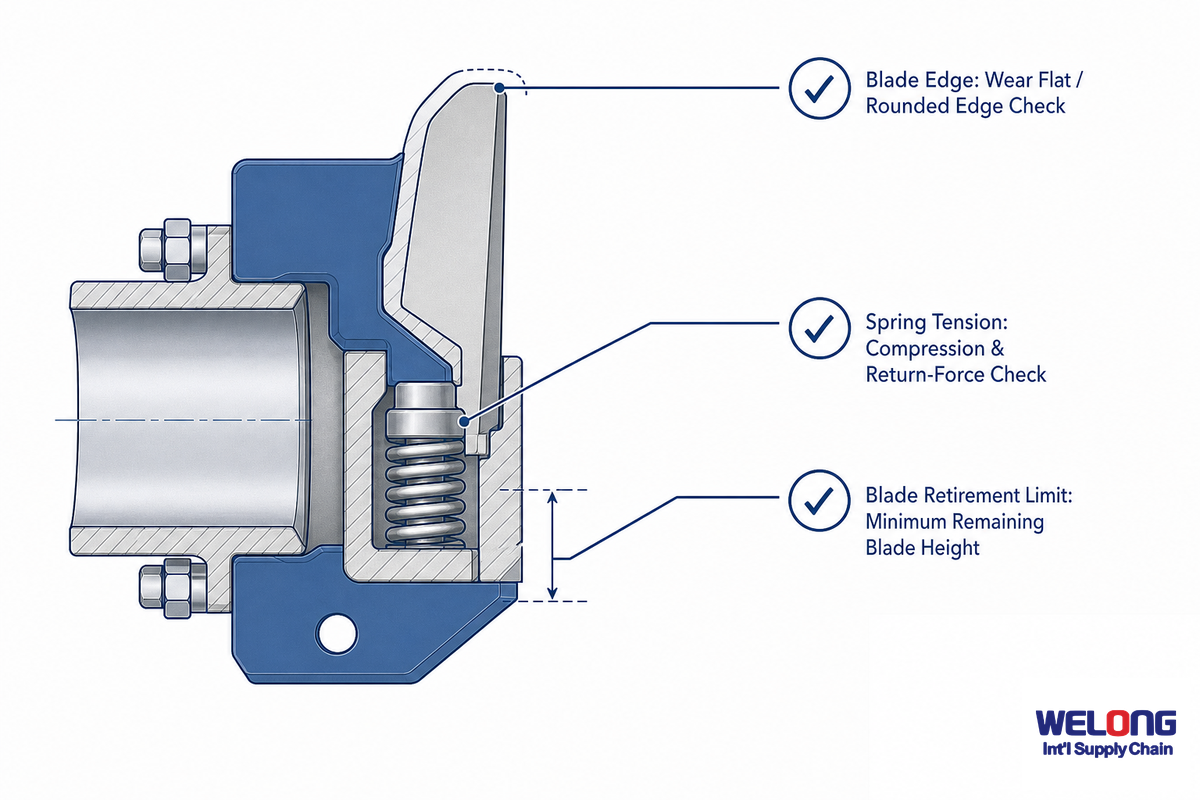
It’s human nature to get comfortable when a process works – but when you’re running the scraper and it comes out of the hole looking like the job was completed, yet the blades no longer have sufficient bite, it’s an easy mistake to be made. But a good, solid OEM manual, such as National Oilwell Varco’s manual for the Bowen casing scraper (its Full-Circle model), makes no bones about the necessary maintenance discipline. “Good maintenance will prolong the life of the tool and prevent misruns,” it says plainly. “After each use, the tool should be completely disassembled and thoroughly cleaned. Any worn or damaged parts should be replaced.” The OEM handbook, in essence, is saying if you skip maintenance, your field team can expect a misrun.
📑 Engineering Note
There’s no “one size fit all” spec for when scraper blades are considered past their prime – it’s often more a case of experienced judgment than an arbitrary value. A useful on-site check is to look at a new 55-62 HRC hardness-class blade alongside the tool in use — the same case-hardened, deliberately-not-hard-faced design described in the blade-mechanism patent — and confirm the cutting profile of the used tool still retains its square shape at the edges. Worn, rounded edges, or blades that don’t spring back all the way into the expanded position are clear signs the tool needs to be taken apart for maintenance rather than for a trip into the hole.
Once post-use teardown is complete, further inspection will likely uncover problems not visible from the surface-such as cracked blade blocks, a weakened spring, or damaged threading on the tool joints. Skipping this maintenance step for the sake of efficiency between jobs is the exact sort of shortcut described as leading to a field misrun in the manufacturer’s handbook.
Common Field Mistakes That Cause Casing Scraper Failures
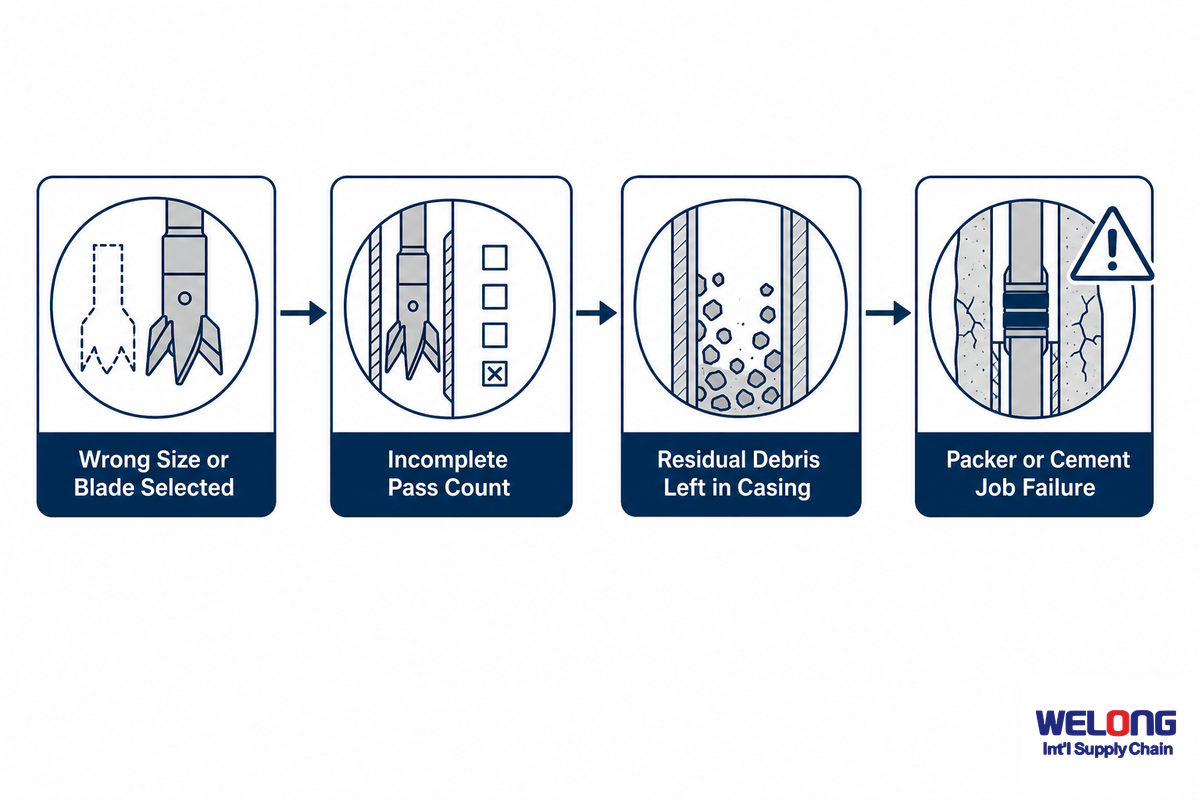
Industry experience – compiled from trade literature, manufacturer-published materials and case studies-points to several recurring, avoidable errors in field operations.
- ✓ Sizing to the wrong dimension. It may seem obvious, but running a scraper too small or too large is a classic mistake — even though the spring-biased blade design is built to self-adjust within a working range, that range still has real limits. If too small, there’s a gap that won’t be cleared. Too large, and the scraper can stick. Remember: size to the casing I.D., not the O.D.
- ✓ Running without circulation. Trip speed without circulation doesn’t move debris, it simply shuttles it down the wellbore for a different team to deal with later in the operation.
- ✓ Skipping post-use maintenance. Field teams that bypass disassembly, thorough cleaning and examination for wear after using a scraper, exactly as recommended by manufacturers in their manuals, contribute directly to misrun events.
- ✓ Treating older fixed-blade designs as adaptable. A retrospective of scraper design in the 1990s highlighted how fixed-block scrapers frequently fell apart downhole, and noted that failure to clean wells adequately was the leading cause of nonproductive time in the completion phase. Later scraper designs were improved to include self-adjusting blocks.
- ✓ Under-scoping the cleanup. Excess pipe dope, debris, or other material clinging to casing walls can plug perforations and impede wellbore access. One SPE case study documented over $5 million in savings when a limited, appropriately sized cleanup procedure was employed on the Zawtika Phase 1B project.
Industry Outlook: What’s Changing in Wellbore Cleaning
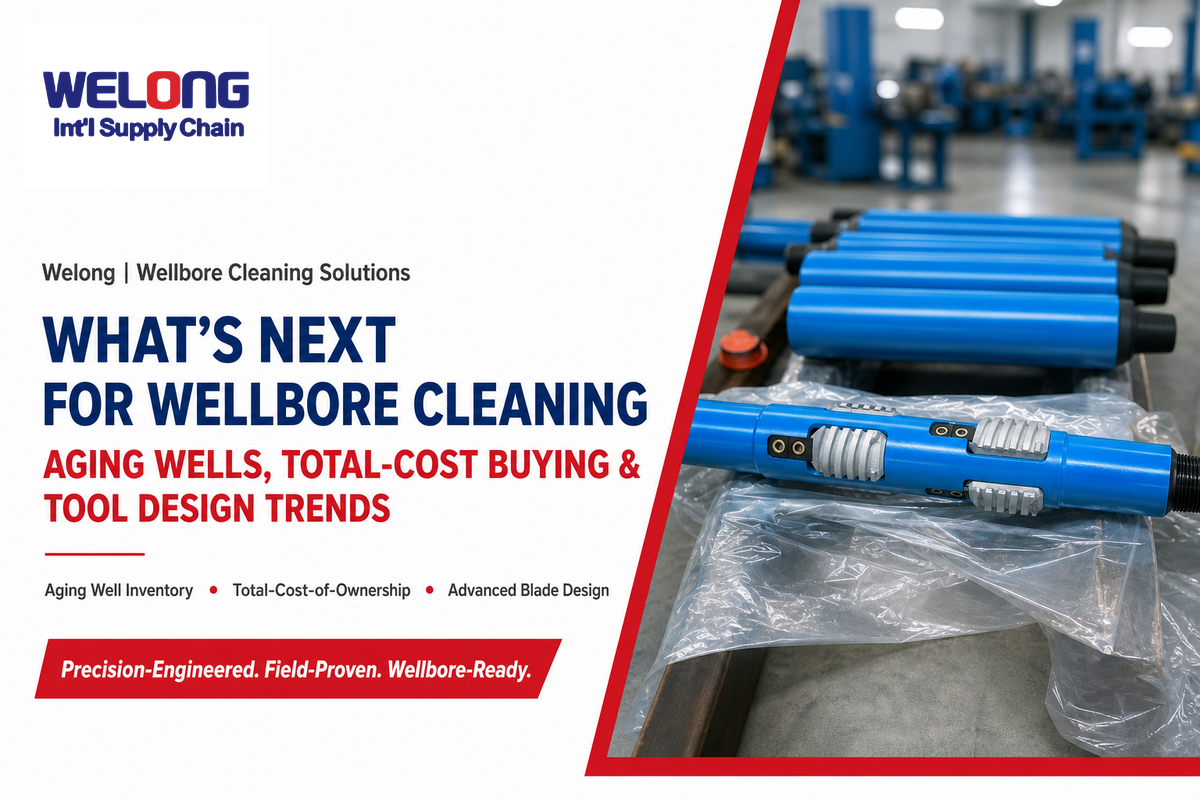
Perhaps the most recent innovation in this area is less about making the blade even sharper and more about using tools to avoid the cleanout trip entirely. The DrillRdillo, from Odfjell Technology, is described by the company’s global product line manager for well intervention in a March 2024 write-up as operating in a “dormant,” retracted blade condition as part of the overall BHA, then activating via ball drop to provide 360° coverage of the casing without a separate run. In place since 2018 on hundreds of wells worldwide, the tool is credited with 36 hours and about $240,000 on a well in Brunei, 18 hours in Norway, and 14 hours on a UK North Sea well, all for rolling a cleanout pass into a planned run.
Weatherford’s AlphaV system, covered by a bylined March 2025 IADC Drilling Contractor story, makes the same move for casing window-milling operations by integrating the mill gauge and the scraper into one trip. Actual field results from 2024 show savings of 30 rig-hours in a Kuwaiti onshore well and 14 hours in a North Sea well where a double-casing window was completed in one run rather than two. Halliburton’s own CleanWell service was reported in an earlier trade-press case to remove 500 lbs of debris from a Gulf of Mexico well and save approximately $400,000 on one job.
For operators, this is the critical take-away: If a cleanout run can be integrated into a planned trip, always inquire with suppliers about doing so rather than planning for a dedicated run. The rig time saved will almost always outweigh whatever gains might come from improving blade cutting. From a higher level, the total global wellbore cleaning tool market, estimated at $3.32 billion in 2025 and $3.51 billion in 2026, represents mid-single-digit growth that gives an idea of the category’s overall size but little information on who’s winning actual rig time by folding trips.
Frequently Asked Questions
Q: What is a rotating casing scraper?
View Answer
A rotating casing scraper turns at roughly 40-120 RPM while reciprocating through the casing, giving the blades a more aggressive cutting action than a simple straight up-and-down pass. It’s suited to hardened scale or cement that a non-rotating pass can’t remove, but it also carries a real, documented downside: a higher risk of casing wear, drag, and stuck-tool or torque problems in deviated and horizontal wellbore sections, where a non-rotating scraper is generally the safer choice.
Q: Can a casing scraper get stuck downhole?
View Answer
Yes – two frequent issues include undersizing the tool for the actual casing internal diameter (ID) and running a rotating pass in a highly deviated or horizontal section of the well, where wear and torque climb as wellbore angle increases. Oversizing has the same effect from the other direction, since a scraper too large for the casing simply drags. Correct casing sizing (matched to ID, not OD) and defaulting to a non-rotating pass in difficult geometry will mitigate both failure modes.
Q: What sizes are casing scrapers available in?
View Answer
Casing scrapers can be found across virtually every common casing size, including all the Welong casing sizes. For Welong’s detailed size chart, connections, and specs, refer to the casing scraper product page.
Q: Is a “casing driller” the same as a casing scraper?
View Answer
No. A casing driller is a technique and tool set for drilling and running casing simultaneously, using the casing string itself as the drill string. A casing scraper is a separate, much simpler tool, run afterward to remove debris from the casing ID. The similar-sounding names are a common source of confusion in search and casual conversation.
Q: How many casing scraper passes are enough?
View Answer
Guidance for field use recommends three full passes with circulation in between, for routine cleanout, with up to five or more passes after milling operations, leaving heavier debris. See the 2-Cycle Pass Rule above for how to make this operational in a horizontal or deviated well – the real indication to look at is if returns are still visibly dirty, not just what pass number you’re on.
Q: Does a casing scraper work in horizontal wells?
View Answer
Yes, but the type is more important than it was in a vertical well. In horizontals and highly deviated wellbores, a non rotating casing scraper is generally the safer default, as rotating types are established to be associated with more frictional drag, casing wear, and stuck-tool or torque problems as wellbore angle increases – this has been independently confirmed by both field crews and patent researchers (see the types comparison above). Condition-of-the-well-guides selection, not a default preference for either type, should be the priority in these geometries. Also increasingly common are integrated one-trip tools, like those in the Industry Outlook section above, designed specifically to cut down on extra trips in complex horizontal completions.
References & Sources
- Casing Scraper, SLB Energy Glossary
- US Patent 7,311,141, Casing Scraper — USPTO
- US Patent 12,188,332, Downhole Scraper for Radial and Axial Motion — USPTO, Halliburton, 2025
- Casing Operations — OSHA Oil and Gas eTool
- Characterization of Oil Well Cement, Formation Sheath Bond Strength — Fuels (MDPI), peer-reviewed
- Drill Tech® Casing Scraper Data Sheet — Halliburton
- API Specification 5CT, 11th Edition — American Petroleum Institute
- Access to Data, Enhanced Tool Designs Drive New Efficiencies Downhole — IADC Drilling Contractor, 2025
- Dormant Casing Scraper Tool Rewrites the Rulebook on Well Services — Odfjell Technology, 2024
- Well Perforation — ScienceDirect Topics
About This Guide
This guide is based upon a mix of USPTO patent filings, an OSHA field-operations reference, a peer-reviewed cement-bond study, and manufacturer OEM data sheets, not just a single vendor-made product sheet, for the casing scraper category where independently published information online is very limited. Several sources cited (especially the rotating-vs-non-rotating tradeoff and the blade-material hardness ranges) had to be cross-checked with two or more independent sources before inclusion. Data on something we couldn’t verify, such as the exact steel grade in scraper blades, was just left out.
Reviewed by the China Welong technical team.
Related Articles
- Oilfield Fishing Tools — the full category of downhole recovery and cleanout tools
- Drill Pipe Screen — another downhole tool commonly run on the same string
- Hydraulic Fishing Jar — for recovering tools that do get stuck downhole
- Manual Tong — casing and tubing make-up/break-out tools
- Die Collar — an external-catch fishing tool for a different downhole recovery scenario
- Sourcing Oilfield Equipment From China
![Choke & Kill Hose: [Field Guide]](https://welongoiltools.com/wp-content/uploads/2026/07/choke-kill-hose-guide-featured-1-150x150.png)