Get in touch with Welong Company
Choke & Kill Hose Inspection: Routing, Records, and Replacement Decisions

![Choke & Kill Hose: [Field Guide]](https://welongoiltools.com/wp-content/uploads/2026/07/choke-kill-hose-guide-featured-1.png)
Field guide | Updated July 2026
Choke & Kill Hose refers to a flexible high-pressure section used within a well-control route when the approved system design calls for it. This guide treats the hose as part of that route, because a hose alone doesn’t tell the full readiness story. The route, records, interfaces, and accountable decision path must still agree.
By DD | China Welong
Quick Read
- A choke line and a kill line have different system roles, so their labels shouldn’t be swapped in a route record.
- Field observations are evidence, not a fitness certificate or a replacement order.
- When conditions change, reconcile the route record, pressure-and-test record, and traceability record before a configuration discussion start.
Keeping a short field note separate from the controlled record reduce handoff risk because it preserves the decision owner. In the field, this guide is a review prompt, not a selection instruction. For an official well-control scope reference, read the Texas RRC clarification.
Choke Line vs. Kill Line: Start With the System Role
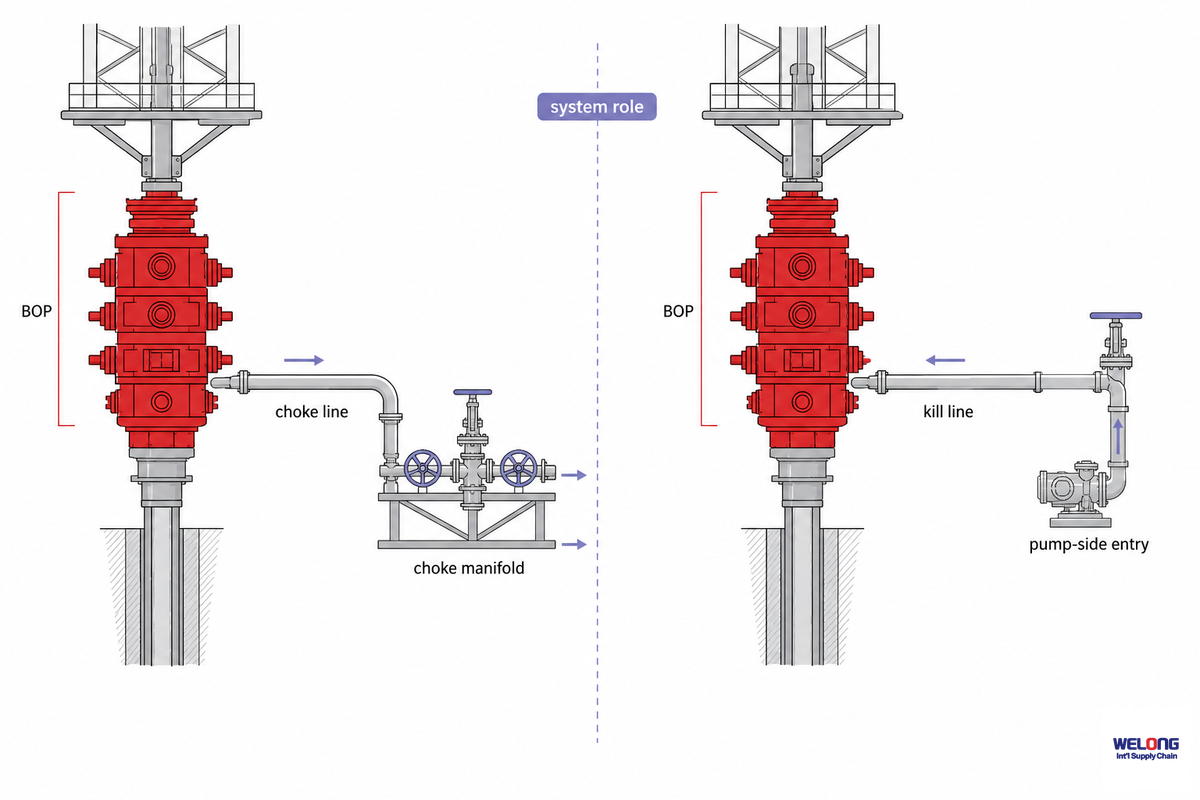
In well-control use, a choke line is associated with the controlled return path through the choke during an operation. During a kill operation, the kill line provides a path for pumping fluid into the well-control system when the operating procedure call for it. Those terms describe different jobs in the system, which is why a route sketch should identify the line purpose before anyone reviews a flexible section, hose ID, or document package. SLB’s choke-line definition and its kill-line definition provide a concise starting point.
Risk begins when a label travels farther than the evidence behind it. Teams may call a line a kill hose in conversation while the route drawing, test record, or operating procedure uses another identifier. This mismatch create delay during a handoff because the team must stop and work out whether the same physical item is being discussed. Start with the system role, then connect that role to the actual hose identifier and its two interfaces.
That mismatch is a handoff risk because a routine well-control application can involve more than one familiar name for the same route. Record the role, drawing reference, and physical identifier together before the next reviewer has to reconstruct the context.
What Is the Difference Between a Choke Line and a Kill Line?
For a choke line, the controlled return path runs through the choke; for a kill line, the approved path support pumping fluid into the well-control system. Records should name the purpose, end points, and operating context because a loose label can’t establish duty.
Exact arrangements remain site-specific and must follow the applicable procedure. Clear naming prevents a later crew from applying the right record to the wrong route. Where a drawing and a field label differ, preserve the discrepancy and ask the accountable authority to resolve it. Before a handoff, read the role field and the physical identifier together rather than treating either one as enough.
Where a Flexible Choke & Kill Hose Fits in the Well-Control Route
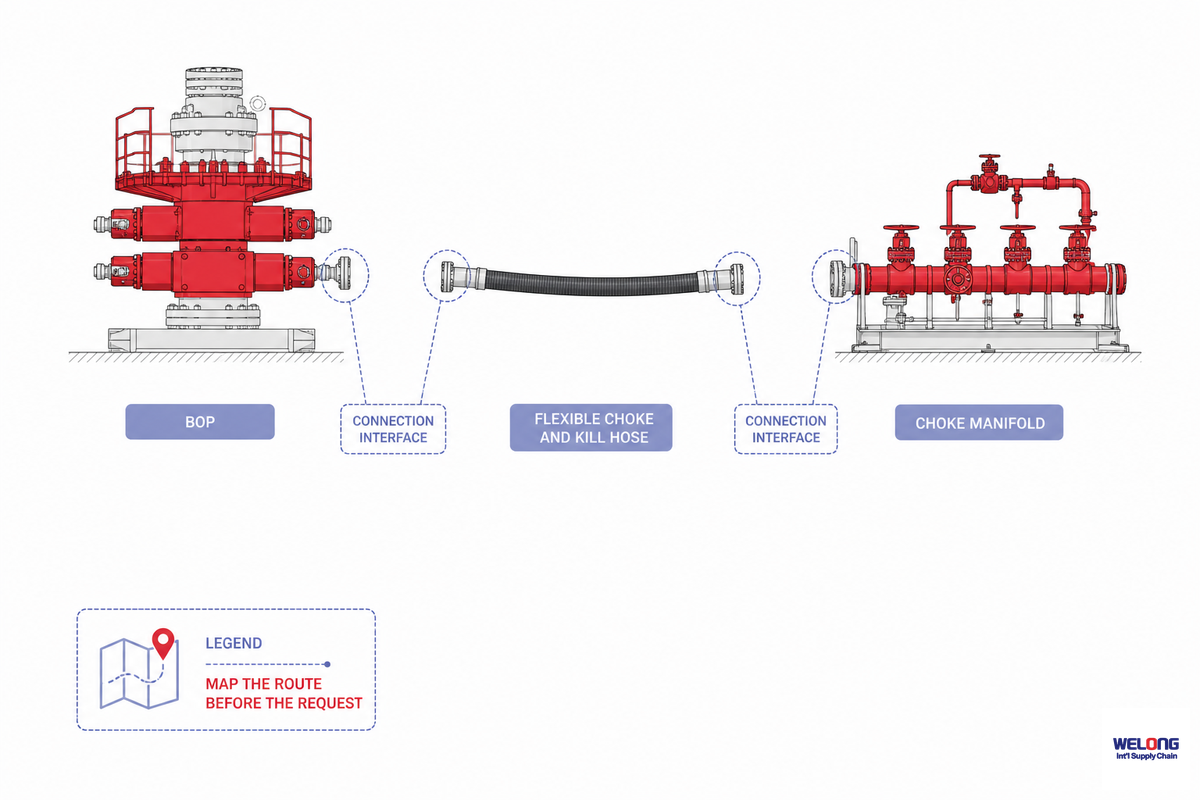
A flexible Choke & Kill Hose is one link in a wider route: well-control equipment, connection interfaces, a flexible section where needed, and surface equipment such as the choke manifold. Route drawings don’t need to be elaborate to be useful. Show where the line begins, where it ends, what it passes near, and which connection or adaptor creates the handoff point.
Viewing the hose as part of the system matter because it isn’t evaluated in isolation. Changes at the BOP, manifold, support point, or connection can alter the questions that the record package must answer. In its clarification of well-control requirements, the Texas Railroad Commission notes that API Specification 16C covers flexible choke and kill lines; this is a reminder to identify the applicable governing basis before treating a generic drilling hose as equivalent. Read the Texas RRC clarification.
Integration risk grows because a BOP application can have a correct hose label while one interface, support point, or record reference no longer agrees. Such a route drawing makes the discrepancy visible before a handoff become an urgent investigation.
How Do Choke and Kill Lines Work With a BOP and Choke Manifold?
Choke and kill lines link well-control equipment with the surface path used for controlled circulation. For a route review, mark the BOP and Choke & Kill Manifold as interfaces, then retain the evidence tied to the physical hose. Escalate any question that the approved procedure doesn’t settle.
What Changes When the Route Moves, Bends, or Can Be Damaged?
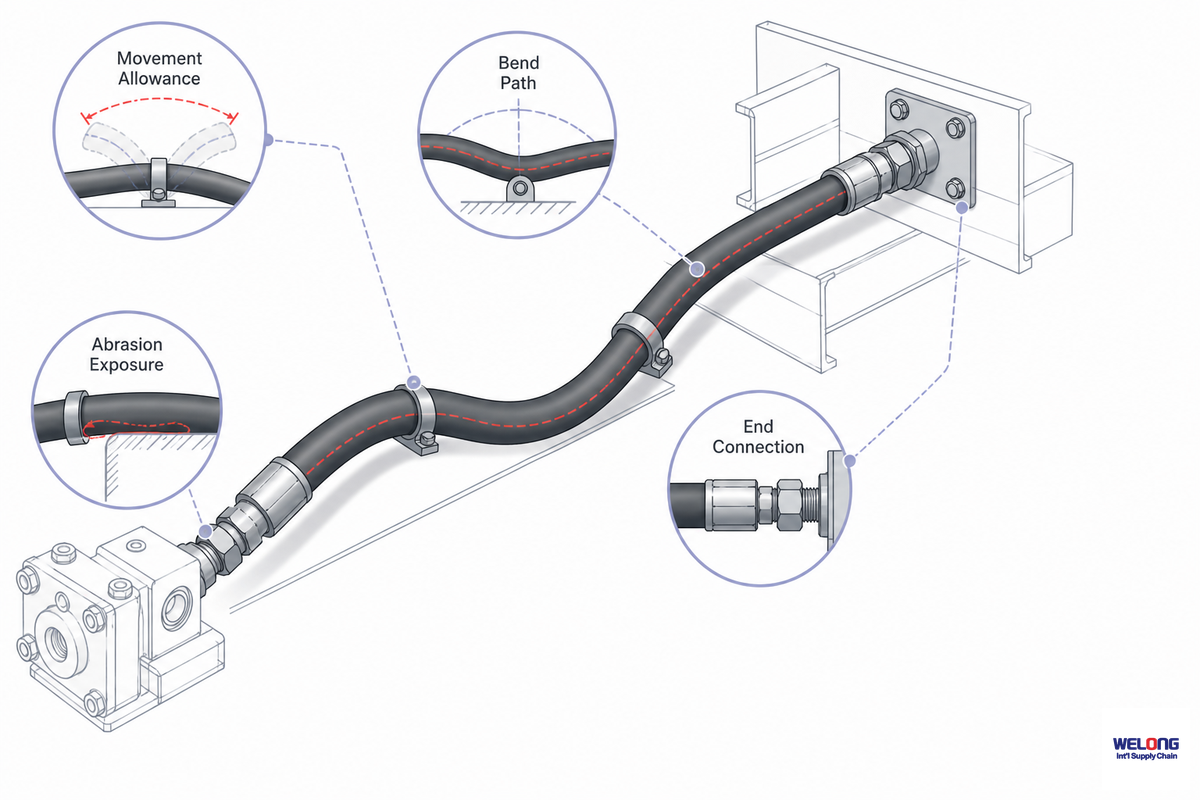
When a route change, the hose record can be left behind. Moving a line can introduce new contact points, heat exposure, unsupported spans, handling damage, or a different line-of-fire condition even when the hose identifier hasn’t changed. Field teams should record what changed and identify the authority that must decide whether the existing evidence remains applicable. Visual evidence can’t, by itself, pronounce the line fit for service.
BSEE Safety Alert 465 describes an incident involving a 100-foot hose with a 5,000 psi maximum working pressure that was used with 2,500 psi nitrogen even though the hose was intended for hydraulic fluid. That alert concerns high-pressure hoses generally, not a universal Choke & Kill Hose rule. Its value here’s narrower: route conditions, the conveyed medium, connection compatibility, and the manufacturer’s instructions belong in the escalation conversation. See BSEE Safety Alert 465.
Visible marks aren’t final dispositions. Nor is a missing record a minor paperwork issue: a missing record create an unanswered compatibility question. Applicable regulatory requirements, operator rules, manufacturer instructions, and accountable engineering review together determine the outcome. Alberta’s drilling directive is one jurisdiction-specific example showing that route protection, certifications, and related acceptance evidence can be regulated; it shouldn’t be converted into a global specification table. Review Alberta Energy Regulator Directive 036.
Jumping to a conclusion is the practical risk because a changed route may alter the context attached to an existing record. In a hydraulic application, record the observation and the unresolved question before the accountable authority decides the disposition.
| Mismatch category | What to record | Who owns the next decision |
|---|---|---|
| New contact point | Location, guard or support condition, and photos where permitted | Operations plus the designated technical authority |
| Changed bend path | Route sketch, movement allowance, and approved source to consult | Engineering or manufacturer-designated reviewer |
| Heat or exhaust exposure | Source of exposure and whether shielding or rerouting is being considered | Operations and applicable safety authority |
| Unsupported span | Support condition, observed movement, and change date | Engineering review path |
| End-connection concern | Connection identifiers, observed condition, and approved compatibility evidence | Responsible operator and technical authority |
| Conveyed-fluid question | Intended medium, service context, and source of compatibility confirmation | Manufacturer or engineering authority |
| Line-of-fire change | Handling position, securement question, and required job-safety review | Site safety and operations |
| Missing test evidence | Record identifier, date, acceptance owner, and gap statement | Document-control owner and technical authority |
| Unclear governing basis | Applicable regulation, operator requirement, manufacturer document, and engineering reference | Accountable operations authority |
3-Record Hose Readiness Map Before Acceptance
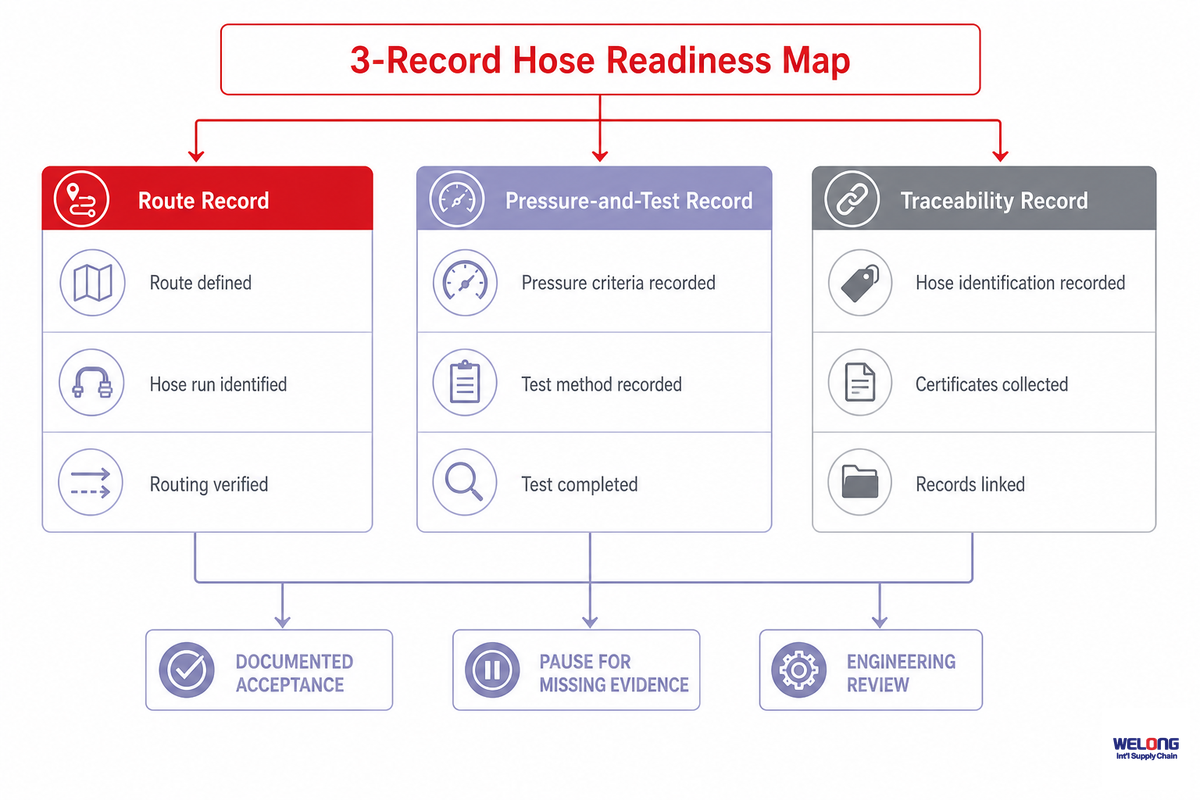
This 3-Record Hose Readiness Map is a buyer-side decision aid, not a standard and not a certification method. It separates three records that are often mixed together during a busy handoff: the route record, the pressure-and-test record, and the traceability record. Keeping them separate makes the open question visible instead of allowing a familiar hose label to stand in for evidence.
Separate records reduce review risk because each one answers a different question in the field: where the line is, what evidence is being relied on, and how that evidence connects to the physical identifier. A field application shouldn’t collapse those questions into one unchecked status.
- Route record: purpose, end points, interfaces, route changes, contact risks, supports, and the authority basis to consult.
- Pressure-and-test record: the approved evidence available, its identifier and date, the accountable acceptance party, and any gap requiring review.
- Traceability record: physical hose identifier, supporting documents, observation history, current disposition, and escalation owner.
Its role is to distinguish a document hold from an engineering question. By keeping records apart, the map prevent a field note from becoming an unsupported conclusion. API’s public 2021 third-edition material for Specification 16C identifies flexible choke and kill lines alongside design documentation, quality-control, storage, and shipping context; the map turns that broad documentation context into a practical review order without claiming that every field below is an API mandate. Before using that source as a record basis, check the dated update history for the governing addendum or errata. View API’s public Specification 16C material.
| Record state | Decision question | Next action |
|---|---|---|
| Route is unchanged and documented | Do interfaces and supports still match the record? | Proceed to record reconciliation |
| Route changed | What new condition needs review? | Open a route-change escalation |
| Test record located | Is the evidence tied to this identifier and intended context? | Confirm the acceptance owner |
| Test record incomplete | Which evidence is absent or unreconciled? | Hold for document control |
| Identifier readable | Can records be linked to the physical item? | Complete traceability check |
| Identifier unclear | Can the item be positively matched? | Escalate before acceptance |
| Visible observation recorded | Does the approved process define the disposition? | Route to the stated authority |
| Compatibility question open | Which source can answer it? | Request manufacturer or engineering review |
| Authority basis unclear | Which regulation, operator rule, or procedure governs? | Resolve hierarchy before a field decision |
Which Documents Should Be Checked Before a Hose Is Accepted?
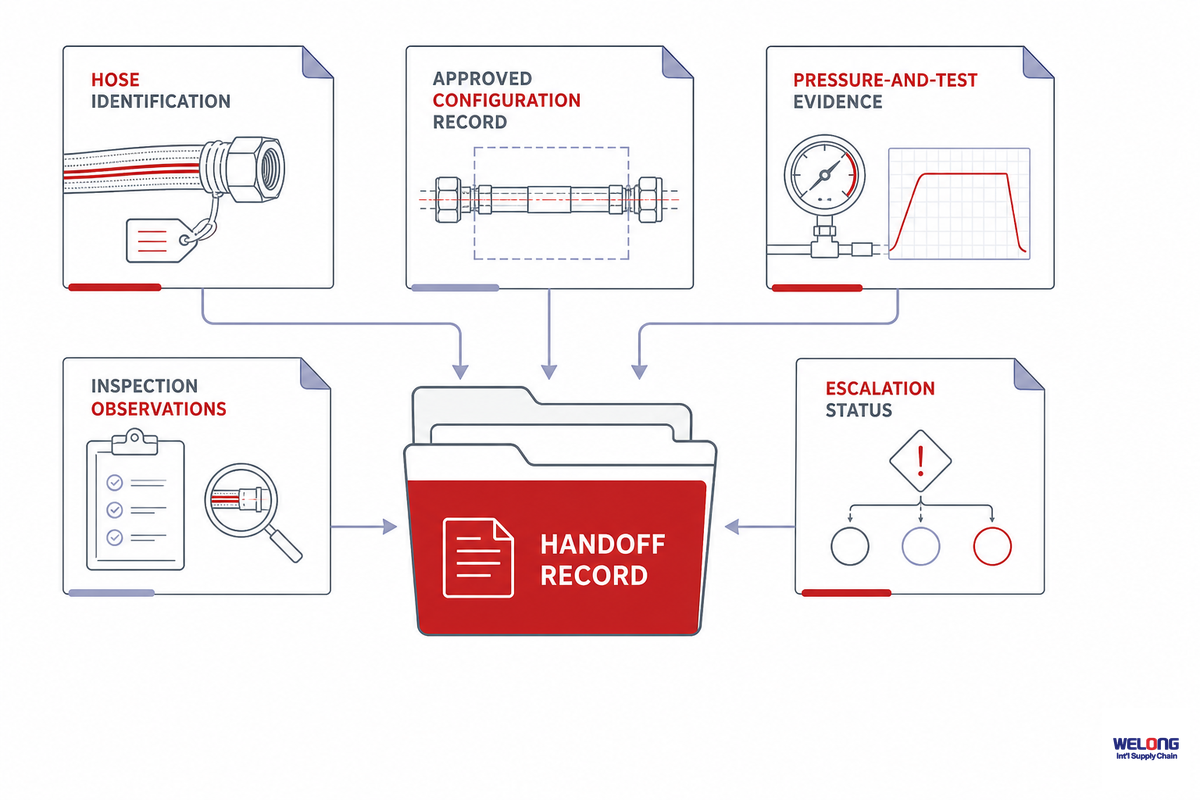
Ask for a controlled record package, then check what it can actually prove. Controlled packages may include the physical identifier, approved route information, record of the applicable requirement basis, pressure or rating class as recorded, nominal-size record, end-connection provenance, service-compatibility declaration, test or certification evidence, inspection observations, and the party accountable for the disposition. Those are record fields, not values to copy from a blog into a field decision.
That distinction matters. Product pages can describe available configurations. Handoff guidance should show how to reconcile the configuration evidence that an approved program asks for. If a required field is missing, record the gap and identify the right owner. Don’t backfill it from memory, a similar line, or a general catalogue.
A document gap is a handoff risk because a record used in the field must identify what it supports and who accepted it. Request the missing controlled evidence rather than infer a value from a similar configuration. For the public scope material behind this boundary, view API’s public Specification 16C material.
Some controlled files may use construction or service labels such as steel wire or an FSL3 designation. Those terms must be verified against the applicable source document for the identified hose. They aren’t facts that an observer should infer from appearance, a similar hose, or this guide.
Why Does API 16C Documentation Matter to a Hose Handoff?
API 16C documentation matters because a hose handoff need a traceable basis, not simply a product name. Preserve source documents, their identifiers, and the accountable reviewer so the stated service can be compared with the available evidence. This also preserve a documented decision trail.
API’s public material shows that the scope around Specification 16C includes flexible choke and kill lines as well as documentation and quality-control context. This doesn’t mean a general blog can interpret a specific compliance requirement. Record the governing edition, addendum, or errata basis whenever the program requires it, then let the responsible authority decide whether the evidence apply to the stated service. An undated document is often the first record gap to resolve.
Record Vocabulary: A Term Is Not a Decision
Controlled files can carry technical labels that are meaningful only when they remain tied to the identified hose, governing program, and intended service. This vocabulary help a reviewer recognize labels worth preserving in the record package. It doesn’t state that any label apply to a given hose, and it doesn’t convert a catalogue phrase into a field acceptance rule.
| Record category | Examples of labels to preserve, not guess | Record question |
|---|---|---|
| Fluid and pressure context | drilling fluid, drilling mud, kill mud, hydraulic, fluid flow, well pressure, formation pressure, pressure control, pressure choke | Which approved document connects the term to this service? |
| System and equipment context | API 16C choke, API 16C monogrammed, API 16C hose, API 7K, blowout preventer assembly, choke valve, kill manifold, manifold system, choke manifold and kill | Does the record identify the actual interface and governing basis? |
| Route and operating context | drilling operation, oil drilling, oil and gas drilling, drilling rigs, drilling platform, rotary drilling, onshore, onshore drilling, offshore drilling, control well, wellbore, well conditions | Has the route or operation changed since the evidence was issued? |
| Line and construction descriptors | high-pressure line, pressure hose, flexible choke and kill, rotary drilling hose, stainless steel armored, stainless steel wire, synthetic rubber, polyethylene | Is this phrase verified in the controlled source for the physical identifier? |
| Environment and condition | H2S service, corrosion, corrosive, abrasion, ozone, oil resistance, pressure resistance, high temperature, fire-resistant synthetic rubber | Which applicable authority decides whether the stated environment is relevant? |
| Document-specific labels | Techfluid, 704°C, pressure test, choke and kill systems | Can the label be traced to a source, date, and accountable reviewer? |
“Follow manufacturer-recommended inspection and replacement intervals.”
BSEE Safety Alert 465, cited as adjacent high-pressure-hose safety context
A Field Inspection Conversation Is Not a Fitness Certification
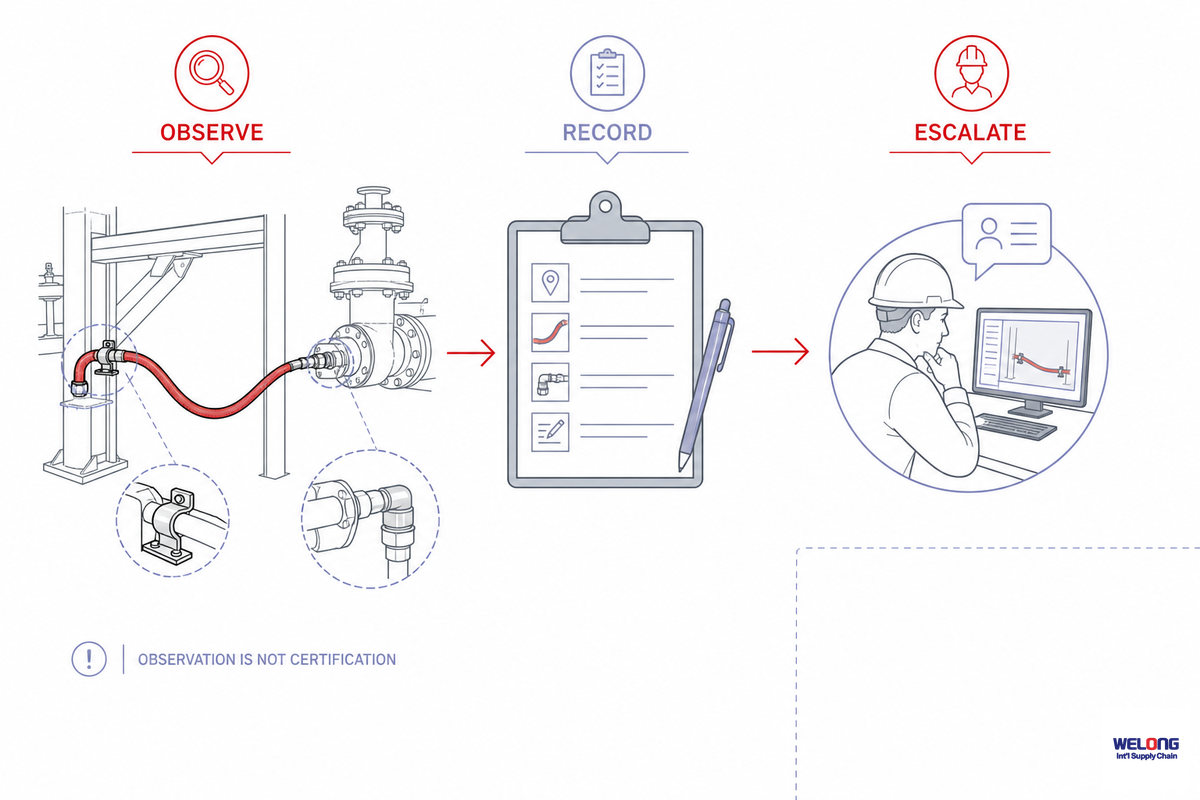
An inspection conversation can be useful when it separates what was seen from what still needs a decision. Record the observation, the location, the hose identifier, the evidence available, and the person or function that owns the next step. That makes the discussion easier to hand over and keeps the record from implying a conclusion that nobody with the right authority made.
BSEE material discussing a blowout-preventer failure report refers to visual inspection of choke and kill lines in a broader assessment context. The takeaway is disciplined language, not a new universal inspection rule: write what’s observed, write what can’t be confirmed, and retain the gap for the responsible authority. Read the BSEE technical assessment report.
That boundary is especially important after handling, a route change, or a documentation gap. A finding may need an operator decision, a manufacturer interpretation, an engineering review, or action under the governing regulatory regime. It should never become a replacement instruction simply because it appears in a field note.
The inspection risk is overstatement because an observation can be accurate without answering the final service question. In the field, retain the finding, its location, and its evidence gap so the correct application owner can decide what follows.
When Does a Choke & Kill Hose Need Engineering Review or Replacement Planning?
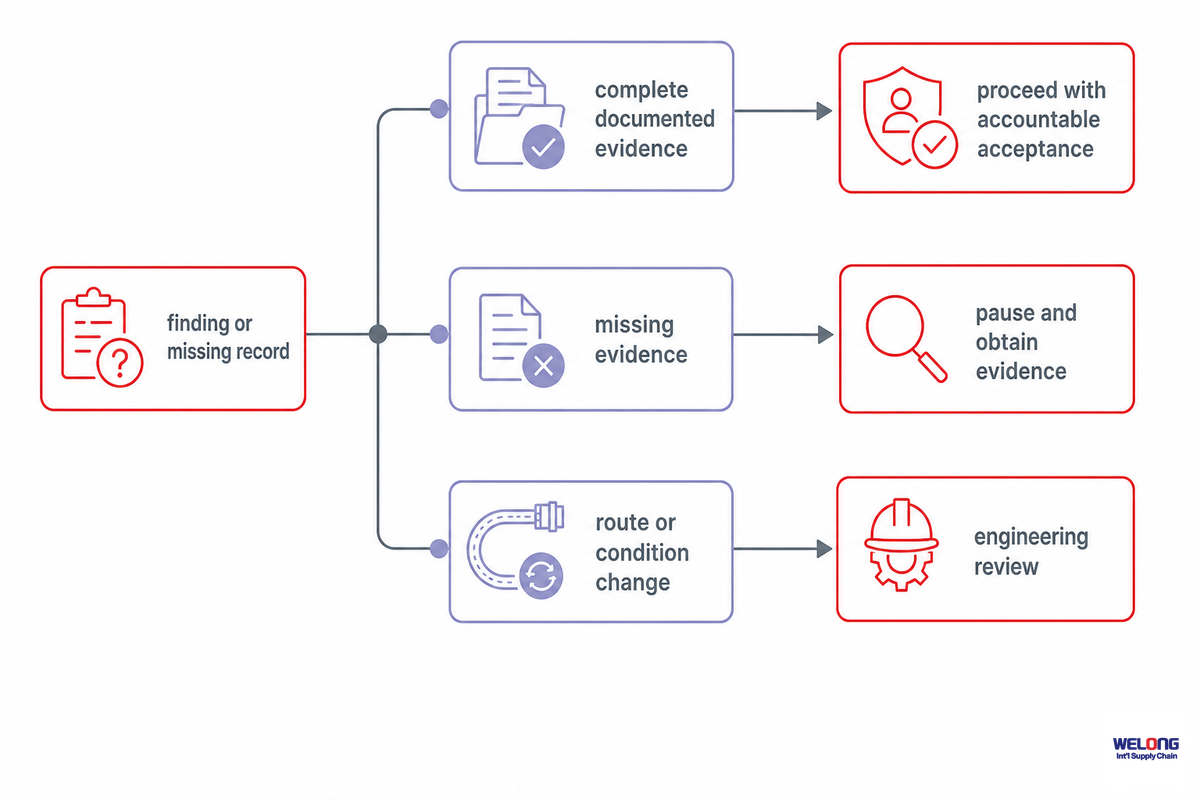
Move from observation to accountable review when the route changes, the available evidence doesn’t reconcile to the hose identifier, an interface create an unanswered compatibility question, or the applicable requirement basis is unclear. Replacement planning may be part of that review, but the blog can’t prescribe a universal discard interval or a pressure threshold. The correct outcome depend on the governing requirements and the facts of the specific operation.
For U.S. offshore operations, the regulatory framework matter alongside standards and manufacturer instructions. The eCFR well-control provisions address how BOP systems and components must be designed, installed, maintained, inspected, tested, and used, with the applicable hierarchy determined by the regulation. Check the current 30 CFR Part 250 text before treating any generic standard reference as the final word.
A clean escalation brief contains the physical identifier, a simple route sketch, the observed change, the documents found, the documents missing, and the decision requested. It gives the reviewer a defined problem to resolve instead of a vague request to “check the hose.”
The review risk remains open because the application facts, not a generic threshold, determine the next action. A concise escalation brief keeps the service context, route condition, and evidence gap together for the accountable review.
From Field Findings to a Configuration Discussion
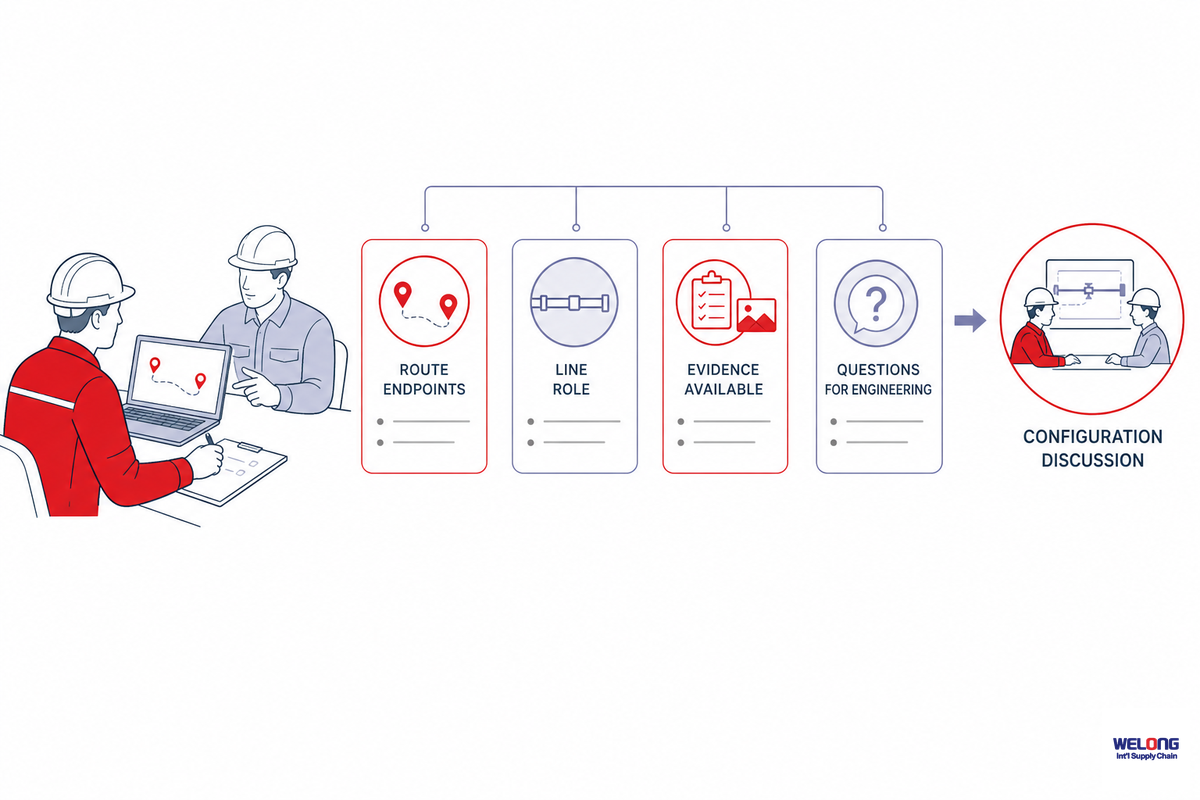
Once the route and records have been reconciled, the next conversation can be more precise. Prepare a brief that states the system role, two end points, connection interfaces, intended operating context, route constraints, and the evidence package already available. This protects both the operator and supplier from treating an incomplete field note as a configuration request.
For configuration details, available options, and a product-specific discussion, use the existing configuration details for a choke and kill hose. That page owns product-level questions; this guide owns the route-and-record brief that should arrive before the question is raised.
China Welong was founded in 2001 and works in supplier development, purchasing supervision, and quality control for industrial supply chains. A useful request to its team start with the controlled facts above, not with a guessed configuration or a copied pressure value.
This is a commercial risk because an industrial buyer and a supplier can otherwise begin with different assumptions about the route and evidence. A controlled brief turn the application question into a traceable discussion without converting this guide into a product-selection table.
What Is Changing the Choke & Kill Hose Handoff?
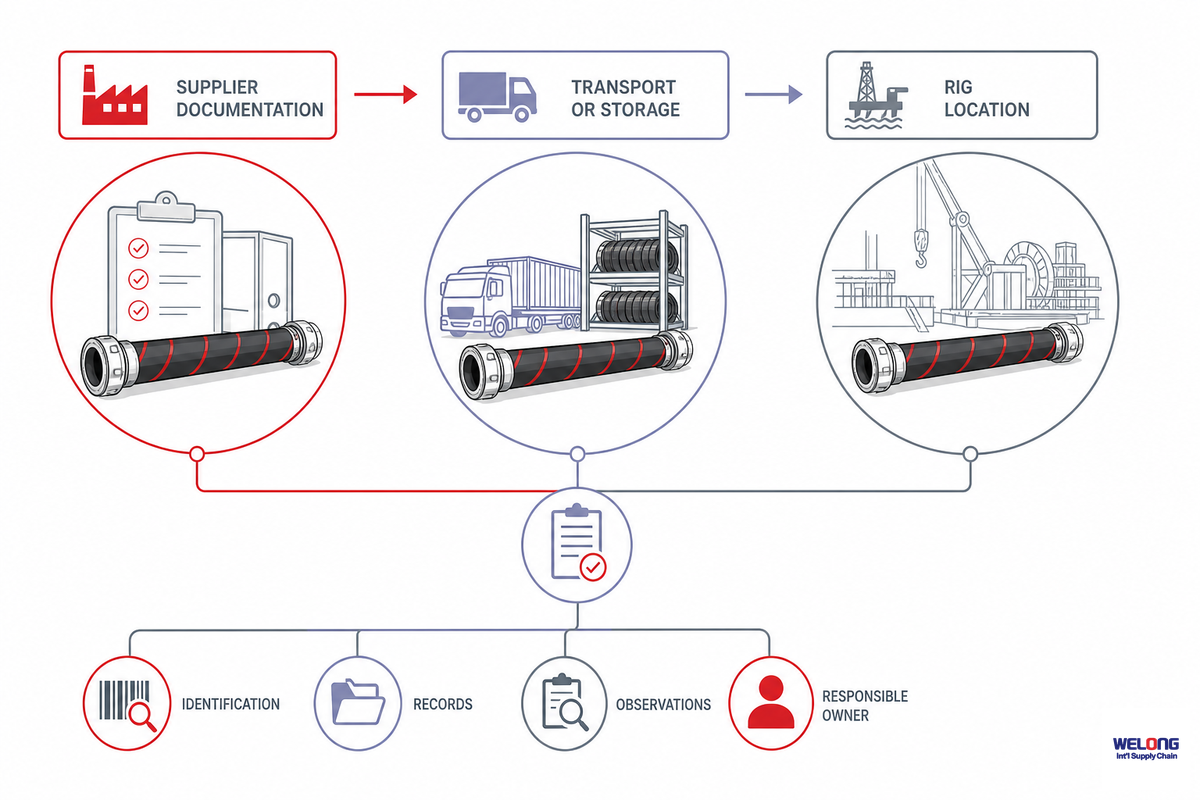
Practically, the change isn’t a market forecast. It’s the need to identify the document basis behind a handoff. API’s official update history contains dated third-edition addenda and errata notices for Specification 16C. The useful action isn’t to infer an outcome from any notice, but to record the applicable edition, notice date, and source URL for a specific handoff. An undated statement of compliance can be too thin for a controlled record. Check API’s latest updates page.
When a line change location, crew, or configuration context, protect continuity across the three records. The route record explains where it’s. The pressure-and-test record show the evidence being relied on. The traceability record links that evidence to the physical item and its current disposition. That’s a more useful handoff than a generic claim that the hose is “good.”
The handoff risk grows because a change in crew or location can separate a document from the application it was meant to support. Recording the governing version and route context gives the next reviewer a concrete starting point.
FAQ: Choke & Kill Hose Questions From Search Results
These questions create a review risk because brief answers can omit the route, evidence, and authority context. Use them in the field as an application checklist, then return unresolved facts to the approved procedure and accountable owner.
What is the difference between a choke line and a kill line?
In a well-control system, a choke line and a kill line have different functions, so records can’t treat the labels as interchangeable. A choke line is associated with returns through the choke manifold, while a kill line supports pumping fluid into the system when the approved plan call for it.
Exact system arrangements and approved operating procedures remain site-specific, which is why the role and physical identifier should appear together in the record. This distinction also guides later record searches: a name alone can’t establish the correct duty or approval basis.
How do choke and kill lines work with a BOP?
Choke and kill lines connect well-control equipment to surface equipment that supports controlled circulation and pressure management. Their interfaces, route, connection condition, and supporting records matter because a flexible line is only one part of the wider system. Record the route, interfaces, connection condition, evidence, and decision needed, then pass every unresolved service, compatibility, or condition question to the accountable authority identified in the approved well-control procedure. That work doesn’t replace the applicable regulatory requirements or an accountable engineering decision.
What is the role of a choke manifold in the line system?
In the line system, a choke manifold is surface equipment used in the controlled flow path associated with a well-control operation. In a route review, it’s an interface point rather than proof that every connected hose has the same duty, condition, or record basis. Identify the hose purpose, end connections, and evidence available, then send unresolved compatibility or condition questions to the responsible operations or engineering authority. A review should also state which team owns any resulting document gap.
What should be recorded during a hose inspection?
Record the hose identifier, route and interface observations, visible contact or handling concerns, available documentation, inspection date, and the owner of the next disposition. Where the governing program require technical identifiers, record the required fields and their source documents. Never substitute a remembered value or a similar product for controlled evidence.
When should a hose finding be escalated for engineering review?
Escalate when the intended route or service context changes, records are incomplete or can’t be reconciled, an interface or handling condition creates an unanswered compatibility question, or the observation can’t be resolved by the approved operating procedure. Include the hose identifier, route sketch, evidence available, and the specific decision required.
Prepare the Record Brief First
Before asking for a product configuration, gather the line role, route sketch, interfaces, hose identifier, available evidence, gaps, and the decision owner. China Welong can then review a clearer industrial supply-chain request without turning a field note into a specification.
The practical risk is a vague request because an industrial buyer may otherwise send a supplier an observation without the route or evidence it needs. Where the record basis invokes API 16C, retain the governing edition or addendum reference from API’s current updates. A short brief keep the application question anchored to controlled facts.
Why Buyers Work With Welong
About Welong Engineering Support
China Welong supports oilfield buyers with engineered supply-chain service for drilling tools, well-control equipment, rig-floor tools, casting parts, and industrial forged components.
Project Review Before RFQ
We help buyers compare tool family, material route, API or ISO requirements, inspection records, supplier capability, delivery risk, and documentation needs before a purchase decision is finalized.
Request An Oilfield QuoteCompany Profile // Data Sheet
CompanyChina Welong International Supply Chain
BrandWelong
CountryChina
Business TypeOilfield tools and industrial supply-chain partner
Main ProductsDownhole drilling tools, fishing and milling tools, wellhead and well-control equipment, oilfield hoses, rig-floor handling tools, mill rolls, and forgings
Engineering CapabilityTool-family selection, specification envelope review, API / ISO reference support, material traceability, inspection coordination, and supplier-route comparison
RFQ Data NeededTool type, size, connection, rating, grade, standard, quantity, drawings, and delivery target
Websitewelongoiltools.com
![Choke & Kill Hose: [Field Guide]](https://welongoiltools.com/wp-content/uploads/2026/07/choke-kill-hose-guide-featured-1-150x150.png)