Get in touch with Welong Company

Quick Specs
| Outer Diameter Range | 2⅜” to 6⅝” / 60.3mm to 168.3mm (regular drill pipe, API 5DP) |
| Standard Lengths | Range 2: 29-32 ft / 8.8-9.8m | Range 3: 40-45 ft / 12.2-13.7m |
| Steel Grades | E75, X95, G105, S135 (min. yield strength, ksi) |
| Governing Standard | API Spec 5DP (body) / API RP 7G-2 (used-pipe classification) |
| Material | High-strength low-alloy (HSLA) steel, typically 4130/4137-family |
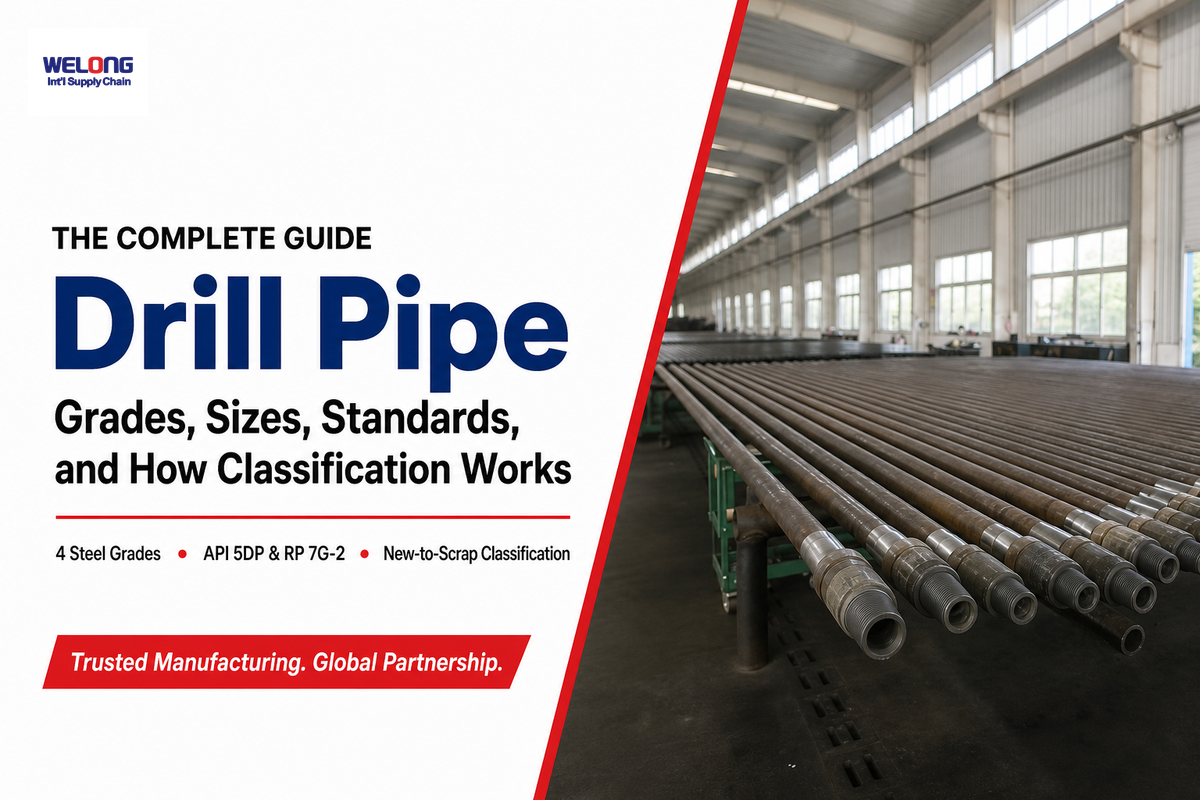
The hollow, threaded steel tubing that makes up the bulk of the drill string, connecting the rig floor to the drill bit thousands of feet down, drill pipe is designed to transfer drilling torque to the drill bit and to carry drilling fluid from the rig to the drill bit and through its bore, respectively and section by section, allow an operator to drill a well that’s miles deeper than the pipe itself is long.
Drill pipe is API 5DP-specified, hollow, threaded steel tubing forming the backbone of a working drill string, it connects the drill floor to the bottom-hole assembly thousands of feet below. This tubing carries both rotation and torque to the bit from the drill rig, while it serves as the conduit for drilling fluid, allowing it to circulate from the rig down through the bore of the pipe and out to the bit, where it exits the string to carry cuttings back to the surface in the annulus, a fluid-flow path that drills through varied geological formations. Made in joints of roughly 29 to 45 feet, drill pipe accounts for the majority of a working drill string’s length across most types of drilling.
Key Facts
- Demand for “drill pipe inspection” (+40% YOY) and “used drill pipe” (+75% YOY) is up more than the decline in general pipe-shape spec-shopping: buyers care less about new pipe price, more about condition.
- drill pipe grade names reflect yield strength in thousand-psi (ksi): from the relatively weaker E75 up to S135 for higher pressure, high strength applications.
- After the first use, the pipe will forever carry the designation of Used; there’s no upgrade available from Used.
- Based on data from a large North Sea field, actual fatigue-life of drill pipe can be predicted with published fatigue-life models only 20% of the time.
- “used drill pipe” in search traffic doesn’t solely represent pipe being purchased for downhole use; a significant chunk of it’s used pipe that has been purchased for the fence or construction markets, and isn’t relevant for drilling operations.
What Is a Drill Pipe?
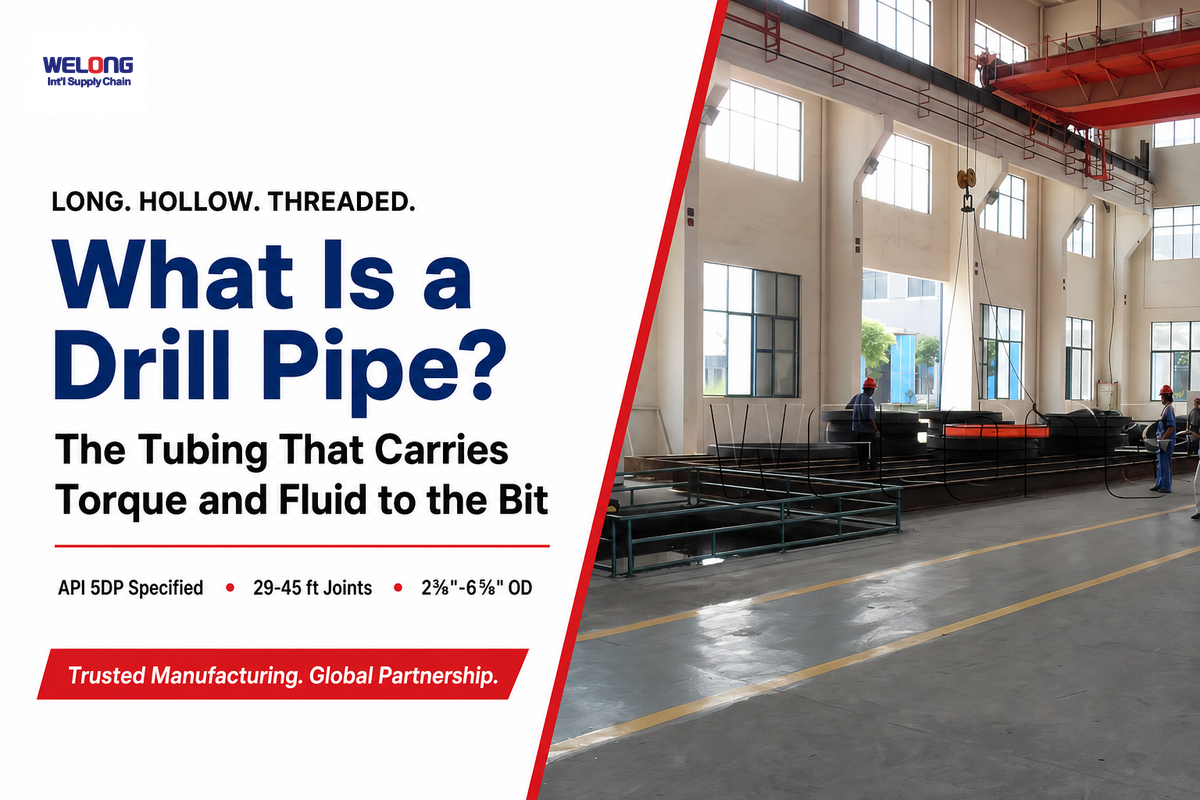
Drill pipe is long, hollow-threaded steel tubing fabricated to API Spec 5DP and designed to withstand the torque and pressure of a working drilling operation. Each length is finished on both ends with a forged, welded tool joint and assembled, in the shop or on the drilling rigs, into strings hundreds of joints long in wells thousands of feet deep. Drill pipe makes up the overwhelming bulk of the drill string’s length, from the rig floor to the bottom-hole assembly.
Understanding drill pipe in these terms also clarifies why drill pipe serves a role no other tubular in the string can substitute for, and why choosing the right drill pipe — not simply the right pipe by size alone — is the first real engineering decision in any string design.
While on the drill floor, the drill pipe’s inside carries torque down the wall to spin the bit, while simultaneously circulating drilling fluid down its bore, out the bit and carry cuttings back up to the surface. If a length of drill pipe breaks at any point in the drill string, it will cut off both rotation and fluid circulation at once — a real risk that can cost a rig 2-3 days of downtime while the string is fished out, because a parted joint downhole cannot simply be reconnected — and has, as a result, one of the most stringent inspection protocols of any piece of equipment in use today. Manufacturers like China Welong engineer their drill pipe body and tool joint specifically to reduce that failure risk across real oilfield applications, not just to pass a paper spec.
It isn’t the only tubular in the string, though. Regular drill pipe makes up most of the string’s length, but it works alongside heavier-walled components positioned closer to the bit, a distinction covered in the next section.
💡 Key Takeaway
drill pipe have two fundamental purposes: transmit torque and circulation fluid, to the well bore. Everything about a joint of drill pipe (the steel grade, size, joint style, etc.) supports these two essential functions at depth.
Drill Pipe Anatomy: Body, Tool Joint, and Its Place in the Drill String
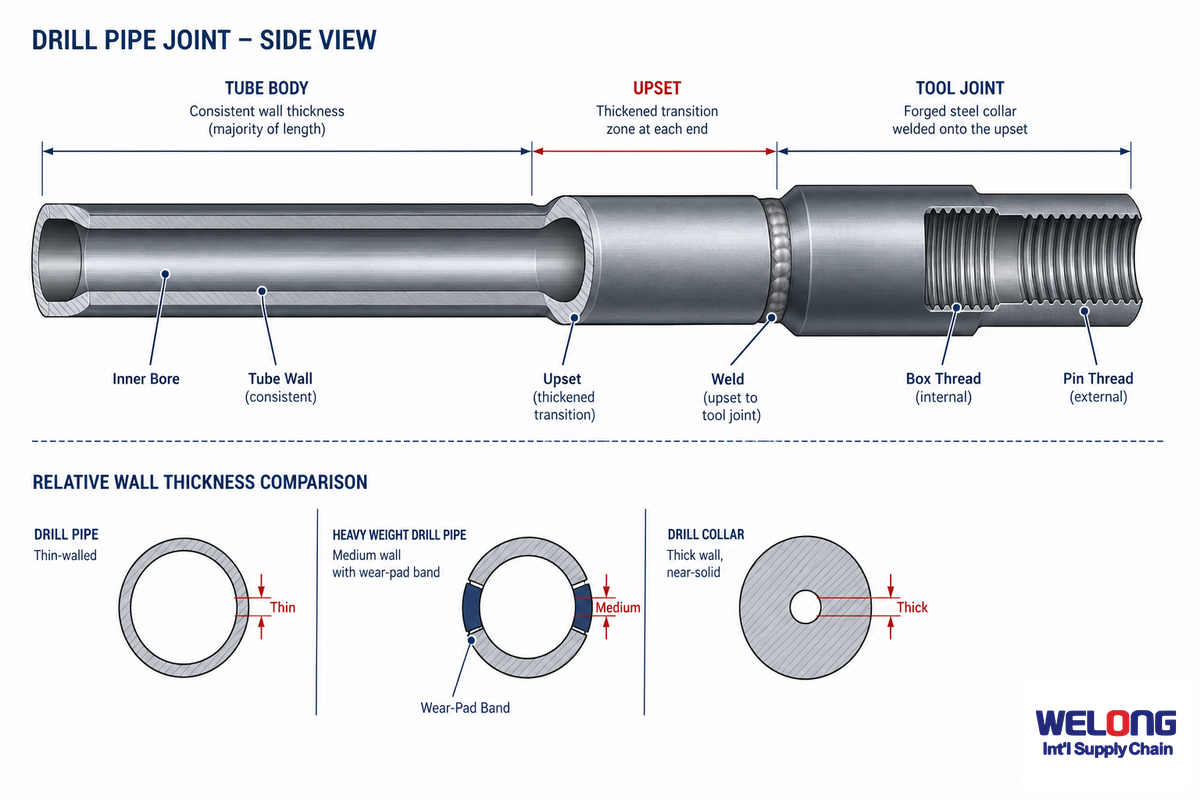
A drill pipe joint has three structural sections: the tube body (consistent wall thickness over most of its length), the upset (a widened transitional zone at each end where the wall is thickened to support threading), and the tool joint (a separate Forged/Heat-Treated steel collar welded onto the upset where the real API connection thread resides). It’s at the tool joint – not the pipe body – that virtually all thread-related failures originate, as this is the only part of the joint to see make-up and break-out torque repeated times.
What Is the Difference Between Drill Pipe and a Drill Collar?
Drill pipe, Heavy Weight Drill Pipe (HWDP) — sometimes called heavyweight drill pipe — and drill collars share the same drill string but play distinct roles. Regular drill pipe is thin-walled, working primarily in tension at the top of the string. Drill collars are heavy-walled tubulars above the bit, placing weight on the bit (WOB) in compression. HWDP — thicker than drill pipe, lighter than a collar — sits between them, buffering the bending stress where stiffness changes abruptly.
Mismatches between a component’s role and its position in the broader drilling system are serious engineering mistakes, not trivial labeling differences across different pipe types: inserting one of the heavier drill collars directly into a thin-walled string, for instance, concentrates cyclic stress across the entire drill string exactly where it’s most likely to fail — the connection — undermining the structural integrity the transition zone is meant to protect.
| Component | Typical OD Range | Primary Role | String Position |
|---|---|---|---|
| Regular Drill Pipe | 2⅜”–6⅝” | Torque + fluid transmission, tension | Bulk of the string, surface to transition zone |
| Heavy Weight Drill Pipe (HWDP) | 3½”–6⅝” | Fatigue-resistant transition zone, ~2x weight/ft of regular pipe | Between drill pipe and collars |
| Drill Collar | 3″–11″+ | Weight on bit (compression), 3-4x weight/ft of regular pipe | Bottom-hole assembly, just above the bit |
“The most common place for drill pipe to fail is in the threads, and the most common way threads become damaged is from debris left in the connections during handling.”
For example, a driller in the Permian Basin, after tripping out of a long horizontal section, may be surprised to find early signs of wear in his connection at the tool joint shoulder rather than at the pipe body – another good point to remember before concluding you’ve a “bad batch” of pipe when it’s actually handling debris or an under-torqued connection.
Drill Pipe Grades and Steel Metallurgy Explained
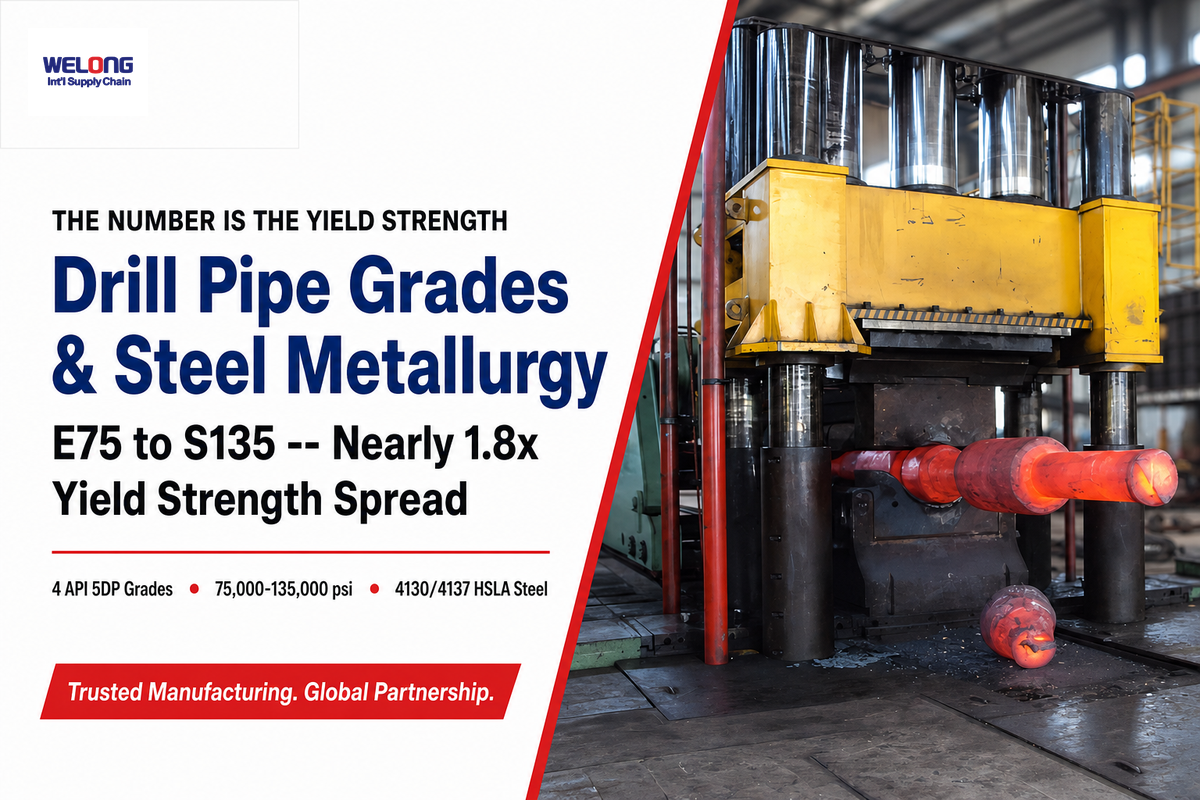
Four standard steel grades of drill pipe are recognized by API 5DP – E75, X95, G105 and S135 – with a designation which indicates the minimum yield strength in thousands of psi; for example, S135 will yield at a minimum of 135,000 psi, while E75 will yield at a minimum of 75,000 psi – nearly twice as strong. The pipe steel is usually a high-strength, low-alloy steel (HSLA) of the 4130/4137 family of chemistries, chosen for its strength, toughness, durability, fatigue resistance, and weldability at the tool joint — the same connection whose joint-thread mechanical properties under complex loads a 2024 peer-reviewed study analyzed in detail. Choosing the right grade for your specific drilling program, based on the conditions encountered during drilling — not merely selecting the largest number — will extend pipe longevity in the oil and gas industry, especially for demanding drilling programs in directional and horizontal drilling.
| Grade | Min. Yield Strength | Typical Application |
|---|---|---|
| E75 | 75,000 psi | Shallow, low-torque vertical wells |
| X95 | 95,000 psi | Moderate depth, general-purpose drilling |
| G105 | 105,000 psi | Deeper/directional wells, higher torque loads |
| S135 | 135,000 psi | Deep, extended-reach, and high-torque directional/horizontal wells |
Higher grade isn’t automatically the better choice. S135, on the contrary, is significantly more prone to corrosion fatigue failure in corrosive environments and sour service conditions. The crack growth rate under sour conditions can be about ten times greater than in air. Conditions can be even worse under rotation: published research on rotating specimens (60 rpm) found a 41% higher corrosion rate under rotation than under static exposure, and a separate, recent analysis identified a failure in an S135 pipe, which met all of API Spec 5DP’s physical specifications, as being driven by combined corrosion and stress concentration in the thread region. If your application is a sour well, it may be better off served by lower strength steel, which will accommodate an corrosion resistant coating and NACE metallurgical qualifications, than a blanket, generic Spec 5DP S135 string-a real engineering trade-off.
📐 Engineering Note
A physical spec alone doesn’t make S135 the correct answer, because it only specifies physical and chemical properties and doesn’t directly account for in-situ downhole conditions. A well’s downhole conditions should dictate the choice between lower grade steel and NACE qualifications over generic S135; it shouldn’t be a default, simple selection. Properly matched drill pipe delivers its full rated performance only when grade selection accounts for those downhole conditions, not strength alone.
Drill Pipe Sizes and Weight, The Reference Tables
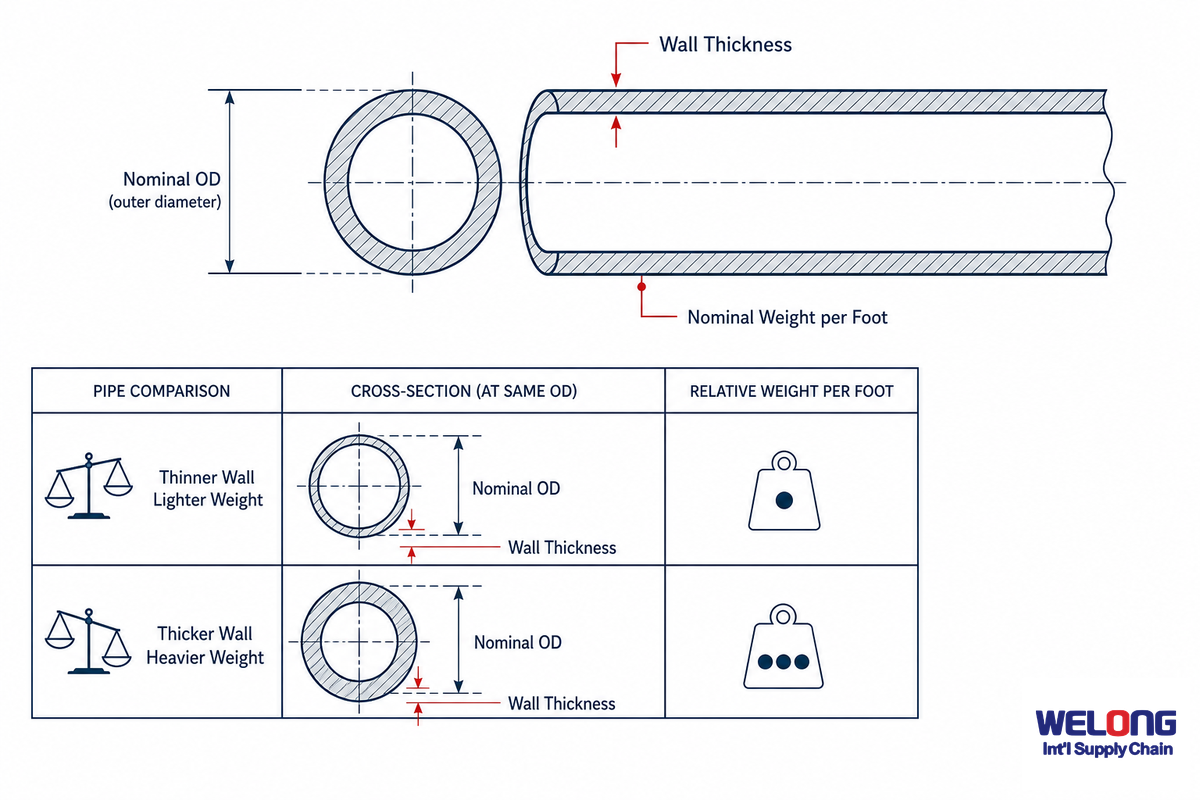
API 5DP organizes drill pipe length into two standard ranges, giving buyers a real variety of sizes to match well drilling and deep drilling programs. Per length figures cited in a Canada Border Services Agency trade-investigation filing on drill pipe (a government document that references the API range definitions), Range 2 generally runs 29 to 32 feet per joint, though it’s very often around 31.5 feet, this length accounts for most drill pipe used in standard wells. Range 3 runs 40 to 45 feet and is growing more common in deepwater wells and when running drill pipe adjacent to casing, where fewer, longer joints mean fewer connections, and fewer connections mean fewer potential failure points and less time spent making up and breaking out pipe on a trip.
How Is Drill Pipe Size Measured?
Specifying drill pipe size requires understanding the difference between tool joint OD and nominal body OD. Drill pipe size is defined by nominal OD and nominal weight per foot, which together imply the wall thickness engineered into the body. A 5-inch, 19.50 lb/ft drill pipe has a body OD of 5 inches and a wall engineered to weigh 19.50 pounds per foot, before the tool joint is added.
Since two pipes of the same OD can have different nominal weights — and therefore different wall thickness and resulting burst and collapse pressures — a string can’t be fully defined by OD alone; nominal weight must be used together with OD and grade. This applies whether a string is ordered new or a string of used oilfield pipe is being reviewed for purchase.
| Nominal OD | Common Use | Length Range |
|---|---|---|
| 2⅜”–3½” (60.3-88.9mm) | Slimhole, workover, coring | Range 2 (29-32 ft / 8.8-9.8m) |
| 4″–5″ (101.6-127mm) | General-purpose land and offshore drilling | Range 2 (29-32 ft / 8.8-9.8m) |
| 5½”–6⅝” (139.7-168.3mm) | Deepwater, large-bore, casing-adjacent work | Range 3 (40-45 ft / 12.2-13.7m) |
Worked example: a 5,000-foot vertical well drilled with Range 2 (31.5 ft average) pipe needs about 5,000 ÷ 31.5 ≈ 159 joints, each one requiring a make-up/break-out cycle on every trip out of the hole. Switching that same well to Range 3 (42.5 ft average) drops it to 5,000 ÷ 42.5 ≈ 118 joints, about 41 fewer connections to inspect, torque, and possibly fail on every single trip into and out of the hole — a real drilling efficiency gain across cost-effective drilling operations and demanding drilling applications.
OCTG and API Standards That Govern Drill Pipe
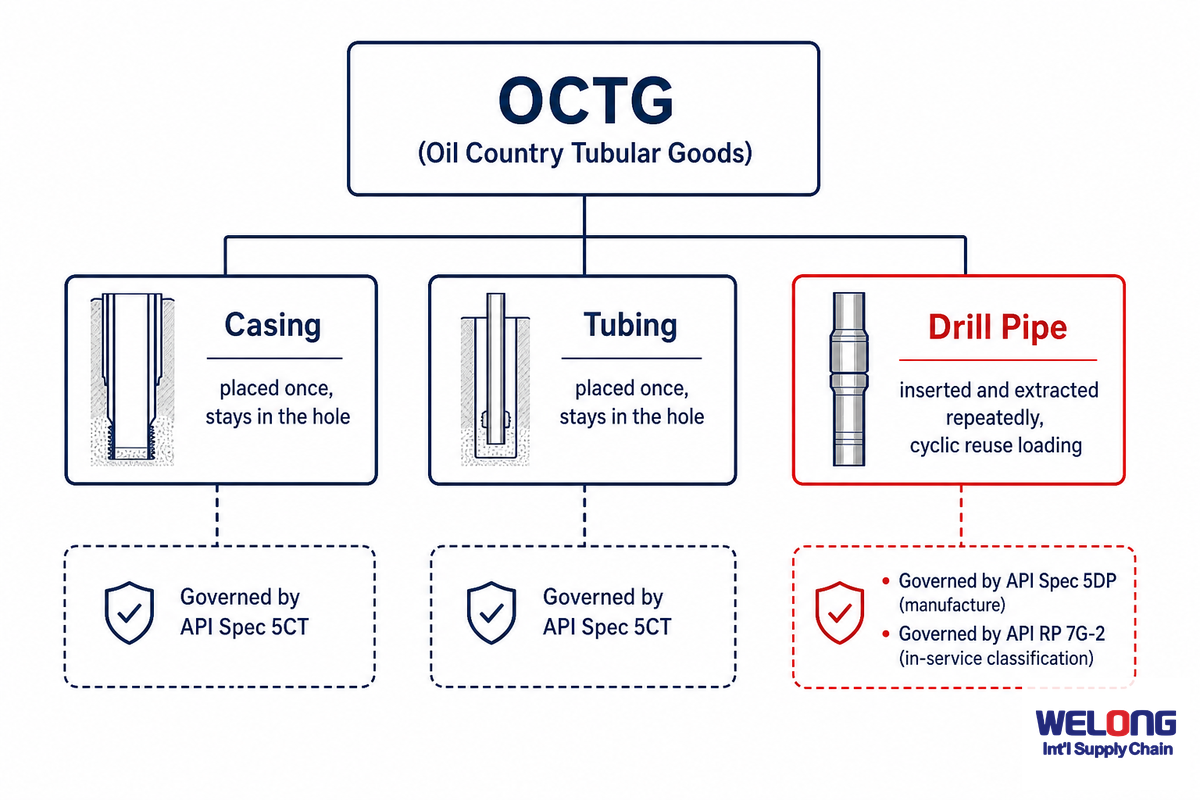
The OCTG-to-Drill-Pipe Terminology Bridge
OCTG – Oil Country Tubular Goods – is often treated as if equivalent to “drill pipe,” and that’s where much confusion in selection occurs. OCTG is the generic term encapsulating all tubular products deployed in a well: casing, tubing, and drill pipe. drilled pipe is a handling tool inserted and extracted from a hole repeatedly during its service, but casing and tubing are placed once, then remain in the hole until decommissioned. Drill stem design has always treated drill pipe as the reusable, cyclically loaded member of the string rather than a static tubular, and that difference is functionally important – API 5DP’s fatigue, torque, and inspection requirements for drill pipe are based on cyclic, multi-trip, reuse loading, while API 5CT (casing/tubing) isn’t.
API Spec 5DP is the prime governing standard for drill pipe manufacture: it establishes chemistry, tolerances, four steel grades, and minimum toughness (API 5DP requires a minimum longitudinal full-size impact toughness of no less than 54 J at ambient temperature). A separate document, API RP 7G-2 — long published as the U.S. national mate to ISO 10407-2 — controls inspection and classification once the pipe has been placed into service. API 5DP and RP 7G-2 both have addenda and revision updates published in 2025, so quoting one or the other should always involve confirmation of the exact edition in question rather than a casual handwave. The “drill pipe OCTG standards” question that buyers mean is really two documents at two distinct points of a pipe’s life: 5DP during manufacture, RP 7G-2 during service. Confusing the two is a real, costly mistake for OEM buyers and procurement teams: a supplier quoting generic OCTG pricing without confirming which specification actually governs your application can leave you with tubing that is a few percentage points short of the fatigue rating your well program actually needs. China Welong engineers its drill pipe specifically to API 5DP requirements — not generic OCTG catalog specs — for exactly this reason, since the two document families are not interchangeable in the field.
Tool Joint Connections: How Drill Pipe Sections Are Joined
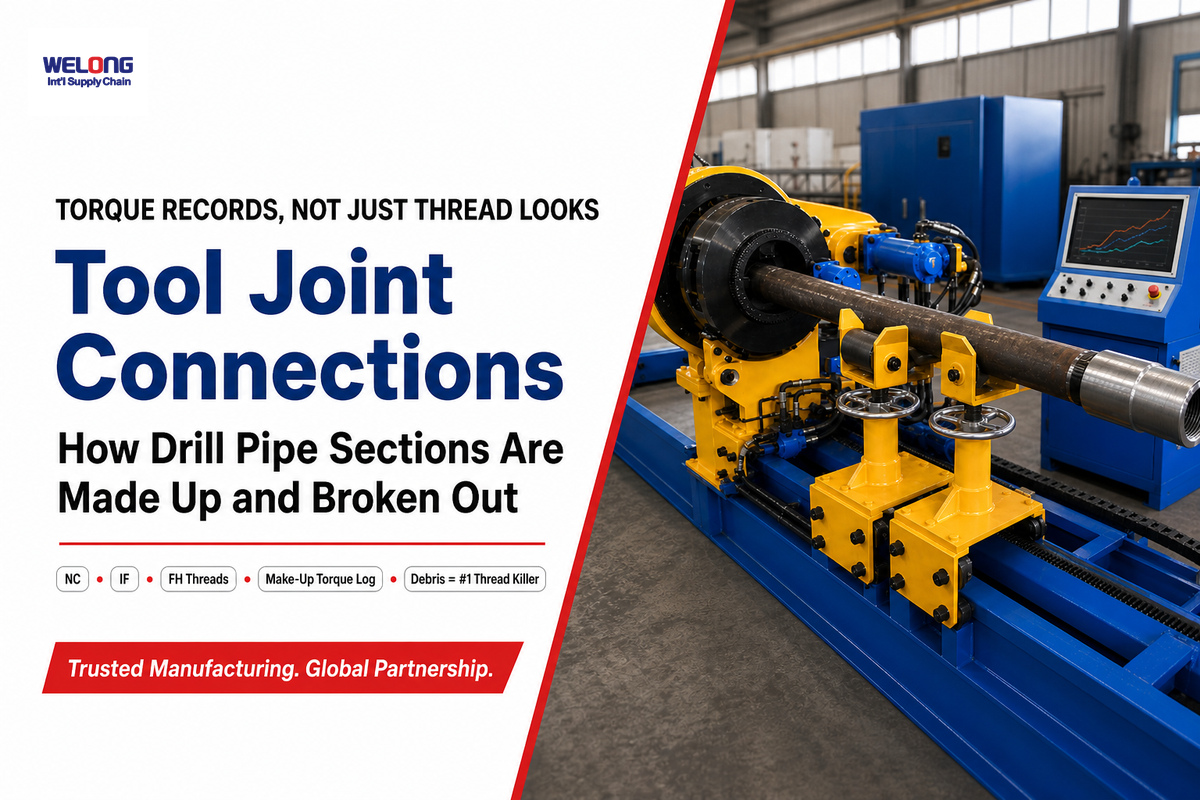
Every drill pipe joint has a pin (male, tapered external thread) as the pin tool on one end and a box tool (female, tapered internal thread) on the other, allowing a series of threaded tool joints to screw into one another to create a continuous string. The connection is a rotary-shouldered thread family – NC (numbered connection), IF (internal flush), and full-hole (FH) are the most common generic thread families across the industry – sized to correspond with the pipe OD and torque expected for the string.
Correct torque making-up the connection is equally important as thread choice itself. If a connection isn’t brought to its specified make-up torque before being put into service, it continually attempts to tighten downhole as the string rotate – a cyclic micro-slip-and-catch-on-the-shoulder-face process that scuffs the threads via a repeated jackhammer-mimicking impact, powered by bit vibration and surface torque. That isolated detail is why torque records, not merely thread inspection, are included in a serious connection integrity program. The financial risk is real: a single galled connection discovered mid-well can force an unplanned trip and days of rig downtime, a mistake that a documented make-up torque log — cross-checked against the tool joint manufacturer’s specification — would have flagged before it became a field failure. China Welong verifies make-up torque tolerances on its own tool joints as a standard part of quality control before shipment, because a connection engineered to spec on paper but assembled a few percentage points outside its torque window is a common, avoidable failure point in real oilfield applications. OEM buyers and drilling contractors specifying NC/IF/FH connections in the field should request the same torque documentation from any supplier.
⚠️ Common Mistake
Not a manufacturing defect but by far the single biggest reason for damaged threads is debris that got lodged in the connection during the make-up procedure. This is exactly why the importance of drill pipe maintenance is so often underestimated: a clean-and-inspect step before every make-up costs a few minutes and prevents the majority of avoidable thread failures, extending the useful life of the pipe. A well-maintained drill pipe fleet is simply better equipped to meet the demands of specific drilling needs used in oil and gas operations worldwide.
Tool joint manufacturing itself hasn’t stopped advancing either: from patent filings concerning improved thread geometry — such as tool joint sawtooth-profile thread designs providing better distribution of loads across the flanks of engaging threads — to advancements in upset-forging processes at the junction of the pipe to the tool joint: drill pipe engineering hasn’t yet become a resolved issue of decades ago.
Classification, Inspection, and the New-vs-Used Market
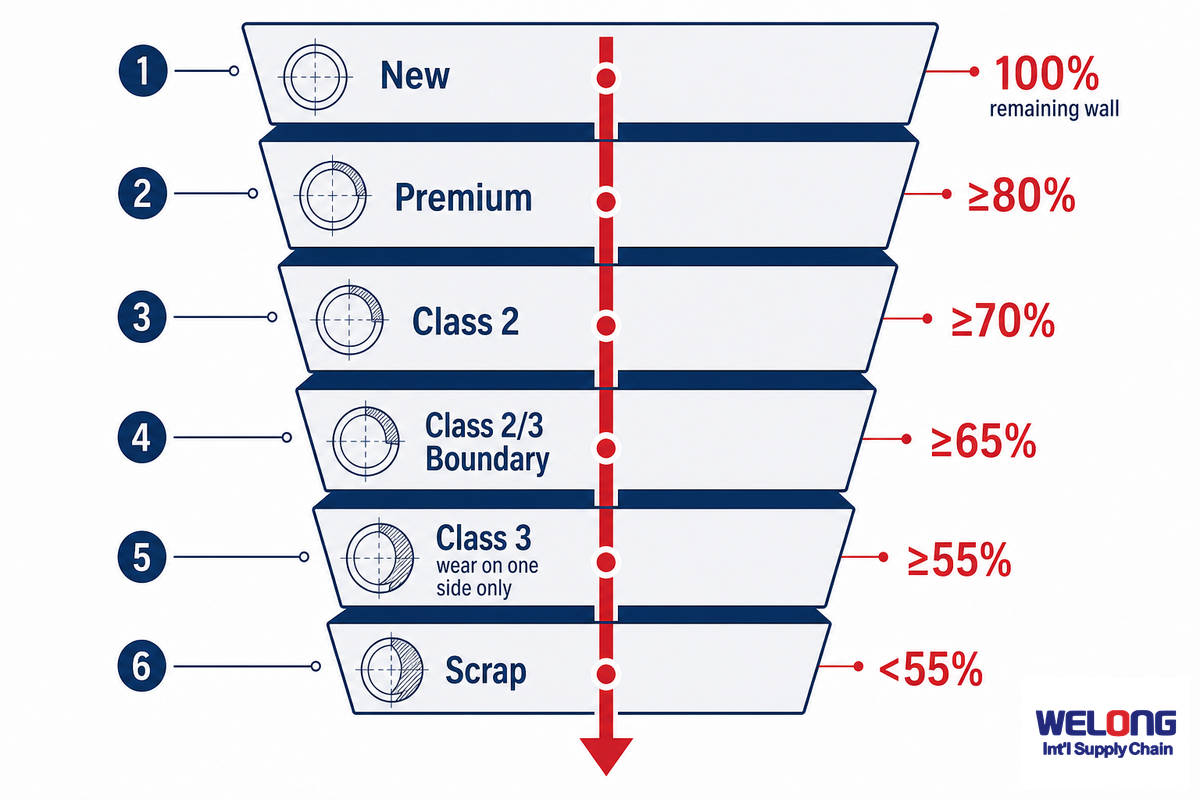
The Drill Pipe Downgrade Path: New to Scrap in 5 Classes
Once drill pipe goes downhole for the first time, it is permanently reclassified, the system only moves in one direction.
The current edition of API RP 7G-2, historically adopted as the U.S. national counterpart to ISO 10407-2, grades used drill pipe mostly based on the percentage of remaining original wall thickness, determined by ultrasonic or other calibrated measuring devices, not based on its appearance or how many wells it has drilled. The minimum acceptable wall-thickness percentages quoted in the table below represent the figures most consistently used in engineering and inspection-service practice and are consistent with the classifications found in the IADC Drilling Lexicon. A full inspection also evaluates additional imperfections, pitting, slip cuts, thread condition, separately from wall thickness. Full specification is only to be found in the original standard, available through official distributors of API/ANSI accredited standards.
Other parameters besides the level of wall thickness, such as corrosion and thread condition, are part of the RP 7G-2 standard for grading. These factors can contribute to the degradation of a joint and cause it to fall out of its classification class. Use the tables below as an informal guide; always consult the published standard. The table also lists two market categories a buyer will encounter that sit outside the formal five-class API schedule: reclaimed structural-grade pipe and unclassified/pending-inspection listings, both discussed in more detail below.
| Classification Category | Remaining Wall | Typical Disposition |
|---|---|---|
| New (N-Class) | 100% | Unused; only classification level that can never be reassigned upward |
| Premium (P-Class) | ≥ 80% | Fit for continued standard service after inspection |
| Class 2 (field practice: C-1) | ≥ 70% | Service-restricted; re-inspect on a shorter interval |
| Class 2/3 boundary (field practice: C-2) | ≥ 65% | Some inspection services subdivide this band separately from the base Class 2 threshold for fleet-tracking purposes |
| Class 3 (field practice: C-3) | ≥ 55%, wear on one side only | Light-duty use only; approaching end of service life |
| Scrap | < 55% | Removed from service, not to be run downhole |
| Reclaimed / Structural-Grade (non-oilfield) | N/A – failed oilfield inspection | Resold for fencing, ranch construction, and other non-drilling structural use; not to be represented as classified oilfield pipe |
| Unclassified / Pending Inspection | Unknown until measured | Listed by length and diameter only, with no wall-thickness report; treat as unverified regardless of asking price |
If You’re Evaluating “Used Drill Pipe” — A Condition-to-Action Guide
- If the list of offered joints includes an API RP 7G-2 or ISO 10407-2 certified wall thickness inspection report, assume the material is original oilfield grade and verify it has been classified to match the requirements for your job.
- If the only listing include visual condition and price per foot without documentation of any inspection, request a full wall thickness report prior to purchase – any pipe lacking inspection reports isn’t assumed to be graded and could fail the application.
- If the listing simply states length and diameter for fence or other structural construction and doesn’t mention API classification or grade, assume that it’s reclaimed, non-oilfield-grade material not intended for drill pipe use regardless of cost.
This distinction is more than theoretical; some pipe suppliers openly list reclaimed drill pipe for ranch construction and other non-oilfield applications. Field discussion among machinists and fabricators confirms this is common practice: used drill pipe, typically 4130/4140-family steel, gets inspected, often by X-ray, for cracks, and pipe that fails inspection for oilfield reuse is frequently sold as scrap into exactly this kind of structural or fencing market instead. Both markets are legitimate, but they aren’t the same product, and a buyer sourcing pipe for a well need classification documentation a fence-post buyer never asks for. This isn’t a misclassification on their part, but an indication that there are two entirely different products, each requiring different kinds of verification from a buyer, that are called drill pipe.
How Drill Pipe Is Manufactured
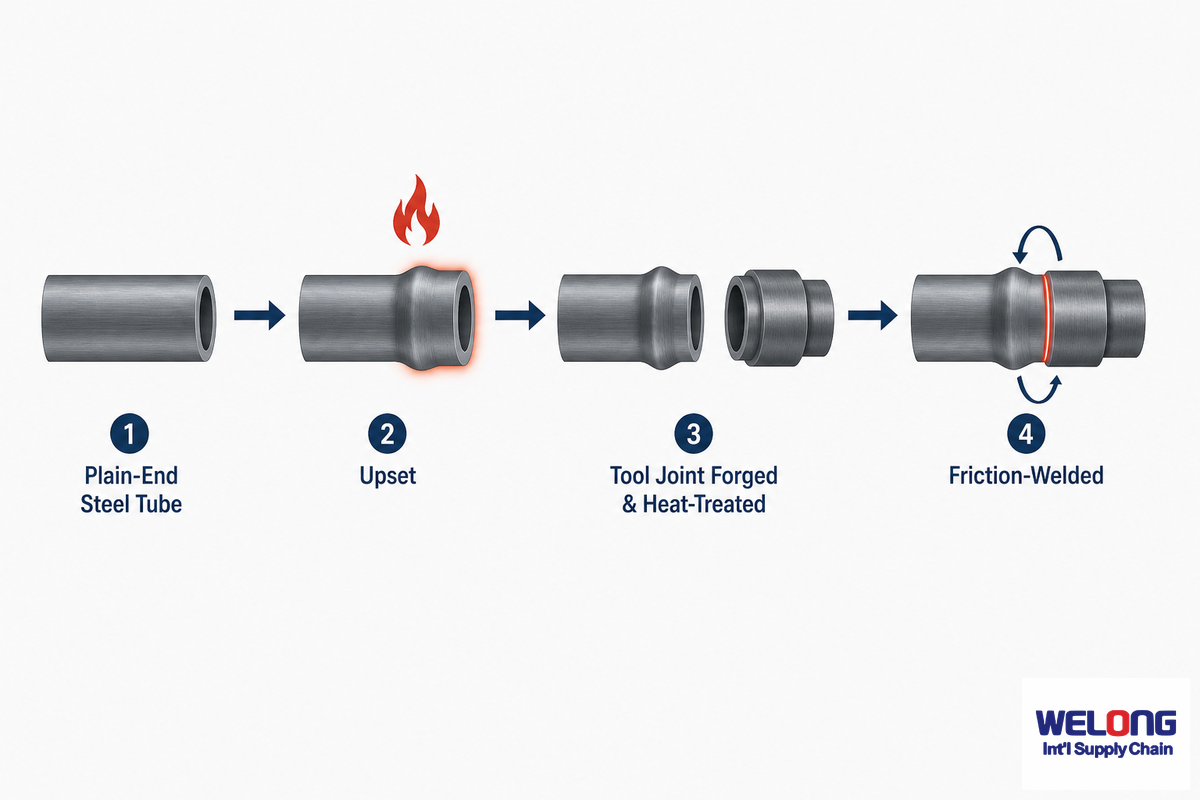
Modern drilling relies on a process where drill pipes are manufactured starting from a single length of continuous, plain-end steel tube, sized and wall-gauged for the intended grade and nominal weight. Each end is upset — locally heated and thickened to build a tempered steel transition zone — to accept a pre-forged, heat-treated tool joint, which is then friction-welded onto the upset as part of the drilling process.
Friction-welding, not arc welding, is the industry standard because the joining happens in a solid state, requiring no filler metal and therefore no fusion heat-affected zone that could create weak spots at a joint expected to withstand many millions of torque cycles over its service life.
China Welong manufactures drill pipe with friction-welded tool joints as part of its downhole tubular product line, alongside its heavy weight drill pipe and drill collar products in the same BHA family. Control of the upset-forging process at the pipe-to-tool-joint junction has continued to be an active area for patent filings by many companies — and a recent set focuses on achieving better thermal management throughout this region to limit formation of the fatigue-crack initiation points indicated by field reports to be the leading cause of failure. Depending on the service environment, drill pipes may be coated internally, externally, or both to resist corrosion and abrasion, in addition to — not instead of — the grade and NACE-qualification decisions covered above.
💡 Key Takeaway
Normally it is the tool joint weld property – not the steel pipe base – which is determining fatigue life. Inquire from your supplier details about their process control on upset-forging and friction-welding. It’s not the steel grade certificate they provide.
Drill Pipe in the Downhole Tool Family
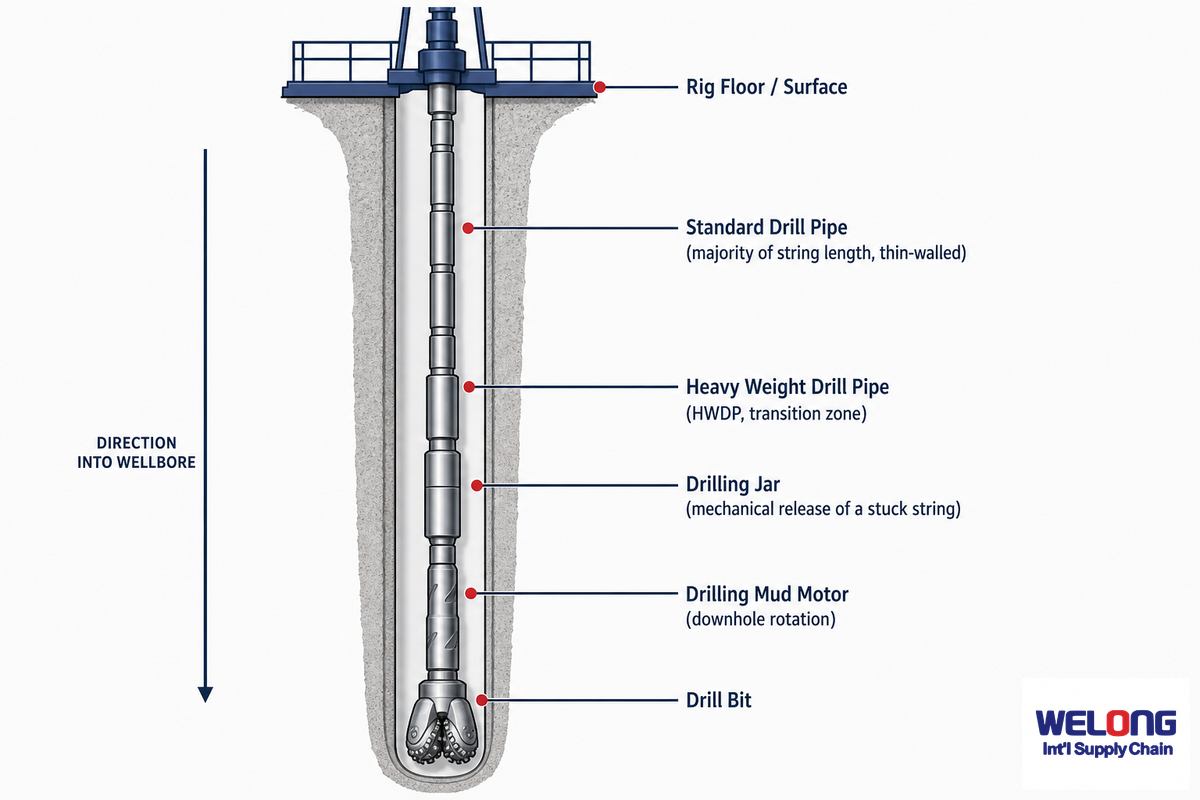
Rarely is it run solo on real drilling projects in demanding drilling environments. On a directional or extended-reach well, the string often contain drilling mud motors for downhole rotation, drilling jars for mechanical release of a stuck string, and wireline tools plus measurement while drilling instrumentation for logging and intervention — a full family of drilling tools, each a separate product category with its own specifications and failure modes. A BHA must consider drill pipe as just one part of a larger, interconnected system: pipe grade, Mud Motor bend set and jar positioning all behave under common torque and tensile loads. For example, a directional crew that specifies S135 pipe for a high-torque horizontal section but pairs it with an undersized drilling jar may find the jar itself become the weak link during a stuck-pipe event, the string is only as reliable as its least-matched component, not its strongest single joint. This is a common, costly mistake in BHA planning for OEM and drilling-contractor buyers alike — mismatched components in the field routinely add days of remedial trip time. China Welong supplies drill pipe alongside its own drilling jar and mud motor lines specifically so components in a real oilfield BHA are engineered to work together, not sourced piecemeal from mismatched catalogs.
Industry Outlook: What’s Changing in Drill Pipe Demand
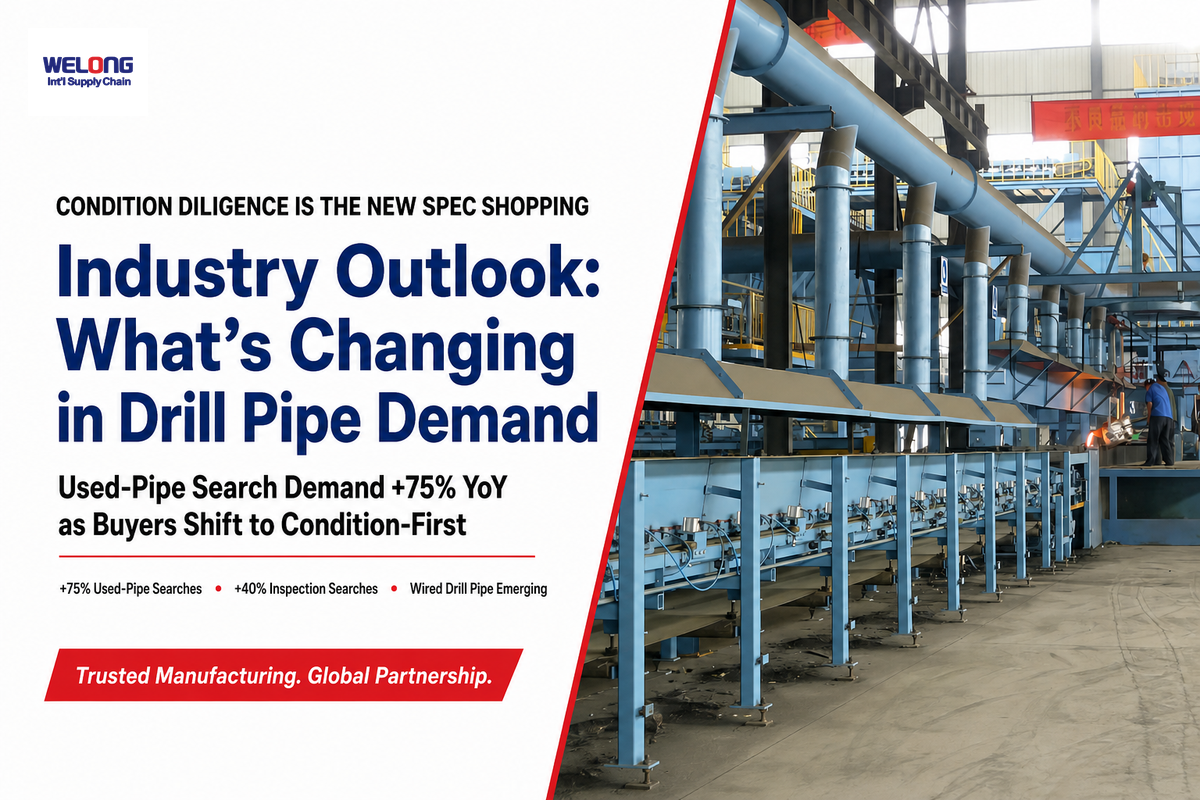
The single biggest change reflected in today’s search behavior: it’s less about “spec shopping” and more about “condition diligence.” Search volume for “used drill pipe” is up roughly 75% year-over-year and “drill pipe inspection” is up roughly 40% over the same period, even as searches on raw spec data, sizing, and even the bare term “drill pipe” itself have fallen about 23% year-over-year. Read alongside a drilling-fatigue literature that openly admits current models predict only about 20% (a fifth) of actual service life, the clear message for pipe buyers is: history of the condition and classification of used and reconditioned pipe is just as important (if not more important) as grade and size on its own when deciding which product to buy. The risk of skipping this diligence is not hypothetical — buyers who rely on price and nominal grade alone routinely discover, weeks into a project, that unclassified pipe fails inspection they should have required up front. China Welong provides documented mill-test and inspection records with its drill pipe specifically to close that gap for OEM and drilling-contractor buyers.
On the technology front, wired drill pipe is branching out from a deepwater niche to be applied to more complex wells. Halliburton released its StreamStar wired-drill-pipe interface system on Oct. 30, 2025, to an already growing field of players — including SLB’s NeoLink and Reelwell, whose CEO has argued wired pipe’s moment has finally arrived after its own North Sea debut. While the performance advantage is a known quantity, adoption rates will vary by provider: Wired-pipe telemetry sends data in tens of thousands of bits per second, compared with tens of bits per second with traditional mud-pulse telemetry – an order-of-magnitude difference enough to enable continuous downhole data rather than just discrete pulses. If your 2026 well program involves extended-reach or highly steerable wells, wired-pipe compatibility should be addressed at the string design stage rather than added later; ask your service provider for current adoption figures, rather than relying on estimates in any one publication.
Estimates from market researchers value the global wired drill pipe segment at approximately $7.4 billion in 2025, growing to approximately $11.4 billion in 2034 – a CAGR of roughly 4.9%. The values below serve only as directional context for the operational advice given herein.
Frequently Asked Questions
Q: What is a drill pipe?
View Answer
drill pipe is standard-specification pipe with a hole in the middle – typically made of threaded steel, manufactured in accordance with API Specification 5DP. Most of a drill string consists of drill pipe pipe joints, each about 27 to 45 feet long, joined together with forged tool joints. Together they transmit torque from the surface to the bit and carry the circulating drilling fluid, which cools the bit and returns cuttings to the surface.
Q: How strong is drill pipe?
View Answer
Strength varies by grade: API Specification 5DP includes four grades, with minimum yield strengths spanning 75,000 psi (E75) up to 135,000 psi (S135). Heavier-walled HWDP tensile load capacities run about 200,000 lbs on the low end and can top 1,000,000 lbs, depending on grade and diameter. But grade choice will be driven by tensile load, torque and the wellbore environment as much as strength alone.
Q: What are the API drill pipe classifications?
View Answer
API RP 7G-2 — historically adopted as the U.S. national counterpart to ISO 10407-2 — classifies used drill pipe by remaining wall thickness as follows: New (100%), Premium (≥80%), Class 2 (≥70%), Class 3 (≥55%, wear on one side only), and Scrap (below 55%). The classification is a one-way street — a pipe once run downhole cannot be classified as “New” again, no matter its condition.
Q: How often should drill pipe be inspected?
View Answer
A North Sea study published in 2007 (Zafar, Maersk oil and gas) demonstrated that the frequency of washout failures was more than halved when inspected at 35,000- to 40,000-foot intervals in their dataset; in your case, inspection intervals should be tailored to current operator policy, your well’s specific circumstances and your inspection provider’s recommendations, not the recommendations from this single, older field study.
Q: How much does a drill pipe cost?
View Answer
There is no single price-per-foot, because drill pipe pricing depends on grade, OD, nominal weight, connection, and whether the pipe is new or used-classified stock. New API 5DP pipe, certified used Premium or Class 2 stock, and non-classified reclaimed pipe represent three different price tiers, so provide your grade, size, and connection when requesting a quote.
Don’t compare used drill pipe listings on price alone — always confirm what inspection paperwork backs the classification before comparing per-foot numbers across sellers. When pipe crosses an international border, the proper drill pipe HS code is needed to value it accurately for customs; get that code confirmed by your customs broker or freight forwarder before quoting a landed cost to your own customer.
Q: What materials are used in drill pipes?
View Answer
Standard drill pipe is a high strength low alloy (HSLA) steel from the 4130/4137 chemistry family, which offers good strength, toughness, and the weldability required by the tool joint connection. Variations in aluminum alloy are also used where weight is an issue and some sour service wells demand a corrosion-resistant metallurgy tested and certified to NACE MR0175/ISO 15156 instead of the standard steel grades.
About This Analysis
This guide compiles publicly available API and ISO standard scope, USPTO patent filings, and independently sourced field/failure-analysis literature on drill pipe grades, classification, and manufacturing. Grade yield strengths and classification wall-thickness thresholds are cross-checked across multiple independent industry sources; the Shunbei Oilfield case figures referenced in early drafts were paywalled and could not be independently verified, so they were not carried into the final content. Reviewed by the China Welong technical team.
References & Sources
- Design and Mechanical Properties Analysis of Drill Pipe’s Joint Thread with Unequal Taper Under Complex Loads — PMC (2024 peer-reviewed)
- API RP 7G-2, Inspection and Classification of Used Drill Stem Elements — American Petroleum Institute / identical adoption of ISO 10407-2
- North Sea Data Yield Insight on Fatigue Life of Drill Pipe — Oil & Gas Journal
- Longer, Deviated Wells Push Drill Pipe Limits — Drilling Contractor (IADC)
- Q&A With Reelwell: Wired Pipe’s Moment Has Arrived — Journal of Petroleum Technology (SPE)
- US9561537B2, Process for Upset Forging of Drill Pipe and Articles Produced Thereby — USPTO / Google Patents
- CN101571035B, Sawtooth Thread of Drill Pipe Joint — USPTO / Google Patents
- IADC Drilling Lexicon, Class 3 Used Drill Pipe — International Association of Drilling Contractors
- Drill Pipe Trade Investigation, Length Range Classifications — Canada Border Services Agency
Related Articles
- Drill Pipe, Grade & Connection Selection — spec-driven decision guide and RFQ tools for sourcing drill pipe
- Heavy Weight Drill Pipe (HWDP) — specifications and selection for the transition-zone tubular
- Heavy Weight Drill Pipe: A Complete Guide — grades, sizing, and selection walkthrough for HWDP
- Drill Collar Selection Framework — choosing collar type and material by drilling condition
- Drilling Jars, Specification Guide — hydraulic drilling jar models and API connection matrix
- Drilling Mud Motors — flow rate to torque selection ladder
![Casing, Tubing & Drill Pipe Elevators [Field Guide]](https://welongoiltools.com/wp-content/uploads/2026/09/casing-tubing-drill-pipe-elevators-guide-featured-768x512.png)
![Choke & Kill Hose: [Field Guide]](https://welongoiltools.com/wp-content/uploads/2026/07/choke-kill-hose-guide-featured-1-150x150.png)