Get in touch with Welong Company

Updated July 2026
Quick Specs to Collect Before Selection
| Recovery objective | Free, retrieve, reposition, back off, or abandon the engaged fish |
| Impact requirement | Upward, downward, or double-acting action, tied to the suspected sticking mechanism |
| Mechanical fit | Tool outside diameter, bore, passage restrictions, and upper/lower connections |
| Operating envelope | Current stroke, load, pressure, temperature, fluid, and seal limits from the approved model sheet |
| System checks | String stretch, friction, surface capacity, peak-load monitoring, release path, and intensifier need |
Fishing Jar (Super / Hydraulic) is a downhole impact tool used in a fishing string to help move, free, or retrieve an engaged object. Selection starts with the stuck condition and the complete fishing string, not a product-family label. Stored axial energy becomes an impact near the fish, while well restrictions, connections, impact direction, surface limits, the catching tool, and the recovery contingency determine fit.
Direct answer: a hydraulic fishing jar delays relative movement while pull builds, then releases a moving section to create a hammer-and-anvil impact. “Super” doesn’t prove one universal mechanism or rating; confirm the current design, operating procedure, interfaces, and load envelope for the quoted model.
Key Takeaways
- Fishing and drilling jars use impact, but they enter different job plans and document sets.
- Hydraulic labels describe a control family, not a single internal architecture.
- Displayed hook load can miss short transient peaks; surface monitoring belongs in the selection conversation.
- Useful quotation requests define the fish, force-transfer path, interfaces, limits, release path, and current records.
What Does a Fishing Jar Do in a Fishing String?
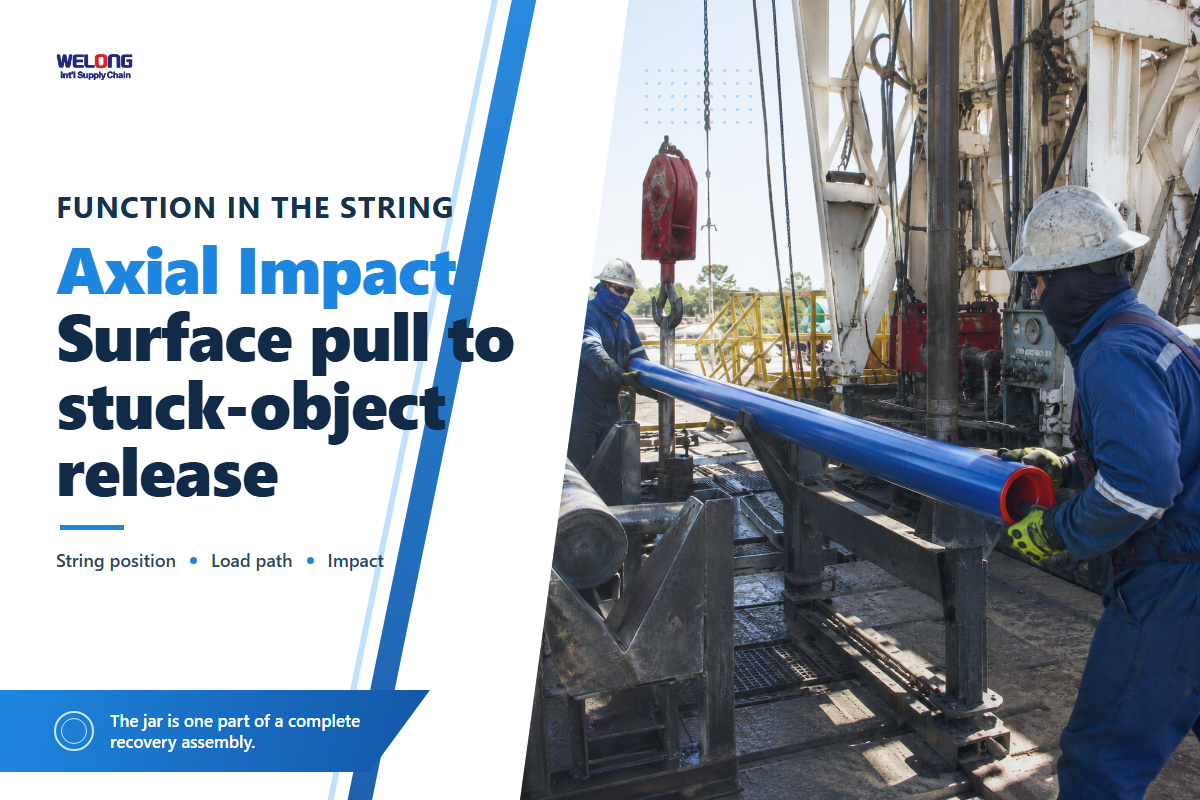
Installed in a fishing string, the jar delivers a controlled axial impact to help move, free, or retrieve an engaged downhole object. Impact release is only one part of the system. Catch quality, direction, placement, string stretch, friction, connection strength, and the stuck condition decide whether energy reaches the fish in a useful form.
Issued in 2009, U.S. Customs and Border Protection ruling N076953 describes a hydraulic fishing jar installed in a fishing string for fishing, coring, washover, and other work requiring upward impact. Its drilling-jar examples sit in a drill string. That narrow public record supports the tool function and assembly context; it doesn’t supply a universal load, stroke, or operating procedure.
PETEX’s University of Texas page for Open Hole Fishing, 4th Edition frames fishing as a broader job involving twist-offs, stuck pipe, wireline, junk, causes, avoidance, and economics. Its 2010 description covers a 112-page training book. Scope comes from the public page; the book itself wasn’t parsed for this guide.
Common mistake: treating the jar as the catch tool. An overshot, spear, latch, or another fishing tool engages the target; the jar supplies impact through that connection. Weak or uncertain engagement can slip, deform, or release before useful energy reaches the stuck point.
Decision takeaway: define the fish and the recovery objective before discussing jar size. “Free the string,” “retrieve the tool,” and “create room to disengage” are different outcomes, even when the same jar family appears on the equipment list.
Hydraulic, Super, Mechanical, and Hydro-Mechanical: Separate the Label from the Mechanism
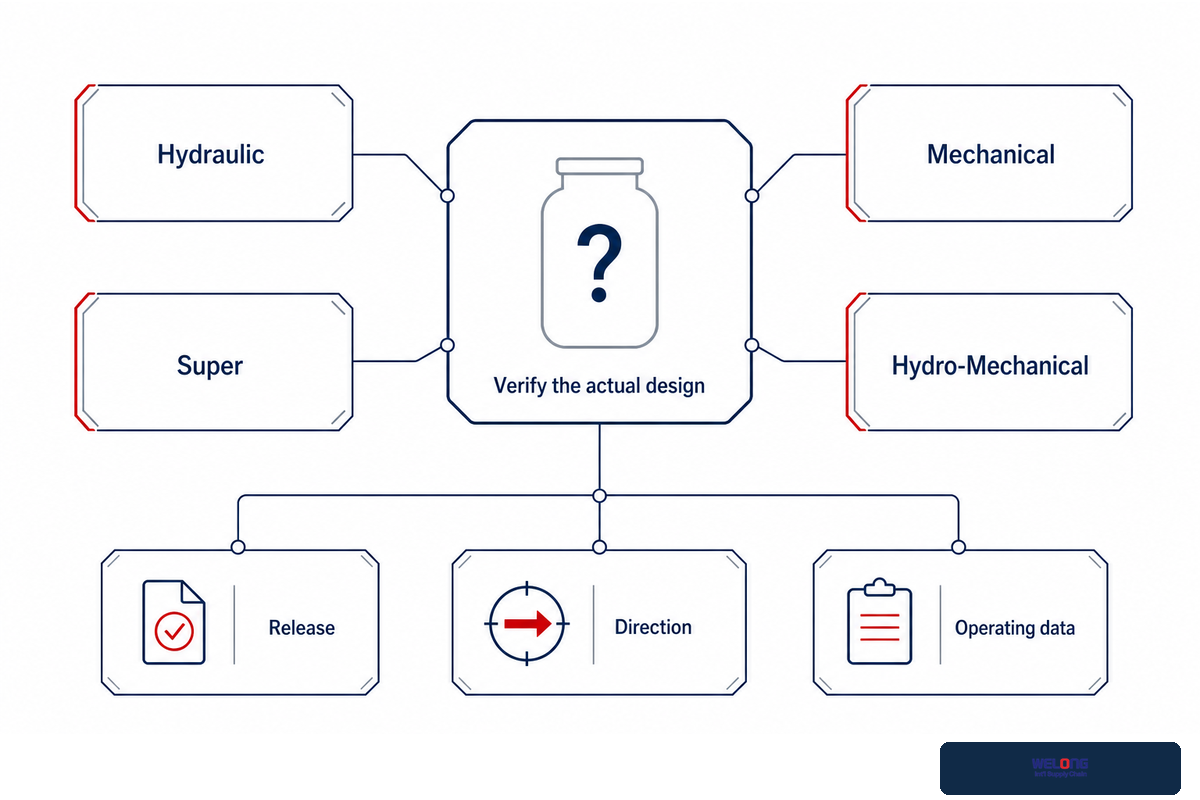
Hydraulic, mechanical, and hydro-mechanical describe how a jar controls or triggers release; “Super” may identify a supplier’s product family rather than an industry-wide mechanism. Buyers should ask what meters movement, what releases the mandrel, which direction the tool jars, how it recocks, and which current document defines its limits.
U.S. patent 5,411,107 provides one concrete hydraulic example: a metering ring and fluid restrictor control relative movement before accelerated travel produces impact at mandrel, hammer, and anvil surfaces. Patent scope is a coiled-tubing, dual-acting design. Its architecture can’t be assigned to every hydraulic fishing jar merely because the product name contains “hydraulic.”
Other public records show why the boundary matters. U.S. patent 4,361,195 describes a double-acting hydraulic jar with controlled fluid resistance and a valve-release arrangement, while U.S. patent 3,566,981 records another hydraulic drilling-jar configuration. Three patent examples prove variety, not equivalence.
What the label can tell you
- The stated control or release family
- The product family used in the quotation
- Questions to ask about action and recocking
What the label cannot prove
- One universal piston, valve, or free-stroke layout
- A transferable impact-force rating
- Compatibility with the catch tool or string
US5411107 also treats an intensifier as additional energy-storage capacity used with the jar to increase impact and isolate shock. Within that assembly, the jar’s delay-release-impact mechanism and the intensifier’s energy-storage role are adjacent decisions, not interchangeable names. Below the jar, the catching tool is a third decision; the string above creates the force-transfer path.
Field check: if a supplier description uses “Super” without naming action direction, trigger method, stroke, connections, working limits, and recocking procedure, the label is incomplete for engineering review. Fix the gap with a current model sheet and operating manual, not an assumption based on a similar catalog.
Decision takeaway: compare disclosed mechanisms and limits, not adjectives. Ask, “How does this quoted model load, release, impact, and reset in this assembly?”
Pull-Delay-Impact Sequence Map
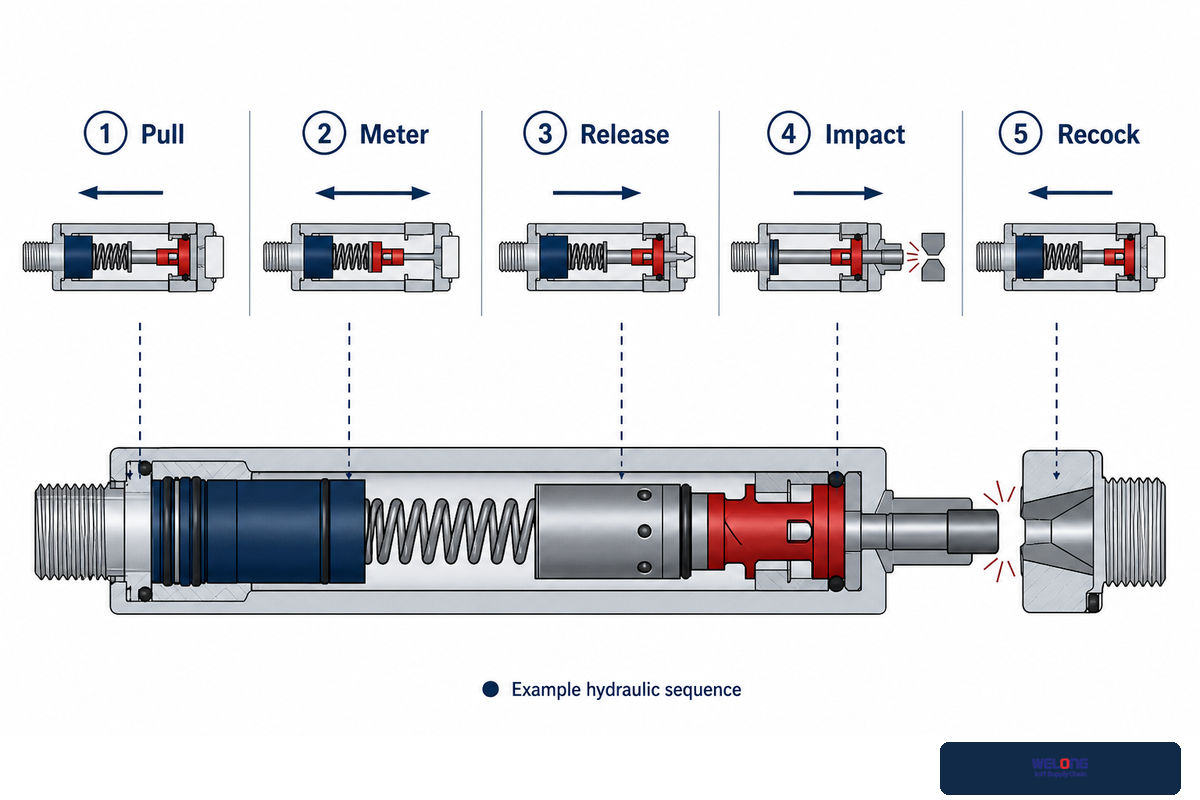
Hydraulic jar cycles can be understood as six planning stages: engage the fish, apply pull within verified limits, meter relative movement, release the moving assembly, convert stored string energy into impact, and recock under the model procedure. This map explains the principle; it isn’t an operating instruction for an unidentified tool.
| Stage | Mechanism-level event | Planning risk and limitation |
|---|---|---|
| 1. Engage | Catching-tool elements connect to or grip the fish. | Poor engagement can slip or damage the fish top; the jar cannot correct it. |
| 2. Load | Surface pull builds axial energy in the free string. | Pull must remain inside current string, connection, surface, fish, and jar limits. |
| 3. Delay | Hydraulic fluid moves through a restricted or metered path. | Delay behavior varies by architecture, fluid condition, temperature, and procedure. |
| 4. Release | Geometry or a bypass path changes resistance and frees faster travel. | Do not infer the release point from a different model’s manual. |
| 5. Impact | Stored string energy accelerates the moving section into hammer-and-anvil contact. | Friction, placement, string stretch, and interfaces change delivered impact. |
| 6. Recock | Load changes return the jar to its next-cycle condition. | Incomplete recocking makes the next cycle unreliable; follow the current procedure. |
Evidence boundary: this sequence map generalizes the design-specific mechanism disclosed in U.S. patent 5,411,107; it does not turn that patent into a universal operating procedure.
Engineering Note
“Delay” isn’t a generic countdown. It’s a mechanical and fluid response inside a specific tool. Temperature, contamination, seal condition, hydraulic fluid, applied load, and internal clearances may affect that response. Never substitute a timing example from another jar for the current manufacturer procedure.
What operators get wrong: increasing pull after a weak blow may feel like a direct cure, yet the root problem may be a poor catch, friction loss, incorrect placement, incomplete recocking, or the wrong impact direction. Changing only surface pull can raise risk while leaving the actual energy-transfer gap untouched.
Decision takeaway: use the six stages as a failure-isolation map. When progress stops, identify which stage is uncertain before changing the load or repeating the cycle.
Fishing Jar vs Drilling Jar: Same Impact Principle, Different Job Context
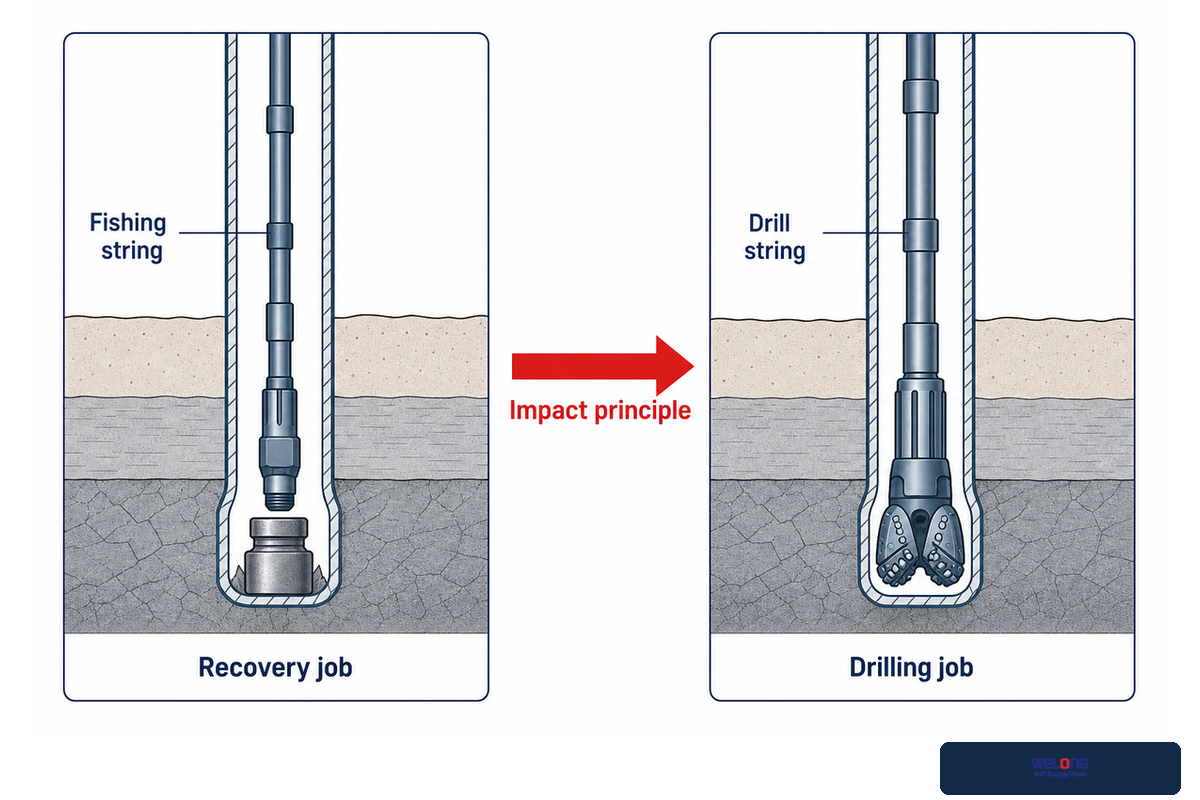
Fishing and drilling jars both create axial impact, but the job context differs. Drilling-jar planning normally occurs inside bottom-hole-assembly design for a potential stuck-drill-string event. Fishing-jar selection starts from an identified recovery objective, catch tool, fish condition, stuck point, and contingency after the operation has been defined.
| Planning question | Fishing-jar context | Drilling-jar context | Limitation |
|---|---|---|---|
| When is it selected? | Around a defined recovery or freeing job. | During drill-string and bottom-hole-assembly planning. | Job timing does not prove one jar is stronger or better. |
| What sits below it? | Catch or fishing tool selected for the fish. | Planned drilling assembly. | Actual placement varies with the engineered string. |
| What defines success? | Movement, retrieval, release, or another recovery objective. | Restoring drill-string mobility and continuing the well plan. | Impact alone is not automatically a successful job. |
| Which documents matter? | Fish data, fishing program, catch-tool and jar documents, inspection history. | Assembly program, jar placement and operating procedure, drilling limits. | Catalog comparison cannot replace current job documents. |
IADC’s official page for the Special Operations chapter of the IADC Drilling Manual, 12th Edition lists job planning, stuck-pipe mechanisms, stuck-point estimation, string stretch, and fishing tools and techniques. That 20-page chapter page carries 2018–2019 copyright information. It supports the planning categories shown above, not a claim that every field program uses one layout.
Buyer warning: a drilling-jar data sheet may contain familiar fields, yet transferring its load, action, or placement assumptions into a fishing string creates a scope mismatch. Fish condition, catch mechanism, release path, and desired recovery outcome introduce new constraints.
Decision takeaway: compare the two jar contexts by job, assembly, and document set. Avoid “fishing jar versus drilling jar” rankings based only on nominal force.
The 9-Point Fishing-Jar Fit Matrix
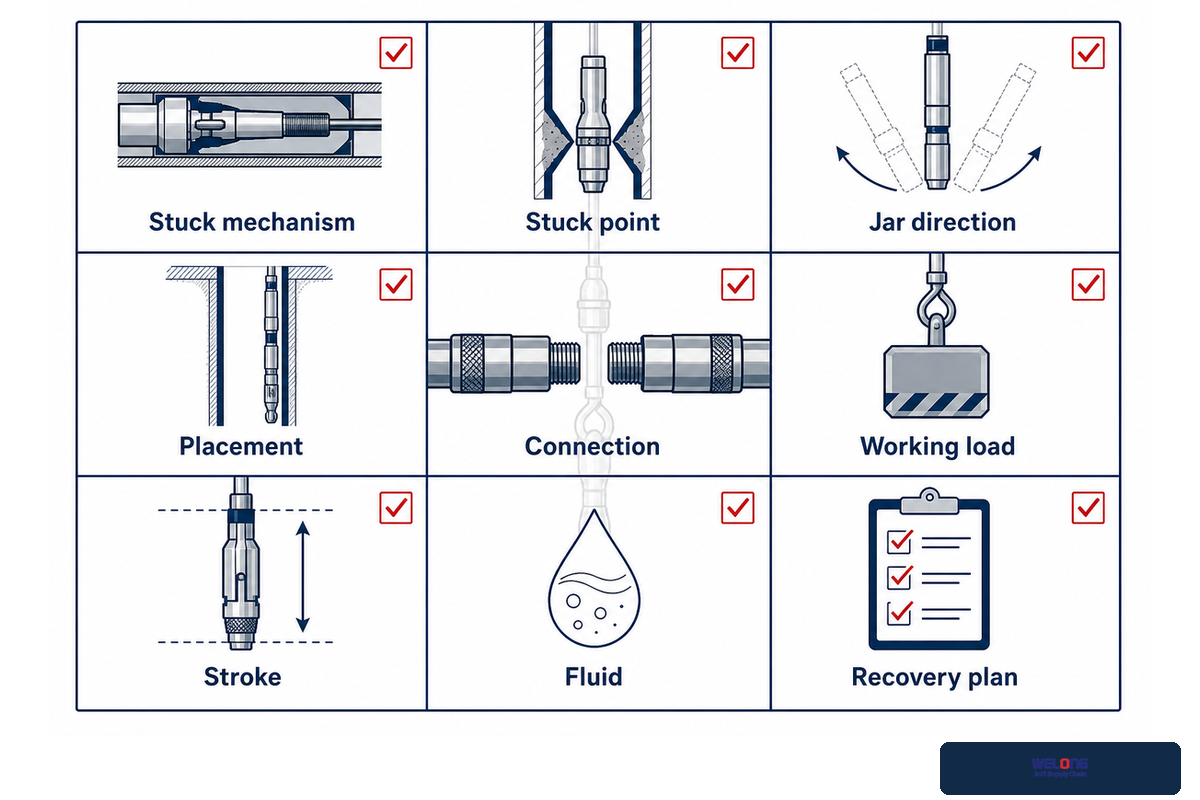
Nine linked checks turn a vague “super fishing jar” inquiry into a usable selection brief: recovery objective, sticking mechanism and direction, physical passage, interfaces, current action and load limits, well geometry and force transfer, surface capacity and sampling, release contingency, and intensifier plus document status.
| Fit category | Information to verify | Decision it supports | Risk if missing |
|---|---|---|---|
| 1. Fish and objective | Fish type, top condition, engaged tool, free/retrieve/release goal | Defines what useful movement means | Wrong catch or no measurable success condition |
| 2. Sticking mechanism and direction | Likely cause, stuck point, jar-up/jar-down need | Aligns impact with the recovery hypothesis | Impact can tighten or damage the problem |
| 3. Passage | Minimum restriction, tool OD, bore and circulation path | Confirms physical access and utility | Hang-up, blocked passage, or unusable clearance |
| 4. Interfaces | Top/bottom connections, crossovers, torque and tension weak links | Creates a compatible load path | Connection mismatch or premature interface failure |
| 5. Action and limits | Direction, stroke, recocking, verified load envelope, current procedure | Defines controlled operation | Guessing from an obsolete or similar model |
| 6. Force transfer | Well angle, drag, free string, stretch, placement, collars | Tests whether energy can reach the fish | Surface pull rises while downhole impact stays weak |
| 7. Surface system | Rig capacity, hook-load sampling, short-peak interpretation, stop criteria | Bounds surface loading and observation | Displayed load can understate transient peaks |
| 8. Release path | How the catching assembly can disengage if recovery cannot proceed | Creates an exit from a failed attempt | The recovery string becomes the next stuck assembly |
| 9. Intensifier and records | Energy-storage need, placement, inspection, repair history, approved documents | Separates system support from jar mechanism | Hidden condition or document-version mismatch |
Selection scenario: a buyer has an engaged fish and asks for an upward-acting hydraulic jar. Nominal jar OD clears the casing, so the first pass looks complete. Three unresolved interfaces remain: the lower connection doesn’t yet match the catch tool, available string stretch is unknown in the high-angle interval, and no release path has been defined if the fish won’t move. Ordering on OD alone would solve the easiest dimension while leaving the load path, disengagement risk, and impact transfer open. Correct next action isn’t a larger jar. Revise the assembly tally, obtain current connection drawings, review the stuck point and friction, and agree on a recovery exit.
U.S. patent 5,278,550 documents one design-specific releasable fishing latch. It doesn’t establish a universal rule that every job needs two release methods. It does support the narrower question in row 8: how can this catching assembly disengage if recovery can’t proceed?
Data boundary: Welong’s archived local source pack was reviewed for the fields buyers may need, but its model values aren’t reproduced here. Use the current approved data sheet and operating manual at quotation stage. Historical tables don’t prove the present rating, seal package, connection option, or test status.
Decision takeaway: a model is fit only when all nine rows form one compatible system. Passing OD and connection checks doesn’t compensate for an undefined load path, surface limit, or release contingency.
Placement, Operating Limits, and Failure Modes
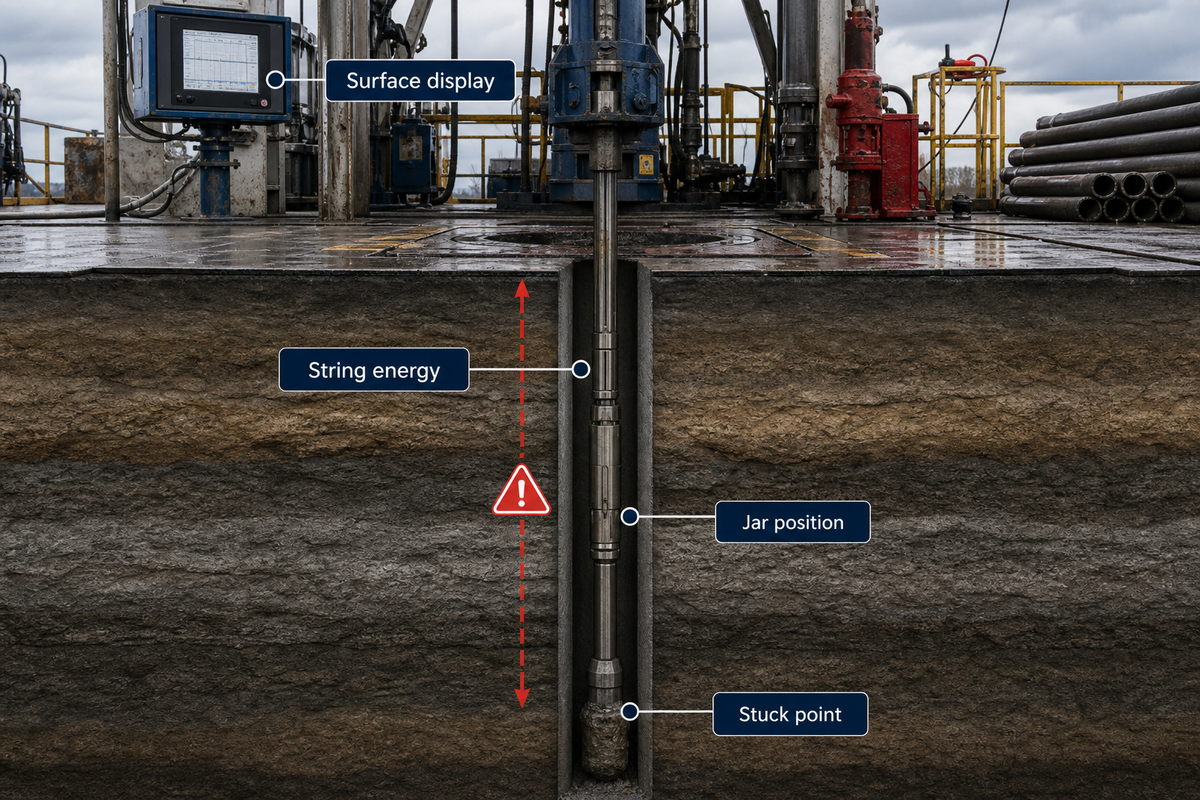
Jar performance depends on the complete mechanical system. Wrong impact direction, high drag, poor engagement, weak interfaces, insufficient string stretch, contamination, damaged seals, incomplete recocking, or load beyond verified limits can reduce useful impact or create a new failure. Each changed condition should trigger reassessment before another cycle.
SPE-160428-MS, Planning for Successful Jarring Operations, warns in its abstract that pulling beyond the mechanical or hydraulic limits of a drilling impact system can make the jar useless. Its drilling scope matters: verify the weakest relevant envelope and stop criteria rather than transferring a value into a fishing program.
Published transient drill-string analysis treats jarring as a system event rather than a catalog-force event. String geometry, friction, stiffness, placement, and boundary conditions shape the response. That’s why the same surface pull may not create the same impact at two stuck points.
Engineering Note: surface sampling is part of the risk envelope
SPE/IADC 118435 analyzes two drilling-rig collapses after prolonged jarring in its 2009 abstract. It reports that log intervals of 10 seconds or longer didn’t capture peak shock loads and that rig instrumentation or sampling rate damped the displayed peaks. Dynamic analysis used an interval of 0.01 seconds. Those figures belong to the two analyzed cases; they don’t establish a universal safe sampling rate or incident probability.
“These large time intervals did not allow the peak shock loads to be recorded.”
Reassessment scenario: repeated blows produce no visible movement, while the surface display appears to remain inside the planned pull window. Assuming that the displayed peak is the full event and increasing load would be the wrong response. Disciplined review asks whether the sample rate can show a short peak, whether friction or a dogleg is absorbing motion, whether the catch remains sound, whether the jar fully recocked, and whether the fish condition has changed. Forum discussion can suggest those field questions, but it can’t set the limit. Return the decision to the current jar procedure, string tally, surface capacity, and approved recovery program.
SPE-166745-MS reports in its case abstract a high-angle Saudi well where conventional fishing assemblies had failed and an axial-oscillation component later helped release the fish. Its bounded lesson is that drag and static friction can dominate system performance. It isn’t evidence that one accessory or jar brand solves every high-angle fishing operation.
When the Current Jarring Plan Needs Reassessment
- The catch, fish top, stuck-point estimate, or desired impact direction is uncertain.
- Next pull would exceed a verified jar, string, connection, fish, or surface limit.
- Recocking is uncertain, or fluid, seal, debris, or temperature condition may have changed.
- Surface sampling can’t resolve short peaks, yet the displayed value is being treated as complete.
- No agreed stop condition or disengagement path exists.
Decision takeaway: repeated jarring is a controlled test of a recovery hypothesis, not an unlimited escalation. Changes in load, string, fish, surface reading, or attempt outcome alter the hypothesis and warrant a new review.
Spec-to-Risk RFQ Checklist
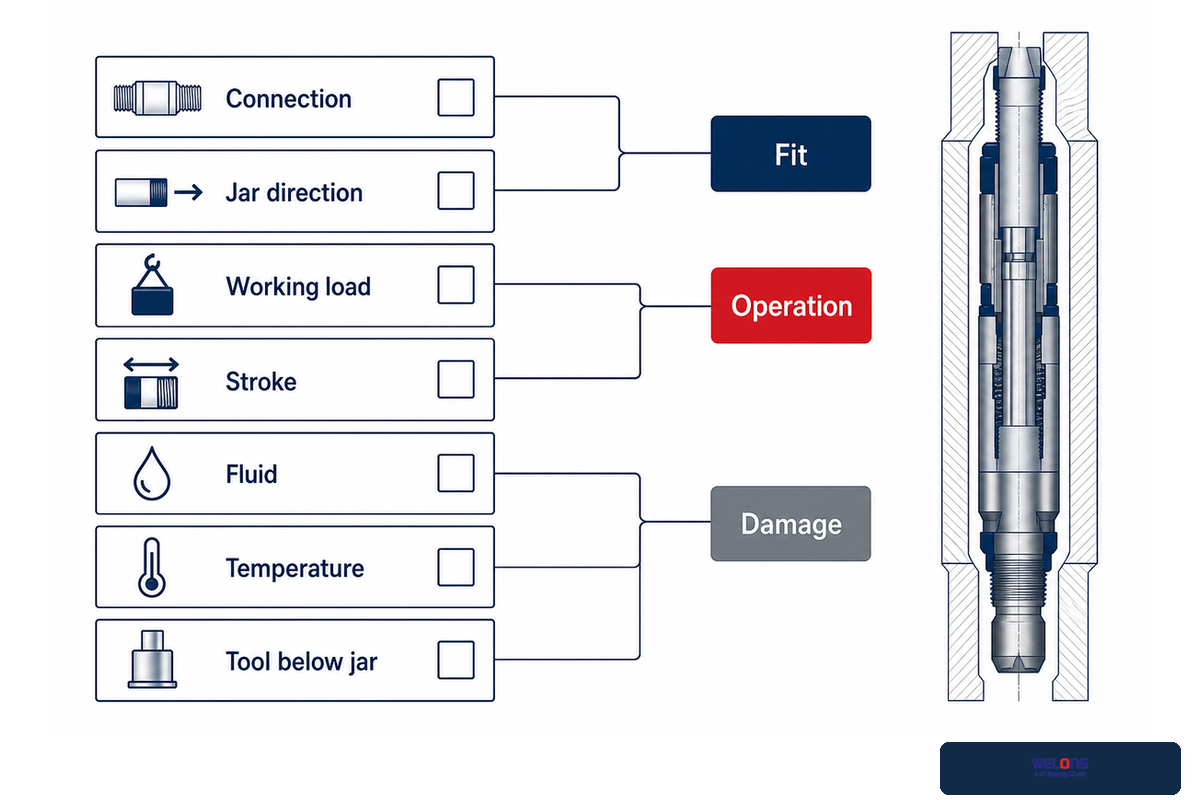
A buyer-ready request for quotation links each requested field to a job risk. It should identify the well and fish, recovery objective, impact direction, string interfaces, passage, verified load envelope, environment, surface monitoring, intensifier assumptions, release contingency, and the current documents needed for technical acceptance.
Twelve fields to put in the technical inquiry
- Well context: open or cased hole, depth, inclination, minimum restriction, and circulation constraints.
- Fish description: object, material, dimensions, top condition, and how it is engaged.
- Recovery objective: free, retrieve, reposition, back off, release, or abandon.
- Sticking assessment: suspected mechanism, stuck point, prior attempts, and changed conditions.
- Impact action: jar up, jar down, or double acting, with the reason for that direction.
- Mechanical fit: jar OD, bore, passage need, top/bottom threads, crossovers, and fishing neck where applicable.
- Load path: string tally, free length, available stretch, collars, drag, and placement assumptions.
- Verified envelopes: current stroke, working and tensile limits, pressure, torque, and recocking procedure.
- Environment: temperature, pressure, drilling or completion fluid, solids, corrosion, and sour-service requirement.
- Surface system: equipment capacity, hook-load sampling, short-peak interpretation, and stop criteria.
- Adjacent tools: catch tool, bumper sub, safety joint, accelerator or intensifier, and disengagement method.
- Records: current data sheet, operating manual, drawings, inspection and test reports, redress status, repair history, and third-party scope.
The planning categories listed on the official IADC Special Operations chapter page support the need to gather job, stuck-point, string-stretch, and fishing-tool inputs. The checklist above is an editorial synthesis for quotation review, not an IADC standard.
Procurement scenario: two quotations use the same “Super Hydraulic Fishing Jar” description, but one includes a current drawing, connection callouts, operating procedure, inspection report, and stated action direction. By contrast, the second lists only an outside diameter and a tensile value copied from an older catalog. Price-only comparison would treat them as equivalent. Missing details make them incomparable: the second quote leaves passage, recocking, pressure and temperature scope, release method, document revision, and test status unresolved. Procurement should issue a clarification sheet with identical fields to both vendors, then compare exceptions and evidence rather than filling gaps with assumptions.
Dated-evidence note: the current-run search didn’t find a jar-specific standard revision dated 2024–2026. That absence isn’t proof that no applicable document changed. Confirm the active customer specification, operating manual, thread standard, inspection scope, and any jurisdictional or operator requirements during quotation review.
Disqualifying gap: if a supplier cannot identify which current document governs the quoted action, limits, connections, and test status, the buyer does not yet have an auditable technical offer. Familiar model names or similar product photos are not substitute evidence.
Decision takeaway: the strongest inquiry isn’t the longest specification list. It’s the one that connects each field to a physical fit, operating boundary, monitoring question, or recovery contingency.
Frequently Asked Questions
The questions below answer the most common definition, activation, comparison, selection, monitoring, and quotation concerns. Each answer stays at principle level because exact load, delay, stroke, recocking, inspection, and maintenance requirements belong to the current model documents and the approved fishing program.
What is the difference between a fishing jar and a drilling jar?
View Answer
Fishing-jar selection starts from a retrieval or freeing job, the fish, catch tool, stuck point, and recovery contingency. Drilling-jar planning normally belongs to bottom-hole-assembly design for a possible stuck-drill-string event. Both tools create impact, but neither label proves a transferable load, direction, placement, trigger, or recocking procedure. CBP ruling N076953 documents the string-context distinction for the products it reviewed in 2009; it does not rank one family above the other or define current model ratings.
How does a hydraulic fishing jar fire?
View Answer
One documented hydraulic principle uses fluid restriction to delay relative movement while axial load builds. Release or bypass change then allows faster travel, and stored string energy drives hammer-and-anvil impact. To activate a fishing jar safely, follow the current model procedure and approved fishing program; patent sequence is not an operating manual.
Does “Super” identify a universal fishing-jar mechanism?
View Answer
No. “Super” may be a product-family label rather than a universal mechanism. Public patents disclose several hydraulic trigger, metering, and impact arrangements. Ask the supplier to identify the quoted model’s control method, action direction, stroke, release behavior, interfaces, operating limits, recocking procedure, and current document revision. Do not infer those details from the adjective or from a similar catalog.
Can one jar solve every stuck-pipe case?
View Answer
No. Wrong direction, poor engagement, high friction, limited stretch, or a weak interface can keep impact from reaching the fish. Reassessment may point to another recovery method.
Why can surface load readings miss short jarring peaks?
View Answer
Short transient peaks can occur between recorded samples or be damped by the measurement system. In the two cases analyzed by SPE/IADC 118435, log intervals of 10 seconds or longer did not capture peak shock loads. Rig instrumentation or sampling also damped the displayed peaks. That paper supports a surface-monitoring question and shows why the display may not represent the complete transient event; it does not define a universal safe sample rate, load threshold, or incident probability for every rig.
What factors should be considered when selecting a super fishing jar for specific well conditions?
View Answer
Start with the fish and recovery objective. Add the suspected sticking mechanism, desired impact direction, stuck point, minimum restriction, jar outside diameter and bore, top and bottom connections, crossovers, string tally, available stretch, friction, and placement. Then verify current load, stroke, pressure, temperature, fluid, seal, and recocking limits. Surface equipment capacity, peak-load sampling, release contingency, intensifier need, inspection status, repair history, and current documents complete the review. Leaving any of those fields open turns the model recommendation into a guess.
How often should a super fishing jar undergo maintenance and inspection?
View Answer
Use the current model schedule and job-specific inspection criteria; no universal interval applies. Request the latest inspection, test, redress, and repair records before mobilization.
Move from a label to a technical review
Once the nine fit points and twelve request-for-quotation fields are available, compare them with the current model documents. You can then review Welong’s Super / Hydraulic Fishing Jar options without turning a product-family name into an unsupported recommendation.
This guide is for selection and procurement preparation. It isn’t a field operating procedure, engineering approval, or substitute for the current manufacturer manual and the operator’s authorized fishing program.
References & Sources
- Ruling N076953: Drilling and Fishing Jars U.S. Customs and Border Protection
- Open Hole Fishing, 4th Edition Petroleum Extension, The University of Texas at Austin
- U.S. Patent 5,411,107: Coil Tubing Hydraulic Jar Device USPTO record via Google Patents
- U.S. Patent 4,361,195: Double-Acting Hydraulic Drilling Jar USPTO record via Google Patents
- U.S. Patent 3,566,981: Hydraulic Drilling Jar USPTO record via Google Patents
- Special Operations, IADC Drilling Manual, 12th Edition International Association of Drilling Contractors
- U.S. Patent 5,278,550: Releasable Downhole Fishing Latch USPTO record via Google Patents
- Planning for Successful Jarring Operations, SPE-160428-MS Society of Petroleum Engineers / OnePetro
- Transient Dynamic Analysis of the Drillstring Society of Petroleum Engineers / OnePetro
- Analysis of Hook Load Forces During Jarring, SPE-118435-MS Society of Petroleum Engineers / OnePetro
- SPE-166745-MS High-Angle Well Case Abstract Society of Petroleum Engineers / OnePetro