Get in touch with Welong Company

Updated November 2026
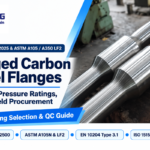
Forged carbon steel flanges are solid pipe connectors shaped from heated steel billets inside high-pressure forging dies. Under ASME B16.5-2025, Material Group 1.1 grades like ASTM A105 and ASTM A350 LF2 cover Class 150 through Class 2500. At 100 °F (38 °C), working pressure runs from 285 psig (19.6 bar) up to 6,170 psig (425.5 bar).
Correct specification prevents three costly field failures in pressurized piping systems. Buyers avoid plate-cut or hot-rolled bar substitutions on hubbed joints. Engineers prevent brittle hub fracture caused by un-normalized coarse-grain heats. Inspection teams verify sour-service hardness across parent metal, weld metal, and HAZ under ISO 15156-2. This guide converts 2025–2026 standards into grade matrices, derating calculations, facing tolerances, and mill certificate checks.
Quick Specs: Forged Carbon Steel Pipe Flanges
| Governing Dimensional Codes | ASME B16.5-2025 (NPS 1/2 to NPS 24; Class 2500 up to NPS 12); ASME B16.47-2025 Series A and B (NPS 26 to NPS 60) |
| Primary Forging Grades | ASTM A105 / A105N (ambient to elevated heat); ASTM A350 Grade LF2 Class 1 (Charpy tested at -50 °F / -46 °C); ASTM A694 F42–F70 (high-yield transmission) |
| ASTM A105 Single-Forging Cap | 10,000 lb (4,540 kg) maximum per ASTM A105/A105M Scope 1.1; larger forgings may use ASTM A266/A266M where permitted by the governing piping code |
| Group 1.1 Working Pressure (-20 °F to 100 °F, code-qualified) | Class 150: 285 psig (19.6 bar) | Class 300: 740 psig (51.1 bar) | Class 600: 1,480 psig (102.1 bar) | Class 1500: 3,705 psig (255.3 bar) |
| Thermal & Sour Hardness Ceilings | Prolonged exposure above 800 °F (425 °C) risks graphitization; 22 HRC and 250 HV10 represent sour hardness limits on different test scales, not exact conversions |
| Standard Facing Roughness | Serrated RF/FF per ASME B16.5; metallic RTJ grooves finished finer (details in Facing section) |
What Makes Forged Carbon Steel Flanges Different from Cast and Plate-Cut Flanges?
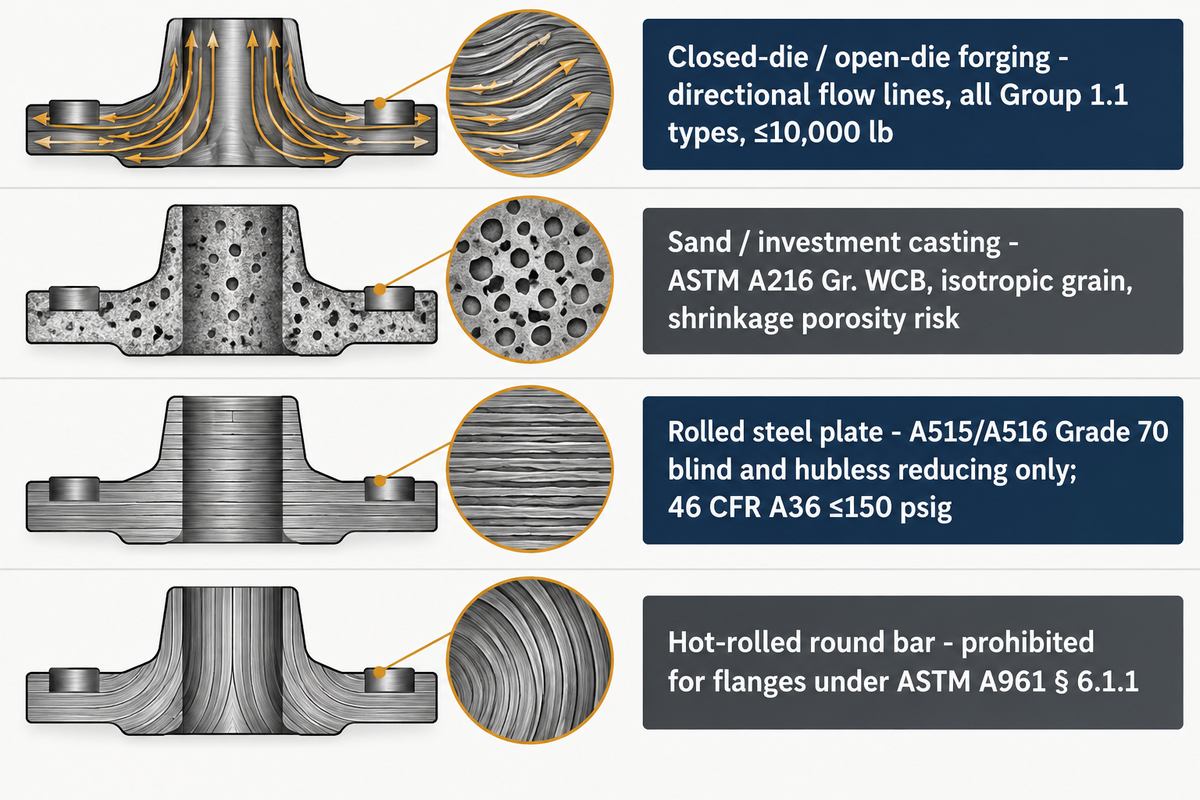
Forged carbon steel flanges align directional metal grain flow along the hub and bolt circle. Cast and plate-cut rings retain isotropic or planar grain paths that establish quicker crack propagation under cyclic stresses. Under ASME B16.5-2025 Material Group 1.1, rolled steel plates such as ASTM A515 Grade 70 and A516 Grade 70 are permitted only for blind flanges and hubless reducing flanges.
Hot forging works like kneading bread dough into aligned strands rather than slicing a brittle sponge. Compressive dies close internal shrinkage voids and refine steel piping components. That grain alignment builds higher strength and durability across demanding industrial applications where pipe bending loads the hub. Standard ASME B16.5 flanges normally use closed-die steel forging. Larger custom blanks rely on the open-die forging process or rolled forged steel rings. For custom geometries up to 50 tons, engineering teams specify custom industrial forgings machined to drawing tolerances.
Low-priced bids often hide rings cut from rolled plate or machined from hot-rolled round bar. Two rules draw a strict boundary against improper substitutes. First, Valve Magazine quotes ASTM A105 Section 4.2 and ASTM A961 Paragraph 6.1.1 directly. Flanges, elbows, and tees cannot be machined directly from bar stock, even when the bar certificate cites ASTM A105 chemistry. Second, US 46 CFR § 56.30-10 limits steel-plate flanges (including ASTM A36/A36M) to low-hazard Class II marine piping. Method 5 caps pressure at 150 psig and temperature at 450 °F, whereas Method 6 caps pressure at 150 psig with a 650 °F ceiling. Outside those plate exceptions and standard-permitted cast steel flanged fittings, hubbed ASME B16.5 pipe flanges are supplied as forgings.
| Manufacturing Route | Typical ASTM Material | Grain Structure & Defect Risk | ASME B16.5-2025 Eligibility | Limitations / Not Suitable For |
|---|---|---|---|---|
| Closed-die / open-die forging | ASTM A105, A350 LF2 | Directional flow lines; closed internal voids | All hubbed and non-hubbed types (Group 1.1) | Single A105 part capped at 10,000 lb (4,540 kg) |
| Sand / investment casting | ASTM A216 Gr. WCB | Isotropic; prone to shrinkage porosity and sand inclusions | Flanged fittings and integral valve bodies (Group 1.1) | Severe cyclic vibration or rapid thermal shock |
| Rolled steel plate | ASTM A515/A516 Grade 70 (B16.5 Group 1.1); ASTM A36 (46 CFR Class II marine exception only) | Planar rolling grain; reduced through-thickness Z-direction properties | ASME B16.5: A515/A516 Grade 70 blind and hubless reducing flanges only; 46 CFR: A36 capped at 150 psig | Any hubbed weld-neck or Class I pressure line |
| Hot-rolled round bar | A105-certified bar | Longitudinal fibers cut across flange radius | Prohibited for flanges under ASTM A961 § 6.1.1 | All B16.5 flanges; allowed only on non-flange hollow parts ≤NPS 4 |
Sources: ASTM A105/A105M Scope 1.1, ASTM A961 § 6.1.1 (via Valve Magazine), ASME B16.5-2025 Group 1.1 notes, and 46 CFR § 56.30-10.
Is there a difference between forged steel and carbon steel?
Yes. Forged steel is a hot compressive forming process, and carbon steel is a family of iron-carbon alloys. A pipe flange may be carbon steel without being forged, such as a cast ASTM A216 WCB valve flange or a plate-cut steel blind flange.
Mixing process terms with chemistry terms causes quoting errors. Ordering forged steel pipe flanges without naming the alloy lets suppliers quote stainless or alloy steel instead of carbon steel forged to ASTM A105. Ordering carbon steel alone invites cast or plate substitutes. Always state both grade and forging process, such as “ASTM A105N carbon steel forged weld-neck flange per ASME B16.5-2025.”
Which ASME B16.5 Forged Carbon Steel Flange Types (Weld Neck, Slip-On, and Blind) Fit High-Pressure Piping?
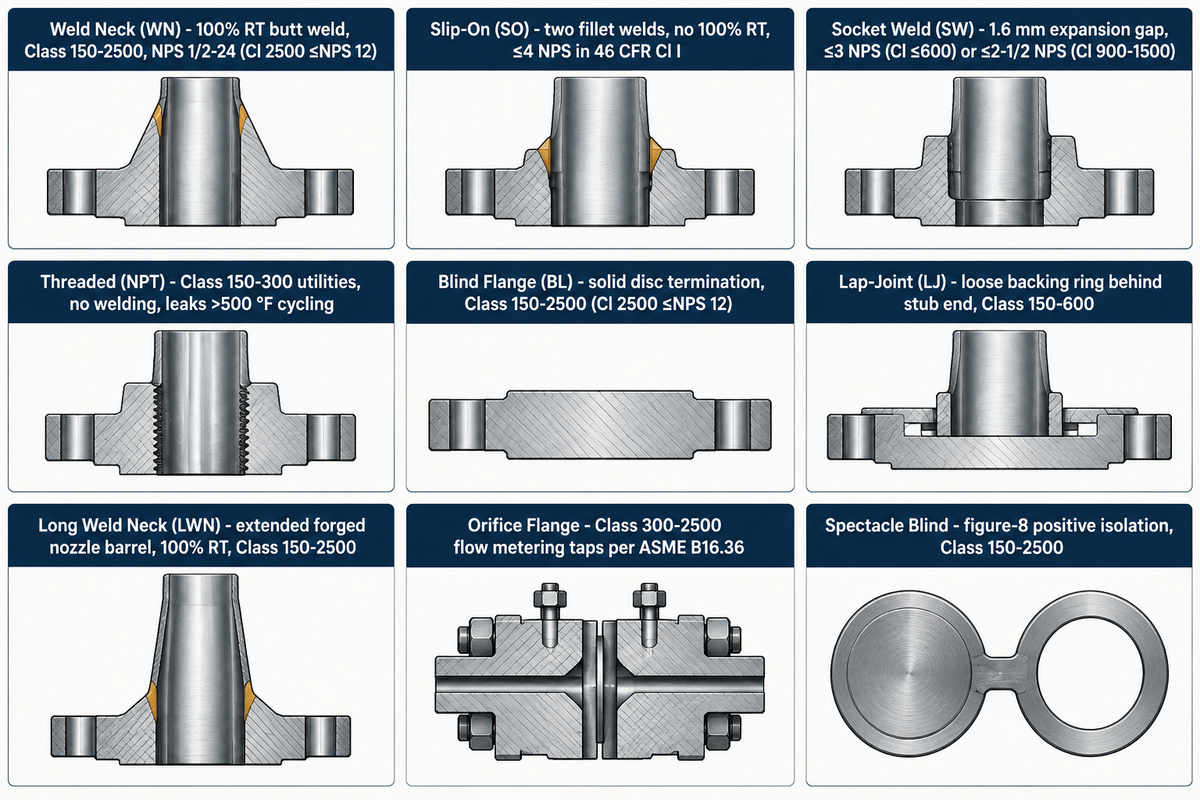
Weld neck flanges fit severe high-pressure and cyclic industrial piping. Their tapered hub moves bending stress into the pipe wall and permits full radiographic weld inspection. Slip-on, socket weld and threaded flanges are permissible for moderate or low-pressure applications.
However, 46 CFR § 56.30-10 caps slip-on flanges at 4 NPS (Class I), caps socket weld at 3 NPS (Class ≤600) or 2-1/2 NPS (Class 900–1500), and bans all three whenever 100 percent radiography is required.
Statutory marine piping rules define clear size limits for steel flange types. Under 46 CFR § 56.30-10, Class I and Class II-L systems cap ASME B16.5 slip-on flanges at 4 NPS. The same rule caps socket weld flanges at 3 NPS in Class 600 and lower, or 2-1/2 NPS in Class 900 and 1500. Threaded flanges with a strength fillet weld stay inside Class 150/300 up to 750 °F and 4 NPS (1 NPS in Class II-L).
“Slip-on flanges meeting ASME B16.5 may be used in piping systems of Class I, Class II, or Class II-L not to exceed the service pressure-temperature ratings, and not to exceed 4-inch Nominal Pipe Size (NPS) in systems of Class I and Class II-L. If 100 percent radiography is required by § 56.95-10, slip-on flanges are not permitted and butt-welding flanges are required.”
Mismatched flange types make high cost field rework. Weld-neck flanges are ordered to an exact pipe schedule, such as Schedule 40 or Schedule 80, so the flange bore matches the inside diameter of the carbon steel pipe at the weld end. Socket-weld flanges mate to the pipe outer diameter inside the socket recess, matching the bore to the pipe inner diameter.
During socket weld fit-up, welders pull the pipe back roughly 1.6 mm (1/16 in) from the socket shoulder before welding to stop thermal root cracking. In common applications needing frequent dismantling or alloy pipe alignment, carbon steel lap-joint flanges slide behind corrosion-resistant stub ends to cut ring cost. Heavy pressure vessels use long weld neck nozzles, while metering runs use orifice flanges and positive isolation uses spectacle blinds.
Compact forged-stem wedge connectors (USPTO US11333280B2) replace unwieldy bolted flange diameters in tightly spaced subsea Pipe-in-Pipe clearances.
| Flange Type | Attachment & Bore Match | 100% RT Inspectable | Typical Pressure Class & Pipe Size | Limitations / Not Suitable For |
|---|---|---|---|---|
| Weld Neck (WN) | Full-penetration butt weld; bore matches pipe schedule | Yes | Class 150–2500; NPS 1/2–24 (Cl 2500 ≤NPS 12) | Highest fit-up precision and axial space demand |
| Slip-On (SO) | Internal and external fillet welds; pipe slips through bore | No | Class 150–300 common; ≤4 NPS in 46 CFR Cl I | Banned under 100% RT or severe thermal cycling |
| Socket Weld (SW) | External fillet weld; recessed socket bore matches pipe | No | ≤3 NPS (Cl ≤600); ≤2-1/2 NPS (Cl 900–1500) | Crevice traps corrosive fluids; banned under full RT |
| Threaded (NPT) | Tapered internal pipe thread; no welding required | Not applicable | Class 150–300 low-pressure utilities & waterworks | Thermal cycling >500 °F or cyclic bending leaks threads |
| Blind Flange (BL) | Solid disc with no bore; bolted end termination | Not applicable | Class 150–2500 across the ASME B16.5 range of sizes (Class 2500 capped at NPS 12) | High bending stress at disc center under hydrotest |
| Lap-Joint (LJ) | Loose backing ring behind butt-welded stub end | Stub weld only | Class 150–600 frequent-dismantle alloy lines | Lower fatigue resistance than integral weld-neck |
| Long Weld Neck (LWN) | Extended heavy forged barrel; pressure vessel nozzle | Yes | Class 150–2500 refinery & pressure vessel shells | Heavy billet mass; forge-to-order lead times |
| Orifice Flange | Weld-neck or slip-on with pressure-tap bores & jack screws | WN type only | Class 300–2500 differential flow metering | Requires ASME B16.36 tap tolerances; not general pipe |
| Spectacle Blind | Figure-8 spacer/blind clamped between mating flanges | Not applicable | Class 150–2500 positive maintenance isolation | Adds bolt length and gasket faces (two leak paths) |
Sources: ASME B16.5-2025 scope via ANSI Webstore and US 46 CFR § 56.30-10(b)(2) through (b)(9).
What is the strongest type of piping flange?
A forged weld-neck flange conforming to ASME B16.5 is a tapered-hub pipe connection that transitions bending and cyclic loads gradually into the pipe wall. Pressure ratings remain set by material group and class, while its single butt weld permits full volumetric radiography without internal crevices.
Carbon steel slip-on flanges rely on two fillet welds that block full radiography and concentrate stress at the hub throat. On steam headers, high-pressure manifolds, and thermally cycled pipelines, weld neck flanges remove that primary fatigue initiation point.
How to Choose Between ASTM A105, A350 LF2, and A694 Carbon Steel Grades
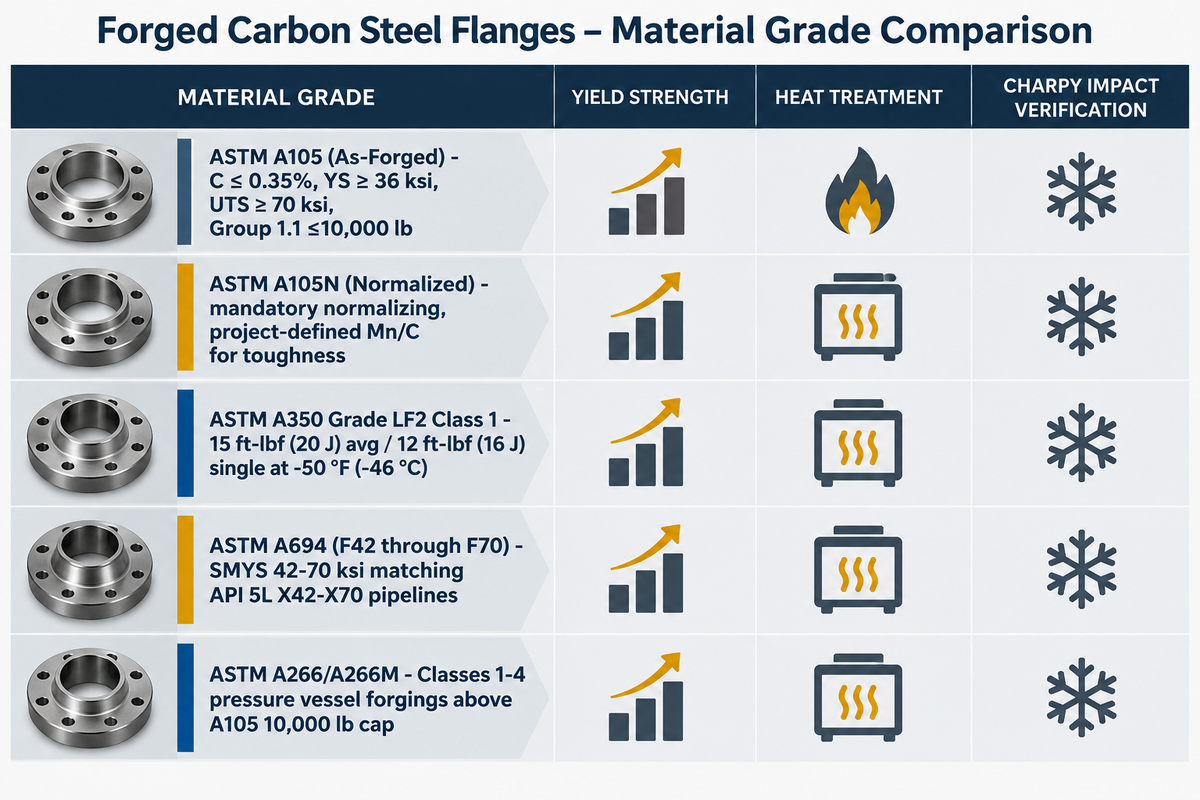
Select normalized ASTM A105N for ambient-to-elevated lines where code impact-test or exemption rules are met. Move to impact-tested ASTM A350 Grade LF2 Class 1 for -50 °F (-46 °C) Charpy verification, and use ASTM A694 for high-yield API 5L pipelines. Both A105 and A350 LF2 share identical ASME B16.5 Group 1.1 pressure ratings.
Two selection myths appear constantly when buyers compare types of carbon steel. First, upgrading from common carbon steel ASTM A105 to ASTM A350 LF2 does not raise the flange pressure rating. LF2 Class 1 keeps 70–95 ksi (485–655 MPa) tensile strength and 36 ksi (250 MPa) minimum yield, matching A105 in Group 1.1. Instead, LF2 mandates normalizing, normalized-and-tempered (≥1,100 °F / 590 °C), or quenched-and-tempered heat treatment. It also proves Charpy V-notch impact energy at -50 °F (-46 °C) to 15 ft-lbf (20 J) average and 12 ft-lbf (16 J) single specimen. Second, as-forged steel A105 does not automatically qualify for sub-zero service. Pressure-vessel engineers report that historical brittle fractures moved as-forged SA-105 to ASME Section VIII-1 Curve A, creating UCS-66(c)(1)(-b) impact-exemption disputes in vessel design audits. Specifying normalized ASTM A105N improves grain uniformity, though final low-temperature qualification still depends on governing code thickness, stress ratio, and impact-test rules.
Melt chemistry governs brittle toughness even more than grade titles. A Fluor Corp. presentation to the ASME B31.3 committee in Chemical Engineering reviewed commodity ASTM A105 material heats. Manganese-to-carbon (Mn/C) ratios ran from 1.7 to 9.0, with roughly 60% exceeding 5. Heats with low Mn/C ratios and micro-alloying additions (Ti, Nb, V, B) lost impact toughness that re-normalizing could not recover. For critical low-temperature or cyclic pipelines, specify aluminum-killed steel, project-defined Mn/C limits, ASTM grain size 7 or finer (8 or finer for LF2 Class 1), normalizing, and verified impact toughness. High-yield ASTM A694 (F42 through F70) matches API 5L line pipe outside ASME B16.5 Group 1.1 tables, pairing with MSS SP-44 or ASME B16.47 large-diameter flanges.
4-Gate Carbon Steel Flange Grade Matrix
| Forging Grade | Carbon Content & Strength | Heat Treatment | Charpy V-Notch Test | Code Grouping & Weight Cap |
|---|---|---|---|---|
| ASTM A105 (As-Forged) | C ≤ 0.35%; YS ≥ 36 ksi (250 MPa); UTS ≥ 70 ksi (485 MPa) | Not mandatory on standard Cl 150–300 flanges | Not required unless ordered | ASME B16.5 Group 1.1; ≤10,000 lb (4,540 kg) |
| ASTM A105N (Normalized) | Same A105 limits; project-defined Mn/C for toughness | Mandatory normalizing (fine uniform grain) | Optional supplement | ASME B16.5 Group 1.1; A105 scope weight cap |
| ASTM A350 Grade LF2 Class 1 | C ≤ 0.30%, Mn 0.60–1.35%; YS ≥ 36 ksi; UTS 70–95 ksi | Mandatory N, NT (≥1,100 °F), or QT | 15 ft-lbf (20 J) avg / 12 ft-lbf (16 J) single at -50 °F (-46 °C) | ASME B16.5 Group 1.1 (same P-T as A105) |
| ASTM A694 (F42 through F70) | SMYS 42–70 ksi matching API 5L X42–X70 pipeline grades | Normalized, NT, or QT per grade | Per project pipeline spec | MSS SP-44 / ASME B16.47 (outside B16.5 Group 1.1) |
| ASTM A266/A266M | Classes 1–4 pressure vessel carbon steel forgings | Annealed, normalized, or NT | Per supplementary order | Optional pressure-vessel forging spec above A105 weight limit if code-approved |
Sources: ASTM A105/A105M Scope 1.1, ASTM A350/A350M LF2 Class 1 tables, and Chemical Engineering (ASME B31.3 report).
ASME B16.5-2025 Pressure-Temperature Ratings, Classes 150 to 2500, and Thermal Limits
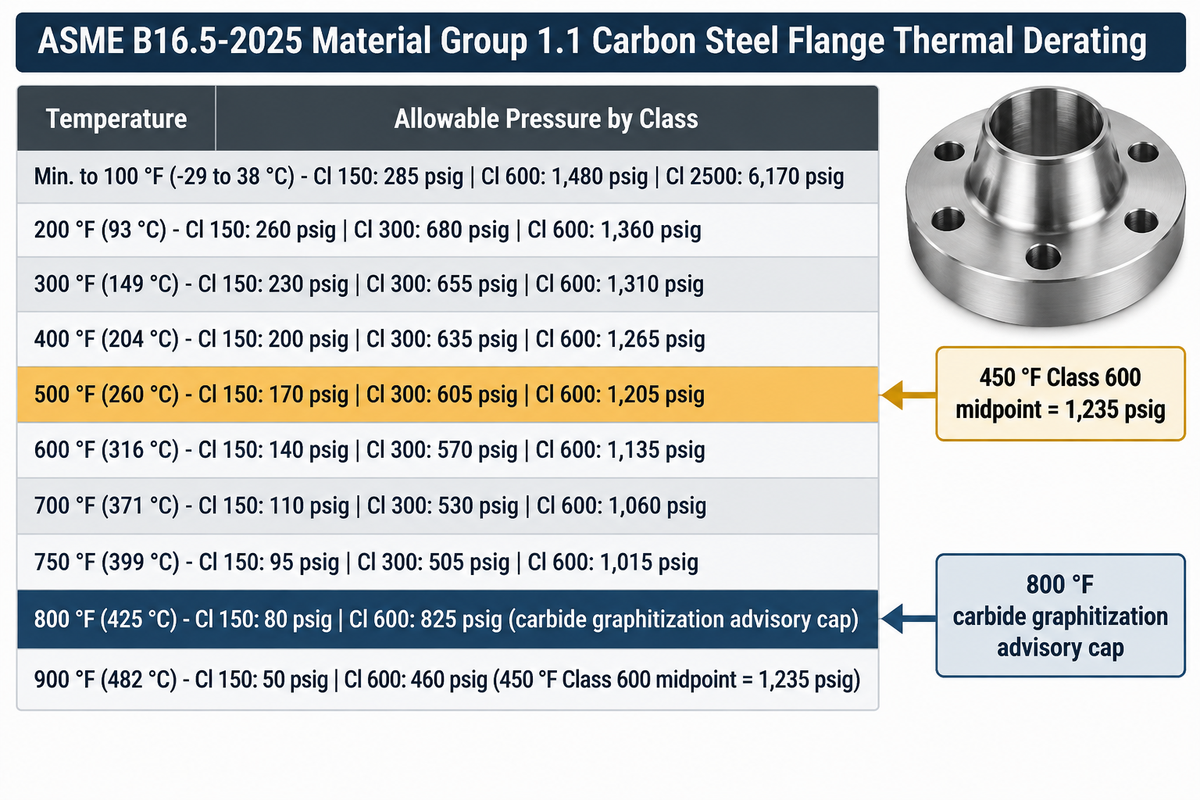
ASME B16.5-2025 pressure classes are dimensionless rating designations rather than psi limits. A Class 150 Group 1.1 carbon steel flange holds 285 psig (19.6 bar) at 100 °F (38 °C) and derates to 80 psig (5.5 bar) at 800 °F (425 °C). ASME B16.5 Group 1.1 notes permit but don’t recommend prolonged carbon steel service above that threshold because of graphitization risk.
285 psigClass 150 max at ≤100 °F (19.6 bar)
1,480 psigClass 600 max at ≤100 °F (102.1 bar)
800 °F425 °C graphitization advisory cap
NPS 12Max size for B16.5 Class 2500
Every pressure and temperature lookup follows ASME B16.5-2025 ratings for conforming flanges and flanged joints subject to the standard’s material, bolting, gasket, and assembly requirements. Joint integrity still requires matching bolting and gasket limits under the governing piping code. Also check nominal diameter limits, because Class 2500 stops at NPS 12 rather than NPS 24 (ANSI/ASME B16.5-2025). In oilfield production and wellhead and well control pressure systems exposed to high temperatures and pressures, missing thermal derating across elevated temperatures causes under-rated joints. Inspectioneering notes that graphitization converts iron carbides into brittle grain-boundary graphite across 825–1,300 °F. That breakdown strips ductility and creep strength from carbon steel under severe temperatures and pressures in power generation and refinery heaters.
Group 1.1 Thermal-Derating Selection Table
| Temp. °F (°C) | Class 150 | Class 300 | Class 600 | Class 900 | Class 1500 | Class 2500 (≤NPS 12) |
|---|---|---|---|---|---|---|
| Min. to 100 (-29 to 38) | 285 psig (19.6 bar) | 740 psig (51.1 bar) | 1,480 psig (102.1 bar) | 2,220 psig (153.2 bar) | 3,705 psig (255.3 bar) | 6,170 psig (425.5 bar) |
| 200 (93) | 260 psig | 680 psig | 1,360 psig | 2,035 psig | 3,395 psig | 5,655 psig |
| 300 (149) | 230 psig | 655 psig | 1,310 psig | 1,965 psig | 3,270 psig | 5,450 psig |
| 400 (204) | 200 psig | 635 psig | 1,265 psig | 1,900 psig | 3,170 psig | 5,280 psig |
| 500 (260) | 170 psig | 605 psig | 1,205 psig | 1,810 psig | 3,015 psig | 5,025 psig |
| 600 (316) | 140 psig | 570 psig | 1,135 psig | 1,705 psig | 2,840 psig | 4,730 psig |
| 700 (371) | 110 psig | 530 psig | 1,060 psig | 1,590 psig | 2,655 psig | 4,425 psig |
| 750 (399) | 95 psig | 505 psig | 1,015 psig | 1,520 psig | 2,535 psig | 4,230 psig |
| 800* (425) | 80 psig | 410 psig | 825 psig | 1,235 psig | 2,055 psig | 3,430 psig |
| 900* (482) | 50 psig | 230 psig | 460 psig | 690 psig | 1,150 psig | 1,915 psig |
*Prolonged elevated-temperature exposure above the 800 °F note threshold isn’t recommended due to carbide graphitization; only killed steel is permitted above 850 °F. Sources: ASME B16.5-2025 Group 1.1 rating tables and Inspectioneering.
📐 Worked Sizing Example: Linear Interpolation at 900 psig and 450 °F
Assumed inputs: NPS 6 ASME B31.3 hydrocarbon line operating at 900 psig and 450 °F (232 °C). The assembly uses an ASTM A105N weld-neck raised face flange, Class 600 spiral wound 316L/graphite gasket, and ASTM A193 B7 / A194 2H studs. ASME B16.5-2025 allows linear interpolation between listed rows. Class 300 drops from 635 psig at 400 °F to 605 psig at 500 °F. Its 450 °F midpoint is (635 + 605) ÷ 2 = 620 psig, which fails the 900 psig load. Class 600 runs from 1,265 psig at 400 °F to 1,205 psig at 500 °F. Its 450 °F midpoint is (1,265 + 1,205) ÷ 2 = 1,235 psig, giving a 335 psig rating margin under ASME B16.5-2025. Final joint qualification still checks gasket seating stress and external piping loads under ASME B31.3.
Flange Facings, Surface Finish, and Bolting: RF vs. FF vs. RTJ
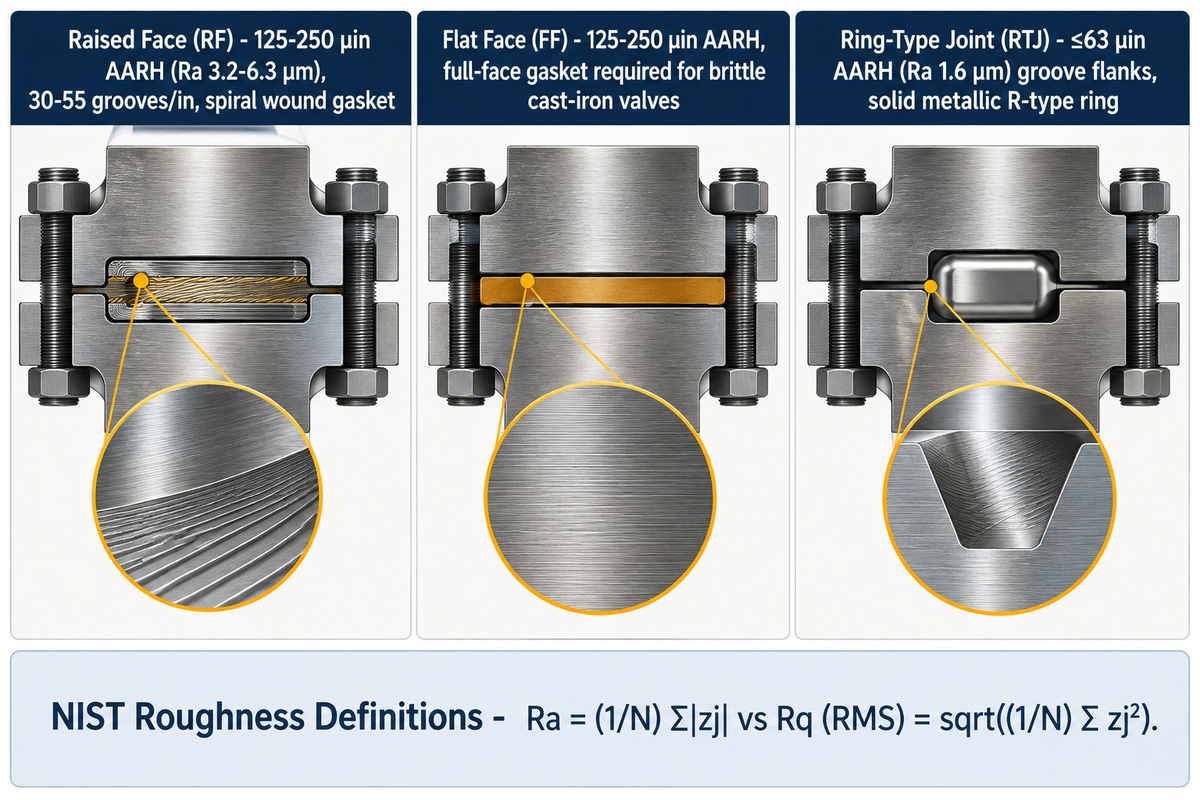
Match ASME B16.5 facing geometry and roughness directly to the gasket type. Spiral wound gaskets on raised face joints use 125–250 µin AARH (Ra 3.2–6.3 µm). Select soft sheet gaskets may use rougher 250–500 µin stock serrations where specified by the gasket manufacturer, while metallic Ring-Type Joint grooves require ≤63 µin AARH (Ra 1.6 µm).
Incorrect surface roughness will prevent a leak-proof seal, even with the right pressure class. For raised-face and flat-face gasket contact surfaces, ASME B16.5 specifies concentric or spiral serrations at 30 to 55 grooves per inch with a standard surface roughness of 125–250 µin AARH. Coarser 250–500 µin stock serrations are used only where specific soft sheet gasket suppliers call for added grip, whereas overly smooth faces can reduce gasket friction. Drawings must also keep roughness parameters straight. The National Institute of Standards and Technology (NIST) defines Ra (arithmetic mean deviation, equivalent to AARH) as (1/N) Σ|zj| under ISO 4287 and ASME B46.1. It defines Rq (root mean square deviation, RMS) as sqrt((1/N) Σ zj²). Because Ra and Rq differ mathematically, specify Ra or AARH consistently on machining drawings.
⚠️ Common Field Mistake: Bolting Raised Face Carbon Steel to Flat Face Cast Iron
Never bolt a Class 150 raised face carbon steel flange directly against a flat face cast-iron valve or pump nozzle. The high step is a fulcrum point inside the bolt circle which will bend the brittle cast-iron rim until it snaps. Machine the carbon steel raised face completely flat and install a full-face non-metallic gasket instead.
| Facing Type | Roughness Target (AARH / Ra) | Matched Gasket Family | Standard Carbon Steel Bolting | Mating Constraint |
|---|---|---|---|---|
| Raised Face (RF), Standard Serrated | 125–250 µin AARH (Ra 3.2–6.3 µm), 30–55 grooves/in | Spiral wound (SWG), kammprofile, metal-jacketed | ASTM A193 B7 studs / A194 2H nuts (sweet service) | Do not bolt against flat-face cast-iron valves |
| Flat Face (FF), Standard Serrated | 125–250 µin AARH (250–500 µin stock only if specified) | Full-face non-asbestos, graphite, or elastomer sheet | ASTM A193 B7 or low-strength Class 150 bolts | Required when mating brittle cast-iron equipment |
| Ring-Type Joint (RTJ) | ≤63 µin AARH (Ra 1.6 µm) on groove flanks | Solid metallic R-type oval or octagonal ring (ASME B16.5) | ASTM A193 B7 (sweet) or B7M / 2HM if exposed to sour H2S | High-pressure Class 600–2500 & high-temperature lines |
Sources: ASME B16.5 serrated and RTJ facing rules and NIST Surface Height Parameters.
Can you put carbon steel bolts in a stainless steel flange?
Yes in dry, near-ambient indoor lines where Process Industry Practices (PIP) standards routinely specify ASTM A193 B7 studs on stainless flanges. Do not use bare carbon-steel fasteners in wet, coastal, or hot outdoor joints. Ingress of conductive moisture drives galvanic corrosion and hydrogen-assisted cracking in the B7 studs.
Materials engineers highlight two additional fastener constraints. Austenitic stainless steel expands faster than B7 alloy studs as temperatures rise, shifting bolt tension across thermal cycles. Switching casually to ASTM A193 B8 stainless bolts creates another trap: un-hardened B8 Class 1 falls under ASME B16.5 low-strength bolting limits. Offshore plants typically specify PTFE-coated B7M/2HM studs or strain-hardened B8 Class 2 and A453 660B bolting with insulating kits.
Carbon Steel vs. Stainless Steel Flanges: Corrosion, Sour H2S, and Cold-Service Limits
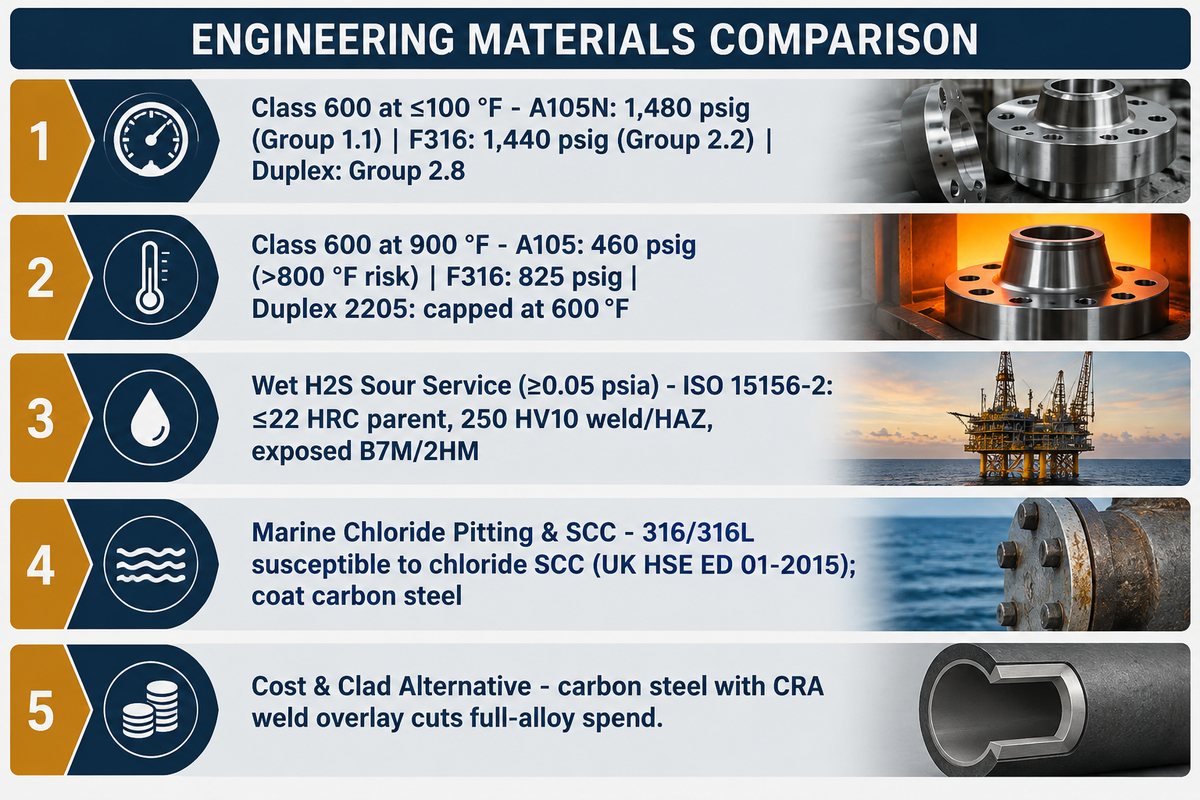
Use forged carbon steel flanges for sweet hydrocarbons, steam, and inhibited waterworks. In wet sour gas (H2S partial pressure ≥ 0.05 psia with free water), upstream ISO 15156-2:2020 controls cracking through material, welding, and hardness limits (22 HRC parent and 250 HV10 weld/HAZ on separate scales). Downstream refining falls outside its automatic scope. Select alloy and stainless grades for wet CO2 pitting according to exposure conditions, and evaluate Cr-Mo alloy steels for continuous high-temperature headers rather than duplex 2205 (limited to 600 °F).
Sour gas causes sudden brittle failure through sulfide stress cracking (SSC). Under NACE MR0175 / ISO 15156-2:2020, sour service begins when gas-phase H2S partial pressure reaches 0.05 psia (0.3 kPa nominal in ISO 15156-2, approximately 345 Pa) with free water. A 500 psia gas stream containing 100 ppm H2S reaches an H2S partial pressure of 0.05 psia, exactly meeting that threshold. Crude and water systems under roughly 65 psia total pressure are generally excluded. Controlling base A105 hardness alone is insufficient because welding hardens the heat-affected zone (HAZ). Qualified weld procedures and MTC hardness data must cover parent metal, weld metal, and HAZ. Where fasteners are directly exposed to sour H2S environments, sour joints replace standard B7/2H fasteners with hardness-controlled ASTM A193 B7M studs and A194 2HM nuts. Where hydrogen-induced cracking (HIC) is credible, add separate NACE TM0284 testing.
Two engineering boundaries prevent costly material mistakes. First, ISO 15156-2:2020 covers cracking mechanisms (SSC, SOHIC, SZC, HIC/SWC) in upstream oil and gas production and natural gas treatment. It leaves general or localized corrosion metal loss outside its scope and may not fit downstream refining equipment. Second, marine chlorides can still crack 316L stainless steel under tensile stress. UK HSE Safety Alert ED 01-2015 recorded external chloride stress corrosion cracking in 316/316L stainless pipe connectors exposed to marine salt spray. Visual and dye-penetrant checks missed internal cracks that only radiography revealed. At high heat, Group 2.2 stainless F316 outperforms carbon steel: at 900 °F, Class 600 F316 holds 825 psig versus 460 psig for A105.
| Evaluation Criterion | Forged Carbon Steel (A105N / LF2) | Austenitic Stainless (A182 F316 / F316L) | Duplex 2205 (A182 F51 / S32205) |
|---|---|---|---|
| Class 600 Rating at ≤100 °F | 1,480 psig (Group 1.1) | 1,440 psig (F316, Group 2.2) | Group 2.8 higher room-temp strength |
| Class 600 Rating at 900 °F | 460 psig (graphitization risk >800 °F) | 825 psig (F316; F316L capped at 850 °F) | Not for continuous >600 °F (embrittlement) |
| Wet H2S Sour Service | Meets ISO 15156-2 when material, weld procedures, ≤22 HRC (250 HV10 weld/HAZ), and exposed B7M/2HM bolting qualify | Tight H2S/chloride/temp caps under ISO 15156-3 | Broader sour + chloride envelope per ISO 15156-3 |
| Marine / Chloride Pitting & SCC | General corrosion; needs coating or allowance | Susceptible to chloride SCC under stress (HSE alert) | High chloride resistance in seawater lines |
| Cost & Clad Alternative | Most cost-effective; CRA weld overlay on sealing face cuts full-alloy spend | Moderate-to-high material premium | High material and weld-qualification premium |
Sources: ISO 15156-2:2020, UK HSE Safety Alert ED 01-2015, and published ASME B16.5-2025 Group 1.1 / 2.2 rating tables.
Should forged carbon steel flanges be painted or galvanized?
Coat outdoor, buried, or coastal carbon steel flanges with fusion-bonded epoxy, zinc-rich primer, or hot-dip galvanizing. First mask off weld bevels and gasket faces. Bare black oxide and mill oil block transit rust only and fail rapidly in corrosive coastal air.
When you galvanize carbon steel pipe flanges for municipal waterworks or cooling loops, avoid molten zinc sitting in serrated raised-face grooves and weld necks. Zinc pooling inside serrations ruins gasket seating, while welding through zinc creates porous welds and toxic fumes. For corrosive specific applications on large high-pressure headers, a corrosion-resistant alloy (CRA) weld overlay across the bore and sealing face preserves carbon steel economics while adding internal corrosion resistance.
Quality Control, EN 10204 3.1 MTC Verification, and Spotting Non-Forged Substitutions
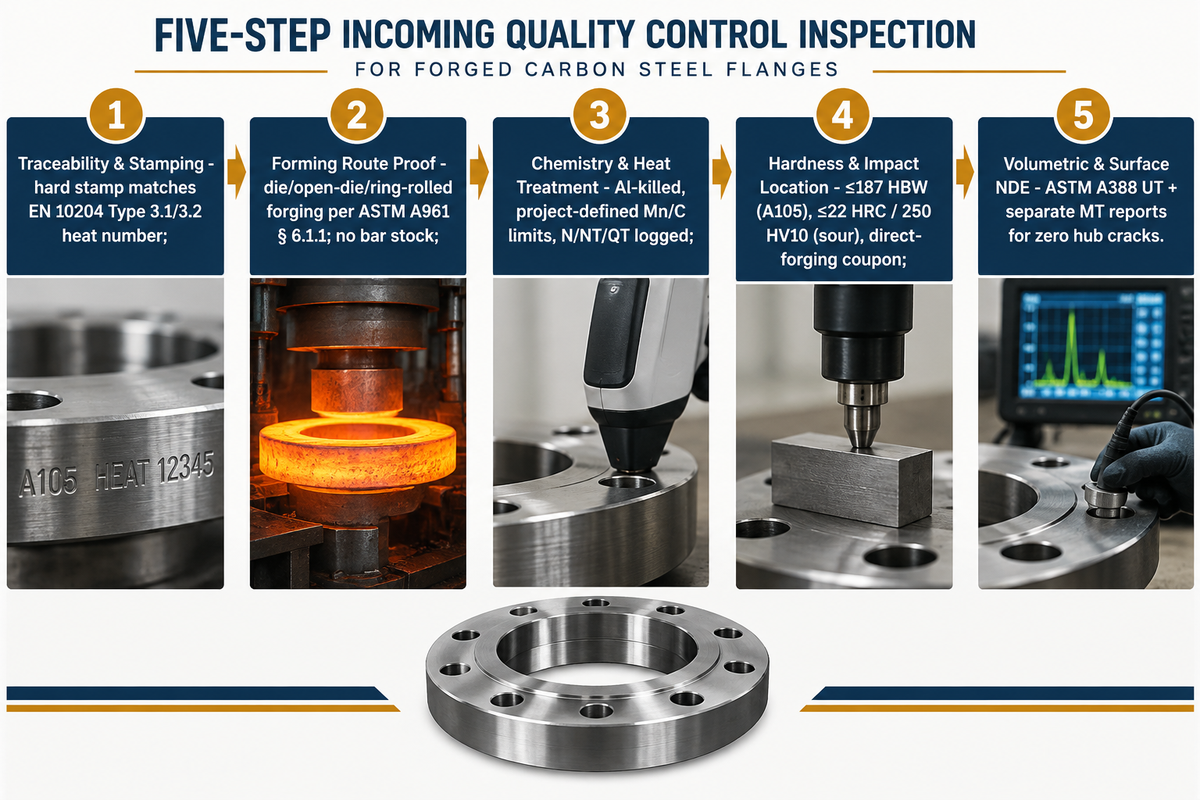
Incoming forged carbon steel flange lots need five concrete checks: matched heat-number stamping on an EN 10204 Type 3.1 certificate, explicit forging-route proof, real Mn/C and hardness readings, hub-representative mechanical test location, and order-specified NDE. ASME B16.5 omits mandatory volumetric ultrasonic testing unless written into the purchase order.
Three documented industry failures explain why generic paperwork misses defective forgings. First, owner-operator toughness audits in Inspectioneering Journal found newly made forged carbon steel flanges and pipe fittings failing the ASME BPVC Section VIII-1 -20 °F impact exemption. Second, a Chemical Engineering report on Fluor Corp.’s Barry Messer ASME B31.3 presentation documented brittle fractures across 6 mm (0.236 in) to 30 mm (1.181 in) walls tied to low-Mn/C heats, and separately flagged coarse grain at the flange hub and radius. Standard ASTM coupons taken from the flange body passed, creating dangerous false positives. In response, ASTM A350-24a added Section 7.3 requiring testing on the actual flange forging rather than a separate test blank. Proposed ASTM Work Item WK97757 (initiated January 15, 2026) is balloting to replicate Section 7.3 into ASTM A961/A961M across A105, A182, A694, and A707.
Third, hot-rolled bar substitution can clear usual visual receiving checks without an explicit clause for a forging-route:
“Bar certified per ASTM A105 can be used for some components, but it cannot be used for hubbed flange components such as weld-neck flanges and bolted valve bonnets.”
Weldability and heat-affected-zone hardness complete incoming quality control. Tight carbon content and carbon-equivalent limits reduce hydrogen cracking during field welding and set preheat or post-weld heat treatment (PWHT) rules on thick hubs. China Welong (Shaanxi Welong Int’l Supply Chain Mgt Co., Ltd.) supplies drawing-led custom forgings from 0.2 to 50 tons at 0.01 mm machining precision. China Welong states that each order dossier includes material certificates described under the legacy EN 10204-3.1B designation (corresponding to Type 3.1), plus CMM, UT, MT, and X-ray reports. Shipments carry 5-year serial traceability with a retained test coupon, and material mills are re-audited every 2 years. See our guide on industrial forging defects and ultrasonic inspection for NDE acceptance workflows.
5-Point Forged Flange MTC Verification Protocol
| Checkpoint | What to Inspect on MTC & Flange | Acceptance Target | Failure Mode Prevented |
|---|---|---|---|
| 1. Traceability & Stamping | Heat number, grade, class, size, B16.5 mark vs EN 10204 Type 3.1/3.2 | Exact character match between hard stamp and MTC | Mixed heats and mismatched broker certificates |
| 2. Forming Route Proof | Explicit forging statement vs hot-rolled bar/plate wording | Die/open-die/ring-rolled forging (ASTM A961 § 6.1.1; plate only for blind and hubless reducing flanges) | Non-compliant hot-rolled bar substitution on hubbed ASME B16.5 flanges |
| 3. Chemistry & Heat Treatment | Heat analysis C, Mn, P, S, micro-alloys, furnace chart | Project-defined Mn/C limits for low-temp/cyclic lines, Al-killed, N/NT/QT logged | Reduced low-temperature impact toughness from low Mn/C heats |
| 4. Hardness & Impact Location | Actual Brinell/Rockwell values and Charpy coupon location | ≤187 HBW (A105); ≤22 HRC parent / 250 HV10 weld-HAZ (sour); direct-forging test where required by specification or PO | Body-coupon false positive and sour SSC cracking |
| 5. Volumetric & Surface NDE | Ultrasonic (UT) reports to ASTM A388 and separate magnetic particle (MT) reports | Zero laminar tears, forging laps, or hub cracks | Hidden internal voids missed under default B16.5 |
Sources: ASTM WK97757, Valve Magazine, Chemical Engineering, and Inspectioneering Journal.
Pricing, Lead Times, MOQs, and How to Vet Forged Carbon Steel Flange Suppliers
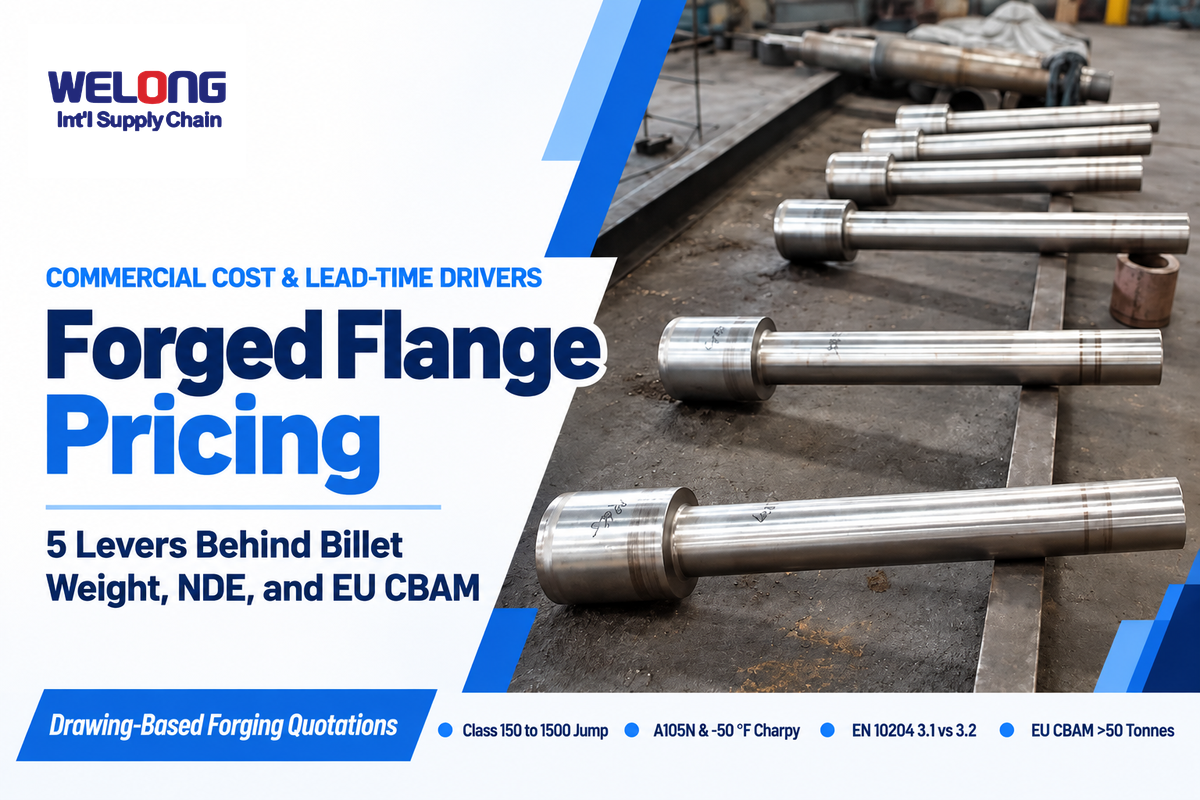
Carbon steel flange forging prices are based on finished billet weight, pressure-class multiplier, heat treatment, NDE scope, and AML source, not fixed price sheets. Published US distributor terms for stock Class 150 ASTM A105 flanges show $40 order minimums and 24–48 hour warehouse dispatch. Custom heavy-wall forgings, A350 LF2 lots, and large-diameter B16.47 orders require forge-to-order mill schedules quoted per drawing and heat lot.
Five commercial cost levers cause two quotes on the same unit, for example, pipe size, to diverge dramatically:
- Pressure-class weight jump: Moving from Class 150 to Class 600 or Class 1500 multiplies steel billet mass, forging tonnage, and CNC machine time per piece.
- Heat treatment and Charpy testing: Adding normalizing (A105N) or -50 °F (-46 °C) impact tests (A350 LF2) adds furnace cycles and destructive coupon costs.
- Inspection and Certification tier: QA fees and lead time will be increased for moving from EN 10204 Type 3.1 to witnessed Type 3.2 with full ASTM A388 UT and separate MT.
- Minimum order quantity (MOQ): Master stockists will sell small-lot warehouse quantities with distributor markup; direct forge runs will set per-heat MOQs to recover die setup.
- Export customs and carbon reporting: EU CBAM rules require authorised declarant registration and installation-level embedded-emissions reporting once an importer exceeds 50 tonnes per calendar year across covered goods other than electricity and hydrogen.
Unit prices follow live steel billet futures, normalizing cycles, and NDE scope instead of static rate cards. Custom and high-pressure orders therefore require drawing-based quotations rather than unnormalized retail catalog estimates. Importers shipping into Europe will find the registration rules on the European Commission EU CBAM definitive regime page.
How to Shortlist Reliable ASTM A105 Flange Manufacturers and Complete an RFQ
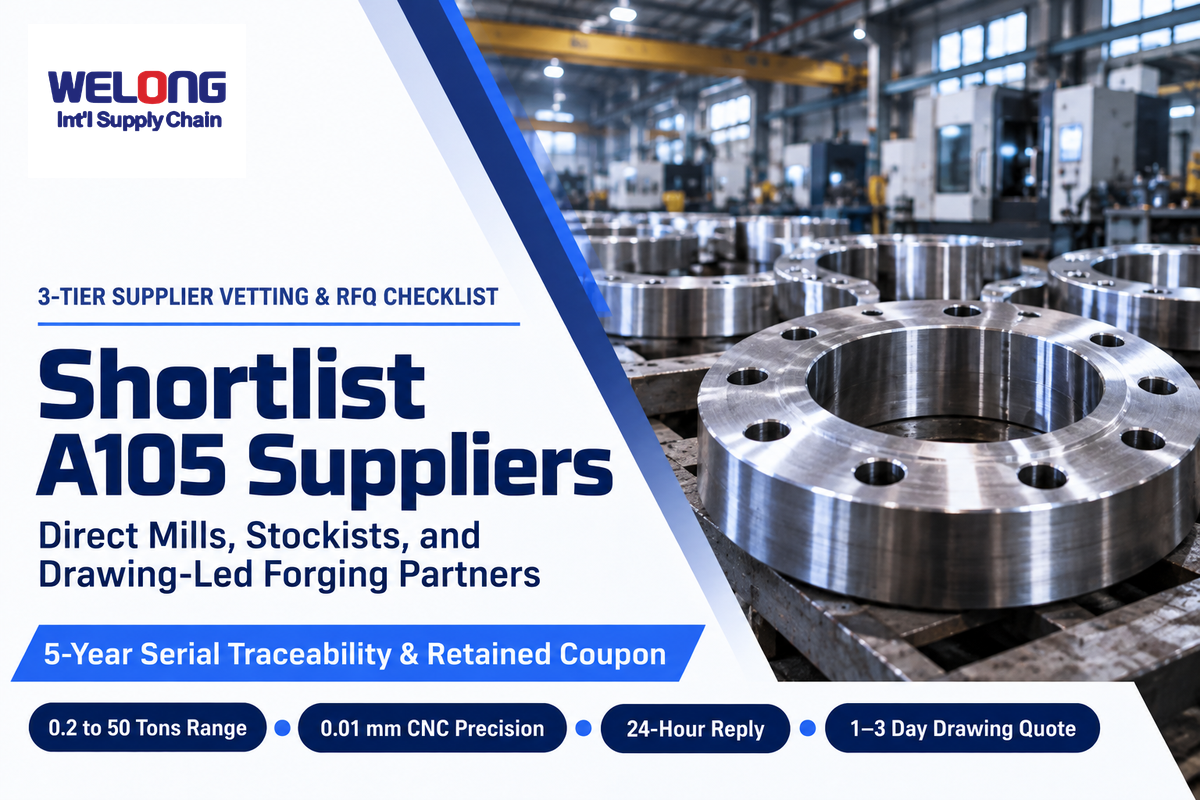
Shortlist reliable ASTM A105 flange manufacturers across three vetted supply tiers: global AML direct mills, domestic master stockists, or audited drawing-led forging partners. Verify each candidate against EN 10204 Type 3.1 traceability and ASTM A961 forging compliance. A supplementary forged-material clause in the purchase order defines the required forming route for the ASME B16.5 flanges being purchased.
| Evaluation Dimension | Global AML Direct Forge Mill | Domestic Master Stockist | Drawing-Led Forging Supply Partner |
|---|---|---|---|
| Best Order Fit | High-volume EPC packages on strict AML lists | Urgent MRO small-lot stock & standard Cl 150–600 | Custom bores, heavy forgings (e.g., China Welong: 0.2–50 t), mixed NDE lots |
| Traceability & Audit Control | Direct melt-to-forge mill dossier | Relies on upstream mill MTCs in warehouse stock | Audited mill network, named producer on quote, retained test coupon |
| Custom Machining Flexibility | Limited to high-MOQ standard dies | Standard off-the-shelf schedules only | Drawing-based CNC machining (e.g., China Welong: 0.01 mm stated CNC capability on drawing-specified features from .dwg / .igs) |
| Quotation Speed | Multi-week mill desk review | Same-day catalog pricing | Fast drawing quotes (e.g., China Welong: 24-hour reply; 1–3 working day quote) |
Duplicate these structured parameters into your quote request, or combine them with our forging RFQ readiness checklist. China Welong quotes list the accountable producer and the purchase-specific assessment scope. Our engineers reply within 24 hours and deliver drawing-based quotes (.dwg or .igs) in 1–3 working days.
RFQ checklist — copy these into your quote request:
| Parameter | Recommended range | Why it matters | How to verify |
|---|---|---|---|
| Dimensional & material code | ASME B16.5-2025 + ASTM A105N (or A350 LF2 Cl. 1 for -50 °F / -46 °C) | Locks current rating edition and avoids un-normalized coarse-grain delivery | Verify exact edition and grade on EN 10204 Type 3.1/3.2 MTC |
| Flange type, NPS & bore schedule | Weld neck + exact NPS (1/2–24) + Sch 40/80/XXS bore | Eliminates internal bore steps and ensures full-penetration RT weldability | Dimensional inspection report (CMM) before shipment |
| Forming route clause | True forging only (closed-die, open-die, or rolled ring); no hot-rolled bar | Closes the ASTM A961 § 6.1.1 bar-stock CMTR loophole on ASME B16.5 flanges | Written forging-route statement on MTC + mill audit record |
| Chemistry & toughness control | For critical low-temp/cyclic A105 or LF2 lines: Al-killed, project-defined Mn/C and fine grain; direct-forging coupon if ordered | Reduces low-toughness heat risk and body-coupon false positives | Heat analysis + Charpy V-notch report on actual flange forging where ordered |
| Facing type & roughness | Serrated RF/FF or metallic RTJ matching gasket spec (see Facing table) | Helps limit joint leakage when combined with suitable gasket selection and bolt preload | Profilometer reading recorded in Ra / AARH on dimensional sheet |
| Hardness & sour service | ≤187 HBW (A105); ≤22 HRC parent / 250 HV10 weld-HAZ + exposed B7M/2HM (sour) | Reduces sulfide stress cracking susceptibility in wet H2S service; tensile stress and material condition also govern | Measured Brinell/Rockwell base-metal and Vickers weld/HAZ hardness values on MTC |
| NDE & traceability dossier | ASTM A388 UT + separate MT + 5-year serial traceability & retained coupon | ASME B16.5 omits mandatory volumetric NDE unless specified on PO | Signed UT/MT reports matched to hard-stamped flange heat number |
2025–2026 Standards Revisions and Global Compliance Shifts Buyers Must Track
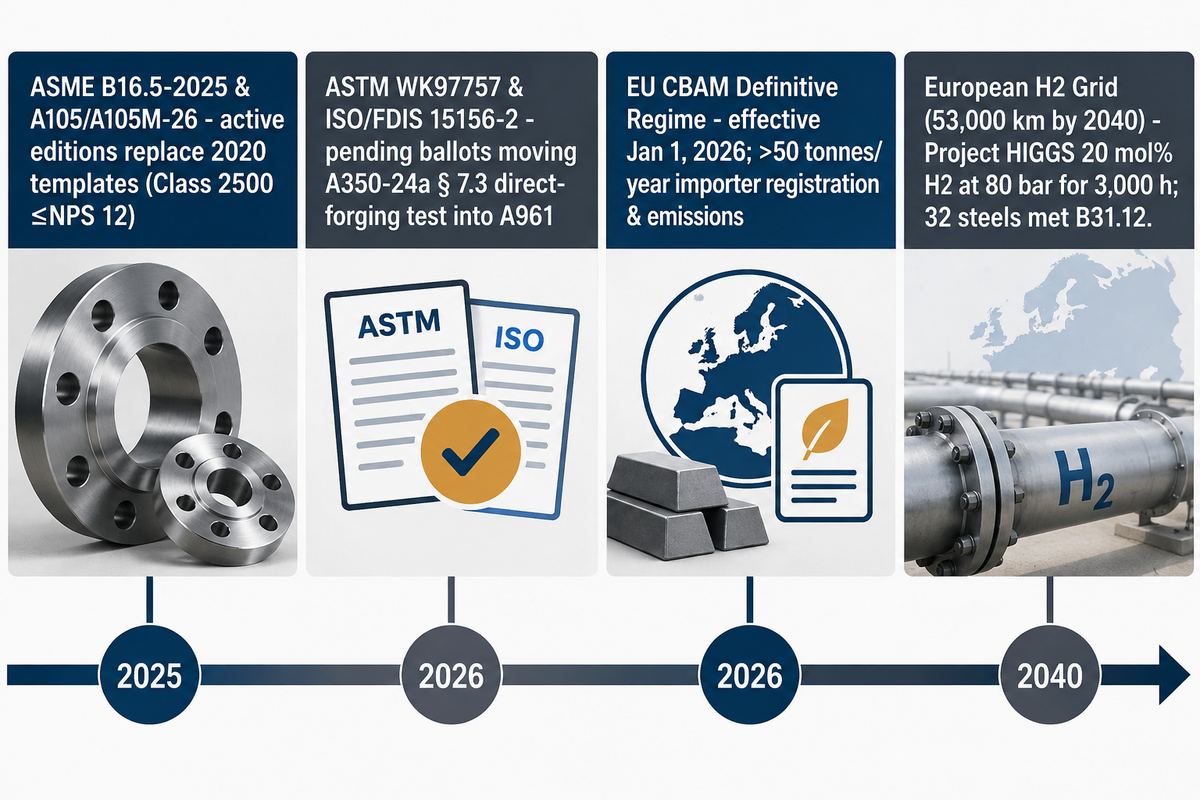
Four concrete standards and regulatory milestones now reshape 2026–2027 forged carbon steel flange orders. ASME B16.5-2025 replaces the 2020 edition, and EU CBAM’s definitive regime entered force on January 1, 2026. Meanwhile, ASTM WK97757 targets direct flange-forging testing in A961, and Europe’s 53,000 km hydrogen grid expansion increases ASME B31.12 toughness qualification demand.
First, update engineering templates from 2020 references to active editions: ASME B16.5-2025 (NPS 1/2–24, Class 2500 up to NPS 12), ASME B16.47-2025 (NPS 26–60), and ASTM A105/A105M-26. Second, keep published editions distinct from pending drafts. ASTM WK97757 (initiated January 15, 2026) is moving ASTM A350-24a Section 7.3 direct forging testing into A961. Similarly, ISO/FDIS 15156-2 is under development to replace ISO 15156-2:2020. Cite published editions plus supplementary clauses on contracts until those revisions issue.
Third, EU border carbon rules now add direct landed-cost obligations. Under the European Commission CBAM Definitive Regime effective January 1, 2026, EU importers bringing in more than 50 tonnes of covered CBAM goods in a calendar year must register as authorised declarants. They surrender CBAM certificates priced on EU ETS auction averages (quarterly in 2026, weekly from 2027), and the November 2026 EEA decision extends CBAM to Norway and Iceland. Pair installation-level mill emissions records with EN 10204 Type 3.1 certificates on EU-bound shipments. Fourth, hydrogen transport raises toughness scrutiny on carbon steel lines. Peer-reviewed research in Welding in the World (August 2025) maps 28 European countries building nearly 53,000 km of hydrogen pipelines by 2040. Germany alone targets 9,700 km by 2032, with 60% converted from natural gas lines at roughly €20 billion in investment. Project HIGGS reported no cracking in tested API 5L X42–X70 steels, welds, valves, and couplings exposed to 20 mol% hydrogen at 80 bar for 3,000 hours. Project SyWestH2 reported that 32 pipeline steels met ASME B31.12 fracture-toughness requirements. Teams bidding 2026–2027 projects in the oil and gas industry should align emissions documentation and direct-forging tests now.
Frequently Asked Questions About Forged Carbon Steel Flanges
Q: What is a forged carbon steel flange?
A forged carbon steel flange is a pipe connector produced by pressing heated solid carbon steel billets into a shaping die. CNC machines then finish the bore, bolt holes, and gasket faces.
Compressive forging seals internal voids and guides directional grain flow along the hub, providing fatigue resistance in general industrial and cyclic piping when heat-treated and inspected.
Q: Are ASTM A105 flanges suitable for high-temperature and high-pressure applications?
Yes. ASTM A105 forged flanges serve high-pressure and high-temperature systems up to 6,170 psig at 100 °F in Class 2500. Continuous operation stays recommended up to 800 °F (425 °C).
Long exposure above that temperature range risks carbide graphitization that makes the carbon steel brittle. Continuous steam or refinery headers above that range evaluate chromium-molybdenum alloy steel grades.
Q: What is the difference between ASTM A105 and ASTM A105N flanges?
ASTM A105N is standard ASTM A105 forged carbon steel with required normalizing heat treatment. Bare ASTM A105 Class 150 and Class 300 flanges can be shipped as-forged without normalizing.
Normalizing improves coarse forging grain structure and enhances low-temperature impact toughness, which in turn aids code impact-exemption assessment per the applicable code standard governing the piping or vessel.
Q: What grade of steel is most commonly used in carbon steel pipe flanges?
ASTM A105 (and normalized A105N) is the standard grade used for ambient and elevated-temperature forged carbon steel flanges.
For sub-zero pipelines requiring verified notch toughness, ASTM A350 Grade LF2 Class 1 mandates Charpy V-notch testing at -50 °F (-46 °C). Final low-temperature qualification follows the governing piping or vessel code.
Q: Why is a Class 150 carbon steel flange not limited to 150 psi?
ASME B16.5 pressure class numbers are dimensionless rating designations rather than cold psi caps. A Group 1.1 Class 150 normalized ASTM A105N flange holds 285 psig (19.6 bar) up to 100 °F (38 °C) when code low-temperature rules are met.
Working pressure drops as temperature climbs: 260 psig at 200 °F, 200 psig at 400 °F, and 140 psig at 600 °F. Always size from the Group 1.1 pressure-temperature table rather than the class number.
Q: When should buyers specify ASME B16.47 instead of ASME B16.5?
ASME B16.47 covers large-diameter steel weld-neck and blind flanges from NPS 26 through NPS 60 within its specified pressure classes.
ASME B16.5 covers NPS 1/2 through NPS 24 (stopping at NPS 12 for Class 2500), while ASME B16.47 governs larger diameters in Series A and Series B.
Q: Does ASME B16.5 automatically require ultrasonic or magnetic particle testing on forged flanges?
No. Standard ASME B16.5 and ASTM A105 specifications do not mandate routine ultrasonic (UT) or magnetic particle (MT) testing on forged carbon steel pipe flanges unless ordered by the buyer.
For high-pressure, sour H2S, or heavy-section forged fittings and flanges, specify full ASTM A388 ultrasonic examination and separate magnetic-particle testing. Combine those reports with EN 10204 Type 3.1 or 3.2 inspection certificates to identify interior laminations before you install.
Need Drawing-Led Forged Carbon Steel Flanges with Full QA Traceability?
Send your .dwg or .igs drawings, ASTM grade, bore schedule, and NDE requirements to China Welong. Our engineers respond within 24 hours and deliver drawing-based quotes in 1–3 working days for custom forgings from 0.2 to 50 tons.
Related Articles
- Forged Steel Rings Guide Rolled-ring forging metallurgy for large-diameter flange blanks
- Industrial Forgings Guide Defect prevention, ASTM A388 ultrasonic inspection, and heat-treatment control
- Forged Shafts Guide EN 10204 Type 3.1 MTC verification and release documentation practices
References & Sources
- 46 CFR § 56.30-10: Flanged Joints (Modifies 104.5.1(a)) U.S. Coast Guard / Electronic Code of Federal Regulations
- ASTM A105/A105M: Standard Specification for Carbon Steel Forgings for Piping Applications ASTM International
- ASTM Work Item WK97757: Revision of A961/A961M-25a (Flange Forging Testing) ASTM International Subcommittee A01.22
- ASME B16.5-2025: Pipe Flanges and Flanged Fittings (NPS 1/2 through NPS 24) ANSI / American Society of Mechanical Engineers
- ISO 15156-2:2020: Cracking-Resistant Carbon and Low-Alloy Steels for H2S Environments International Organization for Standardization
- Surface Texture Height Parameters (Ra and Rq Definitions) National Institute of Standards and Technology (NIST)
- Safety Alert ED 01-2015: External Chloride Stress Corrosion Cracking of 316/316L Stainless Steel Connectors UK Health and Safety Executive (HSE)
- Carbon Border Adjustment Mechanism (CBAM) Definitive Regime European Commission, Directorate-General for Taxation and Customs Union
- In-Service and Repair Welding of Pressurized Hydrogen Pipelines (Vol. 69, pp. 3141–3164, Aug 2025) Welding in the World / Springer
- US11333280B2: Joining Metal Fittings to a Polymer Composite Pipe United States Patent and Trademark Office (Subsea 7 US LLC)
- Carbon Steel Piping Reduced Toughness and Mn/C Ratio Report (ASME B31.3 Committee) Chemical Engineering
- Developing a Fitness-for-Service Approach for Reduced Toughness Carbon Steel Piping, Flanges & Fittings Inspectioneering Journal
- Overview of Graphitization in Carbon and Low-Alloy Steels Inspectioneering Integripedia
- ASTM A105: Forging vs. Hot-Rolled Bar Stock and CMTR Requirements Valve Magazine (Valve Manufacturers Association)
About This Engineering Analysis
This technical guide cross-checks ASME B16.5-2025 Group 1.1 pressure-temperature ratings, ASTM A105/A350 forging specifications, US 46 CFR § 56.30-10 joint limits, and ISO 15156-2 sour-service rules against oilfield forging quality-control workflows. All pressure-temperature benchmarks, Mn/C toughness findings, and 2026 EU CBAM compliance thresholds reflect published primary records as of November 2026. Reviewed by the Shaanxi Welong Int’l Supply Chain Mgt Co., Ltd. technical team.