Get in touch with Welong Company
China WelongSince 2001Integrated oilfield supply-chain partner — drawing-led quotations in 1–3 working days
What an Industrial Forging Factory Does: Processes, Equipment, and Buyer Vetting

Last updated: November 2026
An industrial forging factory heats solid metal stock below its melting point, typically 950–1,250 °C for hot carbon and alloy steel, and shapes it through press forging, hammer forging, or radial-axial ring rolling. There are three main plant types from which industrial buyers source custom metal forging parts: open-die factories for heavy, simple-shaped blocks and shafts; closed-die factories for complex shapes; and ring rolling mills for circular flanges and sleeves.
Selecting the right forging solutions and forging techniques protects project budgets against die fees, machining waste and ultrasonic scan rejections. This engineering guide covers steel forging metallurgy, compares factory routes via “The 3-Route Forging Selector” and forging presses in an equipment table, demonstrates press-load and die break-even math, and explains the “4-Gate Forging Factory Scorecard” for auditing ASTM, API and EN 10204 compliance.
What Is a Forging Factory and How Is Forged Steel Made?
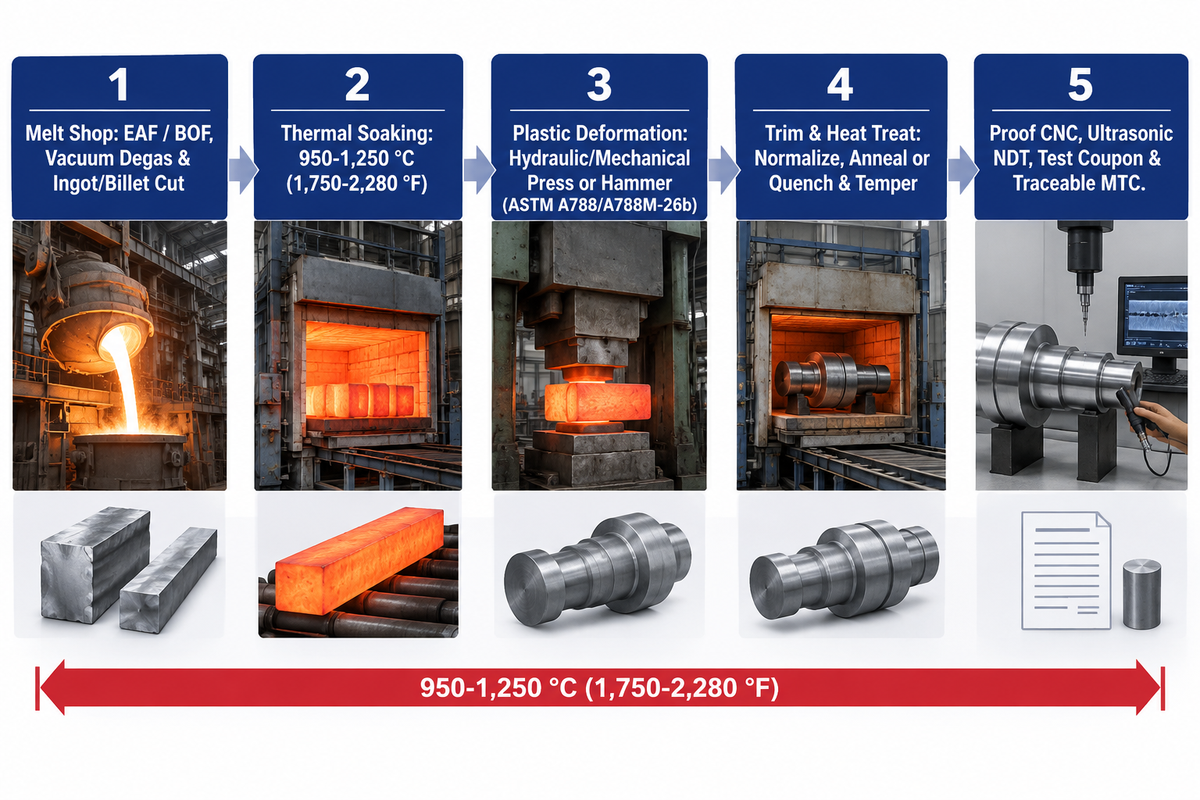
Inside a steel forging factory, the hot forging process heats solid ingots or billets to 950–1,250 °C (1,750–2,280 °F), with heavy open-die re-heat furnaces running around 1,250 °C per Sheffield Forgemasters, and applies localized compressive force. As the steel is only worked in the solid state, internal shrinkage voids in the microstructure are closed and the grain structure is refined. The grain flow is aligned in the direction of the loading stress. The ASTM Steel Standards directory lists A788/A788M-26b and A668/A668M-23 for carbon and alloy steel forgings.
Production in an industrial forge progresses through five quality control stages from raw metal to certified delivery.
- Ingot or billet selection begins at the melt shop, where steelmakers melt carbon, alloy, or stainless heats in electric arc or basic oxygen furnaces, vacuum-degas critical grades, and cast solid ingots or billets cut to gross weight.
- Limited soak time against surface decarburization is accomplished using a gas box, car bottom, or induction forging coils to uniformly heat the workpiece to forging temperature with thermal soaking above recrystallization.
- Plastic deformation through hydraulic presses, mechanical presses, or hammer forging equipment upsets, draws out, or pierces hot steel in several passes. Under the umbrella general-requirements standard ASTM A788/A788M-26b, a specific minimum forging reduction ratio (R = A0 / A1) becomes mandatory only when invoked by the product specification, a Supplementary Requirement, or the purchase order.
- Trimming and post-forge heat treatment remove parting-line excess metal (flash) on closed-die lines, then normalize, anneal, or quench and temper the forged product in calibrated furnaces or deep quench tanks to hit target strength and impact toughness.
- Proof machining, non-destructive testing, and certification prepare smooth ultrasonic scan surfaces, verify internal soundness, pull mechanical test bars from a sacrificial test prolongation (coupon), and issue heat-traceable material certificates.
Procurement teams sometimes equate machined rolled bar or steel castings with a forged component whenever datasheet tensile values look similar.
What Is Forging of Steel Compared to Casting and Bar Machining?
Steel forging shapes solid metal through plastic deformation, and this forging process produces continuous grain boundaries bent around contours such as bosses, shoulders, and fillets. Metal casting, however, leaves behind dendritic or isotropic grains in the cast metal component and can also cause shrinkage porosity. Also, metal components are directly machined from rolled bar stock, thereby cutting through longitudinal grains in the process.
When properly heat treated and free from internal discontinuities, continuous contoured grain flow generally improves directional impact toughness and fatigue endurance compared to equivalent cast steel parts. Still, forging is not universally superior to metal casting or billet machining. Thin-walled housings under 3 mm and intricate cored internal fluid passages cannot be forged cleanly between solid dies, so sand or investment casting wins geometrically on hollow manifolds. On 1–20 small prototype brackets with evolving drawings, direct computer numerical control machining from certified bar avoids tooling lock-in altogether.
| Manufacturing Route | Material State & Grain Structure | Internal Void Risk | Geometry & Cost Boundary |
|---|---|---|---|
| Metal Forging | Solid-state plastic deformation; contoured directional grain flow | Low when melt degassing and reduction ratio are controlled | Suited to shafts, gears, rings, flanges, and heavy blocks; no cored internal hollows |
| Metal Casting | Liquid molten pour; isotropic dendritic solidification structure | Higher risk of gas porosity, shrinkage cavities, and segregation | Preferred for thin walls (<3 mm) and complex internal cored fluid passages |
| CNC Machining from Bar | Subtracted from rolled stock; exposed end-grain at stepped shoulders | Low in rolled bar, though large diameters require center UT checks | Zero tooling cost for small lots; heavy chip scrap on large stepped flanges |
Types of Forging Processes Inside a Modern Forging Plant
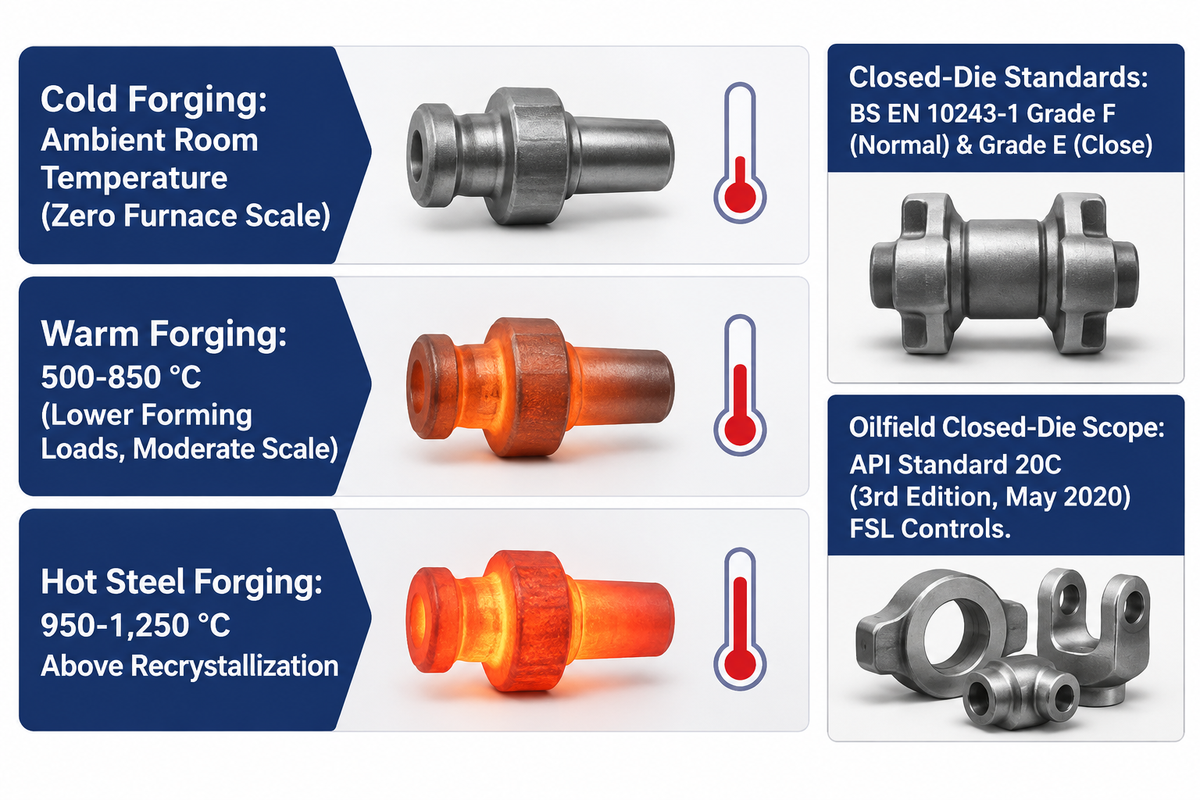
In practice, forging is a manufacturing process described by forming route (open-die, closed-die, rolled-ring, upset, or roll forging) and workpiece temperature (cold forging at ambient temperature, warm forging at 500-850 °C, or the hot forging process at 950-1,250 °C for carbon and alloy steels). Knowing both dimensions allows you to identify which forge company can quote your part cleanly.
Common types of forging rely on distinct press kinematics and tooling architectures:
- Open-die forging (free forging) compresses heated metal between flat, V-shaped, or swaging dies that never fully enclose the workpiece. Heavy manipulators rotate the ingot or billet between strokes to form stepped shafts, discs, hollow cylinders, and industrial blocks without cavity dies.
- Metal is forced into paired three-dimensional cavities cut into hardened die blocks (also called the impression-die or drop forging process). Specialized die forging process variants include flashless forging for symmetric near net precision forging parts, and isothermal forging for aerospace superalloys.
- Ring forging (the ring forging process) pierces a heated upset blank into a donut preform and expands it between radial and axial rolls on a ring rolling mill. Continuous circumferential grain flow suits bearing races, pressure-vessel flanges, and turbine gear rings.
- Upset forging and roll forging shape long bar stock efficiently: horizontal upsetters thicken bar ends for flanged axles and heavy bolts, while roll forging passes heated stock through contoured cylindrical rolls to taper shafts before finish die forging.
What Is Closed-Die Forging and How Does Flash Control Cavity Fill?
Closed-die forging—also known as impression-die forging—compresses a heated or cold billet between matched shaped dies that enclose the part profile. As the ram closes during the die forging process, excess metal escapes into a parting-line flash gutter. Because thin flash cools faster than the thicker core, rising flow resistance builds high internal pressure that forces metal into intricate cavity details.
Good die design guides cavity fill, dimensional accuracy, and tooling life across production runs. Die engineers add external draft angles so forged components release without galling, along with generous fillet radii that prevent folding defects and premature cavity cracking. Under BS EN 10243-1:1999 (confirmed 2006), steel die forgings are classified into Normal (Grade F) and Close (Grade E) dimensional tolerance classes using a shape complexity factor defined as the ratio of forging volume to enveloping shape volume. Oilfield closed-die components follow API Standard 20C (3rd Edition, May 2020), adding Forging Specification Level (FSL) controls beyond commercial tolerances. See our Closed-die forging Design and Tolerance Guide for rules concerning parting lines and drafts.
What Is Cold Forging vs. Hot and Warm Forging Temperature Ranges?
Cold forging deforms ductile metals near room temperature without furnace scaling, delivering smooth surface finishes, tight dimensional accuracy, and added strength through work hardening (Fortune Business Insights). Warm forging runs roughly 500–850 °C to cut forming loads while moderating scale, whereas hot steel forging runs at 950–1,250 °C above recrystallization so heavy sections deform without fracturing.
Temperature controls press tonnage and alloy eligibility. Cold forging employs high unit pressures to form smaller, ductile carbon-steel fasteners, gears and automotive shafts. Hot forging lowers alloy flow stress sharply, making it commonly preferred for heavy-section alloy-steel shafts, heavy-duty forging blocks, and crack-sensitive high-alloy stainless or nickel parts depending on grade and section thickness, though hot-forged blanks require descaling and larger finish machining stock.
Open-Die vs. Closed-Die vs. Rolled-Ring Forging Factories: The 3-Route Forging Selector
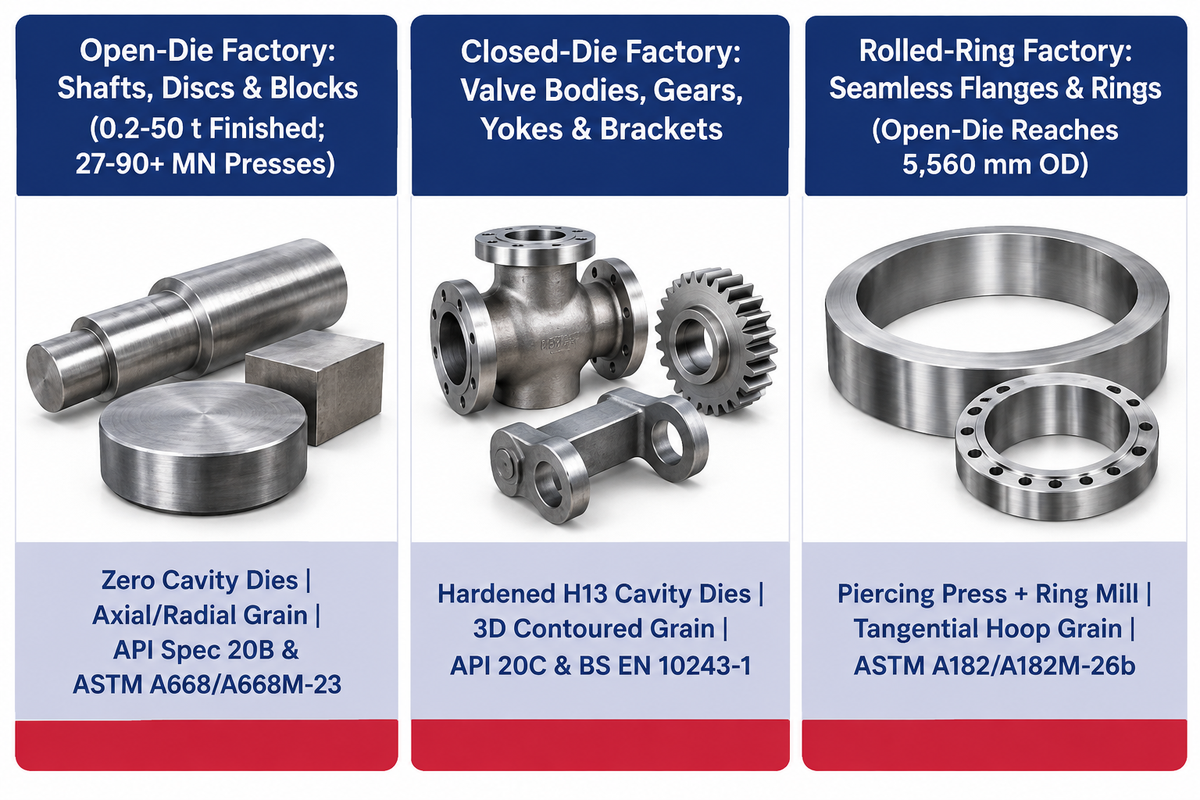
Selecting between an open-die, closed-die, or rolled-ring forging factory depends on factors such as the weight of the piece, the volume of the order, the geometry of the piece, and CNC stock removal. Open-die shops make custom low-volume parts without cavity dies; China Welong lists 0.2–50 ton forgings, while Sheffield Forgemasters handles steel ingots up to 300 tonnes and rings up to 5,560 mm OD, and closed-die lines handle repeatable contoured runs.
Sending a 10-piece stepped shaft inquiry to an automotive closed-die plant triggers prohibitive custom die quotes, whereas routing thousands of contoured brackets to an open-die shop multiplies CNC chip waste. The 3-Route Forging Selector maps ten concrete engineering and commercial criteria across all three factory routes, including conditions where each route becomes uneconomical or geometrically restricted.
The 3-Route Forging Selector (Industrial Carbon & Alloy Steel)
| Selection Parameter | Open-Die Forging Factory | Closed-Die (Impression) Factory | Rolled-Ring Forging Factory |
|---|---|---|---|
| Typical Part Geometries | Stepped shafts, bars, discs, blocks, hubs, hollow cylinders | Valve bodies, gears, yokes, levers, brackets, connecting rods | Weld-free flanges, bearing rings, pressure shells, gear rims |
| Published Weight Envelope | 0.2–50 t finished (e.g., China Welong, GMH to 45 t); forge masters handle 260–300 t starting ingots (check finished & ship weights separately) | Small-to-medium parts sized to press bolster and cavity tonnage | Seamless rolled rings; open-die presses forge rings up to 4,000 mm OD (GMH) and 5,560 mm OD (Sheffield Forgemasters) |
| Dedicated Tooling Investment | None to minimal (reuses standard flat, V, and mandrel dies) | High upfront custom hardened H13 impression-die & trim tooling | Low to moderate (standard rolling tools; contoured rolls add cost) |
| Typical Batch Fit | Single prototypes, spare shafts, and small-to-medium capital lots | Medium-to-high repeat production runs (lower crossover for costly Ti/Ni alloys) | Small batches to repeat industrial ring runs per OD/ID family |
| As-Forged Tolerance Standard | Coarse hot-forged envelope; finished by proof or final CNC machining | Tight commercial grades per BS EN 10243-1 Grade F / Grade E | Moderate OD/ID/height envelope refined by CNC turning |
| Machining Stock Allowance | Larger per-surface stock to remove scale and machine step transitions | Minimal stock on machined faces; near net unmachined webs | Moderate radial and axial stock for roundness and flatness cleanup |
| Grain Flow Orientation | Axial along shaft length or radial across upset discs | 3D contoured around ribs, bosses, and stepped webs | Continuous tangential (hoop) alignment around ring circumference |
| Core Plant Equipment | Hydraulic open-die presses (27–90+ MN), rail/mobile manipulators | Mechanical crank/screw presses, drop hammers, trim presses | Piercing press + radial-axial ring rolling mill |
| Petroleum / Industrial Specs | API Spec 20B (R2025), ASTM A668/A668M-23, ASTM A788/A788M-26b | API Standard 20C (3rd Ed., May 2020), ASTM A182/A182M-26b, BS EN 10243-1 | API Spec 20B (rolled rings), ASTM A182/A182M-26b, ASME SA-182 |
| Limitations / When Not to Choose | Often uneconomical for high-volume intricate shapes where CNC chip waste exceeds die amortization | Often uneconomical for very small runs or unstable designs (though technically feasible when spec-required); bounded by press bolster limits | Restricted strictly to axisymmetric hollow circular profiles; asymmetric lugs need open or closed dies |
Hybrid routing bridges medium-batch requirements: a plant produces an open-die preform or steel ring forging blank and finish-turns critical bearing journals and seal faces on multi-axis CNC lathes. Check your part constraints with our forging route selector or check our industrial forgings specification guide.
Core Forging Press, Hammer, and Alloy Capabilities
Heavy open-die hydraulic presses verified at major Western plants range from 27 MN (~2,750 metric tons-force) up to 90 MN (10,120 short tons-force at North American Forgemasters). Across materials, carbon steel accounts for more than 37.0% of global metal forging revenue in 2025 (Grand View Research), followed by alloy steel, stainless steel, aluminum, copper, brass, titanium, and nickel superalloys. Published open-die hydraulic press specifications are documented on the North American Forgemasters forging capabilities page (up to 440,000 lbs on a 90MN press).
Press kinematics determine which alloys a forging machine deforms cleanly without thermal cracking. Programmable hydraulic presses handle titanium, duplex stainless steel and Inconel alloys as well as large carbon and alloy steel ingots requiring deep core penetration. Mechanical crank presses provide rapid and repeatable closure for automotive and agriculture closed-die forging lines, while screw presses and drop hammers provide high-velocity impact energy to fill thin webs prior to die chill freezing. Modern multi-operation drive concepts, such as patent WO2023004155A2, synchronize hydraulic or screw drives to execute dissimilar closed-die operations within one high-pressure stroke.
| Forging Machine Class | Force / Energy Mechanism | Best-Fit Alloys & Parts | Key Audit Check Beyond Nameplate |
|---|---|---|---|
| Hydraulic Forging Press | Full rated load across entire stroke; programmable slow speed | Heavy open-die 4140/4340/F22 shafts, Ti, Inconel, duplex stainless | Vertical daylight, column spacing, stroke length, manipulator load rating |
| Mechanical Crank / Eccentric Press | Fixed stroke; peak force delivered near bottom dead center | High-volume carbon and alloy steel gears, flanges, automotive hubs | Usable force above bottom dead center, shut height, ejector rating |
| Screw Forging Press | Energy-bound flywheel blow without stalling at bottom | Precision metal blades, valve bodies, aerospace brackets | Available blow energy (kJ), clutch thermal rating, forging tools cooling |
| Drop / Counterblow Hammer | High-velocity kinetic impact across repeated blows | Thin-web drop forging steel tools, yokes, aerospace ribs | Ram weight, blow energy (kJ), anvil guide alignment (die shift risk) |
| Radial-Axial Ring Rolling Mill | Continuous rolling compression between main roll and mandrel | Large steel ring forging flanges, bearing rings, pressure shells | Max OD, max axial height, radial/axial force, piercing press size |
Worked Press-Force Sizing Check (Closed-Die Alloy Steel Hub)
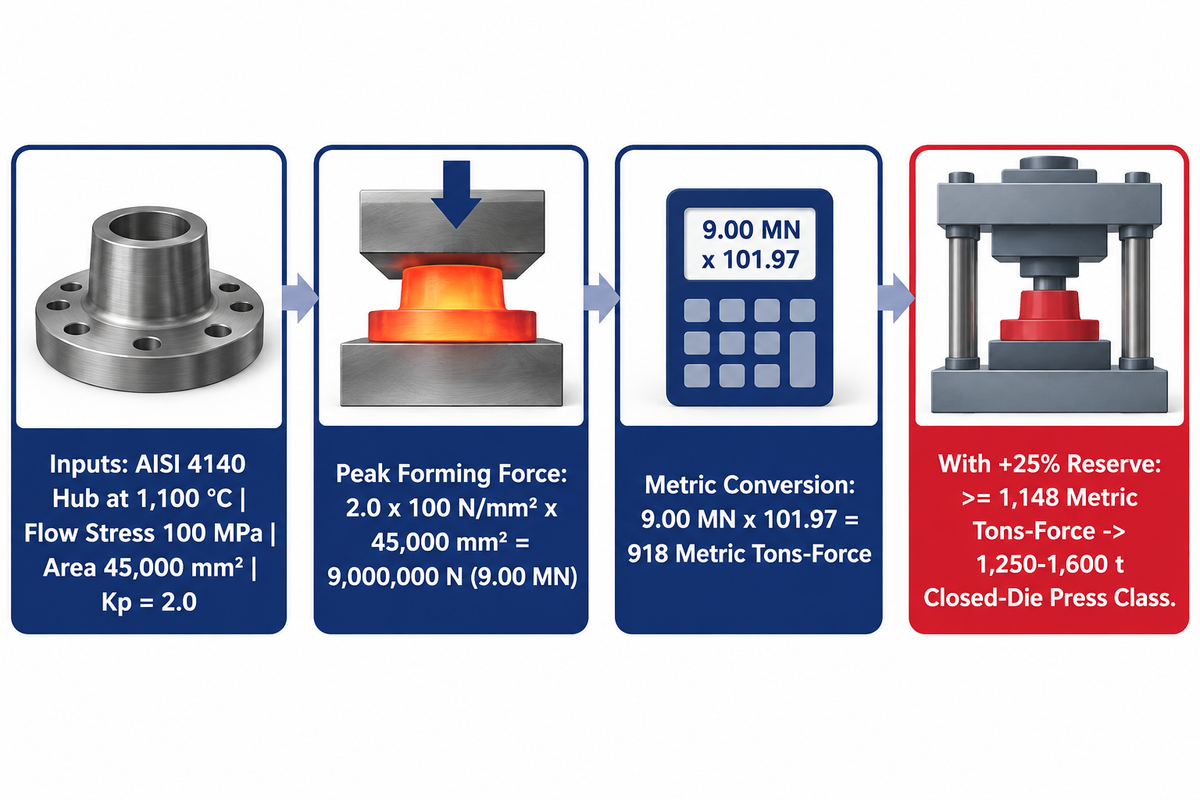
Accepting a plant’s headline press tonnage without verifying alloy flow stress and projected area leads to underfilled cavities. The simplified hot-forging load equation F = K p × σ f × A p (EngiCalcsHub) multiplies projected area including flash (A p) by hot flow stress (σ f) and a friction-and-shape factor (K p, typically 1.0–2.5 for basic shapes and higher for deep ribs).
Assumed inputs (illustrative pre-RFQ screen): Consider an AISI 4140 steel hub forged hot at 1,100 °C with representative flow stress σf = 100 MPa (100 N/mm²). Set projected area including flash at Ap = 45,000 mm² (~240 mm OD envelope) and friction/shape factor Kp = 2.0. Convert force using 1 MN = 1,000,000 N and 1 metric ton-force = 9,806.65 N (so 1 MN = 101.97 metric tons-force), then apply an engineering reserve margin of 25%.
| Calculation Step | Formula & Unit Conversion | Result |
|---|---|---|
| Peak Forming Force (F) | 2.0 × 100 N/mm² × 45,000 mm² | 9,000,000 N (9.00 MN) |
| Metric Tons-Force Equivalent | 9.00 MN × 101.97 metric tons-force/MN | 918 metric tons-force |
| Minimum Rated Press (+25% Reserve) | 918 × 1.25 | ≥ 1,148 metric tons-force (1,250–1,600 t press class) |
Considering the inputs above, the hub is in the 1,250-1,600 metric-ton closed-die press class. Cooler billet transfer temperatures and thinner deeper ribs lead to higher values of Kp, and the die shop would need to perform a finite element analysis to verify the closed-die forging loads.
Forging Factory Cost Economics: Tooling, Unit Pricing, and Break-Even Volume
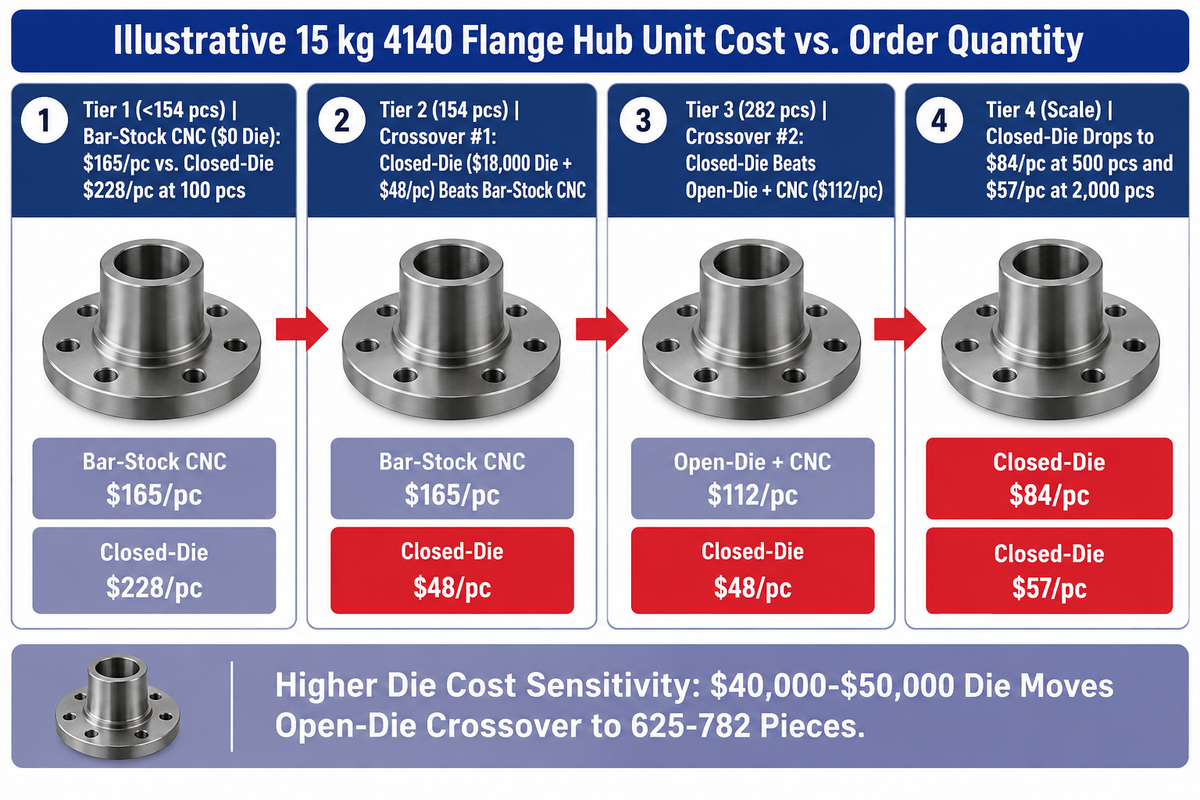
The total landed forging cost consists of two contradictory levers: upfront cost for cavity tooling and downstream cost for material yield and CNC machining hours. Open-die forging eliminates custom cavity dies for small heavy batches, whereas closed-die drop forging requires dedicated hardened H13 dies that pay back only once batch volume spreads tooling expense below the machining and chip-scrap savings.
Is Drop Forging Expensive Compared to Open-Die Forging and CNC Machining?
Prototypes and low runs of drop-forged parts are expensive for several reasons. Custom hardened dies and press tooling costs are spread out over a small volume. As order volume scales up, faster press cycles, closer near net shapes, and lower billet waste can reduce per-part closed-die cost below billet CNC machining or open-die forging once amortized die expense falls beneath the machining savings.
Alloy machinability shifts the breakeven point dramatically. According to 2025–2026 industrial process-breakeven data (MatsonCorp), difficult-to-machine grades such as Grade 5 titanium (where CNC machining cost can run 5–8× steel) and Inconel 718 reach tooling break-even at much lower quantities than carbon steel because every kilogram of avoided chip scrap saves steep alloy and spindle expense. A closed-die tooling bid may look attractive, but if the die steel is too soft, there will be an increased flash and further CNC rework. Detailed process design, machining allowance, and forging reduction comparisons for titanium and Inconel alloys are outlined in the Forging Industry Association process design guide.
Parametric Break-Even Illustration (15 kg Alloy-Steel Flange Hub)
Assumed inputs (illustrative sensitivity model, not a live mill quote): Suppose a 15 kg finished 4140 flange hub carries an illustrative custom closed-die + trim tooling fee of $18,000 and a recurring closed-die + light CNC cost of $48/pc. Compare that against an open-die blank ($0 dedicated die) + heavy CNC at $112/pc, and solid bar-stock CNC ($0 die, highest chip waste) at $165/pc.
| Order Quantity | Bar-Stock CNC (Zero Die) | Open-Die + CNC (Zero Die) | Closed-Die Forging (Assumed $18k Die) | Lowest Total-Cost Route |
|---|---|---|---|---|
| 10 pieces | $165 / pc | $112 / pc | $1,848 / pc ($1,800 die + $48) | Open-Die + CNC |
| 100 pieces | $165 / pc | $112 / pc | $228 / pc ($180 die + $48) | Open-Die + CNC |
| 500 pieces | $165 / pc | $112 / pc | $84 / pc ($36 die + $48) | Closed-Die Forging (crossover ~282 pcs) |
| 2,000 pieces | $165 / pc | $112 / pc | $57 / pc ($9 die + $48) | Closed-Die Forging |
Under these exact per-piece assumptions ($112 − $48 = $64/pc savings), closed-die forging crosses over open-die plus CNC at 282 pieces and bar-stock CNC at 154 pieces. Holding those same unit costs while raising the die set to $40,000–$50,000 moves open-die crossover to 625–782 pieces; changes in alloy billet price, machining hours, or inspection scope require recalculating with live quotes. Freeze drawing tolerances and material grades before authorizing closed-die sinking.
How to Vet a Forging Factory: The 4-Gate Forging Factory Scorecard
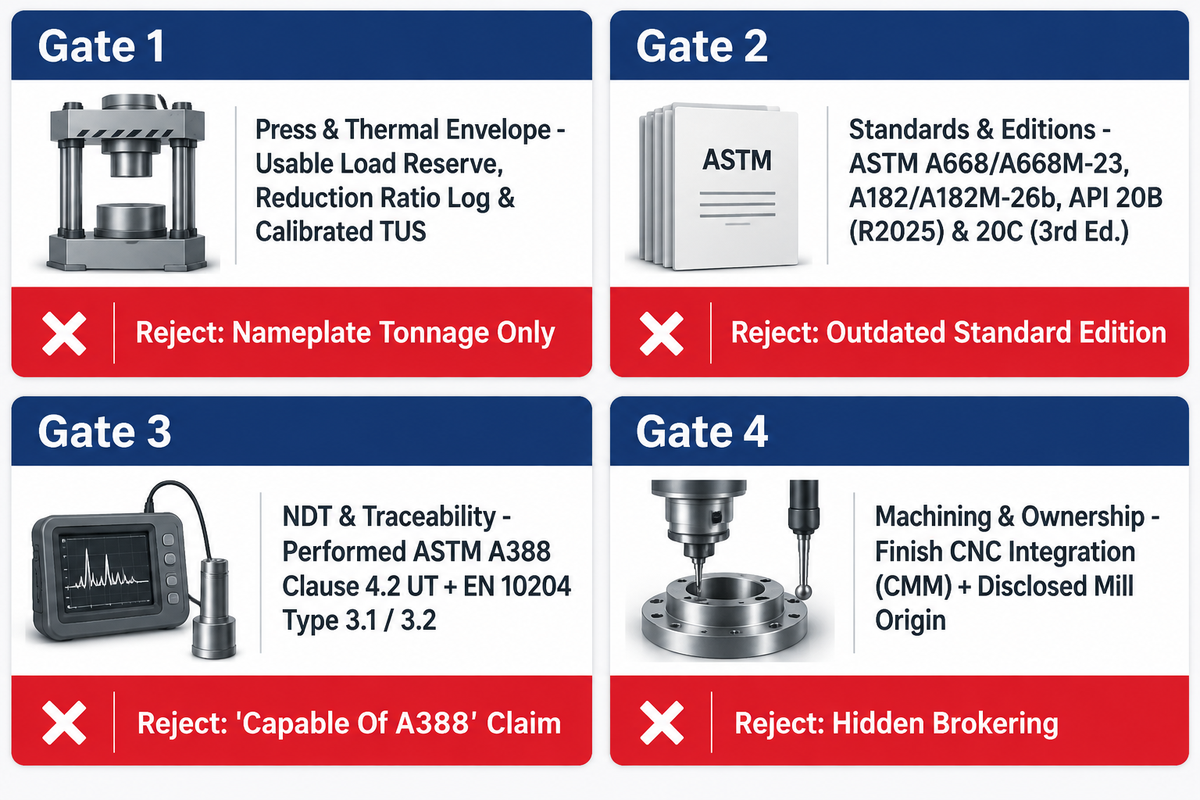
A thorough assessment of a forging company evaluates four main areas: usable press force and forging method capacity, the exact editions of ASTM or API specifications on the purchase order, performed ultrasonic and surface NDTs tied to the acceptance level of the purchase order, and disclosure of in-house and audited partner press sites.
Two documentation traps routinely trip up B2B buyers during quotation review. First, some suppliers quote material as “capable of ASTM A388”; as New Equipment Digest explains, “capable of” means theoretical conformance rather than confirming ultrasonic examination was actually performed. ASTM A388/A388M-26 defines the pulse-echo examination practice rather than a universal pass/fail threshold, so Clause 4.2 requires the purchaser to write the exact ultrasonic quality/acceptance level (such as flat-bottom hole equivalent or back-reflection limit) onto the purchase order. Second, older sheets still print “EN 10204-3.1B”, whereas DIN EN 10204:2005-01 (EN 10204:2004) replaced legacy 3.1.B with EN 10204 Type 3.1 signed by the manufacturer’s QA representative independent of production. EN 10204 Type 3.2 adds dual countersignature by either an external independent third-party inspector (such as TÜV, SGS, Bureau Veritas, or Lloyd’s Register) or the purchaser’s authorized inspection representative.
The 4-Gate Forging Factory Scorecard (10 Engineering Verification Checkpoints)
| Gate | Checkpoint | Governing Standard / Basis | Pass Requirement vs. Reject Red Flag |
|---|---|---|---|
| Gate 1: Press & Thermal Envelope | 1. Usable press load & geometry | Signed machine list + part load estimate | Pass: adequate press reserve, vertical daylight, and manipulator reach. Reject: nameplate tonnage only |
| Gate 1: Press & Thermal Envelope | 2. Forging reduction ratio log | ASTM A788/A788M-26b when invoked on PO | Pass: log records starting stock, deformation steps, and achieved ratio matching PO clause. Reject: undocumented bar upset |
| Gate 1: Press & Thermal Envelope | 3. Heat-treatment furnace uniformity | Calibrated TUS records; Nadcap (aerospace) | Pass: current thermocouple calibration & quench tank records. Reject: uncalibrated batch ovens |
| Gate 2: Standards & Editions | 4. Material & dimensional specs | ASTM A668/A668M-23; ASTM A182/A182M-26b | Pass: exact grade, class, and edition written on PO. Reject: vague “equivalent alloy” claims |
| Gate 2: Standards & Editions | 5. Oilfield forging qualification | API Spec 20B (R2025); API Standard 20C (3rd Ed., May 2020) | Pass: explicit FSL level and honest Monogram vs. built-to-spec scope. Reject: unverified Monogram claims |
| Gate 2: Standards & Editions | 6. Quality systems & pressure directives | ISO 9001:2015, AS9100; PED 2014/68/EU & class approvals (DNV/LR/ABS) | Pass: active QMS covers forging & heat treat; pressure/marine orders carry matching directive or class approval |
| Gate 3: NDT & Traceability | 7. Ultrasonic & surface NDT | ASTM A388/A388M-26 (PO acceptance level per Clause 4.2) + MPI/LPI | Pass: performed UT and MPI reports signed by qualified NDT technicians. Reject: “capable of A388” |
| Gate 3: NDT & Traceability | 8. Material certificates & coupons | EN 10204 Type 3.1 (supersedes 3.1.B) or Type 3.2 | Pass: heat-stamped serial number linked to MTC and retained test coupon where specified. Reject: unlinked MTCs |
| Gate 4: Machining & Ownership | 9. Proof & finish CNC integration | CMM dimensional report + surface roughness log | Pass: single-responsibility rough/finish machining and post-machining UT. Reject: split vendor blame |
| Gate 4: Machining & Ownership | 10. Mill origin & re-audit transparency | Disclosed forging site + periodic raw-mill re-audit | Pass: quotation explicitly discloses in-house press vs. approved partner mill. Reject: hidden brokering |
Cross-checking alloy grades across ASTM, ASME, DIN, JIS, BS, and GB standards before quoting avoids costly material-substitution disputes. For alloy equivalence verification, see our forging material and standard review.
Common Forging Defects and How Factory Process Controls Prevent Them
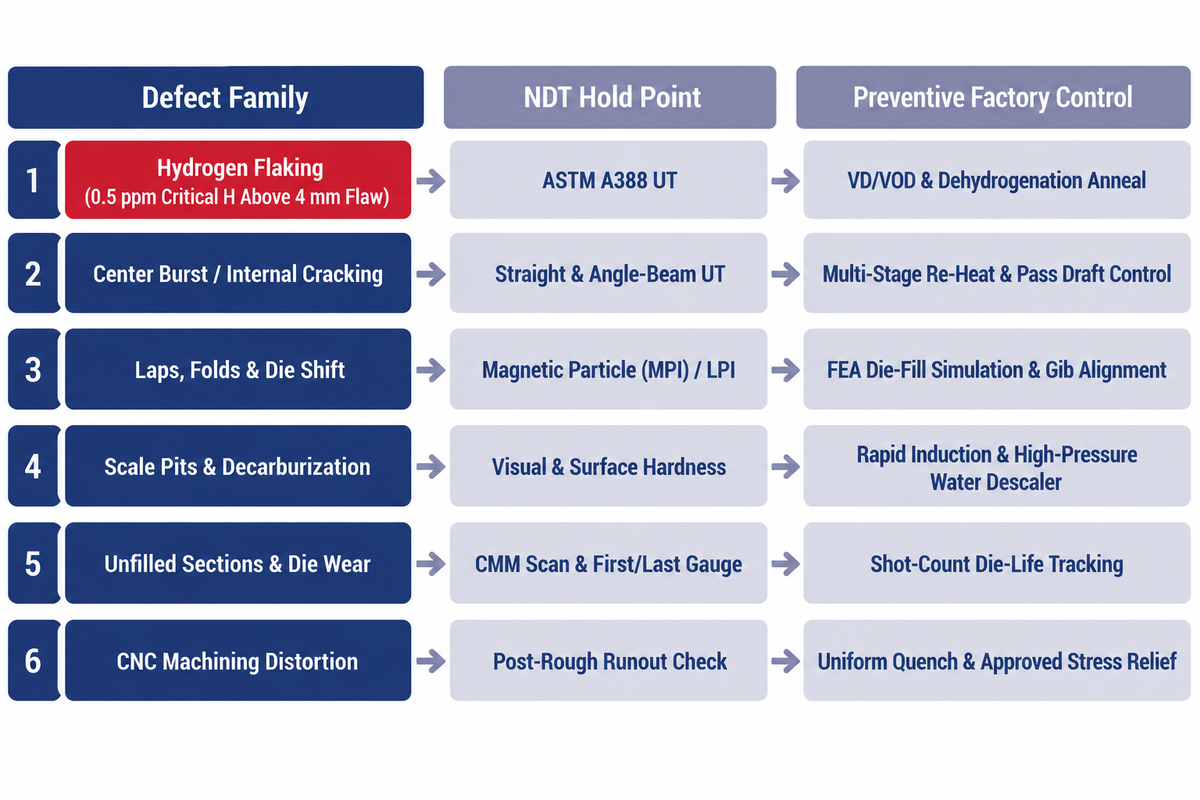
Six shop-floor defect families account for most heavy forging rejections: hydrogen flaking, internal center bursts, surface laps and folds, scale pits and decarburization, unfilled sections and die wear, and CNC machining distortion from residual stress. To prevent field failures, each root cause needs to be linked to an inspection hold point rather than relying on visual sign-off.
Abrupt failure of thick alloy-steel sections due to hydrogen flaking is a concern. Peer-reviewed modeling studies on Cr5VMo heavy roll steel (Fan et al., Materials 2018, PMC5978067) show that increasing the lattice hydrogen content from 0 to 2 ppm created internal trap pressures in the range of 1,500 MPa. In that study, critical hydrogen content for flake formation is 2.2 ppm at a 0.5 mm crack radius and drops to a constant 0.5 ppm once crack diameter exceeds 4 mm.
“For heavy forging, once flakes are detected, the whole forging will be seen as a scraped product, which is a huge waste.”
| Forging Defect | Shop-Floor Root Cause | NDT Detection Method | Preventive Factory Control |
|---|---|---|---|
| Hydrogen Flaking | Dissolved hydrogen, internal flaw traps, and residual tensile stress (0.5 ppm critical H above 4 mm flaw in Cr5VMo study) | ASTM A388 ultrasonic scan after controlled cooling | Vacuum degassing (VD/VOD) and controlled dehydrogenation annealing |
| Center Burst / Internal Cracking | Excessive single-pass bite or forging below minimum temperature | Straight- and angle-beam UT per ASTM A388/A388M-26 | Multi-stage re-heating, controlled draft per pass, pyrometer checks |
| Laps, Folds & Die Shift | Metal folding over itself in poor preform or misaligned die guides | Magnetic particle (MPI) or liquid penetrant (LPI) | FEA die-fill simulation, proper blocker stage, press gib alignment |
| Scale Pits & Decarburization | Oxidizing furnace atmosphere, excessive soak time, poor descaling | Visual inspection, metallography, surface hardness check | Rapid induction heating, high-pressure water descaler, stock allowance |
| Unfilled Sections & Die Wear | Undersized billet volume, cold workpiece, or worn H13 die cavity | CMM dimensional scan + first/last-article gauge log | Shot-count die-life tracking rather than running dies until scrap |
| CNC Machining Distortion | Asymmetric quenching residual stress released during rough cutting | Runout check after rough machining prior to finish pass | Uniform quench control and approved stress-relief cycles where permitted by material spec |
Die-life tracking is cited by engineering professionals on the subreddit /r/manufacturing as a failure point of closed-die forging, with many noting that plants wait until tolerances are exceeded before re-sinking cavities. This results in borderline geometry being shipped at the end of a forging run. For more information on tests to determine the soundness of cast industrial mill hardware prior to release, see our cast mill rolls melt-to-release guide.
Heavy Industrial and Oilfield Forging Factories: Sourcing Custom Parts from 0.2 to 50 Tons
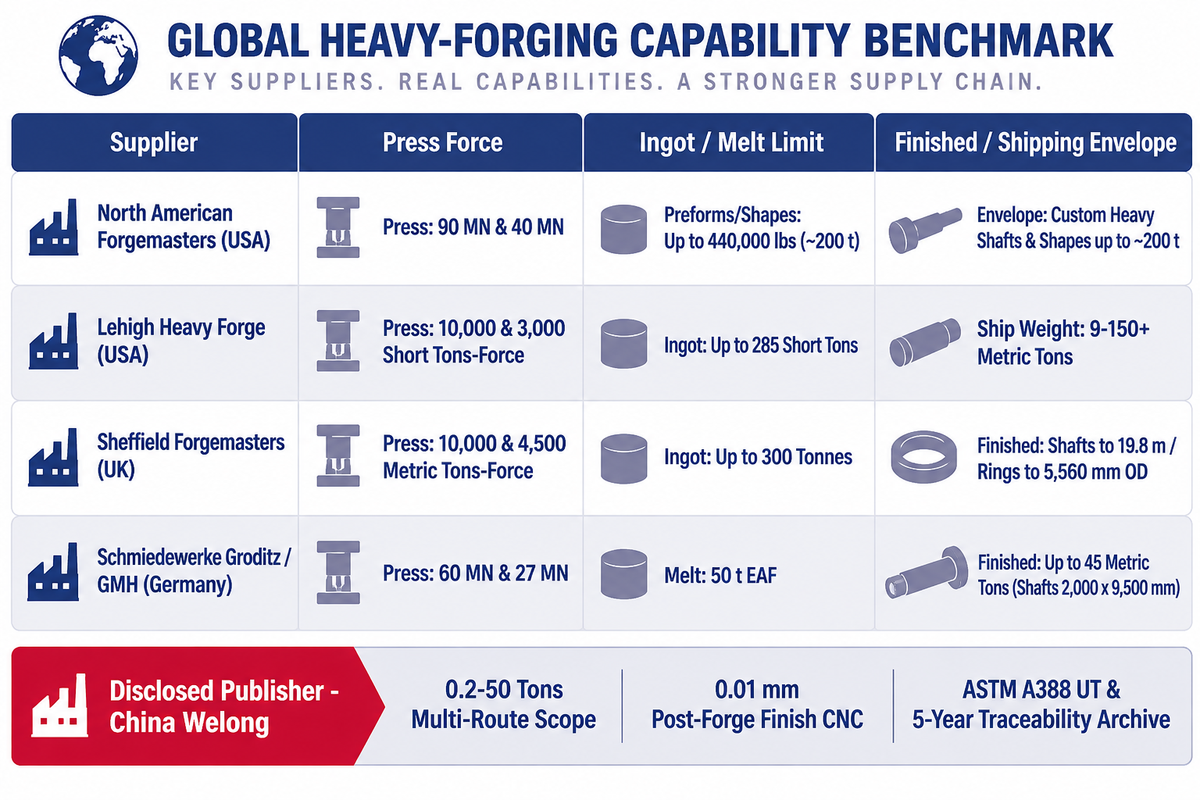
Sourcing custom steel forgings across 0.2 to 50 metric tons spans lighter closed-die or small open-die runs at the lower end and multi-thousand-ton hydraulic open-die presses, car-bottom heat-treatment furnaces, and heavy turning for multi-ton oilfield shafts, BOP blocks, and energy rotors. Global buyers balance ultra-heavy Western forge masters against integrated supply chain partners in Asia, with reported weights of 45 to 300 metric tons referring to ingot, finished, or shipping stages.
Accurately benchmarking metal forging companies producing high-quality forged components requires separating four published metrics: press force, starting ingot weight, finished piece weight, and shipping weight. A 300-tonne ingot ceiling never equals a 300-tonne finished shaft after crop discards and CNC stock removal, so the OEM table below keeps every published metric in its own column.
| Forging Factory / Partner | Location | Published Press Force | Starting Ingot / Weight Limit | Finished / Shipping Envelope & Scope |
|---|---|---|---|---|
| North American Forgemasters (Scot Forge / Ellwood JV) | New Castle, PA, United States | 10,120 short tons-force (90 MN) & 4,500 short tons-force (40 MN) | Custom shapes and preforms up to 440,000 lbs (~200 metric tons) | American forging benchmark for ultra-heavy shafts and hollows; 236 in (6 m) daylight; 220-ton manipulator |
| Lehigh Heavy Forge (WHEMCO) | Bethlehem, PA, United States | 10,000 short tons-force (9,072 metric tons-force) & 3,000 short tons-force (2,722 metric tons-force) | Ingots up to 285 short tons (260 metric tons) | Shipping weights 10–166+ short tons (9–150+ metric tons); ISO 9001:2015, PED, ABS |
| Sheffield Forgemasters | Sheffield, United Kingdom | 10,000 metric tons-force & 4,500 metric tons-force hydraulic presses | Ingots up to 300 tonnes; 330-tonne crane | Shafts to 19.8 m length / 2,100 mm dia; discs to 5,080 mm; rings to 5,560 mm OD; 20 m quench tanks |
| Schmiedewerke Gröditz (GMH Gruppe) | Gröditz, Germany | 60 MN & 27 MN open-die presses | In-house 50 t EAF + VD/VOD + ESR double plant | Finished parts up to 45 metric tons; shafts to 2,000 mm × 9,500 mm; DNV, PED, Lloyd’s Register |
| China Welong (Disclosed Publisher) | Xi’an & Jiyuan, China | Multi-route open-die, closed-die & ring-rolling network | Custom forgings 0.2 to 50 tons (carbon, alloy & stainless) | Post-forge CNC finish machining to 0.01 mm on machined features; ASTM A388 UT/MPI/CMM/X-ray; 5-year traceability & retained coupon |
Ultra-heavy Western forge masters lead 60–150+ metric ton nuclear rotors, defense shafts, and domestic Buy-America contracts, often with higher minimum weights (Lehigh Heavy Forge’s smaller press starts ship weights near 9 metric tons). For oilfield, energy, and industrial machinery orders in the mid-to-heavy range, China Welong (founded in 2001 with 30+ engineers across Xi’an and Jiyuan) supplies custom industrial forgings from 0.2 to 50 tons across open-die (built to API Spec 20B), closed-die (API Standard 20C), rolled-ring, and forged-stock plus CNC routes.
Manufacturing origin and certification scope are specified explicitly in every China Welong quote. Each quotation states whether the component is produced in-house, or at an approved partner mill that Welong develops and re-audits every two years. Components are manufactured to applicable ASTM A668/A668M, ASTM A182/A182M, API Spec 20B/20C, ISO, DIN, BS, JIS, and GB specifications and are verified by inspection; China Welong does not claim an API Monogram license for its industrial forgings.
Post-forge CNC finish machining at China Welong reaches 0.01 mm precision on specified machined features rather than hot as-forged blanks. Shipments include EN 10204 Type 3.1 material certificates (listed on legacy sheets as 3.1B), dimensional CMM reports, ASTM A388 UT and MPI records, stamped serial numbers with Welong’s 5-year traceability archive, and a retained test coupon. Buyers sourcing rotating shafts can inspect our custom forged steel shafts page and forged shafts engineering guide.
How to Prepare a Forging RFQ Package and Manage Production Lead Times
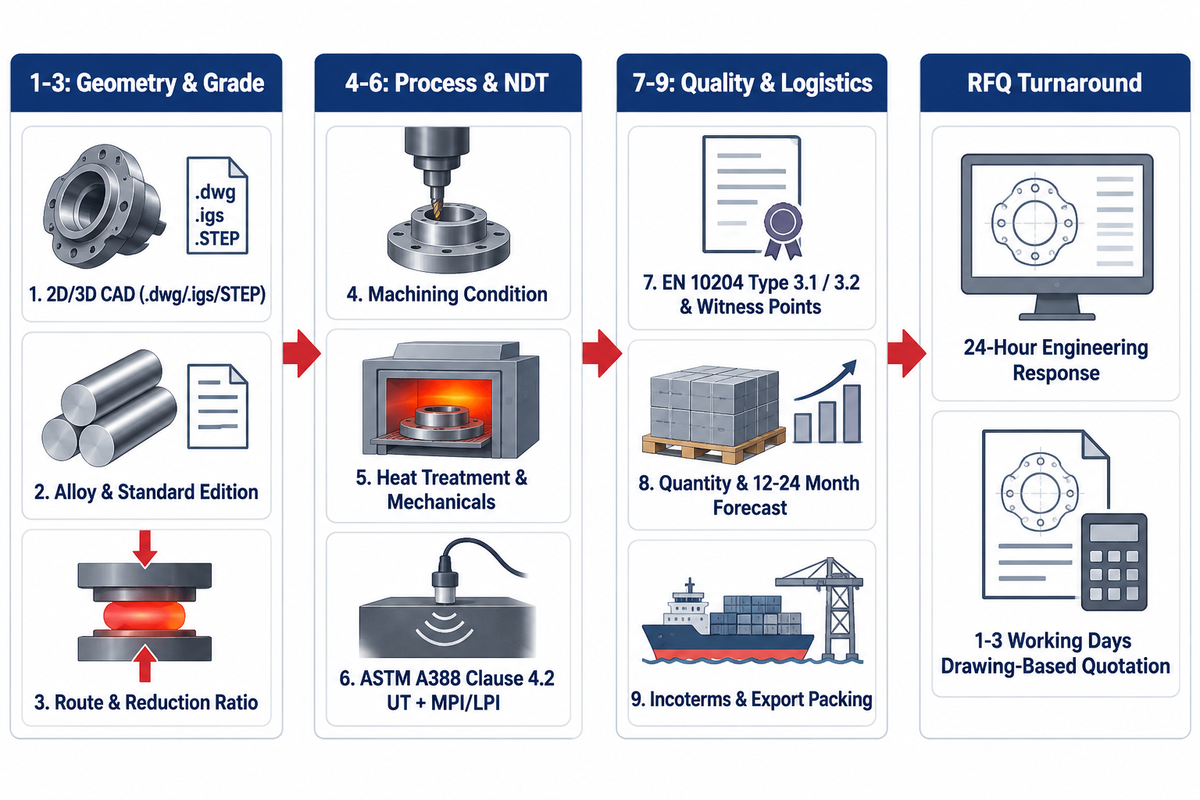
A complete forging RFQ allows China Welong’s engineering desk to respond in 24 hours with a quotation based on drawings in 1-3 working days. This prevents weeks of technical back-and-forth across any factory in your shortlist. Open-die production skips the cost and time of custom cavity-die sinking, though it still requires billet cutting, heating, and press scheduling; closed-die projects require additional die-machining time before first-article forging.
Not including heat treatment condition, ultrasonic acceptance class or finish-machining stock causes factories to either pad quotes with risk contingencies or not include NDT in the base price. Use the nine-item checklist below to lock every price-driving requirement before you request a quote.
| # | RFQ Package Input | Exact Detail to Specify | Impact on Price & Lead Time |
|---|---|---|---|
| 1 | 2D Drawings & 3D CAD Models | Revision-controlled .dwg, .igs, or STEP files with datum references | Locks billet gross weight, press route, and CNC fixture hours |
| 2 | Alloy Grade & Standard Edition | e.g., ASTM A668/A668M-23 Class K, ASTM A182/A182M-26b F22/316, AISI 4140/4340 | Determines melt source, alloy surcharge, and forging temperature window |
| 3 | Forging Route & Reduction Ratio | Open-die, closed-die, or rolled ring + minimum A0 / A1 ratio if mandated | Sets starting ingot size and whether dedicated H13 die charges apply |
| 4 | Delivery & Machining Condition | As-forged, proof-machined for UT, rough-machined, or finish CNC | Prevents surprise post-forge turning costs and defines tolerance responsibility |
| 5 | Heat Treatment & Mechanicals | Normalized, annealed, or Q&T; target yield, tensile, hardness, and Charpy temp | Adds furnace cycle time, quench medium constraints, and test-coupon sizing |
| 6 | NDT Scope & Acceptance Class | 100% UT per ASTM A388/A388M-26; acceptance criteria specified in the PO separately from Clause 4.2; MPI/LPI/PMI listed separately | Defines the testing scope and rejection limits for the quotation |
| 7 | MTC Level & Witness Points | EN 10204 Type 3.1 vs. Type 3.2; named TPI agency or buyer inspector | Type 3.2 adds inspector fees and hold-point scheduling buffers |
| 8 | Order Quantity & Annual Forecast | Initial trial lot + expected 12–24 month call-off volume | Decides whether closed-die tooling amortization pays back against open-die |
| 9 | Commercial Terms & Export Packing | Incoterms (EXW, FOB, CFR, CIF), payment (T/T or L/C), export wooden cases | Aligns landed freight cost, rust-preventive coating, and crane-lifted crating |
Before issuing tenders to multiple forging plants, have your drawing reviewed against our forging RFQ readiness checklist or submit .dwg and .igs files to request a drawing-based forging quotation.
Forging Factory Modernization: Near-Net Simulation, Automation, and Energy Shift
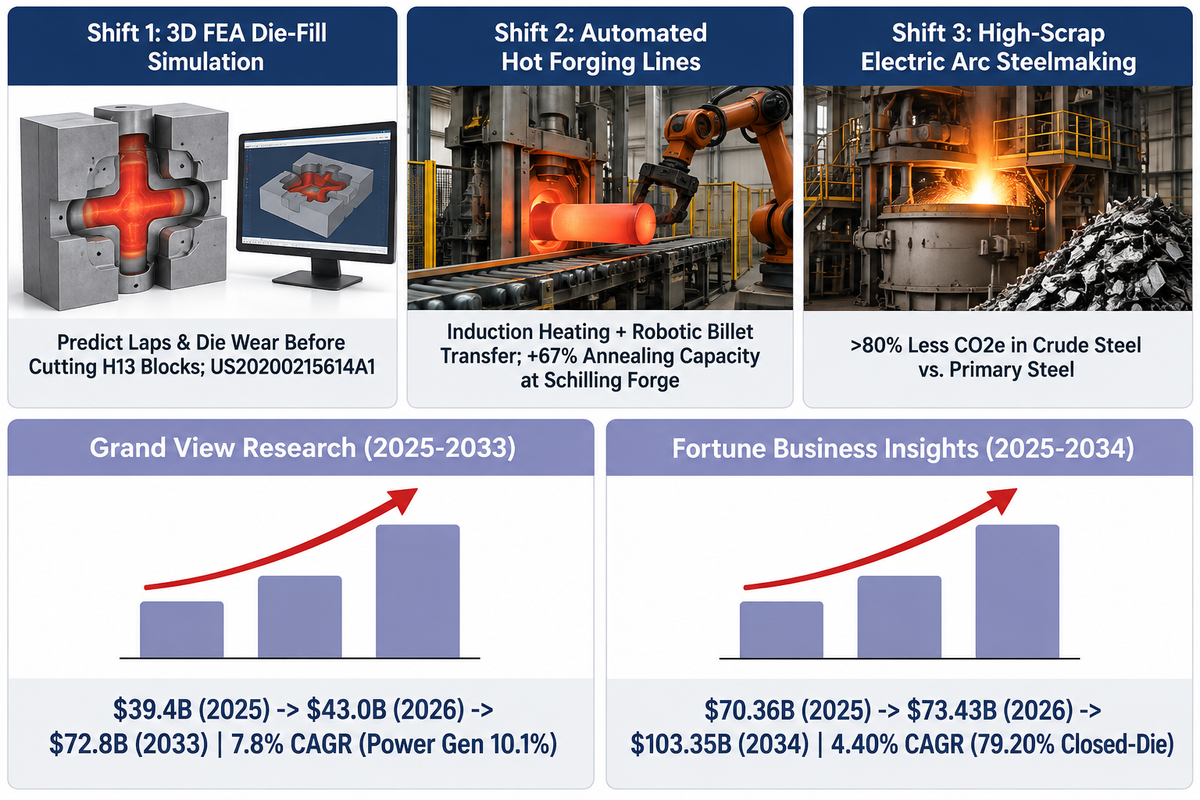
Forging technology upgrades now differentiate top factories through three engineering shifts: finite-element (FEA) die-fill simulation cutting trial scrap, automatic hot forging lines pairing induction heating with robotic billet transfer, and electrified furnaces plus high-scrap electric arc steelmaking, where GMH Gruppe (Schmiedewerke Gröditz) documents more than 80% less CO2e in electric crude steel production than primary steel production.
Modern forging expertise can use 3D FEA simulation for precision forging to predict laps, die wear, and grain flow before cutting an H13 die block. Separately, acoustic forming patents such as ultrasonic micro-forging device US20200215614A1 explore applying ultrasonic vibration during forming to refine microstructure and mechanical properties. On the thermal floor, gas re-heat ovens are steadily supplemented by induction coils and electrified heat-treatment furnaces: Schilling Forge in Syracuse, New York installed an electrically heated Gasbarre car-bottom furnace in November 2024 that expanded its annealing capacity by 67% (Grand View Research). At the melt level, Schmiedewerke Gröditz’s high-scrap EAF route demonstrates how integrated mills cut Scope 1 and 2 emissions without sacrificing heavy open-die metallurgy. Electric-arc steelmaking emission disclosures and 27-MN to 60-MN press capabilities are published on the GMH Gruppe open-die forgings page.
Global market forecasts reflect steady demand across energy, automotive, aerospace, and heavy fabrication, though published totals vary by research methodology. Grand View Research sizes global metal forging at $39.4 billion in 2025 and $43.0 billion in 2026, reaching $72.8 billion by 2033 (7.8% CAGR; power generation fastest at 10.1% CAGR). Using a broader scope, Fortune Business Insights reports $70.36 billion in 2025 and $73.43 billion in 2026, projecting $103.35 billion by 2034 (4.40% CAGR), with closed-die forging representing 79.20% of global technology share. Factories investing in FEA simulation, automation, and documented electric-route steelmaking deliver tighter dimensional consistency and cleaner audit trails than legacy manual shops.
Frequently Asked Questions About Forging Factories
What is forging manufacturing and how is it different from blacksmithing?
Forging manufacturing uses high-tonnage hydraulic presses, mechanical presses, drop hammers, and calibrated furnaces to deform solid billets under the ASTM, API, or ISO standards specified on the purchase order. Blacksmithing uses manual tools and open hearths to forge individual pieces. A qualified forging factory can ensure repeatable tolerances, a controlled grain flow, and traceable NDT, if specified by contract.
Is there such a thing as forged aluminum in industrial forging factories?
Yes, industrial forging factories manufacture forged components (aluminum, carbon steel, alloy steel, stainless steel, titanium and magnesium) (Fortune Business Insights). Aerospace and automotive buyers specifically ask for aluminum forgings for high strength-to-weight ratios in structural brackets, suspension arms, and housings, where controlled forging temperatures and careful die-temperature management preserve surface integrity and dimensional accuracy.
What is a drop hammer and when do factories still use it over a hydraulic press?
A drop hammer shapes metal by impact from a falling or power-driven ram. An anvil die at the bottom absorbs the impact. Forging factories still choose drop hammers over slower hydraulic presses for thin-walled, complex closed-die steel parts because rapid impact blows fill deep die ribs before the workpiece loses heat to the cooler die surface.
What certifications should an industrial forging factory hold?
Baseline factories hold ISO 9001:2015 for quality management. Critical sectors add AS9100 and Nadcap for aerospace, PED 2014/68/EU compliance or DNV and Lloyd’s Register approvals for pressure and marine forgings, and API Spec 20B or 20C qualification for oilfield parts.
What is the typical minimum order quantity and lead time at a custom forging factory?
Open-die forging factories commonly accept single-piece or small custom lots, and production can start once billet stock is cut, heated, and scheduled on the press, without waiting for cavity-die tooling. Closed-die drop forging adds upfront die-machining lead time to cut hardened H13 impression cavities plus larger batch minimums to amortize tooling cleanly, typically higher for standard carbon steel and lower for costly titanium or nickel alloys where avoided CNC chip scrap speeds payback across repeat orders.
What is the biggest forging press or hammer capacity available worldwide?
Documented Western open-die presses include North American Forgemasters’ 10,120-short-ton-force (90 MN) press and Sheffield Forgemasters’ 10,000-metric-ton-force press handling 300-tonne steel ingots.
How do buyers verify whether a forging supplier owns its press line or subcontracts?
Verify factory ownership by inspecting a signed equipment list aligned to the physical plant address and press-side videos or live video audits showing heat-number stamping on your actual batch, because trading brokers can forward genuine mill certificates. Manufacturing origin and certification scope stay explicit on every China Welong quote. Buyers should review periodic steel-mill audit logs, verify who operates the heat-treatment furnaces, and require written disclosure on every quotation stating whether forging is performed in-house or at a named, supervised partner press shop.
Need Custom Industrial Steel Forgings from 0.2 to 50 Tons?
Submit your 2D drawings or 3D CAD models (.dwg, .igs), alloy standard, heat treatment spec, and ASTM A388 or MPI requirements to China Welong’s engineering desk. Expect a drawing-based quotation in 1 – 3 working days for open-die, closed-die, rolled-ring, and precision finish CNC delivery.
Published capabilities for North American Forgemasters, Lehigh Heavy Forge (WHEMCO), Sheffield Forgemasters, and Schmiedewerke Gröditz (GMH Gruppe) reflect their public engineering pages as of November 2026.
References & Sources
- ASTM Steel Standards Catalog: A668/A668M-23, A182/A182M-26b, A788/A788M-26b, and A388/A388M-26 (ASTM International)
- API Monogram & APIQR Latest Updates: API Standard 20C (3rd Edition, May 2020) (American Petroleum Institute)
- API Spec 20B (R2025): Open Die Shaped Forgings for Use in the Petroleum and Natural Gas Industries (Accuris Standards Store / API)
- DIN EN 10204:2005-01 Metallic Products, Types of Inspection Documents (Type 3.1 Superseding 3.1.B) (DIN Media)
- Product Design Guide for Forging (Forging Industry Association)
- BS EN 10243-1:1999 (Confirmed 2006): Steel Die Forgings, Tolerances on Dimensions (British Standards / CEN)
- Fan, J., Chen, H., Zhao, W., & Yan, L. (2018). Study on Flake Formation Behavior and Its Influence Factors in Cr5 Steel. Materials (Basel), 11(5):690 (NIH / PubMed Central)
- Decoding ASTM A388: What “Capable Of” Really Means for Your Forged Parts (New Equipment Digest)
- Open Die Forging Equipment and Capabilities (North American Forgemasters)
- Lehigh Heavy Forge Open Die Forging Capabilities (WHEMCO)
- Forge Capabilities, Re-Heat Furnaces, and Quench Facilities (Sheffield Forgemasters)
- Open-Die Forgings & Low-CO2e Electric Steelmaking (Schmiedewerke Gröditz / GMH Gruppe)
- Metal Forging Market Size, Share & Growth Report, 2026–2033 (Grand View Research)
- Metal Forging Market Size, Share, Trends & Growth Report, 2026–2034 (Fortune Business Insights)
Why Buyers Work With Welong
About Welong Engineering Support
China Welong supports oilfield buyers with engineered supply-chain service for drilling tools, well-control equipment, rig-floor tools, casting parts, and industrial forged components.
Project Review Before RFQ
We help buyers compare tool family, material route, API or ISO requirements, inspection records, supplier capability, delivery risk, and documentation needs before a purchase decision is finalized.
Request An Oilfield QuoteCompany Profile // Data Sheet
CompanyChina Welong International Supply Chain
BrandWelong
CountryChina
Business TypeOilfield tools and industrial supply-chain partner
Main ProductsDownhole drilling tools, fishing and milling tools, wellhead and well-control equipment, oilfield hoses, rig-floor handling tools, mill rolls, and forgings
Engineering CapabilityTool-family selection, specification envelope review, API / ISO reference support, material traceability, inspection coordination, and supplier-route comparison
RFQ Data NeededTool type, size, connection, rating, grade, standard, quantity, drawings, and delivery target
Websitewelongoiltools.com
Related Posts
Trending now