Get in touch with Welong Company
China WelongSince 2001Integrated oilfield supply-chain partner — drawing-led quotations in 1–3 working days
Forged Blocks Explained: Open-Die Steel Metallurgy, Grades, and Specification Standards

Updated November 2026 | Technical Engineering and Procurement Guide
Industrial forged blocks are solid steel or alloy preforms compressed from heated ingots through open-die forging for high-pressure valves, manifolds, and dies. Unlike sand-cast engine blocks, solid forged steel blocks can close internal voids during forging; ASTM A668 or ASTM A182 defines the material, while ASTM A388 covers ultrasonic testing when ordered.
Quick Engineering Reference: Custom Forged Steel Blocks
| Industrial Forging Envelope | 0.2 to 50 metric tons finished to 0.01 mm CNC precision (China Welong industrial forgings program) |
| Primary Material Standards | ASTM A668/A668M-23 (general industrial); ASTM A182/A182M-26b (covered pressure piping forgings up to 10,000 lb / 4,540 kg) |
| Ultrasonic Testing Split | ASTM A388/A388M-26 (heavy ferritic steel) vs. ASTM A745/A745M-24 (austenitic stainless steel) |
| Worked Buy-to-Fly Ratio | 1.26x gross forge input weight on a 500 x 400 x 300 mm block (471.0 kg net vs. 592.5 kg gross at 7,850 kg/m³) |
| Quotation Turnaround | 24-hour engineering reply and 1 to 3 working days for drawing-based quotes (China Welong) |
Key Technical Takeaways
- Production automotive engine blocks are sand-cast to form internal coolant passages, whereas industrial forged steel blocks are solid open-die preforms drilled and milled for high-pressure containment and heavy tooling.
- Forgings don’t automatically hold up stronger in every direction; steel forgings are anisotropic and can require higher preheat temperatures to resist weld underbead cracking compared to cast steel equivalents.
- Industry standards set material chemistry and test practices, not automatic pass/fail purchase terms; buyers must write exact specifications for forging reduction, heat-treatment tests, and ultrasonic acceptance limits into every order.
- Suppliers bill custom forged blocks on gross forged or rough-machined shipping weight, so a deterministic gross-to-net calculation is needed to normalize competing quotes.
What Are Forged Blocks and How Do They Differ from Cast Engine Blocks?
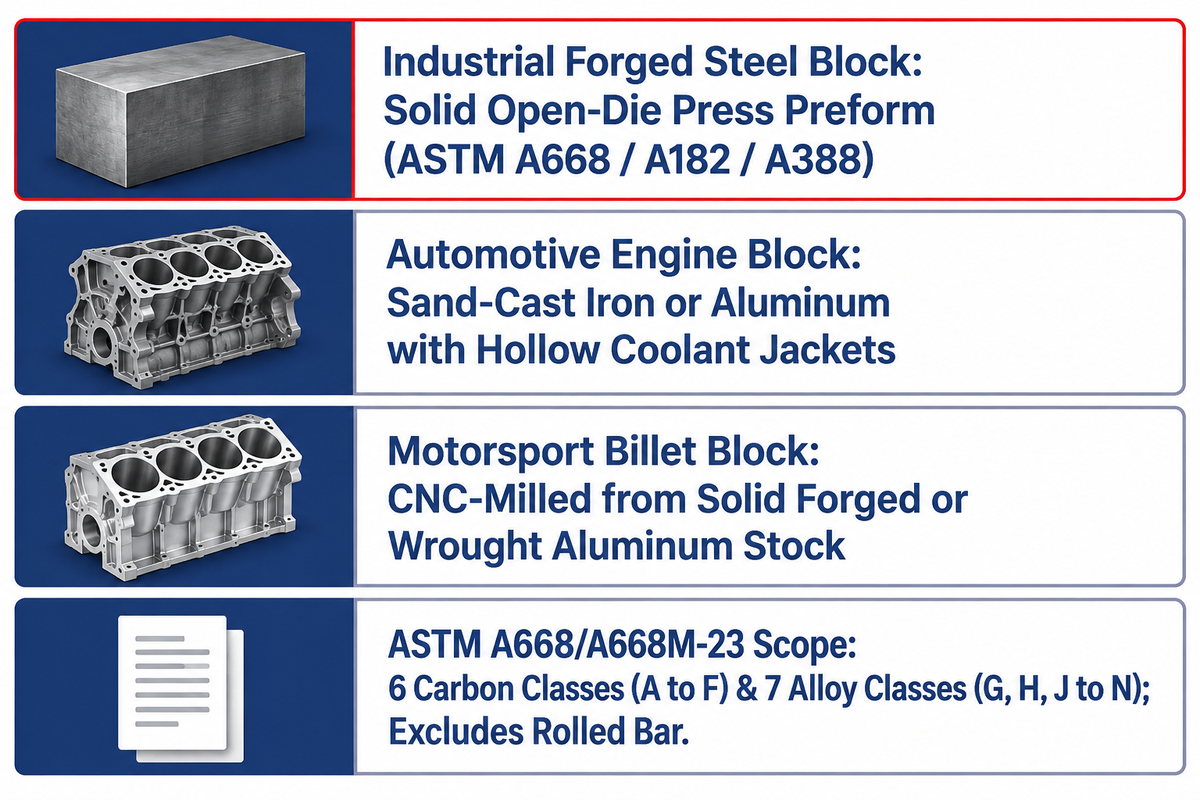
An industrial forged block is a solid rectangular or square steel preform compressed on an open-die press for heavy machining. Under ASTM A668/A668M-23, general industrial forgings span six carbon classes (A to F) and seven alloy classes (G, H, and J to N), and Clause 1.2 excludes hot-rolled or cold-finished bars from the standard.
Confusion starts because automotive shops and heavy manufacturers use the same term for completely different parts. In oilfield trade proceedings, U.S. Department of Commerce notice 91 FR 20100 covers forged steel fluid end blocks used in high-pressure pump housings.
If a buyer requests a “forged block” without clarifying solid preform versus cored casting, quoting stalls immediately because open dies can’t form hollow water jackets.
Do Forged Engine Blocks Exist in Production Vehicles or Racing?
Production automotive engine blocks aren’t hammer-forged in one piece. Automakers use sand casting in iron or aluminum because sand molds and internal cores form complex coolant jackets and oil galleries that solid forging dies can’t produce. In racing, a “billet” engine block is CNC-milled from solid forged or wrought aluminum stock, while a “forged short block,” for street use, combines a cast aluminum cylinder block with a forged crankshaft, rotating assembly, rods, and pistons.
Internal passages draw the engineering line between the worlds. Sand-cast iron blocks form intricate shapes around each cylinder bore with cast-in sand cores. Solid high-performance industrial forged blocks begin as a dense basic shape with zero internal cavities, and machine shops gun-drill intersecting fluid passages through solid metal to eliminate core-shift leaks.
| Product Category | Manufacturing Process | Internal Passages / Cavities | Typical Material & Use |
|---|---|---|---|
| Industrial Forged Block | Open-die hot forging from cast ingot or bloom | None as forged; gun-drilled and milled after heat treatment | 4140, 4340, A105, F316, H13; manifolds, valves, fluid ends, dies |
| Production Cast Engine Block | Sand casting with internal cores | Cast-in coolant jackets and oil galleries formed by sand molds | Gray iron or aluminum; passenger and truck blocks and heads |
| Motorsport Billet Engine Block | 5-axis CNC machining from solid wrought or forged aluminum billet | Milled pockets or solid dry-block deck without water jackets | 6061-T6 or 7075 aluminum; top-fuel and pro-mod racing |
| Automotive “Forged Short Block” | Cast iron block or aluminum block fitted with forged rotating hardware | Standard cast cylinder block with forged crankshaft, rods, and pistons | High-boost street and performance engine rebuilds |
How the Open-Die Forging Process Produces Sound Steel Forged Blocks
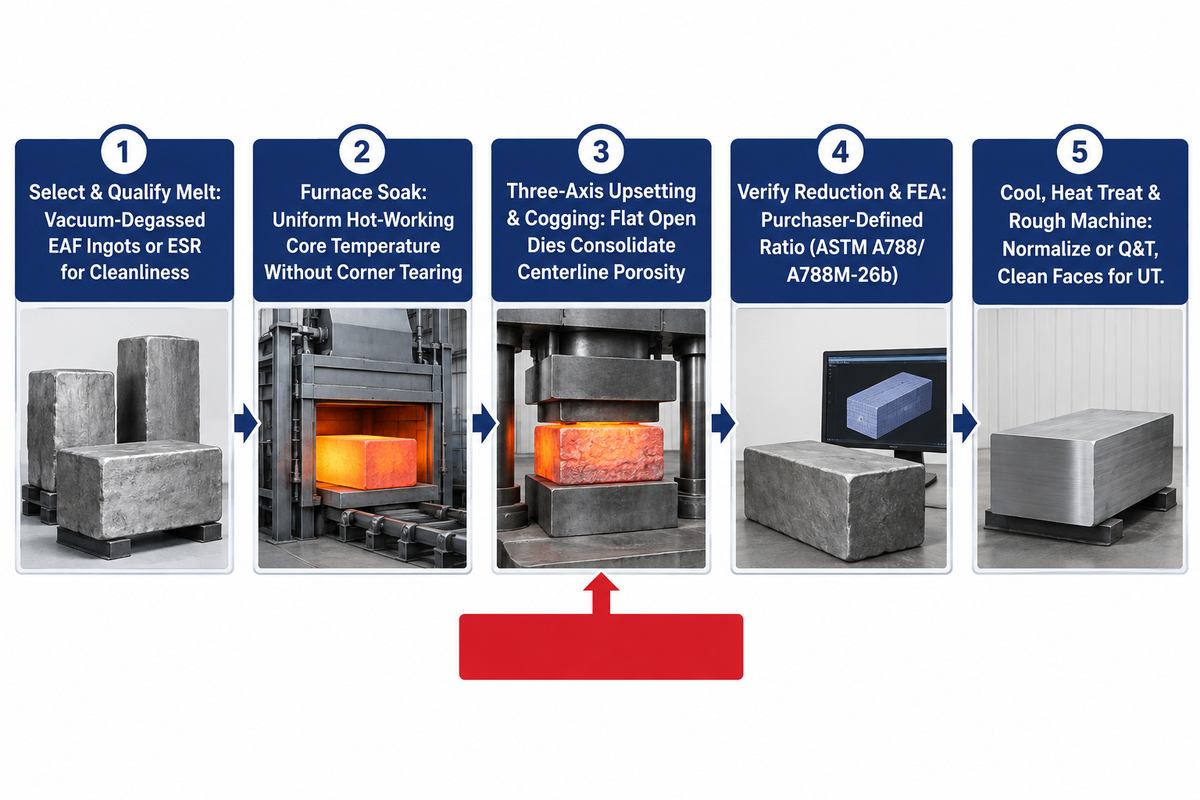
The open-die forging process compresses a heated steel ingot between flat dies along multiple axes to close internal shrinkage voids and refine the grain structure. Indicate the target forging reduction ratio on the purchase order. General umbrella standards such as ASTM A788/A788M-26b and ASTM A668/A668M-23 Clause 1.5 make supplementary requirements optional unless invoked by the buyer.
Think of kneading heavy clay in one direction versus folding and pressing it from top, side, and end. Single-axis drawing stretches inclusions along one plane and weakens transverse ductility. Multidirectional upsetting and triaxial cogging work the core in three directions so mechanical properties stay balanced when CNC shops drill cross-bores. Auditing industrial forging factory process controls confirms whether a forge’s press force and furnaces can penetrate your block’s centerline.
- Select and qualify the melt: Vacuum-degassed electric arc furnace (EAF) ingots serve most carbon and alloy steel forged blocks, while electroslag remelting (ESR) cleans inclusions for extreme cyclic pressure or polishable die cavities.
- Soak to hot-working temperature: Controlled furnace heating brings the ingot core to uniform hot-working temperature so press blows reach the centerline without tearing block corners.
- Upset and compress along three axes: Flat open dies compress the ingot axially (upsetting) and draw it back into a rectangle (cogging) to consolidate centerline porosity and refine grain flow across the solid block.
- Reduction and simulation targets: Shops follow purchaser-defined reduction targets and finite-element forging simulation to predict core plastic strain and reduce oversize allowances.
- Cool, heat treat, and rough machine: Controlled post-forge cooling precedes normalizing or quenching and tempering, followed by rough machining so inspection surfaces are clean for ultrasonic examination.
What Are the Three Main Types of Forging Used for Industrial Steel?
The three main processes of industrial steel forging are open-die forging, closed-die (impression-die) forging, and rolled-ring forging. Open-die forging forms solid rectangular blocks, flats, and heavy shafts between flat dies with zero dedicated die-sinking charge. Closed-die forging shapes repeatable high-volume forged parts inside machined die cavities, while ring rolling expands pierced rings into one-piece annular flanges and bearing races.
Most engineers compare cylindrical and rectangular geometries on drawings and pair the same block specs with the forged shafts engineering guide knowing both shapes run on the same hydraulic presses. Unlike extrusion dies that extrude fixed cross sections, open-die forging produces custom one-off dimensions without tooling delays.
Forged Blocks vs. Castings, Rolled Plate, and Billet Stock
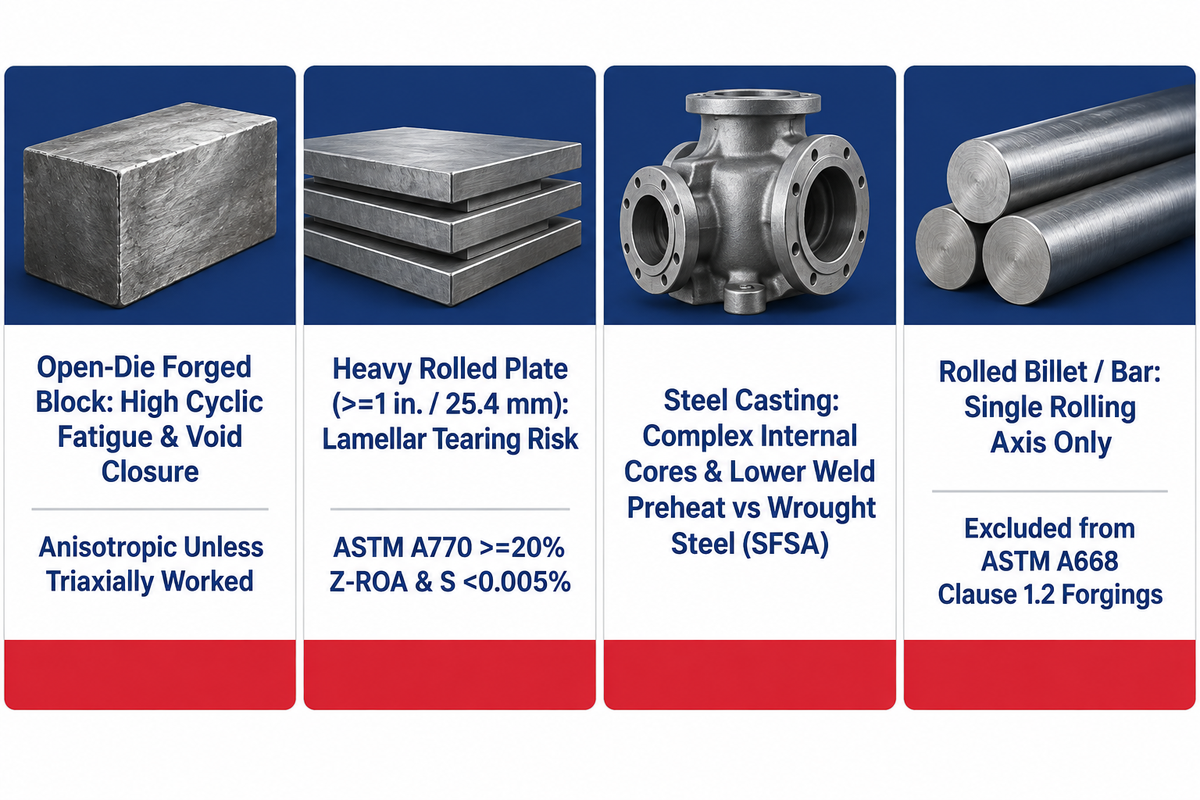
Forged blocks have increased cyclic fatigue resistance and internal void closure over the castings, but they aren’t superior in all directions. A Steel Founders’ Society of America (SFSA) evaluation describes wrought and forged steels as anisotropic, with lower ductility and impact resistance in transverse and axial directions than in the longitudinal direction.
In ASME B16.34 Table 2-1.1 Material Group 1.1, carbon steel forgings (ASTM A105 and A350) have the same pressure-temperature ratings as ASTM A216 carbon steel castings. Buyers still often ask why a shop can’t cut a manifold from cheaper heavy rolled steel plate.
The boundary is through-thickness (Z-direction) weld restraint on plates 1 inch (25.4 mm) and thicker. As Penn State Architectural Engineering failure records document, restrained plates tear parallel to the surface within roughly 5 mm of the weld face. ASTM A770 specifies the through-thickness tension test for plate.
Penn State’s failure guidance pairs at least 20% Z-direction reduction of area with sulfur below 0.005% to curb lamellar tearing, or engineers step up to a forged block.
4-Route Forged-vs-Plate-vs-Cast Trade-Off Selector
Use this matrix to compare starting stock with through-thickness stress, cyclic pressure, internal cavity requirements, and tooling volume prior to issuing an RFQ.
| Stock Route | Metallurgical Soundness & Grain | Through-Thickness (Z-Axis) Integrity | Geometry & Tooling Fit | Limitations / Not Suitable For |
|---|---|---|---|---|
| Open-Die Forged Block | Closes ingot voids; refined grain structure; requires triaxial forging to limit anisotropy | High when upset and cogged across three axes | Solid rectangles and squares; zero hard-die tooling cost | Not suitable for hollow cast-in coolant jackets, thin walls, or intricate shapes without heavy CNC metal removal |
| Cast Steel Block / Housing | More uniform multi-axis properties on average; surface or shrinkage porosity may require weld repair | Lower weld cold-cracking risk at a given preheat than wrought steel | High geometry freedom via patterns and sand cores; pattern amortizes over repeat runs | Not suitable for extreme cyclic pressure (10,000+ psi frac fluid ends) or zero-porosity high-pressure cross-bores |
| Heavy Rolled Steel Plate | Strong in rolling direction; flattened sulfide inclusions along mid-plane | Lamellar tearing risk (~5 mm from weld face) on >=25.4 mm restrained welds; test via ASTM A770 | Fastest and lowest cost for flat 2D profiles and standard stock thicknesses | Not suitable for heavy through-thickness cyclic loads, high-pressure cross-drilled blocks, or sections above plate mill limits |
| Rolled Billet / Bar Stock | Unidirectional rolled grain; outside ASTM A668 forging scope | Moderate in small sections; drops in large cross sections | Immediate warehouse stock for small prototypes and compact manifolds | Not suitable where PO mandates ASTM A668 forged compliance, heavy cross sections, or multidirectional grain flow |
“However, tensile strength, elongation and impact properties decrease in the transverse and axial directions. Thus, wrought steel and forgings in particular, are anisotropic (exhibiting different values of a property in different directions)… At a given preheat temperature, welds on steel castings tend to be less susceptible to under-bead cracking than welds on steel forgings.”
That weldability result surprises engineers who expect forgings to win every comparison. In University of Tennessee tests cited by SFSA across 8630 steel and four manganese-silicon grades, cast steel required lower preheat temperatures than wrought steel to avoid underbead cold cracking. Elongated inclusions in wrought steel initiate cracks more easily than round inclusions in castings. SFSA also notes a U.S. tank ice cleat redesigned from a forging into a steel casting that cut lead time by 70%, illustrating how casting can beat forging on intricate geometries. Engineers comparing these options on active drawings can use our forging route selector worksheet.
What Is Stronger Between Cast and Forged Steel Blocks?
Forged steel blocks deliver greater strength in notched impact, cyclic fatigue, and high-pressure durability because hot mechanical compression closes solidification shrinkage voids. Static tensile strength and yield strength can sit close together at identical alloy chemistry and heat treatment. Casting uniformity still varies with section thickness, solidification structure, and soundness, whereas blocks and forged parts vary by forging direction unless triaxially worked.
Selecting Carbon, Alloy, Stainless, and Tool Steel Grades for Forged Blocks
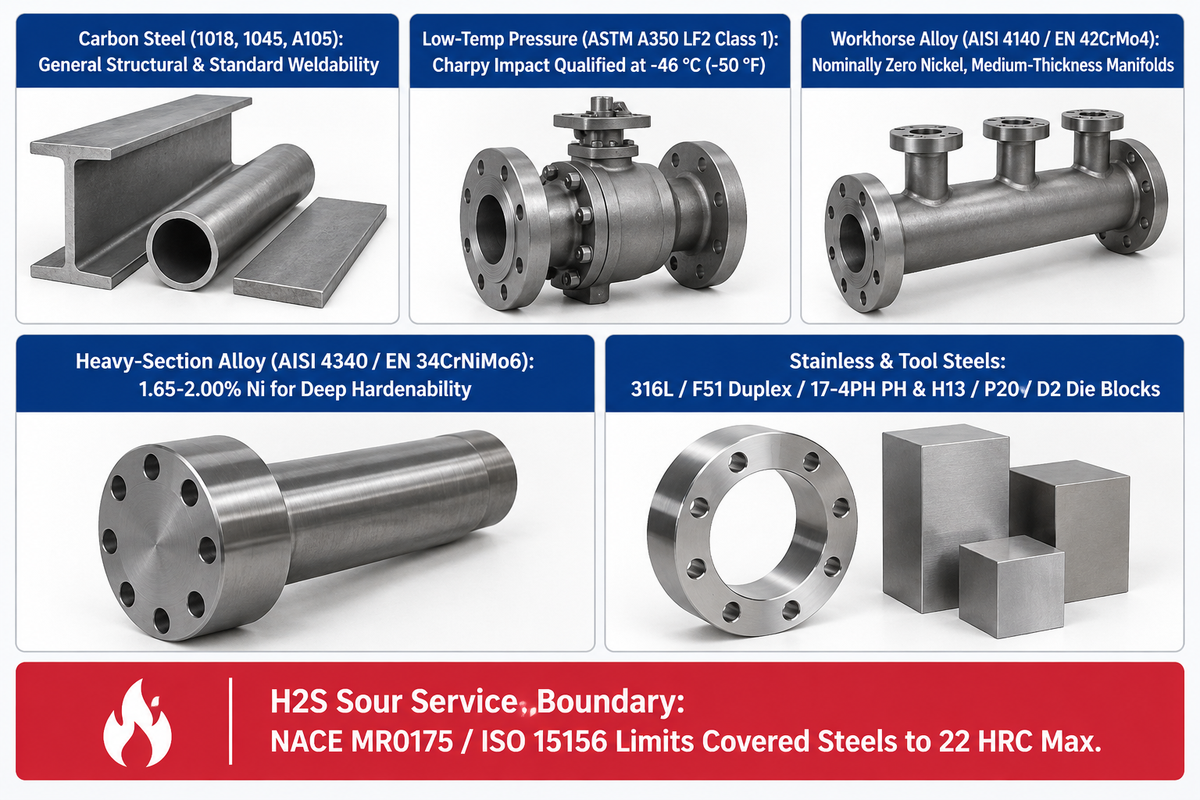
Grade selection for forged steel blocks balances section-thickness hardenability, corrosion resistance, thermal-fatigue demands, and service-specific code qualifications. For low-temperature carbon steel pressure parts requiring Charpy impact qualification at -46 °C (-50 °F), engineers select ASTM A350 LF2 Class 1 over ASTM A105. Minimum design metal temperature still needs verification against the governing code.
In H2S sour service, NACE MR0175 / ISO 15156 sets hardness limits by alloy family and heat-treatment state, including 22 HRC max for covered carbon and low-alloy categories.
Nickel content drives the biggest mechanical gap between workhorse alloy blocks in demanding industrial applications. Metallurgical practitioners on Eng-Tips note that AISI 4140 contains nominally zero nickel, whereas AISI 4340 carries 1.65 to 2.00% nickel. That nickel addition improves deep-section hardenability and fracture toughness in thick forged blocks and allows gentler oil quenching with lower distortion, while plain 4140 offers lower alloy cost and easier machinability on medium-thickness manifolds.
| Grade / Equivalent | Family | Governing Spec | Primary Service Niche | Key Engineering Boundary |
|---|---|---|---|---|
| AISI 1018 / 1020 | Low-Carbon | ASTM A668 (class per required properties) | Welded structural bases, low-pressure manifolds | High weldability; limited through-hardening |
| AISI 1045 / C45 | Medium-Carbon | ASTM A668 (class per required properties) | General machinery bolsters, press pads, fixtures | Shallow through-hardening in thick sections; needs weld preheat |
| ASTM A105 | Carbon Pressure | ASTM A105 / A105M | Ambient and elevated-temperature valve blocks, flanges | No -46 °C Charpy qualification; verify sour-service hardness cap per spec |
| ASTM A350 LF2 Cl. 1 | Low-Temp Carbon | ASTM A350 / A350M | Subzero wellhead manifolds, cold-climate valve bodies | Charpy impact qualified at -46 °C (-50 °F); verify sour-service limits |
| AISI 4130 / 25CrMo4 | Cr-Mo Alloy | ASTM A668 / oilfield pressure specs | Oilfield wellhead blocks, blowout preventer bodies | Better weldability than 4140; enforce alloy-specific sour-service HRC limit |
| AISI 4140 / 42CrMo4 | Cr-Mo Alloy | ASTM A668 (class per required properties) | High-pressure hydraulic manifolds, heavy gears, die holders | Nominal 0% Ni; verify core hardness on thick blocks; control weld preheat |
| AISI 4340 / 34CrNiMo6 | Ni-Cr-Mo Alloy | ASTM A668 / aerospace & oilfield specs | Thick frac fluid end blocks (>=10,000 psi), heavy tooling | 1.65–2.00% Ni boosts deep-section hardenability and toughness; higher alloy cost |
| F22 (2.25Cr-1Mo) | Elevated-Temp Alloy | ASTM A182 (<=4,540 kg) or covered A336 scope | Refinery hydrocracker valves, high-temperature steam manifolds | Creep resistance at elevated temperature; requires controlled PWHT |
| 316L / F316L & F51 Duplex | Stainless & Duplex | ASTM A182 (<=4,540 kg) or covered A965 scope | Subsea manifolds, chemical valves, seawater stainless steel blocks | Austenitic UT follows ASTM A745-24; F51 adds chloride pitting resistance |
| H13 / P20 / D2 | Tool & Die Steel | Tool steel buyer specification | H13 hot-work forging dies, P20 plastic mold bases, D2 cold-work dies | High thermal-fatigue and wear resistance; ESR often ordered for mirror polish |
Cross-referencing regional standards helps prevent unnecessary mill delays during international sourcing. Buyers routinely compare AISI 4140 with EN 42CrMo4 and AISI 4340 with EN 34CrNiMo6, provided the order states exact chemical ranges, impact test temperatures, and core hardness targets rather than treating two standards as identical.
What Metals Can Be Forged Into Heavy Industrial Blocks?
Ductile ferrous and non-ferrous engineering metals forge cleanly into solid industrial blocks. Ferrous industrial metal families include carbon steels (1018, 1045, A105), alloy steels (4130, 4140, 4340, F22), austenitic stainless steels (304, 316L), duplex stainless steels (F51), martensitic precipitation-hardening stainless steels (17-4PH), and tool steels (H13, P20, D2). Non-ferrous forged blocks include aluminum (6061-T6, 7075), titanium (Ti-6Al-4V), and nickel superalloys (Inconel 625, 718), whereas brittle gray cast irons fracture under hot forging dies.
Industrial Applications: Hydraulic Manifolds, Valve Bodies, and Forged Die Blocks
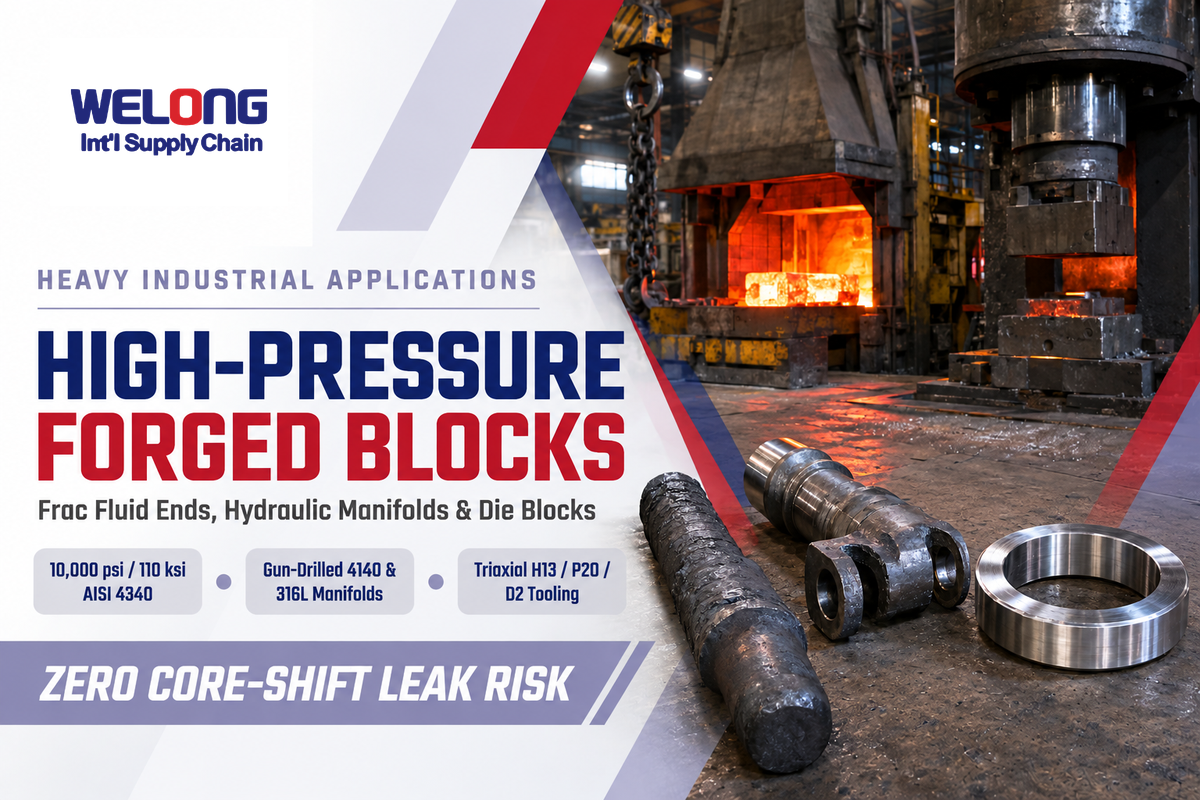
Heavy industries list solid forged blocks in process specifications where internal fluid passages, tie-rod tension and cyclic shock may reveal casting porosity or rolled-plate laminations. Across oil and gas, hydraulic fluid power, tooling, aerospace, and power generation, the dominant failure mode dictates both melt cleanliness and heat-treatment state.
- Oilfield Wellhead, BOP, and Frac Fluid-End Blocks: High-pressure hydraulic stimulation and well-control systems expose intersecting cross-bores to extreme cyclic pressure. USPTO Patent US9791082B2 describes multiplex plunger pumps with 2,000+ HP power ends running at 10,000 psi and up to 100 bbl/min, using single-piece forged AISI 4340 modules heat treated to at least 110 ksi yield strength. Upstream assemblies pair these blocks with wellhead and well control pressure-retaining equipment and high-pressure choke and kill manifold blocks.
- High-Pressure Hydraulic Manifold Blocks: Mobile cranes, steel-mill presses, and subsea actuators gun-drill dense networks of cartridge-valve bores inside solid 4140, 1045, or 316L steel blocks. A subsurface micro-void between closely spaced pressure galleries can open an internal bypass leak after expensive five-axis CNC finish machining.
- Forged die and mold blocks: Hot-work H13 forging dies, P20 plastic mold bases and D2 cold-stamping tool blocks are consolidated by triaxial forging with evenly dispersed carbides. That structure helps deep machined cavities resist thermal checking and take a clean polish.
- Power Generation, Aerospace, and Heavy Machinery: Steam turbine casing blocks, aerospace structural test fixtures, and heavy-duty mining bearing housings depend on custom forged blocks for predictable fatigue resistance and dimensional stability.
Deep-drilling a manifold block cut from un-degassed stock risks exposing centerline inclusions only during final hydrostatic testing, scrapping both raw steel and dozens of CNC machining hours.
ASTM A668, ASTM A182, and ASTM A388 Ultrasonic Testing Specifications
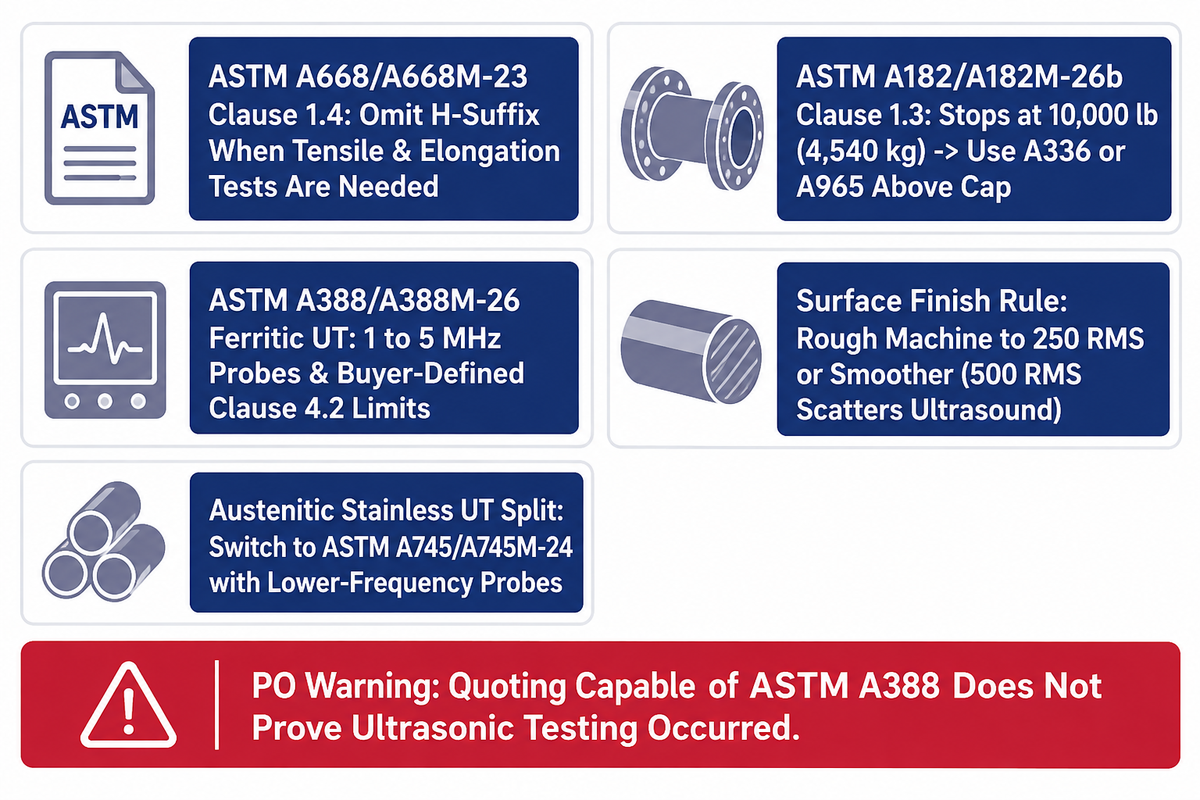
Completing the purchase order with “ASTM A668 plus UT per ASTM A388” creates three primary omissions. Neither ASTM A668/A668M-23 nor ASTM A182/A182M-26b sets default ultrasonic rejection limits or forging reduction ratios. While ASTM A182 stops at 10,000 lb (4,540 kg), New Equipment Digest (April 2025) notes that quoting “capable of ASTM A388” doesn’t document that ultrasonic testing actually occurred.
Surface preparation affects whether pulse-echo waves penetrate heavy blocks cleanly. A contributed forging industry article in New Equipment Digest notes that scaly as-forged faces and 500 RMS surfaces scatter ultrasound heavily. Their ASTM A388 procedure requires rough machining to 250 RMS or smoother before testing. For heavy ferritic forgings, Sonatest’s ASTM A388 guide highlights Section 6.1’s 1 to 5 MHz probe capability and SNT-TC-1A qualification. For coarse-grained austenitic stainless steel blocks such as F316L, purchase orders switch to dedicated austenitic practice ASTM A745/A745M-24 with lower-frequency probes.
Two scope clauses also catch buyers off guard. First, ASTM A182/A182M-26b Clause 1.3 caps covered pressure piping forgings at 10,000 lb (4,540 kg). Larger forgings move to ASTM A336/A336M (ferritic) or ASTM A965/A965M (austenitic) within those standards’ scopes. Second, ASTM A668/A668M-23 Clause 1.4 allows an H-suffix option for forgings supplied after hardness testing only. Buyers who need tensile strength, yield, and elongation data must omit the H suffix and specify those tests. See our industrial forgings defects and inspection guide for defect taxonomy details.
ASTM A668-to-A388 PO Clause Callout Table
Copy these active ASTM, API, and EN 10204 clause controls onto your purchase order so weight caps, surface preparation, and rejection limits stay unambiguous.
| Standard & Edition | Scope & Weight Boundary | Common PO Loophole | Exact Clause Action to Write on PO |
|---|---|---|---|
| ASTM A668/A668M-23 (Base) | 6 carbon classes (A–F), 7 alloy classes (G, H, J–N); excludes rolled bars (Cl. 1.2) | Assuming optional UT or reduction ratio is included automatically | Name exact class for target properties and invoke supplementary requirements per Cl. 1.5 |
| ASTM A668/A668M-23 Cl. 1.4 | Certification and marking with H suffix | Ordering an H-suffix class and receiving hardness-only certification without tensile data | Omit H suffix and specify tensile, yield, and elongation tests on the order |
| ASTM A788/A788M-26b | Umbrella general requirements for steel forgings | Assuming a forging reduction ratio is auto-enforced | State explicit minimum reduction ratio and forging direction directly on PO line item |
| ASTM A182/A182M-26b | Covered pressure piping alloy & stainless forgings up to 10,000 lb (4,540 kg) per Cl. 1.3 | Citing A182 on heavy 10 to 50 ton manifold or vessel blocks | Use A182 only at or below 4,540 kg; specify SI “M” designation if metric units govern (Cl. 1.6) |
| ASTM A336 / ASTM A965 | Referenced by A182 Cl. 1.3 for larger ferritic (A336) and austenitic (A965) forgings within their scopes | Leaving overweight pressure blocks under an out-of-scope A182 header | Verify material, product form, and pressure scope, then cite A336/A336M or A965/A965M when applicable |
| ASTM A388/A388M-26 | Pulse-echo UT practice for heavy ferritic steel forgings (1–5 MHz per Sec. 6.1) | Writing “UT per A388” without naming a rejectable flaw size (Cl. 4.2) | State ultrasonic acceptance limits directly on the PO or reference an applicable pressure code |
| ASTM A388 Surface Prep | Prepared acoustic coupling surfaces per UT procedure | Accepting “capable of A388” quotes without documented scanning or surface prep | Specify required inspection surface finish (e.g., 250 RMS max per NDT procedure) and signed SNT-TC-1A report |
| ASTM A745/A745M-24 | Dedicated pulse-echo UT practice for austenitic stainless steel forgings | Applying standard ferritic A388 settings to coarse-grained 304/316L blocks | Invoke ASTM A745/A745M-24 with agreed acceptance level and post-heat-treat machined surface |
| API Spec 20B (R2025) & EN 10204 | Oilfield open-die forging qualification and Type 3.1/3.2 MTCs | Accepting generic compliance letters with no heat-number traceability | Require EN 10204 Type 3.1 (or 3.2 witness) plus stamped heat/serial numbers and retained test coupons |
Heat Treatment, Heavy-Section Defects, Welding, and Machining Allowances
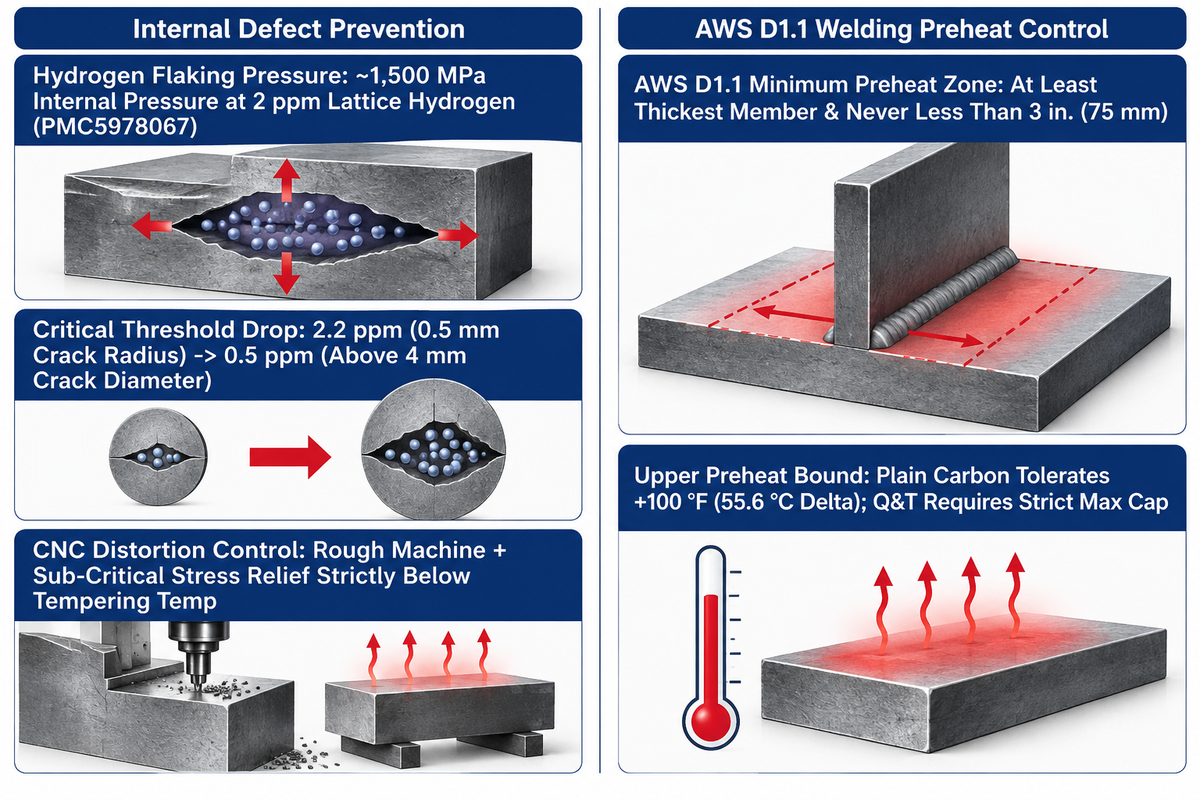
Heat treatment and controlled post-forge cooling prevent delayed internal cracking and CNC distortion in thick forged blocks. In heavy Cr5VMo forged steel studied by Fan et al. in Materials (2018, PMC5978067), trapped atomic hydrogen reached roughly 1,500 MPa internal pressure at 2 ppm lattice hydrogen. That study reported critical hydrogen thresholds dropping from 2.2 ppm at a 0.5 mm crack radius to 0.5 ppm above 4 mm crack diameter.
Vacuum degassing and slow dehydrogenation cooling are common industrial controls to keep hydrogen low in thick alloy blocks.
The second shop-floor hazard is machining distortion on quenched-and-tempered blocks. Rapid quenching locks residual stresses inside thick cross sections, so hogging deep cavities out of one face often twists bore alignments. Hogging deep cavities from one face can distort bore alignment; separating rough machining from a sub-critical stress-relief cycle held strictly below the original tempering temperature stabilizes dimensional flatness when the cycle is compatible with the block’s existing temper and specified hardness, and post-cycle testing verifies core hardness.
Open-die machining stock allowances depend on multiple factors, not a single general thickness chart. Per-face allowance varies in accordance with open-die flatness tolerance, furnace scale and decarburization penetration, risk of quench distortion and finish needed for ultrasonic inspection. The precise per-face roughing stock on the forge drawing ensures you don’t overpay for chips or run out of clean-up in your finish machined CNC passes.
Can You Weld Forged Steel Blocks Without Cracking?
Low-carbon forged blocks such as AISI 1018 and ASTM A105 weld readily with standard procedures. Medium carbon and alloy grades 1045, 4130, 4140, and 4340 possess greater hardenability. Welding procedures must match alloy chemistry, thickness, and heat-treatment state with low-hydrogen consumables, controlled preheat, and PWHT where required.
Under AWS D1.1, minimum preheat must extend at least the thickness of the thickest member and never less than 3 inches (75 mm) in all directions from the weld.
Quenched-and-tempered steel blocks also impose a strict upper preheat boundary. According to Lincoln Electric’s AWS D1.1 preheat guide, plain carbon steel tolerates overshooting minimum preheat by roughly 100 °F (a 55.6 °C temperature delta). By contrast, Q&T steels require both minimum and maximum preheat controls to protect heat-affected-zone toughness. Because welding-arc hydrogen diffusion can’t be eliminated completely, dry low-hydrogen electrodes and controlled cooling keep cold-cracking risk under control.
Custom Forged Block Cost Drivers, Gross-to-Net Weight Math, and Lead Times
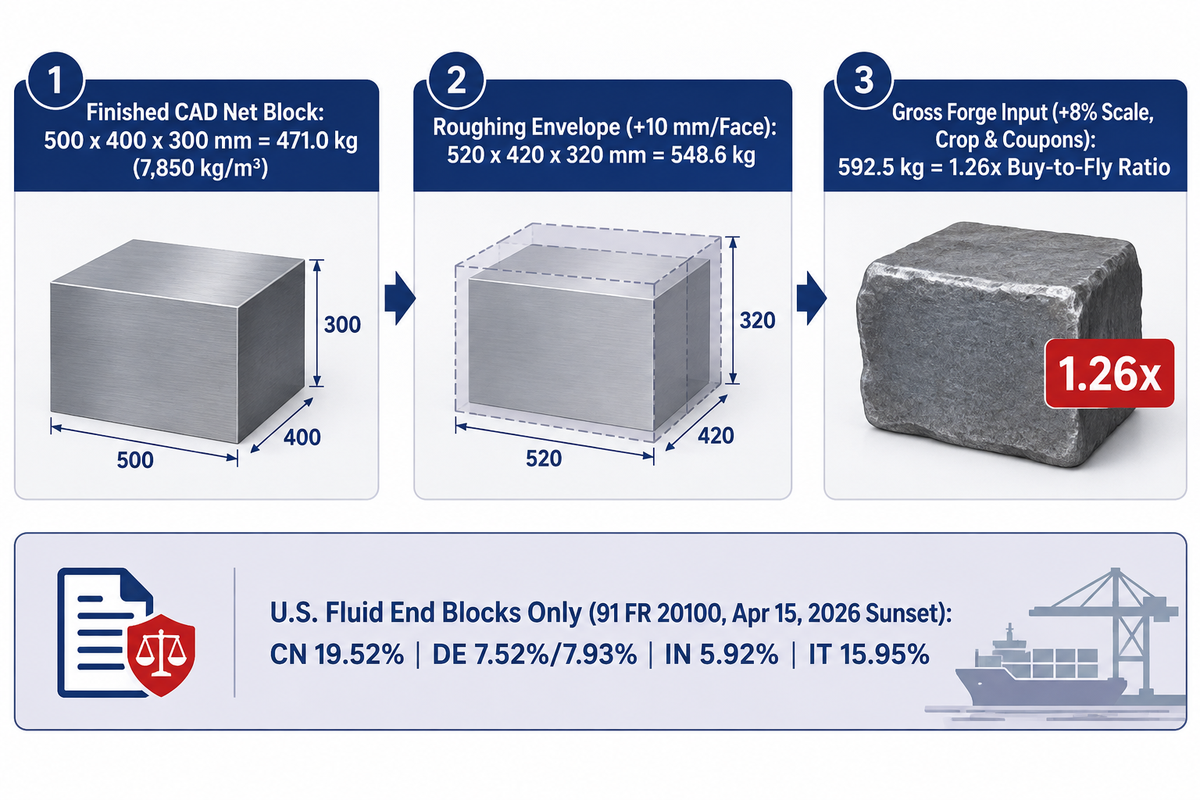
Custom open-die forged steel blocks don’t carry fixed catalog list prices or universal delivery dates. Mills quote per drawing from alloy melt surcharge, gross forged input mass, heat-treatment cycle, and ultrasonic acceptance scope; China Welong returns drawing-based quotes within 1 to 3 working days. Quotes can’t be compared on a raw dollars-per-kilogram rate when one vendor charges on finished net weight while another charges on gross forge weight.
To convert quotes apples-to-apples, use your finished CAD dimensions to determine the buy-to-fly multiplier. Assume a finished rectangular AISI 4140 steel block measuring 500 x 400 x 300 mm at standard steel density of 7,850 kg/m³. To rough out, add 10 mm per face to create a roughing stock blank, which makes the pre-roughing forged envelope 520 x 420 x 320 mm, and then add 8% for furnace scale, ingot crop, and test coupons to get total gross forge input mass.
All dollar figures below illustrate weight-normalization arithmetic rather than a binding quote.
| Production Stage | Envelope & Formula (7,850 kg/m³) | Calculated Mass | Weight Multiplier | Illustrative Normalization (at $3.50/kg Gross Input) |
|---|---|---|---|---|
| Net Finished Block | 0.50 x 0.40 x 0.30 m = 0.0600 m³ | 471.0 kg (1,038 lb) | 1.00x (baseline) | $4.40/kg effective net mass ($2,073.75 ÷ 471.0 kg) |
| Pre-Roughing Forged Envelope | 0.52 x 0.42 x 0.32 m (+10 mm/face) = 0.069888 m³ | 548.6 kg (1,209 lb) | 1.16x net | $3.78/kg on pre-roughing blank mass ($2,073.75 ÷ 548.6 kg) |
| Gross Forge Input | 548.6 kg x 1.08 (+8% scale, crop, coupon loss) | 592.5 kg (1,306 lb) | 1.26x buy-to-fly | $3.50/kg illustrative gross input ($2,073.75 total) |
Importers bringing oilfield pump blocks into the United States also need to factor trade-remedy exposure into landed budgets. U.S. Department of Commerce issued Federal Register notice 91 FR 20100 (April 15, 2026) finalizing expedited sunset reviews of countervailing duty orders (CVDs) on in-scope forged steel fluid end blocks.
The notice reports its likely-to-prevail net subsidy rates of 19.52% (China all-others), 7.52% (Germany, 7.93% for Schmiedewerke Groeditz), 5.92% (India), and 15.95% (Italy). These rates apply to in-scope fluid end blocks rather than general industrial block types, and importers verify company-specific CBP entry cash deposit rates at the time of import.
Lead times are a stark division between stocked blooms and custom melts, and neither ASTM nor open-die mills maintain a single constant ship window. Carbon and 4140 blocks forged from stocked blooms ship fastest once press time is booked, whereas custom vacuum-degassed heats, thick-section Q&T cycles, third-party witness tests, and five-axis finish machining extend schedules substantially. Require each vendor to provide a detailed milestone schedule covering melt, forge, heat treatment, UT, and CNC machining prior to PO.
Evaluating Forged Block Suppliers and Writing an Airtight RFQ
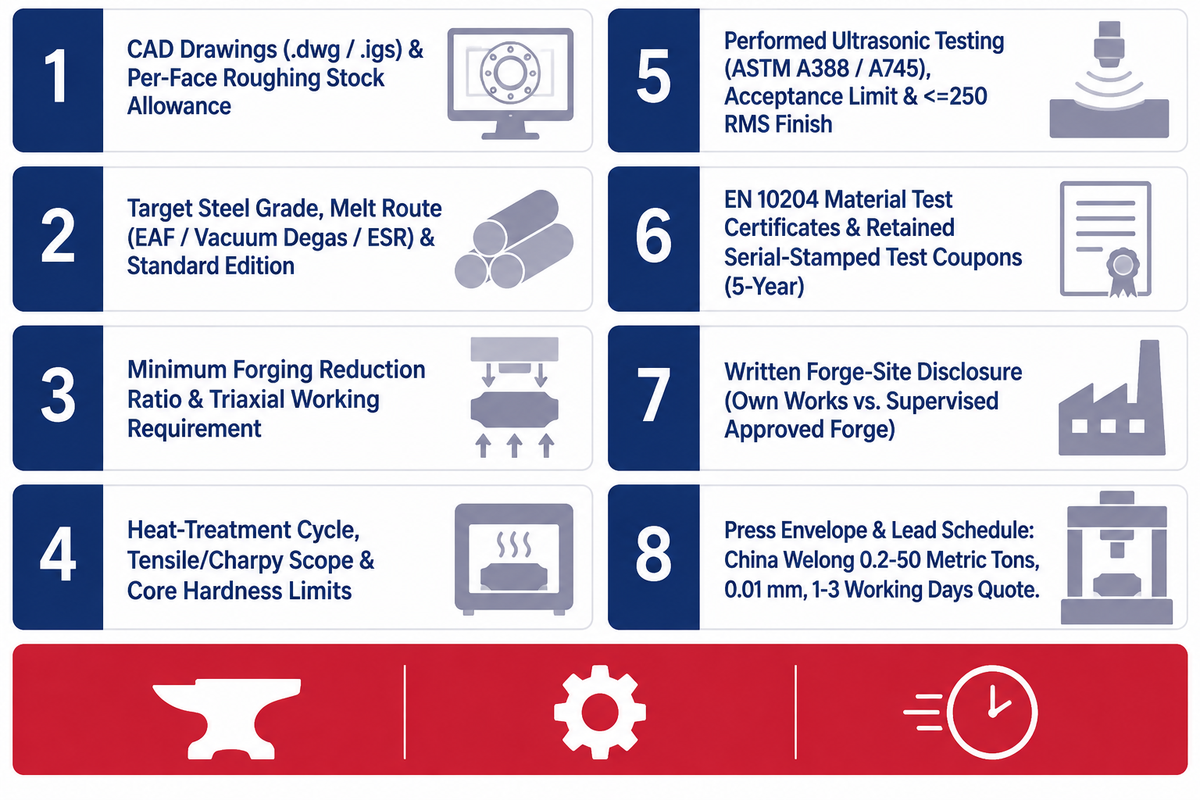
Evaluating forged block suppliers means matching usable hydraulic press envelope, melt traceability, and finish machining capability to your project requirements. Commercial open-die producers differ sharply in weight range. R&M Forge & Fittings lists forged blocks up to 350 inches long and 60,000 lb, while Great Lakes Forge lists custom blocks from 1.5 inches thick up to 4,000 lb.
Well-Forge supplies custom AISI 4140 open-die blocks, and China Welong coordinates 0.2 to 50 metric ton industrial forgings finished to 0.01 mm precision.
| Evaluation Factor | Domestic Direct Forge Master | Supervised Supply-Chain Partner (e.g., China Welong) |
|---|---|---|
| Best Fit | Domestic-melt mandates, ITAR/defense specs, rapid domestic freight | Custom forged steel blocks (0.2 to 50 metric tons) needing forging, heat treat, and finish CNC |
| Machining & Finish Scope | Often ships rough-machined; buyer hires separate finish machine shop | Single-contract delivery from open-die forging through 0.01 mm finish machined parts |
| Audit & Disclosure Control | Single-facility audit on press and furnace lines | Written disclosure of own works vs. supervised approved forge; 2-year mill re-audits |
| Traceability Package | Mill heat report, UT chart, mechanical test cert | EN 10204-3.1B cert, dimensional, UT, and MT reports + 5-year serial traceability & retained coupons |
Written production-site disclosure defends you against undocumented bar substitution. Established in 2001 with sites in Xi’an & Jiyuan and 30+ engineers, Shaanxi Welong International Supply Chain Management Co., Ltd. (China Welong) coordinates custom industrial forgings from 2D and 3D CAD drawings (.dwg and .igs). China Welong replies within 24 hours, states on every quote whether production runs in its own works or a supervised approved forge, re-audits steel mills every 2 years, and retains test coupons under 5-year stamped serial traceability. Parts are built to customer drawings and ASTM or API specifications and verified by inspection documentation rather than claiming an API Monogram license.
Copy the checklist below into your next quote package so every forge supplies comparable pricing with zero missing test clauses, or review our forging RFQ readiness guide before sending drawings.
RFQ checklist: copy these into your quote request:
| Parameter | Recommended range | Why it matters | How to verify |
|---|---|---|---|
| Finished & Rough Envelope | 2D/3D CAD (.dwg/.igs) + agreed per-face roughing stock | Prevents hidden buy-to-fly gross weight inflation across quotes | Require gross forge weight and rough-machined weight on quote sheet |
| Material Standard & Weight Cap | ASTM A668-23 (omit H suffix for tensile data) or covered A182-26b (<=4,540 kg) / A336-A965 within scope | Keeps the order inside standard scope and secures mechanical test results | Check ASTM edition, class, and tensile data on EN 10204 3.1 MTC |
| Forging Route & Reduction | Triaxial open-die with PO-defined minimum reduction ratio | Supports core consolidation and transverse ductility alongside UT verification | Require ingot size, finished size, and reduction calculation on MTC |
| Melt Cleanliness & Cooling | Vacuum-degassed EAF (or ESR for high-cyclic/mold steel) + controlled cooling | Controls internal inclusion cleanliness and hydrogen flaking risk in thick alloy blocks | Audit ladle chemistry, gas content log, and furnace cooling chart |
| Heat Treatment & Hardness Cap | Q&T with post-rough stress relief; set alloy-specific HRC limit for H2S service | Controls machining distortion and sulfide stress cracking risk | Review furnace time-temperature chart and multipoint Brinell/HRC map |
| Ultrasonic Testing & Surface | ASTM A388-26 (ferritic) or A745-24 (austenitic) + PO acceptance limits & finish | Replaces untested “capable of A388” wording with documented scan coverage | Require signed SNT-TC-1A UT report stating probe MHz, surface finish, and calibration |
| Responsible-Source Disclosure | Named forge location + 2-year mill re-audit + 5-year coupon retention | Stops unauthorized subcontracting or bar-stock substitution | Require written forge identity on quote and stamped serial numbers on block |
| Packing & Trade Classification | VCI wrap, rust-preventive oil, fumigated crate, HS/CN code check | Protects machined bores in sea transit and confirms tariff/CBAM scope | Approve packing photos and commercial invoice HS/CN code prior to dispatch |
Industry Outlook: EAF Decarbonization, HPHT Oilfield Demand, and Digital Traceability
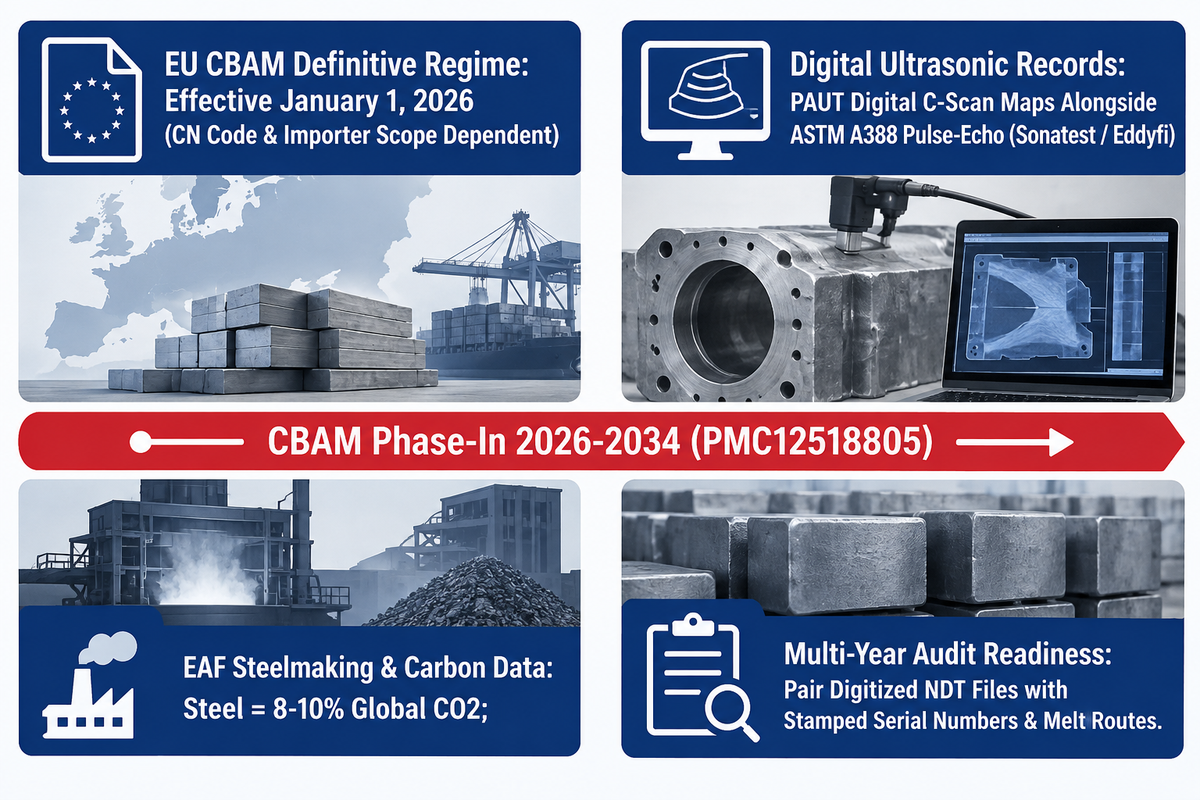
How do 2026 carbon-border rules and digital inspection files impact multi-year forged block RFQs?
Buyers shipping machined steel blocks into Europe confirm customs tariff codes and steelmaking melt routes before the order. Multi-year oilfield contracts can also evaluate digital ultrasonic record formats alongside physical test coupons.
- EU CBAM Definitive Regime and EAF Steelmaking: According to the European Commission Taxation and Customs Union, the EU Carbon Border Adjustment Mechanism (CBAM) entered its definitive regime on January 1, 2026 after its 2023 to 2025 transitional phase. Applicability depends on whether a block’s CN customs code and EU importer fall inside CBAM iron-and-steel scope rather than charging an automatic flat fee on every shipment. Peer-reviewed modeling in Nature Communications (October 2025, PMC12518805) notes that steel accounts for 8 to 10% of global CO2 emissions. That study tracks the 2026 to 2034 phase-in of CBAM certificates alongside EU ETS pricing, pushing European-bound buyers toward scrap-EAF melt documentation.
- Digital Ultrasonic Records and Traceability: NDT equipment guides from Sonatest and Eddyfi document phased-array ultrasonic testing (PAUT) as an option alongside conventional ASTM A388 pulse-echo scanning for recording digital C-scan maps. Pairing digitized NDT files with stamped serial numbers simplifies quality audits for multi-year oilfield and power-generation supply agreements.
Frequently Asked Questions About Forged Blocks
Can forged steel blocks rust, and how are they protected during shipping?
Yes. Carbon and low-alloy forged steel blocks such as AISI 1045, 4140, and 4340 oxidize rapidly in humid sea air once rough-machined surfaces expose bare metal. Suppliers apply rust-preventive oil or wax coatings, seal blocks inside VCI anti-corrosion film with desiccant packs, and crate heavy loads in fumigated export timber.
What is the difference between an as-forged (“black”) block and a rough-machined forged block?
An as-forged black block ships off the press with dark mill scale, decarburized skin, and rough surface texture that can impede ultrasonic coupling. A rough-machined forged block has its designated inspection surfaces milled or turned to the specified ultrasonic procedure finish, such as 250 RMS maximum when ordered, before shipment.
Is rolled billet stock the same as an open-die forged steel block?
No. Rolled billet and hot-rolled bar stock are deformed primarily along a single rolling axis and don’t qualify as open-die forgings under general industrial steel forging standards. An open-die forged steel block undergoes multidirectional upsetting and cogging under flat dies to consolidate centerline soundness and balance transverse mechanical properties across heavy machined sections.
What industrial products are most often machined from forged steel blocks?
Machine shops convert solid forged steel blocks into high-pressure hydraulic manifolds, wellhead valve bodies, choke and kill housings, frac pump fluid ends, injection mold bases, forging dies, turbine casings, and heavy press bearing blocks.
Why is “100% ultrasonic testing per ASTM A388” not enough on a forged block purchase order?
ASTM A388/A388M-26 defines the pulse-echo scanning method, transducer frequency range (1 to 5 MHz), and calibration rules, yet it sets no universal pass-or-fail defect rejection size. Clause 4.2 leaves acceptance criteria strictly to the buyer. For ferritic blocks examined under ASTM A388, your purchase order can state ultrasonic acceptance limits directly and name the required inspection surface finish. Austenitic stainless steel blocks instead follow ASTM A745/A745M-24 with lower-frequency probes.
What is the typical minimum order quantity for custom open-die forged blocks?
Open-die forging requires zero closed-die tooling, so most forge shops accept a minimum order quantity of one piece from stocked forging blooms. Custom alloy melts only require full-heat minimums for non-standard chemistries.
When should an engineer specify ESR-remelted steel instead of conventional vacuum-degassed steel for a forged block?
Specify electroslag remelting (ESR) whenever extreme inclusion cleanliness drives service life. Common examples include hot-work H13 die blocks needing thermal-fatigue resistance, optical-grade P20 mold cavities requiring mirror polish without micro-pitting, and ultra-high-pressure oilfield fluid end blocks cycling above 10,000 psi. Conventional vacuum-degassed EAF steel handles general industrial blocks, standard hydraulic manifolds, and moderate-stress valve bodies at lower cost when controlled cooling and verified ultrasonic acceptance criteria are enforced.
Need a Drawing-Based Quote on Custom Forged Blocks?
Send your 2D or 3D CAD drawings (.dwg or .igs), target steel grade, and ultrasonic acceptance criteria to our engineering team. China Welong supplies custom open-die forged blocks and custom solutions built to your exact specifications, complete with mill certificates, ultrasonic reports, and written forge-site disclosure.
Our Perspective on Forged Block Specifications
Shaanxi Welong International Supply Chain Management Co., Ltd. supplies custom open-die forgings and precision-machined blocks for oilfield, hydraulic, and heavy machinery buyers worldwide. Clear purchase orders protect both buyers and reputable forges by lining up weight limits, mechanical testing scope, rolled-plate trade-offs, and buy-to-fly weight math up front, stopping costly inspection disputes before steel hits the furnace.
This text has been reviewed by the Technical Team at Shaanxi Welong International Supply Chain Management Co., Ltd.
References & Sources
- ASTM International. ASTM A668/A668M-23: Standard Specification for Steel Forgings, Carbon and Alloy, for General Industrial Use (Updated May 9, 2023).
- ASTM International. ASTM A182/A182M-26b: Standard Specification for Forged or Rolled Alloy and Stainless Steel Pipe Flanges, Forged Fittings, and Valves and Parts for High-Temperature Service (Updated October 16, 2026).
- ASTM International. ASTM A745/A745M-24: Standard Practice for Ultrasonic Examination of Austenitic Steel Forgings This standard practice was updated on May 8, 2024.
- U.S. Department of Commerce, International Trade Administration. Forged Steel Fluid End Blocks From China, Germany, India, and Italy: Final Results of Expedited Sunset Reviews of Countervailing Duty Orders (91 FR 20100), April 15, 2026.
- Blair, Malcolm, and Raymond W. Monroe. Castings or Forgings? A Realistic Evaluation. Steel Founders’ Society of America (SFSA).
- Penn State Department of Architectural Engineering. Lamellar Tearing Overview and Failures Cases (ASTM A770 Through-Thickness Criteria).
- Fan, Y., et al. Hydrogen Flaking in Heavy Cr5VMo Forged Steel, Materials (2018), National Library of Medicine (PMC5978067).
- Forum US, Inc. USPTO Patent US9791082B2: Modular Fluid End for a Multiplex Plunger Pump Granted October 17, 2017.
- Williams, Del. Decoding ASTM A388: What “Capable Of” Really Means for Your Forged Parts, New Equipment Digest, April 2, 2025.
- Sonatest Engineering. ASTM UT Standards for Forged Parts, March 25, 2024.
- Lincoln Electric. Preheating for Welding Explained (AWS D1.1 Zone and Quenched-and-Tempered Steel Bounds).
- European Commission, Taxation and Customs Union. Carbon Border Adjustment Mechanism (CBAM) Definitive Regime, 2026.
- Johnson, N., et al. Emerging Green Steel Markets Surrounding the EU Emissions Trading System and Carbon Border Adjustment Mechanism, Nature Communications, October 13, 2025 (PMC12518805).
- Taleb, M. A., et al. Numerical Simulation of Die Forging Processes: A Review of Finite Element Studies (2016–2026), Applied Sciences, 2026.
Related Engineering Guides on China Welong
Why Buyers Work With Welong
About Welong Engineering Support
China Welong supports oilfield buyers with engineered supply-chain service for drilling tools, well-control equipment, rig-floor tools, casting parts, and industrial forged components.
Project Review Before RFQ
We help buyers compare tool family, material route, API or ISO requirements, inspection records, supplier capability, delivery risk, and documentation needs before a purchase decision is finalized.
Request An Oilfield QuoteCompany Profile // Data Sheet
CompanyChina Welong International Supply Chain
BrandWelong
CountryChina
Business TypeOilfield tools and industrial supply-chain partner
Main ProductsDownhole drilling tools, fishing and milling tools, wellhead and well-control equipment, oilfield hoses, rig-floor handling tools, mill rolls, and forgings
Engineering CapabilityTool-family selection, specification envelope review, API / ISO reference support, material traceability, inspection coordination, and supplier-route comparison
RFQ Data NeededTool type, size, connection, rating, grade, standard, quantity, drawings, and delivery target
Websitewelongoiltools.com
Related Posts
Trending now