Get in touch with Welong Company
Power Tong vs Bucking Unit: Which Fits the Connection Work?

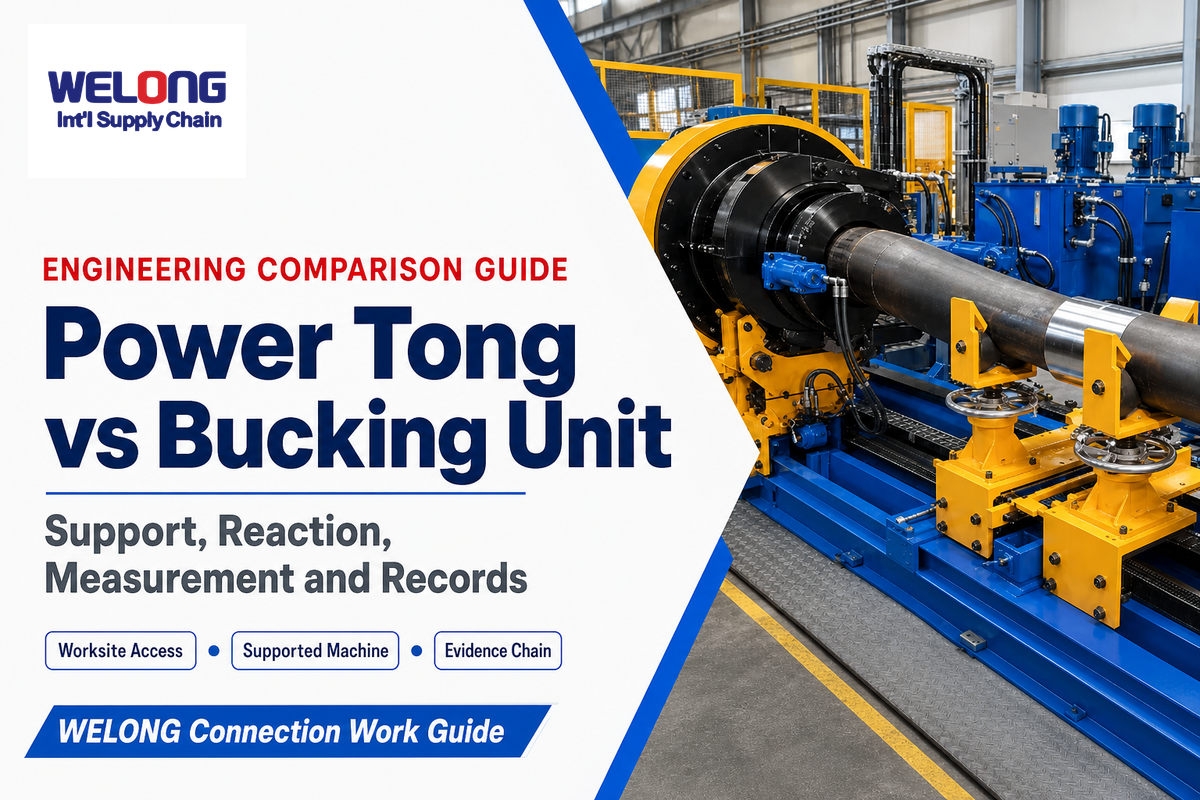
Oilfield connection-work guide · Updated October 2026
Choose the complete work system, not the largest torque number. The useful comparison covers support, reaction path, access, mobility, measurement, safety interfaces and the evidence required for an accepted connection.
TL;DRA power tong is usually selected when the connection work must move to the tubular, while a bucking unit usually brings the tubular into a supported machine. That rule is only a starting point. Mobile bucking units and instrumented power tongs exist, so the final choice must also bind reaction, handling, access, safety functions, measurement and acceptance records.
Power tong vs bucking unit is not simply a rig-versus-shop question. Both equipment families can grip a tubular, apply rotational torque and oppose that torque through a backup or reaction structure. The decisive difference is how the complete system supports the workpiece, controls the reaction path, reaches the connection and produces the evidence the procedure requires.
This is an informational selection guide. It does not replace the connection owner’s procedure, the equipment manufacturer’s instructions, a site-specific risk assessment, or the current standards and legal requirements that apply in the operating jurisdiction.
For drilling operations, an efficient handoff names whether the work occurs on a drilling rig, at a service base or in a manufacturing shop. That context matters across the oil and gas industry, but it still has to be paired with the exact equipment manual, connection procedure and site controls.
Quick specification boundary
Equipment label + rated torque + size range are screening data. Usable selection also needs the connection family, workpiece geometry, support and reaction arrangement, site interfaces, control mode, measurement chain, acceptance rule and required record.
The Short Answer: Match the Complete Connection Work System
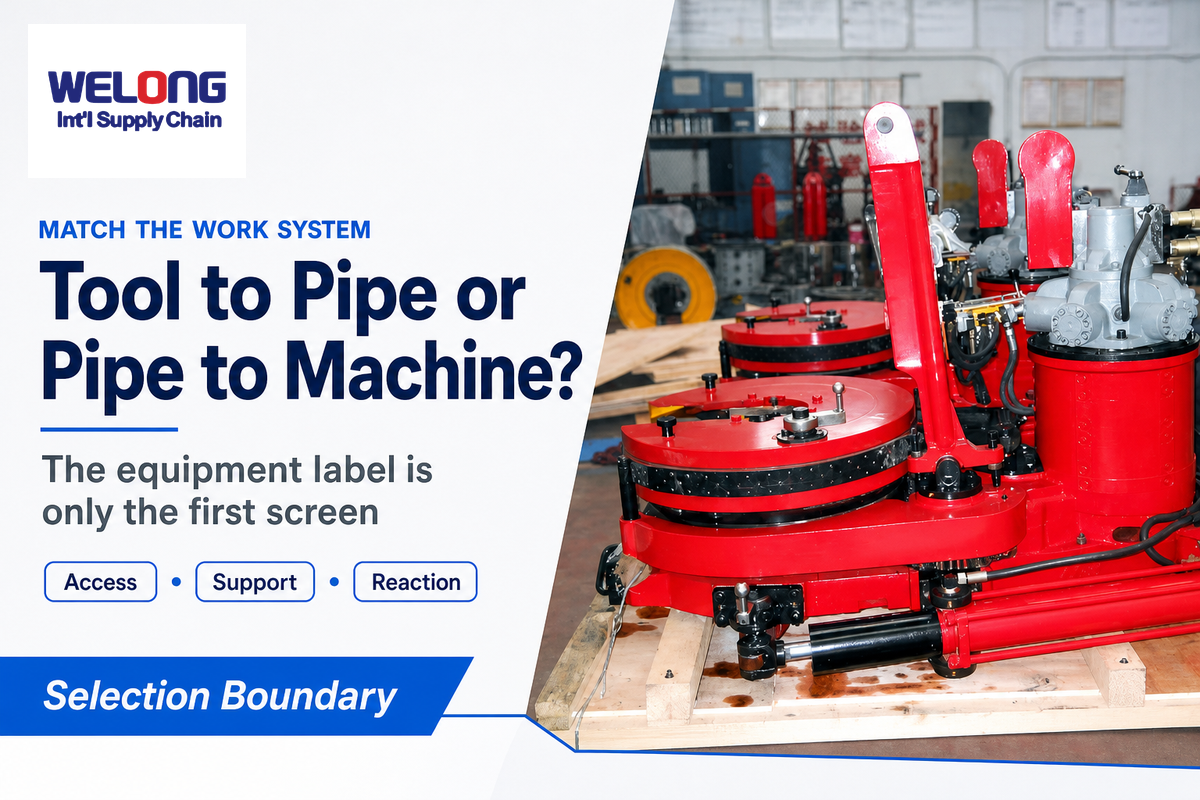
Direct answer: start with where and how the connection must be accomplished. In the case where the tool must be positioned around pipe in the operating area, a power-tong work system is usually chosen. If the pipe can be loaded into a supported machine for controlled make-and-break work, a bucking-unit work system is usually chosen. Neither label proves accuracy, safety, traceability or suitability by itself.
Commercial equipment names are useful, but they are not a standards-defined binary taxonomy. Product families can overlap, so the label still does not select the equipment on its own. Power tongs can have a backup with torque-turn monitoring, instrumentation and data recording. Bucking units can be mobile or containerized. A comparison can be drawn when converted to functional questions, e.g. what’s rotating, what’s resisting rotation, what’s carrying the tubular, etc. One of the main functional questions remains: Who decides if the outcome is acceptable?
| Comparison category | Power-tong work system | Bucking-unit work system |
|---|---|---|
| Typical work relationship | Tool is brought to pipe at the worksite | Pipe is brought into a supported machine |
| Primary advantage | Mobility and access around field operations | Repeatable support and controlled work envelope |
| Support question | Rig, handling equipment and procedure share the support task | Beds, headstocks, tailstocks or handling modules may support the workpiece |
| Reaction path | Backup, snub line or designed reaction arrangement, depending on the system | Opposed headstock or backup integrated into the machine structure |
| Workpiece handling | Closely coupled to site tubular-handling sequence | Requires loading, alignment, support and unloading plan |
| Changeover | Jaw, die, backup and tool setup must match the tubular | Headstock, gripper, support and software recipe may need changeover |
| Instrumentation | May be basic or include torque-turn acquisition and records | May be basic or include programmed control and records |
| Main limitation | Site access, suspended-tool control and changing field interfaces can dominate | Footprint, foundation, loading route and workpiece length can dominate |
| Best first screening question | Can the tool and reaction system safely reach the connection? | Can the complete workpiece be supported and moved through the machine? |
| What the label does not prove | Connection acceptance, calibration status or record quality | Connection acceptance, calibration status or record quality |
Work Location Is Only One Selection Constraint
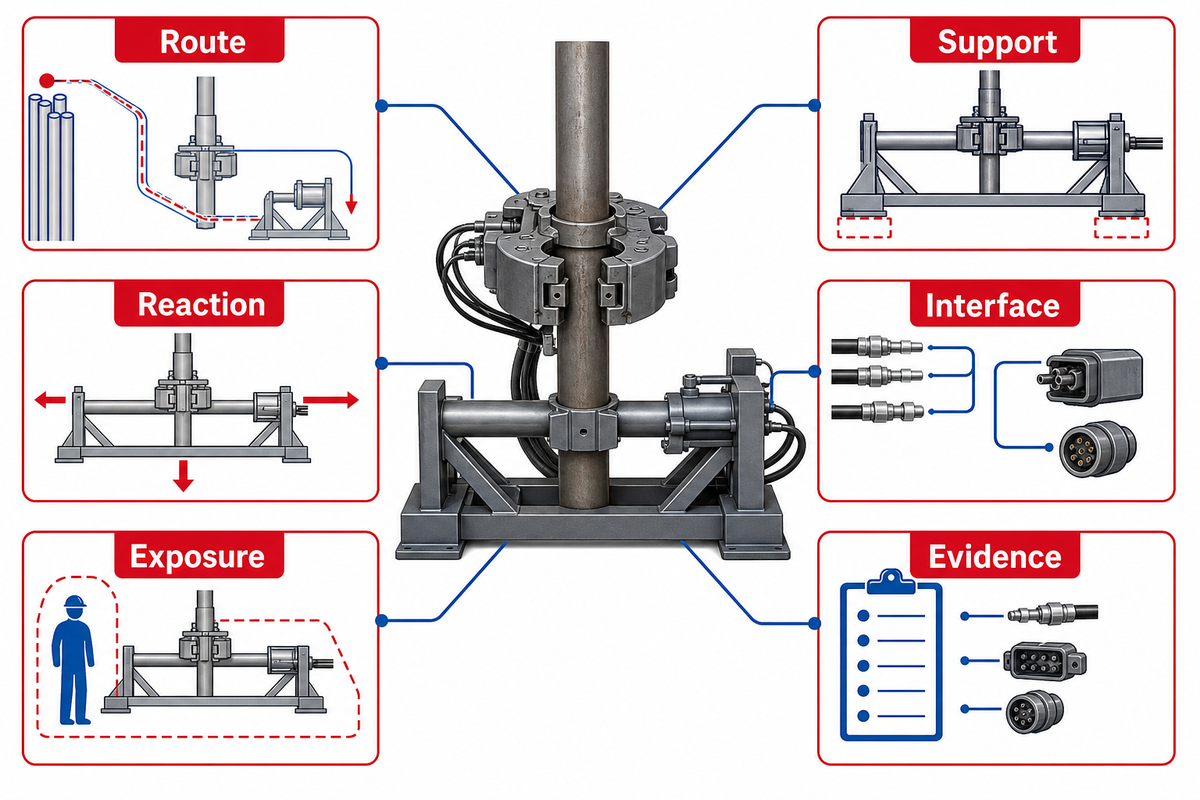
Direct answer: location affects access, lifting, utilities, hazardous area classification, exposure to weather and personnel. Location alone doesn’t determine the best equipment. Compare the actual workpiece route, support method, available approach, foundation, utilities and personnel exposure before selecting either equipment family.
A rig-floor job may strongly favor a mobile power-tong package, yet the package must still fit the connection height, pipe OD, available approach and tubular-handling sequence. A workshop job may favor a bucking unit, yet floor capacity, foundation, straight loading distance, lifting points and the longest component can make a proposed machine impractical. Containerized bucking units blur the usual fixed-shop assumption, and an instrumented power tong blurs the assumption that records belong only to a stationary machine.
6-Part Hidden Bottleneck Map
- Route: can every module and the longest workpiece reach the operating position?
- Support: what carries bending, alignment and suspended loads?
- Reaction: where does torque close through the structure?
- Interface: are power, hydraulics, controls and communications compatible?
- Exposure: where can people encounter moving pipe, pinch points, stored energy or a failed restraint?
- Evidence: can the configured system produce the record the owner will accept?
Deployment planning must address the hydraulic connection sequence. Reliable maintenance and troubleshooting depend on documenting that sequence. Route, foundation or leveling, lifting, suspended loads, hose and fitting inspection, and tool positioning are concerns that should be addressed. OSHA’s Oil and Gas Well Drilling and Servicing eTool is useful advisory material for recognizing field hazards, but the eTool states that it does not create new OSHA requirements. Jurisdiction, operation type and the applicable rule set still need competent review.
How Each System Grips, Rotates and Reacts Torque
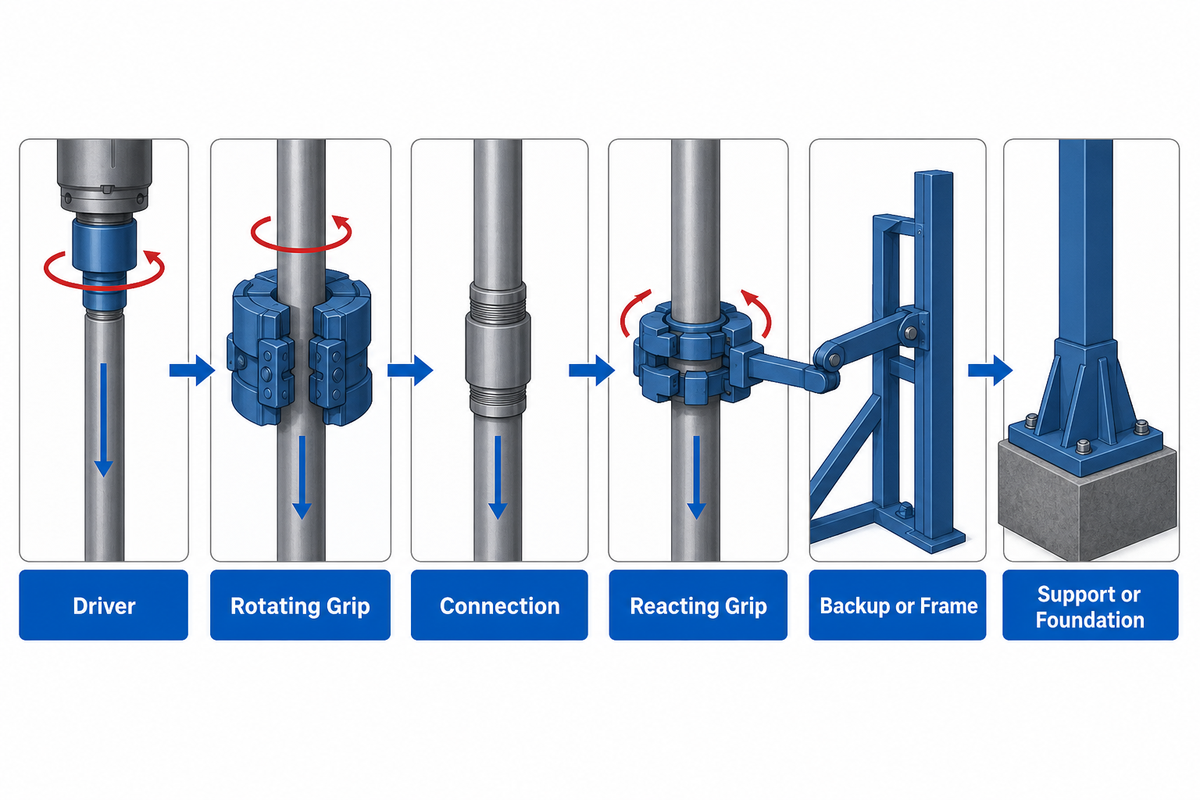
Successful make-or-break systems require an arrangement of a rotating member, a reaction member and a support configuration that keeps the connection within allowable limits. The name of the housing is less important than the path that the load takes through every operating condition.
For a power tong, the powered head typically grips and rotates one tubular and a backup, or other reaction member, holds the mating member. The tool, suspension or positioning system, backup and surrounding structures create one load path. For a bucking unit, opposed gripping heads are usually built in a frame, with one head rotating and the other reacting. Beds or supports position the work piece and help control alignment. High-strength materials do not remove the need to verify the complete load path and its interfaces.
Torque Path Map
Driver → rotating grip → connection → reacting grip → backup/frame/restraint → support/foundation.
At each arrow, record the rated interface, expected movement, inspection point and failure consequence. If one element is described only as “the rig” or “the frame,” the handoff isn’t specific enough.
The reaction path is of equal importance to the powered head. A fatal incident described in IADC Safety Alert 09-20 followed a change in tong-restraint configuration: a temporary long snub line wasn’t restored after a prior operation, and the tong rotated much farther than intended. This isn’t a universal hardware recommendation. The lesson is that temporary configurations, restraint geometries, and their restoration, should be controlled as changes not remembered informally.
Local rules may add specific requirements. For example, California Title 8, Section 6605, contains tong-restraint provisions for drilling and production work, and an exception related to pipe outside diameter not exceeding 4 1/2 inches. That is jurisdiction-specific evidence, not a global design limit. The operating team has to determine which law, standard, owner rule, and manufacturer instruction actually govern the work.
How to read common specification language
Search pages often use hydraulic power tongs as a broad label. In a technical review, determine the hydraulic system behind the label. State the system in terms of the pump, valve, hose, fittings, relief system and the flow or pressure conditions which govern the system. Also, state the gear or drive system, tong opening and approved die set. These elements influence how a system is set up, maintained and troubleshot. These can’t be deduced from “high torque” or a single maximum value.
For drill pipe work, define if the task is makeup, breakout, or the connection and disconnection of drill pipes. “Torque to make or break” isn’t a sufficient acceptance statement. The handoff should distinguish makeup torque from breakout torque. The application of torque changes across the process, and the procedure should define when the connection is made, how turns or shoulder events are recognized, and how the pipe joint is identified. Repeatable display does not automatically prove consistent torque at every connection.
When tongs are positioned around the joint, the work system must grip securely without assuming that more bite force is always better. The permitted contact area, surface conditions and gripping limits belong to the specific pipe connections. Claims of using high strength materials or precision are material or performance claims that require a named grade, property, tolerance and test basis. The same applies to any statement regarding the efficiency of machinery.
Site language also needs definition. “Suitable for oil fields” does not state whether the equipment is intended for a new rig, an existing drilling rig, a service base or a hazardous location. Site conditions, utilities and weather, classification and local site rules determine the boundaries. “Improves the efficiency and safety of drilling” is an outcome claim, not a specification. The safety of drilling operations depends on the configured equipment, procedure, people and site controls.
Finally, don’t choose a piece of equipment from a demand statement, which in this case means required operating load and workflow, not an unfounded guess at market growth. A mechanical engineering review can better define the buyer’s specific needs in terms of loads and interfaces, and provide evidence in a more constructive way than stating, for example, that a particular product keeps operations running smoothly, or that a feature in a catalog is the reason for a safe outcome.
Torque Capacity Is Not Measurement or Acceptance
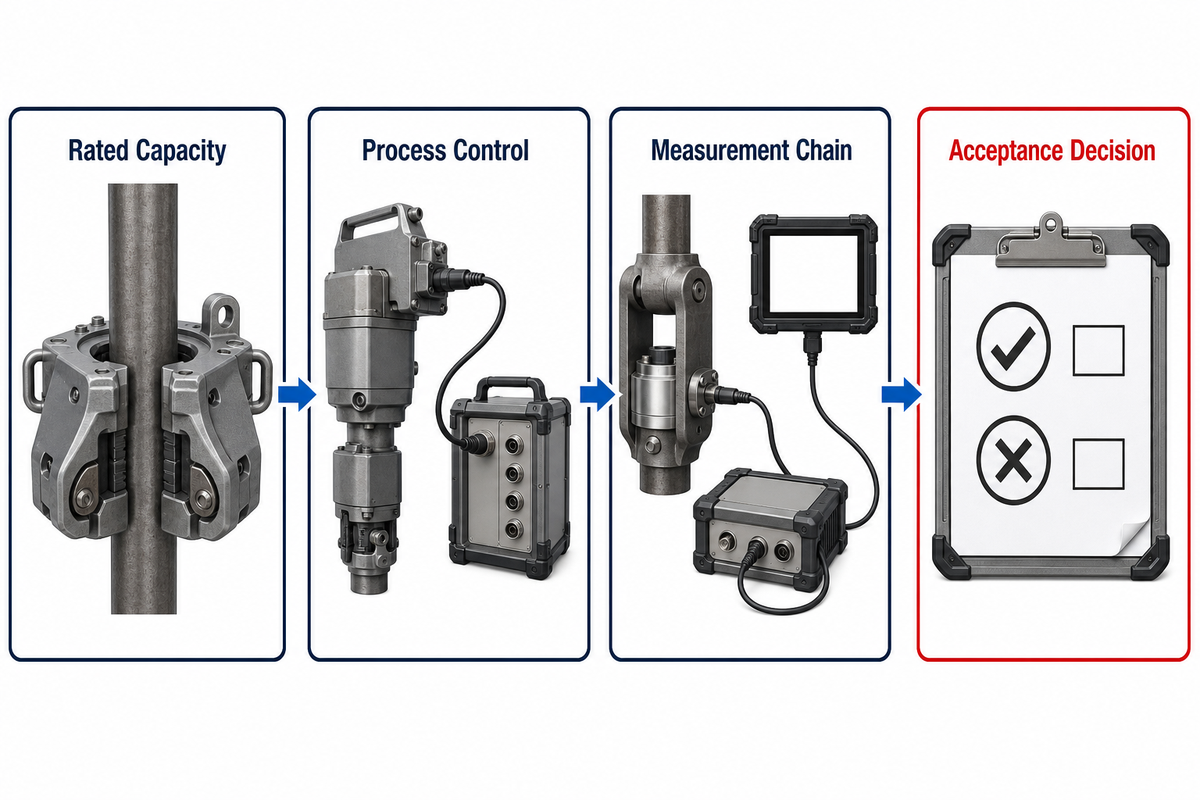
Direct answer: rated torque tells you that a configured machine is intended to operate within a stated capacity envelope. It doesn’t prove what torque reached the connection, how accurately it was measured, whether the instrument was fit for purpose, or whether the connection met its procedure.
Reading the published model range with the associated jaw range, backup range, speed, pressure, duty and configuration is critical. A large maximum can still have a poor fit at the actual OD. A large maximum can also hide a control range that isn’t adequate for the procedure being performed. Reliable torque control is crucial, but a lower headline torque range may be perfectly adequate given the appropriate definition of the connection envelope and control resolution.
Published examples show why capacity must stay attached to size and configuration. Weatherford lists its 14-100 model at up to 100,000 ft-lb (135,600 N·m) for a 7-14 in range, while its 7.6-30 model is listed at up to 30,000 ft-lb (40,670 N·m) for 2 3/8-7 5/8 in. These are manufacturer examples and may not reflect industry averages. Buyers still need the operating curve, setup and procedure-specific acceptance basis for the proposed configuration.
Measurement traceability is frequently overstated. Traceability, according to NIST, is the property of a measurement result established through a documented unbroken chain of calibration and each link of the chain contributes to the overall uncertainty of the measurement. Traceability doesn’t guarantee fitness for purpose. The handoff should therefore name the measuring system, range, uncertainty or applicable performance statement, calibration status, measurement conditions, data acquisition method and the acceptance decision that will use the result.
| Published or proposed field | Hidden condition to expose | Evidence needed |
|---|---|---|
| Maximum torque | Configuration, pressure, speed and duty at the stated maximum | Rated configuration and operating curve |
| Jaw or die range | Actual OD, surface, ovality and permitted contact marking | Compatibility check and approved gripping setup |
| Torque display | Sensor location, conversion, update rate and displayed units | Measurement-chain description |
| Torque-turn graph | Sampling, filtering, rotation reference and event definition | Configured acquisition record and review method |
| Calibration certificate | Covered range, uncertainty, conditions and validity at time of use | Certificate plus in-service assurance plan |
| Automatic stop | Trigger variable, latency, overshoot and safe state | Functional test under the approved recipe |
| Recipe name | Revision, permissions and connection applicability | Controlled recipe-to-procedure mapping |
| Pass indication | Who defined the window and which procedure revision applies | Approved acceptance logic and exception review |
| Saved record | Connection identity, time, operator, configuration and audit trail | Retrievable sample record and retention rule |
Connection Risk and the Four-Layer Evidence Chain
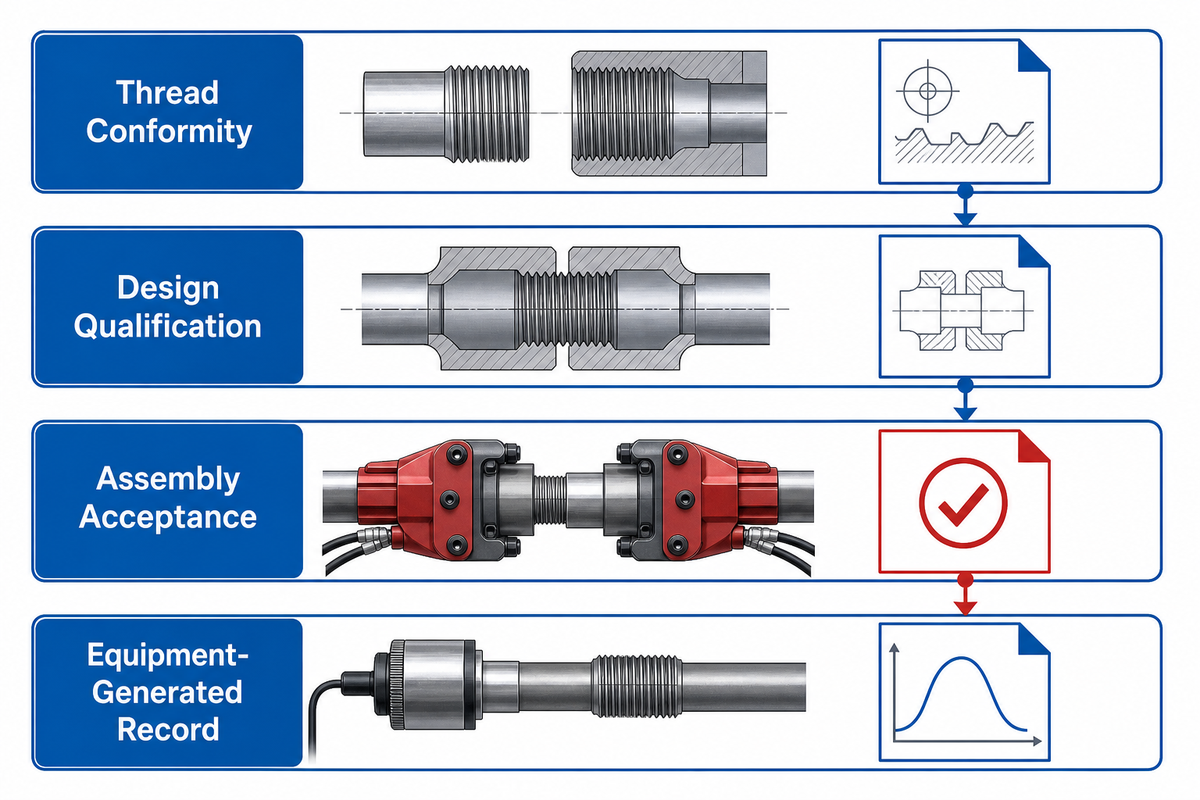
Direct answer: equipment data is just one level of connection assurance. Other assurance layers include thread conformity and design qualification. They also include procedure-specific assembly acceptance and the actual measurement record. Keep the four layers separate so that a valid machine rating is not mistaken for proof that a connection met its procedure.
Four-Layer Connection Evidence Chain
- Thread conformity and inspection: what geometry, gauging and inspection basis applies to this connection family?
- Design qualification: what test program qualifies the connection design for its stated scope?
- Assembly acceptance: what controlled procedure and limits decide whether this particular makeup is acceptable?
- Equipment-generated record: what measured data, configuration identity and audit trail show what occurred?
These layers should not be collapsed. API’s October 7, 2026 announcement for the 17th edition of API Specification 5B concerns casing, tubing and line-pipe thread dimensions, gauging, inspection, validation, calibration and related records. It does not turn a power tong or bucking unit record into completed-makeup acceptance. ISO 13679:2019 addresses connection test procedures for casing and tubing within its stated scope. It is design-qualification evidence, not proof that one field or shop makeup passed its procedure.
Scope matters by tubular family. ISO 11960 covers steel pipe used as casing or tubing and explicitly excludes threading requirements. Rotary-shouldered drill-stem connections have a different standards path. ISO 10424-2:2007 was withdrawn in 2025, and its ISO lifecycle page lists no replacement. Therefore, a technical hand-off should identify the current governing document rather than copying a familiar number from a previous specification.
Thread compound is another interface, not a substitute for acceptance. ISO 13678:2010 covers laboratory testing of thread compounds for casing, tubing, line pipe and drill-stem elements within its scope. Identity, condition and application of compound still remain as controlled aspects of the assembly process. They do not identify the equipment family by themselves.
A Seven-Question Handoff Framework
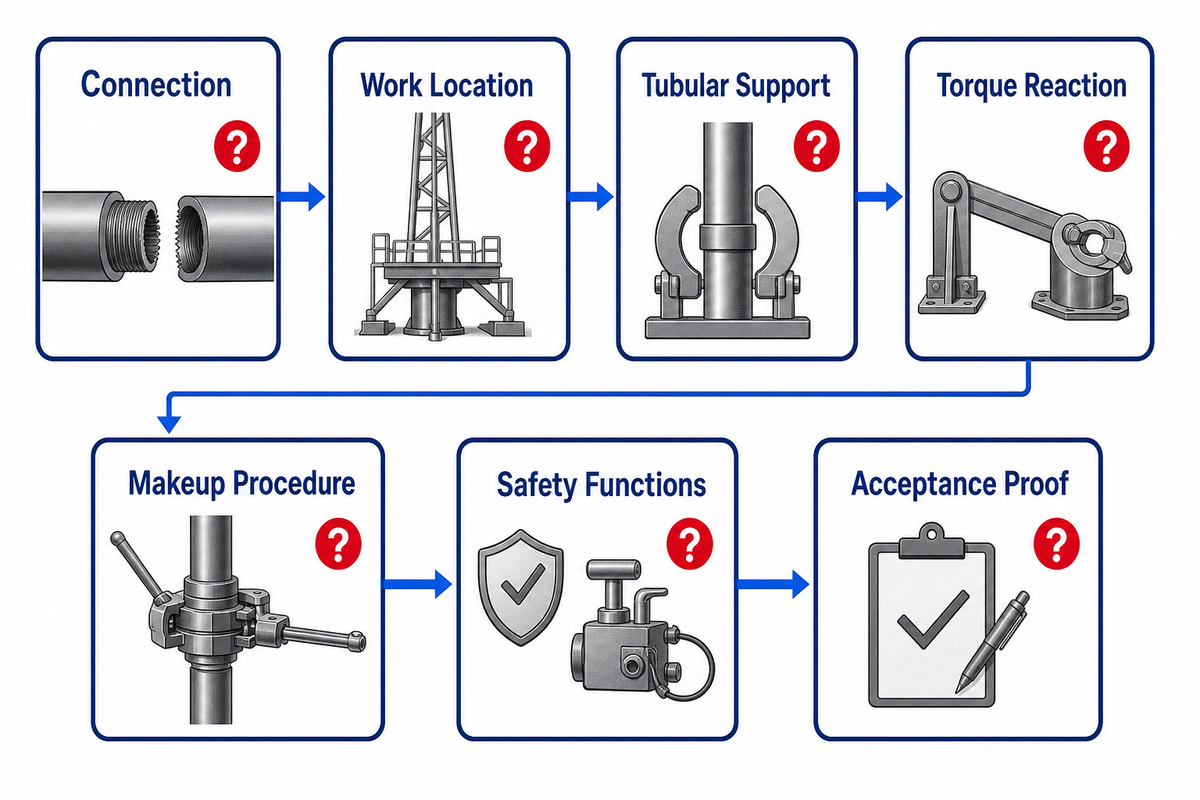
Direct answer: answer the following seven questions before comparing models. Each answer should name an owner, an applicable document and the evidence required at handover. They convert a vague equipment request into a work-system handoff that procurement, operations, HSE and QA can review together.
| Question | Minimum answer | Primary owner |
|---|---|---|
| 1. What connection is being worked? | Tubular family, connection designation, OD range, length, mass, surface and permitted gripping area | Connection owner / engineering |
| 2. Where must the work occur? | Field or shop, orientation, access, route, footprint, foundation and environmental classification | Operations / facilities |
| 3. How will the tubular be supported? | Lifting, alignment, bending control, supports, loading and unloading sequence | Operations / lifting authority |
| 4. Where does torque react? | Rotating grip, reacting grip, backup or restraint, structural load path and inspection points | Equipment engineering / HSE |
| 5. What procedure controls the makeup? | Revision-controlled preparation, compound, speed, target, turn or shoulder criteria, stop rules and exceptions | Connection owner / QA |
| 6. What safety functions and isolations are required? | Hazard analysis, protective functions, performance requirement, validation, energy isolation and recovery | HSE / controls engineering |
| 7. What proves acceptance? | Measurement chain, calibration status, acceptance logic, record fields, reviewer and retention period | QA / connection owner |
This framework intentionally separates safety functions from safety-rated components. ISO 13849-1:2023 provides a methodology for safety-related parts of control systems, but it does not select the required safety functions or performance levels for a specific application. ISO 13849-2:2012 addresses validation by analysis and testing. A proposal that lists a safety PLC or light curtain without the risk-derived function, required performance and validation plan is incomplete.
Legal scope also has to be evaluated. In the U.S., OSHA 1910.147 explicitly excludes oil and gas well drilling and servicing from that general-industry lockout/tagout standard. Therefore, a workshop activity and a field well-servicing activity may have different regulatory scope even if similar equipment is involved. Hazardous location suitability under OSHA 1910.307 also depends on the classified location, equipment marking, and the jurisdiction, not on a generic “oilfield rated” description.
Where Simple Rules Break Down
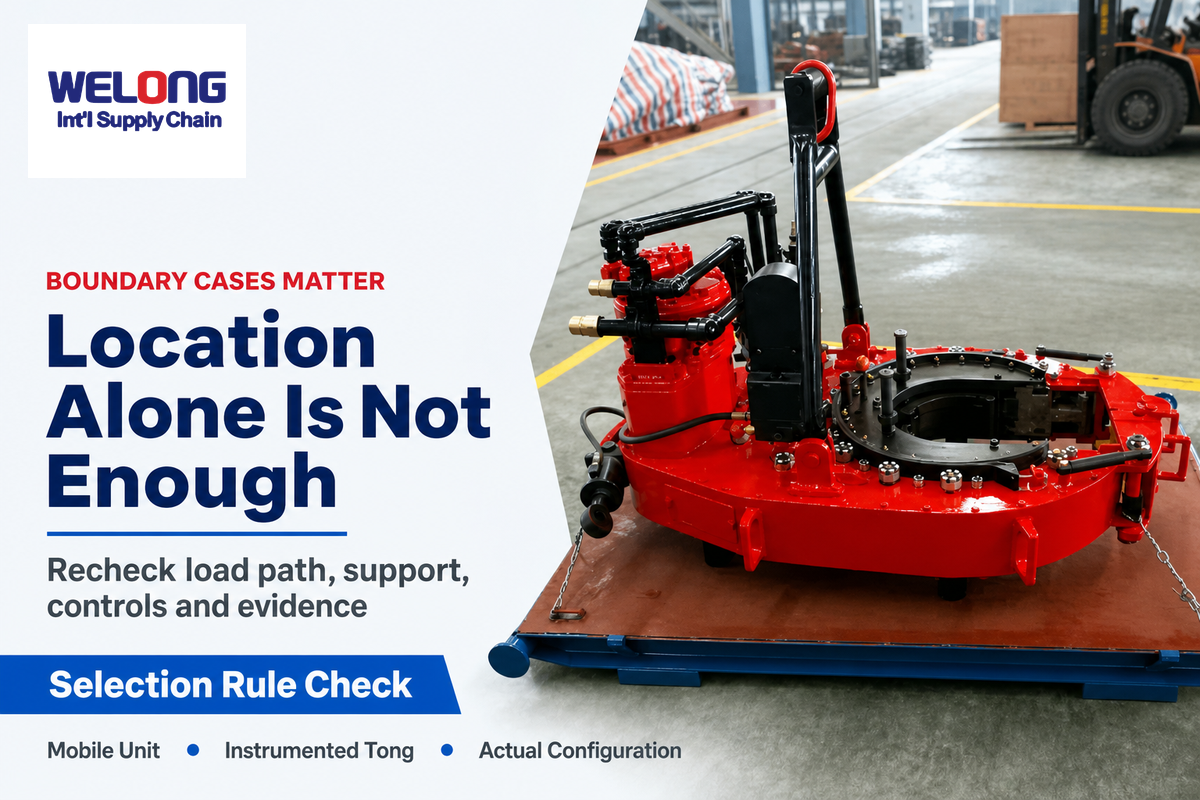
Direct answer: the shortcuts “power tong for the rig” and “bucking unit for the shop” are useful orientation, not final selection rules. Mobile bucking units and instrumented power-tong systems cross those familiar boundaries, so the actual load path, support, access, control and evidence requirements still decide the fit.
Instrumented power tong
A field-oriented tool can include torque-turn monitoring, data capture and controlled stopping. Don’t reject it merely because records are required. Review its complete measurement chain and field configuration.
Mobile bucking unit
A supported machine can be containerized, skid-mounted or moved between sites. Don’t assume every bucking unit needs a permanent factory bay. Verify route, leveling, foundation, utilities and commissioning after each move.
Low-volume workshop work
A stationary machine may offer excellent support but still be excessive if the workpiece mix, handling burden and record requirement are modest. Compare the total workflow, not machine capability alone.
High-consequence field makeup
Mobility may be non-negotiable while measurement and records remain strict. That points to a configured work system with instrumentation and controlled procedure, not automatically to a stationary unit.
There’s no universal statement that says a bucking unit is always more accurate. Accuracy is a function of the measurement system and its configuration to a measured quantity. Nor is a power tong automatically less controlled. The actual question is whether the selected configuration can operate in the required range, control the relevant variables, manage the reaction and handling risks, and produce evidence fit for the acceptance decision.
What to Put in the Technical Handoff Before Selection
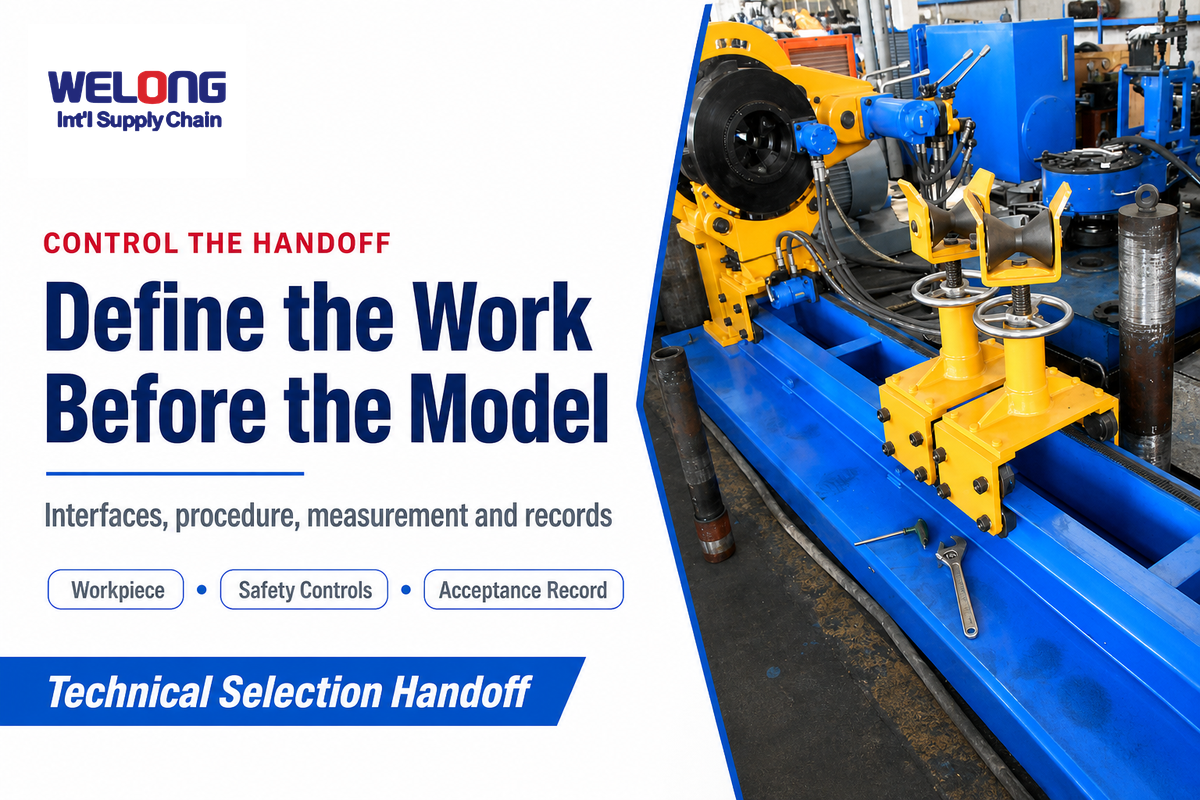
Direct answer: issue one controlled handoff instead of asking suppliers only for torque, size and price. This approach prevents multiple technically different offers from looking comparable. The handoff should bind the workpiece, site interfaces, reaction system, procedure, safety controls, measurement chain, records and authorized changes.
| Handoff block | Required fields | Review evidence |
|---|---|---|
| Connection identity | Family, designation, procedure revision, scope and exclusions | Controlled connection documentation |
| Workpiece envelope | OD, length, mass, end geometry, straightness and gripping restrictions | Worst-case workpiece drawing |
| Torque and motion | Operating range, speed stages, direction, turns and stop behavior | Procedure-to-equipment range map |
| Support and reaction | Handling sequence, supports, backup, restraint, load path and interfaces | Layout and load-path review |
| Thread interface | Inspection, cleanliness, compound, application and rejection conditions | Procedure and material records |
| Site interfaces | Route, footprint, foundation, lifting, hydraulic and electrical supply, environment | Site survey and interface schedule |
| Safety controls | Hazards, functions, isolation, safeguarding, validation and recovery | Risk assessment and validation plan |
| Measurement | Sensor, range, performance, calibration, sampling and assurance checks | Measurement-chain file and sample data |
| Acceptance and records | Limits, exception route, identity fields, reviewer, retention and export | Approved logic and completed sample record |
| Change control | Authorized substitutions, temporary configurations, software revisions and reset requirements | Change register and restoration check |
As these components are defined, the commercial model selection becomes relevant. Start with Welong’s oilfield tongs overview to place both families in context. Catalog phrases such as “high-quality power tongs” are not acceptance criteria. Welong’s manufacturing and engineering background provides company context. The project team can contact Welong with a controlled handoff. Welong’s range of power tongs and bucking unit range can instead be assessed against the same work-system handoff, actual usage profile and specific needs. Pricing, configuration, lead time, logistics and quotation belong in that commercial discussion after the technical boundary is clear.
The decision in one sentence
Select the system that can support the actual tubular, close the torque reaction path, fit the operating environment, control the relevant hazards and produce the exact evidence required by the connection procedure.
FAQ
Is a bucking unit always more accurate than a power tong?
No. Equipment family names don’t define measurement accuracy. Either system may use different sensors, calibration arrangements, acquisition settings and control logic. Define the required result, operating range, performance statement, calibration status and acceptance rule. Then evaluate the configured system as well as a representative record.
In a given operating range, support and repeatability can be improved by the judicious positioning of a frame, but that improvement shouldn’t be generalized to improved absolute measurement accuracy. Ask where the sensor is located, how the indicated value is calculated, which range was calibrated, what uncertainty applies, how the system is checked between calibrations, and which procedure revision evaluates the trace. The same applies to both families of equipment.
Can a power tong generate torque-turn records?
Yes, an instrumented power-tong system can generate torque-turn data and connection records. Review sensor location, calibration status, sampling, filtering, turns reference, connection identity, procedure revision, stop logic, operator permissions and record retention. The connection owner is responsible for defining how evidence is reviewed and what happens when the trace goes outside the acceptable window.
Can a bucking unit be used outside a permanent workshop?
Some bucking units are skid-mounted or containerized and therefore, may not require a permanent factory installation. Each deployment should address transport route, lifting points, foundation or leveling, utilities, environmental suitability, safeguarding, hazardous-location requirements where applicable, commissioning and any tests invalidated by the move.
Does the highest torque rating identify the best machine?
No. Maximum torque is one screening limit. The actual machine must operate effectively over the required range, fit the OD, and be suited for the type of gripping. It must control speed and reaction, accommodate workpiece length and mass, match the site utilities, and furnish the required evidence. An oversized system can introduce poor control resolution, handling burden or unnecessary complexity. The correct selection has adequate margin under declared conditions, not the largest catalog number. Document the selected operating envelope.
Which standards decide whether a connection is acceptable?
There is no single equipment standard that decides every completed connection. The governing path depends on tubular and connection family, owner requirements, design qualification, thread specification and the controlled assembly procedure. API 5B, ISO 11960, ISO 13679 and ISO 13678 have different scopes and must not be treated as interchangeable. The connection owner should identify the applicable documents and define the acceptance rule for the particular assembly.
References & Sources
- NIST: Metrological Traceability
- API: 17th Edition of API Specification 5B Announcement
- API: Specification 7K equipment-scope change notice
- ISO 13679:2019 connection test procedures
- ISO 11960:2020 casing and tubing scope
- ISO 13678:2010 thread compound tests
- ISO 13849-1:2023 safety-related control-system design
- ISO 13849-2:2012 validation
- OSHA Oil and Gas Well Drilling and Servicing eTool
- OSHA 1910.147 hazardous energy control scope
- OSHA 1910.307 hazardous locations
- California Title 8, Section 6605
- IADC Safety Alert 09-20
Technical note: Standards undergo revision and go through a lifecycle. Laws change as do the configurations of equipment. Ensure you’re using the latest editions, verify jurisdictional applicability, and follow manufacturer instructions before procurement or operation. The final decisions for acceptance of connections and the procedures remain with the owner and qualified persons.
Why Buyers Work With Welong
About Welong Engineering Support
China Welong supports oilfield buyers with engineered supply-chain service for drilling tools, well-control equipment, rig-floor tools, casting parts, and industrial forged components.
Project Review Before RFQ
We help buyers compare tool family, material route, API or ISO requirements, inspection records, supplier capability, delivery risk, and documentation needs before a purchase decision is finalized.
Request An Oilfield QuoteCompany Profile // Data Sheet
CompanyChina Welong International Supply Chain
BrandWelong
CountryChina
Business TypeOilfield tools and industrial supply-chain partner
Main ProductsDownhole drilling tools, fishing and milling tools, wellhead and well-control equipment, oilfield hoses, rig-floor handling tools, mill rolls, and forgings
Engineering CapabilityTool-family selection, specification envelope review, API / ISO reference support, material traceability, inspection coordination, and supplier-route comparison
RFQ Data NeededTool type, size, connection, rating, grade, standard, quantity, drawings, and delivery target
Websitewelongoiltools.com
![Casing, Tubing & Drill Pipe Elevators [Field Guide]](https://welongoiltools.com/wp-content/uploads/2026/09/casing-tubing-drill-pipe-elevators-guide-featured-768x512.png)