Get in touch with Welong Company

Quick Selection Criteria
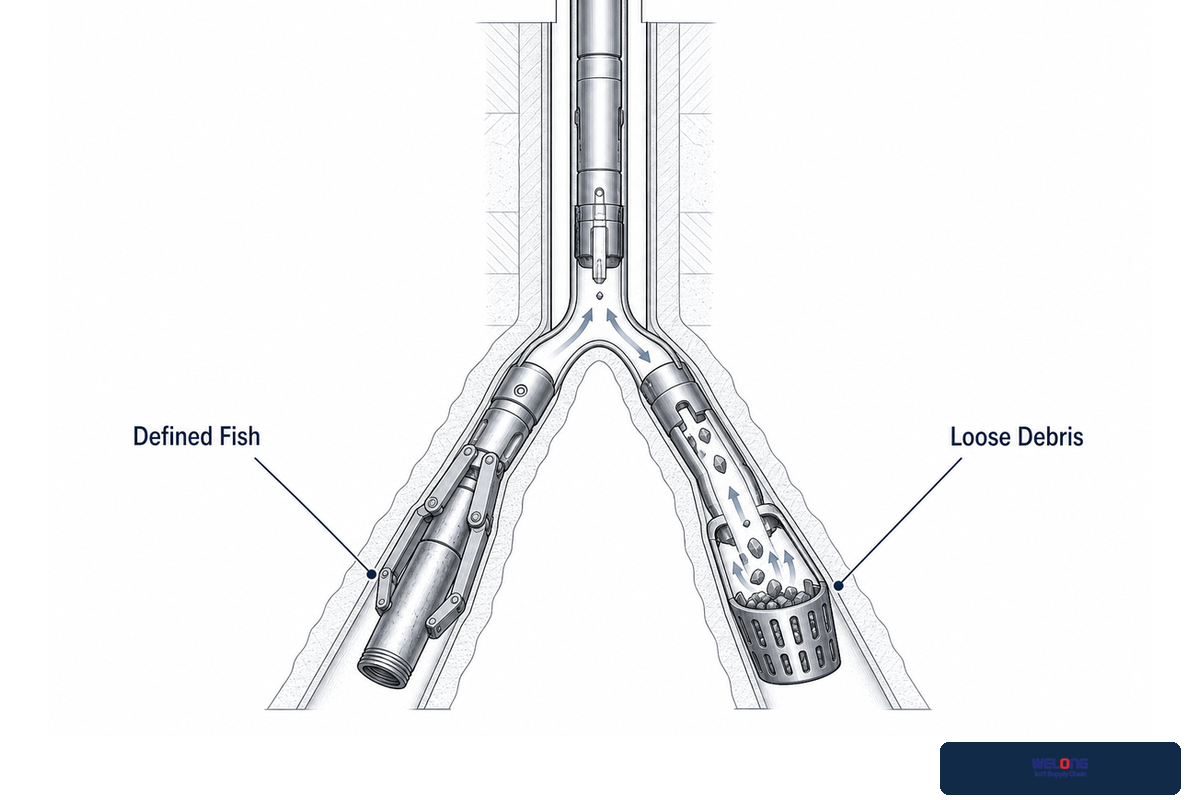
Before picking an overshot or a junk basket, define the target form: an oilfield overshot grips the outside of a defined tool through a grapple-and-bowl mechanism. By contrast, a junk basket uses circulation to transport loose debris into a catcher. So the first question is whether the fish has a usable engagement surface, not which tool is strongest.
Overshot & Junk Basket refers to two different oilfield fishing-tool families: an overshot engages a defined fish, while a junk basket collects loose debris. A junk basket is a downhole fishing tool, not a household waste receptacle. Both can appear in a fishing-tool catalog, but they serve distinct object-recovery tasks.
Begin with the object, its position, and its possible recovery path. If the recovery path has already been decided and your query is now about available product options, commercial information, or connection types, see the oilfield overshot and junk basket configurations page. Here, the focus stays on diagnosis and handoff to avoid overlap with the solution page.
Overshot or Junk Basket? Start With the Fish You Need to Recover
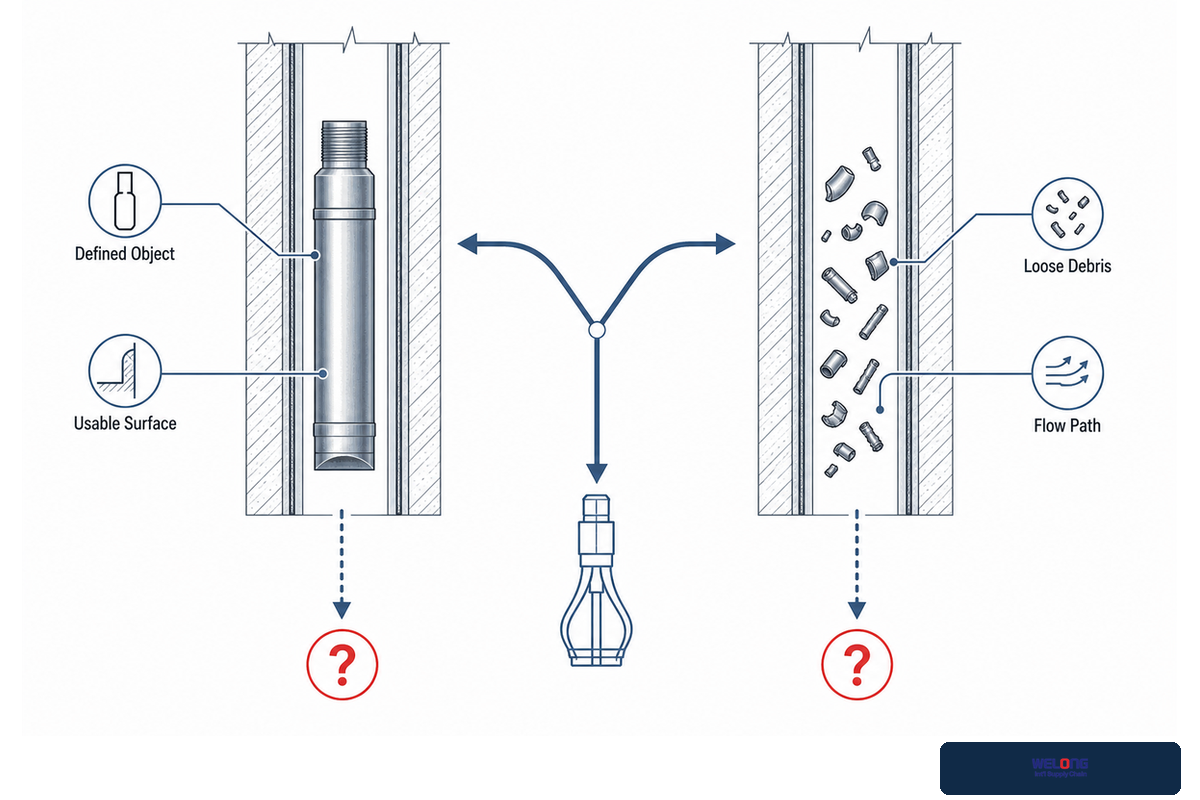
An overshot is often the preferred family for a structured tool or continuous pipe-type fish when an outer surface is available and reachable from above. By contrast, a junk basket suits fragmented material that can be moved by circulation into a catcher. Neither name guarantees run success.
International Ocean Discovery Program reports document an overshot used on a specific rotary tool and a reverse-circulation junk basket used to retrieve debris in another operation. These field examples aren’t universal instructions, but they support classifying the target before opening a tool catalog.
| Type / decision point | Overshot route | Junk-basket route |
|---|---|---|
| Target form | Defined, substantially continuous fish | Loose, fragmented, or small debris |
| Engagement | External grapple contacts a usable fish surface | Debris enters and is retained by a catcher system |
| Circulation role | Configuration-dependent support function | Central to moving debris toward the basket |
| Confirmation | Compare planned surface response with retrieved fish and tool inspection | Inspect recovered contents and reconcile them with the debris model |
| Primary unknown | Fish-top access and usable outside surface | Debris mobility, flow path, and retention |
| Failure clue | Tool cannot pass, engage, or produce the planned response | Material does not enter, is not retained, or does not match the debris model |
| Not suitable when | No accessible external catch surface exists | The target is a continuous stuck object that cannot enter the basket |
| Adjacent path | Internal catch, impact, or another engineered engagement route | Magnetic recovery, milling, or another debris-management route |
| Commercial handoff | Model review after fish geometry is known | Model review after debris and circulation conditions are known |
Overshot route: advantage and boundary
Direct engagement is lost when the fish top can’t be accessed, the exterior surface is compromised, or debris blocks the path.
Junk-basket route: advantage and boundary
Circulation can guide small, loose items toward a catcher. This route doesn’t suit a stuck tool that can’t enter the catcher path.
It’s easy to ask the wrong first question: “Overshot versus junk basket sizes.” Before addressing size or consulting a catalog, establish a clear object model. For an overview of tool types, use the guide to oilfield fishing tools.
How an Overshot Grapple Engages a Tubular Fish
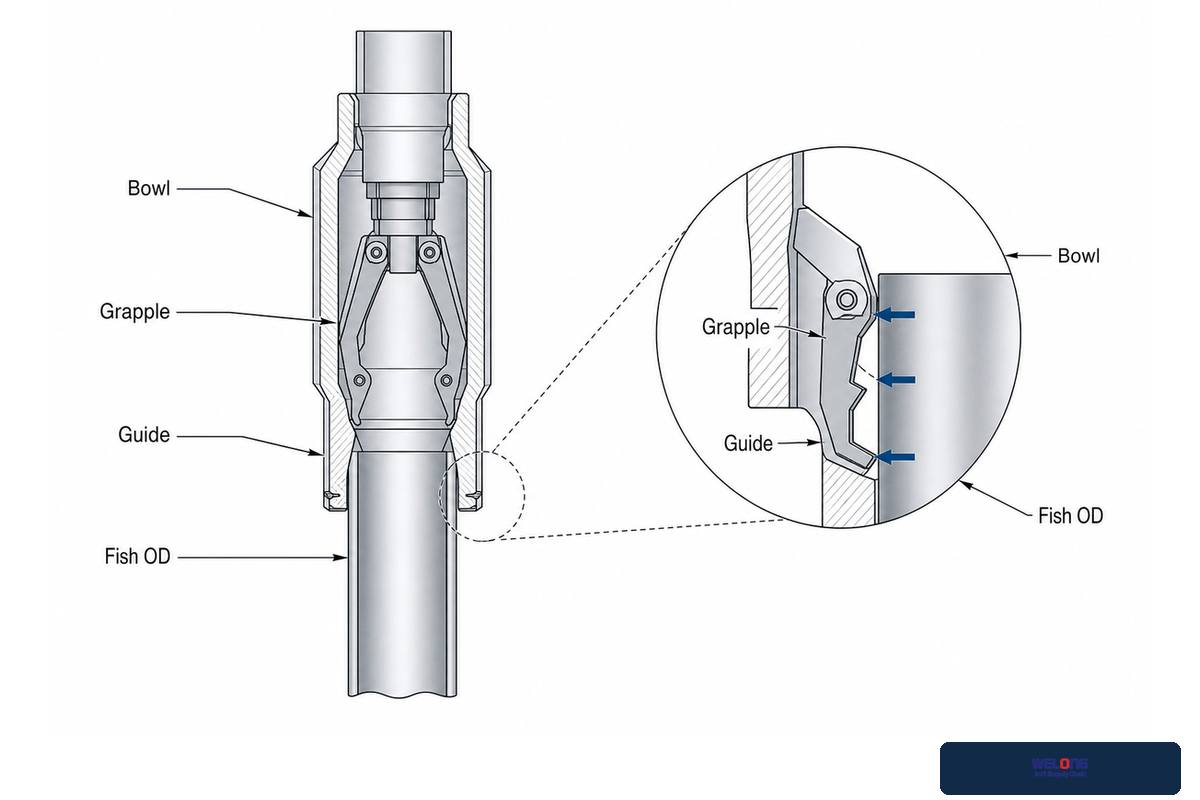
External catching starts when an overshot slips over the fish top and its internal grapple clamps the outer surface. Bowl and body geometry support the grapple design; packoff elements, guide geometry, and circulation access remain configuration details for model-specific review.
One patented wide-catch overshot uses a spiral-grapple arrangement adapted for varied external dimensions. Patent drawings can illustrate that mechanism, but they don’t prove product interchangeability or universal fit. Actual fish dimensions, surface condition, accessible length, and surrounding restrictions still control the application.
- Approach: The guide and body must pass the fish top without an obstruction blocking the path.
- Envelop: The catch section moves over enough usable outside surface for the intended grapple to engage.
- Engage: Relative movement loads the grapple against the fish and supporting bowl geometry.
- Confirm and retrieve: The crew compares the observed response with the expected signal, then verifies the catch through recovery and inspection.
Failure can occur before the grapple gets a fair opportunity.
In an IODP Expedition 313 operation, sand entered the bottom-hole assembly and blocked core-barrel release, preventing latching and requiring a pipe trip for recovery. It’s a useful counterexample: knowing the object didn’t eliminate the effect of fill and access conditions.
What are the different types of overshot?
Within drilling and workover fishing, basket-grapple and spiral-grapple arrangements are common external-catch concepts. Overshot is also used in wireline, slickline, and coiled-tubing contexts, where the interface and operating assumptions can differ materially. Treat the service context and specific mechanism as part of the name.
For deeper external-engagement context, read external catch fishing tools.
How a Reverse Circulation Junk Basket Collects Loose Debris
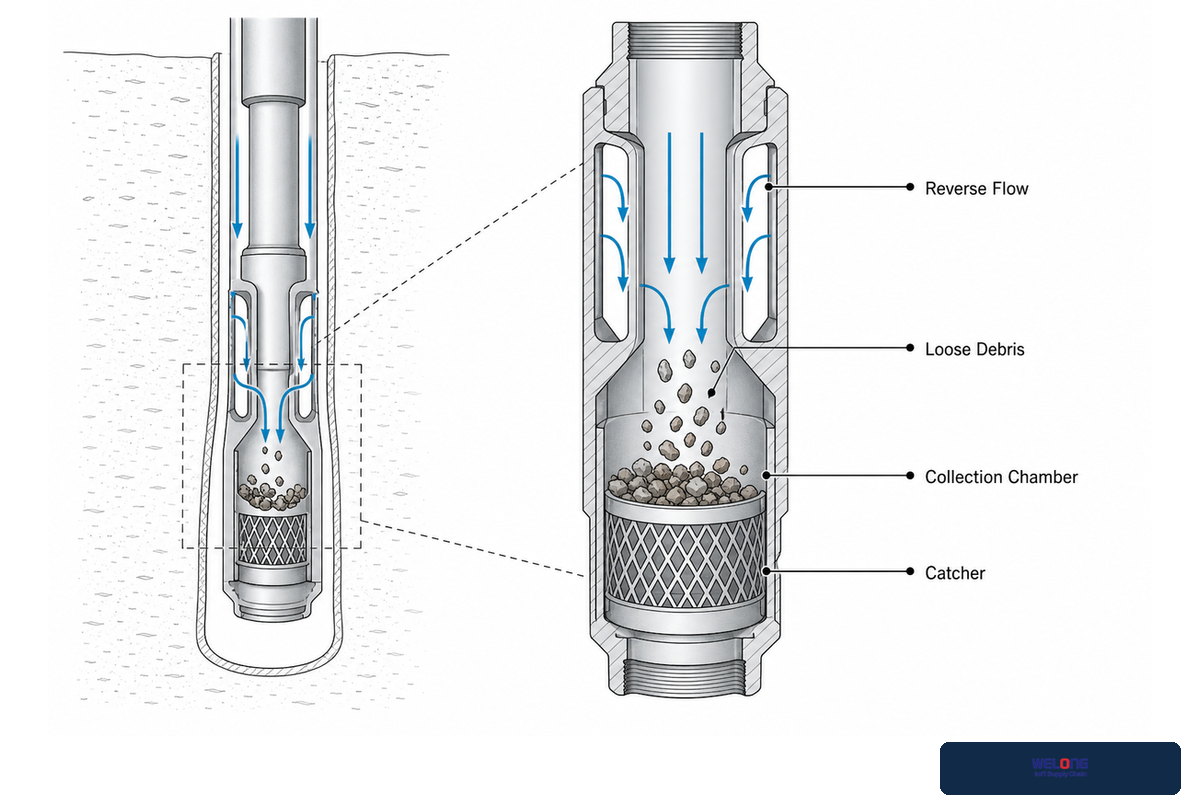
Fluid movement becomes a debris-transport path in a reverse-circulation junk basket.
As the tool is circulated according to its job-specific procedure, flow is directed so loose material can move toward the collection chamber. Mechanical catchers then help retain collected pieces while the assembly is retrieved.
What is a reverse-circulation junk basket?
A reverse-circulation junk basket is a downhole fishing tool for collecting loose debris through circulation-assisted transport and mechanical retention. The target must be movable into the tool’s collection path; a stuck continuous fish doesn’t become a junk-basket target simply because it’s unwanted material.
An IODP operations report records an RCJB deployment and the physical material recovered in that borehole. That field report supports the tool-family concept but doesn’t supply a general flow, pressure, or debris-size limit. Commercial model tables also show that body outside diameter, mill-shoe outside diameter, catch range, hole range, ball size, and connection vary by model.
That variability is exactly why this guide publishes no family-wide operating number.
Junk-basket drilling discussions sometimes collapse three separate questions: can the material be loosened, can fluid transport it, and can the catcher retain it?
This type of fishing tool is only plausible when all three paths are credible. Likewise, a junk sub isn’t automatically the same device or recovery mechanism as a reverse-circulating junk basket.
Search language also overlaps. Phrases such as “junk basket drilling,” “junk basket fishing tool,” “reverse circulating junk basket,” and “junk sub” can point to different mechanisms, so the service context must remain explicit.
System boundary
Debris control elsewhere in the string can be relevant, but it doesn’t replace the basket’s recovery logic. For example, a drill pipe screen belongs to a different equipment role and shouldn’t be described as a substitute for an RCJB.
The 4-Factor Catchability Boundary Canvas
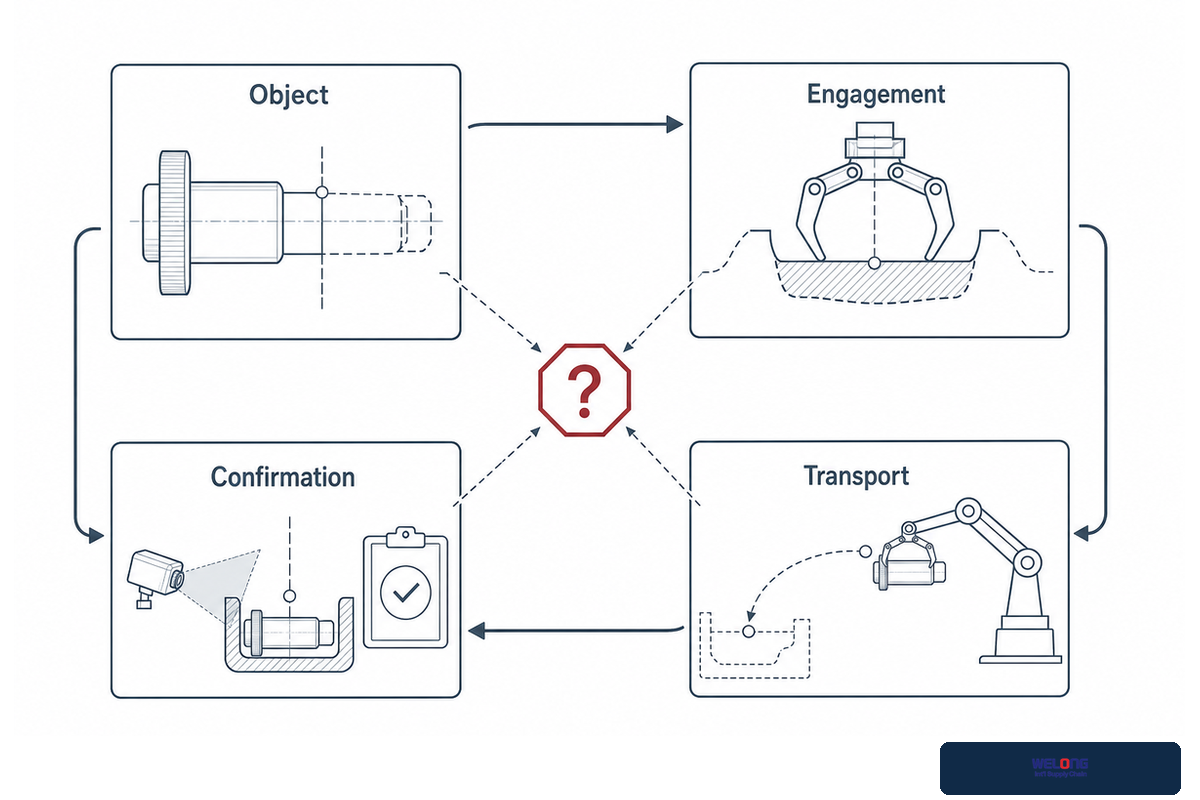
Welong’s 4-Factor Catchability Boundary Canvas synthesizes the reviewed field reports, mechanism records, and scope limitations. It is not an API or ISO standard. Its purpose is to expose an unknown that would invalidate an otherwise neat tool choice.
1. Object form
Continuous fish, fragmented components, gravel, cuttings, or mixed debris?
2. Engagement surface
Is a usable outside or inside surface accessible, or is the top split, buried, bridged, or obstructed?
3. Transport path
Can loose material move to a catcher, and are fill or restrictions likely to block the path?
4. Confirmation path
What planned surface response, recovered object, or post-run inspection would distinguish success from drag or blockage?
Guidance here is intentionally conservative: if a needed path isn’t known, choose “collect more evidence,” not a forced overshot or junk-basket selection. Better camera evidence, an impression, a debris sample, past-run history, or improved geometry can shift the object model before the tool changes.
Expedition 360 illustrates these boundaries. Successive junk-basket and fishing-magnet trips produced different results on multiple roller cones and other objects. One later RCJB trip retrieved a missing cone; a later magnet recovered a different, heavily abraded cone stuck in the drill bit. Separate IODP operations reports hosted by Texas A&M document an object-specific overshot recovery and a junk-basket debris recovery. The evidence doesn’t make either tool family a universal winner. Material, location, and accessibility can shift the job into an adjacent recovery path.
Do not increase certainty just because the tool name is familiar. Increase certainty by closing the object, engagement, transport, and confirmation gaps.
— 4-Factor Catchability Boundary Canvas
Pre-Job Data That Prevents a Misrun
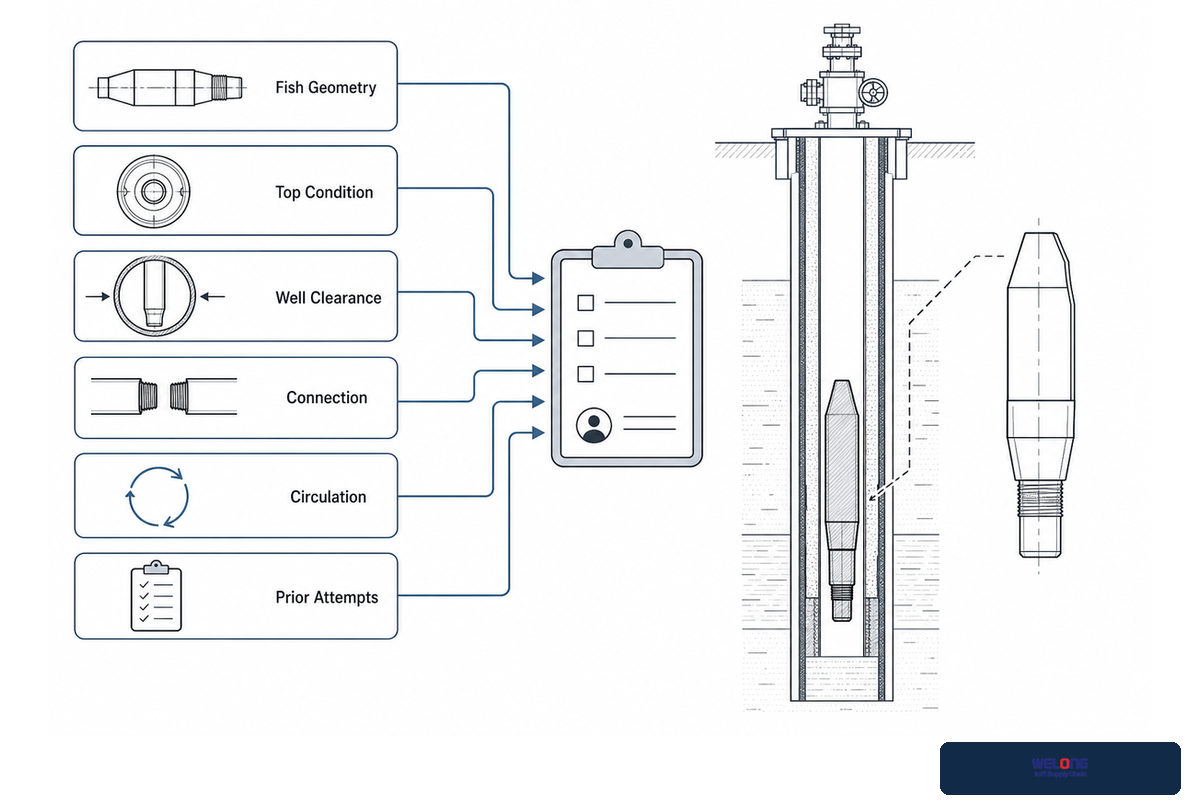
Selection failures often begin as information failures. Nobody can responsibly step from “stuck pipe” or “junk in hole” to a configuration without the fish geometry, hole context, and a valid recovery hypothesis. Use the worksheet that follows to gather inputs, not as a substitute for an approved work program.
Overshot/Junk Basket Pre-Job Data Worksheet
- Describe target: continuous, fragment, mixed, magnetic, or unknown and how this determination was made.
- Record fish geometry: available outside and inside dimensions, fish-top condition, accessible length, and any split, flare, taper, or other obstruction.
- Record well geometry: hole or casing ID, any restriction in ID, deviation context, depth reference, and any fill or bridge.
- Define the interfaces: planned string, required connection(s), relevant crossovers, and the specification or drawing revision controlling the interfaces.
- Describe circulation: whether a fluid path exists, what can hinder debris transport, and any returns or losses noted.
- Define confirmation: expected surface response, evidence from the recovered object, basket-content inspection, and post-run tool inspection.
- List previous attempts: tool used on each attempt, observed response, material recovered, and changes supporting the new hypothesis.
Even official API update records and the ISO 10424-1 lifecycle record show why “manufactured to a standard” is inadequate when the edition, scope, addendum, or withdrawal notice isn’t identified. Pages reviewed for this guide concern rotary drill-stem elements and do not certify overshots or junk baskets; they serve as a document-control reminder, not product approval.
Engineering Note
The data package should separate source evidence from tolerance fields. Include measured fish outside/inside dimensions and their uncertainty; whether the fish-top shape is known or estimated; the minimum accessible length; any casing or hole restrictions; the specification or drawing revision governing the string connection; and the revision of the exact applicable specification. If the listed API or ISO document does not address the fishing tool, explicitly note that limitation in place of borrowing the document’s authority.
Selection language that changes the recommendation
Identify the exact fishing tool deployed on each trip; “fishing tool used” is insufficient. State the drill string, top sub, and the presence or absence of a riser or crossover in the recovery path. Record whether the target is at the bottom of the hole or higher in the wellbore. Lower confidence when the fish top is ill-defined, the measured value suggests a smaller OD, or an irregular, damaged surface can prevent an overshot grapple from obtaining a usable grip.
For a basket route, distinguish small pieces of junk from one continuous object. Small junk can break into smaller pieces, remain behind the catcher, or be washed away before inspection. Record the mud-pump and circulating-fluid context, but don’t infer pump pressure from a competitor page or generic drilling manual. Check the selected tool against its own approved program.
Adjacent functions also need separation. For example, a junk mill can alter or reduce an obstruction; it isn’t the same fishing-tool type as a basket. Bit cones and other debris can be magnetic, mixed with nonmagnetic material, or lodged where circulation can’t transport them. Those facts decide whether debris collection, magnetic recovery, milling, or another engineered path deserves review.
A High-Level Fishing Sequence and Surface Confirmation
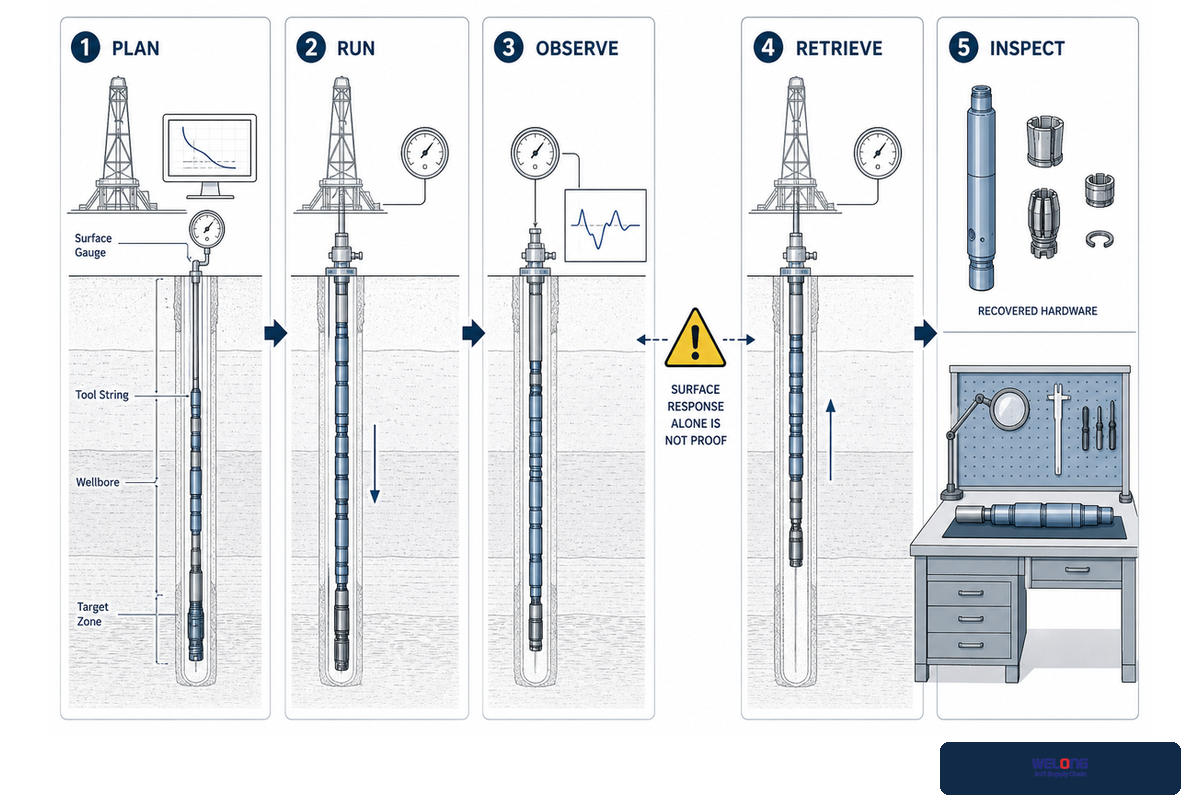
In the field, the primary risk is treating a generic sequence as a job program. This article can’t prescribe torque, pull, set-down weight, pump rate, pressure, rotation, or trip speed for an unidentified assembly. Those values depend on the well, fish, string, selected tool, and approved operating program. What transfers across fishing operations is the planning sequence:
- Prepare: verify the object model, drawings, tally, interfaces, limits, contingency, and expected confirmation evidence.
- Run in: approach the target under the job program while monitoring for a response that contradicts the expected access path.
- Engage or circulate: execute the selected family’s model-specific procedure: external engagement for an overshot route or fluid-assisted collection for an RCJB route.
- Confirm: compare the observed surface response with the planned signal rather than interpreting any change as a catch.
- Retrieve and inspect: reconcile the recovered fish or basket contents, tool condition, and remaining downhole uncertainty.
How do you know on the surface if the overshot has latched onto the fish?
No single universal surface signal proves a catch. Changes in string weight, movement, rotation, pressure, or returns can have more than one cause, including drag, fill, blockage, or partial engagement. The job plan should define the expected response for the selected assembly and the confirmation check. Final confirmation comes from the complete evidence chain, including recovered hardware and inspection, not from one gauge change in isolation.
For example, a bumper sub can appear in an adjacent fishing-string discussion, but it has its own function and limits. Its presence doesn’t prove that the catch tool below has engaged.
The 5-Step Recovery-Path Triage Ladder
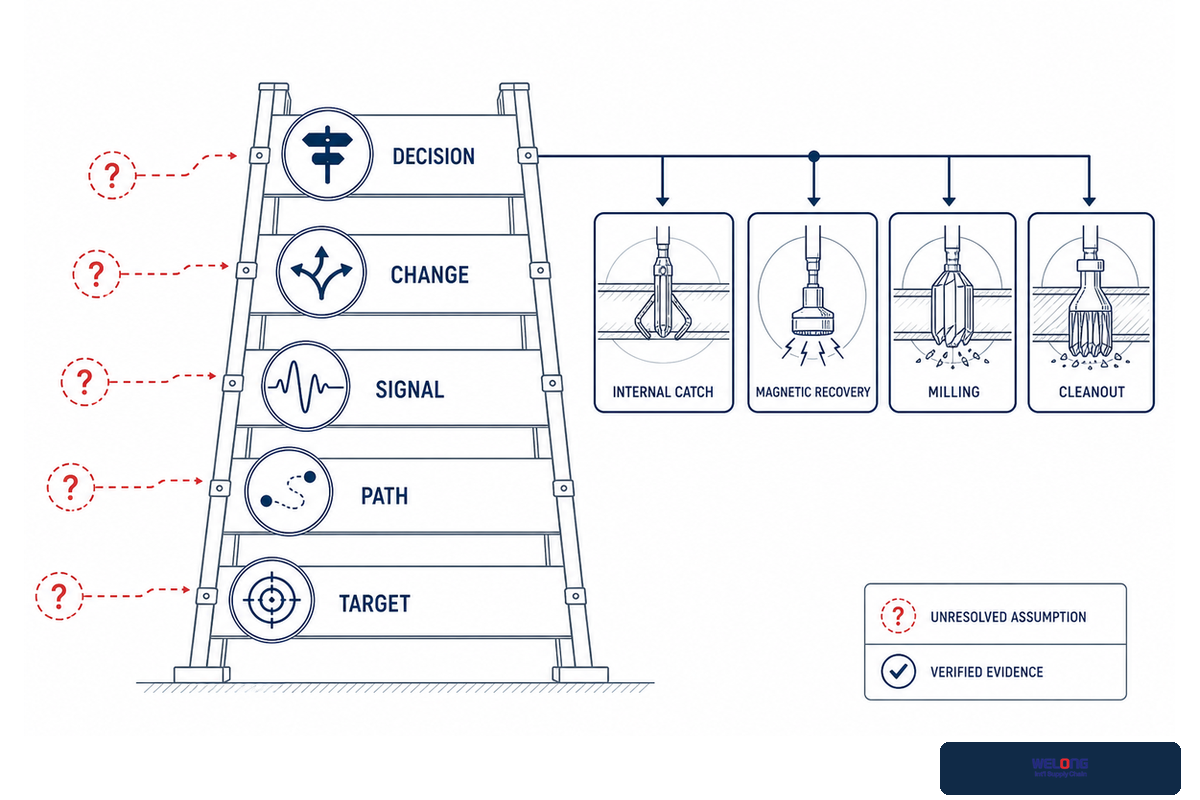
In practice, an unchanged repeat risks preserving a failed recovery hypothesis. The 5-Step Recovery-Path Triage Ladder is a diagnostic framework, not a universal operating sequence or fixed instruction to abandon a job.
Step 1 – Reconfirm the object model. Did the run recover material, change the likely fish top, or show that the target is fragmented rather than continuous?
Step 2 – Recheck the path. For an overshot, reconsider access and engagement surface. For a basket, reconsider loosening, circulation transport, and retention.
Step 3 – Compare signal with expectation. Separate the planned catch indication from drag, packed fill, restricted movement, or another plausible cause.
Step 4 – Change the hypothesis before only changing effort. Ask what new evidence justifies another run and whether the load case, string condition, or target geometry has changed.
Step 5 – Escalate to the correct specialist path. Consider an internal catch, magnetic recovery, impact, milling, cleanout, or another engineered route when the evidence moves outside the original two-tool boundary.
OSHA records a fatal well-servicing incident in which the same force was reused after more than twenty joints had been removed, without recalculating the changed rig load. That event isn’t an overshot procedure, but it’s strong evidence for one narrow principle: changed string and load conditions require reassessment, not automatic repetition.
For an accessible inside surface, a die collar for an internal catch can belong in the discussion. Suitable ferromagnetic debris can call for magnetic recovery. An impact route can involve a super hydraulic fishing jar. These are adjacent paths, not interchangeable versions of an overshot or junk basket.
Drilling, Wireline, Slickline, and Thru-Tubing Scope Boundaries
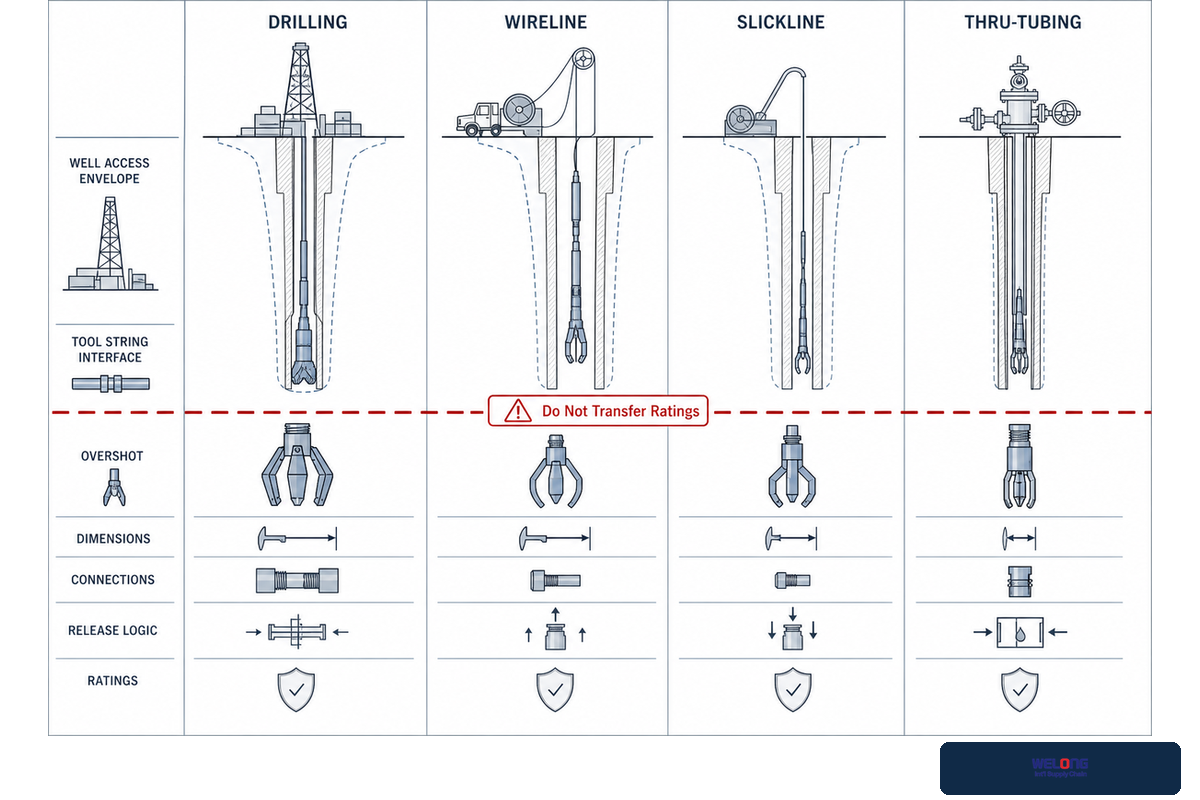
For a supplier or operator, the risk is assuming that one shared name defines one application. “Overshot” describes a catch concept in more than one intervention context, but it doesn’t guarantee shared dimensions, interfaces, release logic, ratings, or operating practice. Drilling, wireline, and coiled-tubing overshots can all engage an object while belonging to different systems.
The thin-wall/coiled-tubing overshot patent is useful precisely because its scope is specific. It shouldn’t be read as a specification for a drilling overshot. Apply the same caution to “junk basket,” “circulating junk basket,” “junk sub,” and related terms: resolve the service context before transferring a mechanism or value.
Shared concept: recover an unwanted downhole object through a defined interface or transport path.
Do not transfer by name alone: dimensions, connection, load, pressure, circulation program, release procedure, or acceptance criteria.
Do not transfer by name alone: dimensions, connection, load, pressure, circulation program, release procedure, or acceptance criteria.
From Diagnosis to Overshot or Junk Basket Specifications
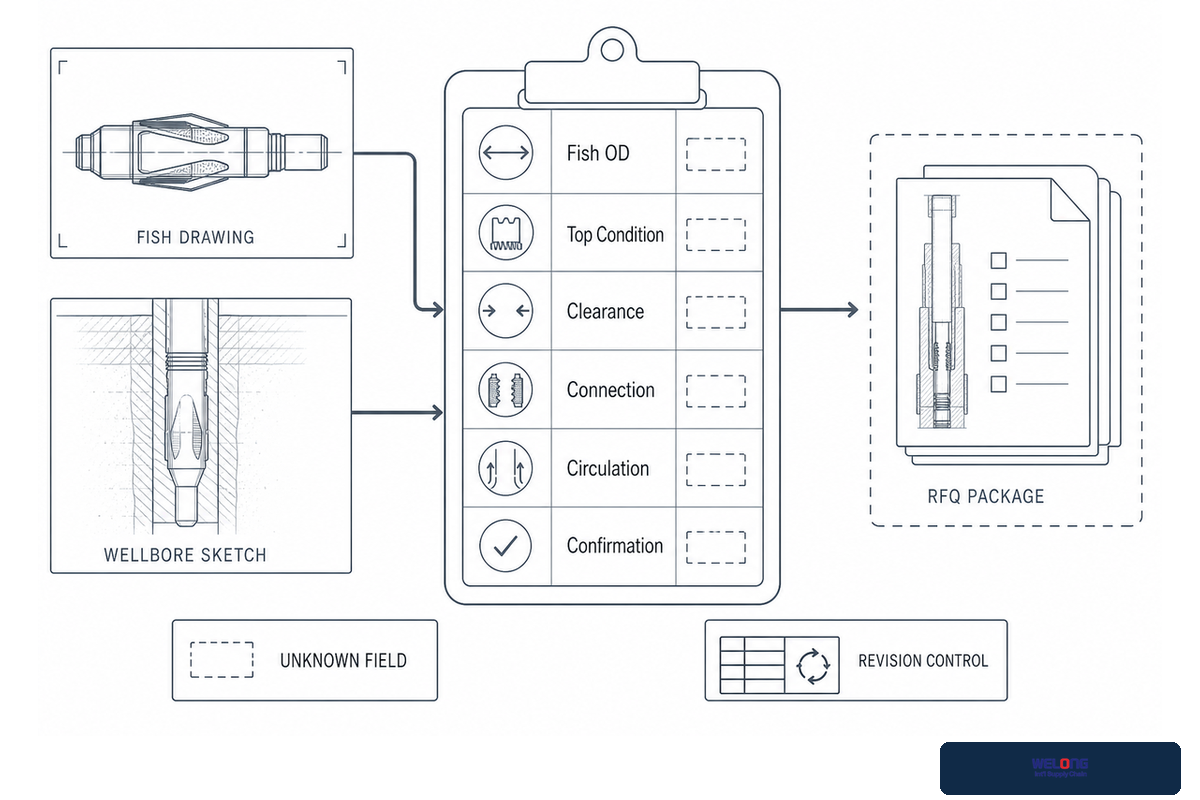
Once the target and recovery path are defensible, the commercial handoff becomes straightforward: package the worksheet, state the chosen tool-family hypothesis, identify the required interfaces, and request a model-specific review. This is the point to compare overshot and junk basket sizes and configurations without forcing those tables into an informational guide.
For buyers coordinating documentation, inspection, and supplier communication, the separate guide to sourcing oilfield equipment from China provides the procurement context. The technical recommendation should still be tied to the actual job inputs and approved by the responsible fishing specialist.
Reviewed by the Welong technical team.
Related Fishing-Tool Guides
- Oilfield fishing tools and recovery-path families
- External catch fishing tools and engagement concepts
- Die collar internal-catch context
Frequently Asked Questions
What is the main difference between an overshot and a junk basket?
An overshot fishing tool externally engages a defined fish through a usable outside surface. A junk basket collects loose debris through a circulation-assisted path and catcher. Select the recovery family from the target form and available path before comparing sizes, connections, or models.
Can a junk basket recover a stuck drill pipe?
No. Stuck drill pipe is a continuous tubular fish, so crews normally evaluate an external or internal catch route rather than a junk basket. A basket becomes relevant only for loose, transportable debris that can enter and remain within its collection path. Confirm fish geometry, accessible surface, surrounding restrictions, string condition, and the planned confirmation signal. If those inputs are uncertain, gather diagnostic evidence before choosing a tool family and have the responsible fishing specialist review the recovery hypothesis.
How do you know on the surface if an overshot has latched onto the fish?
Compare the observed response with the model-specific job plan. Movement, string weight, torque, pressure, or returns can reflect drag, fill, blockage, partial engagement, or a catch. Confirm the result through trip-out evidence, recovered hardware, and post-run inspection; no single surface change is definitive.
What is a reverse-circulation junk basket?
A reverse-circulation junk basket is a downhole fishing tool that directs fluid so loose debris moves toward a collection chamber, where a catcher helps retain it during retrieval. An IODP operations report records a job-specific junk-basket run and recovered debris; it does not establish a universal operating setting. It is suitable only when the debris is loose, transportable through the available flow path, and retainable by the selected assembly. Model-specific operating values still come from the approved job program.
What information is needed to select an overshot or junk basket?
Provide the target description, fish dimensions, fish-top condition, accessible length, hole or casing geometry, restrictions, connection data, circulation path, debris form, and results of previous attempts. Mark unknowns explicitly, include the governing drawing or specification revision, and state what evidence will confirm recovery.
When should you stop repeating the same fishing run?
No universal attempt count or time limit applies. Review the evidence after each trip out. If the last run adds no support to the object model and nothing has changed in the load case, string condition, target geometry, or recovery hypothesis, an unchanged repeat is hard to justify. Gather better diagnostic data or have the responsible specialist reassess internal-catch, magnetic, milling, cleanout, or other engineered routes. Document why the revised path addresses the last run’s evidence.
References & Sources
- IODP Expedition 349 Week 8 operations report
- IODP Expedition 362T operations report, 21 July 2016
- OSHA Oil and Gas Well Drilling and Servicing eTool: Abandoning the Well
- US9200495B2, wide-catch overshot patent record
- EP0418057A1, context-specific coiled-tubing overshot patent record
- API Monogram and APIQR latest updates
This guide separates field-event records, mechanism evidence, standards-scope pages, and model-specific commercial data. IODP operations aren’t presented as universal operating values, and patent filings aren’t treated as proof of field performance. Tool finalization and operating data belong to the responsible fishing specialist and the approved fishing plan.
![Casing, Tubing & Drill Pipe Elevators [Field Guide]](https://welongoiltools.com/wp-content/uploads/2026/09/casing-tubing-drill-pipe-elevators-guide-featured-768x512.png)
![Choke & Kill Hose: [Field Guide]](https://welongoiltools.com/wp-content/uploads/2026/07/choke-kill-hose-guide-featured-1-150x150.png)