Get in touch with Welong Company

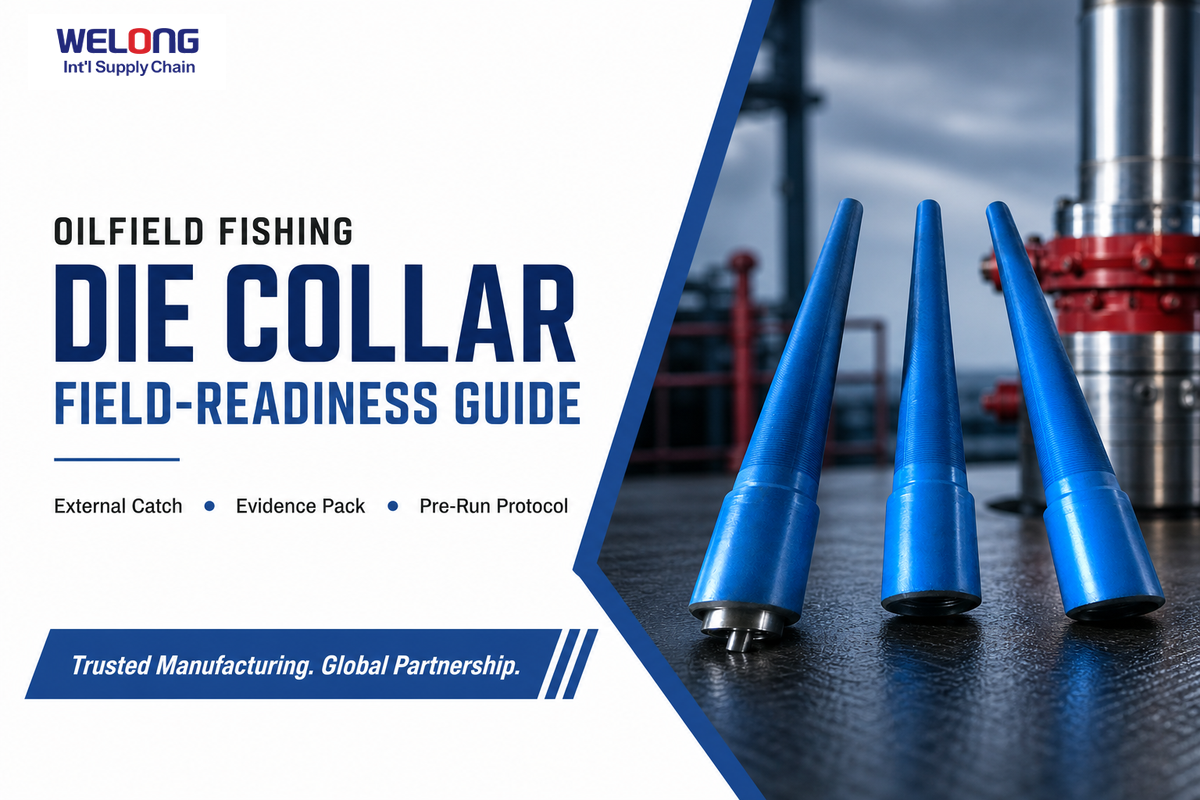
A Die Collar is an external thread-cutting recovery tool whose use must be assessed against the fish condition, well records, and the approved job procedure. This guide does not offer a catalogue, a catch-range table, or running instructions. It identifies the facts, uncertainties, and stop conditions that should be visible before a qualified team decides whether the external recovery route merits technical review.
Evidence, not catalogue size, should drive any die collar assessment. Visible fish conditions, record quality, alternative routes, and contingency owners should be identified and documented before a qualified team evaluates any die collar route. That overview establishes the evidence-handoff boundary and is not a replacement for the approved job procedure.
Quick scope
| Decision supported | Whether an external thread-cutting route is ready for technical review |
|---|---|
| Evidence pack | Fish condition, movement record, surface record, route alternative, string context, and contingency |
| Explicitly excluded | Capacity limits, running instructions, product sizing, and job-specific approval |
Key points before technical review
- Record what was observed separately from what was inferred.
- Until the procedure owner closes it out, keep internal, external, preparation, and alternate routes visible.
- Any missing record is sufficient reason to pause for clarification and is never a basis for a capacity assumption.
- Use case volumes only as context, not as tool limits.
Drawing the line matters. Product-focused search results often feature an extensive inventory. China Welong has a commercial Die Collar solution page. What follows outlines evidence-handoff preparedness; it does not describe product use, but provides a handoff for the technical review that follows approval.
Safety & Scope Note: The material within is not an instruction or authorization to conduct a fishing operation. Any fishing operation must follow the prevailing operating-company procedure, job safety analysis, well-control plan, field expertise and judgment, and authority requirements. API Recommended Practice 54 outlines a process-safety context and does not describe a die collar operating process. An independent well-servicing fishing incident decision underscores that safety controls must remain with the applicable procedure and responsible field personnel; this guide is not an operating procedure.
What a Die Collar Is, and What It Is Not
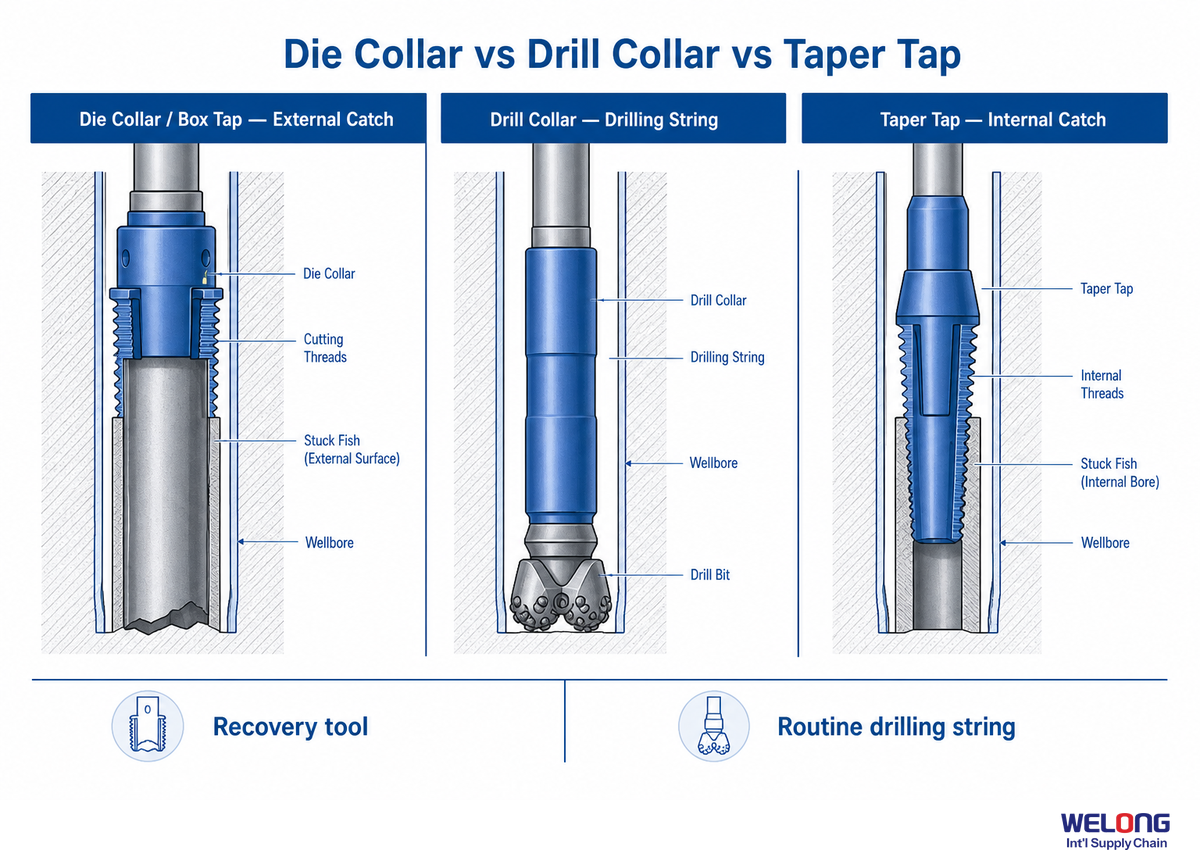
When an external-engagement fishing route is being assessed, this guide does not ask the reader to infer damage to, or the condition of, a fish left in place through an existing internal entry. Public descriptions do not always distinguish the tools cleanly. Use those differences to examine the applicable procedure and records and confirm the actual equipment involved, rather than treating tool terms as interchangeable.
Search terms such as “die collar fishing tool” may help locate a relevant recovery discussion, but they do not establish a product, fish condition, procedure, or operating route. No search identifier can replace the records and technical analysis needed for a specific tool or route. RFQs require more information.
It is also not a drill collar—a standard part of a drilling string. If a die collar is considered, it follows a problem that raises a recovery question beyond routine drilling. The Texas oil-well servicing manual is retained as historical and terminology-comparison background only; it is not an oilfield operating procedure or evidence for decisions about a specific operating route or contingency.
What is a die collar in drilling?
In this guide, a die collar is an external thread-cutting recovery route assessed against fish condition, well records, and the approved job procedure. It is not a label for any tool that might grab pipe or a promise that a visible fish can be recovered. Public sources support a limited technical scope, not a universal oilfield acceptance limit.
Start With the Recovery Route, Not the Tool Name
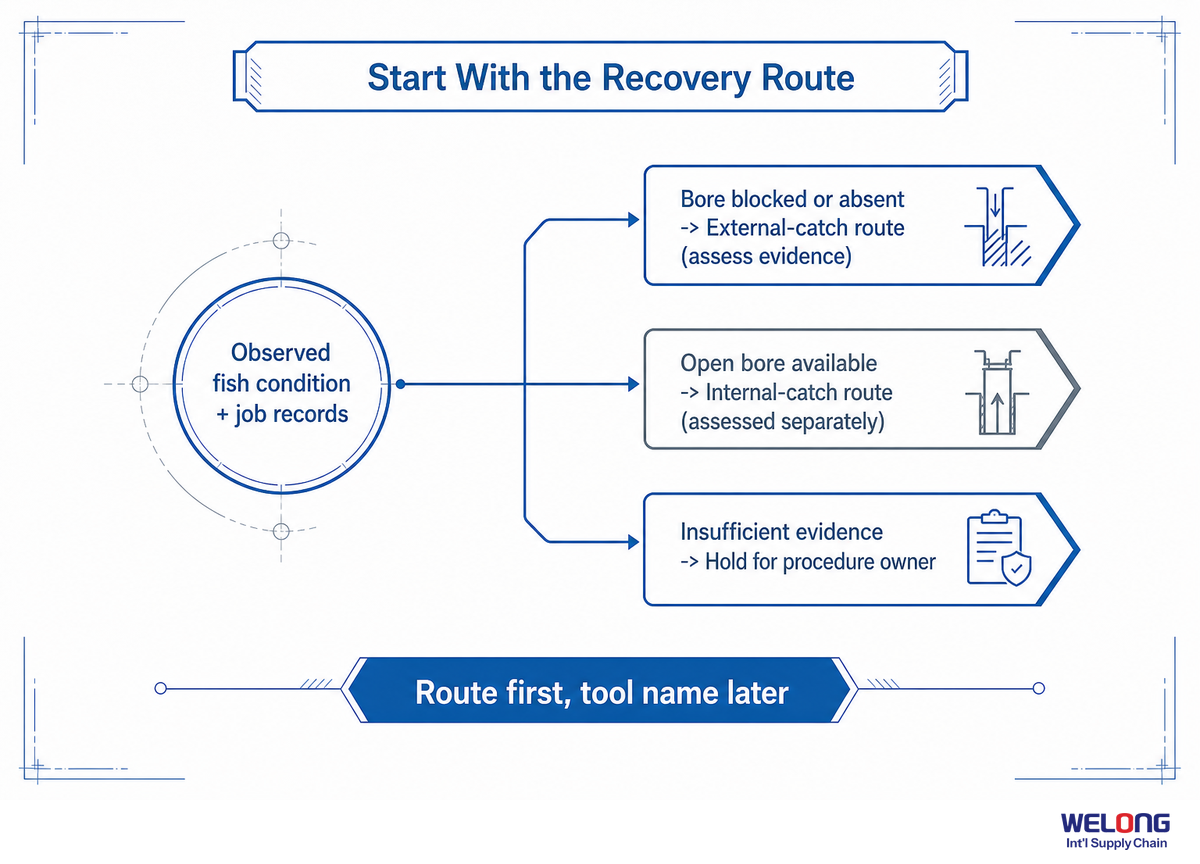
Fishing decisions concern routes, decision trees, and paths. State the recovery issue before giving a product-family name, and keep choices open until the procedure and best available evidence support a technical review.
State a one-sentence route before naming the die collar: “We’re considering an external engagement for the planned work because of the observed fish condition; the execution remains contingent on the approved procedure, wellbore movement evidence, outside-surface evidence, and a contingency plan.” This sentence will guard a product discussion from backfilling bore access assumptions, outside-surface assumptions, or releasability assumptions that aren’t substantiated by evidence and the procedure. Product families don’t dictate the job routes.
If the evidence-based route statement doesn’t specify or mention data or alternative choices, a risk is inherent: a named product will cover evidence gaps. Ensure these evidence gaps are addressed by qualified persons prior to the handoff for technical review or contracting procurement because the requesting document won’t be able to supplement evidence requirements per the approved procedure.
- Identify observations and inferences about the top or exposed end of the fish or fish substitute.
- Identify observations and inferences about fish or fish-substitute movement.
- State which alternative route is being kept open.
- Refer to and cite the applicable procedure, risk-assessment, and well-control precautions that govern the technical review.
That structure will help you differentiate this page from a fishing and milling tools category page, which serves as a menu for families, and the evidence statement below, which assists a project team in deciding which items require verification before mentioning the fish family or families for a specific case.
Gate 1: What Movement Evidence Must Be Recorded Before Engagement?
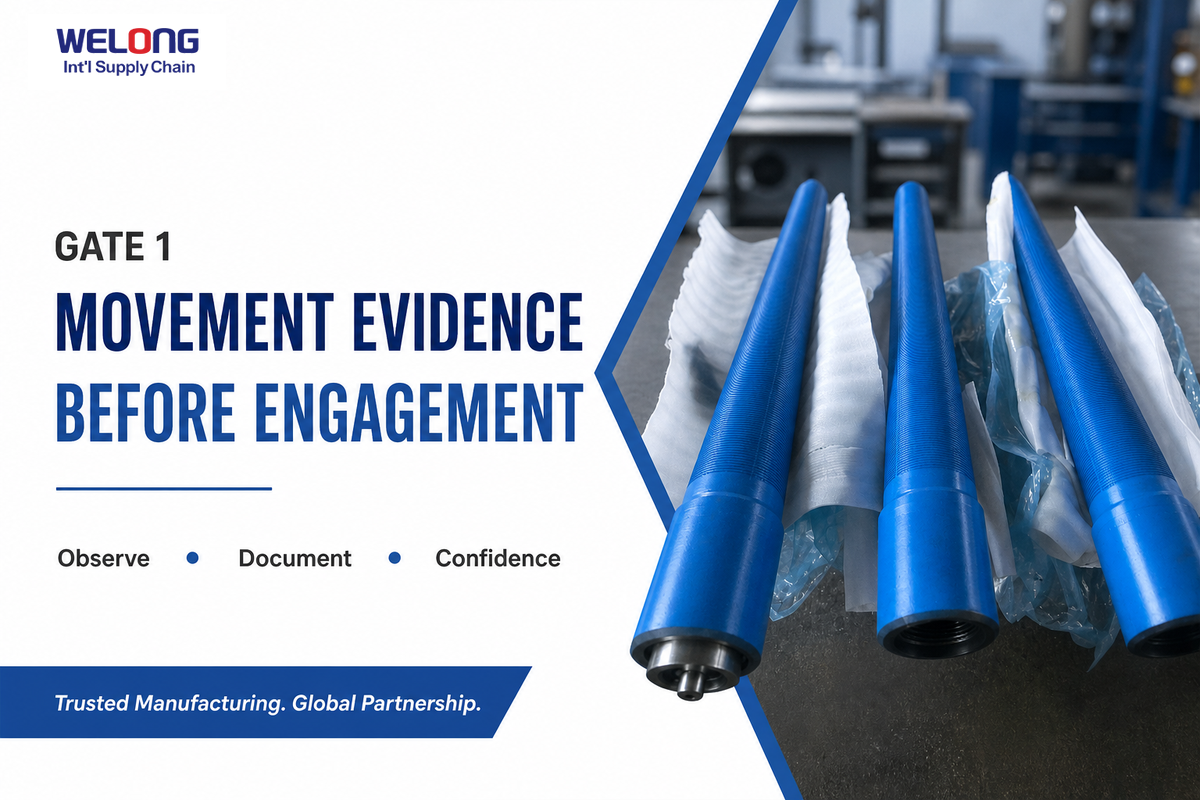
Avoid phrasing a requirement as “the fish must be stationary,” as a public oilfield standard that defines a general movement threshold for die collars wasn’t found during this investigation. Instead, focus your question: “What’s the job team’s observed knowledge of fish movement?” and expand: “How was the observation made and where in the available procedure will the observation be documented and used to direct the job or a future action?”
Document observations, their sources, a confidence level for the information, and intended actions if confidence is low. Guidance should not encourage documentation merely for paperwork. Where 30 CFR 250.740 applies to the relevant drilling operation, the official eCFR requires well records to be legible, complete, and accurate for daily operations; this regulation does not mandate a die collar log or provide general standards.
If a motion observation is orphaned from its job record and review basis, don’t transform it into a technical or purchasing assumption. That doubt is pertinent, because an unauthenticated observation neither justifies nor explains why the route should prevail; keep the alternate route. Pass the documentation deficiency back to the procedure owner.
“Complete, legible, and accurate daily records for each well.”
30 CFR 250.740, official eCFR, where applicable
For perspective, public case literature on stuck-pipe events shows why an undecided completion maneuver needs a documented evidence handoff before string movement. It is not a die collar benchmark or an operating procedure.
Contextual string components are described on a fishing-jar context page; do not confuse it with the evidence requirement.
No generic component page can stand-in for an explicit job record motion observation and its authorized contingency.
Gate 2: What Outside-Surface Evidence Is Usable Without Inventing a Capacity?
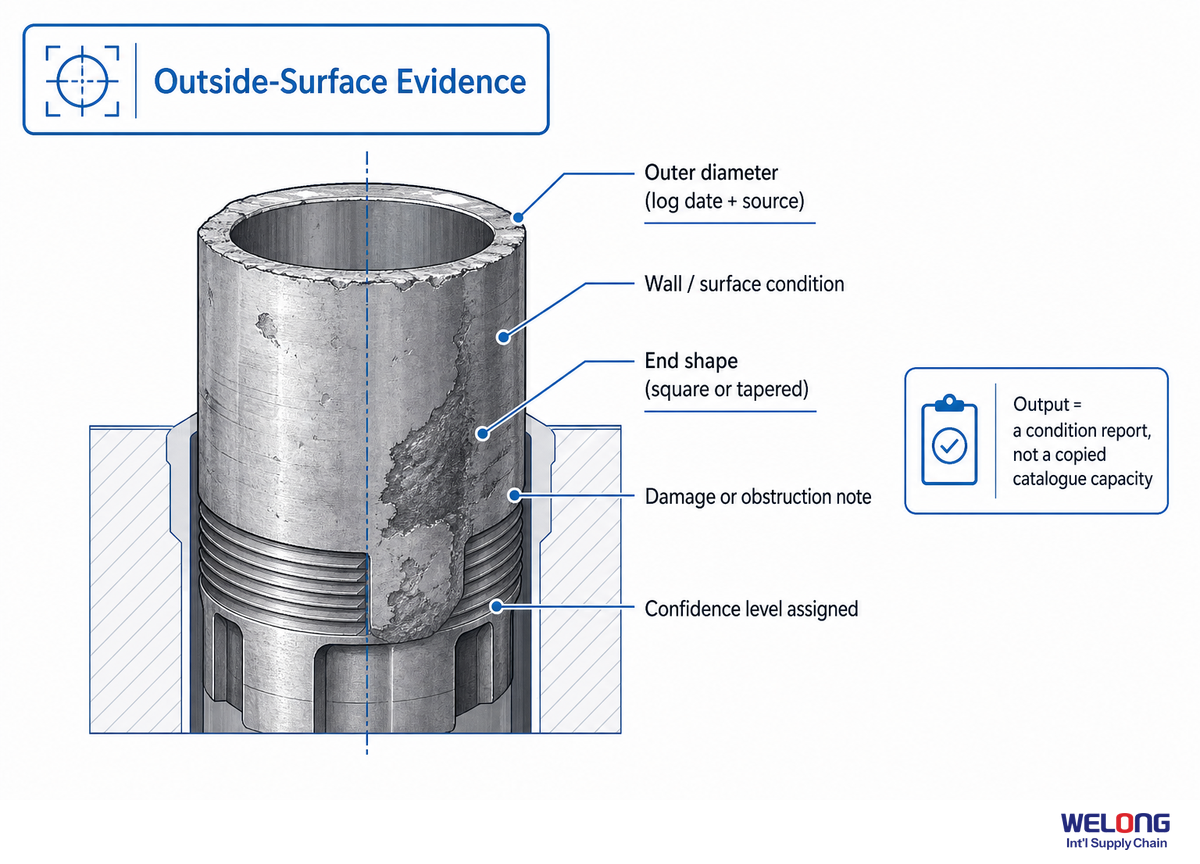
An observed exterior surface condition does not equate to validated engagement potential. No all-purpose die collar capacity limit is established here for engagement limits, torquing range, or required wall thickness.
A condition report, not a copied catalogue number, is the proper output of this gate.
Supporting material might include the date the diameter was logged, whether the exposed end surface looks damaged, its shape (square, tapered, and so on), the reported condition of that end, the certainty assigned to these inputs, and the standard governing the qualified analyst. If field preparation or other context is requested, refer to casing-scraper information or a technical RFQ checklist; this document is not for instructing field execution.
An official Occupational Safety and Health Review Commission (OSHRC) decision below illustrates why manufactured limits should not be used. It shows that numerous pieces of data can be required for decisions about string conditions; none of its numerical values are a universal safe limit, capacity benchmark, or operating target for a die collar.
| Reported case fact | Rounded SI conversion | Why the evidence boundary matters |
|---|---|---|
| 7,500 ft below the wellhead | 2,286 m / 2.286 km | Location is a case fact, not a route-selection rule. |
| 300,000 lb mobile-rig lifting capacity | 136,078 kg / 136.1 metric tons | Rig capability in one case cannot rate another tool or job. |
| 85 ft base-beam length; 4 ft width | 25.9 m; 1.2 m | Support geometry belongs to that rig record. |
| 6–12 in reported base-beam thickness | about 152 mm to 305 mm | Structural details do not become external-catch criteria. |
| 60 ft position above the rig floor | 18.3 m / 1,828 cm | Personnel exposure requires site-specific controls. |
| 96,000 lb pipe and bottom-hole assembly weight | 43,545 kg / 43.5 metric tons | String facts must stay attached to their source record. |
| 120,000 lb and 170,000 lb reported pull changes | 54,431 kg / 54.4 metric tons and 77,111 kg / 77.1 metric tons | Changing loads illustrate context, never generic targets. |
| 15–16 stands over nearly 1.5 hr | about 90 min | Removal pace is not a published operating prescription. |
| 85,000–100,000 lb indicated pull | 38,556 kg / 38.6 metric tons to 45,359 kg / 45.4 metric tons | One indication cannot establish a safe setting elsewhere. |
| 20–30 min reported time aloft | 1,200 sec to 1,800 sec | Timing belongs in the case narrative, not a tool guide. |
These numerical values are editorial conversions of reported case data and are provided only for international context; they do not create a technical specification.
That evidence boundary prevents two forms of document-control failure: relying on a case figure for capacity or importing it into an RFQ as operating data. That figure remains associated with the specific OSHRC case; it is not a die collar threshold value.
Gate 3: When Should the Team Assess an Alternative Route?
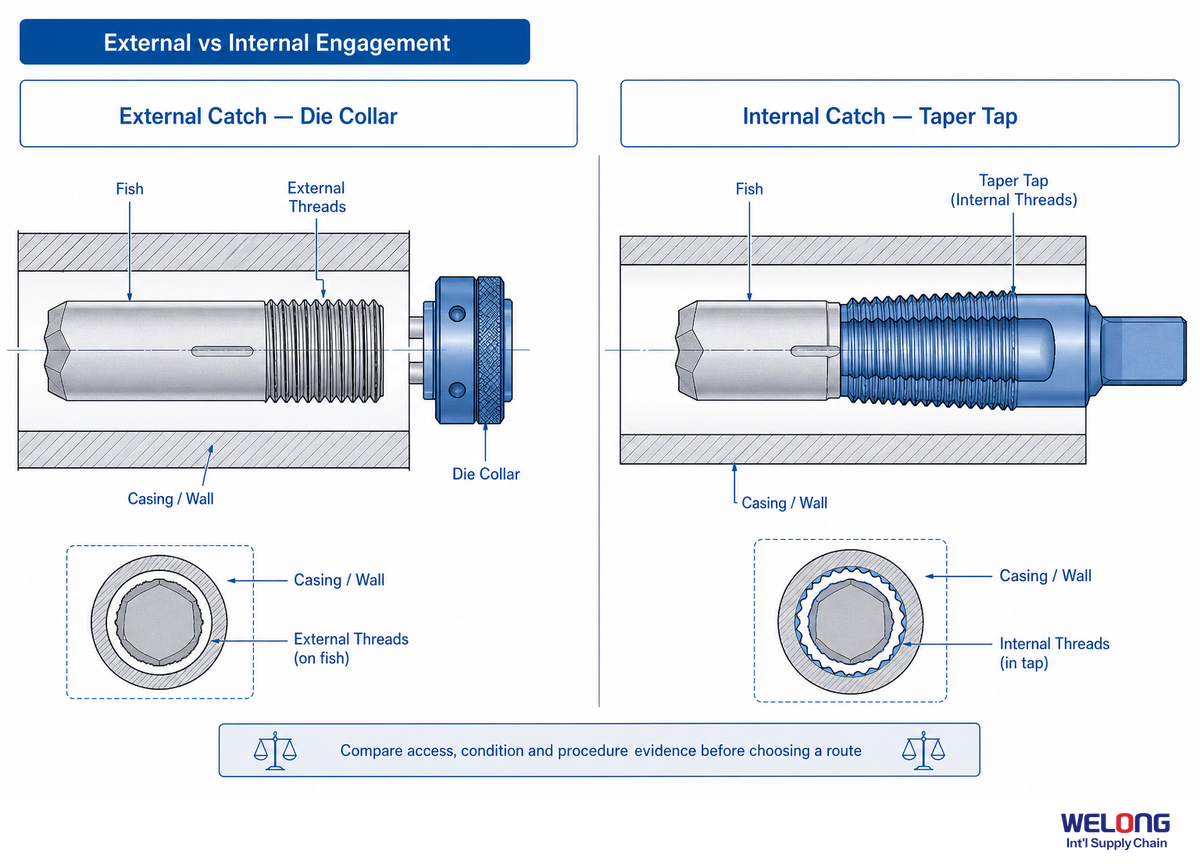
An alternative route should be assessed whenever the evidence stack fails to justify external engagement for the actual fish condition and approved procedure.
No default winner is advocated between alternative routes. Choices must be based on conditions and the authorized procedure.
When is a taper tap assessed instead of an external catch tool?
The team may assess a taper tap when the approved procedure and available condition records support an internal-engagement route; a die collar is considered separately for external engagement. OSHA’s glossary identifies a taper tap as the male counterpart to a die collar, but that terminology does not select a route. The qualified technical reviewer must compare access, condition, and procedure evidence before a commercial handoff.
If the internal and external route records can’t be compared on the same evidence basis, pause the commercial handoff rather than treating either label as a preference. One reason is simple: a qualified technical reviewer needs the missing access or condition record before procurement can describe a reviewable route.
In a China Welong procurement handoff, unclear catalogue wording can obscure the route under review and mislead readers about the product being considered. The appropriate technician needs the same access record regardless of route. Keep order-specific inspections subordinate to the chosen route; this guide does not claim capability or select an external tool.
For context on related string components, see drill pipe, drill collar, and drilling jars. These pages help distinguish the articles, not the fish condition.
Gate 4: What Must Be Confirmed in the String and Contingency Plan?
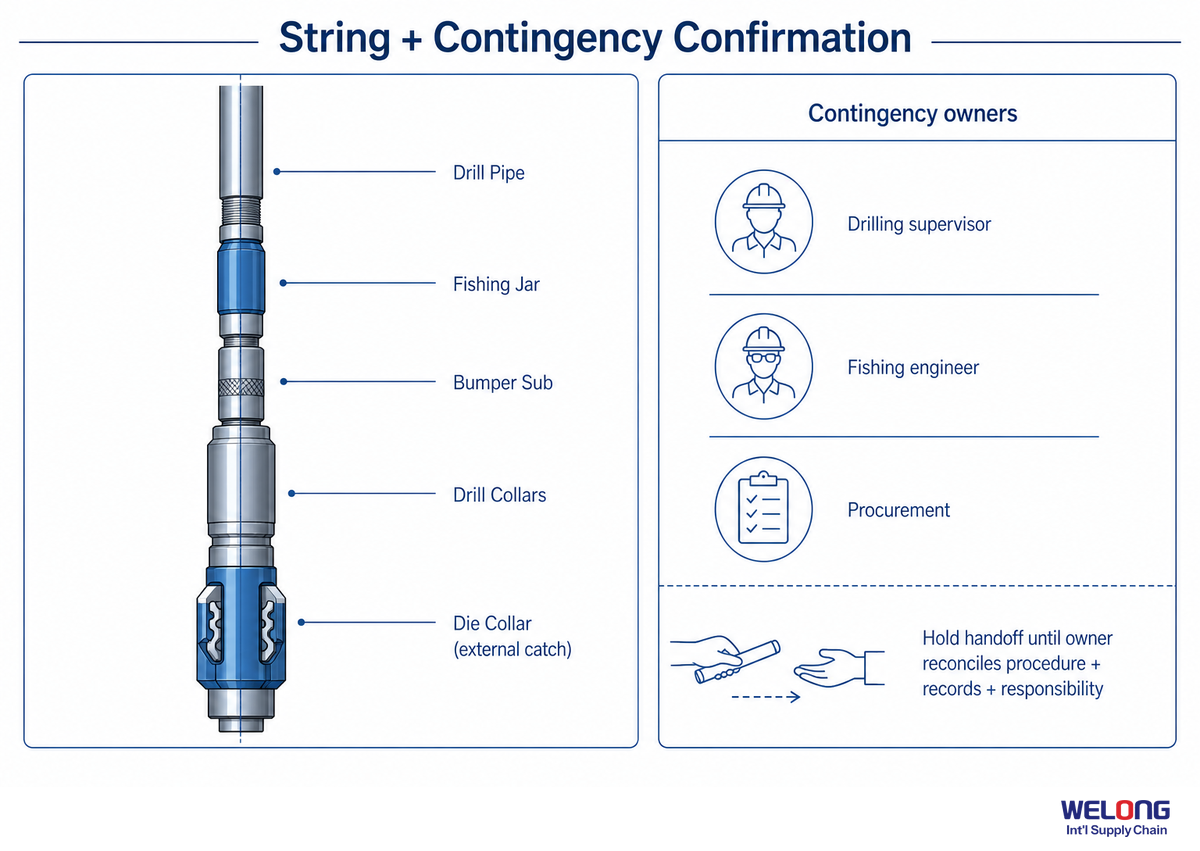
The governing procedure and field records, rather than the Texas oil-well servicing manual’s historical and terminology comparison, should establish the contingency. That manual is not an operative oilfield procedure. A qualified technician’s decision should identify the supporting information or record, the governing procedure, and the committed engagement condition.
IADC Special Operations covers related subjects, including fishing planning, stuck-pipe mechanisms, stuck-point estimation, string stretch, and fishing tools. It does not provide a specific oilfield operating procedure or a publicly available general procedure. The evidence pack should therefore identify fish conditions, string context, risks, available well-control information, and the responsible decision-maker before a qualified technician considers the route for technical review.
A contingency can appear complete while the string record or response owner remains unresolved, even when everything else appears settled. Because that mismatch leaves the next action without an accountable basis, hold the technical and procurement handoff until the qualified review owner reconciles the governing procedure, record status, and contingency responsibility.
In a China Welong procurement handoff, catalogue wording can obscure a contingency or be misapplied to selection of an internal or external route. A sound decision process coordinates the governing procedure, response owner, and any order-specific inspection record, and holds the handoff pending confirmation of decision authority. This establishes a document-control boundary without claiming capability or providing a running instruction.
Six-Record Pre-Run Protocol: Fish-to-Thread Fit Map
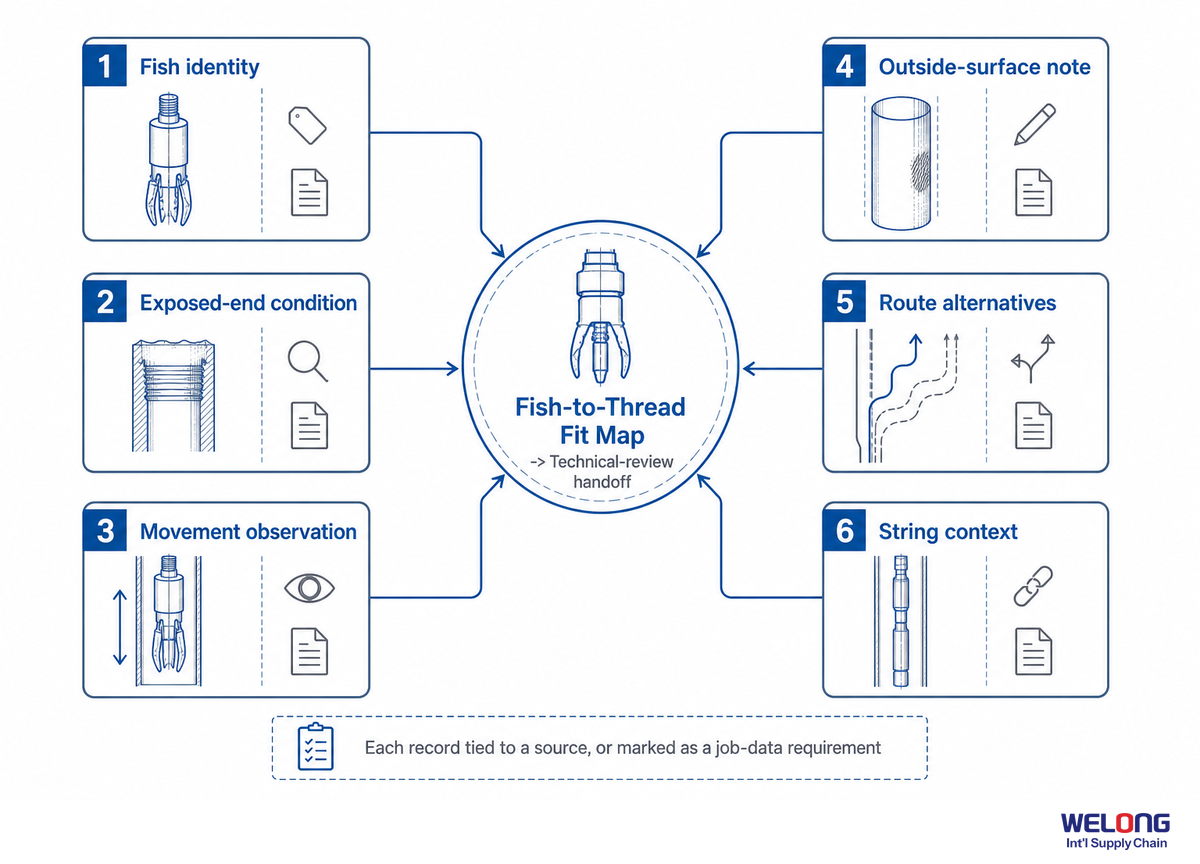
The Six-Record Pre-Run Protocol provides a structured handoff from six key data points before a die collar route is submitted for technical review.
Use the following worksheet to capture public-source context as a buyer-usable handoff; it deliberately remains unquantified when evidence does not support a threshold. Document it with the qualified job team under the procedure governing the well; anything unsupported by documentary evidence requires clarification, not guessing. Where applicable federal rules require complete, legible, and accurate daily records, the eCFR language reinforces the need to distinguish what the job record can and cannot evidence.
| Evidence type | Record | What to capture | Why it changes the next decision | Owner | If missing |
|---|---|---|---|---|---|
| Identity | 1. Fish identity | What is left in hole; source of identification | Separates a recovery description from a tool label | Drilling supervisor | Stop and reconcile records |
| Surface | 2. Exposed-end condition | Observed top/end condition and evidence source | Determines whether a route needs further assessment | Fishing engineer | Assess preparation or another route |
| Movement | 3. Movement observation | What moved, how observed, confidence and uncertainty | Prevents an unsupported stability assumption | Tool coordinator | Escalate under governing procedure |
| Condition | 4. Outside-surface note | Condition, obstruction, damage, and measurement source | Stops invented capacity claims | Engineering reviewer | Request evidence; do not estimate |
| Route | 5. Route alternatives | External, internal, dressing, debris-clearance, or other assessment | Makes the next question explicit | Fishing engineer | Document why no alternative is viable |
| System | 6. String context | Relevant components, records, and procedure references | Links tool discussion to the actual recovery system | Rig and service leads | Hold technical review |
| Control | 7. Risk and well-control boundary | Applicable job safety analysis, plan, and authority requirements | Keeps the worksheet subordinate to site controls | Operations lead | Do not proceed from the guide |
| Contingency | 8. Contingency | Owner, trigger, communications path, and alternative review | Tests readiness for a committed catch | Named decision owner | Reassess the route |
| Status | 9. Evidence status | Verified, qualified, missing, or contradictory | Turns uncertainty into a managed handoff | All reviewers | Use stop-and-switch matrix |
Use the 6-Record Fish-to-Thread Fit Map. The first six rows represent the basic handoff, while rows 7–9 expose the boundaries of safety, contingency, and uncertainty. Once the full evidence package is complete, the team can review Welong’s external-catch Die Collar options in the appropriate commercial context.
Stop-and-Switch Decision Matrix: Reassess, Stop or Proceed
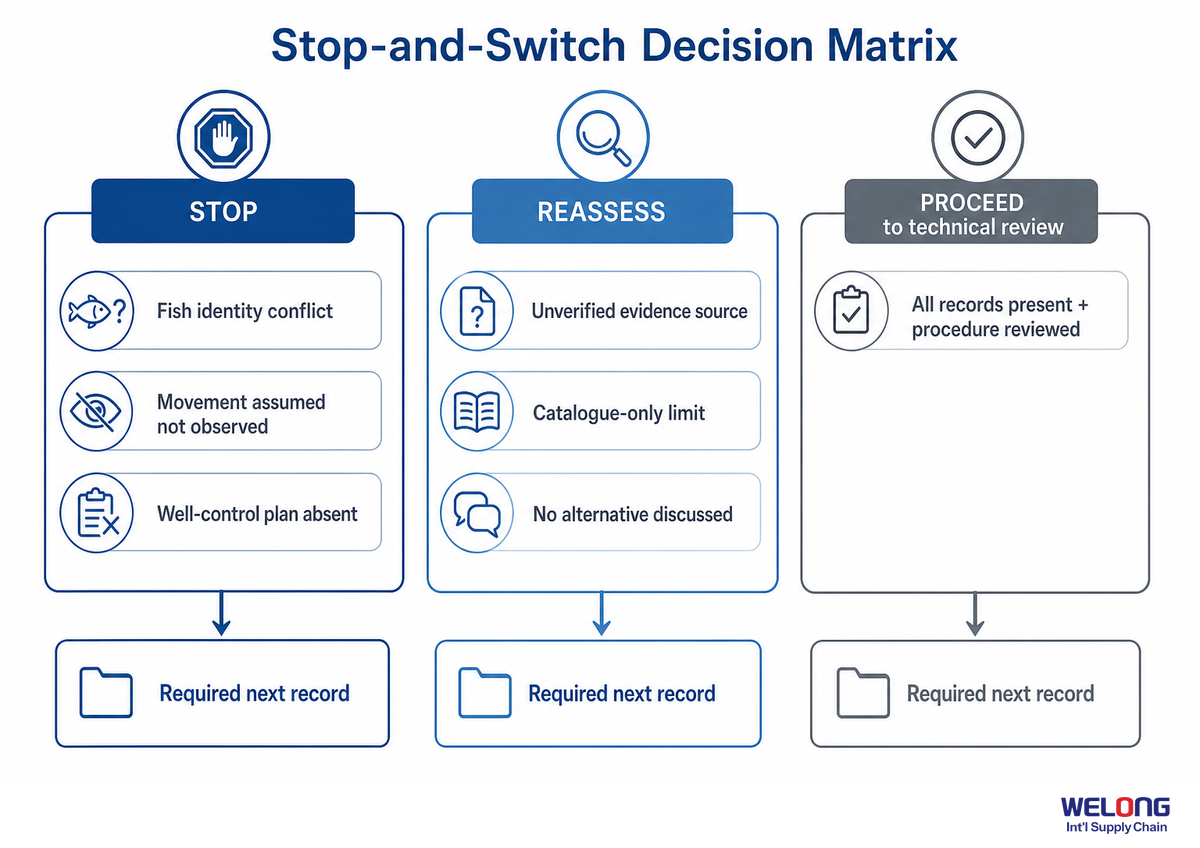
The Stop-and-Switch Decision Matrix helps ensure evidence gaps are identified before a blog article or vendor brochure is mistaken for an instruction to a rig crew. It is not a protocol for operating a tool in a wellbore.
| Observed evidence state | Decision posture | Reason | Required next record |
|---|---|---|---|
| Fish identity conflicts across records | Stop | Recovery question is not stable | Reconcile source records |
| Exposed end is described but evidence source is unknown | Reassess | Condition cannot be checked | Obtain the governing observation |
| Movement is assumed rather than observed | Stop | No universal threshold is supported here | Record observation and procedure basis |
| Outside condition is paired with a catalogue limit only | Reassess | Catalogue data is not a job-specific acceptance record | Capture condition evidence |
| Alternative route is not discussed | Reassess | Route choice has not been tested | Name the next assessment |
| String context is incomplete | Stop | Tool discussion is detached from recovery system context | Collect plan and component records |
| Risk assessment or well-control plan is absent | Stop | A guide cannot replace site controls | Return to authorized procedure |
| Contingency owner is unnamed | Reassess | A committed-catch response is not accountable | Assign owner and trigger |
| All records are present and procedure review is complete | Proceed to technical review | Evidence supports discussion, not automatic execution | Use approved job process |
Why does a non-releasable fishing route need a stop rule?
Between evidence and confidence, a stopping rule is necessary. That protocol neither treats the Texas oil-well servicing manual’s historical product-family comparison as current oilfield practice nor uses it as validation. Any stop condition, along with all contingencies, should be established per the governing job procedure, relevant risk assessment, well-control considerations, and job records where that regulatory context applies.
Use this matrix as a procedural check against differing evidence states between technical review and an RFQ. Evidence discrepancies are grounds for a halt and full resolution because no procurement language can override a lack of documented procedure or an absent accountability owner; qualified review input is required.
What Changes in Better-Prepared Fishing Jobs

Better-prepared fishing jobs improve the handoff when the supervisor, fishing engineer, tool coordinator, quality staff, and purchasing team share the same verified facts, uncertainties, and decision boundaries. The outcome is not a claim of universal tool performance. Where it applies, 30 CFR 250.740 supports keeping daily well records complete, legible, and accurate rather than replacing record evidence with sales language.
Simply using information from sales support literature as though it were technically supported or vetted does not improve the handoff. Before proceeding, reconcile any discrepancies between procurement-documented status and technical-support documentation, because qualified technical review—not catalogue or procurement language—drives the next inquiry.
This process can create a clearer, more efficient handoff between China Welong teams responsible for technical work and sales or procurement. The team can produce an evidence package and transmit relevant components to China Welong for review of manufacturing capabilities, supplier development oversight, purchasing supervision, and quality-assurance and control measures. It does not include field performance of China Welong wells, nor is it a claim of relative or best-in-class recovery or other performance characteristics specific to China Welong.
Retain the final record in the job file, apply well-specific authority and operating-company requirements, and use the evidence pack to sharpen the next technical discussion.
7-Field Catalogue Claim Boundary

Catalogue language can start a conversation, but it does not close one. A catalogue statement such as “a Die Collar is a special external fishing tool” may introduce external oil-tubing routes and drill pipe but does not establish an external catch, fishing threads, or suitability for a particular recovery operation. Incomplete job records limit equally short claims such as “die collar is a special” and “collar is a special external.”
Words indicating geometry are merely prompts for evidence, not admission criteria. An inner access question, a bottom condition, a diameter description for the fish, a cylindrical body, or an actual pressure context must be attached to a governing procedure, as well as to supporting records. No geometric term presents here a universal limit for selection of a route. Where an applicable record-keeping rule applies, use an official eCFR recordkeeping context reminder to identify whether the word represents an observation or an inference.
Similarly, phrases like “make threads easily,” “plain,” “flat,” “lipped guide,” “processed by special heat treatment,” “high quality alloy steel,” “integral,” or “made with chip groove” may appear in original equipment manufacturer (OEM) literature for machinery or oil tools. These are industrial terms, not verified components of a particular China Welong production. Treat such catalogue terms as indications of industry vocabulary and require order-specific documentation signed by a qualified person for review.
Each catalogue field still comprises a claim boundary for purposes of an RFQ or technical review unless the appropriate records and governing procedure can be clearly identified. If they aren’t available, an initial claim shouldn’t be added to handoff for the work. A qualified reviewer or its delegate should resolve such a gap before a buyer can rely on it for procurement.
Outlook: Better Evidence Before the 2026 Technical Review
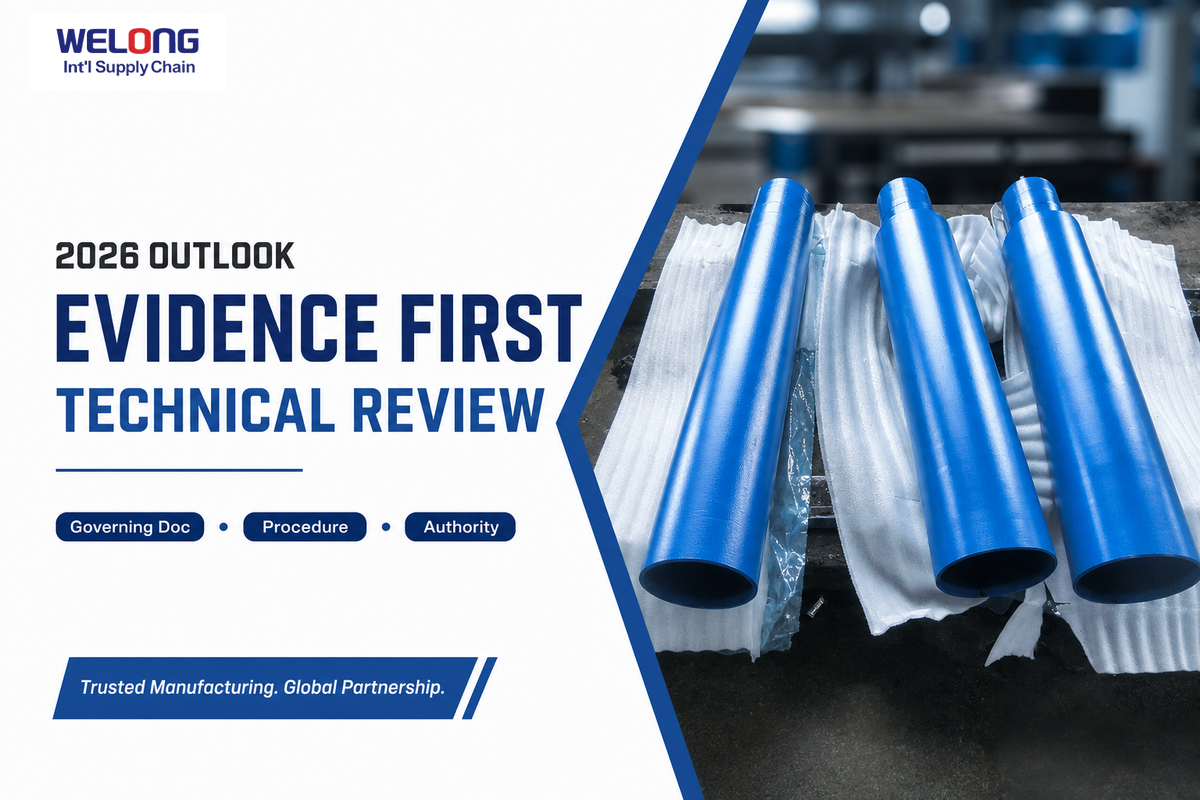
A 2026 technical review should feature less catalogue language and more evidence handoff—one that separates observed facts from estimated facts and separates both from the procedure owner’s forthcoming decision. Such a handoff can provide lasting value without assuming a universal external-thread-cutting limitation from the public record.
Relevant equipment documentation can signal change control, not development of a new die collar procedure. The public records used in this guide do not indicate a universal standard for operating a die collar in actual wells. Before placing an RFQ for a technical review, identify the current governing document, well-specific operating procedure, equipment documentation, and responsible authority for the work.
A qualified reviewer should confirm that the job and governing procedures support an intended handoff before it becomes a purchase decision. Publicly available records cannot fill that gap. If the underlying authority for a proposed route cannot be provided, send the matter to technical review rather than an RFQ.
Ready for a commercial review after the evidence handoff?
Forward qualified job records, the external-route question, and the sanctioned review route to China Welong’s die collar technical review page. Begin the product conversation following the evidence pack, not instead of it.
FAQ
What is the difference between a die collar and a drill collar?
View answer
A Die Collar belongs to a recovery conversation about external thread-cutting engagement. A drill collar is part of the normal drilling string and supplies weight and stiffness near the bit. Similar naming shouldn’t drive an operating or purchasing decision. A useful distinction is recovery-route assessment versus routine drilling-string function. The article stays on the recovery-evidence side and doesn’t provide a drill-string design recommendation.
Can a die collar be used when the fish has no open bore?
View answer
An external thread-cutting route may be assessed because it doesn’t depend on access through an open bore. That doesn’t make the route automatic. No public source reviewed for this guide establishes an oilfield-wide acceptance threshold. A qualified job team should document exposed-end condition, observed movement, the governing procedure, applicable risk controls, and the contingency route before technical review decides what to assess next.
Why should movement be recorded before an external thread-cutting run?
View answer
Nothing in the public record reviewed here establishes a universal oilfield rule for a stable fish. It does show that thread-cutting engagement is a mechanism with scope-sensitive limitations. Record the observed movement, the basis for the observation, the procedure that governs the job, and the alternative route to consider if evidence is incomplete. It is a decision record, not a substitute for a qualified field procedure.
What job records should be sent before a Die Collar is selected?
View answer
Send depth, fish identity, exposed-end condition, diameter evidence, movement observation, outside-surface note, applicable operating procedure, risk and well-control references, and string and contingency details. Treat this list as an evidence handoff, not a tool specification or an instruction to run a tool. Its purpose is to prevent a commercial conversation from filling gaps that the job record should resolve first.
When should the recovery team reassess a committed route?
View answer
Reassess when movement is assumed rather than evidenced, the exposed end can’t support a credible assessment, the condition record is incomplete, a route alternative hasn’t been reviewed, or the contingency owner is unnamed. Reassessment can also be appropriate when a catalogue description becomes more detailed than the job record, when an internal versus external route hasn’t been owned by the qualified reviewer, or when the relevant risk and well-control references aren’t attached to the handoff. Its purpose isn’t to declare a tool suitable or unsuitable from a blog. Instead, keep an uncertain evidence pack from becoming an irreversible decision underground, and move the next conversation back to the person and procedure that can evaluate the actual well conditions.
Related Reading
- Bumper Sub vs. Jar: related string-context comparison
- Stuck-pipe cost estimator: use only after technical evidence is organized
- Rotating vs. non-rotating selector
- Size and connection finder
- Bumper-sub model finder
References & Sources
Reference this documentation only to verify scope, not to select a tool. If a questioned limit or route can’t be clearly linked back to the job records and applicable governing procedures, remove it from the handoff and return the question to the qualified review owner.
- API Recommended Practice 54, oil and gas drilling and servicing safety context.
- eCFR: 30 CFR 250.740 (official daily well-record requirement where applicable)
- OSHRC well-servicing fishing incident decision, safety context only; not an operating procedure.
- Texas oil-well servicing manual, historical and terminology-comparison background only; not an oilfield operating procedure.
![Choke & Kill Hose: [Field Guide]](https://welongoiltools.com/wp-content/uploads/2026/07/choke-kill-hose-guide-featured-1-150x150.png)