Get in touch with Welong Company

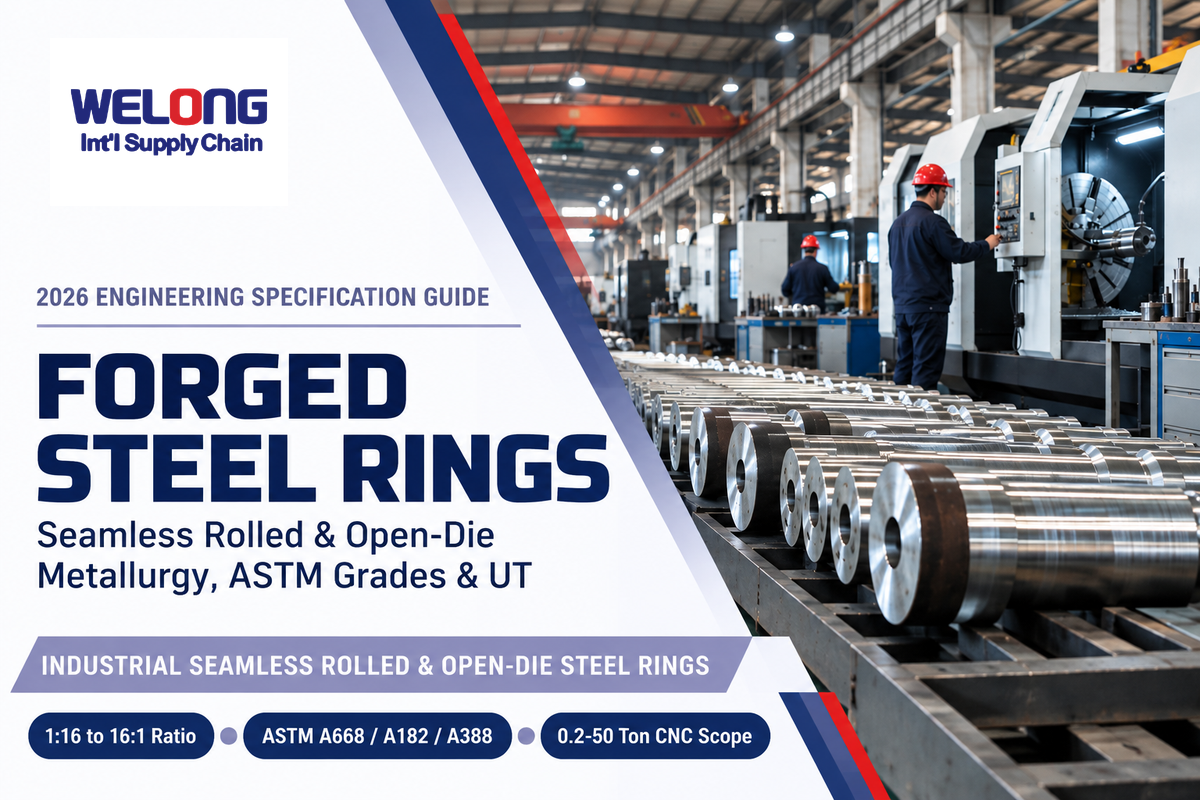
Forged steel rings are solid-state compressed annular metal components made by radial-axial seamless ring rolling or open-die mandrel forging to align circumferential grain flow with hoop stress in bearings, gears, flanges, and pressure vessels. Industrial forged steel rings conform to the ASTM A668, A182, A336, and EN 10204 metallurgy standards as used in heavy rotating and pressure equipment. They are independent of drop-forged fall-arrest hardware, decorative square-bar fence rings, or wearable jewelry bands.
Key Engineering Specifications at a Glance
Seamless ring rolling covers wide circular blanks across 1:16 to 16:1 wall-to-height ratios; taller heavy-wall sleeves route to open-die mandrel presses up to 150+ tons.
ASTM A182/A182M-26b Clause 1.3 limits individual alloy and stainless piping rings to 10,000 lb (4,540 kg), routing heavier forgings to ASTM A336/A336M or ASTM A965/A965M.
Valid ASTM A388/A388M-26 ultrasonic inspection demands proof-machined surfaces at 250 RMS or finer, circumferential angle-beam scanning on thick hollow rings, and ASTM A745/A745M-24 for austenitic stainless steel.
EU Carbon Border Adjustment Mechanism (CBAM) final reporting and certificate rules became effective as of January 1, 2026, requiring verified melt-route emissions data for EU-bound steel ring shipments falling under covered CN iron and steel tariff codes.
What Are Industrial Forged Steel Rings and How Do They Differ From Rigging and Jewelry Rings?
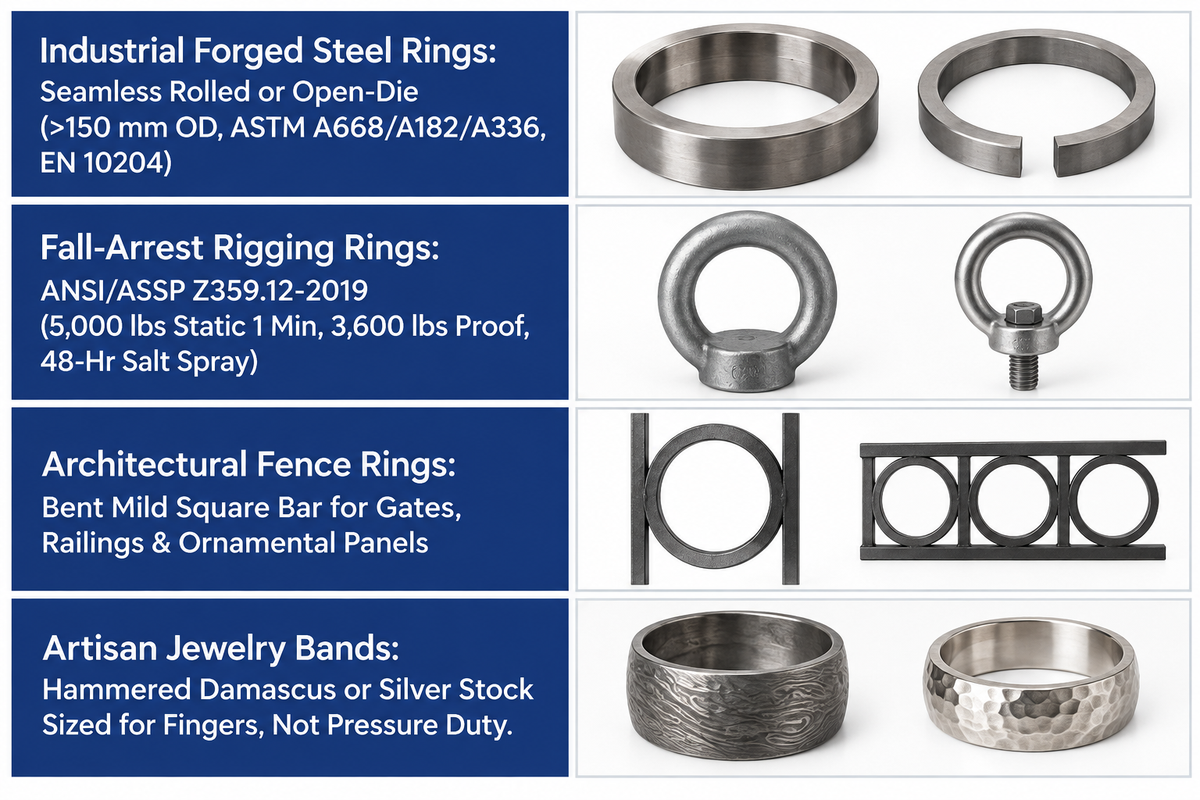
Industrial forged steel rings are custom-engineered annular forgings for heavy machinery and pressure work, hot-formed from solid billets according to ASTM and EN metallurgical specifications. Unlike ANSI/ASSP Z359.12 drop-forged rigging rings (5,000 lbs static), decorative square-bar fence hardware, or artisan jewelry bands, industrial rings are equipped with certified ladle chemistry, directional grain flow, and ultrasonic inspection.
Procurement engineers must separate four unrelated metal rings that share the same search name but come from completely different factories and safety codes. Industrial seamless rolled rings and open-die mandrel rings serve wind turbine slewing bearings, wellhead flanges, and gear rims. Drop-forged rigging connectors such as ANSI/ASSP Z359.12-2019 fall-arrest D-rings and O-ring holder loops are tested at fixed load rather than with custom machining.
Architectural ironwork suppliers such as Koenig Eisen bend decorative steel rings from mild square bar for fencing panels, gates, and railing inserts. Artisan studios hammer damascus steel or silver stock into personal bands sized for fingers, not pressurized housings.
Fall-protection connector standards show why rigging rings cannot substitute for industrial forgings. According to SATRA testing guidance for ANSI/ASSE Z359.12-2019 and the ASSP Z359 standards catalog, drop-forged D-rings, O-rings, and oval rings must hold a 5,000 lbs (22.2 kN) static load for at least 1 minute without failure. They must also pass a 3,600 lbs (16 kN) major-axis proof load with zero cracking or permanent deformation, survive a 5,000–5,405 lbs (22.2–24 kN) dynamic drop arrest using a 100 kg mass, and pass a 48-hour neutral salt-spray test. None of those PPE checks verify thick-wall pressure metallurgy, ultrasonic flaw limits, or steelmaker heat traceability.
| Ring Category | Typical Forming Method | Governing Standard | Typical Size / Load Scope | Primary Industrial Use |
|---|---|---|---|---|
| Industrial Forged Steel Rings | Radial-axial seamless rolling or open-die mandrel forging | ASTM A668, A182, A336, A965, A350, EN 10204 | <1 lb to 350,000 lbs; up to 30 ft OD (FIA) | Flanges, slewing bearings, gear blanks, valve seats, pressure vessels |
| Drop-Forged Rigging & PPE Rings | Closed-die drop forging + zinc/cadmium plating | ANSI/ASSP Z359.12-2019 (fall arrest) | 3,600 lbs (16 kN) proof; 5,000 lbs (22.2 kN) static; 48 h salt spray | Fall-arrest lanyard D-rings, tie-down O-rings, lifting connectors |
| Decorative Ironwork Rings | Hot/cold bending and butt welding from square bar | Architectural catalog grades (non-pressure) | 60–200 mm OD mild steel decorative elements | Fence pickets, balcony railing inserts, ornamental gates |
| Artisan & Jewelry Bands | Hand hammering, pattern welding, or lathe turning | Consumer sizing standards | 15–23 mm inside diameter; damascus steel or silver | Personal wearable bands (zero structural pressure rating) |
For any industrial steel ring above 150 mm outside diameter or any pressure-containing flange or gear blank, immediately rule out PPE hardware suppliers and architectural ironwork installers. Put the exact ASTM material grade, forging route, and EN 10204 certificate level on line one of the inquiry.
Seamless Rolled Rings vs. Open-Die and Closed-Die Ring Forging
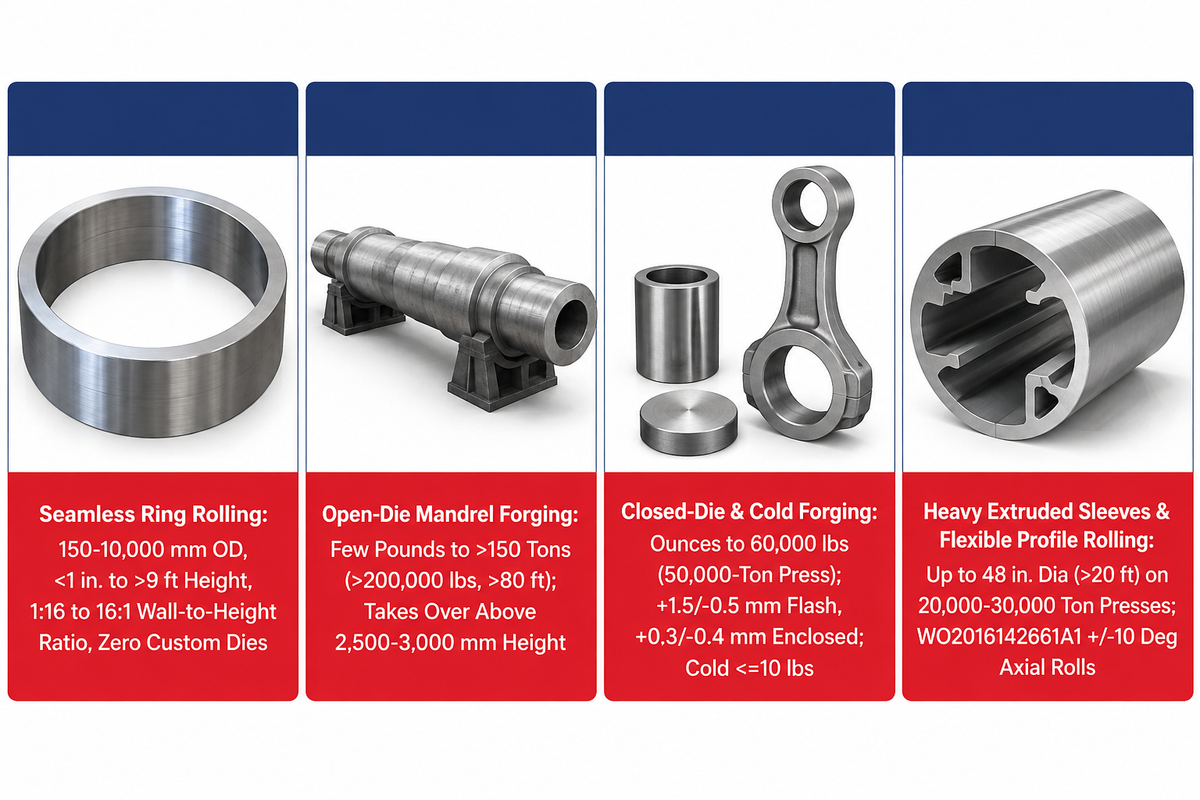
Seamless radial-axial ring rolling is the fastest, highest-yield forging process for circular rings from 150 mm to 10,000 mm OD because continuous deformation aligns circumferential grain flow with zero custom dies. Open-die mandrel forging takes over when height exceeds mill daylight, while closed-die forging fits high-volume small rings.
Capability boundaries – as published by the Forging Industry Association (FIA) – neatly show how the routes differ by weight and geometry. Seamless rolled rings include axial heights of less than 1 in., up to more than 9 ft, with wall-thickness-to-height ratios between 1:16 and 16:1. Open-die forging can produce parts from a few pounds up to more than 150 tons (200,000+ lbs, exceeding 80 ft), limited primarily by ingot size.
Impression-die (closed-die) forgings range from an ounce to 60,000 lbs on hydraulic presses up to 50,000 tons, while cold forging is most economical at 10 lbs or less (7 lbs for symmetrical parts).
Tolerance and press-tonnage benchmarks clarify the closed-die threshold. For 0.5–1 kg hot closed-die steel flash forgings, The Open University Manupedia lists dimensional tolerances of +1.5/−0.5 mm on 500–14,000 ton crank or friction screw presses with 2–5° ejector draft angles. Totally enclosed Hatebur-type hot formers tighten that band to +0.3/−0.4 mm.
Where axial length far exceeds diameter, mills extrude seamless tubing or forge heavy-wall tube sleeves up to 48 in. diameter and over 20 ft long on 20,000–30,000 ton presses (FIA) instead of rolling a flat ring.
The Annular Forming Capability Spectrum below compares geometry, tooling exposure, grain flow, and lot size across nine industrial ring-making methods. On the same material bill for non-annular forgings, see our open-die forged steel blocks guide and determine part geometry with our annular process matching tool.
| Manufacturing Route | OD / Weight Envelope | Grain Flow Pattern | Dedicated Tooling | Best Lot Size & Use Case |
|---|---|---|---|---|
| 1. Radial-Axial Seamless Rolling | 150–10,000 mm OD; <1 to 350,000 lbs (FIA) | Continuous circumferential hoop flow | None for rectangular sections | 1–500+ pcs; bearings, wind flanges, gear rims |
| 2. Radial-Only Ring Rolling | 100–1,200 mm OD; small-to-medium rings | Circumferential; unconstrained axial growth | Simple cylindrical main roll + mandrel | Medium batches where higher axial stock is acceptable |
| 3. Contoured / Profiled Rolling | 200–5,000 mm OD (below flat-face max, FIA) | Follows stepped OD/ID flange contour | Custom profiled rolls (or flexible ±10° axial mill) | Repeat OEM rings reducing lathe chip removal |
| 4. Open-Die Mandrel / Saddle Forging | Up to 150+ tons; tall heavy walls (FIA) | Circumferential + radial work via flat dies | Zero custom dies (standard mandrels/saddles) | 1–20 pcs; ultra-thick walls or height exceeding mill daylight |
| 5. Closed-Die / Impression-Die Forging | Ounces to 60,000 lbs; +1.5/−0.5 mm (0.5–1 kg) | 3D flow matching bosses, lugs, bolt pads | High die cost; 2–5° draft required | 500–50,000+ pcs; non-circular flange hubs and sprockets |
| 6. Cold / Warm Forging | <=10 lbs (<=7 lbs symmetrical, FIA) | Work-hardened fine grain, smooth skin | Hardened precision punch and die sets | 10,000+ pcs; automotive races, small hubs, lock rings |
| 7. Extruded Heavy-Wall Tube Sleeves | Up to 48 in. OD, >20 ft long (20–30k ton press, FIA) | Longitudinal axial grain flow | Extrusion container and mandrel | Long tubular sleeves where H > 2×OD |
| 8. Rolled-and-Welded Plate Rings | 1,000–12,000+ mm OD; thin-to-medium walls | Plate rolling direction broken at weld seam | Zero dies; plate bender + weld WPS | Low-stress ducts, kiln tires, static structural collars |
| 9. Centrifugal / Static Cast Steel Rings | Virtually unlimited section size and alloy mix | Isotropic solidified structure (no directional flow) | Low-cost wood/resin pattern or spin mold | Complex housings, unique non-forgeable alloys (approx. 13% Mn, SFSA) |
How Are Seamless Rolled Steel Rings Made Step by Step?
A seamless ring rolling mill forms a forged steel ring in four stages: heating a solid round billet to 900–1,200 °C, upsetting and piercing a center hole, expanding the donut between radial and conical axial rolls, and applying heat treatment plus proof machining.
Piercing only a small central slug and expanding custom seamless rolled rings between radial, conical axial, and guide rolls holds tight circular concentricity while avoiding the heavy center-disk scrap typical of flame-cut plate rings. First, the mill saws a solid round billet to calculated mass and heats it above recrystallization temperature. Second, a hydraulic press upsets the billet vertically and punches a central hole whose bore clears the rolling mandrel by at least 4 mm (d0 = dm + 4 mm, per Gontarz et al., Materials 2024); third, the pierced preform mounts onto the idle mandrel, and as the driven main roll feeds radially against the outer wall, the ring spins continuously, thinning its radial thickness while expanding inside diameter and outside diameter under twin centering guide rolls.
The axial height is simultaneously controlled by upper and lower conical rolls.
Conventional radial-axial mills place conical axial rolls 180° opposite the radial roll bite, which requires costly part-specific profiled rolls for L-shaped or flanged cross-sections. Cambridge Enterprise patent WO2016142661A1 solves this barrier on 1-5 m industrial rings locating the top and bottom axial rolls within ±10° of the radial roll bite alongside an axially moveable profiled mandrel. That close constraint allows low volume custom rolled profiles to be formed without dedicated dies.
A modern forge manufactures rectangular rings, contoured rings, and non-ferrous aluminum, copper, titanium, or nickel-base rings on the same rolling foundation before normalizing or quench-and-temper heat treatment.
Switch from seamless ring rolling to open-die mandrel forging whenever axial height exceeds 2,500–3,000 mm or wall-to-height ratios fall outside 1:16 to 16:1; switch to closed-die forging only when annual orders exceed 500 identical small rings with asymmetric lugs.
Forged Steel Rings vs. Cast, Rolled-and-Welded, and Plate-Cut Rings
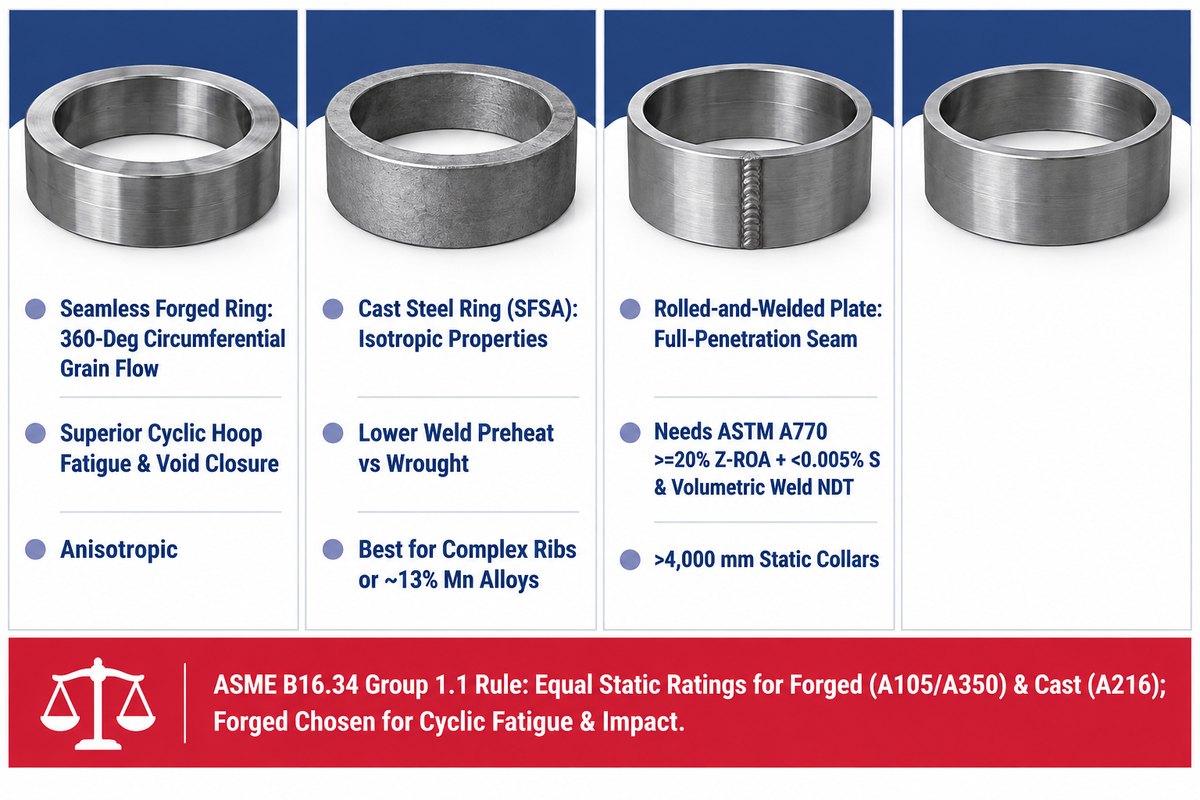
Seamless forged steel rings outperform cast, rolled-and-welded, and flame-cut plate rings under cyclic hoop fatigue, sub-zero impact loading, and zero-weld pressure duty, even though ASME B16.34 provides equivalent static pressure ratings for forged and cast steels in each material group. Use seamless forged rings for cyclic hoop fatigue and zero-weld containment, cast steel rings for isotropic multi-axial loads or integral cavities, and rolled-and-welded ASTM A770 plate rings for oversized low-stress collars.
Imagine the grain of the wood versus flat sawn stock: Cutting a ring from rolled flat plate has straight unidirectional fibers tangent at two points, and terminated perpendicularly into the outer rim ninety degrees away. Seamless ring rolling wraps continuous controlled grain flow 360 degrees around the circumference, aligning peak tensile strength and resistance directly with hoop stress. Rotational flexing tests on SAE 1045H steel (Metals, 2023) measured higher fatigue life along the forging grain-flow direction, while solid-state compression closes internal shrinkage cavities common in static castings.
The directional grain flow in forged steel rings creates a mechanical anisotropy between the longitudinal and transverse axes compared to the isotropic cast steel of the same composition. Strength and toughness in the longitudinal direction along the rolling direction increase, whereas ductility in the transverse and axial directions decreases. The Steel Founders’ Society of America commented:
“For equivalent alloys, the ductility and impact strength of steel castings generally lie between the longitudinal and transverse values of forgings. In castings, the metal is isotropic, with similar properties in all directions.”
The same SFSA technical record documents two design boundaries buyers should factor into trade studies. First, ASME B16.34 Table 2-1.1 Group 1.1 assigns equal static pressure-temperature allowables to forged carbon steels (A105, A350) and cast carbon steel (A216), and forged alloy or stainless grades likewise share static ratings with cast equivalents in their respective material groups. Forged rings earn selection through cyclic fatigue life, impact toughness, and internal soundness rather than higher static code allowables. Second, University of Tennessee weldability test results of 8630 and four Mn-Si grades showed elongated needle-like inclusions in wrought steel pose a greater threat of underbead cold-cracking than rounded inclusions in cast steel, so cast steels achieve crack-free welds at lower preheat temperatures.
Rolled-and-welded plate rings introduce a full-penetration longitudinal weld seam and expose thick rolled plate to lamellar tearing near the weld face. Mitigating lamellar tearing on heavy welded rings requires through-thickness Z-direction qualified plate (such as ASTM A770 minimum 20% Z-direction reduction of area) paired with low-sulfur steelmaking (below 0.005% S) plus full volumetric weld NDT. Flame-cut plate rings eliminate the weld seam but leave a heat-affected cut edge, unidirectional plate grain, and high center-disk steel waste.
Seamless rolled rings reduce downstream processing and wear risk by entering the machine lathe near net shape with zero weld seam.
When Should Engineers Choose Rolled-and-Welded or Cast Rings Instead of Forged Rings?
Choose rolled-and-welded plate rings for static structural collars above 4,000 mm diameter under low cyclic stress when weld inspection cost stays below mill forging premiums. Select cast steel rings when there are complex integral ribs, multi-axial loading, or alloys that do not lend themselves to forgeability (roughly 13% Mn work-hardening steel (SFSA)), making solid-state forging cost prohibitive.
Three boundaries flip the choice away from seamless forging. First, wear-resistant and controlled-ferrite stainless chemistries that crack under hot deformation must be poured at a foundry rather than forged. Second, rings with integral mounting brackets, internal fluid passages or variable wall bosses require a heavy hog-out machining from a rectangular forging while the casting pattern shapes those cavities with a lower fabrication cost.
Third, oversized thin-wall non-pressure shrouds and kiln support collars achieve a lower-cost solution via rolled-and-welded Z-qualified plate when weld radiography satisfies the end-use code.
Carbon, Alloy, and Stainless Steel Grades, Grain Flow, and Heat Treatment
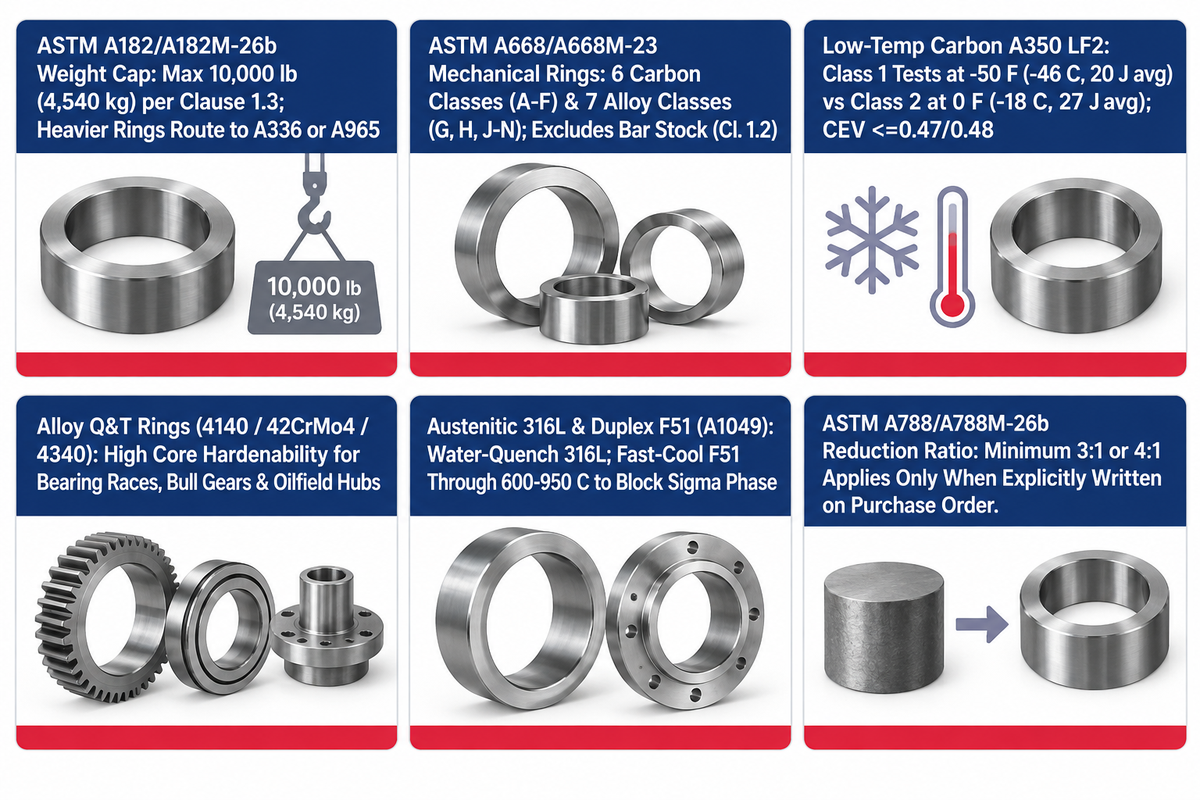
Selecting a forged steel ring grade pairs alloy chemistry (carbon 1045/A105, low-temperature A350 LF2, alloy 4140/4340/42CrMo4, or stainless 316L/17-4PH/F51) with the governing ASTM weight ceiling and heat-treatment class. Contracting ASTM A182 on a 12,000 lb ring breaches Clause 1.3 and is subject to contract rejection during mill assessment.
Four ASTM boundaries apply to industrial steel ring orders. Under ASTM A182/A182M-26b (updated October 16, 2026), Clause 1.3 limits individual forged or rolled piping components to 10,000 lb (4,540 kg). Larger ferritic alloy rings transition to ASTM A336/A336M, larger austenitic stainless steel rings transition to ASTM A965/A965M, and duplex grades cross-reference Specification A1049/A1049M (Clause 1.4).
For general mechanical power-transmission rings outside piping codes, ASTM A668/A668M-23 defines six carbon classes (A–F) and seven alloy classes (G, H, J–N), excludes hot-rolled or cold-finished bar stock (Clause 1.2), and adds an H-suffix option for hardness-only acceptance (Clause 1.4). Under ASTM A788/A788M-26b general requirements, a minimum 3:1 or 4:1 forging reduction ratio applies only when explicitly written onto the purchase order.
Low-temperature carbon steel rings carry a widely misquoted test trap. Supplier datasheets frequently misstate ASTM A350 LF2 Class 2 impact testing as −50 °F. In the primary ASTM A350/A350M specification, full-size 10×10 mm Charpy V-notch impact testing runs at −50 °F (−46 °C) for LF2 Class 1 (15 ft·lbf / 20 J average; 12 ft·lbf / 16 J single minimum). By contrast, LF2 Class 2 tests at 0 °F (−18 °C) (20 ft·lbf / 27 J average; 15 ft·lbf / 20 J single minimum), with maximum carbon equivalent (CEV) capped at 0.47 up to 2 in. thickness and 0.48 above 2 in. When matching forged rings with rotating shafts, align hardenability cycles via our forged shafts design and release guide or verify alloy compliance through our ASTM and EN alloy specification lookup.
| ASTM / EN Grade | Steel Family | Weight / Scope Boundary | Standard Heat Treatment | Primary Industrial Application |
|---|---|---|---|---|
| ASTM A105 / C45 (1045) | Carbon Steel | Ambient & higher-temp piping; A105 <=10,000 lb | Normalized (mandatory >Class 300 or >4 in.) | Piping flanges, spacers, medium-load gear blanks |
| ASTM A350 LF2 Class 1 | Low-Temp Carbon | Charpy at −50 °F (−46 °C), 20 J avg; CEV <=0.47/0.48 | Normalized, N&T, or Q&T | Sub-zero pipeline flanges, arctic wellhead rings |
| ASTM A350 LF2 Class 2 | Low-Temp Carbon | Charpy at 0 °F (−18 °C), 27 J avg (not −50 °F) | Normalized, N&T, or Q&T | Moderate cold-service flanges and valve bonnets |
| ASTM A668 Class D / E | Carbon Mechanical | General industrial; excludes bar stock (Clause 1.2) | Normalized & tempered (D) / Q&T (E) | Industrial crane wheels, hoist drums, mechanical collars |
| ASTM A668 Class K / L (4140 / 42CrMo4) | Cr-Mo Alloy Steel | High-strength mechanical classes G–N; H-suffix optional | Quenched & tempered (Q&T) | Slewing bearing races, wind yaw/pitch gears, oilfield subs |
| AISI 4340 / 34CrNiMo6 | Ni-Cr-Mo Alloy | Deep through-hardening in thick sections (>150 mm) | Oil/polymer Q&T + double temper | Heavy pinion gears, high-torque couplings, BOP rings |
| ASTM A182 F11 / F22 | Cr-Mo High-Temp | Capped at 10,000 lb (4,540 kg) per Clause 1.3 | Normalized & tempered (or Q&T) | Refinery hydrocracker flanges, steam turbine rings |
| ASTM A182 F304L / F316L | Austenitic Stainless | Capped at 10,000 lb; UT requires ASTM A745 | Solution annealed + rapid water quench | Chemical vessel flanges, cryogenic & marine rings |
| ASTM A182 F51 / A1049 Duplex | Duplex Stainless | A182 <=10,000 lb; A1049 for pressure vessels | Solution annealed (50/50 ferrite-austenite) | Subsea oil & gas connectors, chloride-rich pumps |
| ASTM A336 F22 / ASTM A965 F316L | Heavy Pressure Alloy / SS | Required above 10,000 lb (4,540 kg) A182 cap | N&T or Q&T (A336); solution anneal (A965) | Heavy reactor shell flanges, pressure vessel nozzle rings |
Can Stainless Steel Be Forged Into Seamless Rings Without Cracking?
Yes—300-series austenitic (304L, 316L), 400-series martensitic (410), precipitation-hardening (17-4PH), and duplex (F51/2205) stainless steels are routinely rolled into seamless rings when mills hold narrow hot-working temperature windows and apply post-forging solution annealing or aging to prevent sigma phase and intergranular corrosion.
Stainless alloys resist plastic deformation more strongly than carbon steel and lose ductility rapidly outside their thermal window. Austenitic 316L must be quenched in water immediately following solution annealing to keep chromium carbides in solution instead of precipitating out along grain boundaries. Duplex F51 must be soaked and cooled quickly through 600-950 °C to prevent the formation of brittle sigma-phase while preserving the corrosion resistance of a balanced ferrite-austenite alloy.
Martensitic 410 and precipitation-hardening 17-4PH rings require slow post-roll cooling followed by dedicated heat treat and aging cycles (such as H900 or H1150) to perform without quench cracking.
Size Envelopes, Tolerances, Machining Allowances, and Ring Weight Math
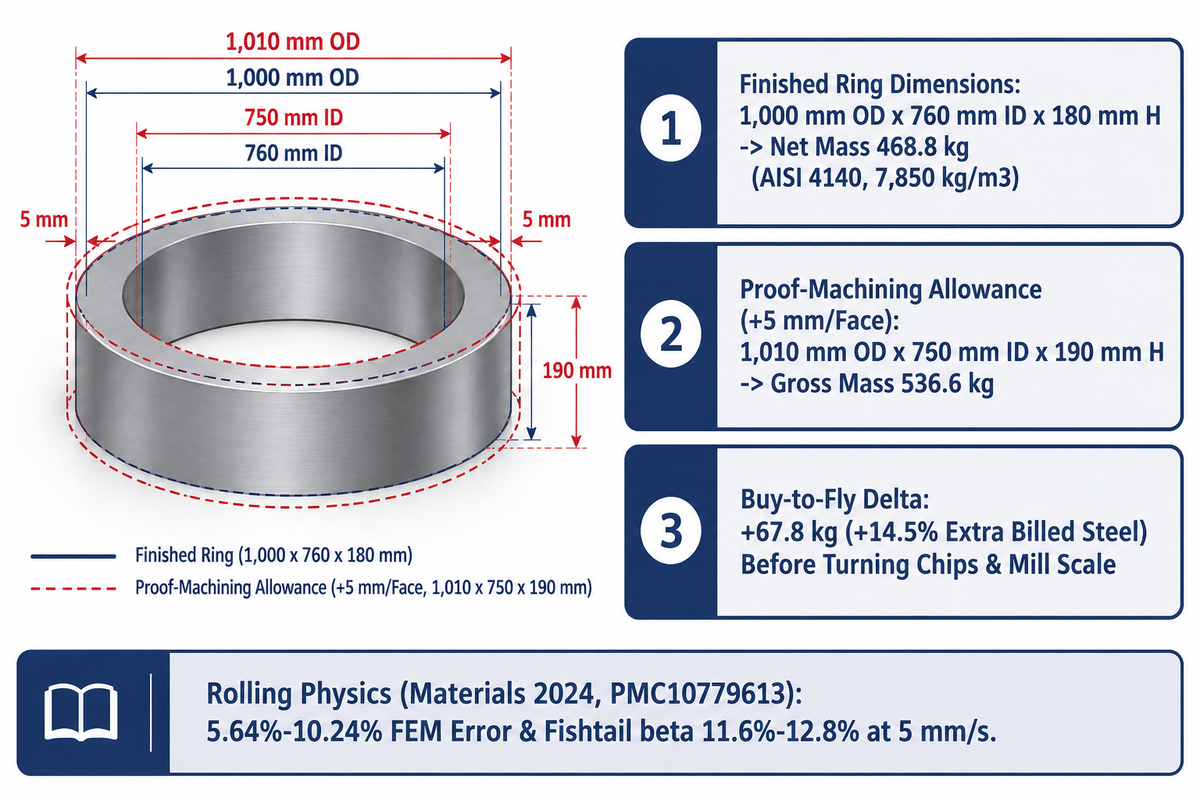
A finished 1,000 mm OD × 760 mm ID × 180 mm height AISI 4140 steel ring weighs 468.8 kg net at 7,850 kg/m³. Adding a uniform 5 mm proof-machining stock per surface lifts delivered ring mass to 536.6 kg (+67.8 kg) before pierce-slug and furnace-scale losses.
Buyers comparing quotes by net drawing weight against mills pricing by gross forging mass frequently see wide commercial spreads before unit rates are even negotiated. Rolling physics explains that stock requirement. Experimental C45 radial ring rolling trials published by Gontarz et al. (Materials, 2024, PMC10779613) rolling 100 × 50 × 20 mm preforms to 13 mm wall thickness at 900–1,200 °C and 60 rpm, proved that finite-element models deviate from measured ring dimensions by 5.64% to 10.24%. Unconstrained axial flow forms a concave side defect called a “fishtail” (coefficient β measuring 11.6% to 12.8% at 5 mm/s feed speed). Mills therefore add a minimum axial allowance of hn >= hfa × β so turning cleans up every face to a flat, smooth surface.
To normalize bids on a custom ring order, run the Ring Buy-to-Fly Mass Worksheet below before locking down delivery condition. Assumed inputs: AISI 4140 steel density of 7,850 kg/m³, rectangular cross-section, and 5 mm radial and axial proof-machining stock per surface (contoured profiles and taller rings adjust allowance by mill height and heating scale).
| Worksheet Step | Ring Geometry (OD × ID × H) | Formula Applied | Calculated Mass | Commercial Impact |
|---|---|---|---|---|
| Step 1: Net Finished Ring | 1,000 × 760 × 180 mm | (π/4) × (1.00² − 0.76²) × 0.18 × 7,850 | 468.8 kg | Baseline CAD drawing weight (not billable forge mass) |
| Step 2: Proof-Machined Delivery (+5 mm/face) | 1,010 × 750 × 190 mm | (π/4) × (1.01² − 0.75²) × 0.19 × 7,850 | 536.6 kg (+67.8 kg) | Ready for valid ASTM A388 ultrasonic coupling (<=250 RMS) |
| Step 3: Starting Gross Billet (Plus Slug & Scale) | Solid round upset + pierced blank | 536.6 kg + pierce slug + furnace scale loss (ρ) | >536.6 kg gross input | True steelworks melt input priced inside mill quotes |
On these exact geometric inputs, a proof-machined ring delivers 67.8 kg more steel than the finished drawing weight before pierce-slug and furnace-scale losses are added. An engineer comparing two bids on the same part must confirm whether each supplier quotes per-kilogram rates on 468.8 kg net mass or 536.6 kg proof-machined mass. Always specify at least 5 mm stock allowance per surface on rings around 1,000 mm OD to ensure full removal of mill scale and fishtail recesses, increasing allowance to 8–12 mm per surface on thin-walled rings above 2,000 mm OD that ovalize during quench-and-temper manufacturing. For precision gear blanks and bearing races, order rings proof-machined rather than as-rolled so the mill proves sound subsurface metal prior to dispatch.
ASTM A388, ASTM A745 Ultrasonic Testing, and EN 10204 3.1 Quality Records
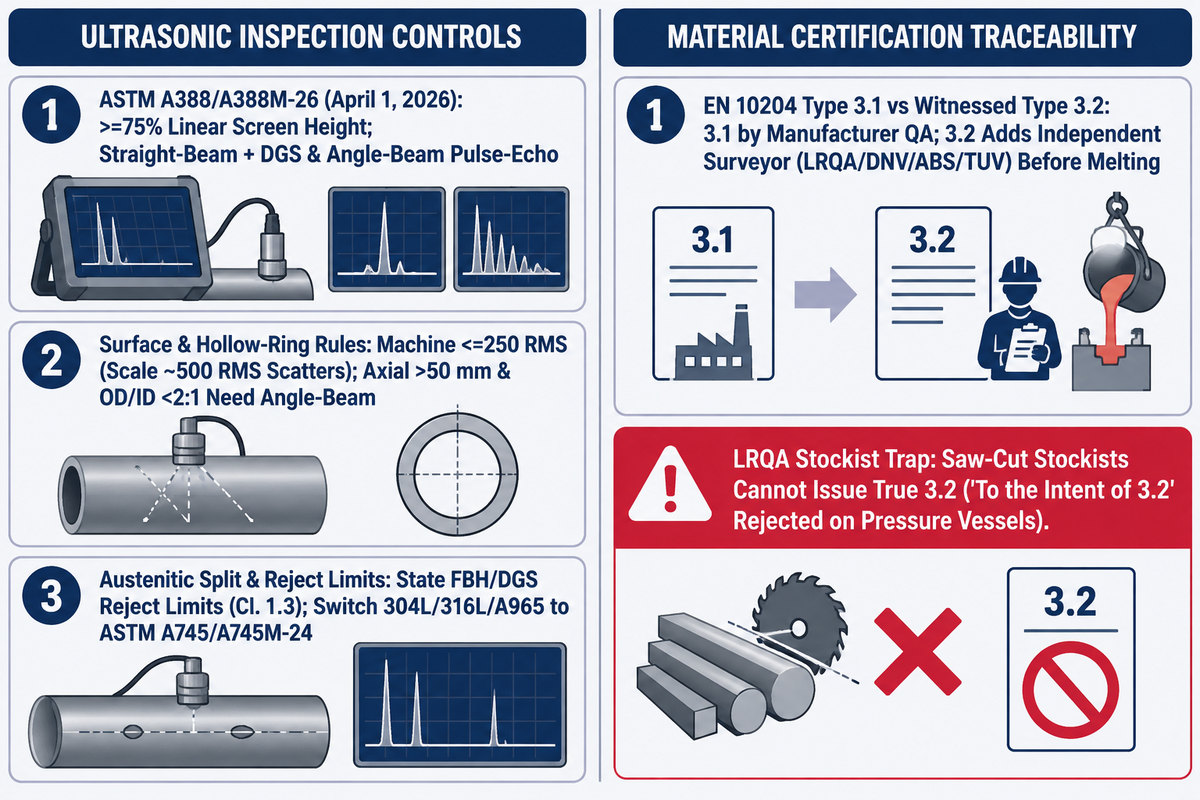
Rings quoted as “capable of ASTM A388” have not undergone ultrasonic testing. Valid contact pulse-echo examination under ASTM A388/A388M-26 depends on four purchase-order controls: machined coupling surfaces, geometry-matched beam angles, explicit acceptance criteria, and the proper austenitic specification.
ASTM A388/A388M-26, issued 1 April 2026 and replacing the 2023 edition, covers the straight-beam (including distance gain-size DGS calibration) and angle-beam pulse-echo testing of heavy carbon and alloy steel forgings using instruments with a linear screen height of a minimum 75%. Three technical rules prevent ultrasonic compliance failures before shipment: (1) rough as-forged mill scale (~500 RMS) scatters sound waves and prevents valid coupling, so cylindrical OD/ID surfaces and parallel end faces must be machined to 250 RMS or finer; (2) straight-beam scans alone miss radial-axial cracks in hollow rings, so rings with axial length above 2 in. (50 mm) and OD/ID below 2:1 require circumferential angle-beam scanning; and (3) ASTM A388 defines test practice rather than pass-fail limits, with supplementary requirements applying only when specified individually on the order (Clause 1.3), so buyers must state flat-bottom hole (FBH) or DGS reject limits explicitly. For coarse-grained austenitic stainless rings (304L, 316L, ASTM A965), high beam attenuation requires switching to ASTM A745/A745M-24 on heat-treated, scale-free machined surfaces.
Material certificates demand the same rigor for every entity involved in worldwide supply chains. Under EN 10204:2004, the forging manufacturer issues a Type 3.1 certificate and its authorized representative independent of production validates it. That record links ladle chemistry and mechanical results to stamped ring serial numbers. Type 3.2 adds an independent third-party surveyor (such as LRQA, DNV, ABS, or TÜV) who physically visits the plant for visual and dimensional checks, verifies heat traceability back to the steelmaker, and witnesses lab testing.
“The goal of type 3.2 certification is to independently verify material conformity across the supply chain, all the way back to the steelmaker.”
As LRQA warns its buyers, steel stockists who only saw unmodified 3.1-certified stock are not manufacturers under EN 10204:2004. Third-party assessors cannot issue genuine Type 3.2 certificates for saw-cut stock and must record those reports “to the intent of 3.2” (which pressure-vessel end users routinely refuse). Likewise, asking a test lab to stamp “EN 10204 3.2” onto a standalone report or requesting a paperwork-only review does not certify Type 3.2 compliance.
Specify EN 10204 3.1 from the originating forge for typical industrial orders, and invoke witnessed EN 10204 3.2 before melting where PED Category III/IV or offshore pressure codes dictate.
Forged Steel Ring Defects, Failure Modes, and Downstream Welding Controls
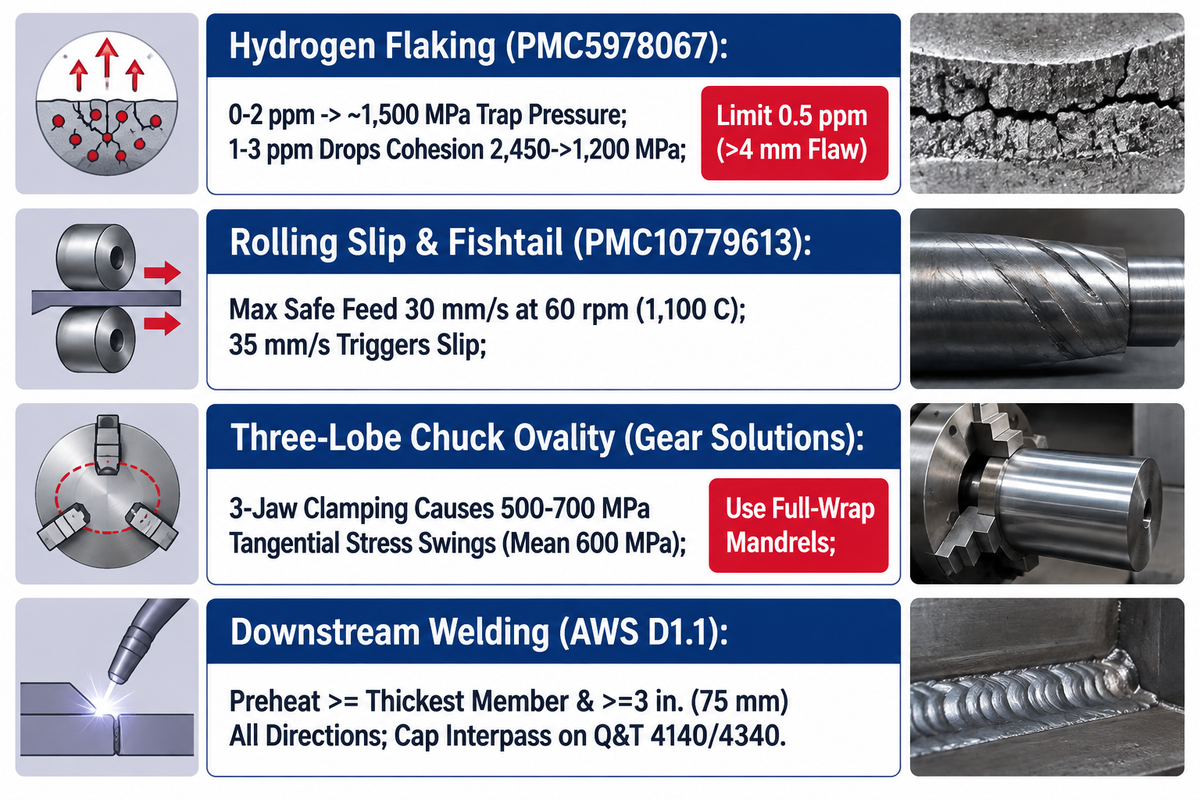
Three preventable mechanisms drive most forged steel ring rejections: delayed internal hydrogen flaking in heavy alloy sections above 0.5–2.2 ppm dissolved hydrogen, radial rolling slip or axial fishtail concavity from improper roll feed speeds, and three-lobe machining ovality linked to 500–700 MPa tangential residual-stress swings under 3-jaw chuck clamping.
Hydrogen flaking is the most destructive subsurface failure mode in thick-wall Cr-Mo and Ni-Cr-Mo steel rings because cracks can appear days after forging or right after finish turning relieves surface compression. In a finite-element fracture study of heavy Cr5VMo forged steel at 20 °C (Fan et al., Materials 2018, PMC5978067), raising lattice hydrogen from 0 to 2 ppm built roughly 1,500 MPa of internal molecular hydrogen pressure inside micro-traps. Raising average hydrogen from 1 ppm to 3 ppm dropped minimum critical cohesive stress from 2,450 MPa to 1,200 MPa. Flaw size cuts the margin further: critical hydrogen for flake growth falls from 2.2 ppm at a 1 mm crack diameter (0.5 mm radius) to a constant 0.5 ppm above a 4 mm flaw diameter. Vacuum degassing at the steelworks, controlled post-forging dehydrogenation annealing, and ultrasonic scanning after cooling stop flakes before assembly.
Rolling geometry defects trace directly to speed and temperature windows. In the Gontarz et al. (2024) C45 radial rolling experiments at 60 rpm main-roll rotation, pushing feed speed V1 from 30 mm/s to 35 mm/s at 1,100 °C (or 25 mm/s at 1,200 °C) triggered immediate roll slippage and scrapped deformed rings. Conversely, feeding too slowly (5 mm/s) deepened axial fishtail concavity (β = 11.6%–12.8%), increasing machining waste. Mills balance preform soak temperature against feed speed to stay safely below the slip boundary while minimizing fishtail depth.
Even a sound rolled ring can warp out of round during turning. As D. Scott MacKenzie, Ph.D., FASM reports in Gear Solutions (citing Nowag et al. and Grote et al.), clamping 100Cr6 (SAE 52100) bearing rings on a uniform mandrel versus three 120-degree segmented jaws gave the same ~600 MPa mean tangential residual stress. However, three-point jaws imposed a three-lobe stress swing between 500 and 700 MPa at the jaw contact points, and hard jaws produced measurably greater out-of-roundness after unclamping. In Germany alone, heat-treatment distortion losses across machining, automotive, and transmission industries exceeded 850 million euros (1 billion USD) in 1995 (Thoben, cited in Gear Solutions). Shop machinists on r/Machinists report the same fixturing lesson: thin-walled rolled rings spring oval when pinched in hard 3-jaw chucks, so shops use full-wrap pie jaws, rough-turn OD and ID faces symmetrically, and run an intermediate stress-relief cycle before final finishing.
Downstream fabrication welding onto forged alloy rings demands strict thermal discipline. Under AWS D1.1 structural welding rules, minimum preheat must extend at least equal to the thickness of the thickest joined member and not less than 3 in. (75 mm) in all directions from the weld point. Quenched-and-tempered alloy steel rings (such as 4140 or 4340) require minimum preheat to avoid hydrogen cold cracking, and a strict maximum interpass temperature so welding doesn’t soften the heat-affected zone.
For extensive defect testing of heavy forgings, see our heavy-section forging flaw and ultrasonic controls guide.
Industrial Applications for Forged Steel Rings Across Energy and Heavy Machinery
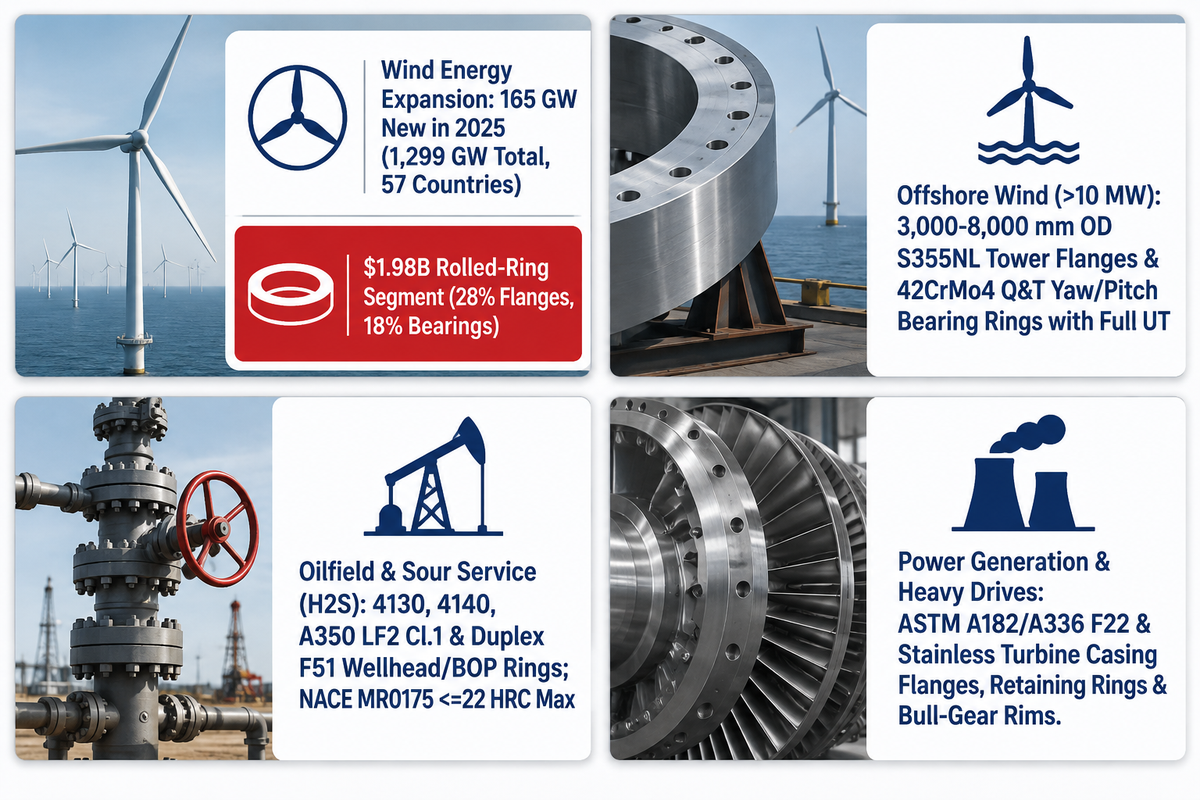
Wind energy, oil and gas extraction, power generation, mining, and heavy rotating equipment consume most industrial forged steel rings because continuous hoop grain flow resists radial bearing contact loads, bolt-circle flange clamping forces, and high-pressure cyclic fatigue without a weld seam.
Global Wind Energy Council data cited by Global Market Insights reports a record 165 GW of new wind capacity installed globally in 2025, bringing cumulative capacity to 1,299 GW across 57 countries. That expansion lifted the wind turbine rolled-ring forging segment to $1.98 billion in 2025, with tower flanges representing 28% and bearing rings 18% of wind forging revenue. Offshore turbines over 10 MW draw high demand for 3,000-8,000 mm OD S355NL tower flanges and 42CrMo4 Q&T yaw and pitch bearing rings held to full-volume ultrasonic inspection.
What Are Seamless Rolled Steel Rings Used For in Oilfield and Power Equipment?
In oilfield and power-generation machinery, seamless rolled steel rings serve as pressure-retaining wellhead flanges, blowout preventer (BOP) body rings, high-pressure valve seat rings, turbine casing rings, and generator retaining rings where voids or weld seams risk catastrophic leaks or rotor fracture.
High-pressure oilfield hardware subjects forged rings to sour-gas corrosion (H2S), pressure cycling, and sub-zero ambient temperatures. AISI 4130, 4140, ASTM A350 LF2 Class 1, and duplex F51 rings form structural hubs, swivel joints, and bonnet closures inside wellhead and well control assemblies, where NACE MR0175 / ISO 15156 hardness ceilings (typically 22 HRC maximum for standard carbon and low-alloy sour service) set tempering targets. In thermal and hydroelectric plants, ASTM A182 F22, ASTM A336 F22, and stainless rolled rings form turbine casing flanges, labyrinth seal carriers, and heavy gearbox bull-gear rims.
Custom Forged Steel Ring Pricing, Tooling, MOQ, and Lead-Time Drivers
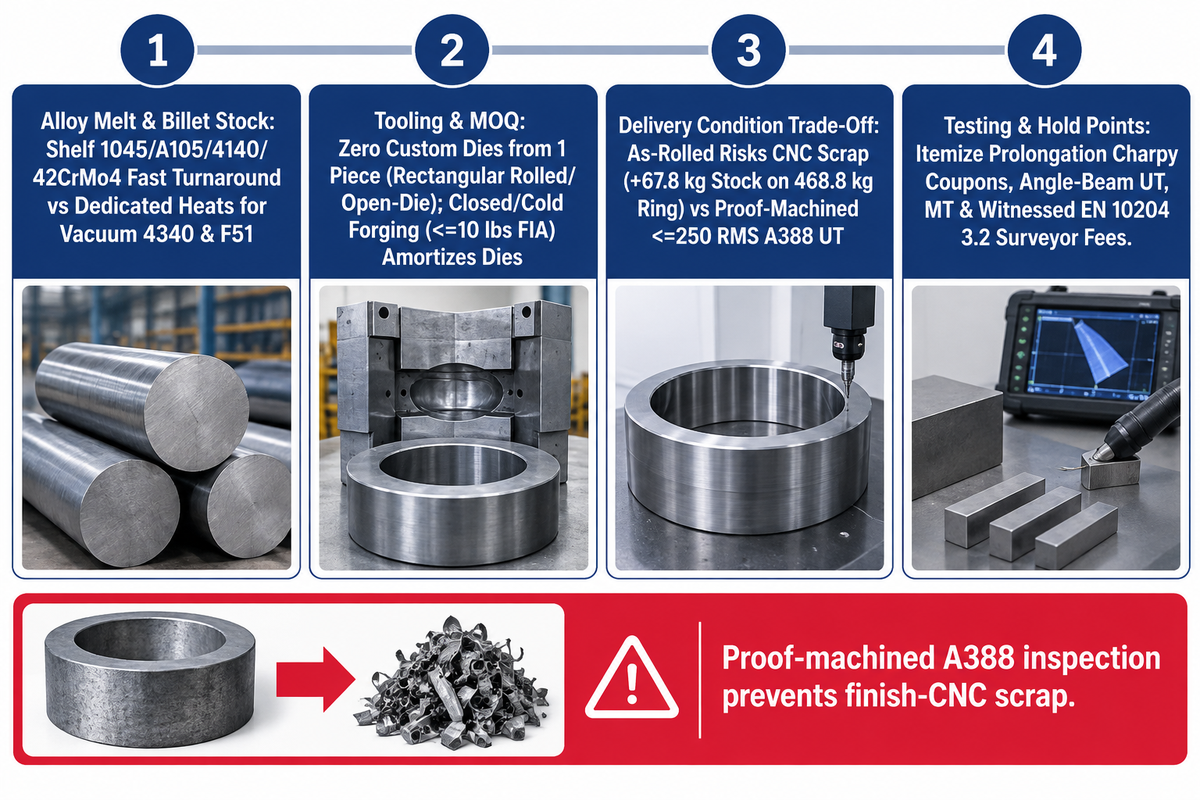
Custom industrial forged steel rings have no fixed standard public per-kilogram list price because every mill prices from alloy melt cost, gross billet weight (including +67.8 kg of proof-machining stock on a 468.8 kg 1,000 mm ring), heat-treat and UT scope, and tooling amortization, starting from a 1-piece MOQ on rectangular rolled rings.
There are four structural levers that drive landed cost and delivery lead time more than a cost per kilogram comparison:
- Commodity carbon steels (1045, A105) and standard 4140 or 42CrMo4 billets stay on mill shelves for rapid turnaround, while vacuum-degassed 4340, duplex F51, or heat-specific stainless ingots often require dedicated steelworks heats that lengthen schedules.
- Rectangular seamless rolled rings and open-die mandrel forgings require zero customer-funded dies from 1 piece upward; contoured rolled rings need custom roll sets justified on repeat programs, while closed-die impression forging and cold forging (most cost-effective at 10 lbs or less, per FIA) amortize hardened dies across large runs.
- As-rolled rings have the least mill invoice but foist scale removal, fishtail cleanup, and subsurface flaw risk upon the buyer’s machine shop, and proof-machined rings add turning hours, but allow solid <=250 RMS ASTM A388 ultrasonic validation prior to ocean departure.
- Prolongation test rings for Charpy impact coupons, full-body angle-beam ultrasonic testing, magnetic particle testing (MT), and witnessed EN 10204 3.2 surveyor hold points add laboratory fees and inspection lead time that should be itemized separately on every bid.
Consider a practical sourcing trade-off on a single 1,000 × 760 × 180 mm AISI 4140 ring (468.8 kg net, 536.6 kg proof-machined). Ordering an as-rolled blank lowers the upfront mill invoice, yet if finish CNC turning uncovers a subsurface inclusion, both the forging and the machine shop’s lathe hours become scrap. Ordering the ring proof-machined with ASTM A388 inspection at the forge catches non-conforming metal prior to dispatch.
How to Qualify Forged Steel Ring Suppliers and Write an Airtight RFQ
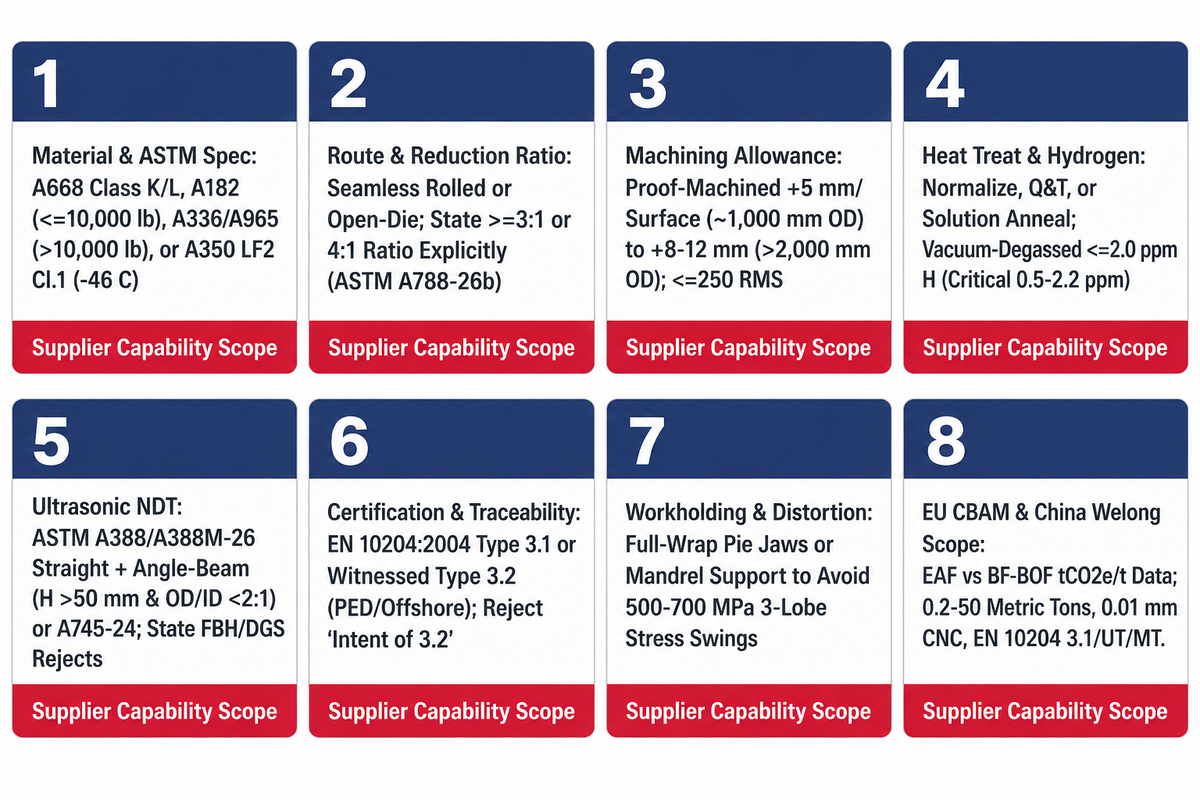
Qualifying a forged steel ring supplier requires matching maximum OD, axial height, and unit weight against verified mill press and ring-roller capacities, auditing heat-to-ladle EN 10204 traceability, and locking every metallurgy, machining-allowance, and ultrasonic clause into the RFQ before award.
Global seamless rolled ring mills operate across distinct mechanical footprints. Major ring-rolling producers such as Scot Forge, Ringmasters, GMH Gruppe, thyssenkrupp rothe erde, and Euskal Forging span roughly 300 mm to 10,000 mm outside diameter depending on mill class, so verifying physical mill daylight and crane capacity prevents unauthorized subcontracting. Shaanxi Welong International Supply Chain Management Co., Ltd. (China Welong), founded in 2001, operates as an integrated supply-chain coordinator rather than an API-monogrammed direct forge. China Welong coordinates custom industrial forgings from 0.2 to 50 metric tons with CNC finish machining to 0.01 mm, biennial mill re-audits, EN 10204 3.1/UT/MT documentation packs, and transparent forge-source disclosure, supplying rings built to ASTM and EN specification and verified by inspection. Before issuing your next tender, cross-check package fields with our pre-tender ring specification check and review our industrial forgings supply program.
Simply copy the checklist below into your quote request so every competing forge prices the identical metallurgical and inspection scope:
RFQ checklist — copy these into your quote request:
| Parameter | Recommended range | Why it matters | How to verify |
|---|---|---|---|
| Material & ASTM Spec | ASTM A668 Class K/L, A182 (<=10,000 lb), A336/A965 (>10,000 lb), or A350 LF2 Class 1 (−46 °C) | Prevents invalid A182 calls above 4,540 kg and Class 1/Class 2 Charpy mix-ups | Match spec edition and ladle chemistry on EN 10204 3.1/3.2 MTC |
| Forming Route & Reduction Ratio | Radial-axial seamless rolled (or open-die if H > mill limit); state >=3:1 or 4:1 ratio explicitly | ASTM A788-26b leaves reduction ratio optional unless written on the PO | Require ingot/billet cross-section ratio on forging route sheet |
| Machining Allowance & Condition | Proof-machined +5 mm/surface (~1,000 mm OD) to +8–12 mm (>2,000 mm OD); <=250 RMS | Removes fishtail concavity and 500 RMS scale so ultrasonic beams couple cleanly | Dimensional inspection report + profilometer reading before UT |
| Heat Treatment & Hydrogen Control | Normalize, Q&T, or solution anneal; vacuum-degassed <=2.0 ppm H (heavy alloy) | Prevents delayed hydrogen flaking (critical threshold 0.5–2.2 ppm) and soft cores | Furnace time-temperature chart + degassing heat log |
| Ultrasonic Testing (UT) | ASTM A388/A388M-26 (carbon/alloy) including angle-beam scans if H >50 mm & OD/ID <2:1; ASTM A745-24 (austenitic) | Eliminates “capable of A388” non-inspection loophole and defines exact FBH/DGS reject line | Signed Level II/III UT report naming probe angle, frequency, and FBH/DGS level |
| Certification & Traceability | EN 10204:2004 Type 3.1 (standard) or witnessed Type 3.2 (PED/offshore); reject “intent of 3.2” | Guarantees heat-number chain back to the originating steelmaker | Match die-stamped heat/serial ID on ring face to original forge certificate |
| Workholding & Distortion Check | Full-wrap pie jaws or mandrel support; symmetric roughing + stress relief on thin walls | Avoids 500–700 MPa 3-lobe tangential residual-stress swings and final out-of-roundness | 4-plane OD/ID circularity check after unclamping |
| EU CBAM Emissions Data (EU imports) | Verified melt route (EAF vs. BF-BOF) and embedded tCO2e/t per CN tariff code | Mandatory under EU CBAM definitive regime effective January 1, 2026 | Verified installation emissions report from melting steelworks |
2026 Regulatory and Supply-Chain Outlook for Forged Steel Ring Sourcing
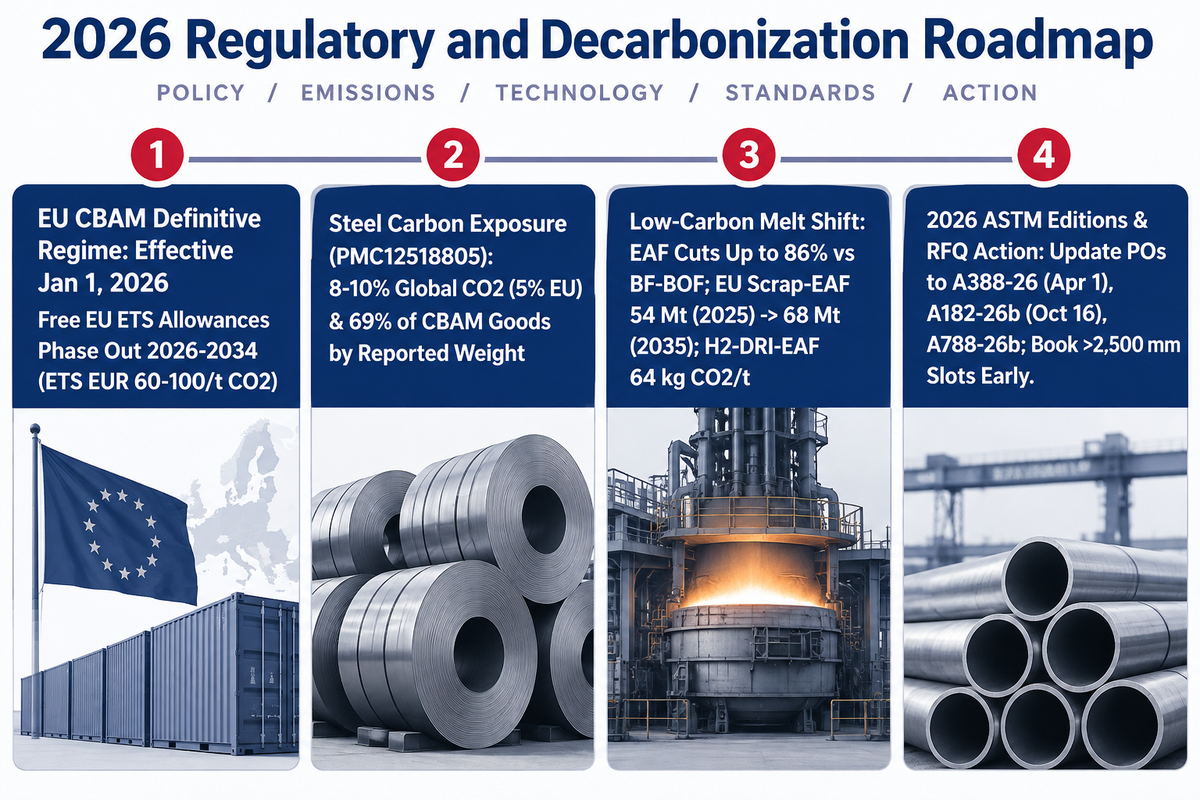
From Jan 1, 2026, the EU Carbon Border Adjustment Mechanism (CBAM) definitive regime transitioned forged steel ring sourcing to verified melt-route carbon accounting. EU importers must hold authorization, report verified embedded emissions, and surrender certificates as free EU Emissions Trading System (ETS) allowances phase out between 2026 and 2034.
Policy modeling by Johnson et al. (Nature Communications, October 2025, PMC12518805) shows why steel forgings sit at the center of CBAM exposure. Iron and steel generate 8–10% of global CO2 emissions (5% in the EU) and account for 69% of CBAM goods by reported weight. With EU ETS prices trading between €60 and €100 per tonne of CO2 over the prior five years, blast furnace–basic oxygen furnace (BF-BOF) billets face rising border charges compared with scrap-fed electric arc furnace (EAF) and green hydrogen-direct reduced iron (H2-DRI-EAF) routes. According to Global Energy Monitor, EAF steelmaking can cut emissions by up to 86% versus BF-BOF. Johnson et al. project EU secondary scrap-EAF output rising from 54 Mt in 2025 to 68 Mt by 2035, while low-emission H2-DRI-EAF reaches 64 kg CO2 per tonne of crude steel.
These standards updates reflect the same sourcing discipline planned for 2026. ASTM International published active 2026 editions across core forging specifications—including ASTM A388/A388M-26 (released April 1, 2026, superseding -23), ASTM A182/A182M-26b (updated October 16, 2026), and ASTM A788/A788M-26b. Procurement teams should update legacy 2020–2023 PO templates before signing annual frame agreements.
For 2026–2027 EU-bound orders, request steelworks melt-route declarations (EAF versus BF-BOF) alongside EN 10204 certificates at the RFQ stage, and book heavy rolling-mill slots well in advance for wind and offshore rings above 2,500 mm OD.
Frequently Asked Questions About Forged Steel Rings
What is a forged ring?
A forged steel ring is a solid-state formed annular part made by heating a steel billet above recrystallization temperature, piercing a center hole, and expanding the blank on a seamless ring rolling mill or open-die forging press. Continuous circumferential deformation aligns metal grain flow around the hoop axis, closing internal voids and delivering stronger cyclic fatigue resistance than cut plate or static cast rings.
How much does it cost to forge a ring?
Ring mills price custom orders individually rather than publishing fixed per-kilogram catalog rates. Custom industrial forged steel rings are priced by inquiry rather than listed in a catalog at a fixed price per kilogram because quotes are based on alloy grade, gross initial billet mass, heat-treatment cycle, and extent of non-destructive testing. Rectangular rolled rings have zero custom die fees on 1-piece orders upwards while closed-die impression forging spreads the cost of hardened dies across large runs.
Can forged steel rings rust?
Yes—carbon steel (1045, ASTM A105, A350 LF2) and low-alloy steel (4140, 4340) forged rings oxidize and rust when exposed to moisture, humidity, or chloride brine unless protected by oil coatings, epoxy primers, thermal spray, or weld overlay cladding. For corrosive marine, chemical or sour-gas service use austenitic stainless (ASTM A182 F316L / A965) or duplex stainless (ASTM A182 F51, referenced in ASTM A1049/A1049M per A182 Clause 1.4) forged rings.
Forged steel vs. stainless steel: which is better for industrial rings?
Choose forged carbon or Cr-Mo alloy steel (such as ASTM A668 Class K/L or 4140 Q&T) when high yield strength, surface hardenability for gear teeth or bearing raceways, and lower billet cost come first and coatings can control corrosion. Choose forged stainless steel (304L/316L, 17-4PH, or duplex F51) when chloride, acid, or cryogenic exposure demands built-in corrosion resistance. Because “forged steel” is a forming process rather than an alloy group, stainless steel is routinely rolled into seamless rings; simply specify ASTM A745/A745M-24 for austenitic ultrasonic testing.
Can forged steel rings be cut or repaired by welding?
Yes: ASTM A105 and ASTM A350 LF2 rings (CEV <=0.47 up to 2 in., 0.48 above 2 in.) weld readily, while Q&T 4140 and 4340 rings require AWS D1.1 preheat across at least 75 mm plus controlled interpass and temper limits.
What types of steel products do forged ring mills typically make?
Seamless ring mills roll rectangular and contoured rings across wide industrial size bands for wind turbine tower flanges, slewing and yaw bearing races, bull-gear rims, high-pressure pipeline and vessel flanges, valve seat rings, turbine casings, couplings, and heavy-wall sleeves. Several ring mills combine rolling lines with open-die presses to produce matching forged shafts, discs, hubs, and blocks from the same certified billet heat.
Why do forged steel rings break or crack in service?
Field fractures in forged steel rings trace to four controllable metallurgy and inspection failures rather than base alloy limits. Most field fractures in forged steel rings result from four controllable failures: trapped hydrogen above the 0.5–2.2 ppm critical threshold (building roughly 1,500 MPa of internal trap pressure at 2 ppm), misapplying ASTM A350 LF2 Class 2 (0 °F Charpy) instead of Class 1 (−50 °F Charpy) in sub-zero service, breaching maximum interpass temperatures or omitting post-weld heat treatment on Q&T 4140/4340 rings, and accepting “capable of ASTM A388” quotes without actual machined-surface ultrasonic angle-beam inspection. Second, substituting ASTM A350 LF2 Class 2 (0 °F Charpy test) for Class 1 (−50 °F Charpy test) leaves arctic pipeline flanges vulnerable to brittle cleavage fracture. Third, exceeding maximum interpass heat or omitting post-weld tempering on quenched-and-tempered 4140 or 4340 rings softens or cracks the weld heat-affected zone. Fourth, accepting “capable of ASTM A388” quotes without actual machined-surface ultrasonic angle-beam scanning lets rolling laps, center bursts, or inclusion bands enter cyclic service undetected.
What does “capable of ASTM A388” mean on a forged steel ring quote?
It means the supplier believes the steel chemistry and forging practice could pass ultrasonic inspection if tested, NOT that ASTM A388 testing is included in the quoted price. Unmachined 500 RMS forge scale blocks valid pulse-echo coupling; buyers must explicitly order proof machining to 250 RMS or finer plus ASTM A388/A388M-26 straight-beam and angle-beam scanning with defined FBH or DGS rejection limits.
Need Custom Industrial Forged Steel Rings Built to Spec?
Provide your drawing specs (OD × ID × H), desired ASTM/EN grade, heat-treatment class, and ultrasonic call-outs to review custom forged ring options and mill capability matching through our drawing-led industrial forgings review (0.2–50 metric tons, CNC machining to 0.01 mm, EN 10204 3.1/UT/MT packs).
Technical Review Note: Reviewed by the Shaanxi Welong International Supply Chain Management Co., Ltd. technical team; every specification threshold and standard clause in this guide is cross-checked against current ASTM, FIA, SFSA, LRQA, and peer-reviewed primary publications.
References & Sources
- Forging Industry Association (FIA). Types of Forging Processes: Seamless Rolled Ring, Open-Die, Impression-Die, and Cold Forging Capabilities.
- Gontarz, A., Surdacki, P., & Michalczyk, J. (2024). Research the Dimensional Accuracy of C45 Steel Ring Forgings Produced by Radial Rolling. Materials, 17(1):3 (PMC10779613).
- Allwood, J., & Cleaver, C. / Cambridge Enterprise Ltd. Ring Rolling Process and Apparatus for Ring Rolling (WO2016142661A1).
- Blair, M., & Monroe, R. W. Castings or Forgings? A Realistic Evaluation. Steel Founders’ Society of America (SFSA).
- ASTM International. ASTM A182/A182M-26b: Standard Specification for Forged or Rolled Alloy and Stainless Steel Pipe Flanges, Forged Fittings, and Valves and Parts for High-Temperature Service (Updated Oct 16, 2026).
- ASTM International. ASTM A668/A668M-23: Standard Specification for Steel Forgings, Carbon and Alloy, for General Industrial Use.
- ASTM International /European Standards. ASTM A388/A388M-26: Standard Practice for Ultrasonic Examination of Steel Forgings (Available April 1, 2026; replaces -23)
- ASTM International. ASTM A745/A745M-24: Standard Practice for Ultrasonic Examination of Austenitic Steel Forgings.
- ASTM International. ASTM A770/A770M: Standard Specification for Through-Thickness Tension Testing of Steel Plates for Special Applications.
- Thompson, D. EN 10204 Type 3.2 Certification Getting Complex? LRQA.
- Fan, J., Chen, H., Zhao, W., & Yan, L. (2018). Study on Flake Formation Behavior and Its Influence Factors in Cr5 Steel. Materials, 11(5):690 (PMC5978067).
- MacKenzie, D. S., Ph.D., FASM. Development of Residual Stresses During Machining and Workholding. Gear Solutions Magazine.
- SATRA Technology & ASSP. ANSI/ASSE Z359.12-2019 Connecting Components & ASSP Z359 Fall Protection Standards Catalog.
- The Open University (Manupedia). Hot Forging, Closed Die.
- Johnson, C., Åhman, M., Nilsson, L. J., & Li, Z. (2025). Emerging Green Steel Markets Surrounding the EU Emissions Trading System and Carbon Border Adjustment Mechanism. Nature Communications, 16:9087 (PMC12518805).
- Global Energy Monitor. Electric Arc Furnaces and the Decarbonization of Steel.
- Global Market Insights (citing GWEC). Wind Turbine Forging Market Size & Forecasts 2026–2035.