Get in touch with Welong Company

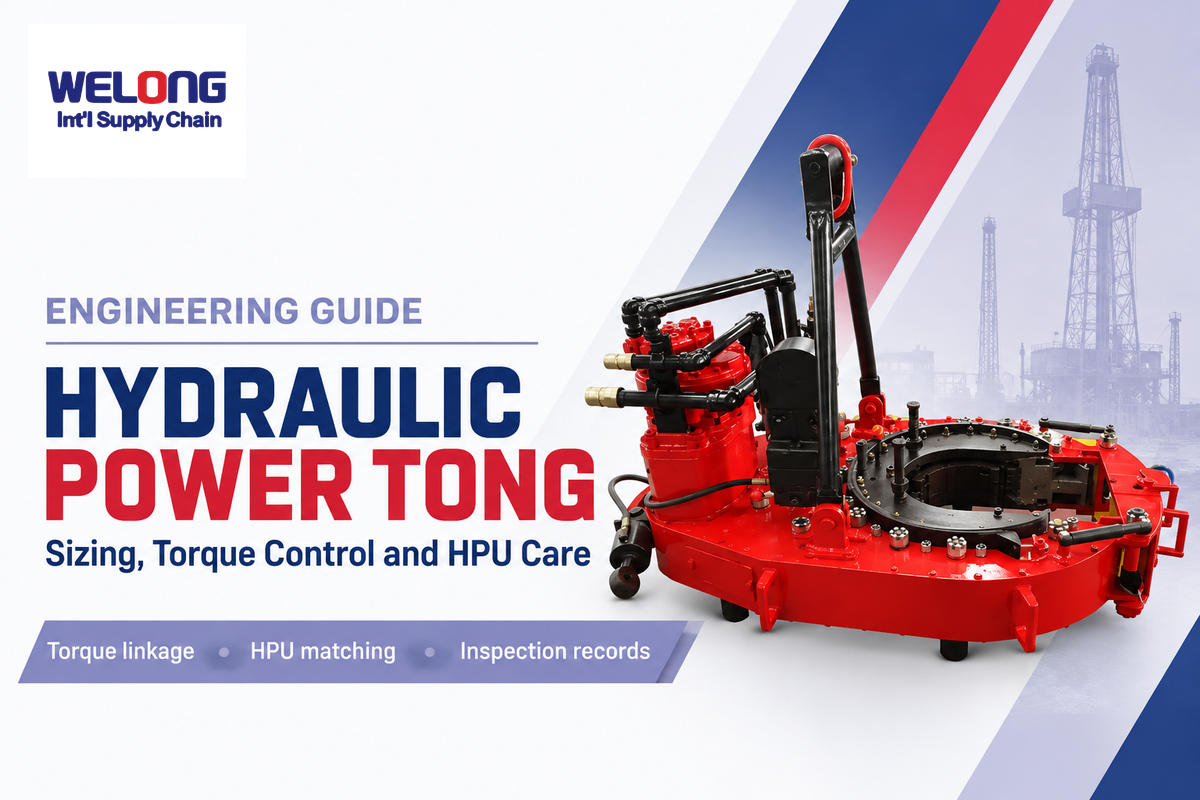
A Power Tong consists of a mechanized wrench driven by hydraulic or pneumatic systems, suspended over the well center during drilling operations or workover jobs for the connection and disconnection of threaded oilfield tubulars. By pairing a two-speed rotary master unit with an integral or snub-restrained backup assembly and a calibrated load cell, power tongs replace manual cathead lines and provide precise torque control across tubing, casing, and drill pipe strings.
This engineering guide incorporates the mechanics of a rotary master and backup assembly; load-cell cosine error geometry; model selection across tubing (XQ), casing (TQ), and drill pipe (ZQ) strings; pressure and flow sizing of hydraulic power units (HPU); torque-turn graphing; low-marking dies for corrosion-resistant alloys (CRA), rig-floor troubleshooting and contract inspection verification. For catalogs of custom jaws, and project quotations, see our Welong Power Tong specifications and torque tables or our hydraulic power tongs across ZQ, XQ, and TQ series.
Updated November 2026 · By Karry
Quick Engineering Summary
An oilfield hydraulic power tong uses spinning and torque gears with gripping jaws to make up and break out tubular joints. The cited models span ODs from 42.2 mm (1.66 inch) on the Weatherford 5.5-15 tubing tong to 508 mm (20 inch) on a casing tong; the 14-100 casing tong is rated at 135.6 kN·m (100,000 ft-lbs) for 7- to 14-inch casing. API RP 54 Section 7.8.6 recommends a 90-degree angle between the tong body and snub line when securing pipe in the rotary table. OSHA calls for personnel other than tong operators to stand outside the tong swing radius, four feet from the hole center, when breaking pipe.
Key Engineering Takeaways
- True applied torque equals load-cell line pull multiplied by the effective arm length at 90 degrees; adding or removing an under-mounted backup tong shifts the effective handle length and requires gauge constant recalibration.
- Hydraulic pressure sets a tong’s maximum output torque, while pump flow sets rotational speed. The listed XQ89/3C requires 80 L/min; the TQ178-16 casing tong is listed at 110–160 L/min (29–42 GPM) and 18 MPa (2,610 psi), so its flow range doesn’t describe every XQ, TQ, and ZQ model.
- Breakout operations can require up to 2.5 times (250%) of the connection make-up torque when thread dope dries or downhole thermal cycling locks the shoulders.
- The API Spec 7K 6th Edition Monogram update, issued December 22, 2016 and effective December 30, 2016, removed power tongs and spinning wrenches from the cited licensing scope. Buyers can specify model-level design records, proof-load results, EN 10204 Type 3.1 material certificates, and third-party witness reports in the purchase contract.
How a Hydraulic Power Tong Works: Master Tong, Backup Tong and Load-Cell Torque Linkage
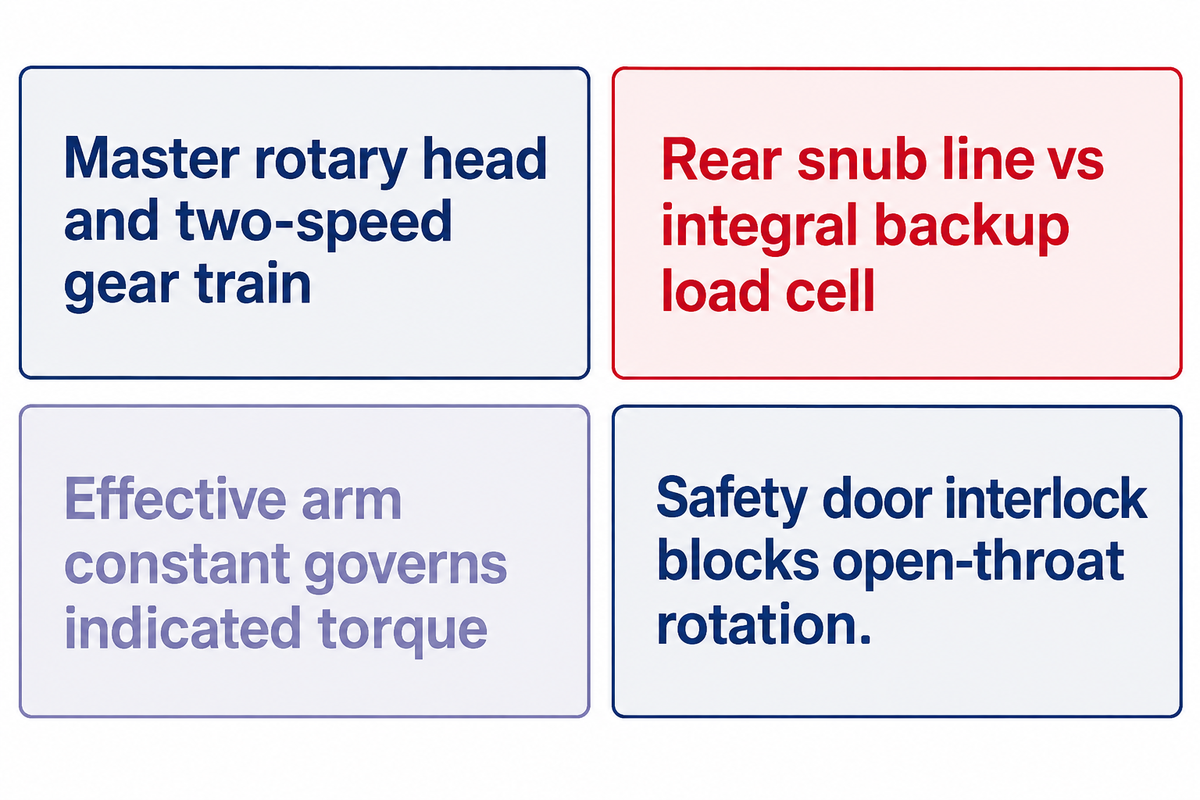
A hydraulic power tong is a three-part mechanical and measuring assembly, suspended from the mast by means of a spring hanger and lift cylinder. With an integrated backup tong, a compression load cell can measure reaction between the master and backup frames; a tong restrained by a rear snub line can instead measure line tension to calculate torque.
Why does the snub line have to stay at a 90-degree angle to the power tong arm?
A power tong torque gauge multiplies measured tension or compression force by a fixed effective arm length. It assumes the reaction force acts at 90 degrees to the tong arm centerline. According to API RP 54 Section 7.8.6, the length of the snub lines should be such that when piping is positioned in the rotary table, a 90-degree angle is formed between the body of the tong and the snub line. Angular drift decreases true pipe torque. As noted on Welong’s power tong engineering page, an under-torqued connection risks casing leakage, while a calibrated master and backup system provides a consistent torque across a 300-joint casing run.
During drilling operations, a hydraulic or pneumatic motor drives the rotary head. The motor in hydraulic or pneumatic systems is coupled to a two-speed gear train. In high gear, the rotary ring gear is free to spin and the connection is threaded to make up the pipe. In low gear, the ring gear drives the connection, and torque is increased by mechanical multiplication of the cam-ramp jaw assembly. US Patent US6263763B1 discloses a load cell linkage between the rear support legs and the front guide legs. The front stabilizers, in the described arrangement, reduced relative rotational movement between the power tong and backup tong by 87.5% (from 2 inches to 1/4 inch (6.35 mm)), corresponding to an 87% reduction reported in the patent; this does not establish concentric pipe axes in every make-up. This doesn’t establish that concentric pipe axes are attained in all make-up.
As Eckel’s technical engineering FAQ explains, the effective torque arm changes when a power tong switches from a rear tension load cell on a tail snub line to an under-mounted compression load cell in a hydraulic backup unit. See our oilfield tongs category overview for backup assemblies that are matching. On a free-hanging tong, the effective arm is measured from the centerline of the pipe to the clevis pin of the rear snub-line. On an integral backup unit, the effective arm is measured from the centerline of the pipe to the compression load cell. Changing load-cell arrangements without updating the torque gauge arm constant changes the indicated torque according to the old setting and the new effective arm length. Additionally, OSHA’s Drilling Ahead guidance states that tong dies, counterweight cables and snub lines should be inspected prior to each trip and that personnel other than tong operators should be four feet (1.2 meters) from the hole center when breaking pipe. The safety door interlock is a key safety feature that prevents rotary operation for connection and disconnection while the throat gate is open.
Torque-Arm Cosine Error & Line-Pull Matrix
The Torque-Arm Cosine Error & Line-Pull Matrix compares perpendicular 90-degree snub-line geometry under API RP 54 Section 7.8.6 against off-angle snub arrangements and integral backup load-cell setups. It ensures reliable performance.
| Linkage Arrangement & Snub Angle | Effective Arm Basis | Load-Cell Sensing Mode | Governing Standard / Source | Rig-Floor Mechanical & Measurement Effect |
|---|---|---|---|---|
| Rear Tension Load Cell at 90° Baseline | Pipe centerline to rear line-pull mount | Rear tail-line tension | API RP 54 §7.8.6 & Eckel FAQ | Perpendicular reaction geometry; Eckel recommends two snub lines at 90 degrees (one in each direction). |
| Rear Tension Load Cell Drifted Off 90° | Foreshortened by sine of snub angle | Rear tail-line tension | API RP 54 §7.8.6 | True applied torque drops below gauge indication; an under-torqued connection risks casing leakage (Welong). |
| Integral Backup Compression Cell (Recalibrated) | Pipe centerline to compression cell center | Under-mounted compression | Eckel FAQ | Reaction closes between the master tong and integral backup, reducing lateral pipe loading when the assembly is aligned. |
| Integral Backup Cell Without Arm Constant Update | Mismatched tail-line constant retained | Under-mounted compression | Eckel FAQ | Indicated torque shifts according to the old arm setting and the new effective arm length until recalibrated. |
| Bidirectional Frame Linkage + Front Roller Stabilizers | 3-foot wide tong frame with rear links | Bidirectional transverse load cell | US Patent US6263763B1 | Reduces relative rotational movement at the stabilizers by 87% (87.5%, from about 2 inches to 1/4 inch / 6.35 mm). |
Power Tong Types by Tubular String: Casing (TQ), Tubing (XQ) and Drill Pipe (ZQ)
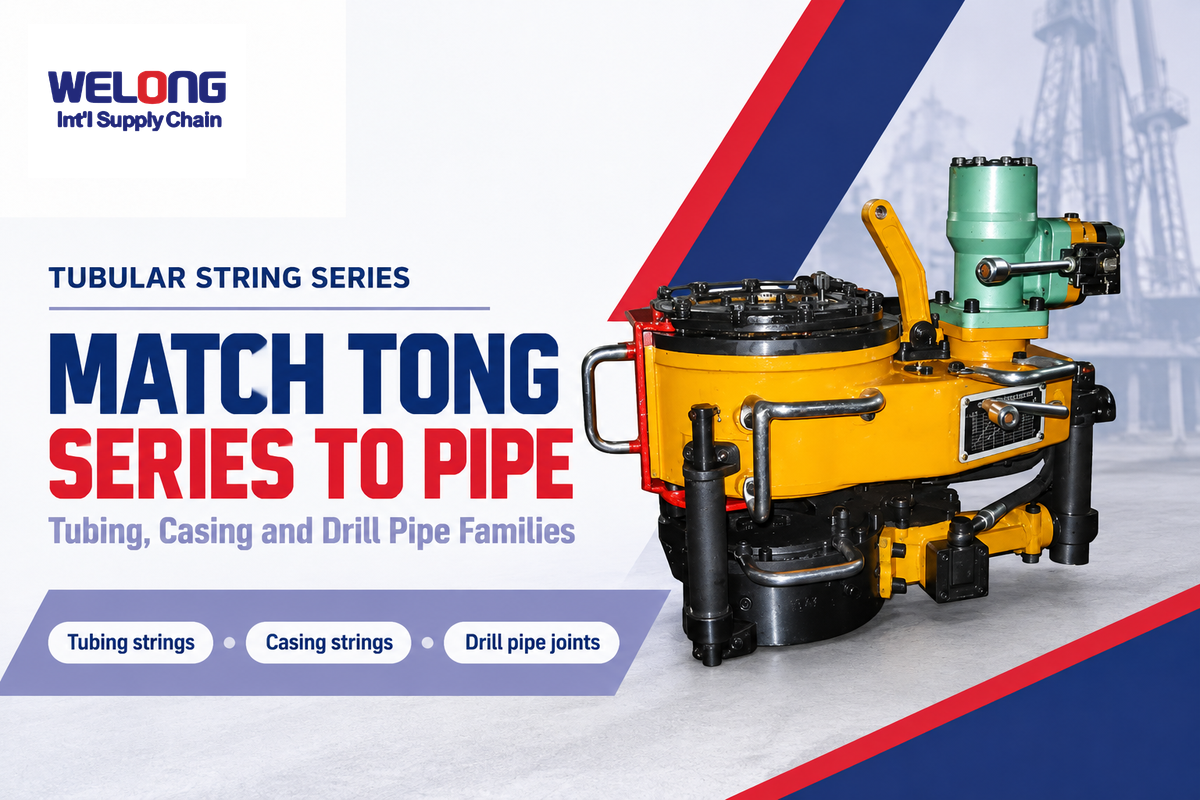
Oilfield hydraulic power tongs are grouped into three primary classes by tubular string: tubing tongs (`XQ` series) for completion and workover strings, casing tongs (`TQ` series) for 101.6–508 mm (4–20 inch) casing, and drill pipe tongs (`ZQ` series) for 65–203 mm tool joints.
As published on China Welong’s power tong specification page, China Welong supplies `XQ` tubing tongs (`60–140 mm`, `3,300–20,000 N·m` / `3.3–20 kN·m`), `ZQ` drill-pipe tongs (`65–203 mm`, `25–125 kN·m`), `TQ` casing tongs (`101.6–508 mm`, up to `90 kN·m`), and `WL` horizontal bucking units (`60–762 mm`, up to `110 kN·m`). Across international drilling equipment fleets, standardized `SY/T 5074` model designations (`XQ`, `TQ`, and `ZQ`, where the first number indicates maximum pipe diameter in millimeters and the second number indicates rated low-gear torque in kilonewton-meters) work alongside Western hydraulic models. For example, Weatherford’s power tong lineup includes the `5.5-15` tubing tong (`1.66 to 5.5 inch` OD, `15,000 ft-lb` / `20,340 N·m`), the `7.6-30` tubing tong (`2-3/8 to 7-5/8 inch` OD, `30,000 ft-lb` / `40,670 N·m`), the `16-25` casing tong (`6-5/8 to 16 inch` OD, `25,000 ft-lb` / `33,900 N·m` with a unique gated rotary), the `14-50` and `24-50` casing tongs (`50,000 ft-lb` / `67,790 N·m`), the `14-100` (`7 to 14 inch` OD) and `30-100` (`16 to 30 inch` OD) casing tongs (`100,000 ft-lb` / `135,600 N·m`), the `21-300` riser tong (`300,000 ft-lb`), and the `SpeedTork 8.0-70` drillpipe tong (`70,000 ft-lb` / `94,900 N·m`, `360°` rotation). Buyers evaluating a `magnum casing power tong •` or comparing `tongs for sale` from a specialized `tongs manufacturer` also encounter Houston-based manufacturer Magnum Manufacturing (`Magnum Casing Tools` `7265-v7` and `14-v8` casing tongs). Under API RP 54 Section 7.8.9, power tongs shall have safety devices in proper working order.
Prior to making an inquiry, engineers can match the required pipe diameter and torque by running our interactive Tubular-to-Torque Tong Selector tool, or review the published model specifications of China Welong, and SGPE reference tables below, for comparison.
| Model / Series | Tubular Class | Applicable Pipe OD Range | Rated Low-Gear Torque Band | Reference Speed (RPM) | Reference Pressure & Flow |
|---|---|---|---|---|---|
| Welong XQ Series (XQ89 / XQ114 / XQ140) | Tubing Power Tongs | 60–140 mm (2-3/8″–5-1/2″) | 3.3–20.0 kN·m (3,300–20,000 N·m; XQ89 ref. 2,434 ft-lbs) | XQ89/3C ref.: 100 / 16 rpm; XQ140/12 ref.: 85 / 12 rpm | XQ89/3C ref.: 10 MPa at 80 L/min; XQ140/12 ref.: 12.5 MPa at 80–120 L/min |
| Weatherford 5.5-15 & 7.6-30 | Tubing / CRA Tongs | 42.2–139.7 mm (1.66″–5.5″) & 60.3–193.7 mm (2-3/8″–7-5/8″) | 20.34 kN·m (15,000 ft-lb) & 40.67 kN·m (30,000 ft-lb) | High-speed spin / low make-up | Free-floating hydraulic backup for CRA strings |
| Welong TQ Series (TQ178 / TQ340 / TQ508) | Casing Power Tongs | 101.6–508 mm (4″–20″ full TQ series) | Up to 90.0 kN·m (TQ178 ref. ~12,900 ft-lbs; TQ508 ref. ~66,000 ft-lbs) | Model-dependent two-speed gear train | Matched to casing string OD and quotation scope |
| SGPE TQ340/35 Reference | Intermediate Casing Tong | 114.3–340 mm (4-1/2″–13-3/8″) | 35.0 kN·m (25,800 ft-lbs) | Two-speed spin and make-up | 18 MPa (2,610 psi) at 110–160 L/min (29–42 GPM) |
| Weatherford 14-100 & 16-25 | High-Torque Casing Tongs | 177.8–355.6 mm (7″–14″) & 168.3–406.4 mm (6-5/8″–16″) | 135.6 kN·m (100,000 ft-lb) & 33.9 kN·m (25,000 ft-lb) | Gated rotary with hydraulic door interlock | Free-floating backup; seven grip points on 16-25 |
| ZQ127/25 (Welong / SGPE Ref.) | Slim-Hole Drill Pipe Tong | 65–127 mm (2-9/16″–5″) | 25.0 kN·m (18,440 ft-lbs) | 65 / 10.5 rpm | 12 MPa at 180 L/min |
| ZQ162/50 & ZQ203/100 | Drill Pipe Power Tongs | 85–203 mm (approx. 3.35″–8″ tool joints; ZQ162: 85–162 mm) | 50.0 kN·m (36,880 ft-lbs) to 100.0 kN·m (73,800 ft-lbs) | 56 / 5.5 rpm | 16 MPa at 120 L/min (ZQ162/50); 16.6 MPa at 114 L/min (ZQ203/100) |
| ZQ203-125 (ZQ203/125) | Heavy Drill Pipe Tong | 89–203 mm (3-1/2″–8″ drill pipe/collars) | 125.0 kN·m (~92,200 ft-lbs) | 45 / 4.8 rpm | 20 MPa at 114 L/min |
Sizing a Power Tong and Hydraulic Power Unit (HPU): Torque Band, Flow and Pressure
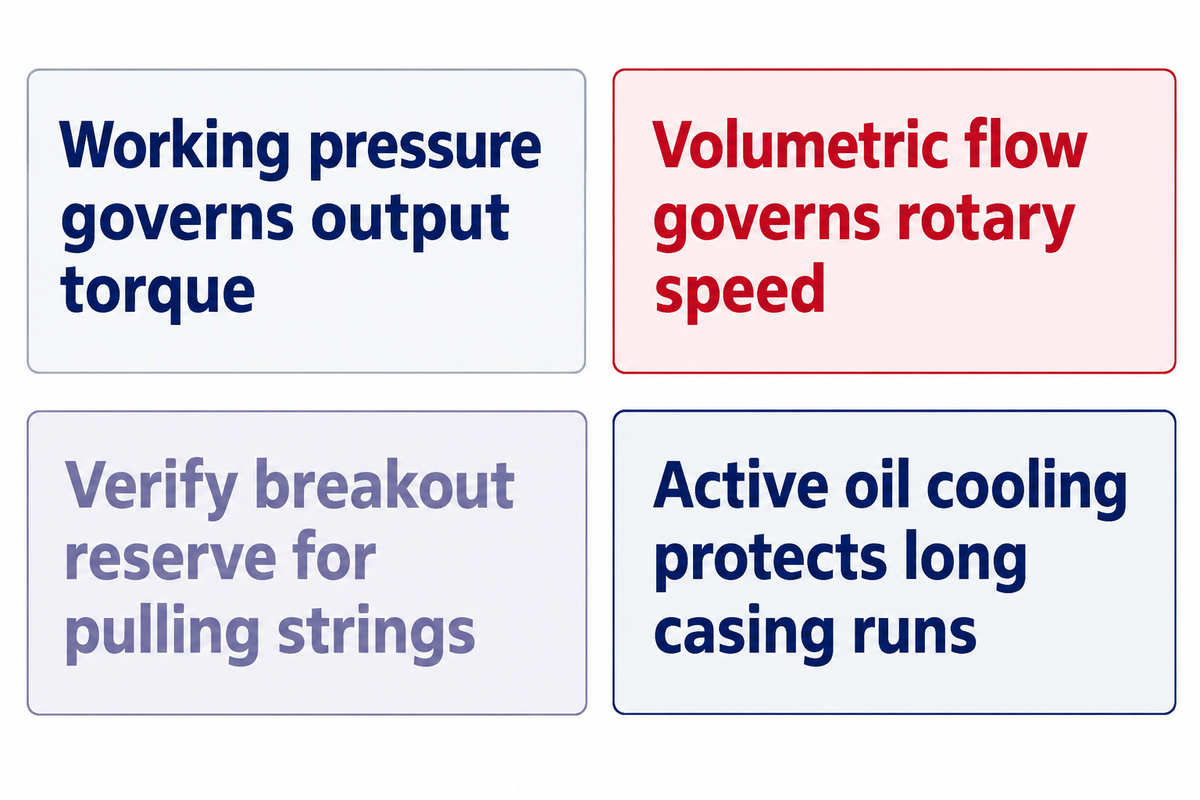
Sizing a hydraulic power tong and its pair requires balancing two independent hydraulic variables. Sizing a hydraulic power tong and its paired hydraulic power unit requires matching two independent hydraulic variables: working pressure (PSI or MPa), which governs maximum output torque, and volumetric flow rate (GPM or L/min), which governs rotary ring-gear speed. For continuous casing or tubing runs, tubular running supervisors size the tong so the connection’s optimum make-up torque falls between 60% and 80% of the tong’s low-gear rated capacity, while verifying sufficient breakout reserve for pulling strings. They check breakout reserve to ensure it’s sufficient for pulling strings.
How do hydraulic flow rate (GPM) and system pressure (PSI) independently control tong speed and torque?
In a positive-displacement hydraulic motor driving a power tong gear train, shaft torque is proportional to fluid pressure drop across the motor ports (in PSI or MPa). Rotational speed (RPM) is proportional to volumetric flow rate (in GPM or L/min) from the HPU pump. Per Eckel’s OEM hydraulic power tong engineering FAQ, Eckel rates all their tongs at the industry standard 2,500 PSI (17.2 MPa), while in some instances it requires up to 2.5 times (2-1/2 times) the make-up torque to break out a connection. Adjusting the pressure-relief valve caps maximum torque without changing free-spinning RPM. Throttling pump GPM slows the rotary head without reducing peak stall torque. That makes hydraulic drive systems easier to control during final shoulder approach.
Worked Sizing Example: 7-Inch to 13-3/8-Inch Casing Strings Matched to TQ340-35, TQ508, or 14-100 and HPU
From Welong’s technical page for the power tong, the stated API torque value for optimum make-up is based on API RP 5C1. A 7-inch N-80 BTC joint is targeted for ~5,190 ft-lbs, and a 13-3/8-inch joint is targeted for ~10,400 ft-lbs. For some connections, maximum torque values can be 50–80% above minimum torque values. Consider sizing the tong and HPU across standard and high-torque casing strings from 10,400 ft-lbs (14.1 kN·m) up to 21,000 ft-lbs (28.5 kN·m):
- Step 1 (Tubular OD Envelope & 60%–80% Torque Window): The TQ340-35 covers 114.3–340 mm (4-1/2–13-3/8 inch) OD and is listed at 35.0 kN·m (25,800 ft-lbs) in low gear. A 10,400 ft-lbs (14.1 kN·m) BTC make-up target uses 40% of that rating, and a 17,500 ft-lbs (23.7 kN·m) target uses approximately 68% and fits the stated 60%–80% window; a 21,000 ft-lbs (28.5 kN·m) target uses approximately 81.4% of rated capacity, above the stated 80% upper limit, and requires stepping up to a higher-rated casing tong such as Welong’s TQ508 series (~66,000 ft-lbs / up to 90 kN·m) or Weatherford’s 14-50 (50,000 ft-lb / 67,790 N·m).
- Step 2 (HPU Flow & Pressure Matching): Supplying the TQ340/35 requires an HPU rated for 18 MPa (2,610 psi) and 110–160 L/min (29–42 GPM) per SGPE’s reference table, whereas smaller tubing tongs such as the XQ89/3C operate at 10 MPa and 80 L/min and heavy tongs for drill pipes such as the ZQ203/125 require 20 MPa at 114 L/min.
- Step 3 (HPU Reservoir Thermal Limit): Eckel reports a 130–150 °F (54–66 °C) hydraulic-oil operating window, field tests showing most power units used above 32 °F (0 °C) with a 200-gallon (757 L) tank exceeding 150 °F during an 8-hour job, and uncooled units exceeding 170 °F (77 °C); those observations don’t establish that every such reservoir reaches that temperature above 32 °F ambient, but show why active oil cooling is specified for long casing runs.
Engineering boundary: Eckel reports that some connections can require up to 2.5× make-up torque for breakout. At a 21,000 ft-lbs make-up target, that would be 52,500 ft-lbs (71.2 kN·m), above the listed ratings of both the TQ340-35 and the 70.0 kN·m TQ508-70; for that breakout requirement, select equipment with a verified breakout capacity at or above 52,500 ft-lbs (71.2 kN·m), such as Welong’s 90 kN·m TQ casing configuration or Weatherford’s 100,000 ft-lb (135.6 kN·m) 14-100 hydraulic power tong for 7- to 14-inch casing.
Torque-Turn Control Systems: API RP 5C1 Buttress vs Premium Metal-to-Metal Connections
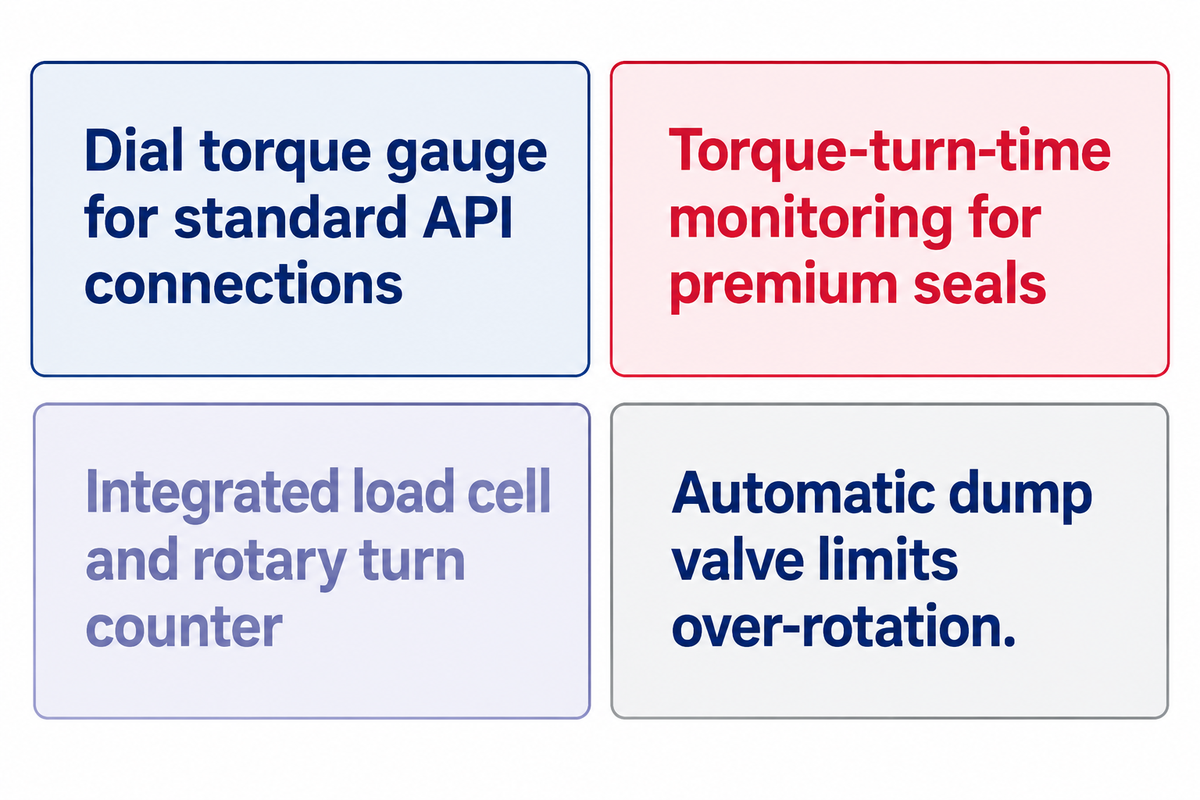
For a hydraulic power tong, use a basic dial torque gauge for standard API round (`8-Round`) LTC/STC and Buttress (`BTC`) casing threads, and a computerized torque-turn-time monitoring system with an automatic hydraulic dump valve for proprietary premium connections. API 8-Round and Buttress connections use their specified thread geometry and thread compound for pressure sealing, and some premium connections add a metal-to-metal seal and a torque shoulder.
As stated in IADC Drilling Contractor’s engineering review of tubular connection integrity and in Offshore Magazine’s field-tested power tong report, make-up systems integrate the load cell in the tong with a rotary turn counter. When the torque-turn acceptance criteria are met, the controller can divert hydraulic flow to the return line in fractions of a second to limit further driven rotation. This automatic shutoff is a key advantage for connection reliability.
Prior to programming a torque-turn computer, crews can check baseline values for our Casing Make-Up Torque Reference tool and compare the published control criteria, below (make-up windows are always governed by the running thread manufacturer’s manual):
| Control Parameter | API 8-Round (STC/LTC) | API Buttress (BTC) | Premium Metal-to-Metal Connection |
|---|---|---|---|
| Primary Sealing Mechanism | Specified thread geometry + thread compound | Specified thread geometry + thread compound | Metal-to-metal radial seal + torque shoulder |
| Primary Make-Up Acceptance Basis | API RP 5C1 target torque + thread engagement | Make-up to triangle stamp + API RP 5C1 torque band (max 50–80% above min) | Simultaneous Torque-vs-Turn window (shoulder + delta turns + final torque) |
| Published Shoulder Torque Window | No positive internal torque shoulder | No positive internal torque shoulder | 5% to 70% of optimum make-up torque in Weatherford’s published joint-analyzed make-up benchmark |
| Published Delta-Turn & Slope Window | Monitored for thread galling spikes | Monitored for coupling split or thread jump | 0.010 to 0.100 delta turns after shoulder in Weatherford’s published joint-analyzed make-up benchmark |
| Final Make-Up Shutoff Control | Manual valve release at target gauge torque | Manual valve release + triangle position check | Electric-over-hydraulic dump valve diverts flow in fractions of a second |
Jaw and Die Metallurgy: Standard Steel vs Non-Marking Dies for 13Cr and CRA Tubulars
Power tong jaws are responsible for transferring high torque into pipe wall by means of a die with an appropriate tooth profile. This application protects corrosion-resistant alloy (`CRA`) completions from deep gouges. Die match governs the grip performance.
When must rig crews switch from standard steel tong dies to non-marking CRA dies?
For `13Cr`, `Super 13Cr`, and duplex stainless strings, low-marking dies can reduce free-iron embedding and mechanical gouging compared with coarse carbon-steel teeth. Standard steel dies that have gripped carbon steel can leave iron residue and sharp tooth marks on stainless surfaces. While alloy qualification against sulfide stress cracking (`SSC`) and stress corrosion cracking (`SCC`) in sour `H2S` service is governed metallurgically by `NACE MR0175 / ISO 15156-3`, CRA running procedures pair dedicated tongs (such as Weatherford’s 5.5-15 and 7.6-30 hydraulic tubing tongs for 1.66- to 7-5/8-inch CRA tubulars) with wrap-around or contour dies.
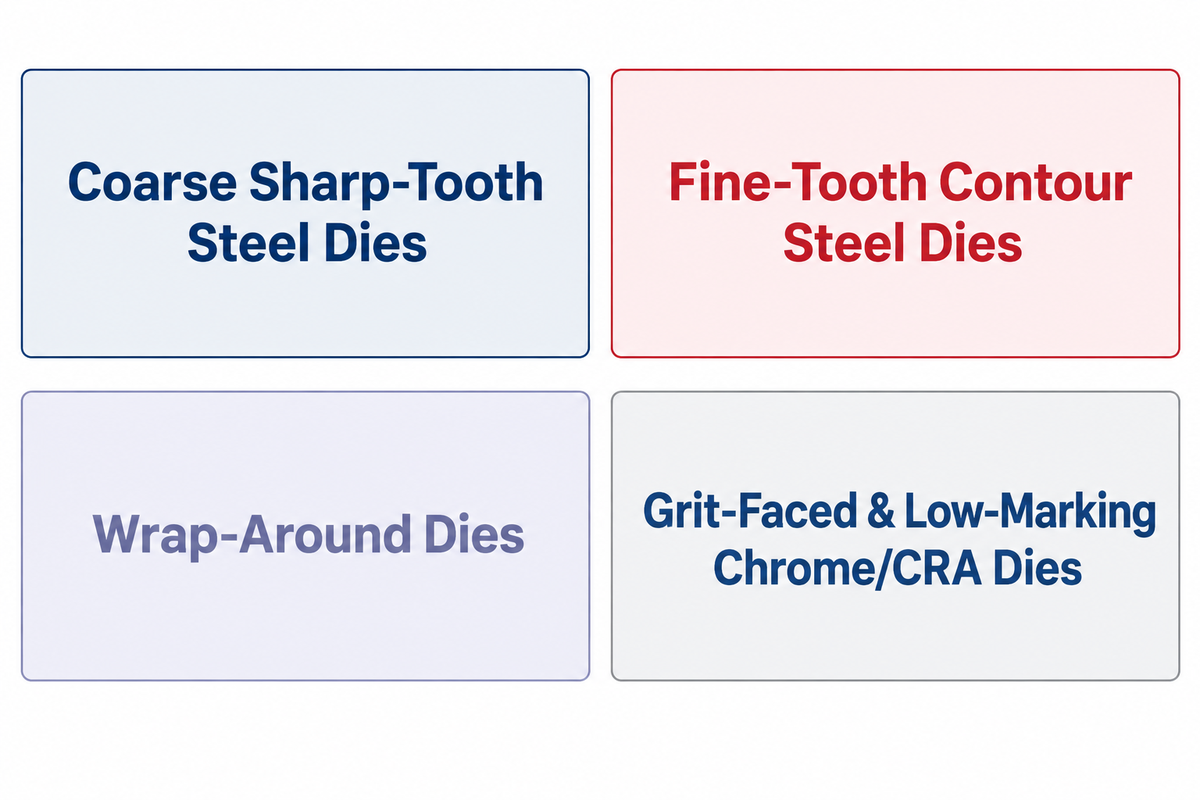
Eckel’s die selection guidance, Goldenman’s review of power tong dies and jaws, and US Patent US6263763B1 covers the jaw-die alternatives provided below; the patent describes a symmetrical three-die backup clamp spaced at 120 degrees with roller stabilizers:
- Coarse Sharp-Tooth Steel Dies: Standard pyramid or longitudinal serrations engineered to bite through mill scale and mud film on carbon-steel casing and drill pipe tool joints.
- Fine-Tooth Contour Steel Dies: Higher tooth count with reduced tooth penetration depth for high-strength carbon-steel tubulars where deep surface markings must be limited.
- Wrap-Around Dies: As noted in Eckel’s FAQ, wrap-around dies offer a larger surface contact area on the tubular and distribute clamping force uniformly around the pipe to reduce point loading.
- Grit-Faced & Low-Marking Chrome/CRA Dies: For chrome tubulars, Eckel lists rig style, contoured rig style, wrap-around, and grit dies, while Weatherford’s 5.5-15 and 7.6-30 tubing tongs handle 1.66- to 7-5/8-inch corrosion-resistant alloy strings.
Power Tong vs Manual Rotary Tongs, Iron Roughnecks and Shop Bucking Units
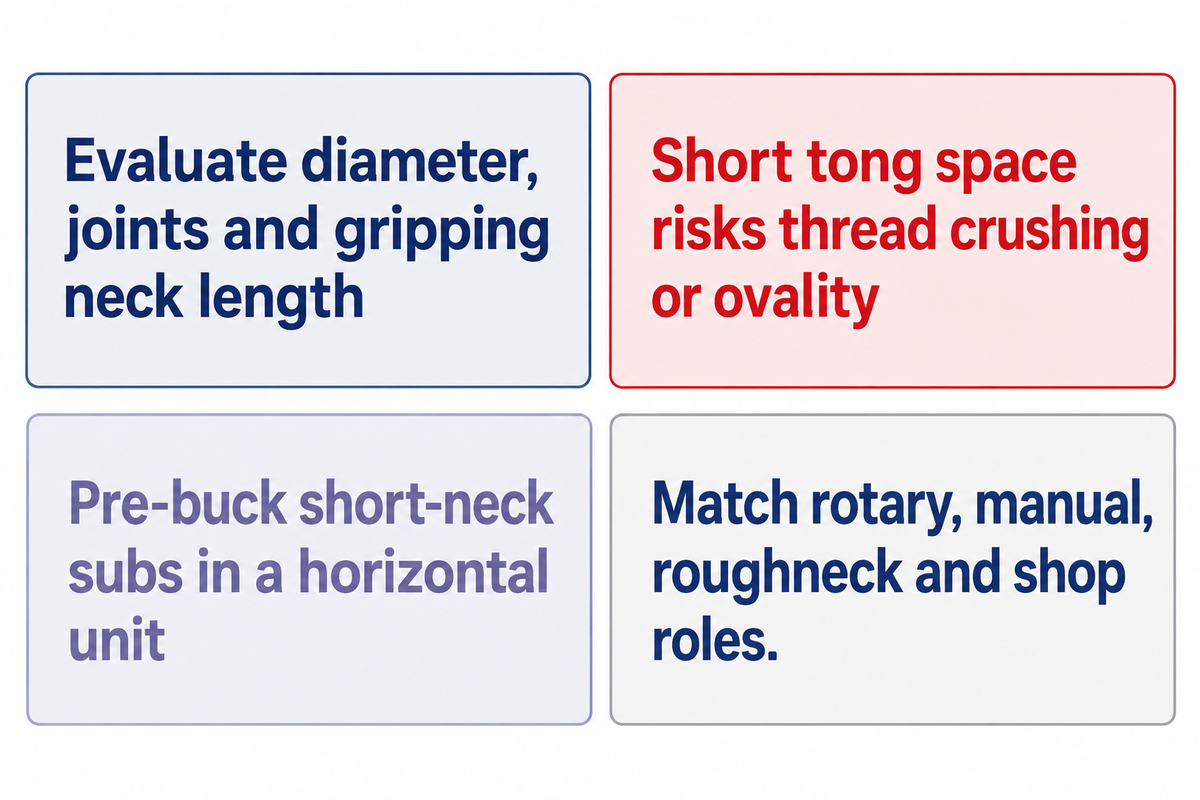
Vertically suspended tongs, rotary manual tongs, automated iron roughnecks, and horizontal workshop bucking units should be evaluated based upon diameter, pipe joints, and the cycle time speed for the available gripping neck length.
A field boundary discussed by petroleum engineers in Eng-Tips Thread 371770 on mandrel casing hanger minimum tong space explains when subassemblies are pre-bucked off the rig floor: if the tong space is too short, gripping over internal threads might crush the thread or deform the roundness of the threads even elastically, increasing the torque needed for proper make-up; the cited field rule of thumb is `6 inches` (`152 mm`) or `1/2 of the coupling length` (with `~2 feet` / `610 mm` spacing between rotary and backup jaws). When a short-neck hanger or float sub lacks that gripping space, crews can pre-buck it with a handling pup joint on a horizontal workshop bucking unit (`WL` series, `60–762 mm` / up to `30-inch` connections and `110 kN·m` peak torque). Compare the four equipment classes across our API 7K manual rotary tongs, WL horizontal shop bucking units, and power tong vs bucking unit comparison guide, as well as US Patent US6263763B1:
| Comparison Dimension | Vertical Hydraulic Power Tong (XQ / TQ / ZQ) | Manual Rotary Tongs (Type B / C / DB / SDD) | Automated Rig-Floor Iron Roughneck | Horizontal Workshop Bucking Unit (WL Series) |
|---|---|---|---|---|
| Operating Orientation | Vertical over well center (suspended from mast) | Vertical over well center (dual lead/backup cathead lines) | Vertical on rig floor (track-mounted or rotating arm) | Horizontal bed in threading or repair shop |
| Pipe Diameter Envelope | 42.2–508 mm (1.66″–20″ across cited models; Welong XQ/ZQ/TQ: 60–508 mm) | 60.3–863.6 mm (approx. 2-3/8″–34″ via interchangeable lug jaws) | 89–248 mm (3-1/2″–9-3/4″ drill pipe & drill collars) | 60–762 mm (2-3/8″–30″ connections on Welong WL series) |
| Published Torque Capacity | 3.3 to 125 kN·m on Welong XQ/TQ/ZQ; 135.6 kN·m (100,000 ft-lb) on Weatherford 14-100 | 20 to 135 kN·m (14,750 to 100,000 ft-lbs by lug jaw class) | High-torque drill-pipe tool-joint make-up and breakout | Up to 110 kN·m (~81,100 ft-lbs) on Welong WL bucking units |
| Spin-In & Make-Up Cycle | Integrated 2-speed hydraulic spin + low-gear torque | Requires separate spinning wrench/chain + cathead pull | Automated roller spinner + hydraulic torque wrench | Radial hydraulic clamp + continuous horizontal makeup |
| Primary Oilfield Duty | Casing running (TQ), tubing workover (XQ), drill pipe (ZQ) | Manual rotary drilling and workover breakout/make-up | Automated drill-stem tripping on mechanized rigs | Shop make-up of couplings, downhole tools & short-neck hangers |
Rig-Floor Troubleshooting, Pre-Tour Inspection, Load-Cell Calibration and API Spec 7K Equipment Records
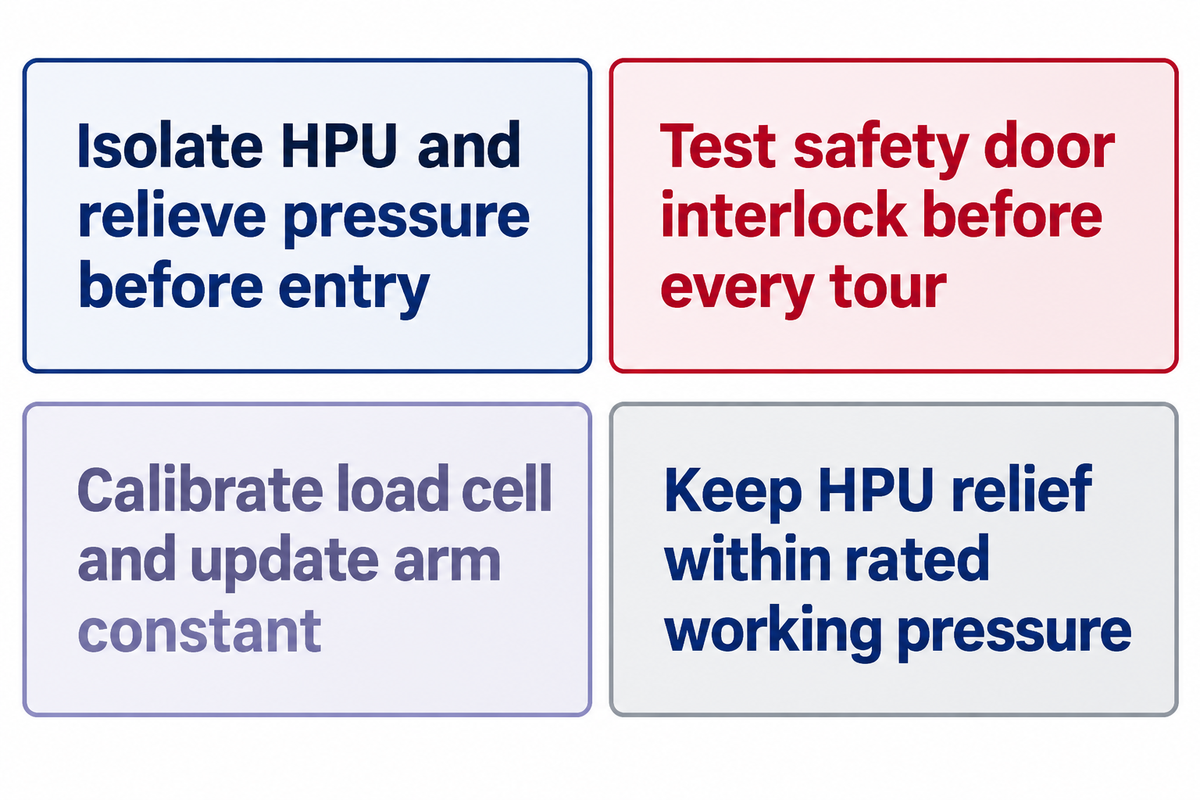
When a hydraulic power tong loses torque or slips on the pipe during a casing run, the root cause isn’t always hydraulic pump pressure. As emphasized in Goldenman’s field troubleshooting analysis on hydraulic power tongs losing torque, there are several other possible causes, such as mechanical resistance in the rotary head, lack of complete high-to-low gear shifting, glazed brake bands, or a pipe dope-filled die packed in the insert. As a result, torque may not reach the connection even if the HPU gauge reads normal. Prompt diagnosis keeps rig operations efficient.
What causes a hydraulic power tong to slip on casing pipe during low-gear make-up?
Power tongs typically slip during low-gear make-up for four mechanical reasons: (1) tong dies packed with dried thread compound and drilling mud, (2) a glazed or oil-soaked drag brake band that fails to hold the jaw carrier stationary while the cam rollers climb the rotary ramp, (3) mismatched reducing jaw inserts installed for a larger pipe outside diameter, or (4) excessive radial clearance from worn hinge pins and rollers. Before entering the rotary throat to inspect or clean a sticking jaw carrier, shut down and isolate the HPU, relieve stored hydraulic pressure, secure moving components, and follow the site’s lockout procedure. API RP 54, Section 7.8 covers tong snub-line and safety geometry; it doesn’t define the fixed hose disconnect sequence stated in the site lock out rules, and OSHA Drilling Ahead states that before trip inspection of tong dies, counterweight cables and snub lines is to be performed.
Die-to-Tubular Grip & Slippage Diagnostic Matrix
The Die-to-Tubular Grip & Slippage Diagnostic Matrix provides eight rig floor failure modes and their physical root causes and safe maintenance fixes.
| Observed Rig-Floor Symptom | Subsystem | Primary Root Cause | Verification Check | Corrective Maintenance Action |
|---|---|---|---|---|
| Dies Chatter or Slip After Initial Bite | Die Insert & Jaw Pocket | Die teeth blunted or packed with pipe dope/mud film; wrong OD jaw size installed. | Isolate HPU; inspect tooth crest sharpness and stamped jaw OD markings. | Wire-brush die grooves every tour; replace worn dies or fit matched OD jaw set. |
| Rotary Ring Spins Without Cam Jaws Biting | Brake Band & Cam Ramp | Drag brake band glazed, oil-contaminated, or under-tensioned; cam roller flat-spotted. | Check brake-band lining, oil leakage, and cam roller rotation on pin after isolation. | Degrease or reline brake band; adjust brake band tension; replace flat rollers. |
| Tong Stalls Below Target Torque in Low Gear | HPU & Two-Speed Gear Train | Mechanical shift lever not fully engaged; relief valve drifting open; HPU oil overheated above 170 °F (77 °C). | Verify complete stop before mechanical gear shifting (Eckel FAQ), relief pressure, and oil temperature. | Come to a complete stop before shifting mechanical lever; use oil cooler to hold 130–150 °F (54–66 °C). |
| Hydraulic Motor Whines With Slow Rotation | Hydraulic Supply & Suction | Suction strainer restricted; oil viscosity outside motor limits; quick-disconnect coupling not seated. | Inspect pump inlet condition, return-line flow, and quick-coupling seating. | Clean suction strainer; warm hydraulic oil within pump/motor viscosity limits; reseat couplings. |
| Open-Throat Door Springs Under High Torque | Throat Gate & Radial Lock | Door latch or radial lock keys worn; door interlock valve out of adjustment. | Perform magnetic particle (MT) check on door lugs and test safety door interlock cut-off. | Remove tong from service; repair door latch/keys and verify door interlock blocks fluid when open. |
| Erratic Torque Gauge Spikes or Zero Drift | Load Cell & Snub Linkage | Air in hydraulic load cell; snub line off 90°; wrong tension/compression arm constant. | Check 90° snub angle, bleed load-cell port, and verify effective handle length. | Bleed load cell, set snub line to 90°, and complete annual calibration under API RP 5C1. |
| Pipe Body Crushed or Internal Threads Deformed | Clamping Geometry & Neck | Short gripping space over internal hanger/sub threads or excessive backup clamping force. | Assess the bare gripping neck using the cited field rule of thumb of 6 inches or half the coupling length, and confirm the selected tong’s jaw-spacing requirements and backup pressure setting. | Regulate backup clamp pressure; pre-buck short-neck hangers in a horizontal shop bucking unit. |
| Jaws Fail to Release Pipe After Make-Up | Reverse Cam & Return Spring | A cam roller may be wedged at the ramp apex, or a jaw-retraction spring may be broken. | With personnel clear of the throat and guards in place, use controlled brief reverse rotation to release a cam-bound jaw. | Isolate and depressurize the HPU before inspecting or replacing the return springs. |
Do (Rig-Floor Best Practices)
- Shut down and isolate the HPU, relieve stored hydraulic pressure, and secure moving parts before changing dies, jaws, or adjusting brake bands.
- Test the safety door interlock before every tour so the rotary ring gear stops whenever the throat gate opens.
- Perform annual calibration of the load cell and torque gauge under API RP 5C1 and update the handle-length constant whenever adding or removing a backup unit.
Don’t (Critical Safety Prohibitions)
- Never adjust the HPU relief valve above the tong’s rated working pressure (such as 2,500 PSI / 17.2 MPa) to force a stalling tong to turn.
- Never stand inside the tong swing radius when breaking pipe (follow the four-foot hole-center clearance stated in OSHA Drilling Ahead).
- Never run coarse carbon-steel dies on 13Cr or duplex CRA strings without checking the pipe manufacturer’s low-marking die requirements.
Procurement Verification: API Spec 7K Design Basis, SGS/DNV Inspection and Traceability
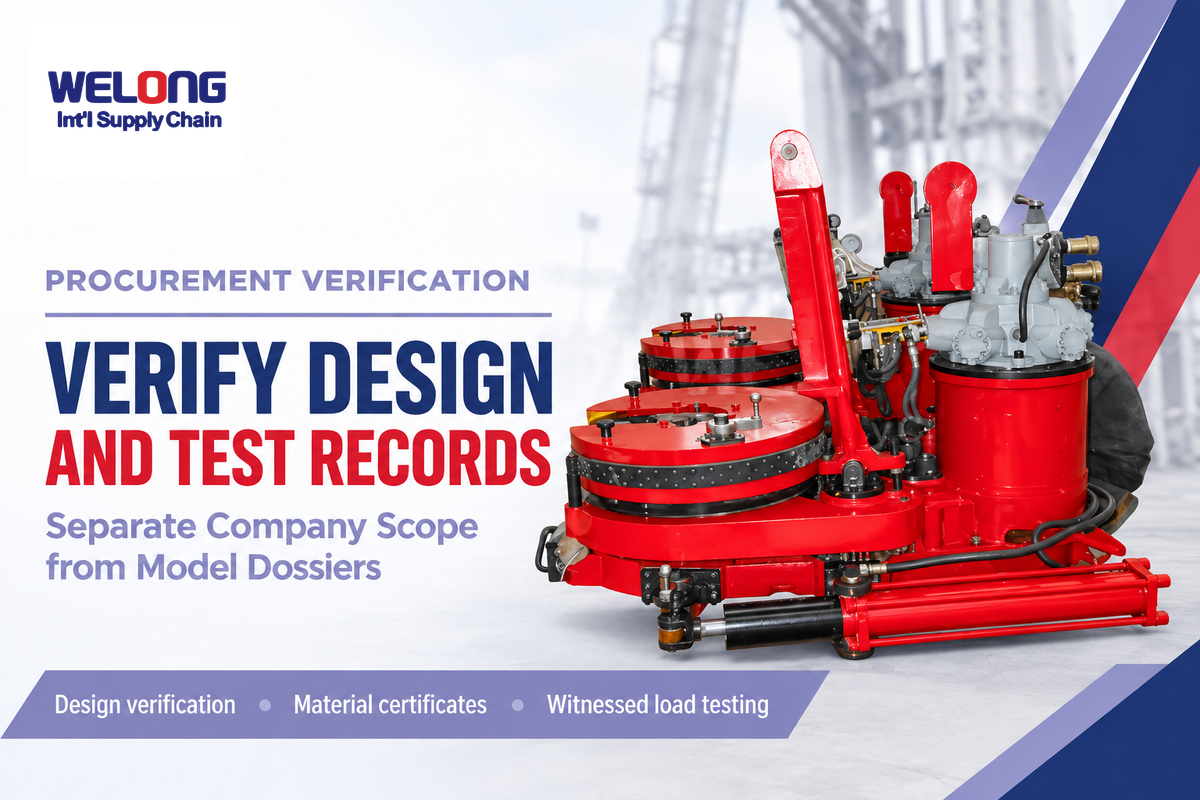
Per the official API Spec 7K 6th Edition Monogram Product Update issued December 22, 2016 and effective December 30, 2016, the American Petroleum Institute removed “Power Tongs, including Spinning Wrenches” from the API Spec 7K Monogram licensing scope (while adding Slip Bowls) and advised manufacturers producing only those items to transition to `API Spec Q1` or `ISO 9001` quality management registration. As summarized in ARDT’s API Specification 7K technical overview and Keystone Energy Tools’ API 7K standards summary, `API Spec 7K` 6th Edition runs 130 pages across eleven numbered sections plus six annexes covering design verification, materials, welding, proof-load testing, and marking requirements, while `API RP 7L` governs in-service inspection, maintenance, and remanufacture.
When assessing suppliers or comparing tongs for sale in Houston for international oilfield tenders, buyers should distinguish companies that provide complete assemblies and matched jaw/die kits from spare-parts specialists. From our validated source records, China Welong (est. In our verified source records, China Welong (`Shaanxi Welong International Supply Chain Management Co., Ltd.`, founded in 2001) provides complete `ZQ`, `XQ`, and `TQ` tongs and `WL` bucking units with matched jaw/die kits; confirm the responsible builder and applicable `API Spec 7K` requirements for the selected model in the quote. On the other hand, `Weatherford` (`5.5-15`, `7.6-30`, `14-50`, `14-100`, `16-25`, `24-50`, `30-100`, `21-300`, `SpeedTork 8.0-70`) and `Eckel` (`5-1/2 Hydra-Shift`, `10-3/4 Standard`, `14 UHT` plus rig, contour, wrap-around, and grit dies) build complete tongs and die sets. Lastly, SGPE focuses on replacement spare parts, jaw assemblies and dies for selected `ZQ`, `TQ`, `XQ`, `XQB` and `XQ29` models, upon verifying the model, original part number, dimensions and hydraulic data.
Regarding purchase price, rental day rates, and delivery lead time: as stated on China Welong’s power tong page, reputable suppliers do not publish a single fixed sticker price, universal rental day rate, or generic delivery lead time because every package is configured to the buyer’s pipe sizes, required torque band, jaw/die kits, control options, and third-party inspection scope. Instead, when buyers submit their tubular OD list, torque range, and destination Incoterm (`EXW`, `FOB`, `CFR`, `CIF`, or `DDP`), China Welong returns an engineer-reviewed quotation with exact model pricing and delivery lead time within `24 hours` on business days. For China Welong, verify company-level quality and product certification scopes (`ISO 9001:2015` and `API Spec 7-1` for its applicable drilling tool product line across customers in the US, UK, Germany, Romania, Italy, Netherlands, UAE, Australia, Argentina, Brazil, South Africa, Algeria, Congo, and Venezuela) separately from the selected power tong’s model-specific inspection records. For every inquiry about a ZQ, XQ, or TQ hydraulic power tong, the quotation explicitly identifies the selected model’s applicable API Spec 7K design requirements, load-test records, and any third-party witness scope:
| RFQ Verification Item | Governing Technical Reference | Required Inspection Evidence in Dossier |
|---|---|---|
| 1. Model-Level Design & Proof-Load Basis | Contractual API Spec 7K 6th Edition design/test clauses (post-Dec 30, 2016 scope update) | Certificate of conformance and factory stall/torque proof-test chart confirmed per model in quotation. |
| 2. Primary Load-Carrying Material Certificates | EN 10204 Type 3.1 (EN 10204-3.1B on Welong order sheet) | Material certificates report specific inspection results against the order’s agreed requirements, including the specified chemistry, mechanical properties, impact tests, and heat traceability for named components. |
| 3. Non-Destructive Examination (NDE) | Contractual UT / MT inspection plan per API Spec 7K / RP 7L | Ultrasonic (UT) and magnetic particle (MT) reports shipped with the order for load-bearing components. |
| 4. Dimensional & Gear-Train Machining QC | In-process, pre-packaging, and pre-shipping dimensional inspection | Dimensional measurement report verifying gear, shaft, and jaw assembly tolerances before shipment. |
| 5. Load-Cell & Torque-Turn Calibration | Annual calibration under API RP 5C1 + effective arm constant | Calibration chart matching serial-numbered load cell and gauge to tension or compression arm length. |
| 6. Serial Number & Order Traceability | Contractual serial traceability scope in quotation | Serial markings on the tong body and jaw sets tied to the quotation’s agreed retention and record package. |
| 7. Third-Party Witness Inspection | Buyer-elected SGS or DNV witness hold points | Signed SGS or DNV inspection release note witnessing functional spin, low-gear stall torque, and NDE review. |
| 8. Export Customs & Incoterm Package | Agreed Incoterms 2020 trade term; 19 CFR origin marking for US-bound shipments | The quotation lists the equipment classification and included spare jaw, die, and seal parts; US-bound shipments also follow applicable country-of-origin marking requirements. |
Engineering Takeaway & Quotation Review
Specify the tong package by pipe OD and the connection’s required make-up and breakout torque. Specify make-up and breakout capacities separately: where the same maximum torque rating applies to both operations, a 2.5× breakout requirement limits the make-up target to no more than 40% of that rating, whereas placing make-up torque at 60%–80% of rated low-gear torque requires verifying that expected breakout loads stay within the tong’s rating. Match HPU pressure and flow, dies, and load-cell geometry to the selected equipment, and account for Eckel’s 130–150 °F hydraulic-oil operating window. API RP 54 describes a 90-degree angle between the tong body and snub line when securing pipe in the rotary table. Buyers can specify model-level API Spec 7K design and test records and EN 10204 Type 3.1 material certificates in the contract.
Frequently Asked Questions
How do you calculate exact make-up torque from power tong line pull and arm length?
Multiply calibrated load-cell line pull by the effective arm length at an exact 90-degree snub angle.
Measure the effective tong arm length from the pipe axis centerline to the rear snub-line pin (or to the compression load-cell axis when an integral backup unit is mounted underneath) and multiply that distance by the perpendicular force. Any angular deviation from 90 degrees reduces actual pipe torque by the sine of the angle.
How often should a hydraulic power tong load cell and torque gauge be calibrated?
Perform annual calibration under API RP 5C1 and recalibrate after any shock load, repair, or backup mounting change.
As noted on Welong’s power tong engineering page, annual calibration under API RP 5C1 paired with proper die and jaw selection governs make-up accuracy across casing runs. Immediate re-verification and arm-constant updates are required whenever hydraulic fluid is bled from the load cell or the crew switches between tail-line tension and under-mounted backup compression arrangements.
Can one hydraulic power tong run both casing and tubing strings on a workover rig?
Yes, within overlapping pipe diameter and torque limits when fitted with matched reducing jaw sets.
Small casing power tongs covering 101.6–178 mm (4–7 inch) OD can grip 4-1/2 inch or 5-1/2 inch tubing when equipped with matching reducing jaws and appropriate dies. However, dedicated XQ tubing tongs (60–140 mm / 2-3/8–5-1/2 inch OD, 3.3–20 kN·m) are lighter and built specifically for fast workover tubing trips.
What hydraulic oil viscosity grade is recommended for power tong HPUs?
ISO VG 32, 46, and 68 are anti-wear hydraulic oil options when matched to the manufacturer’s pump and motor viscosity limits.
ISO VG 32, 46, and 68 are anti-wear hydraulic oil options when the chosen grade stays within the pump and motor viscosity limits, while heat exchangers keep fluid within Eckel’s 130–150 °F (54–66 °C) operating window.
What inspection records should accompany an export power tong order?
Specify model-level API Spec 7K design/test records, agreed EN 10204 Type 3.1 certificates, UT/MT reports, and dimensional sheets.
Because power tongs and spinning wrenches were removed from the API Spec 7K 6th Edition Monogram licensing scope effective December 30, 2016, international buyers should contractually specify their required quality assurance dossier in the purchase order and quotation. On China Welong export orders, an EN 10204-3.1B (Type 3.1) material certificate reporting chemical composition and mechanical properties, a factory dimensional measurement report, and ultrasonic (UT) and magnetic particle (MT) inspection reports ship with the equipment, alongside any agreed third-party SGS or DNV witness release notes and US-bound 19 CFR country-of-origin markings.
Need assistance sizing an XQ, TQ, or ZQ hydraulic power tong, matching a powerful HPU and backup assembly, or specifying third-party SGS/DNV inspection for your upcoming drilling program? Contact China Welong’s engineering supply team with your tubular OD list, connection make-up torque chart, and destination Incoterms for a safe, engineer-reviewed quotation within 24 hours on business days.
Editorial & Scope Disclosure: This engineering guide synthesizes public API and OSHA drilling safety standards, published US patents, IADC trade press engineering studies, and OEM technical records. Worked sizing examples and cosine-error tables illustrate mechanical principles and do not replace connection-specific running manuals. Company supply-chain credentials are provided by China Welong; verify company-level ISO 9001:2015 and API Spec 7-1 scopes separately from the selected power tong’s model-specific API Spec 7K design and inspection records confirmed in the quotation.
References & Sources
- American Petroleum Institute (API), API Spec 7K 6th Edition Monogram Product Update (Issued Dec 22, 2016; Effective Dec 30, 2016)
- American Petroleum Institute (API), Recommended Practice 54 (API RP 54, 4th Edition): Occupational Safety and Health for Oil and Gas Well Drilling and Servicing Operations (§7.8.6 & §7.8.9)
- U.S. Occupational Safety and Health Administration (OSHA), Oil and Gas Well Drilling and Servicing eTool: Drilling Ahead, Tongs and Spinning Chain Safety
- Drilling Contractor (IADC), Joint-Analyzed Make-Up and Dump-Valve Control for Tubular Connections
- Offshore Magazine, Field-Tested Power Tong Handles All Sizes of Casing, Drillpipe, Tubing (Torque-Turn Control & Sub-Second Dump)
- U.S. Patent US6263763B1, Power Tong and Backup Tong System (Bidirectional Load-Cell Linkage & Roller Stabilizer Geometry)
- Eckel Manufacturing Co., Hydraulic Power Tong Engineering FAQ (2,500 PSI Rating, 2.5× Breakout Factor, Effective Arm Shift & HPU Thermal Limits)
- Weatherford International, Hydraulic Power Tongs Technical Specifications (Model 5.5-15 CRA Tubing Tong & Model 14-100 Casing Tong)