Get in touch with Welong Company

Manual Tong Guide: Parts, Capacity, Inspection and Care

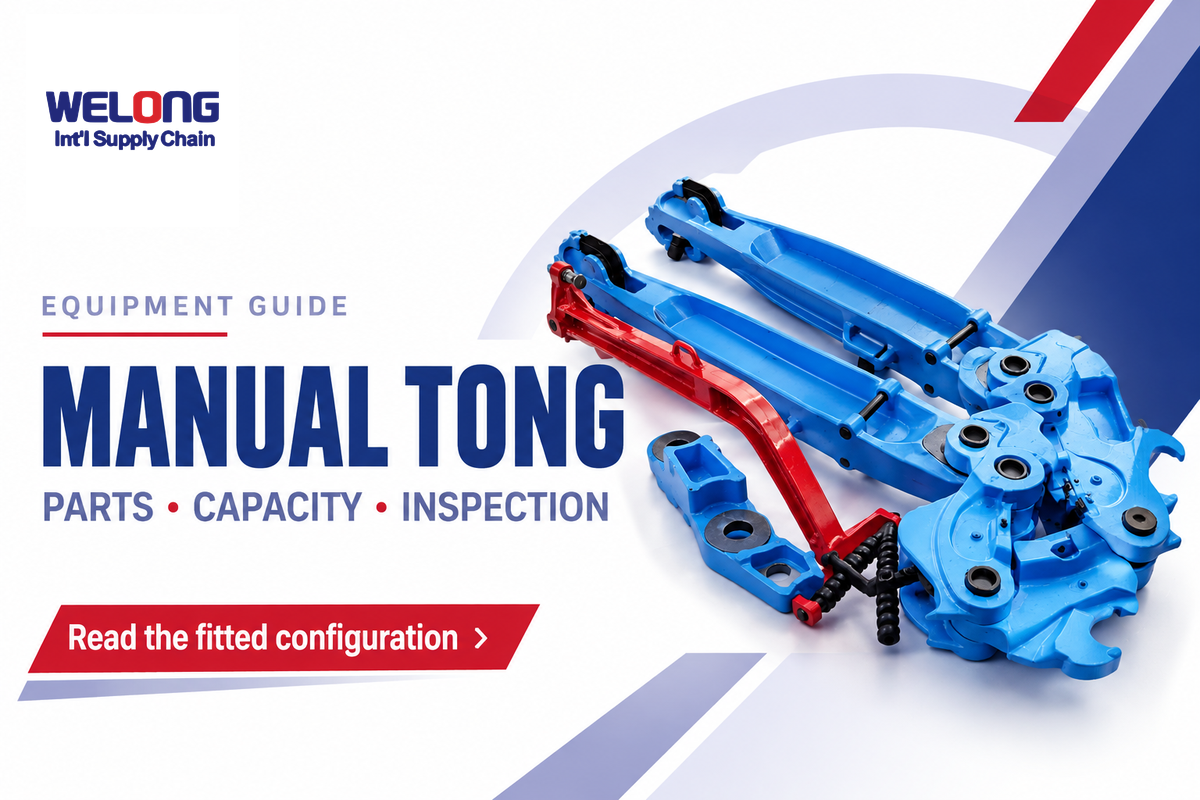
RIG FLOOR EQUIPMENT GUIDE
A Manual Tong is a hinged gripping wrench used to make up and break out tubular connections. Its jaws grip the approved outside surface while the handle transmits turning force. A usable assembly needs the right gripping geometry, a sound load path and a suitable reaction arrangement. Those three conditions explain why a tong can close around a pipe yet still be unsuitable for the job.
This guide follows the tool from identification through inspection and care. Manufacturer examples identify their own equipment; operating details belong to the actual tong manual, connection instructions and rig procedure. It’s intended for equipment understanding and maintenance planning by trained personnel.
What Is a Manual Tong Used for on a Drilling Rig?
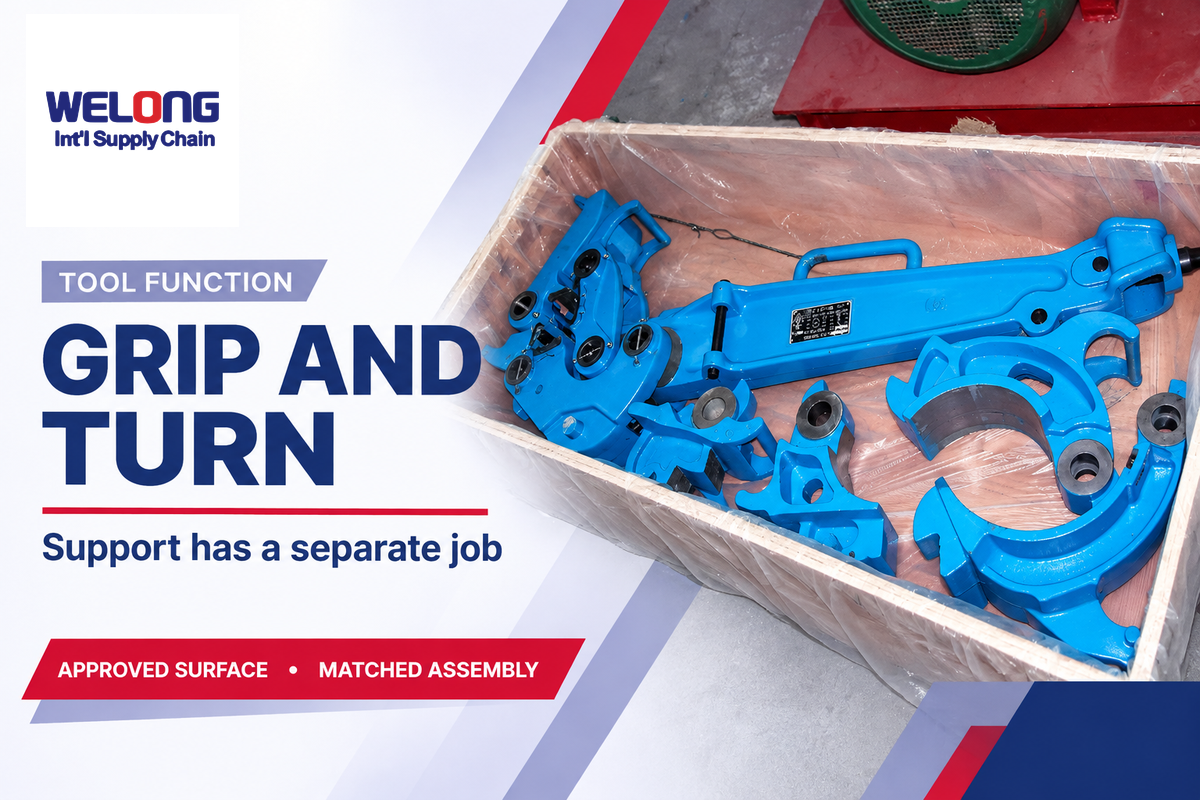
A manual tong turns or holds a tubular while a threaded connection is made or broken. On a drilling rig, this can involve drill pipe, drill collars, casing and tubing, within the tool’s approved range. Separate from lifting and axial support offered by other handling tools, gripping and turning are integral to the operation.
The OSHA drilling eTool defines tongs as large wrenches. Think of a standard wrench enlarged into a jointed head. The head closes around an approved gripping area, dies engage the surface, and the turning moment is transmitted through the handle. This analogy explains the function, but not the operation of the tool.
‘Manual’ describes the arrangement of tongs. It doesn’t restrict turning forces to only hands. Rig tongs can interact with powered pulling equipment and restrained reaction systems. Stored energy, rotating pipe and tongs’ swing are factors to consider even if the head is devoid of a hydraulic motor.
During tripping, the drill string also needs controlled support. Slips and casing, tubing and drill pipe elevators have their own handling duties. A tong’s ability to grip a pipe is no lifting-capacity approval. Procurement should identify the required function before comparing appearance, weight or tong price.
A workover rig may use a different tong range and arrangement from a large drilling unit. Equipment used on the rig must suit that unit’s actual job. “Widely used equipment” is therefore a description of a tool family, not permission to use the same tong set on every rig. The broader pipe-handling tools guide explains the surrounding equipment functions.
Manual Tong Parts and the Load Path Through the Jaws
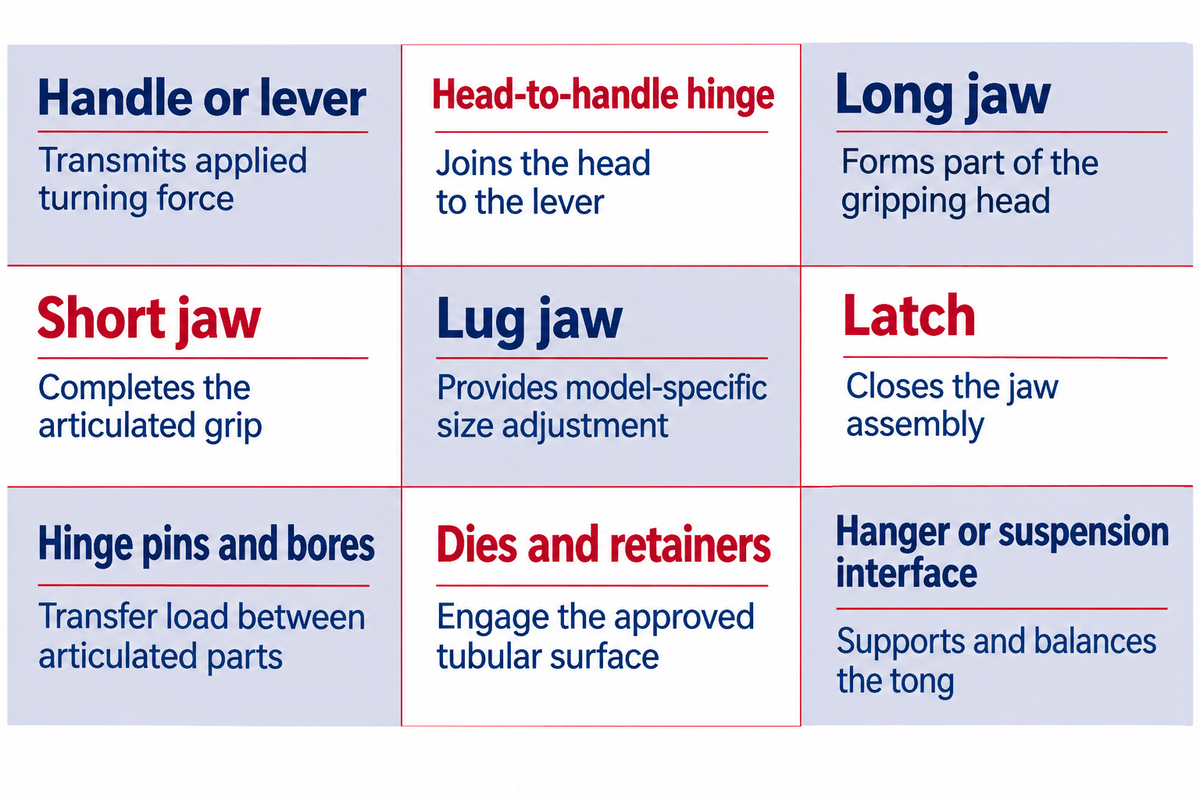
A manual tong is made up of a handle, tong body with hinged jaws, a latch, hinge pins and replaceable dies. Pull passes through this assembly into a gripping surface. Each connection in that path needs the correct fit and condition; sharp tong dies do not compensate for a damaged latch or elongated pin bore.
The parts and inspection sections of Texas International Oilfield Tools’ OM029 Rev A HT manual identify these components. The names and arrangement below are a reading aid; the exploded drawing for the actual serialised tool controls replacement parts.
| Part or interface | Function | Condition question |
|---|---|---|
| Handle or lever | Transmits applied turning force | Is there deformation, cracking or an unapproved alteration? |
| Head-to-handle hinge | Joins the head to the lever | Is the correct pin retained and the joint in acceptable condition? |
| Long jaw | Forms part of the gripping head | Does its identity match the approved assembly? |
| Short jaw | Completes the articulated grip | Is movement free within the specified condition limits? |
| Lug jaw | Provides model-specific size adjustment | Does its approved range cover the actual gripping diameter? |
| Latch | Closes the jaw assembly | Does full engagement occur without damaged contact surfaces? |
| Hinge pins and bores | Transfer load between articulated parts | Is wear assessed against the manufacturer’s limits? |
| Dies and retainers | Engage the approved tubular surface | Are the correct dies installed, sound and retained? |
| Hanger or suspension interface | Supports and balances the tong | Is the suspension arrangement intact and correctly adjusted? |
A die may engage locally while the rest of the head is misaligned. Once the handle is loaded, that misalignment can change how the latch and pins carry force. The historical IADC Safety Alert 99-10 discusses several factors related to slipping tongs, including worn teeth, leveling, lug-jaw selection and cracking. It provides context regarding an incident that occurred to a company; it isn’t a universal wear-tolerance table.
When a stores team has a bin labelled “manual drill pipe tong spares,” the useful next question is the part number and compatible assembly. A similar-looking jaw can have a different geometry. Replacing worn parts by visual resemblance leaves the most important fit question unresolved.
Manual Tong Types, Pipe Sizes and Model-Specific Limits
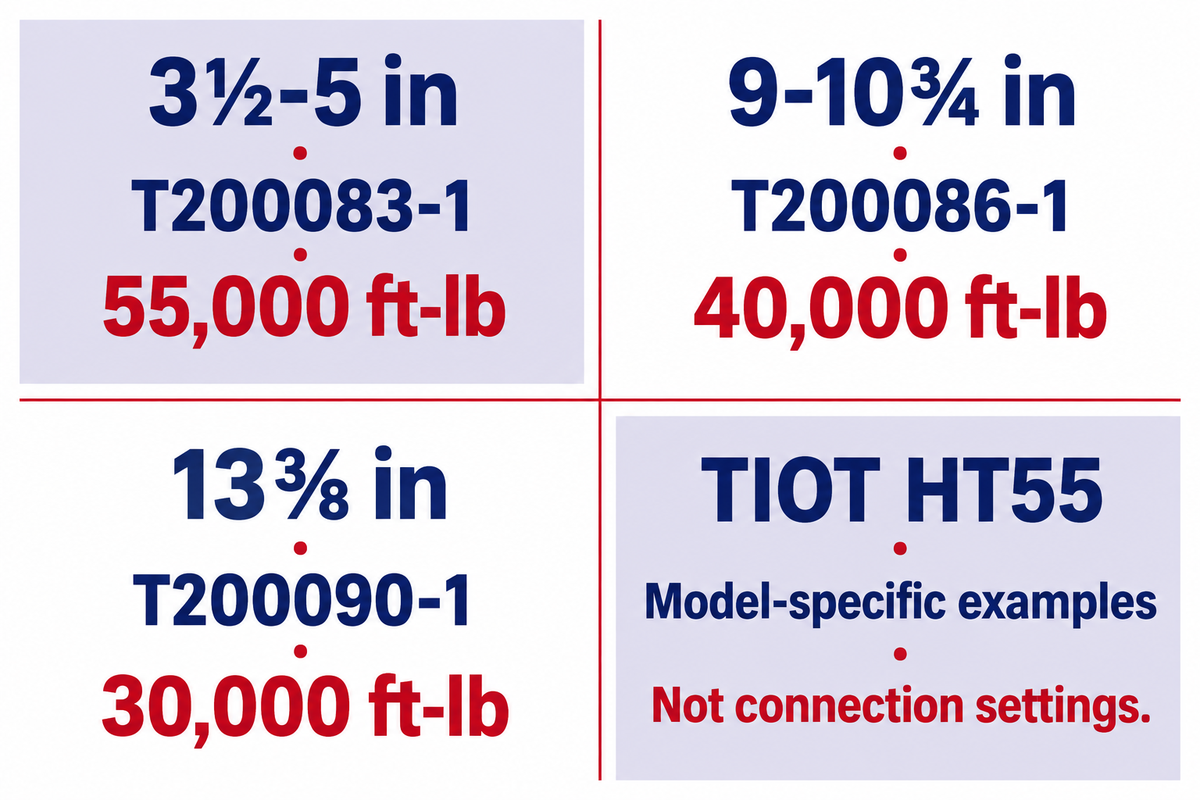
Texas International’s HT55 table lists 55,000 ft-lb, 40,000 ft-lb and 30,000 ft-lb for three different jaw configurations shown below. These are manufacturer rated capacities. Therefore the same model designation does not always give every fitted jaw the family’s largest rating and none of these figures are connection make up settings.
| Published jaw gripping size | Jaw identifier in parameter table | Rated torque | Reading consequence |
|---|---|---|---|
| 3½–5 in | T200083-1 | 55,000 ft-lb | This rating belongs to this listed configuration. |
| 9–10¾ in | T200086-1 | 40,000 ft-lb | A larger approved jaw range has a different limit. |
| 13⅜ in | T200090-1 | 30,000 ft-lb | The model name alone cannot identify capacity. |
As per the TIOT OM029 Rev A, dated August 31, 2023, Main Technical Parameters, these are some examples to give a chart reading and not a complete cross reference of replacement parts, a China Welong rating or an authorization to interchange various assemblies.
Can one Manual Tong handle several drill pipe sizes?
Yes. A model may cover various gripping diameters through approved jaws or latch positions. The actual tool-joint or coupling diameter must fall within the fitted configuration’s range, and its capacity must meet the task. Ensure both of these are documented in the model. Nominal drill pipe size, by itself, doesn’t establish either fit or rated torque.
The pipe body may be smaller than the tool-joint’s gripping surface. The drill pipe guide explains this assembly. The approved size of the tong is selected around the approved gripping surface, as opposed to an adjacent convenient hardband or the pipe body diameter. Tong jaws for different sizes must be within the combination approved for the identified body.
Catalogues indicate designations such as Type B and Type SB, Type SDD and HT. Treat each tong type as a manufacturer’s defined product family. A Type SDD label, or an SDD manual tong description, doesn’t imply the manual tong brand is using the same jaw components. Rutong’s Type SDD product table is another example of a manufacturer’s product with its size and rating rows.
Illustrative scenario: a maintenance planner fits an approved larger-range jaw to an HT55 body. The old job sheet still carries the smaller jaw’s maximum capacity. The changed jaw row, not the unchanged model name, determines which capacity entry must be reviewed before that assembly is allocated.
For heavy drill collars, confirm handling size, gripping surface and available clearance separately. The API 7K public scope announcement identifies manual tongs as a product category; it doesn’t make commercial type codes interchangeable.
Working Tongs, Backup Tongs and Reaction-Line Control
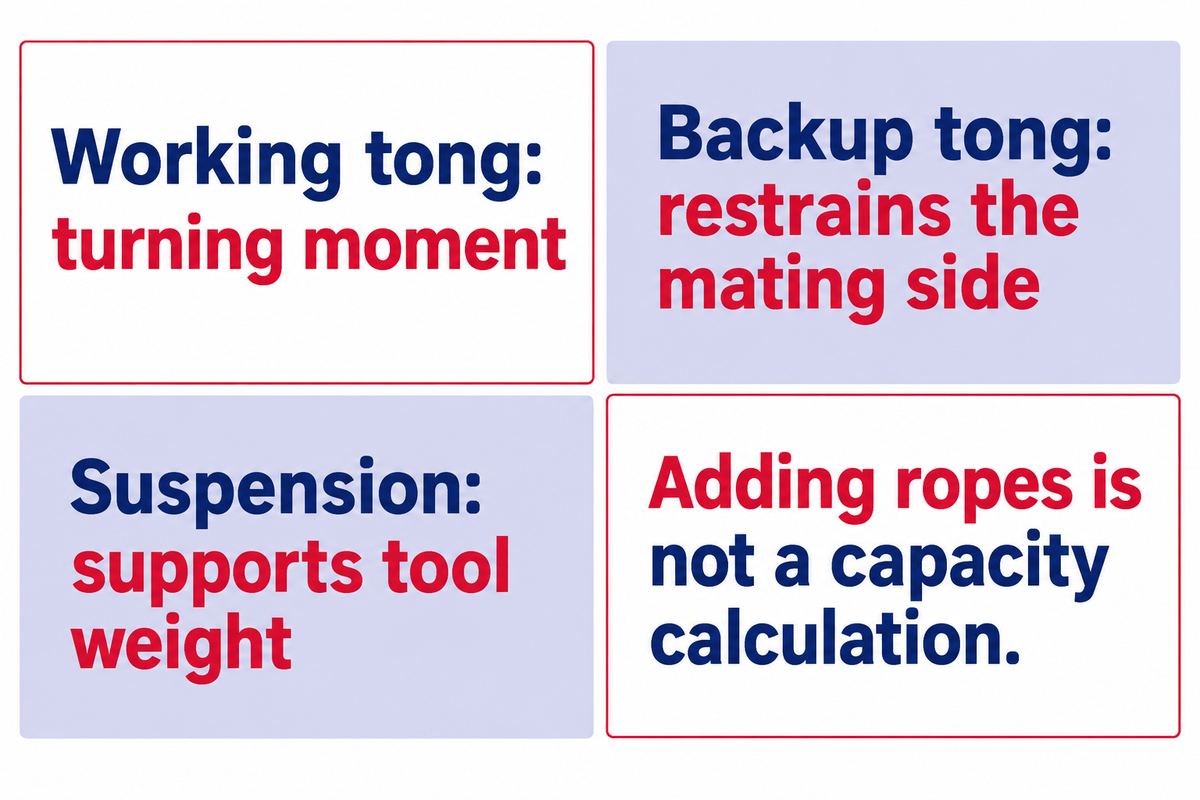
A working tong applies a turning moment. A backup tong restrains the mating side of the connection. Suspension carries tool weight; the reaction arrangement resists turning loads. Incorrectly confusing these functions can result in an apparently complete assembly without a safe path for the forces generated during make-up or break-out.
What is the difference between a working tong and a backup tong?
In a backup system, the working tong does the turning while the backup tong restrains the other side. The identity of each depends upon the approved arrangement and task. Similar appearance doesn’t establish interchangeable capacities, and an anchored tong still needs the correct grip, load rating and reaction-system configuration.
The January 1999 IADC alert on rig tong snub lines describes an incorrect substitution of two smaller ropes for one specified rope, with unequal loading and pinch-point concerns. That historical case explains why adding ropes is not a capacity calculation. It’s also different from a design whereby a primary protection system and a secondary protection system are purposely incorporated.
There are jurisdiction specific requirements. The British Columbia requirement (section 23.60) states that a primary protection system must be in place to control tong movement and a secondary protection system must be in place to control tong movement on failure of the primary protection system. California’s section 6605 addresses line end fastenings and attachment to the derrick or mast, including structural conditions and a stated well-servicing exception. These are particular to specific locations and not general installation requirements.
The reaction path continues through connectors, fixed points and supporting structure. An inadequate end-fastening on a good rope breaks the path of concern. Snub line securement therefore concerns the complete engineered arrangement. With a snub line released or failed, the resulting tong movement can enter an area that looked clear, while everything was kept stationary.
An out-of-service power tong isn’t, by itself, a reason to improvise a manual replacement. Changing the power source, removing a backup or substituting reaction equipment changes the system that needs review. OSHA’s breakout hazard discussion addresses uncontrolled movement and line failures; exclusion and operating controls must follow the installed equipment and site procedure.
Rated Torque Is Different from Connection Make-Up Torque
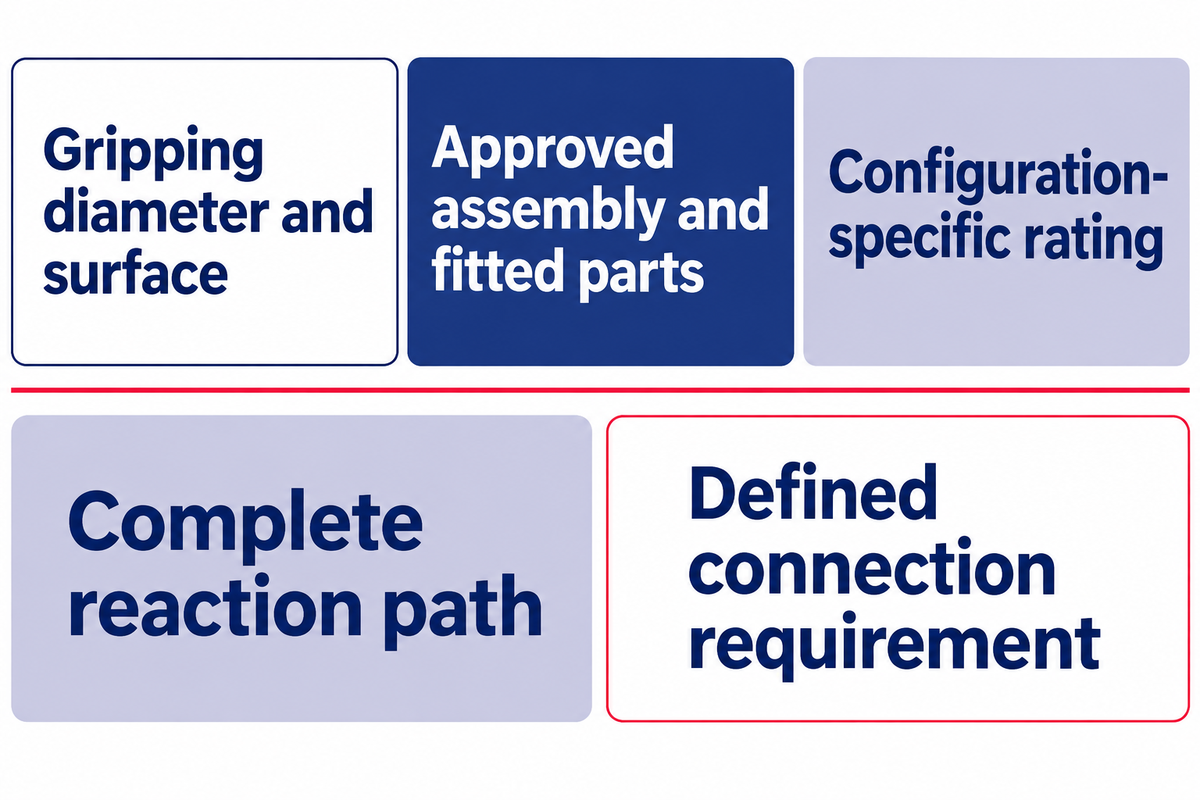
Rated torque is a limit assigned to a tong configuration. Connection make-up torque is a requirement for a particular threaded joint. A correctly sized manual tong is required to meet both the gripping and equipment capacity requirements. The connection instructions will determine the required make-up conditions, and a catalogue maximum can’t supply that setting.
Threaded connections on drill pipe require careful consideration of connection type and the manufacturer’s instructions. The same applies for movement between drill collars and other tubular components. The TIOT parameter table is organized around tool configurations. If a breakout tong is being reassigned from a different job, the planner needs to compare the installed jaw, actual gripping surface, applicable rating and reaction arrangement with the new requirement before the crew treats that tool’s presence on the floor as evidence that the connection task is ready.
Grip-Fit-Load Check separates three questions that get merged in manual tong selection. These are: can the dies engage the approved surface, does the whole fitted assembly match the drawing, and does the documented load capability suit the required task? Each of these needs to be checked separately. Matching tong capability to a job is more than finding a pipe diameter inside a catalogue range.
| Question | Hidden constraint | Decision owner |
|---|---|---|
| Does the jaw cover the gripping diameter? | Nominal pipe OD may describe a different surface. | Operations verifies the actual gripping location. |
| Does the assembly match its approved parts? | A replacement jaw or pin may change compatibility. | Maintenance checks the unit drawing and condition. |
| Does the fitted rating suit the task? | The family maximum may belong to another jaw. | Technical personnel compare the actual rating row. |
| Is the reaction path suitable? | Connectors or supporting structure can govern the system. | Rig personnel follow the approved arrangement. |
| Is the make-up requirement defined? | Tong capacity does not specify connection treatment. | Connection instructions govern the joint. |
Illustrative scenario: A buyer selects a model with a tong capacity comfortably above the expected job requirement and approves it. Maintenance later identifies a different fitted jaw and the revised configuration is outside the documented requirement. The useful action is to resolve the configuration mismatch before purchasing or allocating that unit, rather than to ask the crew for a larger pull.
The OSHA tripping guidance places the tong within a wider hazardous operation. Reading a rating chart is one equipment decision inside that operation. Joint monitoring and connection acceptance have their own requirements, described in our oilfield connection quality and traceability guide.
Inspection Before Use: Dies, Latches, Pins and Suspension
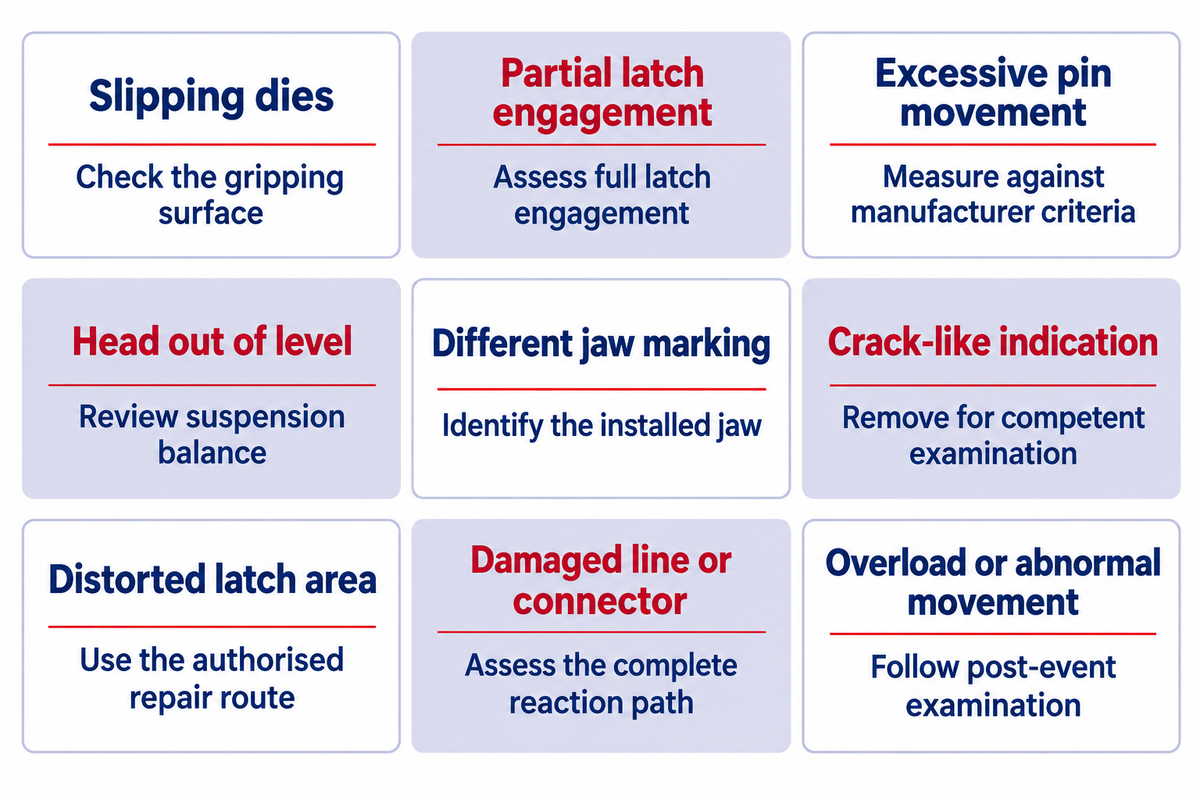
OSHA recommends inspecting tong dies and snub lines each tour; TIOT OM029 calls for daily visual inspection while its HT tongs are in use. Attributed frequencies are starting points for their stated situations. Inspection must also cover the actual assembly, operating conditions and any damage or abnormal event identified by the applicable procedure.
A tong that closes smoothly may still have damaged dies, a poorly engaged latch or worn load-bearing joints. Slipping and sudden movement are some of the issues covered in the OSHA eTool. How findings on the unit are assessed is dictated by the manufacturer’s instructions.
| Observation | What it may involve | Next assessment |
|---|---|---|
| Dies slip on contact | Die wear, surface contamination or wrong grip location | Check approved die type and actual gripping surface. |
| Latch only partly engages | Wrong configuration, obstruction or damage | Stop allocation for use and assess full engagement. |
| Pin movement appears excessive | Pin or bore wear, retention problems | Measure against the specific manufacturer’s criteria. |
| Head sits out of level | Suspension balance or adjustment | Review the approved hanger and counterbalance arrangement. |
| Jaw marking differs from the record | Unrecorded component change | Identify the installed jaw and applicable capacity row. |
| Crack-like indication is visible | Possible structural damage | Remove from service for competent examination. |
| Latch area is distorted | Overload, impact or an earlier repair | Refer to the manufacturer-authorised repair route. |
| Line or connector is damaged | Loss of the intended reaction restraint | Assess the complete reaction path, not just the rope. |
| History includes overload or abnormal movement | Hidden damage beyond surface appearance | Follow the specified post-event examination process. |
TIOT’s manual identifies cracks, distortion, loose or missing parts, corrosion, overload and questionable condition among reasons for further examination. A shared label such as “serviceable” needs a unit-specific inspection basis.
IADC’s March 1999 slipping-tong alert also raises wrong lug-jaw size and contact with hardbanding. This helps explain why a new set of dies may not alleviate a grip problem. “Inspect tong dies” is one of the many tasks involved in a larger assessment rather than a final approval.
The anonymous question “why do workers push on the tongs?” often hides a misunderstanding about making the head bite. A crew anecdote can’t establish a safe way to force engagement. A questionable grip calls for the installed configuration and condition to be assessed through the rig’s approved process.
Maintenance, Wear Assessment and Authorized Repairs
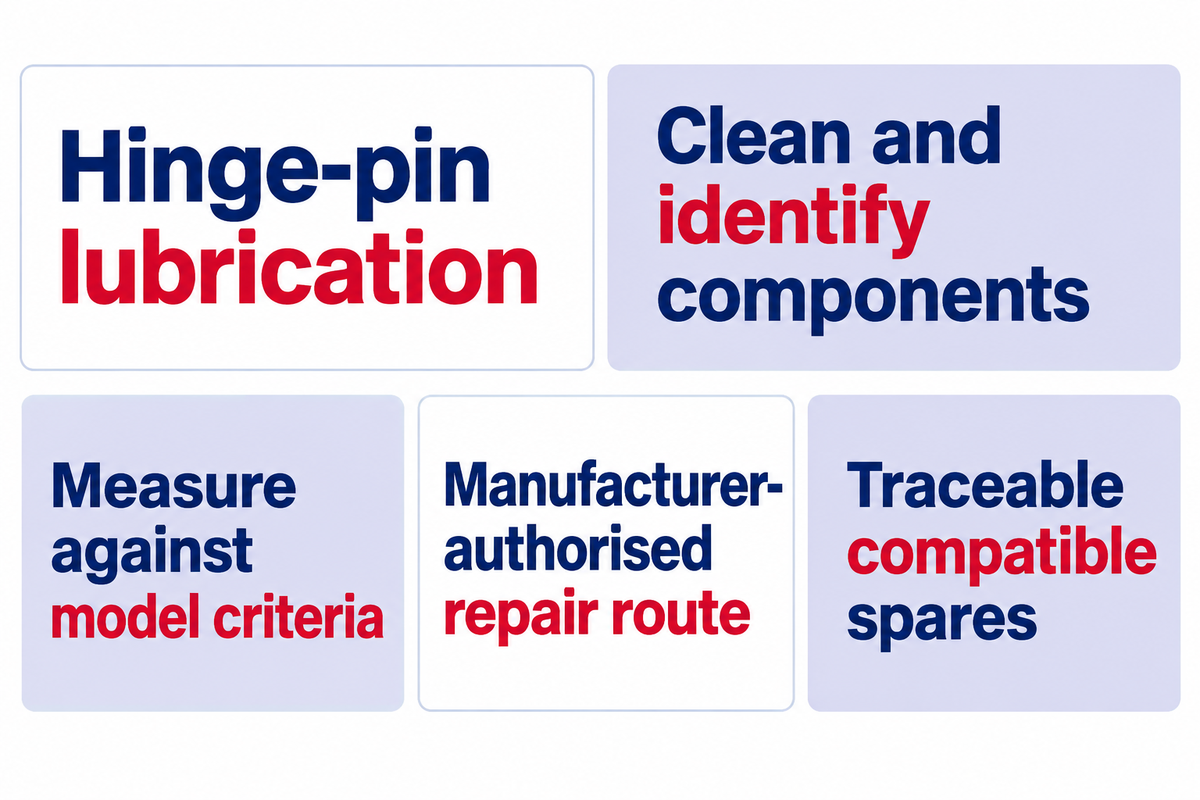
Manual-tong maintenance retains the manufacturer’s intended fit and movement of the tong as well as its load-carrying condition. Lubrication, wear measurement and repair decisions belong to the actual model’s instructions. Replacing dies addresses one contact component; a worn latch, damaged jaw or elongated bore needs its own assessment before the assembly returns to work.
IADC floorman guidance identifies balancing, greasing and lubrication of hinge pins, with particular attention to the head-to-handle joint. The head-to-handle joint requires special attention during maintenance. The tong manual must still stipulate the lubricant, the method of application and the interval, relevant to the unit and service conditions.
Dirt or dried drilling fluid can conceal wear and obstruct movement. Cleaning is an opportunity to check markings and retainers and compare them against the assembly drawing. Keep removed components identifiable during an examination so that the examiner can distinguish damage in service from an incorrect replacement part.
Wear is a dimensional question. “It still moves” and “it looks like the spare” aren’t answers to this question. Compare pin diameters, bores and contact features using the manufacturer’s criteria and the specified inspection method. Applying a convenient tolerance from another tong model can accept an unsuitable component or reject a serviceable one.
Illustrative scenario: new dies stop an obvious slipping symptom, but the latch still fails to seat fully. The concern is with the latch and jaw assembly, not if the dies look new. The unit is out of service while the cause is examined under the applicable instructions.
TIOT’s repair section directs repairs through an authorised repair centre following manufacturer instructions. Welding, grinding or substituting a load-bearing component needs that defined authority and repair procedure. The ability of a workshop to make a weld doesn’t define the required material, treatment, geometry, or post repair examination.
For procurement, a spare tong body without traceable compatible jaws may be a poor downtime purchase. An efficient tong configuration includes the right replacement components and maintenance information for the installed model. Ask for those items with the equipment package rather than discovering their absence during a rig stoppage. When a repairer proposes an alternative component because the original is unavailable, the decision needs the manufacturer’s compatibility and repair requirements, including any examination required after the work, rather than a comparison based only on the spare’s outline or the fact that its pin will pass through the available hole.
Manual Tongs, Power Tongs and Other Connection Equipment
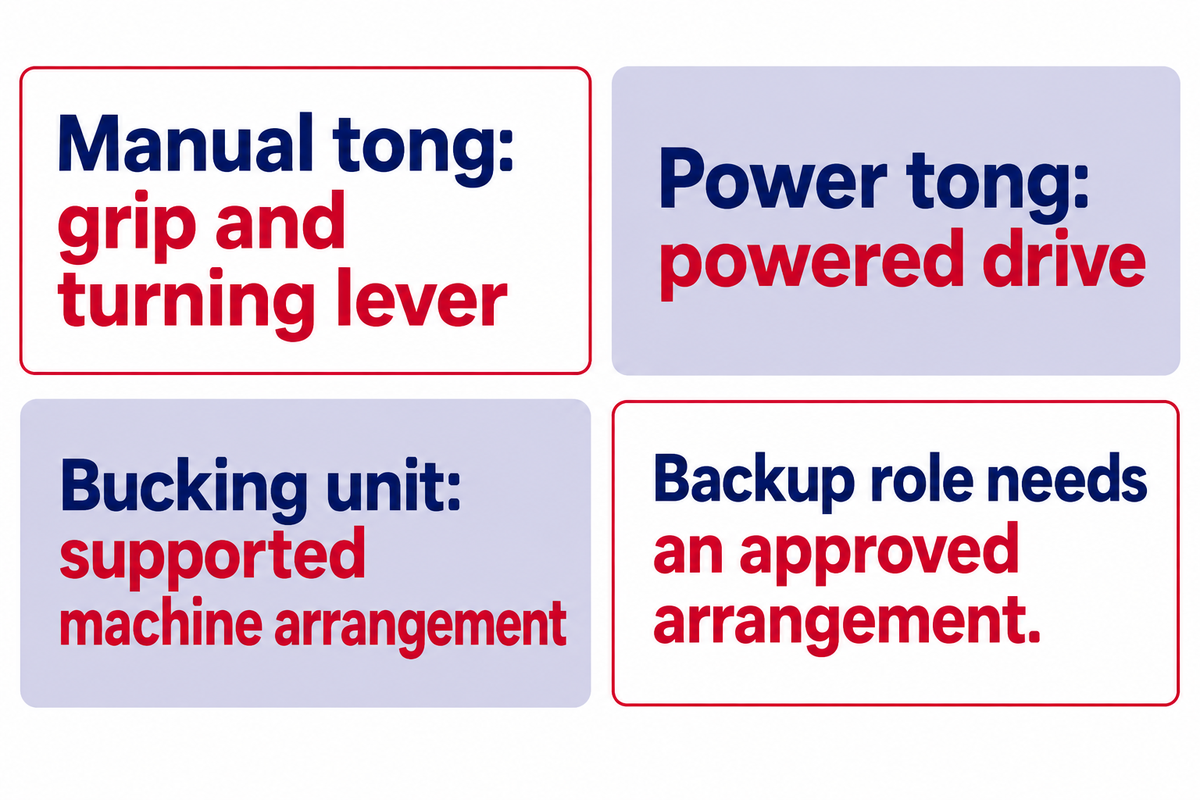
Manual tongs, power tongs, spinners and bucking units differ in how they grip, turn and restrain tubular components. Select equipment by the gripping, turning and restraint functions required for the task and the approved arrangement. A hydraulic power tong adds a powered drive; it does not automatically supply every backup, monitoring or personnel-protection function needed on the rig floor.
Spinners are generally associated with connection cycles that require rapid rotation. Breakout or make-up capability belongs to the documented model and system. A pipe power tong may combine different functions while a bucking unit works in a supported machine arrangement. The detailed Power tongs versus bucking unit comparison addresses the selection question.
Some manual rig tongs can provide a back-up to a power tong in an approved arrangement. The phrase describes a role, not automatic compatibility. When the larger oilfield tong is substituted, the assembly rating, reaction path, and available space must remain acceptable.
“a risk of serious injury from falling objects and moving equipment remains”
Mechanisation alters the way people interface with drilling equipment. Remote handling can move some tasks away from the immediate connection, while machine movement and interactions introduce their own constraints.
For a workover application, manual tong choice should start with the actual service and connection package. Tubing handling tools on one unit may have a different role and size envelope from drill pipe manual tongs on another. An “API 7K manual tong” product description still needs the model information and applicable configuration behind it.
Documentation and Return-to-Service Decisions
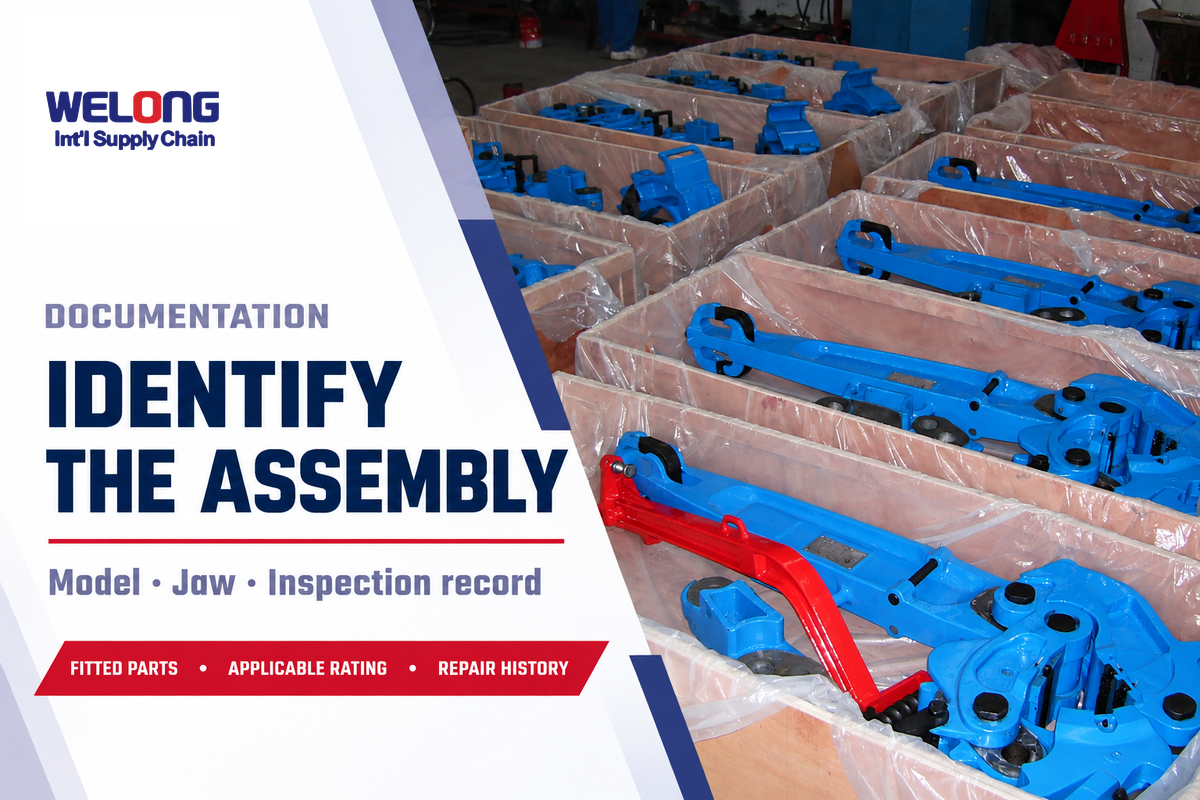
Return-to-service decisions must contain a known tool identity, a defined configuration, and an inspection disposition, as described in the applicable instructions. Procurement and maintenance records provide the aforementioned facts.
Does API Spec 7K cover Manual Tongs?
Yes. Manual tongs are included in API Specification 7K’s product scope. In its public announcement of the sixth edition, API identifies them as drilling and well servicing equipment. For a specific purchase, confirm the applicable edition, product conformity records and any claimed licence scope.
The linked API announcement is dated December 2015; it is used here to identify scope, not the latest edition. API’s Monogram programme is a separate voluntary licensing programme. Confirm the applicable API Spec 7K design and documentation requirements with the named manufacturer and purchasing specification.
ISO 9001 concerns a quality management system. An API 7-1 claim concerns a different product-standard scope. Neither should be silently relabelled as tong-specific API 7K certification. For an existing unit, the practical record includes the tool identifier, installed jaw parts, inspection date and findings, authorised repairs, relevant measurements and the person responsible for the disposition. A purchasing team that receives a certificate with a different company name, product scope or unit reference needs to resolve that identity gap with the supplier before treating the document as part of the delivered tong’s technical package, even where the commercial model description appears to match the requested equipment.
A latch feature also requires the right identity. CA2364344C describes historical manual-tong secondary-latch work associated with National Oilwell LP. It’s design history and not a China Welong patent or a proof that a particular tong carries that design. Ask what latch arrangement is fitted to the unit being supplied.
When comparing offers, record the tong model, approved gripping range, fitted jaw identification, configuration-specific rated capacity and included spares. This makes type and torque meaningful together; the pipe range printed in an offer is insufficient if the supplier has not identified which jaw achieves it.
China Welong was founded in 2001 and provides international supply-chain services of oilfield and customised products. For a specific manual tong product, send the actual gripping diameter, connection duty and required documentation through our Manual Tong configurations and supply page. The technical review can address the required assembly instead of treating a broad family description as a final specification.
Frequently Asked Questions
What is a manual tong used for in drilling operations?
A manual tong grips an approved outside surface of a tubular so that a turning force can make up or break out a threaded connection. The working assembly and its backup or reaction arrangement must suit the job. It doesn’t replace the slips or elevators that support and handle the string, and the exact operation follows the applicable equipment manual.
Can a Drill Pipe Manual Tong handle HWDP and drill collars?
A drill pipe manual tong may handle heavy-weight drill pipe or drill collars when its approved configuration covers their actual gripping surfaces and required duty. Check the tool-joint or collar diameter, jaw match, available clearance and configuration-specific capacity. The name of the tubular family alone doesn’t establish compatibility, especially when moving a tong between different jobs.
What are the available lug jaw options?
Lug jaw options depend on the tong model and manufacturer’s assembly design. A catalogue may list several gripping ranges or positions, each with its own component identity and applicable rating. Ask for the jaw drawing and capacity row for the identified unit. Select the complete approved combination, including the associated pins and latch arrangement, rather than a loose jaw that merely appears to fit.
Is a Manual Tong the same as a Bucking Unit?
No. A manual tong is a lever-type gripping wrench. A bucking unit normally holds and turns tubular components within a supported machine arrangement. Their installation, reaction system and available monitoring differ by model.
What information should I send for a Drill Pipe Manual Tong quotation?
Send the actual gripping diameter and surface, the connection duty and the required equipment capacity or technical requirement. Include the existing tong model and serial identification if the request concerns spares, and identify the installed jaws when available. State whether the tool will work as the turning tong or as part of a backup arrangement, with the relevant system information for technical review. Procurement should also identify the required documentation, inspection records and replacement components. An existing drawing or a clear photograph of the markings can help resolve identity questions, although a photograph can’t establish internal condition. These details let the supplier address the proposed assembly rather than quote a broad family name that leaves the fitted configuration uncertain.
Why Buyers Work With Welong
About Welong Engineering Support
China Welong supports oilfield buyers with engineered supply-chain service for drilling tools, well-control equipment, rig-floor tools, casting parts, and industrial forged components.
Project Review Before RFQ
We help buyers compare tool family, material route, API or ISO requirements, inspection records, supplier capability, delivery risk, and documentation needs before a purchase decision is finalized.
Request An Oilfield QuoteCompany Profile // Data Sheet
CompanyChina Welong International Supply Chain
BrandWelong
CountryChina
Business TypeOilfield tools and industrial supply-chain partner
Main ProductsDownhole drilling tools, fishing and milling tools, wellhead and well-control equipment, oilfield hoses, rig-floor handling tools, mill rolls, and forgings
Engineering CapabilityTool-family selection, specification envelope review, API / ISO reference support, material traceability, inspection coordination, and supplier-route comparison
RFQ Data NeededTool type, size, connection, rating, grade, standard, quantity, drawings, and delivery target
Websitewelongoiltools.com