Get in touch with Welong Company
Fishing & Milling Tools
Oilfield Fishing and Milling Tools for Downhole Recovery
China Welong coordinates jars, bumper subs, overshots, taper taps, die collars, mills, casing scrapers and drill-pipe screens against the fish, casing and well data in your enquiry. The quotation identifies the responsible manufacturer, proposed route and inspection scope.
Oilfield fishing tools are downhole tools that recover what a well refuses to give back: a parted drill string, a stuck packer, a dropped bit cone, or metallic junk left on bottom. Every hour that fish stays downhole is non-productive time, so the job isn’t about owning more tools; it’s about owning the right tool for the fish in front of you. This hub maps China Welong’s fishing and milling range to the four things that actually decide recovery.
Oilfield Fishing Tools, Defined
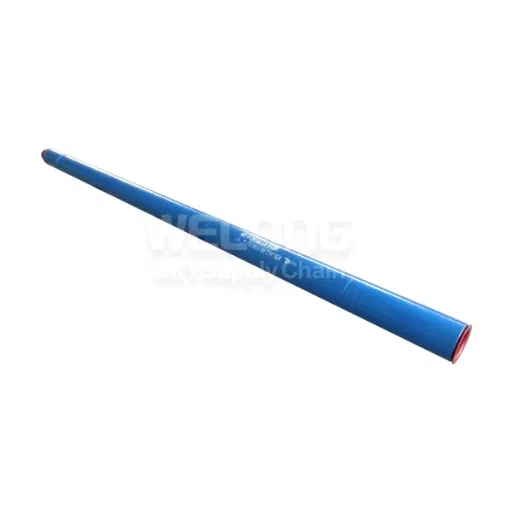
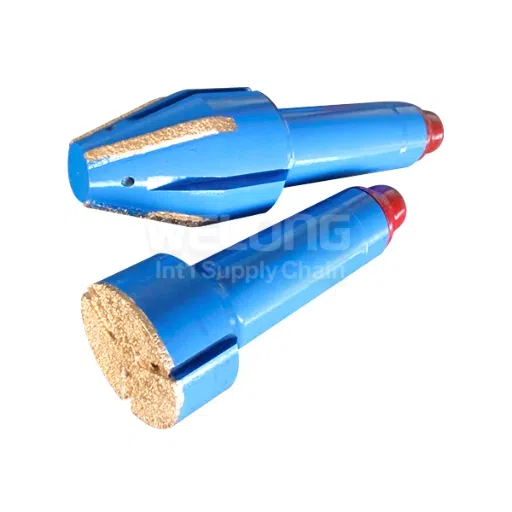
In the oil and gas industry, a fishing operation is the process of retrieving lost or stuck objects, a section of drill string, a drilling bit, or other lost equipment, from the bottom of the hole, deep in the borehole of an oil well drilled toward a petroleum reservoir. Specialized fishing tools are run on a fishing string to grip the top of the fish and retrieve it, and effective fishing starts before the run, when the fishing professionals on site match the tool to the fish. A USPTO-published example, patent US3382925A, describes a reverse-circulating junk basket retrieving broken tool parts, metal and bit cones from a well.
The main types of fishing tools
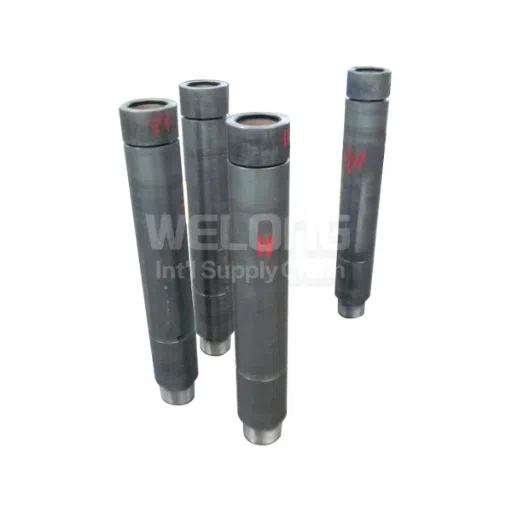
- External catch overshots and die collars grip the outside of the fish.
- Internal catch taper taps, and category tools such as a fishing spear, grip the inside bore.
- Cutting tools & mills junk mills and taper mills perform milling or drilling to grind away what can’t be recovered whole.
- Diagnostic & support an impression block reads the top of the fish, while fishing magnets and junk baskets, along with light wireline tools, clear small debris.
These common fishing tools work across both drilling operations and completion operations, on land and on offshore drilling rigs; when a drilling bit, cone or other downhole drilling tool is lost during the drilling process, hole fishing recovers it. When a fish is stuck fast, a washover pipe cuts it loose or the crew mills through the obstruction instead. There are really only two types of fishing: recover the fish whole, or mill it away (see the Drilling Manual fishing guide).
When a string parts downhole, every hour means lost production. That’s why China Welong coordinates downhole fishing-tool supply against the selected fish and inspection requirements, matching each tool to the fish rather than selling from a generic catalogue.
Tell us your fish, get a matched recommendation →SYS_REQ // ENVELOPE
The Recovery Envelope: match the fish, not the brand
Every fish is either one you can recover whole or one you have to cut away, and this line is built for both, onshore and offshore, in the drilling and completion phases alike. What decides a fishing job is rarely tool quality in the abstract; it’s whether the tool actually fits the problem in front of it, restoring lost equipment such as dropped bit cones or milling through the blockage when whole recovery isn’t feasible. We check every downhole fishing tool against four dimensions, so it doesn’t just fit your wellbore but performs inside it.
Envelope 1
Clearance
Tool outside diameter versus casing or open-hole inside diameter. Too large won’t pass; too small won’t engage. Our range spans 79–425 mm OD across the line.
Envelope 2
Pull & Impact
The tensile load and jarring force the string can deliver and withstand. Our fishing jars deliver 700–1,870 kN tensile; bumper subs carry up to 2,200 kN.
Envelope 3
Temperature
Downhole heat caps hydraulic tool behaviour. Our Super Fishing Jar table rates every model to a 150 °C highest working temperature, stated, not implied.
Envelope 4
Connection
The tool joint must thread to your string. We supply rotary-shouldered API connections from NC23 to 7⅝ REG, gauged to API Spec 7-2.
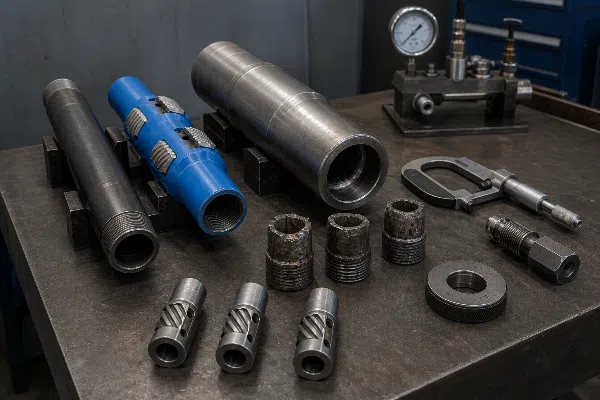
Every envelope has edges, and some edges really count: A casing scraper can clean casing, but it isn’t used in drilling. A worn, unknown fish top on an overshot can take two or three runs with progressively smaller grapples before it grips (see USPTO-published patent US9200495B2). We flag those edges up front to help save a trip.
The selected tool envelope is reviewed against the casing and fish data in your enquiry; the quotation identifies the responsible manufacturer and inspection scope.
Request a matched quote →SPECIFICATIONS / DATA
Cross-product recovery envelope, the whole line at a glance
Each tool in this range is a link in a particular retrieval workflow: apply force, grab, bore, or fix the borehole. Each row below matches first-party dimensions against the mode of engagement it offers. Connections in the table are gauged to API Spec 7-2.
| Tool | Engagement mode | OD / size range | Key duty figure | Connection |
|---|---|---|---|---|
| Super Fishing Jar (CSJ42–CSJ80) | Force delivery — up-jar | 108–203 mm OD | Tensile 700–1,870 kN; 150 °C; delay 30–240 s | NC31 → 6⅝ REG |
| Bumper Sub KXJ (spring) | Force delivery — down-jar / release | 79–229 mm OD | Tensile 300–2,200 kN; torque 3–25 kN·m | NC23 → 7⅝ REG |
| Bumper Sub BXJ (oil-lubricated) | Force delivery — down-jar | 80–203 mm OD | Tensile 30–220 tf; sealing 30 MPa | 2⅜ REG → 6⅝ REG |
| Casing Scraper | Wellbore preparation | Casing 4½–13⅜″ | Cleans cement, scale, paraffin, perforation burrs | 2⅜ REG → 6⅝ REG |
| Junk Mill | Mill away | 80–425 mm OD | Flat-bottom & concave, YD tungsten-carbide dressing | 2⅜ REG → 7⅝ REG |
| Taper Mill | Mill away / restore | 89–381 mm OD | Suitable hole 95.2–444.5 mm; restores fish top | 2⅜ REG → 6⅝ REG |
| Die Collar | External catch (OD) | Fishing range 48–168 mm | Grips cylindrical fish with no usable inner bore | NC26 → 6⅝ REG |
| Taper Tap | Internal catch (ID) | Fishing range 48–113 mm | Cuts thread inside tubing / drill pipe / couplings | NC31 → NC50 |
| Drill Pipe Screen | MWD protection | Slotted & perforated | 33% open area; 304 / 316 stainless | Ring-flange, retrievable |
| Overshot & Junk Basket | External catch / debris capture | Sized to the fish | Bowl-and-grapple grip; type-specific junk capture | Built to your string |
Unlike suppliers who ship one grapple for every job, China Welong coordinates each selected tool to your string with hardened, heat-treated dressing machined to tolerance.
PROCESS / APPLICATIONS
Three ways to take hold, the fishing engagement matrix
In reality, there are only a handful of physical ways to get a grip on a fish in a wellbore: on the outside, on the inside, mill through, or apply force that frees the fish. Whether you catch the fish with a spear, magnet, packer, wash pipe, or wireline retrieval tool simply reflects the mode of attack you choose for a given fishing method. Overshot grapple selection for external catch is documented in USPTO patent US9200495B2.
| Fish / situation | Take hold by | Welong tool |
|---|---|---|
| Tubing or drill pipe with a clean outer wall | External catch (OD) | Die Collar / Overshot |
| Fish with a usable inner bore | Internal catch (ID) | Taper Tap |
| Coupling or box left on the fish top | Internal thread cut | Taper Tap (drilling / clean-out pin) |
| Damaged, deformed or crimped fish top | Restore to a clean profile | Taper Mill |
| Bit cone, slips, non-retrievable junk | Mill away | Junk Mill |
| Stuck string that needs a hard up-pull | Deliver up-jar impact | Super Fishing Jar |
| String needing down-jar or a controlled release | Deliver down-jar / space-out | Bumper Sub (KXJ / BXJ) |
| Dirty casing before a completion run | Prepare the wellbore | Casing Scraper |
| Directional run protecting sensitive electronics | Filter the mud | Drill Pipe Screen |
| Loose junk or fines on bottom | Capture in circulation | Junk Basket (type-specific) |
That’s why a few targeted modes beat the general catalogue: value lies in matching mode to the fish, then in delivering just the right size, pull, temperature, and connection for the situation.
In the field, overshots get pulled empty despite good surface indications, and reading the fish wrong wastes a whole trip. China Welong engineers confirm the catch mode against your fish top before recommending a tool, unlike a blind catalogue pick.
The product line, seven downhole fishing and milling families
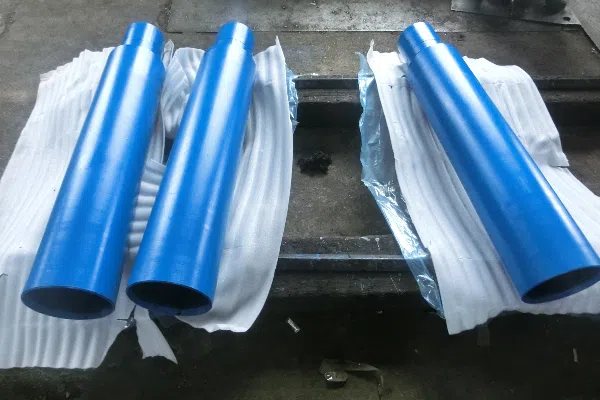
Overshot & Junk Basket
The overshot is the workhorse external-catch tool: a bowl-and-grapple assembly that slips over the fish and grips it as the string pulls. Because the exact wear at a fish top is often unknown downhole, published patent art notes that a conventional basket or spiral grapple is chosen to match the fish outside diameter.
Bowl-and-grapple grip; application-specific junk baskets.
Reverse-circulating and boot/junk subs available.
View Overshot & Junk Basket →
Reverse-circulating and boot/junk subs available.
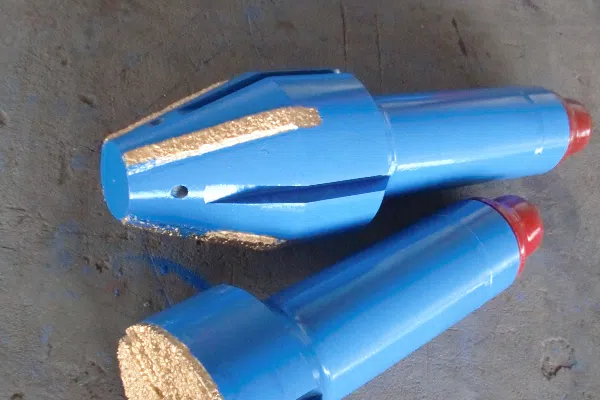
Junk Mill & Taper Mill
When a fish can’t be recovered whole, you mill. The junk mill grinds bits, cones, slips, subs and other hard junk with a flat-bottom or concave face dressed in cemented carbide (tungsten carbide), and the cuttings are carried out by the drilling fluid.
Junk Mill: OD 80–425 mm, 2⅜ REG → 7⅝ REG.
Taper Mill: OD 89–381 mm, hole 95.2–444.5 mm, restores fish top.
View Junk Mill & Taper Mill →
Taper Mill: OD 89–381 mm, hole 95.2–444.5 mm, restores fish top.
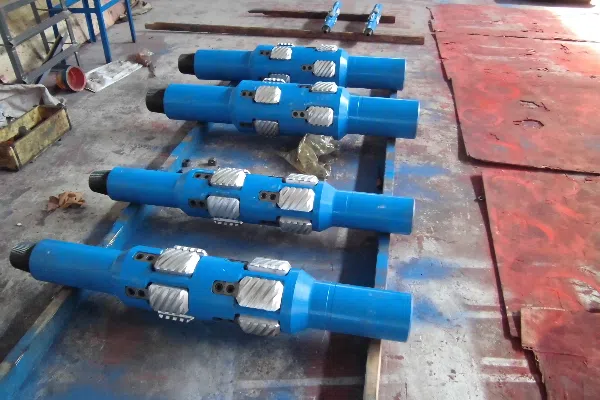
Casing Scraper
Before a completion, logging, or packer run, nothing ruins sealing performance or the clarity of measurement readings like a dirty casing wall. The casing scraper removes residual cement, drilling fluid, embedded projectiles, rust scale, mill scale, and perforation flash (burrs), leaving the casing clean for landing.
Casing: 4½–13⅜″
Connections: 2⅜ REG → 6⅝ REG
Spring-loaded cutter blocks
Limit: Casing scrapers are completion-rig and workover-rig tools, not drilling tools.
View Casing Scraper →
Connections: 2⅜ REG → 6⅝ REG
Spring-loaded cutter blocks
Limit: Casing scrapers are completion-rig and workover-rig tools, not drilling tools.
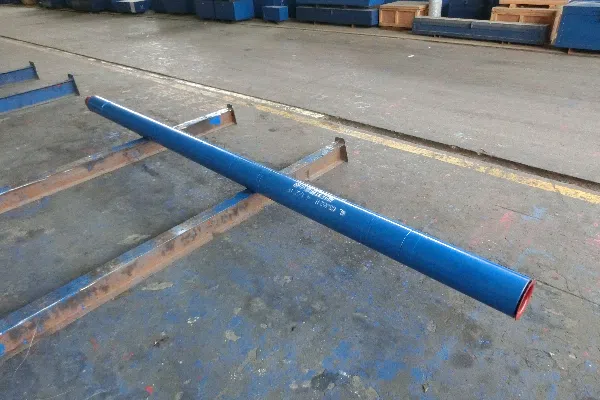
Fishing Jar (Super / Hydraulic)
The Super Fishing Jar is a hydraulic tool with stepless control of up-jarring tonnage, used for fishing and coring recovery. Paired with an accelerator, it turns string energy into a sharp, repeatable up-jar at the stuck point.
Models CSJ42–CSJ80: OD 108–203 mm · ID 32–70 mm
Tensile 700–1,870 kN · temp 150 °C · NC31 → 6⅝ REG
Where datasheet & table differ, table governs.
View Fishing Jar →
Tensile 700–1,870 kN · temp 150 °C · NC31 → 6⅝ REG
Where datasheet & table differ, table governs.
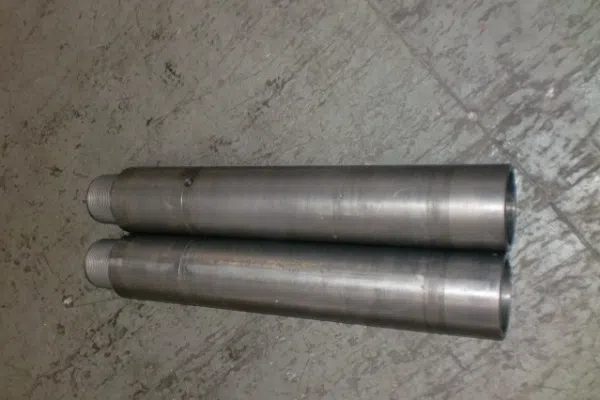
Bumper Sub
The bumper sub provides a down-jar impact force and also spaces out the string when a fishing operation calls for it; it also serves as the releasable connection if you need to disconnect the fish. The quoted manufacturer supplies two classes of tools to meet two levels of performance.
KXJ (spring): long stroke, OD 79–229 mm, 300–2,200 kN, torque 3–25 kN·m, NC23 → 7⅝ REG.
BXJ (oil-lubricated): OD 80–203 mm, 30–220 tf, sealing 30 MPa, 2⅜ REG → 6⅝ REG.
View Bumper Sub →
BXJ (oil-lubricated): OD 80–203 mm, 30–220 tf, sealing 30 MPa, 2⅜ REG → 6⅝ REG.
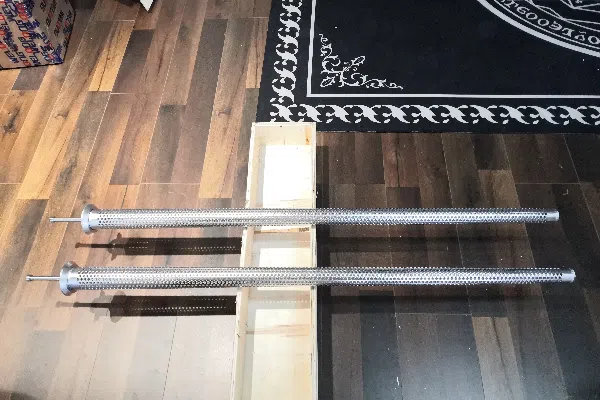
Drill Pipe Screen
On any directional run, debris carried by drilling mud can destroy measurement-while-drilling (MWD) equipment. The coarse- and fine-particle screens filter drilling mud so it doesn’t damage expensive bits, MWD collars or formation samples.
Slotted & perforated types; 304 & 316 stainless.
33% open-area perforation with wear-distribution sleeve.
Interchangeable ring flanges & safety retainer rod.
View Drill Pipe Screen →
33% open-area perforation with wear-distribution sleeve.
Interchangeable ring flanges & safety retainer rod.
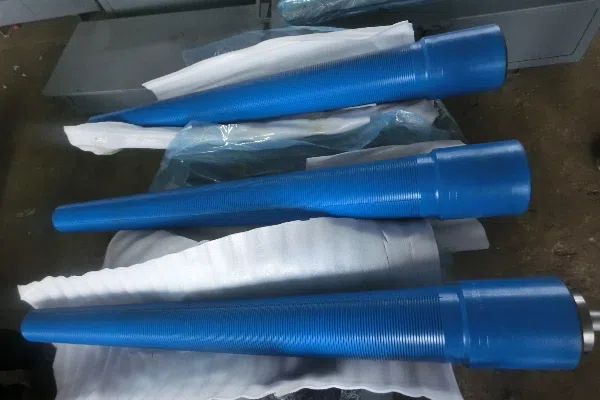
Die Collar
The die collar is an external fishing tool that engages the outside wall of a cylindrical fish, oil tubing or drill pipe, including fish with no usable inner bore or a stuck bore. It cuts a screw thread onto the fish top and takes hold from the outside.
Fishing range: 48–168 mm
Connections: NC26 → 6⅝ REG
View Die Collar →
Connections: NC26 → 6⅝ REG
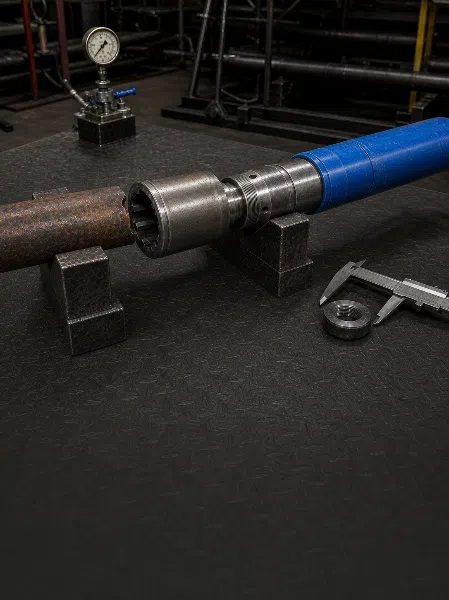
“We size a fishing tool the way the well sees it: clearance, pull, temperature and connection first. A beautifully made overshot that is 5 mm too large has zero recovery value, so we would rather match the envelope than sell you a bigger tool.”
— China Welong Engineering Team
The real cost of a stuck fish, why the right tool pays
Stuck pipe is the single largest contributor to non-productive time on many drilling programs. In one widely-cited industry study (Muqeem et al., 2012, SPE-160845), stuck-pipe cases accounted for roughly a quarter of non-productive time, on the order of two rig-years of lost time each year for the operators studied. More recent fleet-level work reports non-productive time near 8.7% of operational time, so the exact share varies by field, but the direction never does.
Time is the variable you control
Hours not days: recovery odds fall fast
As the fish sits in the hole, your odds of recovery decrease significantly; something that comes free and clear with a jar and overshot on the first day may require milling or a sidetrack by the third. Stage the proper jar, overshot, mill, or die collar, and intervene before the fish starts breaking apart.
There’s also an economic stopping rule, and we would rather you know it than not: practitioners generally abandon a fishing job and sidetrack once fishing cost approaches roughly half the cost of re-drilling around the fish. Good tool selection shortens the fishing window on the near side of that line, which is exactly what a matched envelope buys you.
Machined to tolerance and hardened for the job, a tool staged before the fish decays is the honest way to shorten that window; confirm the choice against your own well data.
Supply Chain & Operations
Buyers source fishing tools from China Welong
Founded in 2001, China Welong coordinates supplier development, purchasing supervision and quality-control support. The quotation identifies the responsible manufacturer, route and inspection scope for the selected tool.
If the well is sour or hot, tell Welong its actual conditions (temperature, H2S, CO2, pressure) and we’ll recommend appropriate materials that will perform in your bore, not what we wish you had. Custom clearance, HTS and country-of-origin marking requirements are your responsibility.
China Welong identifies the quoted manufacturer and available inspection documentation for the selected tool.
Quality & inspection
Inspection scope is confirmed with the responsible manufacturer for the selected tool. On request we coordinate third-party inspection with SGS or DNV; this is inspection coordination, not a certification claim.
Custom to your drawing
The quoted manufacturer supplies to your drawings, samples or specifications, with UT, MT, load and dimensional testing available before shipment.
Global logistics
We serve operators across Europe, the Middle East, Russia, South America and North America, shipping by sea, air or rail on FOB, CIF, DDP or DDU terms.
Honest engineering
First-party dimensions, alloy-steel construction, transparent country of origin, and stated limits. API Spec 7-2 governs the thread gauging on these connections.
A broader catalogue
This focused range is part of a wider variety of tools for the oilfield. The same drilling and workover crews that fish also run China Welong’s oilfield tongs and pipe-handling tools. Sourcing across these lines consolidates your buying through the quoted manufacturer and export desk.
Verifiable Documentation
Downhole Engineering Utilities
Utilize China Welong’s digital engineering utilities to evaluate recovery parameters, map your downhole envelope, and confirm tool selection against actual fish and casing dimensions. Select a utility below to begin.
TOOL.01 // STRATEGY
Decision helper
Navigate a guided engineering logic tree to determine the optimal recovery strategy and engagement mode based on your specific fish condition.
Launch Tool →
TOOL.02 // VALIDATION
Recovery envelope checker
Input your casing dimensions and downhole environment data to calculate clearance tolerances, tensile limits, and thermal operational boundaries.
Launch Tool →
TOOL.03 // SELECTION
Tool recommender
Generate a precise list of matching tool models, outside diameter specifications, and appropriate API connection types tailored for your operation.
Launch Tool →
SYSTEM_INPUT_REQUIRED
Send us your fish, casing and well data
Give us the fish type, casing or hole size, temperature and connection, and our engineers will recommend the right fishing and milling tools, with a spec sheet and a quote.
Fishing and milling tools, frequently asked questions
Still unsure which tool your fish needs? China Welong’s engineers will size the overshot, jar, mill or die collar against your well data and machining tolerances, unlike a self-serve catalogue.
Ask an engineer and request a quote →
Fish it if the top is clean and gripable, using an external catch (overshot or die collar) or an internal catch (taper tap). Mill it if the top is damaged, irregular or stuck; dress it back to a clean profile with a taper mill, then re-fish. Recovering the fish whole is preferred, but it isn’t always possible.
A die collar is an external-catch tool: it threads onto the outside of the fish and is used when there’s no usable inner bore. A taper tap is an internal-catch tool: it cuts a thread inside the fish, such as tubing, drill pipe or a coupling, and takes hold from within.
Yes, a junk mill grinds hard junk such as bit cones, slips, cutter gauges and subs with a cemented-carbide face, while the drilling fluid carries the cuttings up and out of the hole. Recovering junk whole is preferred, but not always possible, so when a fish can’t be caught and pulled the crew mills it away instead. A taper mill can first dress a deformed fish top back to a clean, round profile, after which an overshot or die collar may still take hold and recover the remainder in one piece.
It depends on the type. Reverse-circulating baskets suit larger junk; boot subs catch fines off bottom. Tell us the debris.
The rotary-shouldered connections (NC and REG) are threaded and gauged to API Spec 7-2, which is the specification for threading and gauging of rotary shouldered connections. We’re transparent about scope: API 7-2 covers the connection gauging, and we don’t attach standards a tool doesn’t carry.
Working with China Welong
Order Terms, Evidence and Next Steps
The commercial terms below apply to every oilfield tools order we quote. They are the same terms our quotation repeats back to you, so nothing on this page has to be re-negotiated once a drawing is on the table.
What we make, and from what
We work from 2D drawings and 3D CAD models (AutoCAD, Pro/ENGINEER and SolidWorks; .dwg and .igs).
Founded in 2001. Manufacturing at Xi’an, Shaanxi and at Jiyuan, Henan, with 30+ engineers on staff.
Forgings from 0.2 to 50 tons, finished to 0.01 mm machining precision. Material standards to ISO, BS, ASTM, ASME, DIN, JIS and GB.
How the price is set
Send a drawing and we reply within 24 hours; a drawing-based quotation follows in 1–3 working days.
Payment is T/T or L/C. We ship EXW, FOB, CFR or CIF; other Incoterms on request.
Orders ship in standard export wooden cases, or the packing you specify.
When it ships
Production lead times are confirmed with your quotation, based on quantity, process route and finishing scope.
We hold agreed items in stock and ship against your release to shorten delivery.
Who makes it, and who answers for it
Every quotation states whether the item is made in our own works or by an approved supplier we developed and supervise.
Material mills are re-audited every two years and approved by Welong before they run your order.
The evidence that travels with the order
An EN 10204-3.1B material certificate with chemical composition and mechanical properties, a dimensional measurement report, and UT and MT reports ship with your order.
Inspection is by coordinate measuring machine, ultrasonic, magnetic particle and X-ray.
Each piece carries a stamped serial number and stays traceable for five years to its chemical composition, mechanical properties and measurement report.
What to send to start
Send the drawing or a photograph of the part, the dimensions, the material requirement and the quantity to oiltools@welongpost.com, call +86 029 88331331 or message WhatsApp +86 135 7217 2362, or use the enquiry form on our contact page.
An engineer reviews it and comes back within 24 hours.
| Term | What we commit to |
|---|---|
| Quotation turnaround | Reply within 24 hours; drawing-based quotation in 1–3 working days |
| Production schedule | Confirmed with your quotation, by quantity, process route and finishing scope |
| Drawing formats | 2D drawings and 3D CAD models (.dwg, .igs) |
| Company | Founded in 2001 |
| Machining precision | 0.01 mm |
| Forging envelope | 0.2 to 50 tons |
| Serial traceability | 5 years, with the test coupon retained |
| Documents with shipment | EN 10204-3.1B certificate, measurement report, UT and MT reports |