Get in touch with Welong Company
API Spec 16C · Well Control · China Welong
Choke & Kill Hose
Choke and Kill Hose, API 16C Flexible Lines, 2″–4″, 5,000–15,000 psi
Your armored flexible line between your BOP stack and the choke/kill manifold has to bend where rigid pipe can’t, and hold pressure when a well kicks. Welong supplies that line across the full API 16C range, with published bend-radius and burst figures most catalogues leave blank.
Welong supplies choke and kill hose assemblies and manages their production for the full API 16C range: 2″ to 4″ bore, 5,000 to 15,000 psi standard working pressure, with 20,000 psi available as a custom build. For the selected size, confirm the minimum bend radius, burst margin, responsible manufacturer and supporting records in the quotation.
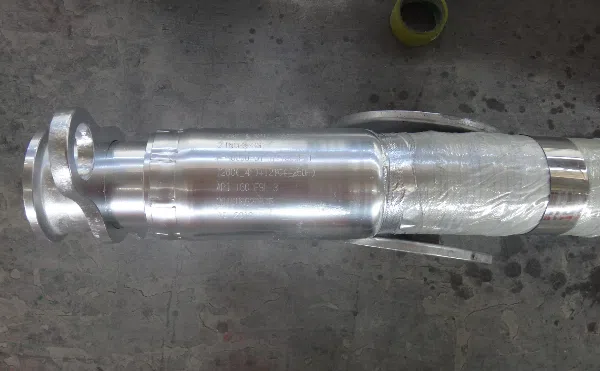
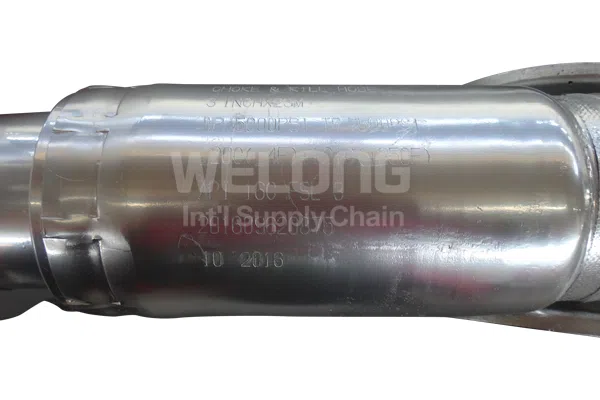
- 2″–4″Bore (50.8–101.6 mm), incl. 2.5″ & 3.5″
- 5–15k psiWorking pressure (20k custom)
- 2.25×Minimum burst vs. working pressure
- 704°CAPI 16C fire-test exposure
- −25°C–+121°CTemperature envelope
- SGS / DNVThird-party inspection on request
Stack-to-Manifold Connection Requirements
Ask which part of a choke and kill line is most likely to fail, and most buyers point at the hose body bursting. Field data points somewhere else. One joint-industry study of blowout preventer (BOP) reliability found that choke and kill valves and connections make up a disproportionate share of failures – and fail more often on surface stacks than subsea.
What actually breaks, and why it matters for what you buy
That reliability signal is the connection interface, driven by repeated make-and-break cycles, not a random rupture of the tube. That reframes the buying question: end-fitting integrity, bend-radius routing, and how the assembly is handled matter as much as a headline burst number. In a formal risk assessment, a choke and kill failure during a kick is itself listed as a blowout mechanism – this connection is part of the wellbore’s last line of defense.
It’s also why a line that only publishes a working-pressure rating tells you less than one that publishes bend radius, burst margin, and fitting detail together.
-
01
Movement
heave, vibration, and stack articulation the manifold connection tolerates without loading the welds.
-
02
Pressure on demand
the line seals at full working pressure exactly when a kick is being circulated out.
-
03
Fire and gas
a well-control event can expose the line to flame and sour gas together.
Those three demands are the reason API Spec 16C exists as a separate standard for choke and kill equipment. This page then shows how Welong’s line answers each one, with the numbers stated rather than implied.
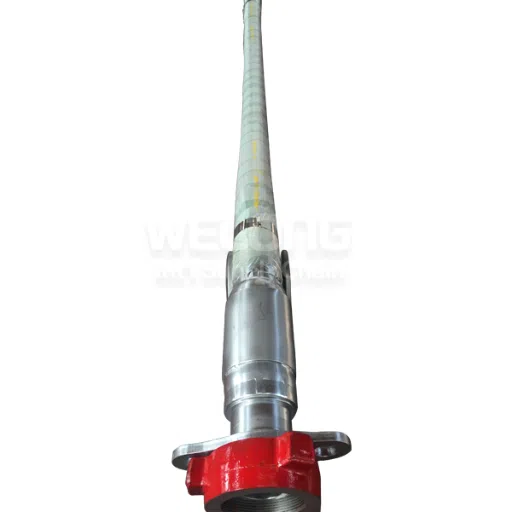
Rigid pipe can’t absorb the movement this connection sees. A rig floor shifts, the stack vibrates, and thermal swings expand and contract the run – a hard line concentrates that motion at the welds. A flexible, armored line takes the displacement across its length instead.
Selection Matrix, Start From Your MASP, Not the Catalogue
Your BOP component’s rated working pressure isn’t one that you just pick off because it looks like a high enough number. Under US offshore rules, the working pressure has to exceed the well’s maximum anticipated surface pressure, and the verification calculations must include corrections for MASP.
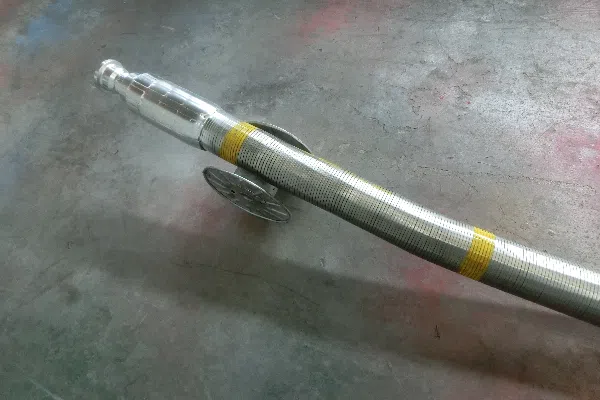
What an under-rated class costs you
Pick a class that only just clears your MASP and the flexible pipe becomes the weak point the moment a well kicks. Reliability data already puts the choke and kill connection among the disproportionate failure points on a surface stack, so the pressure margin you route with isn’t a paperwork detail. It’s where the safety case is won or lost.
That’s why the matrix pairs every pressure class with its own minimum bend radius, rather than quoting one number for the range. A 15,000 psi line at 3″ bore needs an 1,800 mm radius to route without over-stressing the carcass, and picking the class without the radius is how a correctly-rated line still fails to install.
How to read this table
Start with your MASP and bore requirement, and move across the table to the working pressure class that satisfies the need, with margin. If the selected quotation confirms a 1.5x proof-test basis and 2.25x minimum burst margin, a 15,000 psi line would correspond to 22,500 psi proof pressure and 33,750 psi minimum burst pressure; verify the actual order evidence.
| Bore | Working psi | Test psi (1.5×) | Min. burst (2.25×) | Min. bend radius |
|---|---|---|---|---|
| 2″ (50.8 mm) | 5,000 | 7,500 | 11,250 | 1,200 mm |
| 2″ (50.8 mm) | 10,000 | 15,000 | 22,500 | 1,400 mm |
| 2″ (50.8 mm) | 15,000 | 22,500 | 33,750 | 1,600 mm |
| 2.5″ (63.5 mm) | 10,000 | 15,000 | 22,500 | 1,400 mm |
| 2.5″ (63.5 mm) | 15,000 | 22,500 | 33,750 | 1,600 mm |
| 3″ (76.2 mm) | 5,000 | 7,500 | 11,250 | 1,600 mm |
| 3″ (76.2 mm) | 10,000 | 15,000 | 22,500 | 1,700 mm |
| 3″ (76.2 mm) | 15,000 | 22,500 | 33,750 | 1,800 mm |
| 3.5″ (88.9 mm) | 5,000 | 7,500 | 11,250 | 1,700 mm |
| 4″ (101.6 mm) | 5,000 | 7,500 | 11,250 | 1,700 mm |
| 4″ (101.6 mm) | 10,000 | 15,000 | 22,500 | 1,800 mm |
There’s a 2.5″ and a 3.5″ row here, simply because not every well fits the 2″x3″x4″ grid, and a 15,000 psi row here because the wells that require them, high-pressure/high temp applications, do indeed need one. Bottomhole conditions above 10,000 psi already put a well in HPHT territory, and 15,000 psi choke and kill assemblies are pretty much the norm.
API 16C, Evidenced, The Fire Test, the Burst Margin, and What FSL Means
API 16C isn’t just a badge you slap on one line of documentation. Its design criteria include exposure to gas, high temperature, and direct exposure to fire – with its fire testing spec clearly detailing what “fire resistant” is expected to mean. Welong supplies this line against a stated API Spec 16C design basis; the numbers below summarize the cited criteria and must be confirmed with order-specific evidence in the quotation.
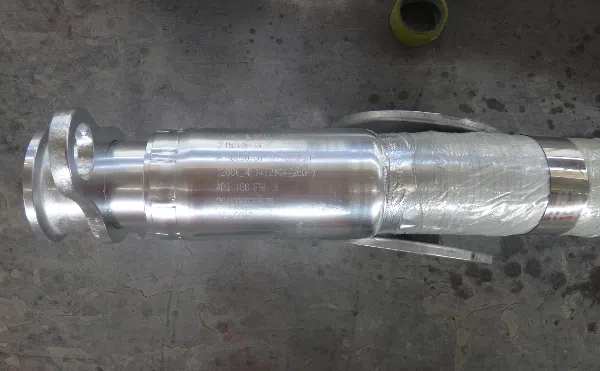
The API 16C fire test, the number that matters
Under the specification, the thermocouple at the line fitting and at the end fitting must reach at least 1,300°F (704°C) when exposed to the fire test for anywhere from 5 to 30 minutes, with the line pressurized full of water. It’s passed if the line displays no visual leaks during the test at the nominal working pressure.
EXPAND TEST DETAILS
The 704C for 30 min figure is the test specification, not the operating temperature, and the actual test that’s certified is that no water leaks at the nominal working pressure during fire. For the selected hose, confirm the cover construction, applicable fire-test scope and test evidence in the quotation.
Confirm the proof-test and minimum burst rating documentation for the selected hose assembly.
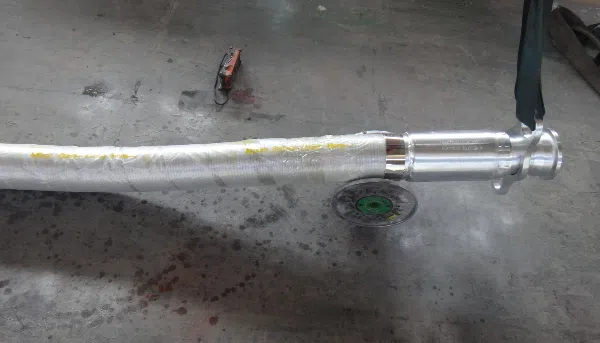
How the line is built
Its construction, including a reinforced steel wire carcass and an abrasion resistant, fire resistant cover, allow the line to perform under pressure, the strain of rigorous rig floor handling, the passage of drilling fluid and kill-weight mud, and without loss of pressure rating through the assembly flexing as it works.
EXPAND CONSTRUCTION DATA
Since the failure point is often at the connection, not the tubing, end fittings are qualified with the hose, rather than added as an afterthought.
Sour Service & H2S
If it’s sour service you’re concerned about, get specific. Welong’s lines are qualified for H2S services, the corrosive gas that causes corrosion of the metallic components of your system, in which case the NACE MR0175 / ISO 15156 standard will be applied; specific material qualification to a named edition is available on request.
What “FSL” is, and the question to ask any supplier
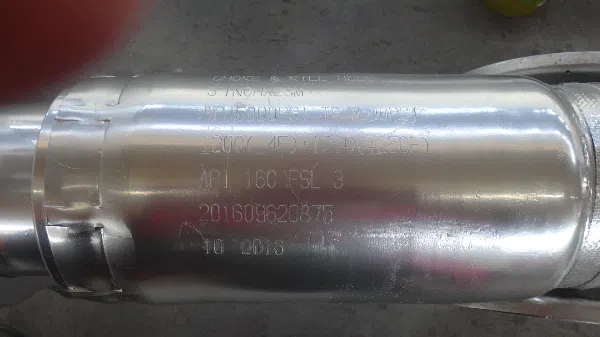
API 16C designates a series of Flexible Specification Levels, FSL 0 to FSL 3 (the top level written FSL3), each one more demanding than the next. FSL 3 represents the highest specification for demanding fire exposure applications. A specific line will fall into one of the FSL’s depending on the nature of the test that qualifies it.
The buyer-useful play is to never take a level on faith. Have your supplier pull the FSL rating and documentation and match it to your program’s fire-exposure risk.
API Spec 16C
Choke & kill design + fire test
Fire test
704°C · no leak at WP
H2S service
NACE MR0175 / ISO 15156 on request
SGS / DNV
Third-party inspection available
“We publish bend radius and burst by pressure class because that is what an engineer needs to route the line and defend the selection, not a single working-pressure number that looks reassuring and answers nothing about the install.”
Verified Product Envelope Comparison
Compare the selected hose against the published selection matrix and confirm the required bore, pressure class, and documentation.
| Axis | Welong | Often published in the market |
|---|---|---|
| Pressure classes | 5,000 / 10,000 / 15,000 psi standard | Often a single 10,000 psi class; 15,000 psi frequently absent from the published table |
| Bore coverage | 2″, 2.5″, 3″, 3.5″, 4″ | Reference 2″ and 3″ only; intermediate 2.5″/3.5″ rarely offered |
| Minimum burst | 2.25× WP (published) | Test pressure (1.5×) often shown; burst rarely stated |
| Fire test | Built to 704°C, no-leak-at-WP criterion | “Fire resistant” often asserted without the tested parameter |
| Upper temperature | +121°C | +121°C is the tier-1 ceiling; Welong’s −25°C low is 5°C colder than a named tier-1 line’s −20°C |
Two honest notes belong with that table.
Welong’s upper temperature matches the tier-1 ceiling rather than beating it, and the advantage on the cold end is a modest 5C. Where Welong genuinely pulls ahead is on pressure-class breadth, intermediate bores, and publishing the burst and fire figures at all.
Not sure which bore and pressure class your well needs?
Ask a Welong engineer — send your MASP and configuration and get a matched spec back.
Procurement, Coverage, Verification, and Cost Context
This line is intended for buyers needing a specified bore or pressure class outside a standard catalogue; confirm the required inspection documentation at RFQ.
That same integration extends across Welong’s oilfield hose range – choke and kill, drilling hose, and BOP hose – so one supplier can cover the connections around the stack.
On price, this niche is deliberately opaque, and a single number rarely means much without your configuration. Your choke and kill line size and pressure class drive the cost more than length or fittings do — that’s the honest trade-off between a stock 2″ build and a custom 15,000 psi line. Beyond those, end-fitting type, sour-service qualification, and inspection scope shape the final quote.
Verify any supplier, including us, before you commit
API maintains a public fraud-alert list of certificates it never issued, alongside a Composite List of genuine licensees. Any API 16C claim, from any vendor, can and should be checked there before purchase.
For the selected choke-and-kill hose order, the quotation identifies the responsible manufacturer, in-process and final inspection scope, with third-party witnessing available on request – and third-party verification is a normal, and for regulated BOP operations a required, part of the process.
Cost context, stated honestly
Published market pricing for a 2” 50 ft, 10,000 psi API 16C line sits around USD 74,500 – a useful anchor, since some suppliers quote only on request.
Set against the cost of non-productive rig time or a well-control incident, the deciding factor is rarely the unit price. It’s whether the line holds where it’s routed. Welong quotes to your exact configuration; we don’t publish a headline price we would have to caveat.
Lead time and length options are quoted with the configuration, because a stock 2” 10,000 psi line and a custom 15,000 psi build in an intermediate bore aren’t the same order. Weights, outside diameter, and exact lengths are provided on the data sheet for your selected class.
Market price point: publicly listed vendor pricing (third-party context, not a Welong quote). Rig-downtime framing is qualitative.
Choke & Kill Hose Engineering Tools
01
Choke Kill Selector
Specify the exact specifications for your high-pressure applications. Quickly match operational requirements with the right hose configurations.
Execute
Pressure Calculator
Calculate working and burst pressures accurately. Ensure absolute safety and compliance for rigorous drilling environments.
Execute
API 16C Verify Checklist
Validate your equipment against API 16C standards. A comprehensive checklist for manufacturing and field inspection compliance.
Execute
Frequently Asked Questions
What is a choke and kill hose?
It is the flexible, steel-armored high-pressure line that connects the BOP stack to the choke and kill manifold. It substitutes for rigid pipe where the connection must accommodate rig movement and seal at full working pressure during well control.
What is the difference between the choke line and the kill line?
The choke line carries well fluids to the choke manifold during a kick, while the kill line carries kill-weight mud back into the well. Confirm the applicable assembly specification for the planned service.
Why does it have to be API 16C?
API Spec 16C is the standard developed for choke and kill equipment and addresses gas exposure, temperature, and fire testing. A line meeting it has been qualified for precisely the conditions a well-control event imposes, which a general hydraulic hose hasn’t. That’s why an operator may mandate an API 16C line at this connection, rejecting any substitute that merely appears similar on a data sheet.
What pressure ratings are available?
The listed classes are 5,000, 10,000, and 15,000 psi, with 20,000 psi subject to quotation; confirm the proof-test basis and evidence for the selected assembly.
Is it suitable for H2S (sour) service?
H2S suitability depends on the selected materials and service conditions. The quotation must confirm the applicable NACE MR0175 / ISO 15156 edition, responsible manufacturer and qualification evidence for the selected hose.
How much does a choke and kill hose cost?
Choke and kill line cost is determined by bore, pressure class, length, end fittings, and scope of inspection, so we quote each configuration individually. As a point of market reference, a 2” x 50’ 10,000 psi line lists for around USD 74,500 – provide your specification for a precisely quoted figure.
Provide your specificationProcurement & Capability
Choke & Kill Hose Capability Review
China Welong reviews the buyer drawing, product specification and inspection scope before quotation.
This review is scoped to the Choke & Kill Hose configurations set out in the specification table on this page — 11 documented rows covering Bore, Working psi, Test psi (1.5×) and Min. burst (2.25×).
24 hEngineer-reviewed quotation on business days
2001Founded in 2001
30+30+ engineers on staff
5 yrStamped serial traceability
Quotation Scope and Commercial Terms
Pricing is prepared against the selected product configuration, material route, inspection scope and shipment terms.
- Quotes are returned within 24 hours on business days, reviewed by an engineer.
- T/T or L/C by wire transfer.
- We ship EXW, FOB, CFR or CIF; other Incoterms on request.
- We work from 2D drawings and 3D CAD models (AutoCAD, Pro/ENGINEER, SolidWorks; .dwg and .igs).
Production Planning
Production timing is confirmed with the quotation after quantity, process route and finishing scope are reviewed.
- Manufacturing at Xi'an, Shaanxi and at Jiyuan, Henan.
- Orders ship in standard export wooden cases, or the packing you specify.
Order Review and Responsibility
The responsible manufacturer, inspection scope and document package are identified for the selected item.
- Every quotation states whether the item is made in our own works or by an approved supplier we developed and supervise.
- We develop, audit and supervise the mills and workshops that make your parts: material mills are re-audited every two years and approved by Welong before they run your order.
Specification and Inspection Evidence
The specification table on this page is the technical basis for this review: its numeric rows define what we quote, manufacture and inspect against.
Request a Product Review
Send the drawing, product specification and inspection requirements for a quotation review.
![Choke & Kill Hose: [Field Guide]](https://welongoiltools.com/wp-content/uploads/2026/07/choke-kill-hose-guide-featured-1-150x150.png)