Get in touch with Welong Company
Casing Slip
Casing Slips 6 5/8″–30″ OD, Rotary Slip Systems
Rotary Slip Systems · Welong Oilfield Tools
Welong casing slips grip casing from 6 5/8 to 30 OD, and the full rotary slip line covers drill pipe, drill collar and tubing on the same rig floor. For the selected size and insert bowl, the quotation identifies the responsible manufacturer and whether independent inspection is required for the batch.
- 6 5/8″–30″ Casing OD range
- 675–2250 kN Drill pipe slip rated load
- 3″–14″ Drill collar handling OD
- SDS·SDML·SDXL Grip-length classes
- SGS · DNV Third-party inspection
- FOB·CIF·DDP Trade terms
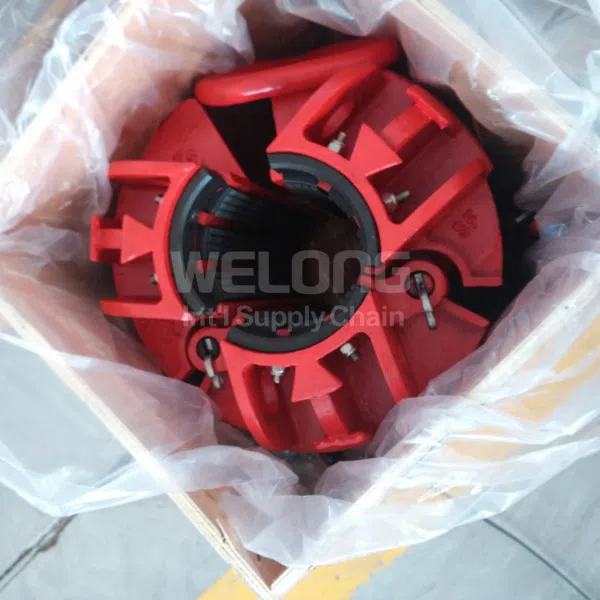
Slip-Area Damage, Why Grip Length and Bowl Fit Decide Tubular Life
In drilling operations, a rotary slip is a wedge-shaped, hinged steel segment set that grips a tubular in the rotary table and suspends the string while a connection is made or broken. It’s one of the simplest tools in the drilling industry. The failure it can cause isn’t.
The cause is a stress path, not a bad slip
The slip transfers the string’s weight into the master bushing through matched tapers. When the bowl angle and the slip-body angle disagree, contact concentrates at the slip toe instead of spreading along the grip length. That concentration is where the crush mark, the stress riser and the eventual fatigue crack begin.
-
SDS
Short strings, shallow holes
(short) grip length spreads a lighter load. -
SDML
Medium depth
→ distributes a mid-range string weight. -
SDXL
Deep drilling, heavy strings
(extra long) increases contact area so unit contact stress stays below the pipe’s crush threshold.
Grip-length class isn’t a catalogue accident. It’s the primary lever a driller has over slip-induced pipe damage, which is why the selection logic in the next section start there.
What the mechanics literature actually measures
A peer-reviewed 2025 analysis of casings in slip-working sections reports that slip anchoring cuts the casing’s ultimate bearing capacity by roughly 52-59% versus the un-gripped pipe, against a tensile ultimate of about 3690 kN before anchoring. On the drill-pipe side, industry analysis has long shown that a slip cut can raise local stress from about 30,000 psi to 50,000 psi at the base of the cut, cutting fatigue life by roughly 85% under sour conditions.
Two different products, two different sources – state them as such. The 52-59% figure is casing-specific; the 30k50k psi figure is drill-pipe-specific. Neither is a marketing number, and neither competitor page on the first page of Google prints either one.
Rig-floor safety is part of the spec, not an afterthought
OSHA’s oil & gas guidance names slip handling among the manual-handling hazards on the rig floor: handle strike, pinch points and back strain when heavy manual slips are lifted and set. Welong slips ship with safety flex handles, and powered slips remove the manual lift entirely where the operation allows it.
Drill Pipe, Drill Collar & Tubing Slips, Type, Taper and Rated Load
This is the one number the rest of the market won’t give you. Every drill pipe slip below carries a published rated load, cross-listed against the industry type code your RFQ already uses.
Search the industry code, not the vendor code
Try searching on a vendor code, such as WLSDML, and you’ll turn up no result, because buyers are searching by the industry code. This is why the two are positioned above side by side – the correct tool for your bowl is a SDML-class slip, no matter what the prefixed designation any mill might put on it.
“We publish the drill pipe rated loads because that is the number a driller actually checks against string weight. When a page says ‘load rated’ and prints no figure, it is asking you to trust a blank.”
| Welong code | Industry code | Body size | Pipe OD | Rated load |
|---|---|---|---|---|
| WLSDS | SDS (short) | 3 1/2″ | 2 3/8″–3 1/2″ | 675 kN |
| WLSDS | SDS (short) | 4 1/2″ | 3 1/2″–4 1/2″ | 675 kN |
| WLSDML | SDML (medium) | 3 1/2″ | 2 3/8″–3 1/2″ | 1125 kN |
| WLSDML | SDML (medium) | 4 1/2″ | 3 1/2″–4 1/2″ | 1125 kN |
| WLSDML | SDML (medium) | 5″ | 4″–5″ | 1125 kN |
| WLSDML | SDML (medium) | 5 1/2″ | 4 1/2″–5 1/2″ | 1125 kN |
| WLSDXL | SDXL (extra long) | 4 1/2″ | 3 1/2″–4 1/2″ | 2250 kN |
| WLSDXL | SDXL (extra long) | 5″ | 4″–5″ | 2250 kN |
| WLSDXL | SDXL (extra long) | 5 1/2″ | 4 1/2″–5 1/2″ | 2250 kN |
Rated loads are the manufacturer’s stated values. 675 kN is roughly 69 tf; 1125 kN roughly 115 tf; 2250 kN roughly 229 tf (1 tf = 9.80665 kN). Confirm the bowl and safety factor for your rig against your own string weight before selection.
Drill collar slips, selected by bowl number, not pipe shoulder
Drill collars have no elevator shoulder, so the collar slip is chosen by handling OD and insert bowl. Drill collar slip segments and inserts change with the collar diameter, the same way drill pipe slips sizes step through the SDS, SDML and SDXL classes. The matrix below maps every collar range Welong handles to its bowl class.
| Welong code | Industry class | Collar OD | Insert bowl |
|---|---|---|---|
| WLDCS-S | DCS-S | 3″–4″ | API or No.3 |
| WLDCS-S | DCS-S | 4″–4 7/8″ | API or No.3 |
| WLDCS-R | DCS-R | 4 1/2″–6″ | API or No.3 |
| WLDCS-R | DCS-R | 5 1/2″–7″ | API or No.3 |
| WLDCS-L | DCS-L | 6 3/4″–8 1/4″ | API or No.3 |
| WLDCS-L | DCS-L | 8″–9 1/2″ | API or No.3 |
| WLDCS-L | DCS-L | 8 1/2″–10″ | No.2 |
| WLDCS-L | DCS-L | 9 1/4″–11 1/4″ | No.2 |
| WLDCS-L | DCS-L | 11″–12 3/4″ | No.1 |
| WLDCS-L | DCS-L | 12″–14″ | No.1 |
Drill collar slips are selected by bowl number and handling OD; rated capacity is available on request against the specific configuration. A safety clamp (Welong WLWA-T / WLWA-C) is fitted above a collar slip because the smooth collar body offers no shoulder to arrest a slip that start to ride.
The wedge itself is the reason the die profile matter: the tapered slip body rides the bowl bore and converts string weight into inward grip, while the die teeth deliberately bite the pipe surface. That penetration is the grip and the hazard at once, which is where insert condition becomes a cost question in a later section.
How the segmented body adapts to size
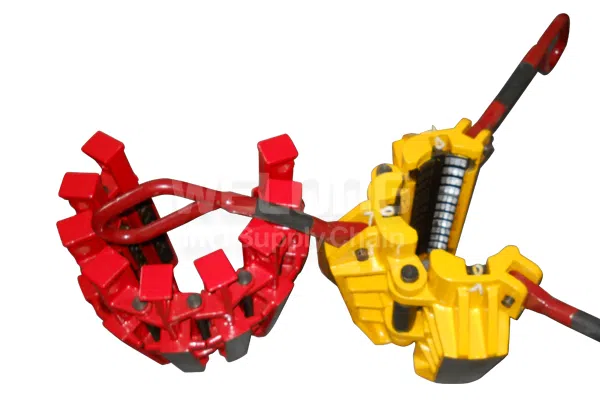
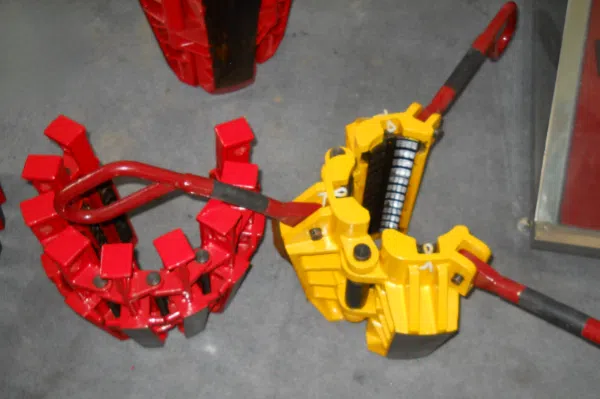
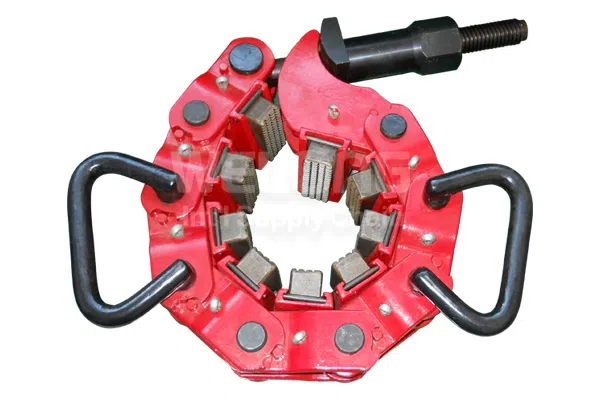
A rotary slip is a multi-segment design: hinged segments wrap around the pipe to form a near-circular grip. By adding or subtracting segments and inserts, one slip body can accommodate a range of pipe diameters rather than a single O.D.
This is why the size range is stated as an OD band per bowl, not one figure, the same body accommodates several diameters as segments and inserts change.
Segment, insert and material
- Full wrap-around grip: the segments close around the full circumference for even load distribution into the bowl, rather than point contact that gouges the pipe.
- Circular button inserts: replaceable dies set into the segment faces; these are the wear parts, and the reason re-dressing is a recurring cost.
- Alloy steel, heat treated: the bodies are machined from alloy steel and heat treated for strength and wear resistance under repeated slip setting.
- API taper: the segment’s outer taper matches the insert bowl and rotary bushing taper, so the wedge action seats correctly.
Because the segmented body carries the full weight of the drill or casing string, an even wrap keeps unit contact stress down and helps prevent damage to the pipe, the mechanism that stop bottlenecking and gouging at the slip toe. Manual rotary hand slips and powered slips share this same segmented, insert-bowl-matched design; only the setting method differ.
Casing Slips 6 5/8″–30″ — The 4-Step Bowl-First Fitment Sequence
Most buyers size a casing slip from the casing OD and stop there. The binding constraint is actually the bowl. If the master bushing taper and bowl number are wrong, the correct OD will still not seat and load correctly.
The 4-Step Fitment Sequence
- 01 Bowl first. Confirm the rotary table / master bushing taper and insert bowl number. The bowl angle must match the slip-body angle.
- 02 Then OD. Read the casing OD across to its insert bowl class in the table below.
- 03 Then grip length. Set SDS / SDML / SDXL against hole depth and string weight.
- 04 Then rating. Check rated capacity against your worst-case suspended weight.
COORD_ALIGN // 0.01
Casing OD to insert bowl.
| Casing OD | Insert Bowl |
|---|---|
| 4 1/2″–8 5/8″ | API or No.3 |
| 9 5/8″–10 3/4″ | No.2 |
| 11 3/4″–13 3/8″ | No.1 |
| 16″–30″ | Matching Bushing |
Running the sequence in that order is what stops the two most common mistakes: a slip that fits the pipe but not the bowl, and a slip sized on OD alone that crushes under a heavier-than-expected string.
Welong casing slips are designed for 6 5/8-inch to 30 inches OD (168.3-762 mm); capacity for a specific size is available on request – we quote it against your bowl and string, not as a headline number.
Where Welong Fits, Casing Slips vs Spider vs Power Slips vs CRT
Honest scope is a buying aid. Welong supplies manual and rotary casing slips and manages their production across the CMS-XL class envelope; we don't build every adjacent tool, and the table says so.
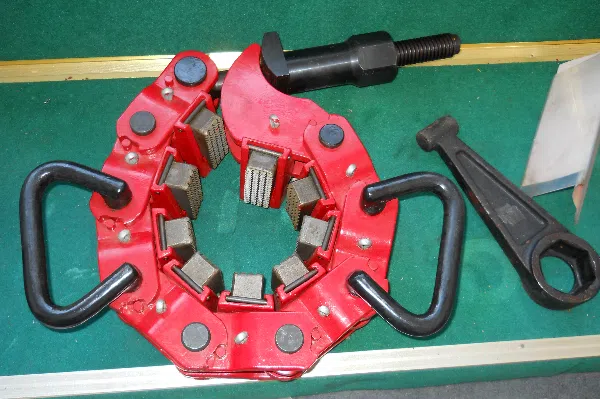
Casing OD coverage by supplier class (published ranges)
Supplier / Class
Casing OD Coverage
Class Note
Welong casing slips
6 5/8″–30″
CMS-XL class envelope
Category-leader CMSXL flagship
6 5/8″–30″
Identical envelope
Large-OD CL class (competitor-published)
6 5/8″–48″
Conductor-class, different product
Small-OD variant (competitor-published)
5″–30″
Reaches below our floor
Our 6 5/8-30 range is exactly the flagship CMS-XL envelope of the market leader - parity, not a headline. Where a job need 48 conductor work or sub-5 strings, that's a different product class and we'll tell you so rather than stretch a claim.
Slip, spider, power slip or CRT?
-
Slip
sits inside the rotary table bowl; the default for compatible bushing sizes. -
Spider
rests on top of the table when the bushing size doesn't suit the tubular, and for flush-joint pipe with no collar. -
Power (pneumatic/hydraulic) slip
removes the manual lift; the engineering control for the OSHA handling hazards above. -
CRT (casing running tool)
top-drive tool that grips, rotates and circulates casing without conventional slips; it replaces the manual method rather than complementing it, and it's a different purchase.
Total Cost of a Slip, What Actually Drives the Number
A casing slip isn't one price, because it's a configured tool. What it costs, and what it costs to keep running, is driven by a handful of variables that scale with size.
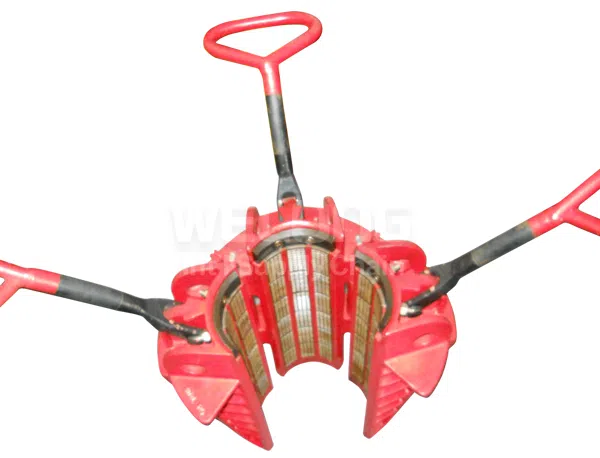
Inserts are consumable
The die inserts that bite the pipe wear and are re-dressed on a recurring interval — the running cost lives here, not only in the purchase.
Durability framing, not a quoted figure — request a configuration-specific analysis.
Two published competitor data points show how the tool scales, and therefore why a single price is meaningless:
- Segment count increases with OD - one competitor's own catalogue runs from 12 segments at 6 5/8 to 56 at 48.
- Button/insert quantity increases with OD too - another runs from 132 buttons at 5 to 444 at 30.
- Grip length (SDS/SDML/SDXL) changes body mass and machining, independent of OD.
The cost question nobody on the first page answers
Every competitor publishes these scaling factors somewhere and connects none of them to money - one even keep a wear guide in its sidebar with no wear data on the product page. The honest total-cost view is insert wear life times re-dress interval, on top of the tool. Field wear figures vary by formation and setting practice, so we scope them to your application rather than print a universal number.
Inspection, Trade Terms and Transport
A 500-ton load-bearing tool from a supplier you haven't met is a trust problem. The answer isn't louder adjectives; it's an inspector who doesn't work for us.
Since 2001
Oilfield manufacturing
SGS
Third-party inspection
DNV
Third-party inspection
UT · MT
Ultrasonic & magnetic particle
Load test
Pre-shipment
For the selected casing-slip order, the quotation identifies the in-process and final inspection scope; third-party inspection can be arranged on request. Pre-shipment testing includes ultrasonic (UT) and magnetic particle (MT) inspection, load testing and dimensional inspection — the checks behind safe rig-floor handling of a load-bearing tool, a hazard area covered by OSHA. That's a depth of check no competitor page on this search states.
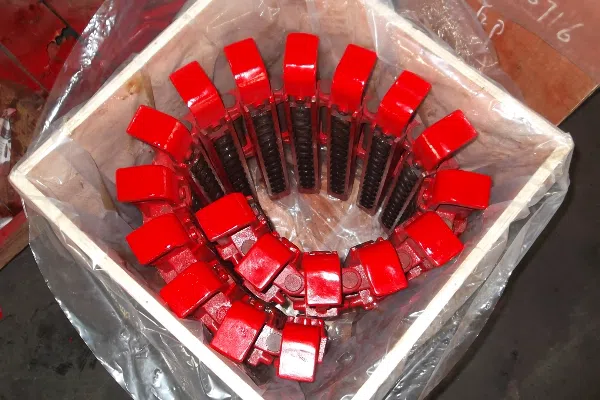
Procurement, transport and terms
- Trade terms: FOB, CIF, DDP or DDU - compare and pick what suits your import setup.
- Transport: sea, air or rail.
- Build to drawing: Welong supplies to your drawings, samples or specifications and manages production, with engineering support.
API 7K, the standard, stated straight
Two different questions, kept separate
API Spec 7K governs rotary slips. Confirm the inspection and documentation scope for the selected batch.compositelist.api.org) is the public directory of record.
Casing Slip Engineering Tools
01
Slip Selector
Input tubular dimensions and string weight to identify the optimal casing slip configuration.
ACCESS TOOL
02
Load Check
Verify load capacities and stress factors to ensure safe operational limits during handling.
ACCESS TOOL
03
Family Compare
Cross-reference technical specifications and hardware compatibility across all slip families.
ACCESS TOOL
Frequently
Asked
Questions
Start from the bowl. Confirm your master bushing taper and insert bowl number, then match the tubular OD to a bowl class, then set the grip-length class (SDS/SDML/SDXL) against hole depth. Send us the bowl spec and we confirm the fitment.
In-process and final inspection as standard, plus third-party inspection through SGS or DNV on request. Pre-shipment testing includes UT, MT, load testing and dimensional inspection.
FOB, CIF, DDP and DDU, shipped by sea, air or rail. We quote against your import setup rather than a single fixed term.
A slip sits inside the rotary table's bowl; a spider rests on top of the table and is used when the bushing size does not suit the tubular, or for flush-joint casing that has no collar. If your table takes the bushing, you use a slip.
The die teeth bite the pipe to grip it, which creates a stress riser exactly where the load is highest. If the bowl and slip tapers disagree, contact concentrates at the slip toe and a fatigue crack can start there. Matched tapers and the right grip-length class keep contact stress below the crush threshold.
- 4 1/2″–8 5/8″ uses API or No.3
- 9 5/8″–10 3/4″ uses No.2
- 11 3/4″–13 3/8″ uses No.1
- 16″–30″ uses a matching bushing
Procurement & Capability
Casing Slip Capability Review
China Welong reviews the buyer drawing, product specification and inspection scope before quotation.
This review is scoped to the Casing Slip configurations set out in the specification table on this page — 9 documented rows covering Welong code, Industry code, Body size and Pipe OD.
24 hEngineer-reviewed quotation on business days
2001Founded in 2001
30+30+ engineers on staff
5 yrStamped serial traceability
Quotation Scope and Commercial Terms
Pricing is prepared against the selected product configuration, material route, inspection scope and shipment terms.
- Quotes are returned within 24 hours on business days, reviewed by an engineer.
- T/T or L/C by wire transfer.
- We ship EXW, FOB, CFR or CIF; other Incoterms on request.
- We work from 2D drawings and 3D CAD models (AutoCAD, Pro/ENGINEER, SolidWorks; .dwg and .igs).
Production Planning
Production timing is confirmed with the quotation after quantity, process route and finishing scope are reviewed.
- We hold agreed items in stock and ship against your release to shorten delivery. Feasibility is confirmed at drawing review.
- Manufacturing at Xi'an, Shaanxi and at Jiyuan, Henan.
- 0.01 mm machining precision.
- Material standards to ISO, BS, ASTM, ASME, DIN, JIS and GB.
- Orders ship in standard export wooden cases, or the packing you specify.
Order Review and Responsibility
The responsible manufacturer, inspection scope and document package are identified for the selected item.
- Every quotation states whether the item is made in our own works or by an approved supplier we developed and supervise.
- We develop, audit and supervise the mills and workshops that make your parts: material mills are re-audited every two years and approved by Welong before they run your order.
- Forgings from 0.2 to 50 tons.
Specification and Inspection Evidence
The specification table on this page is the technical basis for this review: its numeric rows define what we quote, manufacture and inspect against.
- Each piece carries a stamped serial number and stays traceable for five years to its chemical composition, mechanical properties and measurement report, with the test coupon retained.
- An EN 10204-3.1B material certificate with chemical composition and mechanical properties, a dimensional measurement report, and UT and MT reports ships with your order.
- Inspection is by coordinate measuring machine, ultrasonic, magnetic particle and X-ray.
Request a Product Review
Send the drawing, product specification and inspection requirements for a quotation review.
![Choke & Kill Hose: [Field Guide]](https://welongoiltools.com/wp-content/uploads/2026/07/choke-kill-hose-guide-featured-1-150x150.png)